US deploys Black Hawk choppers in Latvia to protect ‘sovereignty & bright future’ (VIDEO)

From RT

March 2, 2017

US deploys Black Hawk choppers in Latvia to protect ‘sovereignty & bright future’ (VIDEO)
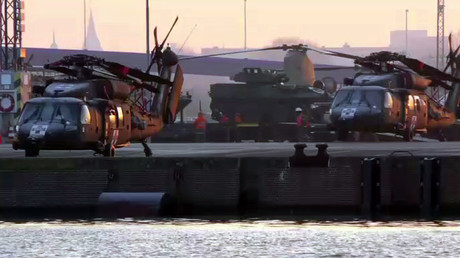
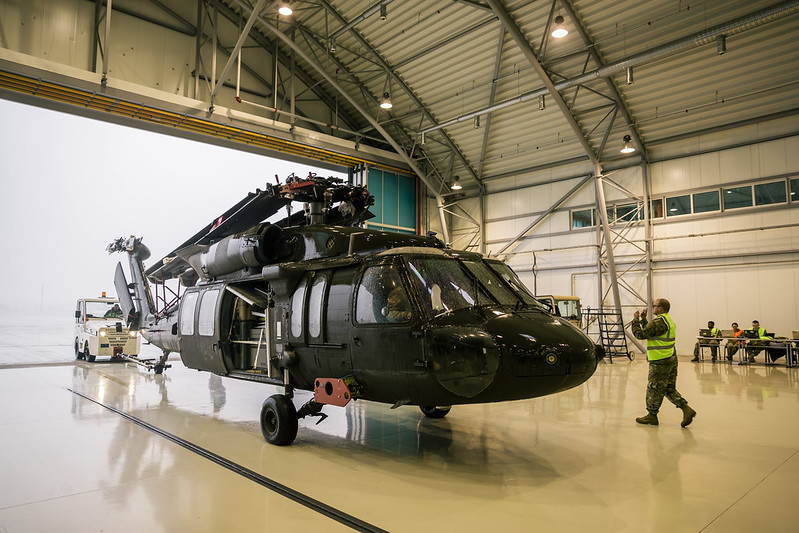
Five UH-60 Black Hawk helicopters and nearly 50 crew members have arrived in the Latvian capital of Riga as part of NATO’s Atlantic Resolve operation which sees an enhancement of American forces across the Baltic States.

The helicopters were unloaded from a transport plane on Wednesday and welcomed by officials including US Ambassador to Latvia Nancy Bikoff Pettit.

“US Air Force transport aircraft with UH-60 Black Hawk helicopters and military units Phoenix 10th Air Brigade of the US Army arrived at Riga airport,” the Latvian Defense Ministry reported. The ministry said earlier that the new arrivals will replace the existing unit of Black Hawk helicopters deployed at the Lielvarde Air Base in central Latvia.

“We are thrilled to welcome so many excellent American soldiers, who will serve as members of the continuing US aviation presence deployed to NATO’s eastern flank in support of Operation Atlantic Resolve,” Ambassador Pettit said at Riga International Airport.

“This year, thousands of US soldiers will rotate through Latvia…,” Pettit added. “You can be assured that they… are committed to standing shoulder to shoulder with our Latvian allies to protect the independence, sovereignty, and security of Latvia.”

“I see nothing but an incredibly bright future for US and Latvian relations because of how closely our two countries work together,”said Maj. Gen. Timothy Zadalis, US Air Forces in Europe vice commander.

The deployment of the choppers in Latvia marks another phase of Operation Atlantic Resolve, which began in April 2014, following the Crimean referendum where people voted to split from coup-stricken Ukraine and join Russia.

In total, the US Air Force is offering the Eastern European countries a total of 85 aircraft, including CH-47 Chinooks, UH-60 Black Hawks, and AH-64 Apaches. Medical evacuation helicopters and some 2,200 soldiers will also be deployed to assist the helicopter forces in Eastern Europe.

Ar lidmašīnu "Galaxy" no ASV Latvijā nogādā helikopterus "Black Hawk"

Atlantic Resolve is perceived by Washington as a demonstration of continued US commitment to the collective security of Europe in view of alleged Russian “assertiveness.” US troops and hardware will be constantly stationed in the Eastern European countries on a rotational basis in this operation.

“Task Force Phoenix, led by the 3rd General Support Aviation Battalion, 10th Aviation Regiment, signifies the first rotational combat aviation brigade deployed to provide a persistent presence in Eastern Europe,” the US Air Force said in a press release.

Russia has continuously criticized the buildup of NATO forces on its borders, where the military bloc has also fortified its naval positions in the Black Sea. In Romania, the US and NATO maintain a naval task force, along with Aegis Ashore ballistic missile defense sites which became operational earlier this year.

Last month, speaking at the Munich Security Conference in Germany, the Russian Foreign Minister Sergey Lavrov, noted that “NATO’s expansion has led to an unprecedented level of tension over the last 30 years in Europe.”

President Vladimir Putin has accused NATO of meddling in Russian affairs and trying to provoke a conflict. Putin warned that the alliance, with its “newly-declared official mission to deter Russia,” and repeated attempts to “draw us into a confrontation” poses a threat to global security.

READ MORE: NATO expansion led to tension in Europe unprecedented in last 30 years – Lavrov

“They are provoking us constantly and are trying to draw us into a confrontation,” the Russian leader stated in February, adding that NATO states are continuing their attempts to “interfere in our internal affairs in a bid to destabilize the social and political situation in Russia itself.”

https://www.rt.com/news/379127-us-black-hawk-helicopters-latvia/

Building a post-West world order of sovereignty, international law, and mutual respect — Foreign Minister Sergey Lavrov, Munich Security Conference, February 18, 2017

Leaders with a sense of responsibility must now make their choice. I hope that this choice will be made in favour of building a democratic and fair world order, a post-West world order, if you will, in which each country develops its own sovereignty within the framework of international law, and will strive to balance their own national interests with those of their partners, with respect for each country’s cultural, historical and civilisational identity.

From the Ministry of Foreign Affairs of the Russian Federation:

Foreign Minister Sergey Lavrov’s address and answers to questions at the 53rd Munich Security Conference, Munich, February 18, 2017

Ladies and gentlemen,

Ten years ago, President of Russia Vladimir Putin addressed this conference with a speech that many in the West saw as a challenge and even a threat, although what his message emphasised above all was the need to renounce unilateral action in favour of honest cooperation based on mutual respect, international law, joint assessment of global problems and collective decision-making. Unfortunately, the warnings he sounded then about the negative consequences of attempting to obstruct the emergence of a multipolar world have become reality.

Humanity stands at a crossroads today. The historic era that could be called the post-Cold War order has come to an end. Its main result, as we see it, was the complete failure of the Cold War institutions to adapt to new realities. The world has become neither ‘Western-centric’, nor a safer and more stable place. This is evident in the results of ‘democratisation’ in the Middle East and North Africa, and in other places too.

NATO expansion has created a level of tension in Europe unseen in the last thirty years. Yet this year marks the 20th anniversary of the signing of the Russia-NATO Founding Act in Paris, and 15 years since the Rome Declaration on a new quality of Russia-NATO relations was adopted. These documents’ basic premise was that Russia and the West took on a joint commitment to guarantee security on the basis of respect for each other’s interests, to strengthen mutual trust, prevent a Euro-Atlantic split and erase dividing lines. This did not happen, above all because NATO remained a Cold War institution. It is said that wars start in people’s heads, but according to this logic, it is also in people’s heads that they should end. This is not the case yet with the Cold War. Some statements by politicians in Europe and the United States seem to confirm this particularly clearly, including statements made here yesterday and today during this conference.

I mentioned NATO expansion just now. We categorically reject the allegations of those who accuse Russia and the new centres of global influence of attempting to undermine the so-called ‘liberal world order’. This global model was pre-programmed for crisis right from the time when this vision of economic and political globalisation was conceived primarily as an instrument for ensuring the growth of an elite club of countries and its domination over everyone else. It is clear that such a system could not last forever. Leaders with a sense of responsibility must now make their choice. I hope that this choice will be made in favour of building a democratic and fair world order, a post-West world order, if you will, in which each country develops its own sovereignty within the framework of international law, and will strive to balance their own national interests with those of their partners, with respect for each country’s cultural, historical and civilisational identity.

Russia has never hidden its views, and has always been sincere in advocating work based on equal footing in order to create a common space of security, good-neighbourliness and development from Vancouver to Vladivostok. The tensions of recent years between North America, Europe and Russia are unnatural; I would even say they go against nature.

Russia is a Eurasian state with a variety of cultures and ethnicities. Predictability and goodwill in relations with all countries, primarily, its neighbours, have always been inherent to our policies. This line of thinking underlies our close work within the CIS, the Eurasian Economic Union, the CSTO, the SCO, and BRICS.

Good-neighbourliness and mutual benefits underlie our relations with Europe as well. We are part of the same continent, we wrote our history together, and we were successful when we worked hand-in-hand to achieve prosperity for our peoples.

Many millions of Soviet people gave up their lives for the freedom of Europe. We want to see Europe strong, independent in international affairs and taking good care of our common past and future, while staying open to the world around it. We are appalled by the fact that the EU is unable to muster enough strength and give up its Russian policy based on the least denominator principle where fundamental and pragmatic interests of its member states are being sacrificed to Russophobic speculations out of sheer “solidarity.” We look forward to seeing common sense take the upper hand.

What kind of relationship do we want to establish with the United States? We want relations based on pragmatism, mutual respect, and understanding of our special responsibility for global stability. Our two countries have never been in direct confrontation with each other. Our history is steeped in friendliness more than confrontation. Russia did a lot to support the independence of the United States as it proceeded to become a united powerful state. Constructive Russia-US relations are in our common interest. Moreover, America is our close neighbour, just like the European Union. We are divided by just 4 km of the Bering Strait. The potential of our cooperation in politics, the economy, and the humanitarian sphere is enormous. But, of course, it has to be tapped. We are willing to go ahead and do so inasmuch as the United States is prepared to do so on its part.

Today there is no shortage in evaluations of the genesis of global challenges such as terrorism, drug trafficking, or the crises that engulfed territories from Libya to Afghanistan, leaving countries such as Syria, Iraq, Libya and Yemen bleeding. Certainly, the Munich debate will provide an opportunity to review in detail all these issues, as well as the continuing conflicts in Europe. Most importantly, a settlement cannot be achieved by military means.

This fully applies to the internal Ukrainian conflict. There’s no alternative to complying with the Minsk Package of Measures through a direct dialogue between Kiev, Donetsk and Lugansk. This is a firm position adopted by Russia, the West and the UN Security Council. Importantly, the Kiev authorities should embark on that path and honour their obligations.

Today, more than ever, we need a dialogue on all complex issues in order to find mutually acceptable compromises. Actions based on confrontation and the zero-sum-game approach will not cut any ice. Russia is not looking for conflicts with anyone, but it will always be in a position to uphold its interests.

Our absolute priority is to use dialogue to achieve our goals and mutually beneficial consensus. It is appropriate to quote a directive which Chancellor Gorchakov, back in the times of imperial Russia, sent to Russian Envoy in the United States Eduard von Stoeckle in July 1861: “there are no such divergent interests that cannot be reconciled through zealous and hard work … in the spirit of fairness and moderation.”

If everyone could subscribe to such an approach, we’d be able to quickly overcome the post-truth period, to reject hysterical information wars imposed on the international community and to proceed to keep up the honest work without being distracted by lies and falsehoods. Let this be a post-fake era.

Thank you.

Question: I have a concrete question about military exercises. Why are Russian military exercises held without prior announcement, and why are they so non-transparent? This year you will hold the largest Zapad (West) exercises in 20 years, which have alarmed your neighbours. What should be done to build up confidence regarding this issue?

Sergey Lavrov: As you know, Russia-NATO relations and the Russia-NATO Council have been suspended at the bloc’s initiative, although after the 2008 Caucasus crisis our American colleagues, including then US Secretary of State Condoleezza Rice, admitted that the suspension of the Russia-NATO Council was a mistake and that it should be more active especially in times of trouble. However, they continue to step on the same rake. NATO has decided to suspend all practical contacts with Russia, as NATO Secretary General Jens Stoltenberg told me yesterday. He said they would maintain contact at the level of ambassadors at the Russia-NATO Council and between himself and me, but that they had curtailed all practical contacts.

At some stage, Sauli Niinisto, the President of Finland which is not a NATO member, expressed concern that not just Russian aircraft but also the planes of NATO states fly over the Baltic with their transponders switched off. He mentioned his concern at a meeting with President Putin during his visit to Russia. Following that, President Putin instructed the Russian military to prepare proposals to settle the issues of transponders and aviation security over the Baltic. Our military experts brought detailed proposals to Brussels in July 2016, when the Russia-NATO Council held a meeting there. We believed that these concrete proposals would prompt a response, and that experts would get together to coordinate security enhancement methods. This did not happen. We still cannot start working on this issue. NATO Secretary General Jens Stoltenberg told me yesterday that an expert meeting might hopefully convene in March. It is taking too long, of course, but we are not to blame for the delay.

He also mentioned the issue of military exercises yesterday and expressed satisfaction that the Russian military held a briefing on the exercises held last autumn. He also expressed hope that special briefings would be held on the exercises we plan for this year.

As for the surprise factor, I am not a military man, but I know that military attachés working in Moscow, including from NATO countries, are invited to such military exercises. But the best answer to this question, as I told Mr Stoltenberg yesterday, is that we should resume military cooperation to remove all these concerns and suspicions. The NATO Secretary General, who was accompanied by his deputies, could not say that NATO is ready to do this, which is a pity, because without military cooperation our diplomats’ meetings will be of little importance for security issues.

As for our relations with NATO, we proposed resuming them long ago. Instead of accusing each other and discussing and implementing plans to deploy NATO combat capabilities on the border with Russia for the first time in a decade, we should sit down to discuss the situation. We proposed looking at the maps to see how many weapons and military personnel NATO and Russia have, and where. After we collect this data, we will be able to gauge the real measures of military security in Europe. And then we will be able to use this information to consider arms control agreements and additional security measures.

Once again, it was not Russia who suspended practical cooperation in the framework of the Russia-NATO Council.

Question: Russia has submitted the first three provisions of Minsk-2 for discussion by the UN Security Council: the cease-fire, the withdrawal of heavy weapons and admission of the OSCE observers to all the Ukrainian regions. Why doesn’t Russia find it possible to meet these obligations and thereby send a message about an increased level of confidence and improved overall situation?

Closer to the end of your remarks, you mentioned the post-fake era. Russia’s interference in the US election campaign was mentioned while it was underway. An election campaign is underway in France, and one of the candidates complained of Russia’s interference as well. French President Hollande even convened an extraordinary meeting of the Security Council to discuss this.

Sergey Lavrov: Regarding your first question, I’m pleased that you are familiar with the Minsk agreements, though it’s a pity you didn’t read them to the end, apparently. Indeed, the first item is the withdrawal of heavy weapons, but then it says that on the 30th day after the start of such withdrawal, which began in April 2014, the Kiev authorities will prepare a draft law on elections and begin consultations thereon with Donetsk and Lugansk. You can ask all kinds of questions about the timeframe of a particular item in the Minsk arrangements – they don’t always offer fixed dates. However, this date is specified and it’s 30 days. The withdrawal has begun. The beginning of consultations with Donetsk and Lugansk did not hinge on the completion of this process. As you may be aware, a lot has changed since then: the weapons were first withdrawn and then disappeared from the warehouses. The OSCE Special Monitoring Mission, which worked in very difficult conditions – and whose work we highly appreciate and hope that the mission will represent more OSCE members, not just  NATO and EU member countries – repeatedly noted violations on both sides with regard to the ceasefire, and the presence of heavy weapons in the security zone. However, the Ukrainian armed forces have always been the champion when it came to heavy weapons missing from warehouses. Again, other kinds of violations happen on both sides.

There have been repeated accusations (interviews with several Ukrainian political pundits have been published recently) that President Putin uses women and children in Donbass as human shields and tries to convince the Ukrainians living to the left of the contact line that people in Donbass hate them, while people in Donbass are being told that the Ukrainian government wants to destroy them. These arguments are false and hold no water. They also wrote that Donbass self-defence forces and unnamed Russian troops shell Donetsk in order to blame everything on Ukraine.

Getting back to your question, I have many times mentioned  how to make a ceasefire stick. No matter what you think about the Russian media, we can see our reporters doing their jobs along the  contact line in Donetsk and Lugansk on a daily basis. They run their stories live showing us destroyed residential areas and social infrastructure buildings, including children’s homes, schools, outpatient clinics, and civilian casualties. I became interested in what’s happening to the west of the contact line and started watching CNN, Fox News, Euronews, and BBC. I haven’t seen anything like that done by Western reporters on the western side of the contact line. They don’t run live reports, which our reporters do, risking their lives and getting wounded and even killed in the process. I asked my Western colleagues whether Western reporters are instructed to stay away from the other side of the contact line for security reasons. There’s no answer. Then we asked the OSCE SMM to focus, in their reports, on the destruction of civilian infrastructure to the left and to the right of the contact line. So far, we haven’t received exhaustive information. This may give an idea of why Western reporters, who are so bent on bringing the truth about the events in Ukraine to the world, do not show what’s happening in the areas to the west of the contact line, which are controlled by the armed forces of Ukraine. Are they discouraged from going there for safety reasons or are they doing some self-censorship? I would like to figure that out.

Our stats show that there are many times more destroyed social infrastructure buildings on the side controlled by Donbass as compared with the situation on the left side of the contact line. In most cases, fire is aimed at the positions controlled by the Ukrainian armed forces. Nonetheless, some members of the media make it into the war zone.

Not long ago, I saw a report by the Washington office of the International Institute for Strategic Studies and Washington Post articles by journalists who have been on the line of contact. They wrote that volunteer battalions are the ones provoking violence in Donbass. These forces do not obey anyone, they do not take orders from Ukraine’s Armed Forces and act solely at their own discretion. The journalists wrote that thousands of ultra-nationalists from the Right Sector are fighting there and are not controlled by Kiev in any way whatsoever. The reporters concluded that Kiev may be interested in armed and angry radicals staying on the line of contact in Donbass instead of staging another Maidan uprising in the capital. These articles also mentioned neo-Nazi foreigners who are fighting in Donbass, while others tend to turn a blind eye to their presence there.

We discuss these issues in the Normandy format. Today, a meeting of French, German, Ukrainian and Russian foreign ministers will take place. The question remains: why is there so little information about what is going on to the west of the line of contact? It is key to answering your question about why so little progress has been achieved in terms of security. However, making progress on security issues is not a goal in itself. Our common aim is to ensure full implementation of the Minsk agreements that provide for security on the line of contact (and I mentioned why it has not been achieved so far), constitutional reform to introduce a constitutional provision on the special status, amnesty for all who took part in hostilities in Donbass (just as all those who took part in what happened during Maidan uprisings benefited from amnesty), and the holding of elections. Under the Minsk agreements, the Ukrainian government can restore full control of the border with the Russian Federation only when these provisions are implemented. As I have already said, we are not there yet.

As for what our European partners are saying regarding sanctions, I have already commented on the illogical and artificial nature of the formula whereby the EU lifts sanctions once Russia implements the Minsk agreements. Russia also wants the Minsk agreements to be implemented, and will not lift its sanctions against the European Union until the Minsk agreements are implemented. There has to be clarity on this issue. Paris, Berlin and hopefully Washington and other capitals, including NATO headquarters, know all too well what is really happening in Ukraine and why the Minsk agreements are not working properly. But they are unable to recognise it in public due to a distorted sense of solidarity with those who decided to bring freedom and European values to Ukraine. When our good friend, the EU High Representative for Foreign Affairs and Security Federica Mogherini says that sanctions are a tool for ensuring implementation of the second Minsk agreements, I see this as a way to use sanctions for regulating the crisis in Ukraine, since sanctions unambiguously shift the blame on Russia. As Federica Mogherini said, maybe it was a Freudian slip, ‘We will wait until Russia concedes and departs from Minsk-2 by undertaking something unilaterally and forcing Donbass fighters to take unilateral action.’ The hidden message behind this position is that there is no need to work with Kiev, Kiev is doing everything right. That said, I strongly believe that the key capitals know the truth. I do hope that they send signals to this effect to the Ukrainian government during their contacts, if not publicly. Not only do I hope but I know that this is the case. It is hard to tell whether these signals come across.

Regarding the second question, on Russia’s alleged interference in election campaigns and other events in countries abroad, if you recall, when Donald Trump said that the election was not very honest and that the Democrats got votes from ‘dead souls’, the Democratic Party demanded to see the facts, but for some reason, when it comes to us, no one demands to see the facts. I have not seen any evidence regarding our alleged hacking of Democratic Party sites, or of whatever we are alleged to have done in France, Germany or Italy. We know that there were facts several years ago in Germany, when the eavesdropping on the entire German senior leadership was revealed. Leaks emerged a few days ago, suggesting that the CIA engaged in cyber-espionage throughout the entirety of France’s 2012 presidential race.  A CIA representative told a journalist today that he had no comment on this subject. No comment. But my good friend, French Foreign Minister Jean-Marc Ayrault, speaking in  parliament after the information came out about suspicions that the CIA had meddled in the 2012 election (though, as I understand it, there are not just suspicions but also concrete facts), said that they oppose all cyber-espionage, no matter whether it comes from Russia or any other country. Modesty is always a fine thing, of course, but in this case, once again, I ask to see the evidence.

Let me remind you that Russia was the first country to initiate work in the UN many years ago on coordinating our positions on international information and cyber-security. Our Western partners evaded tackling these issues for a very long time. Finally, a couple of years ago, we adopted a resolution by consensus and a group of government experts was established, which produced a good report, which formed the foundation for a new resolution. Another expert group has been set up and will continue working on this matter now. We proposed long ago that our colleagues work more actively on the professional, technical and technology aspects of cyber-security issues. When the USA, during Barack Obama’s presidency, started hunting down our citizens in violation of the agreement our countries have, and did not inform us that they were catching these people on suspicion that they were involved in cybercrime, we proposed that both sides sit down together and settle all these issues. We have absolutely no desire to see our citizens involved in these illegal cyber activities. In November 2015, we proposed to the Obama administration that we meet and begin bilateral work on cyber-espionage, cyber-security and other cyber-related areas. A year went by without a response, even though I mentioned the matter to John Kerry every time we met. In the end, they proposed meeting in December 2016, but then said that everything would have to be postponed because of the new administration coming in.

Federal Chancellor Angela Merkel, when she spoke about cyber-security today, put forward the interesting idea that the Russia-NATO Council should address this issue. Let me return to my answer to the first question. We always wanted to see the Russia-NATO Council work on real substantive issues. We were not the ones who broke off practical cooperation. If the Federal Chancellor of Germany, one of the main NATO member countries, wants the Russia-NATO Council to work on cyber-security, we see this as a signal that Berlin, at least, wants the Russia-NATO Council to resume real work and not just limit itself to discussions.

http://www.mid.ru/en/vistupleniya_ministra/-/asset_publisher/MCZ7HQuMdqBY/content/id/2648249

Vladimir Putin’s speech to the Federal Security Service, February 16, 2017

From the Kremlin
February 16, 2017

Vladimir Putin took part in an annual expanded meeting of the Federal Security Service (FSB) Board to discuss the FSB’s results for 2016 and the priority tasks for ensuring Russia’s national security.

President of Russia Vladimir Putin: Good afternoon.

These annual FSB Board meetings give us a chance to meet and not only thoroughly analyse and review the results of the agency’s work over the period, but also to discuss at length all important national security issues in general and outline the priorities for the immediate future and the longer-term.

The FSB plays a key part in protecting our constitutional order and our country’s sovereignty, and in protecting our people from threats at home and abroad.

Let me say from the start that last year’s results were positive and show good development. This concerns your work to counter terrorism and extremism, a series of successful counterintelligence operations, your efforts to combat economic crime, and other areas.

You ensured a high standard of security for major public events, including the State Duma election and regional and local elections.

I would like to thank both the executives and staff for their conscientious attitude towards their work and their timely and efficient performance of their duties.

At the same time, demands on the quality and results of your work grow constantly. The global situation has not become any more stable or better over the past year. On the contrary, many existing threats and challenges have only become more acute.

Military-political and economic rivalry between global and regional policy makers and between individual countries has increased. We see bloody conflicts continue in a number of countries in the Middle East, Asia, and Africa. International terrorist groups, essentially terrorist armies, receiving tacit and sometimes even open support from some countries, take active part in these conflicts.

At the NATO summit last July in Warsaw, Russia was declared the main threat to the alliance for the first time since 1989, and NATO officially proclaimed containing Russia its new mission. It is with this aim that NATO continues its expansion. This expansion was already underway earlier, but now they believe they have more serious reasons for doing so. They have stepped up the deployment of strategic and conventional arms beyond the national borders of the principal NATO member states.

They are provoking us constantly and are trying to draw us into confrontation. We see continued attempts to interfere in our internal affairs in a bid to destabilise the social and political situation in Russia itself.

We also see the recent serious flare-up in southeast Ukraine. This escalation pursues the clear aim of preventing the Minsk Agreements from going ahead. The current Ukrainian authorities are obviously not seeking a peaceful solution to this very complex problem and have decided to opt for the use of force instead. What is more, they speak openly about organising sabotage and terrorism, particularly in Russia. Obviously, this is a matter of great concern.

The events and circumstances I have mentioned require our security and intelligence services, especially the Federal Security Service, to concentrate their utmost attention and effort on the paramount task of fighting terrorism.

We have already seen that our intelligence services dealt some serious blows to terrorists and their accomplices. Last year’s results confirm this: the number of terrorism related crimes has decreased.

Preventive work has also brought results. The FSB and other security agencies, with the National Antiterrorist Committee acting as coordinator, prevented 45 terrorism related crimes, including 16 planned terrorist attacks. You deserve special gratitude for this.

You need to continue your active efforts to identify and block terrorist groups’ activity, eliminate their financial base, prevent the activities of their emissaries from abroad and their dangerous activity on the internet, and take into account in this work Russian and international experience in this area.

The murder of our ambassador to Turkey was a terrible crime that particularly highlighted the need to protect our citizens and missions abroad. I ask you to work together with the Foreign Ministry and the Foreign Intelligence Service to take additional measures to ensure their safety.

You must also work to take our counterterrorism cooperation with partners abroad to a new level, despite the difficulties that we see in various areas of international life. It is a priority, of course, to intensify work with our partners in organisations such as the UN, the CSTO, and the Shanghai Cooperation Organisation.

It is in our common interests to restore dialogue with the US intelligence services and with other NATO member countries. It is not our fault that these ties were broken off and are not developing. It is very clear that all responsible countries and international groups should work together on counterterrorism, because even simply exchanging information on terrorists’ financing channels and sources and on people involved in or suspected of links with terrorism can substantially improve the results of our common efforts.

Our priorities include firmly suppressing extremism. Security methods must go hand-in-hand with constant prevention work. It is essential to prevent extremism from drawing young people into its criminal networks, and to form an overall firm rejection of nationalism, xenophobia, and aggressive radicalism. In this context, of great importance is open dialogue with civil society institutions and representatives of Russia’s traditional religions.

Counterintelligence services also face greater demands today. Operational data show that foreign intelligence services’ activity in Russia has not decreased. Last year, our counterintelligence services put a stop to the work of 53 foreign intelligence officers and 386 agents.

It is important to neutralise foreign intelligence services’ efforts to gain access to confidential information, particularly information concerning our military-technical capabilities.

This makes it a priority to improve our system for protecting classified information comprising state secrets, particularly with agencies going over to an electronic document circulation system.

I would like to note that the number of cyberattacks on official information resources tripled in 2016 compared to 2015. In this context, each agency must develop its segment of the state system for detecting and preventing cyberattacks on information resources and eliminating their consequences.

The public expects greater results in such key areas as economic security and the fight against corruption. I ask you to be particularly thorough in monitoring the funds allocated for state defence procurement (a subject I have spoken about before), major infrastructure projects, preparation of big international events, and implementing federal targeted and socially important programmes. Regrettably, we still see many cases of state funds being embezzled or misappropriated.

Reliable protection of our state borders plays a big part in ensuring our country’s comprehensive security. The priority here is to close off channels through which members of international terrorist and extremist groups enter Russia, and put a firm stop to all forms of smuggling, from weapons to drugs and various bio-resources.

Of course, we must continue the work to develop border infrastructure where it is not yet sufficiently developed, particularly in the Far East and in the Arctic.

Colleagues, let me stress that we will continue to bolster the FSB’s central and regional branches and ensure you have the most advanced arms and equipment. We will also continue to give attention to social provisions for FSB personnel and their family members.

I wish you success in protecting our national interests and the security of our country and our people. I am confident that you will continue working towards your targets with dignity.

Thank you for your attention.

http://en.kremlin.ru/events/president/news/53883

NATO agrees to increase presence in Black Sea – Stoltenberg

From RT
February 16, 2017

NATO agrees increased presence in Black Sea – Stoltenberg

U.S. troops deployed to Bulgaria as NATO boosts Eastern European presence

From RT

February 15, 2017

US troops deployed to Bulgaria as NATO boosts Eastern European presence
US troops arrived in Bulgaria on Wednesday, with armored vehicles and heavy equipment to be shipped by the end of the week as part of NATO’s significant buildup in Eastern Europe, the Bulgarian Defense Ministry has said.

Around 120 US servicemen from Fort Carson, Colorado were accommodated at the Novo Selo military base in the east of the Black Sea country, according to Bulgarian officials.

“Joint drills and training at Novo Selo training range will be increased this year. The US army troops will be rotated for the drills,” the defense ministry said as cited by Reuters.

On Tuesday, tanks and hardware accompanied by another 500 American troops arrived in Romania.

The deployment is part of Atlantic Resolve, the operation to reassure NATO’s allies in the region following Russia’s reunion with Crimea and accusations of Moscow being involved in the Ukrainian conflict.

Russia has denied the claims.

Last summer, NATO members agreed to boost its NATO presence in Eastern Europe and the Baltic region to levels not seen since the Cold War – posting four rotating multinational battalions to Estonia, Latvia, Lithuania, and Poland.

In January, 2,800 pieces of US military hardware, including Abrams tanks, Paladin artillery, and Bradley fighting vehicles, and 4,000 troops arrived in Europe as part of the operation.

READ MORE: Spain plans to send 6 tanks & 350 troops to Latvia as part of NATO buildup – reports

The forces took part in drills in Poland and were then deployed across seven countries, including the Baltic States, Bulgaria, Romania, and Germany.

American troop deployment accelerated in the last months of the President Barack Obama’s presidency as his successor, Donald Trump, announced plans of mending relations with Moscow.

However, Trump’s rhetoric towards Russia has changed since he took office, with White House spokesman, Sean Spicer, saying on Tuesday that the new president “expects the Russian government to de-escalate violence in Ukraine and return Crimea” to Kiev.

READ MORE: ‘No incidents over Black Sea’: Russian MoD denies ‘unprofessional & unsafe’ flyby of USS Porter

On Wednesday, the new US Defense Secretary, James Mattis, who was on his first European visit, warned NATO allies that America will “moderate its commitment” to the alliance if other members don’t increase their financial contribution.

“No longer can the American taxpayer carry a disproportionate share of the defense of western values,” Mattis said.

But the Defense Secretary assured President Trump’s “strong support” for NATO, calling the block “a fundamental bedrock for the United States and for all the transatlantic community.”

Moscow has criticized the expansive NATO military buildup on its borders, saying it increases the risk of incidents and poses a threat to Russian national security.

“This deployment is, of course, a threat for us,” Russian Deputy Foreign Minister Aleksey Meshkov said last week, adding that “it is obvious that the steps by NATO gravely increase the risk of incidents.”

https://www.rt.com/news/377494-nato-bulgaria-us-troops/

‘Confrontational agenda’: Russian envoy blasts NATO border activities

From RT

February 7, 2017

‘Confrontational agenda’: Russian envoy blasts NATO border activities

Briefing by Foreign Ministry spokesperson Maria Zakharova, Moscow, January 19, 2017; on Obama’s impact on Russian-American relations and UN statement by Samantha Power

From the Ministry of Foreign Affairs of the Russian Federation
January 19, 2017

Excerpts:

Obama presidency impact on Russian-American relations


As you may know, the new US President, Donald Trump, is to be inaugurated on January 20. This offers hope that the tensions in Russian-US relations that were engineered by the former Obama team will be supplanted. In recent days, we have heard a lot about Russia, particularly on the foreign policy track, from the US administration and its representatives. Apart from the inauguration, today is the last day for the outgoing administration. It seems that the statements made by foreign policy officials – our colleagues, or our partners, as we call them – over the past few days present an occasion to sum up the relations between our two countries during Barack Obama’s eight years in power. There is a lot to talk about, and so I’ll take the time to talk about it.

The results, regrettably, are lamentable. The outgoing Democratic team has consciously ruined bilateral relations, allowing them to fall to Cold War levels. Moreover, this approach has continued to its final day and even continues in its last hours in an attempt to batter their foundation.

In retrospect, it will be recalled that it was Barack Obama who declared a reset in and an all-out development of relations with Russia at the start of his first term of office in 2009. At a certain stage, we managed to sign a number of important bilateral agreements, including the START Treaty (2010).

But our partnership didn’t last long. While in word promising to cooperate respectfully, Washington really envisioned a style of cooperation that looked more like the leader and the led. This is the approach that the White House is accustomed to using with the Western European countries. When it became clear that it would not work with Russia, the US began to fear that we would strengthen our position in the world and began steering towards a confrontation, which, among other things, included using various forms of pressure.

I would like to stress in particular that this began well before the events in Ukraine. Everything that was later covered up and explained by Crimea, Donbass and so on, had nothing to do with reality. We expressed this on many occasions. I can cite several examples: the anti-Russian Magnitsky Act of December 2012; we also recall that, even before the events in Ukraine, US secret services launched a real hunt for Russians in third countries. The most notorious case in point is the abduction of Viktor Bout, but there were another 27 Russian nationals who fell victim to this vile game thereafter. US secret services and the administration were acting on the sly: they did not advise Russian law enforcement about the grievances against our fellow citizens (although the laws needed for this were in place) but they abducted them during their travels abroad.

Washington even avoided consultations on a joint effort against cybercrime, although 60 per cent of the said arrests in third countries were related to accusations of stealing credit card data or account fraud. Russia regularly and repeatedly offered proposals to cooperate in this area. Similarly, they were reluctant to go along with us on other issues on the bilateral agenda.

Still fresh in our memory were attempts to discredit the Winter Olympic Games in Sochi (incidentally, this was also before Crimea), which were made both shortly before and directly during the Olympics. Later this took the form of an unprecedented public harassment campaign directed against Russia’s entire sports organisation. Symptomatically, the US Anti-Doping Agency played first string in attempts to cut Russian athletes from international competitions. Let me remind you that the USADA is financed by the US.

The coup in Kiev three years ago, in which the Obama administration was involved, put everything in the right perspective in our relations with it. Since the Obama administration openly proclaimed a policy for the systematic containment of Russia, our American partners have suspended many communication channels, including the Bilateral Presidential Commission and its 21 working groups.

Using sanctions to pressure Russia, Washington has imposed or expanded various restrictions against Russia 35 times under a variety of pretexts since 2014. The United States has blacklisted 172 Russian citizens and 350 legal entities, including Russia’s leading companies in energy, the defence industry and the financial sector.

To justify this policy, they have invented a completely unsubstantiated thesis about Russia’s “aggressive behaviour” and unleashed a powerful propaganda campaign to support it. The United States used this pretext to build up the Pentagon’s and NATO capabilities on the Russian border, continued with BMD deployment and carried out other military preparations. We have talked about this in detail and have provided our views on it. Acting within this policy, which has been undermining European and global security, the White House referred to the Baltic countries and Poland as “frontline states,” as if they seriously believed that a military confrontation with Russia was possible.

Initially, Washington’s policy of isolating Russia caused only misunderstanding. It was difficult to take the stated objectives seriously, and we were right, because this policy suffered a crushing defeat. But they provided a philosophical and politological basis for their defeat. US Secretary of State John Kerry said while on a visit in Moscow that the United States cannot do without Russia in tackling international issues. It took them only a few years – not decades – to invent an isolation concept, attempts to implement it and then explain why it failed.

I would like to provide proof of the absurdity of this concept: over 14 months from May 2015 to July 2016, US Secretary of State John Kerry visited Russia four times at his initiative. Also, 66 of the 70 telephone conversations with Foreign Minister Sergey Lavrov were held at his request last year alone, at the height of Russia’s alleged isolation. I wonder how many telephone conversations we could have had if the situation in bilateral relations were close to normal.

However, our attempts to work with the United States on some international issues were complicated by the Obama Administration’s inconsistency. For example, Washington kept advancing new demands regarding Syria but failed to implement its commitment to separate the so-called moderate opposition from the terrorist groups. They had more than enough time to do this. The United States made this commitment a year ago, but as you know, it has not implemented it. On the contrary, instead of following through on White House pledges to proceed towards a peaceful settlement, they did their best to protect the terrorists from strikes and even supplied weapons to them, including Jabhat al-Nusra. They planned to use the terrorists to overthrow the government in Damascus. Mind you, we are not talking about imaginary moderates but a combat division of al-Qaeda, an organisation that killed 3,000 Americans on September 11, 2001. Under American law, support for terrorists is a serious crime. Americans have all heard about the alleged Russian hackers, but nobody knows that the US administration supported an organisation that killed Americans.

The state of affairs in the economy was no better. Washington’s targeted efforts provided all the opportunities for this purpose, using all available leverage on the international scene to make life more difficult for Russian economic operators and the entire Russian economy. You may recall that Barack Obama noted with satisfaction some time later that the Russian economy was “in tatters.” Of course, this could have been true, but I would like to say that leading US companies did not want to leave the Russian market despite the White House’s insistence. It proved impossible to engineer Russia’s complete isolation even within the United States, although bilateral economic relations were damaged. As you understand, we had to do something. So, we took advantage of the emerging situation to promote our own economic development agenda and diversified our global trade ties.

It should be specially noted that, several years ago, the Obama administration started exerting routine pressure on Russian diplomatic missions in the United States. Unfortunately, attempts by the secret service to recruit Russian officials became an extremely unpleasant part of the daily routine. Last year, out of the blue, came a ban on Russian diplomatic missions using some of  their vehicles, including large-capacity buses, which lasted for several months. This was followed by toughening the regulations for the stay of official Russian delegations in the United States: now they had to notify the US Department of State about any trips outside the 25-mile (41-kilometre) zone around Russia’s diplomatic missions. Just think how much this limited their opportunities.

We are now discussing this openly. All this time, we tried to cooperate constructively with the US Department of State on all these issues. This was our day-to-day work which involved the Russian Embassy and the Foreign Ministry, and continued during talks between the Russian Foreign Minister and the US Secretary of State. We raised and discussed all these issues. On the other hand, we do perceive a desire of State Department representatives to sort things out; many of their efforts proved sincere but were blocked  at the administration level. Our work became increasingly difficult.

In 2013, US authorities began to persecute American citizens planning to take part in introductory tours organised by the Federal Agency for the Commonwealth of Independent States, Compatriots Living Abroad and International Humanitarian Cooperation (Rossotrudnichestvo). As you may remember, we have discussed this issue in the past. The FBI began to summon them for interrogations and openly intimidate them. In January 2016, US authorities went as far as to strip five of the six Russian honourary consuls of their accreditation in various states. These honourary consuls also helped expand bilateral ties, conducted practical work and maintained cooperation involving ordinary people. That is the environment in which we had to work.

It is also hard to assess from positions of common sense the russophobic hysteria that began to be incited in the US in the run-up to the presidential election. The US presidential election is a special factor and a special stage in bilateral Russian-US relations. In the summer of 2016, the White House leaked groundless accusations of Russia interfering in the election campaign and information about “Russian hackers” allegedly tampering with servers, websites, etc. to the media. The media and US secret services incited this all the time through “leaks” and through reports published by their “pocket” media. They forced the public to consume this media concoction involving pseudo-facts.

After the November 8 vote, as I see it, the Obama administration just went over the edge. One had the impression that they had decided to vent their entire wrath on us. It was not simply a conceptual story, where we were a factor in their political infighting. No sir, it was base household vengeance that admitted of all expedients. And the whole reason was that the Democratic candidate, Hillary Clinton, lost the election. This was done in order to maximally complicate things for the President-elect, Donald Trump, and call into question his victory. All of that, in our view, assumed morbid forms. Lies and not just concoctions about “hacking” and “Moscow’s stolen election” were pouring in torrents.

We have yet another version. Among other things, all of this might have been done and continues in the same vein today because the Democrats want to vindicate themselves before the numerous sponsors of their campaign. That campaign was not simply expensive: it was one of the costliest or even the costliest in history. A huge amount of money was circulating in the race. The mainstream media were trying to leave people in no doubt that Clinton and no other was to win. This was being done to attract even more money. Now they have to give an account to their donors. Some unseemly things are coming to the surface, like improper use of the media, plants and suppression of information. They have to bear not only moral but also financial responsibility before these people. But they always have an answer at the ready as to who is to blame. That’s right, Russia is to blame. Many millions of dollars were invested in the hope of future political and commercial dividends. Of course, they have to acquit themselves. But regardless of their motives, additional serious damage was done on purpose to our relations, primarily to the trust between our countries and peoples.

The expulsion from the United States of 35 Russian diplomats on New Year’s Eve and the barring of access to the Russian Embassy’s and the Russia UN Mission’s recreational facilities enjoying diplomatic immunity (for they have no other status under the law) is a story apart. This is a case of actual confiscation of property that is owned by the Russian government and enjoys diplomatic immunity, which is a gross violation of the 1961 Vienna Convention on Diplomatic Relations.

As you may know, we have decided to refrain from a mirror-like response to these totally inadequate escapades. But the principle of reciprocity in diplomacy is still in effect. The Obama administration’s behaviour is so absurd and shameful for such a great country as the United States that one is hard put to associate these convulsive actions with what the American people stand for.

We sincerely regret that the Obama presidency, particularly its second term, was a period of lost opportunities for bilateral relations. It did little good for the rest of the world as well, with instability increasing over the past eight years, including because of Washington’s reckless moves.

We would like to hope that following the changes in the White House it will become possible to reverse the dangerous trend towards decay in Russian-American ties and lead our relations out of the nosedive where they were sent by Barack Obama. We expect the new administration to display wisdom and willingness for a normal pragmatic dialogue, for which Russia has always been ready.


The situation with Russian recreation facility in Oyster Bay


I would like to note that according to our data and press reports, unidentified persons, accompanied by the police, broke the locks on the fence and entered the property. All this is clearly a violation of diplomatic immunity and ownership rights, and it is also a very dangerous trend that generally violates all the existing norms and ideas regarding the legality of the authorities’ actions.

Let me reiterate, we will monitor the situation, and we will definitely comment on it as soon as we get updates.


Statement by US Permanent Representative to the United Nations Ambassador Samantha Power


And the last remark to wrap up the topic. I cannot leave this without comment because to a large extent the actions taken by our American colleagues regarding Russia were based on unreasonably high ambitions, and at times it simply looked like ignorance. This is confirmed by a recent statement by US Permanent Representative to the United Nations Ambassador Samantha Power. She claims that the United States “defeated the forces of fascism and communism” and “now confront the forces of authoritarianism and nihilism.”  

Let us get this straight. She referred to four phenomena. Who defeated fascism? This claim is made by a person who works at the United Nations, which was established by the international community following the outcome of World War II. Isn’t it embarrassing to make such a claim? What about the anti-Hitler coalition and its members’ contribution? Is it the US alone that defeated Nazism? She should have said that they defeated fascism on their territory to testify to her total ignorance.

The United States “defeated the forces of communism.” The UNSC has 15 chairs around its table with five of them occupied by permanent members.  Every day Samantha Power faces the Permanent Representative of China. She might at least have wondered how big the membership of the Communist Party in that country is, so as not to feel embarrassed to enter the UNSC.

Now they “confront the forces of authoritarianism.” So much has been voiced during the election race! The administration was totally engaged in the US presidential election. We watched all that, there is nothing to hide. All the administrative backup was aimed at one thing – Hillary Clinton’s victory. I wonder if Samantha Power knows which countries made contributions to the Clinton Foundation? This is regarding confronting the forces of authoritarianism. Or maybe she believes they are fighting authoritarianism by getting money from it? The list of countries should be made public, and then it will become absolutely clear with whom the US cooperates and from whom the Democratic presidential candidate gets the funding.

I don’t even want to comment on confronting the forces of nihilism. It is nothing but historical and philosophical obscurantism to claim that the world’s largest country is fighting nihilism; this is beyond comment.

Those claims have cleared up a lot of things.


Persisting violations of migrant rights in EU countries


We have noticed the information coming from the European Border and Coast Guard Agency, that recorded 503,700 attempts to illegally cross European Union borders in 2016. Most of these people, 364,000 of 503,700, arrived in EU countries via the Mediterranean Sea.

We would like to note that, despite the reduced migrant traffic via the Aegean Sea, the situation in the central Mediterranean region remains tense. In 2016, 181,000 people arrived via Libya in Italy alone last year from Nigeria, Eritrea, Guinea and other African countries; this is 20 per cent more than 2015 levels. And this figure includes 24,000 unattended minors. Of course, this is the most vulnerable category in need of special attention and protection, so that it will not be victimised by organised crime. They arrive in another country absolutely illegally and completely unattended. Doubtless, a tragic fate awaits most of these children.

Obviously, illegal migration via the Mediterranean will continue through 2017, and could lead to new violations and fatalities. According to the International Organisation for Migration (IOM), 219 people died since early January 2017.

We would also like to voice our regret in connection with the absolute sluggishness of the concerned agencies of the EU member-states, including Germany, that have failed to review about 943,000 requests by asylum-seekers in a timely manner. As a result, people have to live in uncomfortable and degrading conditions while waiting for a decision. We urge our European partners to honour their obligations under the 1951 Convention Relating to the Status of Refugees and the 1967 Protocol Relating to the Status of Refugees.

We would like to once again recall that the migration situation has been aggravated by an irresponsible and ill-conceived policy aiming to destabilise states and replace undesirable governments in the Middle East and North Africa. Only a revision of this policy and the attainment of peace and stability in Syria, Libya, Iraq, Yemen and other countries can significantly change the situation for the better.


Anti-Russia insinuations in the context of talks on a Cyprus political settlement


We have reacted with dismay to comments by some Cypriot media outlets in the context of the recent conference on a Cyprus political settlement in Geneva. For example, some stories claim that Russia is allegedly trying to prevent the island’s reunification. According to the logic of these media outlets, EU-Turkey rapprochement, as well as EU-NATO cooperation that has been blocked by the unresolved situation at the talks between the two Cypriot communities, allegedly don’t meet Russian interests.

We clearly see the discontent of certain pro-US and pro-UK political circles with the principled Russian stand implying that ready-made prescriptions and artificial haste should not be imposed on the parties to the Cypriot conflict to quickly achieve a final resolution to the Cypriot issue at any cost.

In this connection, we would like to once again emphasise our conviction that a long-term and lasting resolution to the Cypriot issue is only possible if it reflects the political will of Greek and Turkish Cypriots, and if it is accepted by the entire population of the island. To the best of our knowledge, the leaders of both Cypriot communities agree with this precept. This is simply common sense.

Claims about any Russian attempts to block, obstruct or hamper the negotiating process are not backed by fact and are unreasonable.

We would like to note that anti-Russia insinuations are like a “smokescreen” for obscuring the real problems that need to be resolved in a Cypriot political settlement. For example, Russia only maintains a cultural-humanitarian and economic presence in Cyprus. At the same time, sovereign UK bases are still maintained on the island under the 1960 Zurich-London agreements. This is an obvious anachronism in the current situation. However, the Western press does not consider this situation in any way, and we are not seeing any mood of protest in the Western media.

Russia successfully develops its relations with the Republic of Cyprus in various areas, and we are confident that these relations will continue to be strengthened in the event of the island’s reunification. We know that Cypriot leaders advocate the sustained development of bilateral cooperation. We believe that anti-Russia comments by a number of media outlets do not benefit this process and do not meet the interests of the Cypriots themselves. We hope that the Cypriot authorities will respond accordingly.


Alleged Russian involvement in cyberattacks against the OSCE


Unfortunately, a new page has been added to the unprecedented campaign to discredit Russia in the eyes of the global public.

Washington tried to explain its losses by blaming the alleged Russian high-tech intervention in the US election system. It also did this to shift the image of the top global cyber aggressor from itself to Russia, although we know, from materials which have sent many people in the United States to prison, who staged cyberattacks and who were the targets. Instead of remorse and ceasing cyber interference in the global information space, some Western countries continue to work to present Russia as a cyber-aggressor country that is a threat to global cyberspace.

We regret that Germany has taken this path too, choosing to follow in the footsteps of its senior partners. In particular, German security services have accused Russia of attacking OSCE servers, an international organisation responsible for security and stability in Europe. How should we respond to this?

I don’t have to tell you that we have not received any response to the official requests we sent to the related organisations in charge of investigating any such incidents. You only find information in the information space, which prompts the conclusion that our partners never had and still have no proof or facts to implicate our alleged crimes.

These accusations sound especially absurd considering that a month ago Foreign Minister Sergey Lavrov proposed at the OSCE Ministerial Council meeting in Hamburg, Germany, an action plan aimed at strengthening confidence in the information space. The first measure was to identify ways to improve the OSCE role in resolving cyber incidents and for the OSCE to provide a platform for direct dialogue on this issue.

Russia has proposed many initiatives on international information security over the past years. These include a concept for a UN Convention on International Information Security, the International Code of Conduct for Information Security drafted by the SCO member states, the above action plan for the OSCE and many other documents.

Russia has long urged its partners to adopt a special legal instrument for fighting mercenary cybercrime and cyber bullying.

This could be the universal UN convention on cooperation in fighting information crime, which Russia drafted. The drafted convention includes several provisions on fighting the deliberate abuse of online information, which is, in plain English, hacking.

Russia is ready for any form of cooperation in fighting cyberattacks and has formulated certain proposals in this sphere, whereas the unconstructive Western position is hindering the development of international cooperation in this area. We hope our partners will stop shifting the blame onto us and will instead look at the situation soberly and without bias.

…


For the full press conference:

http://www.mid.ru/en/press_service/spokesman/briefings/-/asset_publisher/D2wHaWMCU6Od/content/id/2605982

From Cold to “Hot War”? Operation Barbarossa II: U.S. military buildup in eastern Europe, the Yanks in their armoured parade

Global Research, January 18, 2017
New Eastern Outlook 18 January 2017
usa tank russia

I stated some months ago, while assembling a criminal dossier against the NATO powers for the ultimate war crime of aggression, that the build-up of NATO forces in Eastern Europe, particularly American, concentrated on the Baltic states and Ukraine, presaged hybrid war operations against Russia leading to a general war. This build up of forces and ancillary developments I termed Operation Barbarossa II in light of the remarkable similarities to the build up of forces by Nazi Germany for the invasion of the USSR in 1941 which the Germans code-named Operation Barbarossa. Events have only confirmed my views.

The degradation of American democracy continues before our eyes with the incessant hysterical allegations against Russia generally and the manipulation of Donald Trump as a device to put out even more sensational allegations, a campaign which serves two purposes; the first, to build up anti-Russian feeling in the west to war levels by accusing Russia of cyber attacks and attacks on “democracy,” the second to either justify the removal of Trump as a factor in the presidency or to force him to toe the line of the war faction and drop any conciliatory rhetoric towards Russia.

It appears that this strategy is working. At his recent press conference Trump not only adopted the “Russia did it” theme but went further and stated that if people thought Hilary Clinton was going to be tough on Russia, they would soon see that he will be tougher than she ever could be. The hopes by some in the United States that Trump was going to open a new policy of dialogue with Russia have been completely shattered. But this should have been no surprise with his immediate insult to China the day after his election and with his cabinet choices and their various testimonies before Congress the past days, as they are vetted for their posts, that show his administration will use war to dominate the world just as enthusiastically as the outgoing administration.

Trump has said that it is better to have good relations with Russia and that only fools would reject that idea. But this statement is part of the general line that if Russia does not do what the US dictates then, of course, force will be used instead. On the PBS Newshour on Thursday July 12 a “former” senior CIA officer, when asked whether Trump had a point in wanting good relations with Russia, laughed and said,

“The United States should not look for good relations with any country. We should strive for one thing only, the advancement of American national interests, and if diplomacy does not work then coercion must be used.”

This is the talk of gangsters.

The world is fatigued with the circus that is the struggle for power taking place between the ruling factions in the United States. There is clearly little to separate these factions ideologically regarding foreign policy and very little regarding domestic policy. It’s just a gang war.

The use of lurid allegations against Trump to portray him as not only a willing dupe of Russia but also a target of blackmail, which allegations appear to originate with a “former” senior MI6 agent named Christopher Steele, smacks of the MI5 and MI6 plot to bring down British Prime Minister Harold Wilson in the 1970s, as they had brought down the Labour government in 1924 with the production and distribution in the press of a forged letter from Zinoviev to the British Communist Party calling for a mass insurrection in Britain. In Wilson’s case too, forged documents were put out by MI5 and MI6 with the help of the CIA, through a compliant media, to smear him as a Russian agent and he later stated that he knew of two planned military coups against him. John Kennedy was assassinated in the coup d’état of 1963 in a poisonous atmosphere generated by allegations he was “soft on communism,” that is, once again, the Russians.

Frankly, whether Trump is ousted in a coup, or by impeachment later, as the Washington Post suggested could happen, or is allowed to stay in office as a compliant front man as the other presidents have been since Kennedy was murdered, matters not; the result is the same, the continuation of a permanent war regime in the United States, that lives for, by and through a permanent state of war. The American people were brainwashed into tolerating and accepting the coup of 1963 and it would hardly be surprising if another one is carried out and tolerated when intelligence agencies, political enemies, the media and Hollywood celebrities are openly calling for a coup to be staged. Democracy? The vote? Who cares? Civil unrest? A price to pay. The result is that the preparations for war continue, and are amplified by the Trump election, which the intelligence services are using to intensify the propaganda attack on Russia and President Putin.

Meanwhile, as the media and Obama regime keep the people off-balance with the Trump scandal US military forces continue their deployments against Russia and China. The machine is in motion. In Europe the Americans have just added to the pressure on Russia with the placement of the 3rd Armoured Brigade in Poland, right on Russia’s doorstep, which Russia rightly considers a threat to its security. This is a unit that was involved as an assault force in the Normandy landings in 1944 and was used to invade Iraq in 2003. The unit is noted for its speed of attack. These forces will fan out from Poland to cover a wide front from Estonia and Latvia to Romania with tank, artillery and armoured mobile infantry units. These are not garrison or occupation troops, these are assault troops.

US Army General Scaparrotti, commander of US forces in Europe and NATO supreme allied commander in Europe, stated that the movement of this force to Poland “marks a significant moment in European deterrence and defence.” He stated,

“The European infrastructure and integrated support has enabled our forces to rapidly be ready and postured should they need to deter Russian aggression.”

Since there is no Russian “aggression” and since the Americans are continually stating that they expect Russia to engage in hybrid, that is unconventional warfare against Eastern Europe, we can be sure that these forces themselves and their specialised units will engage in false flag attacks and provocations to make it look like Russia is taking hostile action to justify the use against Russia of these and allied European forces. It is just a matter of time unless a diplomatic breakthrough occurs which appears highly unlikely, despite Russia’s diligent efforts.

At the same time it was reported on Friday the 13th that Trump’s appointed foreign minister. Mr. Tillerson stated to Congress on the 11th of January, that the US should deny Beijing access to its islands in the South China Sea. China state media responded that any such attempt would lead to large-scale war. Yet, on January 5th, just a few days before Tillerson’s statement the Pentagon announced that “ships and units from the USS Carrier Carl Vinson strike group will soon depart San Diego for the western Pacific” where US strategic B1 and B2 bombers have already been deployed on Guam, capable of carrying nuclear armed cruise missiles.

And lastly, on the propaganda front, the recent illegal seizure of investigatory material by Dutch police from Dutch journalists returning from Donetsk once again adds to the evidence that the shoot down of Malaysian Airlines Flight MH17 with 298 people on board in July 2014 was an action of the Kiev regime with US knowledge. I recently stated in an essay on that subject that it was a Kiev military jet that shot down the airliner, and referred to a Sukhoi 25 being used but I since been shown evidence that it was in fact a Kiev Mig-29 that was used. In any event, the NATO powers have colluded in covering up this fact in order to keep up their propaganda the Russia was behind it.

The situation is grave and the doomsday clock must be knocking on the door of midnight. Many of us have called for the anti-war and peace movements to mobilise but they are nowhere to be seen. Many of them, especially in the United States have been co-opted into supporting these wars, and the left, that is supposed to be against imperialist wars, whether the hard or the soft left, appears to be too weak to make itself felt. It seems there are too few of us in the west any more who give a damn.

But we better act now and make people give a damn or else it will be too late because as my friend, Harold Pinter, so well put it to me once at dinner in London, the world is faced with a people in love with themselves who don’t seem to care about anything or anybody except themselves and think they can commit any crime and get away with it. I can’t express the disgust so well as Harold did in a poem he once sent me that he found difficult to get published, one of several, but which is now in a short collection of his poems called War. Perhaps if there were more like him, more poems like this, read widely enough, more voices speaking out, people would react, wake up, stiffen up, get back their sense of decency and backbone. I don’t know. But I offer it to you here in the hope, perhaps naïve, that it has an effect.

God Bless America

Here they go again,

The Yanks in their armoured parade…

Christopher Black is an international criminal lawyer based in Toronto. He is known for a number of high-profile war crimes cases and recently published his novel “Beneath the Clouds. He writes essays on international law, politics and world events, especially for the online magazine “New Eastern Outlook.”

100’s of U.S. tanks, heavy equipment flow into Europe to ‘counter Russian aggression’; not enough Americans are protesting

From RT

January 6, 2017

100’s of US tanks, heavy equipment flow into Europe to counter ‘Russian aggression’
Thousands of US and German troops, along with tanks and equipment, are being sent to Poland and countries bordering Russia, purportedly in “defense against Russian aggression,” author and journalist David Swanson told RT.

Europe is preparing to counter a perceived ‘Russian military threat.’ NATO countries in the East of the continent are awaiting the arrival of thousands of American soldiers as a part of a US-led battle group. The troops will be stationed along the Russian border from Estonia to Bulgaria.

However, ships carrying the first batch of troops were greeted in a German port by signs reading “Army Go Home.”

Scores of protesters marched through Bremerhaven, urging an end to the Alliance’s saber rattling…

In an interview with RT aired January 9, author and journalist David Swanson said

“…members of the Department of so-called Defense in Washington DC are almost openly talking to the media about profit being the motive for stirring up hostility with Russia. But this sending of thousands of troops – US and German – to Poland and countries on Russia’s border along with tanks and equipment – this is being done in the name of “defense against Russian aggression.” So unless you’re [the Pentagon] able to pretend there has been Russian aggression, you’re  not  going to be able to continue this; all this aggression has to be ‘defensive’. If Russia says otherwise, then what Russia is saying must be fake news.”

…you have serious protests in Germany by those who want peace [and are] against sending Germans or Americans from Germany eastward, as they should. There are not enough of us in the US similarly protesting.”
—
Hundreds of American tanks, trucks and other military equipment have arrived at the German port of Bremerhaven to be transferred to Eastern Europe as part of NATO’s buildup near Russia’s borders.

The Resolve cargo ship arrived on Wednesday, while two more vessels – Freedom and Endurance – are expected in Germany on Sunday, Deutsche Welle reported. The unloading of the ships began on Friday, with the heavy equipment to be transported to Poland via rail and road.

The US plans to deliverer a total of 87 Abrams M1A1 tanks, 20 Paladin artillery vehicles and 136 Bradley fighting vehicles to Eastern Europe, according to Reuters.  Four thousand American troops will reportedly be spread across Poland, the Baltic States, Bulgaria and Romania where they’ll remain on rotation basis.

Polish and US troops are scheduled to hold joint “massing” drills in Poland later this month, which NATO says is aimed at reassuring its European allies in the face of what it calls aggressive Russian behavior.

The 10th Combat Aviation Brigade, with 50 Black Hawk helicopters, 10 CH-47 Chinook helicopters and 1,800 personnel, as well as a separate aviation battalion with 400 troops and 24 Apache helicopters are also scheduled for deployment in Eastern Europe.

“The best way to maintain the peace is through preparation,” US Major General Timothy McGuire explained, adding that the deployment is about “just showing the strength and cohesion of the alliance and the US commitment to maintain the peace on the continent.” 

Estonia, Latvia and Lithuania will host troops from Germany, Canada and the UK, with each nation sending up to 1,000 servicemen.

NATO calls it military buildup near Russia’s borders a defensive measure, claiming it is justified after Moscow’s reunion with Crimea in 2014 and its alleged involvement in the Ukrainian crisis. Russia views the military bloc’s actions aggressive and said the massive military is undermining the security balance on the European continent.

READ MORE: ‘No one in Russia plans to attack NATO’ – US envoy to alliance

In November 2016, the Pentagon shipped more than 600 containers of ammunition for Army and Air Force units in Europe, according military.com, marking the largest single shipment of US ammunition in more than two decades, the website reported.

Moscow has responded by stationing its most modern weaponry and armaments on its western borders, including the enclave region of Kaliningrad, and staging large-scale military drills on its own territory.

READ MORE: Russia not on Trump’s list of Pentagon priorities: Leaked memo worries establishment

Washington opted to speed up the deployment of its troops to Eastern Europe after Donald Trump’s win in the presidential election.

Trump, who is to be inaugurated on January 20, has been calling for improved relations with Russia and has voiced skepticism towards NATO, saying European powers would have to contribute a bigger part of the budget if they wanted to continue relying on US protection.

https://www.rt.com/news/372869-us-tanks-germany-nato/

https://www.rt.com/op-edge/373048-nato-us-europe-russia/

Syria-Gate: NATO weaponry and personnel in East Aleppo Interview with Syrian MP

Global Research, December 29, 2016
Free West Media 28 December 2016

Huge stockpiles of weaponry and ammunition, many with NATO markings, were discovered in East Aleppo when the Al-Nusra militants, a local branch of Al Qaida, were pushed out of the city by Syrian forces.

The previous reports that NATO personnel were captured are now retracted, as they were allowed to leave with the militants on the buses provided according to the agreement, to spare NATO the embarrassment. FWM interviews the Syrian MP Fares Shehabi, an Aleppo resident himself. He calls the discoveries “SyriaGate”.

Mr. Shehabi, European mainstream media and leading politicians are upset about the liberation of Aleppo by the Syrian Arab Army. They write reports about massacres committed by the army and horrified civilians in Aleppo…

It is the total opposite. The news in Europe is a real problem because they report exactly the opposite of the real facts in Syria. We were able to liberate around 100.000 civilians who were held hostage by terrorists in Aleppo. A lot of them were taken hostage for more than four years. These liberated civilians are happy now. The 1.5 million civilians who left Aleppo since 2012 are now able to come home again. This is a very positive and happy moment for Aleppo and Syria in general. We were able to celebrate Christmas in Aleppo for the first time since 4.5 years – we celebrate Christmas every day now in our city!

So the terrorists left the city completely?

 – Yes, but before they left they executed more than hundred Syrian soldiers and hundreds of civilians. We found their bodies. This is all documented. Any international independent investigation can see and check the evidence of these terrorist crimes. But we are happy that our city is now liberated. Some rural areas around Aleppo are still under terrorist occupation. The next step will be to liberate the countryside so the city is well maintained and well protected.

American made weapons found when Al Nusra left. Photo: Syrian Arab Army

Damascus reported about a huge amount of Western military material such as arms and ammunition in Aleppo…

– What we found there whole weaponry warehouses which were put in former school buildings by the terrorist forces. Our schools were turned into Al Qaida military bases. We found at those Al-Nusra bases – Al-Nusra is a branch of Al Qaida – full with NATO weaponry. We found tons of these weapons. I call that “SyriaGate” – the US and NATO arm and support terrorist gangs which are even on the official UN terror list in order to topple the legitimate government of a sovereign country. This is totally ridiculous of the West…

Why ridiculous?

– Because nobody can guarantee that these weapons will not be used one day against the West itself by these terrorists. American and European tax payer’s money is abused to arm terrorist gangs which are ready to direct their guns any time against America and European civilians. This is a huge scandal.

What do you know about the presence of Western military and intel experts and advisors in the terrorist controlled areas of Aleppo? Earlier reports spoke about captured NATO personnel.

– We didn’t capture any European or American military advisor in Aleppo. However we have reliable information that many of them were there and left the city with the buses we provided for the evacuation of the terrorist forces after their capitulation. Also some of these so-called activists as Bilal Abdul Kareem who is an Afro-American from New York and a loud supporter of the Al Qaida gangs in Syria.

Kareem’s presence in Aleppo was supported by the Obama administration and he was often in Western news introduced as “independent journalist”. And there were many other Western agents and terrorist supporters as well in Aleppo who left the city with the buses. This is by the way the reason why the West pushed so hard for this evacuation. Otherwise all these agents, advisors and supporters would have been captured by us and would have been exposed. That would have been a big embarrassment for the West.

Shehabi calls the discovery “SyriaGate” because it proves the US armed a group that is on its own terror list. Photo: Syrian Arab Army

The fate of Aleppo didn’t play such a big role in Western media for the last 4.5 years. Since the start of the liberation operations of the Syrian Arab Army the situation changed completely: All of the sudden Western media, politicians and NGOs were campaigning – against the Syrian Army. They accused the Syrian Army of committing “genocide” in Aleppo, of bombarding hospitals, of massacring children and babies…

– We Syrians paid in blood and destruction. Our own blood is the currency for these Western lies and this “misunderstanding”. Someone in the West can always say “Oh sorry, I got it somehow wrong!”, but we paid with our blood and our lives for this horrible ignorance. Aleppo was conquered by Al Qaida gangs in summer 2012. There were no Aleppo residence involved, our city was very peaceful, no one took the arms against the government. We were conquered by the terrorists with heavy weapons and they took 70 percent of our city. In 2012 around two million civilians lived in East Aleppo, 1.5 million left the occupied territory to safe zones. Nobody in the West spoke about the displacement of these 1.5 million people who were fleeing into government controlled areas. America and Europe were silent. Nobody in the West was interested in the 11.000 civilians killed by the terrorist gangs in four years of random shellings and bombardments. 30 per cent of these killed civilians are children. 4.5 years we were losing innocent civilians by terrorist grenades, explosives and snipers.

In total several tons of NATO weapons were found in East Aleppo. Photo: Syrian Arab Army

European politicians, media and NGOs seem to care more about the fate of the terrorists than about the civilians of Aleppo?

– There is no other explanation for that behaviour. Again: 4.5 years the terrorists brought the hell to the civilians of Aleppo, but the West didn’t care. When we liberate the terrorist controlled areas the West reacts with a huge campaign against us. At the same time the whole Western media campaigns for liberating the Iraqi city of Mosul from the terrorist gangs of the so-called “Islamic State”. Why is it allowed to liberate Mosul, but forbidden to liberate Aleppo?

This is a big hypocrisy. I recommend to the Western audience to put themselves in our shoes. Imagine that tens of thousands Al Qaida terrorists occupy half of Berlin, Paris or London? What would the people do? They would hope for liberation by their army. We Aleppo people waited 4.5 years for our liberation! But we had to bring that sacrifice in order to minimize the civilian causalities. We had to wait for a superpower – the Russian Federation – to help us. If our Army would have immediately started the counter attack in 2012 we might have had thousands of civilian losses and much more destruction. But we waited and we liberated our city. Thank god.

Interview conducted by Manuel Ochsenreiter