NATO increases pressure against Russia; British use Russian tanks and uniforms in training to fight “the enemy”…like Hitler did

Published on Dec 22, 2016

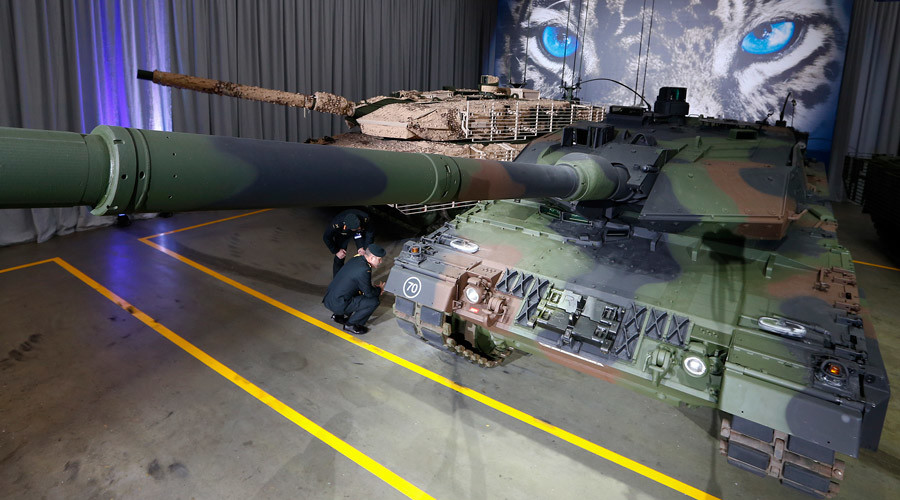
At the annual Defence Ministry Board meeting, Minister Shoigu reveals that NATO has plenty more in store for 2017 than any Western media outlet cares to elaborate on. Amongst which, the British Armed Forces have began their training using Russian- made tanks and uniforms, which identify the “enemy.” As pointed out by Shoigu – the last time this method was employed was by Hitler.

We all know how that ended.

[Editor: Russian equipment is also useful to have on hand for creating false flag attacks.]

Posted at
http://www.fort-russ.com/2016/12/russia-warns-nato-are-modern-nazis-video.html


Russia’s victory in Syria: The real meaning of the Aleppo Hospital tragedy

From Fort Russ

December 8, 2016 – Fort Russ –
Ruslan Ostashko – LiveJournal– translated by J. Arnoldski –
I am not surprised by the double standards of Western media and Western leaders who either don’t want to recognize the fact that our military medics were killed or are issuing statements to the effect of “serves you right.” I’m even more unsurprised by the absence or at least “cheesy” condolences that have been offered on the occasion of the murder of our military adviser. I’ll say something cynical: I would be very worried if suddenly Western media and Western politicians started doing otherwise. 
The point is that chivalry is a luxury that only the winners can afford, and the strength of the globalists’ forces in Syria are now suffering a very serious defeat with very far-reaching consequences. Therefore, when the Pentagon is grinning and the International Red Cross is actually spitting on the memory of our medics, this means that everything is in order. This means that we are doing what’s necessary. This means that our troops have found themselves on the right side of history and are very close to victory.
Our opponents have a long tradition of spitting on the graves of the dead when they can’t beat the living. This is a sure sign that they are losing and that we are winning.
The situation for the globalists sponsoring and coordinating the terrorist “Syrian opposition” is so desperate that they are going to do anything to at least spoil the approaching victory of Russian troops in Syria. Catastrophe is nearing for the globalists and the moment is approaching when they will be deprived of the leverage they now have. This includes the leverage of control over certain American military resources. 
A prudent commander would now be trying to quietly negotiate with Moscow on the withdrawal of American military instructors from Aleppo who are working there to coordinate the work of militants. But instead, the globalists are organizing mortar shelling of a Russian hospital as a farewell, perfectly knowing that the response will be maximally bloody. The chances of American and Western instructors exiting Aleppo alive are now equal to zero. 
It is evident that they don’t care about the fate of their instructors and could care less precisely because the Pentagon will soon come into Trump’s hands. They won’t be able to use such instructors anymore. So why protect them? According to the logic of the departing Clinton team, it is much more important and interesting to spoil the Russian celebration and make victory come at even a greater cost. There is nothing surprising here. The logic of the globalists, for whom both Syrians and Americans are cannon fodder for their personal wars, is reflected in this situation crystal clear. I don’t know about you, but this reminds me of April 1945 when we dealt with one maniac who behaved similarly. He finished very badly.
I am closely following the information wars against Russia, and I remember very well how they told us at every turn that Syria will be Russia’s new Afghanistan. I remember how specialists on the Middle East told us that Assad is doomed in any case. I remember how they told us that Aleppo is impregnable and that Turkey and the United States will fight to the end to protect their militants in Syria. They basically urged us to reconcile with these “facts” and not even try to interfere in the Clintonites’ plans to reshape the Middle East for themselves, lay down pipes carrying Qatari gas to Europe, and turn the region into a factory of terrorists to be used for attacks on Russia. 
But what do we see now? We are now witnessing not only the final battle for Aleppo, but the real triumph of the Russian army and Russian military advisers. We have learned to fight with maximum concern for the lives of our soldiers. That’s why those cases in which we fail to save our medics or military advisers are so painful.
It can already be said that their death is not in vain. Besides the obvious geopolitical advantages now at play and besides the serious reduction in the number of terrorists who could in other circumstances turn up in Russia, the operation in Syria has shown us ourselves and the entire world that Russia can defend its geopolitical interests beyond its own borders even better than the USSR could. 
 
25 years ago, the operation in Afghanistan contributed to society being indifferent towards or even welcoming the collapse of the Soviet Union. But now our operation in Syria is doing the opposite: strengthening our faith in our strength and our country. This is very good. Perhaps 25 years ago we really learned to draw the right conclusions from the mistakes of our past. 

U.S. Navy may increase Black Sea patrols – Admiral

From RT

December 7, 2016

The U.S. Navy guided-missile destroyer USS Truxtun © Stoyan Nenov
Washington may send more ships to the Black Sea in order to extend the amount of time they can patrol the area, according to a senior US Navy officer.

The US has sent a string of warships into the Black Sea since the Ukraine crisis broke out in 2014, and NATO refused to recognize Crimea’s reunification with Moscow or Russia’s military presence on the peninsula.

“It depends on whether or not the challenges in the region become more or less urgent,” Vice Admiral James G. Foggo III told Sputnik on Wednesday, on the margins of the Defense Forum 2016, organized by the US Naval Institute in Washington, DC. “Obviously, when things become more intense you see the presence of additional ships.”

Extending the length of US operations would require additional ships, since the 1936 Montreux Convention limits vessels of outside states to 21 consecutive days in the Black Sea.

NATO has floated the possibility of setting up a “Black Sea flotilla” to get around the restriction, but Romania was not keen on the idea, while Bulgaria has rejected it outright.

“We probably had a US Navy warship in there under a US flag, bilateral or multilateral operations about third of the year, NATO is in there operating about a third of the year, and the Russian Federation Navy is putting more assets in there and things are getting more crowded,” said the admiral.

Foggo became the Director of Navy Staff last month, having previously served as commander of the US Sixth Fleet and deputy commander of US Naval Forces Europe. He commanded the NATO maritime task force during the 2011 intervention in Libya.

During his presentation at the Defense Forum, Foggo said the Navy’s top current challenges were “Russians, Radicals and Refugees.”

“We have to remain vigilant,” Foggo told the conference, noting that the Russian navy had “some very effective weapon systems.”

“They’re out there and they’re pretty good,” he said.

By way of example, Foggo mentioned the incident in April 2016, when two Russian fighters buzzed the USS Donald Cook in the Baltic Sea. Senior US officers in NATO hurried to declassify the video of the event so they could seize the moral high ground in the “YouTube wars” and accuse the Russians of unprofessional and reckless behavior, he explained.

During the 6th Fleet’s BALTOPS 2016 maneuvers, two Russian corvettes shadowed the 49 NATO ships, appearing on the sides of the group photo taken by the alliance’s public relations officers. Foggo recounted declining the offer to edit the Russians out, joking that the photo could serve as proof he commanded a force of “more than 50 ships.”

https://www.rt.com/usa/369555-navy-black-sea-patrols/

Russia ‘prevented’ potential NATO launch of 624 cruise missiles against Syria – Defense Minister

From RT

August 15, 2016

Moscow’s actions following the Syrian chemical weapons attack in 2013 could as well have saved the country from a possible massive strike by NATO forces, Sergey Shoigu, Russia’s defense minister, said. Such a strike could have involved over 600 cruise missiles, he added.

“What would’ve happened if our president [Vladimir Putin] failed to be convincing and implement the idea of surrendering and destroying the chemical weapons? If we only talk about cruise missiles … 624 cruise missiles, as far as I remember, were prepared to carry out a massive strike against Syria within 24 hours,” Shoigu told state television channel Rossiya-24.

It would’ve been “very hard” to restore the Syrian state structure after such a large-scale attack, he said.

Back in 2013, US President, Barack Obama, authorized strikes against Syria, blaming Assad’s government for a sarin gas attack on a rebel-held suburb of Damascus.

But Russia’s involvement managed to avert NATO attacking the county as Moscow brokered a deal, during which Syria renounced its chemical weapons arsenal and joined the Convention on the Prohibition of the Development, Production, Stockpiling and Use of Chemical Weapons and on their Destruction.

In terms of current events in Syria, Shoigu said that Russia and the US are in direct talks aimed at the resolution of the crisis in Aleppo.

He expressed hope that this would help to ensure “peace at this long-suffering land and allow the people to finally return to their homes.”

…

https://www.rt.com/news/356054-russia-nato-strike-syria/

Interview with German MP Sahra Wagenknecht (VIDEO)

From Sophie Co. — RT

December 4, 2016

https://www.rt.com/shows/sophieco/369194-germany-merkel-public-discontent/video/

With Donald Trump’s victory in the US presidential race putting the prospects for transatlantic cooperation in jeopardy, EU leaders are now bracing for change. With Washington promising to focus on internal affairs, Berlin may now have to play the lead among its Western allies. Angela Merkel is planning to run for a fourth term as German Chancellor, and is seen by many as a beacon of stability in turbulent times. But as the country struggles with an influx of refugees, and public discontent grows, will non-establishment candidates be able to take on Germany’s ruling party? We ask the parliamentary leader of the Left Party – Sahra Wagenknecht.

Sophie Shevardnadze: Chancellor Angela Merkel will be running for a fourth term, but in regional elections, Merkel’s CDU party has suffered defeat. Will the Germans vote for the stability that comes with Merkel, or will they vote for change?

Sahra Wagenknecht: I wouldn’t say that Chancellor Merkel represents stability. Merkel has brought even greater social inequality to our country. There are a lot of people who feel that politicians have abandoned them, that we are moving away from democracy. But the problem is, there are no strong candidates within the Social Democratic Party, so the risk is quite real that Chancellor Merkel will remain in office for another four years. I think that most people in this country do not want things to “stay the same”.

SS: There is growing support in your country for the Eurosceptic party Alternative for Germany – AfD. Do they stand any real chance of becoming part of the coalition government and influencing public policy?

SW: Well, I don’t think Alternative for Germany will become part of the next government. But you’re right, Alternative for Germany is, indeed, becoming stronger. It has made some very significant gains in recent regional elections, but not so much because people support the position of the AfD – it is chiefly because they were disappointed with the other parties.

It looks to them as if politicians don’t really care about their interests, and so many believe that by choosing Alternative for Germany they can express their anger, their frustration, and protest. In other words, for many people, a vote given to Alternative for Germany is a way to express their disappointment, not a sign that they wholeheartedly support the idea of AfD defining Germany’s politics. I don’t see them achieving that much, but I fear that they will have a much stronger representation in the next Bundestag.

SS: Der Spiegel wrote that during his visit to Berlin, the outgoing American President Barack Obama personally led the campaign in support of Merkel. Can Merkel be considered a successor to American policies in Europe?

SW: Well, she has always been a very successful proponent of American policy. She always believed that her function is to acknowledge and recognise American hegemony, the hegemony of the United States, meaning that it should ALWAYS be recognised. We do not know of any case in which Merkel has raised any objections against American policy, including military action both with NATO and without it.

I mean the military action that took place under American leadership, and in which Merkel played her part, and, therefore, Germany did, too. The most recent example of this is Syria. So, there has always been a close relationship between Chancellor Merkel and Obama and, unfortunately, she has never said anything critical with regards to the United States. When German Foreign Minister Frank-Walter Steinmeier expressed a different view, for example, when he criticised NATO maneuvers in Eastern Europe, in those cases, of course, Mrs. Merkel always kept silent. There has always been a kind of alignment with the United States, as well as a need for American approval.

SS: According to the New York Times, Angela Merkel is the Liberal West’s Last Defender. If Trump focuses on America’s domestic issues, will Berlin become a beacon for the West? Maybe it’s time for Merkel to become the “Leader of the Free World”?

SW: I have no idea what “the free world” means. I mean, lately, America has been engaged in many military operations in violation of international law. They have not been defending freedom and democracy; they have been using their drones in war zones to kill people, which is a gross violation of international law. So I wouldn’t use such terms lightly.

I also don’t think we should be praising Angela Merkel too much. Germany today should not be pursuing hegemonic goals. On the contrary, many European countries feel that the EU nations are disconnected because Chancellor Merkel is acting on her own again and again without consulting her European partners, so they are not happy about it. So I believe it would be a mistake for Germany to pursue hegemony today.

Continue reading →

NATO force on Russian border ‘not a threat in any way’ – U.S. State Department

From RT

November 22, 2016

© Ints Kalnins
© Ints Kalnins / Reuters

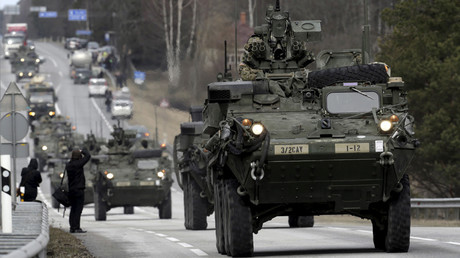
Washington has expressed discomfort over Russia’s deployment of Iskander missiles and air defenses in Kaliningrad, saying that NATO is a “defensive alliance”and is not threatening Moscow. Meanwhile, more tanks and troops are being deployed to the Baltics.

“NATO is a defensive alliance, it’s always been a defensive alliance, it will remain a defensive alliance,” State Department spokesman John Kirby told reporters on Tuesday. “There is no reason why Russia should view NATO in any way, shape or form as a threat.”

On Sunday, NATO kicked off “Iron Sword 2016”exercises in Lithuania, the largest such maneuvers to date, involving 4,000 troops from across the alliance. The exercises in 2015 and 2014 involved 2,500 and 2,000 troops, respectively.

“There is no reason for anybody in Russia to feel threatened by NATO’s military activities or preparations.” Kirby continued. “In terms of recent months and years, there would have been no reason for NATO to advance and commit additional capabilities on the European continent – including American capabilities – had it not been for Russia’s move in Ukraine.”

This is in line with NATO’s official position that military activities in eastern Europe were a defensive response to alleged Russian “aggression” in Ukraine. NATO said Russia was responsible for “annexing” Crimea from Ukraine. The region voted to join the Russian Federation in March 2014, following the coup that overthrew Ukraine’s elected government.

Moscow responded to the recent NATO build-up by announcing it would deploy S-400 air defense systems and “Iskander” missile launchers to Kaliningrad Oblast, a Russian exclave containing almost one million inhabitants sandwiched between Poland and Lithuania.

“Russia is doing all that is necessary to protect itself amid NATO’s expansion toward its borders,” Dmitry Peskov, spokesman for President Vladimir Putin, told reporters at the Kremlin on Tuesday. “The alliance is a truly aggressive bloc, so Russia does what it has to do. It has every sovereign right to take necessary measures throughout the territory of the Russian Federation.”

‘Russia is doing all that is necessary to protect self’ – Kremlin spokesman on deployment of missiles in Kaliningrad http://on.rt.com/7vt8 

Photo published for Russia has right to defend against ‘aggressive’ NATO – Kremlin on Baltic missile placement — RT News

Russia has right to defend against ‘aggressive’ NATO – Kremlin on Baltic missile placement — RT News

Russia has the right to protect itself against NATO’s eastward expansion, Kremlin spokesman Dmitry Peskov said, commenting on the deployment of Russian ballistic missiles in the Kaliningrad Region….

rt.com

NATO’s military drill on Russia’s border comes amid preparations to permanently station 4,000 alliance troops in Poland, Lithuania, Estonia and Latvia, a decision made at the NATO summit in Warsaw in July.

A quarter of the force would be composed of US troops currently based in Germany, who would relocate to Poland. A 1,000-strong German-led force equipped with tanks would be deployed in Lithuania in February for the first time since WWII. The remaining 2,000 British and Canadian troops would be stationed in Estonia and Latvia.

READ MORE: Germany to send modern tanks to Russian border – Defense Ministry

NATO has accused Russia of “aggressive military posturing” over reports that missiles would be deployed in Kaliningrad, while on Monday Kirby called for Moscow to “refrain from words or deeds that are inconsistent with the goal of promoting security and stability.”

Kosovo: An evil little war (almost) all US candidates liked (Op-Edge) http://on.rt.com/7822 

Established in April 1949 – six years before the Warsaw Treaty Organization – NATO ensured a permanent US presence in western Europe during the Cold War. After the dissolution of both the WTO and the Soviet Union, NATO expanded both its boundaries and its mission. On March 12, 1999, the alliance admitted the Czech Republic, Poland and Hungary. Twelve days later, NATO attacked Yugoslavia. After a 78-day bombing campaign, alliance troops were allowed occupy the Serbian province of Kosovo as “peacekeepers.”

Bulgaria, Romania and the Baltic states joined the alliance in March 2004, putting NATO on the shores of the Black Sea and on the western border of the Russian Federation. In March 2011, NATO launched an intervention in Libya, aiding the rebels that overthrew the government of Colonel Muammar Gaddafi.

https://www.rt.com/usa/367860-russia-missiles-nato-defensive/

NATO mulls worst-case scenario in case Trump pulls US troops out of Europe – report

From RT

November 12, 2016

NATO strategists are reportedly planning for a scenario in which Trump orders US troops out of Europe, as the shock result of the US presidential election sinks in, spreading an atmosphere of uncertainty.

According to Spiegel magazine, strategists from NATO Secretary-General Jens Stoltenberg’s staff have drafted a secret report which includes a worst-case scenario in which Trump orders US troops to withdraw from Europe and fulfills his threat to make Washington less involved in European security.

“For the first time, the US exit from NATO has become a threat” which would mean the end of the bloc, a German NATO officer told the magazine.

During his campaign, Trump repeatedly slammed NATO, calling the alliance “obsolete.” He also suggested that under his administration, the US may refuse to come to the aid of NATO allies unless they“pay their bills” and “fulfill their obligations to us.”

“We are experiencing a moment of the highest and yet unprecedented uncertainty in the transatlantic relationship,” said Wolfgang Ischinger, former German ambassador in Washington and head of the prominent Munich Security Conference. By criticizing the collective defense, Trump has questioned the basic pillar of NATO as a whole, Ischinger added.

The president-elect therefore has to reassure the European allies that he remains firm on the US commitment under Article 5 of the NATO charter prior to his inauguration, the top diplomat stressed.

Earlier this week, Stoltenberg lambasted Trump’s agenda, saying: “All allies have made a solemn commitment to defend each other. This is something absolutely unconditioned.”

Fearing that Trump would not appear in Brussels even after his inauguration, NATO has re-scheduled its summit – expected to take place in early 2017 – to next summer, Spiegel said.

The report might reflect current moods within the EU establishment as well, as Jean-Claude Juncker, President of the European Commission, has called on the member states to establish Europe’s own military.

Washington “will not ensure the security of the Europeans in the long term… we have to do this ourselves,” he argued on Thursday.

If Trump is serious about reducing the number of US troops stationed in Europe, large NATO countries like Germany have little to offer, Spiegel said. Even major member states’ militaries lack units able to replace the Americans, which in turn may trigger debate on strengthening NATO’s nuclear arm, a sensitive issue in most European countries for domestic reasons.

Still, an increase in defense spending has already been approved by the Europeans following pressure from the outgoing US administration. Over the past few days in Brussels, representatives of NATO states have been working on the so-called “Blue Book,” a secret strategy paper which stipulates each member’s contribution in the form of troops, aircraft, warships, and heavy armor until 2032, Spiegel reported.

The document stipulates an increase in each NATO members’ military spending by one percent of each nation’s GDP, in addition to the current two percent.

Uncertainty over Trump’s NATO policy seems to be taking its toll; Germany, one of the largest military powers in Europe, plans to allocate 130 billion euros ($140bn) to military expenditures by 2030, but the remarkable figure may be a drop in the ocean.

“No one knows yet if the one percent more would be enough,” the German NATO officer told Spiegel.

Nevertheless, the US is continuing to deploy troops to eastern Europe, justifying the move with the need to protect the region from “assertive Russia.” Earlier this week, the largest arms shipment yet, 600 containers, arrived in Germany to supply the US armored and combat aviation brigades, expected to deploy in Europe by January 2017.

https://www.rt.com/news/366668-trump-us-support-nato/

Imperial nations threatened by the Libyan Army victory in Libya’s oil crescent

Global Research, November 09, 2016
Jamahiriya News Agency 12 September 2016

By August 22 plans were in place to seize Libyan oil fields and ports that were under the control of the oil installation guards led by Ibrahim Jadhran who is allied with Tripoli’s government of accord, working under the command of the presidential council’s national guard (LIFG).

To prepare the way for the liberation of the oil crescent, Sheikh Saleh Alatyosh delivered a stern warning to the men serving under Jadhran.

*I ask the people of my tribe to ensure that no one has a son in the oil installations guards…and advise them to return to the embrace of the tribe…We are with the national army under the leadership of the Khalifa Haftar, with Parliament headed by Saleh and the government emanating from it and we in Cyrenaica do not recognize the legitimacy of the presidential council.

الأول من اليسار شيخ قبيلة المغاربة صالح الاطيوش. (تصوير: صلاح الاطيوش) (photo: )

In 2013 Ibrahim Jadhran declared war on Tripoli’s GNC, announcing Cyrenica’s autonomy and return to the kingdom of Libya’s 1963 regional borders.
Libya-map-AI
With Sheikh Saleh Alatyosh’s announcement, not only were Jadhran’s political ambitions annihilated. The imperialist plot to partition Libya was crushed.

The Libyan National Army launched their strategic strike on the oil installations on Sunday. Aerial bombardments were immediately followed by ground assaults. Within hours the oil fields and ports were firmly under their control.

In an appeal following the victory, Sheikh Saleh Alatyosh offered assurances to Jadhran that if he surrendered to the army he would be well treated. He urged employees of the oil installations to cooperate in a peaceful handover of the facilities to the armed forces in Ajdabiya. He cautioned them to refrain from further sedition and bloodshed and return to their homes.

The victory was a humiliation for the UN-instated presidential council and the foreign nations backing the puppet regime. Fayez al-Sarraj was in the midst of a meeting in Italy when the news of the LNA victory reached him. Clearly shaken, he returned to Tripoli to assess the damage and save what he could of his reputation and that of the sham regime propped up by the United Nations and NATO.

After months of the government of accord’s show battle in Sirte under the command of al Qaeda and LIFG forces, where hundreds of Misratan fighters lost their lives as Da’esh left the city in concerted waves seeking a new base, the Libyan National Army, impeded by international sanctions, proved itself to be the superior, most effective force in the country, capable of defeating terrorist armies, securing Libya’s resource wealth for the people, restoring the rule of law and protecting the civilian population.

The power of the Tribes must also be considered. This victory was achieved through the Libyan National Army’s alliance with Tribal leaders. While the United Nations and foreign interlocutors continue to exclude the Tribes, this victory demonstrates that nothing of benefit to the people in Libya happens without their cooperation. However many meetings the United Nations may host in the name of national reconciliation, they have no power or authority. Their efforts, their declarations and political agreements are dismissed as irrelevant, illegitimate, unwarranted interference in Libya’s sovereign affairs – the most recent deprecation being the Supreme Council of Libyan Tribe’s response to the Tunis meeting held earlier this month.

Authentic Libyan dialogues are the sole province of the Libyan people and the Tribes.

Today the governments of France, Germany, Italy, Spain, United Kingdom and the US issued a joint statement condemning the Libyan army’s victory, demanding that the legitimate armed forces withdraw immediately, without preconditions. They falsely claim that the energy infrastructure is under threat and that only their client regime in Tripoli should have control over Libya’s rich reserves.

Continue reading →

Vladimir Putin speaks at the Valdai Club, 2016 — Part 1 (VIDEO)

15:54
October 27, 2016 — Part 1
Valdai Discussion Club
“The Future in Progress: Shaping the World of Tomorrow”, October 24-27, 2016
RT
Translated by Inessa Sinchougova

Vladimir Putin’s annual address at the Valdai Discussion Club, held in Sochi, Russian Federation.

Transcript, Part 1:

Moderator Timothy Colton, Professor of Russian Studies, Harvard University: 

So, good afternoon, ladies and gentleman. My name is Timothy Colton. I know quite a few of the people in the room. And I’m very happy to have been asked to moderate this final session of our 2016 Valdai, as you call it.

I’d like to start with a special welcome to our lead-off speaker and main speaker this afternoon [subtitled translation by Inessa S.:] Russian President Vladimir Putin. He found the time to be here today – we all know how busy he is!

We appreciate as always your ability to answer questions at the end as well. When you retire, Mr. President, and go to write your memoirs, try to analysis just how much time you spent in your career answering people’s questions [Q&A]. I think you will be astonished!. We are really appreciative of this. Thank you for being here today.

President Vladimir Putin

Thank you. Dear Tarja, Heinz, colleagues, ladies and gentlemen. It is a great pleasure to see you again.

I would like to start by thanking all Russia’s and international participants at the Valdai Discussion Club gor your constructive roles in this work, and I want to thank our distinguished guests for their willingness to take part in this open discussion.

Our esteemed moderator just wished me a sound departure into retirement, and I wish that for myself too – when the time comes. This is the right approach and will be the right thing to do.

But I am not yet retired! I am for now the leader of this big country. As such, it is fitting to show restraint and avoid displays of aggressive reactions. I don’t think that this is my style in any case.

But I do think we should be frank with each other, particularly here in this forum. I think we should hold candid, open discussions, otherwise, our dialogue is pointless, stale, and will not hold anyone’s interest for too long.

I think that this style of discussion is exceptionally needed today given the great changes taking place in the world. The theme of our meeting this year “The Future in Progress: Shaping the World of Tomorrow” is very topical.

Last year, the Valdai forum participants discussed the problems with the current world order. Unfortunately, little has changed for the better over these last months. Indeed, it would be more honest to say that nothing has changed for the better.

The tensions created by shifts in distribution of economic and political influence continue to increase. Mutual distrust creates a burden that narrows our possibilities for finding effective responses to the real threats and challenges facing the world today.

Essentially, the entire globalization project is in crisis today, and in Europe, as we know well and hear of all the time, that multiculturalism has failed.

I think this situation is in many respects the result of mistaken, hasty and to some extent over-confident choices made by some countries’ elites a quarter of a century ago. Back then, in the late 1980s – early 1990s, there was a chance not just to accelerate the globalization process, but also to give it a different quality and make it more harmonious and sustainable in nature.

But some countries that saw themselves as victors in the Cold War — not just saw themselves this way, but said it openly — they proceeded to simply reshape the global political and economic order to fit their own interests.

In their euphoria, they essentially abandoned substantive and equal dialogue with other members of the international community, and chose not to improve or create universal institutions, attempting to bring the entire world instead under the spread of their organizations, norms, and rules.

They chose the road of globalization and security for their own beloved selves, for the select few, but not for all. However, far from everyone was willing to abide.

We may as well be frank here, as we know full well that many did not agree with what was happening, but some were unable by then to respond, and others were not yet ready to respond.

The result though is that the system of international relations is forever feverish, and the global economy cannot free itself from systemic crisis.

At the same time, rules and principles, in the economy and in politics, are constantly being distorted. We see what only yesterday was accepted as a truth and raised to dogma status, manipulated to mean the exact opposite. If the powers that be today find some standard or norm to their advantage, they force everyone else to comply. But if tomorrow these same standards get in the way of their agenda, they are swift to throw them in the bin, declare them obsolete, and set new rules. Or attempt to do so.

Thus, we witnessed the decision to launch airstrikes in the center of Europe, in Belgrade, and then came Iraq, and then Libya. The operations in Afghanistan also started without a corresponding decision from the United Nations Security Council.

In their desire to shift the strategic balance in their favor, these countries broke apart the international legal framework that prohibited deployment of new missile defense systems. They created and armed terrorist groups, whose cruelty has sent millions of civilians into refuge, created millions of displaced persons and immigrants, and plunged entire regions into utter chaos.

We see the way free trade is being sacrificed and countries use sanctions as a means of political pressure, bypassing the WTO and attempting to establish closed economic alliances with strict rules and barriers, in which the main beneficiaries are their own multinational corporations.

And we know why this is happening, too. They see that they cannot resolve all of the problems within the WTO framework, and so why not throw the rules and the organisation itself aside and build a new one instead. This illustrates what I just said before.

At the same time, some of our partners demonstrate no desire to resolve the real international problems in the world today. In organizations such as NATO, for example, established during the Cold War and clearly out of date today, despite all the talk about the need to adapt to the new reality, no real adaptation takes place.

We see constant attempts to turn the OSCE, a crucial mechanism for ensuring common European and also trans-Atlantic security, into an instrument that services someone’s foreign policy interests. The result is that this very important organization has been hollowed out.

But they continue to churn out threats, imaginary and mythical threats such as the Russian military threat. This is a profitable business that can be used to pump new money into defense budgets at home, get allies to bend to a single superpower’s interests, expand NATO and bring its infrastructure, military units ,and arms closer to our borders. Of course, it can be a pleasing and even profitable task to portray oneself as the defender of civilization against the ‘new barbarians’.

The only thing is that Russia has no intention of attacking anyone. It’s hilarious, really.

I also read analytical materials, those written by you here today and by your colleagues in the USA and Europe. It is unthinkable, silly, and completely unrealistic. Europe alone has 300 million people. All of the NATO members together with the USA have a total population of 600 million, probably. Russia today has only 146 million people. It is simply absurd to even conceive such thoughts. But no – they use these irrational ideas in pursuit of their political aims.

Another mythical and imaginary problem is what I can only call the hysteria the USA has whipped up over supposed Russian meddling in the American presidential election. The United States has plenty of genuinely urgent problems, it would seem, from the colossal public debt, to the increase in firearms violence, to the cases of arbitrary action by the police. You would think that the election debates would concentrate on these and other unresolved problems, but the elite has nothing with which to reassure society, it seems, so they attempt to distract public attention by pointing instead to supposed Russian hackers, spies, agents of influence, and so forth.

I have to ask myself, and ask you, too: Does anyone seriously imagine that Russia can somehow influence the American people’s choice? America is not some sort of banana republic, after all, but is a great power. But do tell me if I am wrong!

The question is: if things continue like this, what awaits the world? What kind of world will we have tomorrow? Do we have answers to the questions of how to ensure stability, security and sustainable economic growth? Do we know how to create a more prosperous world?

Sad as it is to say, there is no consensus on these issues in the world today. Maybe you have come to some common conclusions through your discussions, and I would be interested, of course, to hear them. But it is very clear that there is a lack of strategy and ideas for the future. This creates a climate of uncertainty that has a direct impact on the public mood.

It is unfortunate that studies conducted around the world show that people in different countries and on different continents tend to see the future as murky and bleak. The future is not calling us forward – we are afraid of it. At the same time, people see no real opportunities for changing anything, influencing events and shaping policy. Yes, formally speaking, modern countries have all the attributes of democracy: elections, freedom of speech, access to information, freedom of expression. But even in the most advanced democracies, the majority of citizens have no real influence on the political process and no direct and real influence on power.

People sense an ever-growing gap between their interests and the elites’ vision of the only correct course, the course the elite itself chooses.

The result is that referendum and elections increasingly often create surprises for the authorities. People do not at all vote as the official and ‘respectable’ media outlets advised them to, nor as the mainstream parties advised them to.

Public movements that only recently were too far left or too far right are taking center stage and pushing the political heavyweights aside.

At first, these inconvenient results were hastily declared an anomaly or chance. But when they became more frequent, they started saying that society does not understand those at the helm of power and have not yet matured sufficiently to be able to assess authorities’ labor for the public good. Or they sink into hysteria and declare it the result of foreign, usually Russian, propaganda.

Sure, friends and colleagues, I would have liked to have such a propaganda machine here in Russia, but regrettably, this is not the case. Unlike you, we do not have global mass media outlets like CNN, BBC and others. We simply do not have this kind of capability at this stage.

As for the claim that the fringe and populists have defeated the “sensible, sober, and responsible minority,” we are not talking about populists at all, but about ordinary people, ordinary citizens who are losing trust in the ruling class. This is the issue.

By the way, with the political agenda already eviscerated as it is, the elections cease to be an instrument for change. They consist instead of nothing but scandals and digging up who pinched whom where, and who sleeps with whom, if you’ll excuse.

This has crossed all boundaries of decency.

And honestly, a look at various candidates’ platforms gives the impression that they were made from the same mold – the difference is slight, if there is any at all.

It seems as if the elites do not see the deepening stratification in society and the erosion of the middle class, while at the same time, they implant ideological ideas that, in my opinion, destroy cultural and national identity, and in certain cases, in some countries they subvert national interests and renounce sovereignty in exchange for the favor of the suzerain (feudal lord).

This begs the question: who is actually the ‘fringe’? The expanding class of the supranational oligarchy and bureaucracy, which is in fact often not elected and not controlled by a society? Or is it the majority of the citizens, who want simple and plain things – stability, free development of their countries, future prospects for their lives and the lives of their children, preservation of their cultural identity, and finally, basic security for themselves and their loved ones?

Germany to send modern tanks to Russian border – Defense Ministry

From RT

October 27, 2016

Leopard 2A7 © Michaela Rehle
Leopard 2A7 © Michaela Rehle / Reuters

Germany is preparing to deploy its most modern ‘Leopard 2’ tanks and more than 600 infantrymen to Lithuania as it joins NATO’s biggest military buildup since the Cold War, German media reported citing the defense ministry.

The plans to deploy not infantry and tanks to the NATO member state bordering Russia were announced by the German Defense Minister Ursula von der Leyen at a two-day meeting of the alliance’s defense ministers in Brussels.

Deployment of “heavy weaponry” was then confirmed to the German daily Die Welt by a defense ministry spokesman, who said that tanks will be only part of the military equipment that Germany is going to deploy to the Baltic State.

A NATO battalion under German command will be stationed in Lithuania In February. The battalion’s personnel will amount to 1,000 soldiers, with from 450 to 650 of them coming from Germany and the rest being deployed by France, Belgium and Croatia.

According to the German daily Der Tagesspiegel daily, this will be an autonomous combat-ready unit equipped with tanks and armored vehicles that will also have snipers, engineering troops, military medics and even military police. The battalion will be fully operational starting from June 2017, German media reported.

The decision to send tanks alongside with the infantry to Lithuania should “send a clear signal” that Germany takes security concerns of the eastern NATO members “seriously,” von der Leyen said during the ministers’ meeting in Brussels.

“It should send a clear signal that an attack on any NATO member state would be regarded as an attack on all 28 members [of the bloc],” she said, as cited by Der Tagesspiegel. At the same time, she stressed that the deployment of German forces on the Russian border was a “strictly measured” step that has exclusively “defensive” purposes, as reported by Die Welt.

In 2015, von der Leyen ordered 100 new Leopard 2 tanks for the German army, the Bundeswehr, “in response to the Ukrainian crisis.” Additionally, all tanks that are currently in use by German forces should be modernized starting in 2017, according to the defense ministry’s plan.

The upper threshold for the number of tanks in the German army, which was set at 225 in 2011, was then increased to 328 in line with the ministry’s new plans, Die Welt reported.

However, the plans to station tanks almost on the Russian border provoked criticism from some German politicians.

“Sending tanks to the Russian border means forgetting the history,” Sara Wagenknecht, the head of the Left Party’s faction in the German parliament, told the news agency DPA. She also denounced the move as “a step towards further escalation of relations with Russia.”

“Those who really want to preserve peace in Europe should eventually return to relying on the traditions of the policy of détente instead of continuing to support the confrontational course that is neither in German interests, nor in the interests of the EU,” she said.

Continue reading →