Global Research, July 06, 2016
Ward for Senate
From Fort Russ
Zhuravko: Islyamov Could Engage in Nuclear Terrorism for the Sake of Blackmailing Russia
Translated by Ollie Richardson for Fort Russ
27th June, 2016
The situation in Ukraine continues to be alarming, and, unfortunately, does not create hope and optimism. The state under the control of the coup is rapidly approaching collapse on all fronts. In this sense, unfortunately, the threat is not only to the State of the country or the welfare of its inhabitants, but also the lives of millions of people, and not only in Ukraine. The Kiev government largely does not control the situation in Ukraine, does not control its own militants, and cannot prevent many emergencies, among which the safety of Ukrainian Nuclear Power Plant has special status.
This was discussed on the TV programme “Special Status” on the TV channel “Zvezda”, which the Ukrainian opposition politician Alexei Zhuravko participated in.
“I am receiving disturbing information from Ukraine almost every day. The threat of a terrible collapse and many deaths exists. We mustn’t joke on the topic of nuclear plants. In addition, experts seak about one other threat: it is Islyamov, it is “Azov” militants, fighters of “Dnepr”. And no one knows where the gun will turn. The worst thing is that the safety of nuclear power plants, which was ensured by the State, internal security, no longer exists. That is, there is no protection, there are no guns that were defending the stations before, all was stolen, money for major repairs of the stations was looted, very little resources were allocated. In Zaporozhye, according to my real information, there was already a shutdown of this station, and it is linked with experiments. (I still have connections, I used to work with “Energoatom”) In this situation, we need to unite, to connect media, to reach out to the Ukrainians, otherwise there will be a disaster,” he said.
Zhuravko doesn’t exclude that the fugitive Crimean Tatar terrorist Lenor Islyamov and his fighters, who have repeatedly threatened Russia with terrorist attacks, can bring his threats to life. Among those may be the explosion of nuclear facilities, nuclear power plants.
“It is simple. If some fool will get guns and mortars, after that it can explode. It’s scary! If today Islyamov wants to blackmail Russia, he has everything to do it. He can order the militants to close the stations and just to install terror. Nuclear terror. Because in Ukraine, the President does not control the country! And this process must be controlled by specialists,” said the politician.
“I ring all the bells around and I hope god will forbid those bastards from entering into nuclear power plant and chemical plant, and it’s just hard to imagine what the consequences and human toll would be,” adds Zhuravko.
“If today Russia will not interpose, we will have such a blast that it will not look like something small. And it will be Belarus, Russia, Europe, and other countries that will suffer the most! It is necessary to “rear up” Europe… it is necessary to inform Ukrainians, it is necessary to show and to tell the truth on this matter. And to prove to people that they need to rise because a catastrophe will whip up, and humanity will be no more. Think about it for the time being it’s not too late,” warns the politician.
At this time, in the South of Ukraine, armed militants that are massively deployed in the region, continue criminal terror. According to Zhuravko, robbery of the population gains the scope of this disaster.
“Kherson region. 50 people armed to the teeth took away the farmer’s tractor, covers, chemicals, and seed material to the amount of twelve million hryvnias.
Mykolaiv region, Bashtansky district, 25th June 2016, 40 people armed with machine guns and other machetes seized the entire crop from this year.
According to available information, in Ukraine, on the black market and near the area of the ATO, you can buy any kind of weapons, machine guns, grenades, machine guns, explosives, anti-tank mines, and more.
Private territorial battalions in Ukraine are growing like mushrooms after rain. The example of Isylamov’s battalions and their ISIS-isation of the Kherson region is already enough of a problem.
The President does not control the situation in Ukraine, the Security Service of Ukraine is not fighting against private territorial battalions with radical ideas, and are not fighting terrorism,” writes the ex-MP on a social network.
Alexei Zhuravko’s data was unexpectedly confirmed by the famous Ukrainian militant, leader of “Brotherhood” Dmitry Korchinskiy. Battalions under the leadership of businessman Lenur Islyamov, formed on the border with Crimea in Kherson region, are engaged in robbery, he said to the TV channel “112 Ukraine”.
“They have already proclaimed the necessity of national autonomy of the Crimean Tatars, without asking the Ukrainian people. Crimean Tatars, even in the times of Geray (dynasty of Kahn in the 15th Century – O.R), were not a majority in Crimea. And today they say that Crimea should be a national autonomy of Crimean Tatars!
Today in two districts in Kherson region… Tatars under the command of Lenur Islyamov, the former Deputy Prime Minister of the occupational government of Crimea, already have military formations that are very well armed, and are also engaged in robbery and all sorts of boorishness,” said Korchinskiy.
http://www.fort-russ.com/2016/06/zhuravko-islyamov-could-engage-in.html
Article on nuclear power in Ukraine:
http://www.world-nuclear.org/info/Country-Profiles/Countries-T-Z/Ukraine/
From Kremlin.ru
Vladimir Putin addresses the State Duma’s plenary session
April 22, 2016
The President reviewed the Duma deputies’ results and work over the last five-year parliamentary session.
President of Russia Vladimir Putin: Colleagues,
I wanted to meet with you as the parliament’s sixth convocation comes to the end of its mandate and thank you for your work over these years. I want to thank you and say a few words about the results of your work. Of course, I want to take a look forward too at the tasks the next parliament will have before it.
But first of all, let me turn to the tragic date we are marking today. Seventy-five years ago, Nazi Germany treacherously invaded the Soviet Union and the Great Patriotic War began. By this time, as we know, the Nazis has already enslaved many European countries.
The Soviet people took the brunt of the Nazis’ force, but they met the enemy with tremendous unity and resistance, and withstood the onslaught, fighting literally to the death to protect their homeland. They drove the enemy right back to its lair, inflicted a crushing defeat on the invaders and achieved the Great Victory.
Today, we bow our heads before this heroic generation. Our fathers and grandfathers gave their lives to save Russia and all of humanity from the fascist scourge. We will always remember their sacrifice and courage. We treasure the bright memory of all who gave their lives in that war, and all our veterans who are no longer with us now. I propose that we honour their memory with a minute of silence.
(Minute of silence)
It was the Nazis who unleashed this war. Their ideology of hatred, blind faith in their own exceptional nature and infallibility, and desire for world domination led to the twentieth century’s greatest tragedy.
We know the biggest lesson of that war: it could have been prevented. It could have been stopped if efforts had been made to firmly rein in the Nazis and their accomplices’ wild ambitions in time. But this did not happen. Our country, the Soviet Union, made direct proposals for joint action and collective defence, but these proposals were simply left hanging.
The leaders of a number of Western countries chose instead to pursue a policy of containing the Soviet Union and sought to keep it in a situation of international isolation. But it was Nazism that was the real and terrible global threat. Politicians underestimated its danger, overlooked the threat and did not want to admit that enlightened Europe could give birth to a criminal regime that was growing ever stronger.
The international community let its vigilance down and lacked the will and unity to prevent this war and save the lives of millions and millions of people. What other lesson do we need today to throw aside tattered old ideological differences and geopolitical games and unite our forces to fight international terrorism?
This common threat is spreading its danger before our very eyes. We must create a modern collective security system beyond blocs and with all countries on an equal footing. Russia is open to discussions on this most important issue and has repeatedly stated its readiness for dialogue.
For now though, as was the case on the eve of World War II, we see no positive response. On the contrary, NATO is stepping up its aggressive rhetoric and aggressive actions close to our borders. In this situation, we have no choice but to devote particular attention to the tasks we must address in order to increase our country’s defence capability.
I would like to thank the State Duma deputies for their deep and substantive understanding of Russia’s state interests and for knowing how to defend these interests decisively. Of course, I also want to thank you for your consolidated legislative support for the proposals on strengthening our country’s security.
Colleagues, your work and its results deserve a worthy assessment. It is particularly important that the laws you have adopted have played a big part in enabling us to fulfil our social obligations to our citizens, develop our most important economic sectors and improve our country’s political system. I want to stress this point.
You have accomplished a tremendous amount of work in all these areas. This successful work is the result of the efforts made by all parliamentary parties and their willingness to pursue a constructive dialogue with each other, with the Government, and with the other participants in the legislative initiative.
A truly historic result of this convocation’s work was the legal integration of Crimea and Sevastopol, which followed on your sincere and heartfelt moral support for the peninsula’s people on the eve of the referendum on joining the Russian Federation. You were active in supporting the view shared by the vast majority of Crimea and Sevastopol’s people, sometimes emotionally, and when needed, very professionally.
During this time, all parliamentary parties displayed a degree of unity of which your voters can be deservedly proud. In a very short period of time, you adopted more than 120 laws that smoothed the way for Crimea and Sevastopol’s entry into the Russian Federation. You helped people to get through the transition period’s difficulties, feel at home in Russia and know that their rights are reliably guaranteed and new opportunities have opened before them.
A readiness to consolidate for the sake of the tasks at hand and for Russia’s sake is this convocation’s distinguishing feature. It is very important now that the next parliamentary convocation continues these traditions, including this strict respect for the rules of parliamentary ethics. Continuity in law-making work is of tremendous importance.
This ensures the legislative base’s quality and also the authoritative reputation of the entire Russian jurisdiction. We should most definitely continue the practice of annual reports on the state of our country’s legislation. These reports are drafted by both chambers of the Federal Assembly together with the regional parliaments. This is a very useful practice, I think, very important work.
I want to stress particularly that the legislative branch is an independent branch of power and no opportunist, short term interests or desire to push some decision through as fast as possible should interfere with its work. There should be no hasty or superficial approach when examining and adopting laws. I particularly emphasise this point. The key task for the new convocation in the law-making process will be to ensure a well-planned and systemic legislative process with deep and substantive discussion of draft laws.
Colleagues, I particularly want to mention your great contribution to developing our political system. You have passed a whole swathe of laws that strengthen Russia’s democratic foundations, make the political system more transparent and effective, and set higher standards for political competition.
We now have ten times more political parties than we did five years ago. But we know very well that the political system’s quality cannot be measured by the number of parties, but by their ability to influence the decision-making process regarding the issues of greatest concern to our people.
The parliamentary parties have considerable advantages, and these opportunities are deservedly earned. But during the upcoming election campaign, you will have to pass the test once again before your voters. The executive order setting the date for the State Duma election has already been signed. The election will take place under the mixed-member system on September 18th.
Let me stress that the State Duma will soon get an influx of deputies elected in single-seat districts, and this will bolster considerably the parliament’s representative functions and ties with the regions. It is very important that your work gives our people added guarantees of their social rights. These rights should be guaranteed by laws that regulate education, healthcare, and the housing and utilities sector.
You have devoted much effort over these last years to precisely these issues, including support for motherhood and childhood. These are complicated issues of course, difficult problems, but their resolution is crucial for our country’s future. All of the different issues are important of course. Security and international affairs are important, but nothing is more important than the economy and the social sector.
We have put together an effective anti-corruption legal base over these last years, toughened requirements to all categories of civil servants, and introduced bans on opening accounts in foreign banks and possessing foreign companies’ assets.
Now we must ensure that all comply strictly with the law no matter what the office they hold. I am sure that we all share a unanimous position on this issue. I note too that the laws you have passed on strategic planning and industrial policy are extremely important, as is the law on priority development areas, for example.
The work on modernising civil law continues, including incentives for business and investment and measures to combat internet piracy. You have also passed the law on parliamentary oversight, which will most certainly raise the prestige and significance of the deputies’ work.
Improving our environmental legislation is an area of much importance today. Protecting nature and the animal and plant world and guaranteeing people’s right to a good natural environment are common tasks for all political parties. I know that during this parliament’s term you have examined draft laws on the preservation and restoration of forests and ensuring forest fire prevention. The new State Duma will have to continue this work just as actively as you have, all the more so as we have declared 2017 the Year of the Environment.
All parliamentary parties have also shown unity on foreign policy issues. I already mentioned this. Yes, there were some attempts to play up differences between parties, but no one succeeded in splitting your unity and splitting the consolidation in our society and between your voters. At the same time, your contacts with colleagues abroad have become more intensive.
Friends, many political parties have already set dates for holding their congresses to announce candidates and present their campaign programmes. Essentially, the election campaign has begun. Ahead of you is some fierce competition, debates with opponents, and a far from easy time for all who will be taking part in these elections.
I hope that you will do everything possible to ensure that this election is honest, open, and takes place in a spirit of mutual respect. It is also my hope that you will hold a battle not of mudslinging against each other, but of ideas, the implementation of which should strengthen our country and raise our people’s living standards. I appeal to you to do this.
It is very important that all political parties realise their responsibility for preserving social stability and strive not just for the best election results, but for voters’ trust in the election’s outcome. I am sure that stability and trust are key factors and foundations for our country’s successful development.
You are all experienced people and have traversed all the difficulties of election campaigns before. But let me say again nonetheless that the most important players now are not the parties and candidates, but the voters, our country’s people. They are most important. It is they who give you the powers to decide their biggest problems so as to make our country an independent and effectively functioning state in which people can live and work in comfort and safety.
I am sure that you understand well the tasks before our country today. You have already demonstrated this through your work as deputies based on the principles of patriotism and service to people. You have succeeded in developing high standards of political and parliamentary culture and applying them in practice in your everyday work. It will be useful for our country and for the voters if this constructive political style becomes the distinguishing feature of this election campaign too.
You all have much work ahead of you. No matter where you will be working in the future, I wish you professional success and satisfaction, and I want to thank you once again for the very important and responsible work you have done in the Russian parliament.
Thank you very much.
From Syrian Arab News Agency
New York, SANA-Russia’s permanent envoy to the UN Vitaly Churkin called on the international community to press the sides which support terrorist organizations in Syria, among them Jabhat al-Nusra, instead of pressing the Syrian government, demanding the EU to keep channels of communications open with Syria.
“It is necessary to understand that pressures on Damascus will not lead to achieving the aspired-for result, but those who support terrorists should be pressed, including al-Qaeda-linked Jabhat al-Nusra,” Russia Today quoted Churkin as saying at a special meeting between the UN and the European Union on Monday.
He added that some members at “al-Riyadh opposition delegation” form a basic obstacle in front of realizing a political solution for the crisis in Syria.
Churkin called on the EU to keep channels of dialogue with the Syrian authorities open, adding that Moscow welcomes the meeting which was held between Head of the Syrian Arab Republic’s delegation Bashar al-Jaafari and the High Representative of the European Union for Foreign Affairs and Security Policy Federica Mogherini last March in Geneva.
Mazen
The “liberation” of Kosovo unleashed radical Islamism in Europe
Kosovo is Clinton Country: a 10-foot-high statue of Bill overlooks “Bill Clinton Boulevard” in the capital city of Pristina. Hillary is also memorialized in what has become the crime capital of Europe: right off the street named for her husband is a store named “Hillary,” featuring women’s clothing modeled after the putative Democratic party nominee for President. Pantsuits figure prominently. As Vice puts it: “While former President Bill Clinton has had a boulevard named after him, it’s without a doubt that his wife’s the real star out here.” Why is that?
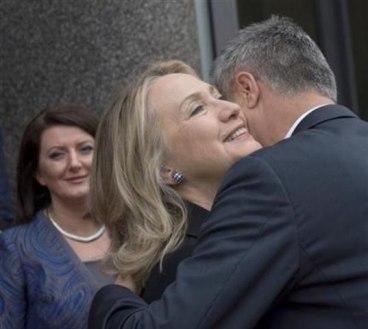
As Gail Sheehy pointed out in her biography of Hillary, it was Mrs. Clinton who hectored her husband into bowing to a chorus of neoconservative and liberal interventionist voices and finally giving the order to bomb the former Yugoslavia. Traveling to Kosovo when Serbs in the northern part of the country were demanding some form of local autonomy to stave off violent attacks by Kosovar ultra-nationalists, Mrs. Clinton reassured her hosts that the US would stand behind Pristina: “For me, my family and my fellow Americans this is more than a foreign policy issue, it is personal.” She then physically embraced Kosovo President and Mafia chieftain Hacim Thaci – who has since been credibly accused by the Council of Europe of stealing human organs from Serb victims and selling them on the black market.
Hillary owns Kosovo – she is not only personally responsible for its evolution from a province of the former Yugoslavia into a Mafia state, she is also the mother of the policy that made its very existence possible and which she carried into her years as Secretary of State under Barack Obama.
As the “Arab Spring” threatened to topple regimes throughout the Middle East, Mrs. Clinton decided to get on board the revolutionary choo-choo train and hitch her wagon to “moderate” Islamists who seemed like the wave of the future. She dumped Egyptian despot Hosni Mubarak, whom she had previously described as a friend of the family, and supported the Muslim Brotherhood’s bid for power. In Libya, she sided with Islamist rebels out to overthrow Moammar Ghaddafi, celebrating his gruesome deathby declaring “We came, we saw, he died.” And in Syria, she plotted with Gen. David Petraeus to get around President Obama’s reluctance to step into the Syrian quagmire by arming Syrian rebels allied with al-Qaeda and other terrorist gangs.
The Clintonian legacy of enabling Islamist terrorists extends to present day Kosovo, where the New York Times has revealed an extensive network of ISIS-affiliated madrassas – indoctrination centers – funded by the Saudis, the Qataris, and the Kuwaitis. The Times reports:
“Every Friday, just yards from a statue of Bill Clinton with arm aloft in a cheery wave, hundreds of young bearded men make a show of kneeling to pray on the sidewalk outside an improvised mosque in a former furniture store.”
“The mosque is one of scores built here with Saudi government money and blamed for spreading Wahhabism” in the 17 years since the war ended with Kosovo’s independence, says the Times.
“Since then – much of that time under the watch of American officials – Saudi money and influence have transformed this once-tolerant Muslim society at the hem of Europe into a font of Islamic extremism and a pipeline for jihadists.”
Kosovo is jihadi heaven. The Times informs us that “Over the last two years, the police have identified 314 Kosovars – including two suicide bombers, 44 women and 28 children – who have gone abroad to join the Islamic State, the highest number per capita in Europe.”
The Wahabist ideology carried by radical imams is directly financed by the Saudis, the Qataris, the Kuwaitis, the United Arab Emirates, and Oman. All of these countries, by the way, are major donors to the Clinton Foundation.
Hillary Clinton’s Islamist-friendly foreign policy created a terrorist base in Kosovo, and her friends the Saudis are instrumental in setting up the conditions whereby ISIS has gained a foothold in the heart of Europe. At sprawling Camp Bondesteel, where US troops have been stationed since the “liberation,” radical imams recruited three Kosovar employees, including Lavdrim Muhaxheri, who is today a commander of the Islamic State: his claim to fame is that he was videotaped executing a Syrian by blowing him to bits with a rocket-propelled grenade. (“I did not do anything less or more than what KLA soldiers did during the war,” he declared in an interview with an Albanian newspaper.)
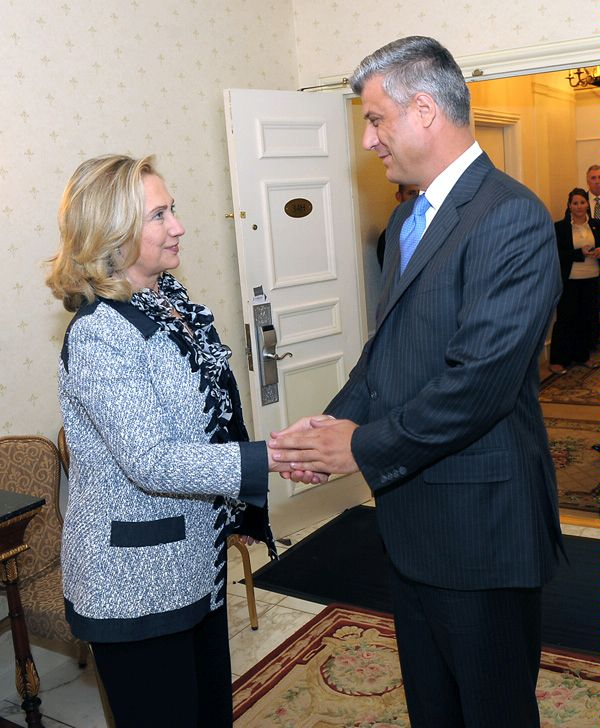
Hillary Clinton and Hashim Thaci
After ignoring the problem for years, the authorities are making a show of rounding up terrorist suspects: five were recently arrested and given long sentences, but there are hundreds more where that came from.
Kosovo today is a fulcrum of terrorism, violence, crime, and virulent nationalism. The Parliament is in chaos as Albanian ultra-nationalists demanding union with Albania shut down sessions with smoke bombs and mob action. This is the legacy of the Clintons in the Balkans: a terrorist state run by Mafia chieftains that has become the epicenter of radical Islamism in the midst of Europe.
This is “blowback” with a vengeance, and Hillary Clinton and husband Bill have their fingerprints all over this outrage: but of course the “mainstream” media isn’t holding them to account. The Times story on the rise of ISIS in Kosovo never mentions the dubious duo, and is vague when it reports on the three employees of Camp Bondesteel who wound up in Syria’s terrorist camps. Who are the other two besides Muhaxheri? Did they receive any military training? This Reuters report confirms that NATO brought Muhaxheri to Iraq, where he worked for two years at a military base.
And there’s more where he came from. As Reuters informs us:
“Thousands of Kosovars have moved on from Bondsteel to work with U.S. contractors on bases in Iraq and Afghanistan over the past decade, earning the kind of money they can only dream of in Kosovo.”
The terrorist pipeline runs from Kosovo, to Iraq and Afghanistan, and then on to Syria – where they fill the ranks of ISIS and al-Qaeda.
Could there be a more perfect illustration of how the principle of “blowback” works, and how we’re creating an army of Frankenstein monsters?
All this brings back memories of Antiwar.com’s first days: this site was born as a protest against US intervention in the former Yugoslavia. Back then we warned again and again (and again!) about the specter of Islamist extremism as the energizing ideology of the Albanian separatists, both in Kosovo and Bosnia.
We were right on target.
That’s the great advantage of being a regular reader of Antiwar.com – we bring you the news before it happens. That’s years before it happens.
But we can’t continue to do it without your support – your financial assistance is critical to our continued existence.
Unlike the War Party, we here at Antiwar.com don’t get seven-figure donations from big foundations, foreign countries, or anybody else for that matter. We depend on you – our readers and supporters – for the funds we need to do our work…
The original source of this article is Antiwar
From Fort Russ
November 28, 2015 –
crimson alter, PolitRussia –
“Supreme Juncker in the black boot”
In the recent terrorist attacks in Paris, there are three important questions to ask.
1) Cui bono?
2) What country could surpass and thwart the sophisticated French intelligence and surveillance system?
3) Why are outcry and public outpourings of support and grief so muted or entirely absent when other countries are invaded or attacked by our forces?
France is on alert since the Charlie Hebdo and market attacks, with heightened security due to President Hollande attending a public sporting event. Who has the resources to wage a coordinated, well-armed, utterly secret attack across Paris and escape notice despite surveillance?
The answer is not “magical evil people,” unless you’ve been watching too much TV or too many Western press conferences.
Look at what is happening in Syria. Look at the timing. There are no coincidences.
U.S., allies, and ISIS losing Syria
Russia, assisting the Syrian government, has destroyed almost 2000 terrorist targets in a few short weeks – ammunition depots, command posts, training camps, fortified positions.[1] The U.S.-led coalition, though claiming to fight terrorists for over a year, has had few if any results. Syrians are retaking their country with the help of Russia, Iran, and Iraq.
The U.S. has repeatedly refused to cooperate with Russia or Syria. The U.S. and its partners kill Syrians, destroy vital national Syrian infrastructure, and lie about Syria and Russia.
Discussions are underway for Syrian political solutions. In contrast, the U.S. funds and trains mercenary terrorist forces to overthrow the democratically-elected and popular President Bashar al-Assad. U.S. Special Envoy Daniel Rubenstein says Syrians may not even be part of the envisioned Western-created government.[2]
The Russian proposals and assistance are gaining popularity internationally.
U.S. losing European support
European leaders talk about working with Russia to fight ISIS and other terrorist groups. Members of the Bundestag (German Parliament) visited Moscow recently. Europeans are being hurt by sanctions. Many oppose U.S.-NATO actions against Russia. The refugee crisis is destabilizing Europe – a powerful impetus to work for peace in Syria.
U.S.-coalition support of terrorism
The U.S. and allies support ISIS and other terrorist groups with active, ongoing aid — supplies, weapons, logistics, medical aid, and protection. This is well documented. These aren’t just a few “mistaken” drops of weapons and supplies to ISIS forces. Turkey, Israel, the UK and France are all involved.[3]
John McCain has been repeatedly photographed with these groups and their leaders.[4] Instead of attacking ISIS, the U.S. and Israel have also attacked and murdered Syrian soldiers defending their country.
U.S.-European regional goals
The U.S. and allies want control of pipelines, oil and gas, and the region.[5] This has been their objective for decades. The U.S. began terrorizing Syria from the beginning, launching its first CIA coup against Syria’s newly formed government in 1949.[6] The U.S. hasn’t stopped since that time.[7] The British and French have been at this even longer.
The military mission by all coalition partners supports powerful economic and financial players. U.S. actions have nothing to do with “American values”, U.S. defense, or the American people. U.S. Marine Major General Smedley Butler said,
The trouble with America is that when the dollar only earns 6 percent over here, then it gets restless and goes overseas to get 100 percent. Then the flag follows the dollar and the soldiers follow the flag… War is a racket. It always has been. It is possibly the oldest, easily the most profitable, surely the most vicious…I spent 33 years and four months in active military service and during that period I spent most of my time as a high class muscle man for Big Business, for Wall Street and the bankers. In short, I was a racketeer, a gangster for capitalism. I helped make Mexico and especially Tampico safe for American oil interests in 1914. I helped make Haiti and Cuba a decent place for the National City Bank boys to collect revenues in. I helped in the raping of half a dozen Central American republics for the benefit of Wall Street… I helped make Honduras right for the American fruit companies in 1903. In China in 1927 I helped see to it that Standard Oil went on its way unmolested. Looking back on it, I might have given Al Capone a few hints. The best he could do was to operate his racket in three districts. I operated on three continents…[8]
Information warfare is waged by U.S. and Western governments to hide what’s going on. The mainstream news media docilely reads whatever cover story it is handed.[9]
Destabilization and/or installation of puppet dictatorships are important to attain U.S./NATO goals.[10] Igniting ethnic feuds and rivalries and supplying weapons keep people divided, distracted, and killing each other, while the U.S. and coalition members loot the region of resources. The powerful American, UK, French, Turkish, Israeli, Saudi and coalition militaries are more than capable of guarding their own critical infrastructure in the midst of this created chaos. They have no qualms with ignoring national sovereignty and destroying people. General Wesley Clarke stated in 2007,
“We’re going to take out seven countries in five years, starting with Iraq, and then Syria, Lebanon, Libya, Somalia, Sudan and, finishing off, Iran.”[11] [12]
But the European public is pushing for peace, especially due to the refugee crisis. What a perfect time to re-galvanize support for U.S./NATO power and goals with a terror attack.
The third question is actually several questions and follows President Assad’s statement that this has been happening in Syria for five years.[13]
3) Why are outcry and public outpourings of support and grief so muted or entirely absent when other countries are invaded or attacked by our forces, and thousands of people killed by our bombs, missiles, bullets, drones, cluster munitions, white phosphorus, depleted uranium, and by sanctions? Libya immediately comes to mind as well as Syria, Iraq, Afghanistan, and eastern Ukraine. Over 500,000 children are dead in Iraq just due to U.S. sanctions in the 1990s. How many Westerners opposed that? How many mourned those hundreds of thousands of dead children due to Western terrorism?
Is it terrorism only when it’s done to “us”?
Do we ignore or even applaud our own countries’ terroristic and illegal actions, especially if the people in the countries we attack are a different ethnicity or race or religion? Europe and America have spawned many of the worst examples of terrorism in humanity’s history. How many millions of Syrian people are dead or are refugees because of French and Western terrorism?
How many Libyans, Syrians, Iraqis, Afghans and others have been tortured, raped or murdered because of the terrorism created and funded by France and others?
Are racism and permissible genocide what really drive our community spirit as well as our foreign policies?
American terrorism has a long, long history across the globe; Syria is just one of the chapters.
The School of the Americas in Ft. Benning, Georgia, has trained death squads and torturers for many years. A protest in November will once again call for its closure.
NATO’s Operation Gladio and the “stay behind armies” have manufactured terror in Europe and elsewhere since the end of World War II. France has been in the crosshairs of the U.S. before, as have many other countries which weren’t firm enough vassal states. There were 31 assassination attempts against President De Gaulle which were traced to the United States and NATO.[14] When there is even a whiff of neutrality, Washington sends its hit men.[15]
Wikileaks just released evidence of John McCain’s involvement in a plot to shoot down an American plane over Syria and blame it on Russia.[16] In the 1960s, the U.S. Joint Chiefs of Staff plotted similar false flag terrorist actions to blame on Cuba in Operation Northwoods.[17] We know that President George W. Bush proposed a similar action against Iraq because of the leaked “Downing Street” memo. Washington will do anything to keep its dominance and economic power.
Any school child can easily find a wealth of documentation on this, yet most Americans haven’t a clue. Why? Because they “believe” in Americanism and exceptionalism. They don’t read widely, they don’t ask questions, they don’t investigate, they don’t think, and they won’t protest. This is very, very dangerous. In Nazi Germany, Germans were afraid and many were inactive, but they weren’t blind. Many Americans are willfully blind, self-focused, and lazy. But what will happen when the mercenaries killing other people come knocking on their doors? They forget Martin Niemoller’s poem.[18]
Already, after the Paris attacks, the knives are out for Syria, the false evidence waved in front of the camera. We now know that France was tracking the purported culprits for years, and then stopped.[19] Coincidentally, the French had already brought their largest warship, the Charles De Gaulle, to the Syrian coast just in time for the attacks, and France has now bombed inside Syria, without Syrian permission.
Cui bono?
It is the responsibility of each person to think and see through the charades and the tragedies, to discern the real shapes hiding in the shadows. It is the obligation of each person to expose these crimes, past and present, and hold all the perpetrators responsible.
Silence is consent.
The time to act is very, very short.
Educate, expose, and demand justice now.
Notes:
[1] http://www.fortruss.blogspot.com/2015/11/current-results-of-russian-military.html
[2] Lecture: “The Challenges of Syria: Assad, ISIL, and the Opposition”, World Affairs Council, Monterey, California, March 2015
[3] http://english.farsnews.com/newstext.aspx?nn=13931209001345
http://www.globalresearch.ca/isis-fires-american-made-missiles-at-syrian-army/5413381
http://www.globalresearch.ca/israeli-commanders-killed-within-al-nusra-ranks-inside-syria/5472791
http://www.youtube.com/watch?v=akbfplUcjLU
http://english.farsnews.com/newstext.aspx?nn=13931223001274
http://awdnews.com/top-news/turkish-president%E2%80%99s-daughter-heads-a-covert-medical-corps-to-help-isis-injured-members,-reveals-a-disgruntled-nurse
http://english.farsnews.com/newstext.aspx?nn=13940109000632
http://www.tasnimnews.com/english/Home/Single/678699
http://english.farsnews.com/newstext.aspx?nn=13931220000903
[4] http://www.voltairenet.org/article185085.html
http://www.globalresearch.ca/us-strike-on-syria-is-desperation-incarnate/5404047
[6] Wikipedia: “March 1949 Syrian coup d’état”
[6] “1949-1958, Syria: Early Experiments in Covert Action”, by Douglas Little, Professor of History, Clark University. May 2003
Killing Hope: U.S. Military and CIA Interventions since World War II, by William Blum. Common Courage Press, 2004.
[8] War is a Racket by Major General Smedley Butler and selected quotes
http://www.ratical.org/ratville/CAH/warisaracket.html
http://www.brainyquote.com/quotes/authors/s/smedley_butler.html
https://en.wikiquote.org/wiki/Smedley_Butler
This is a major cause for PTSD and suicide in veterans. Recruited into the military with flag-waving and promises of free college education, men and women discover the truth too late. Once inside the military, it is almost impossible to get out, and they are virtual slaves. Soldiers can be shot if they refuse to obey orders. True support for the troops means stopping the wars, stopping the war economy, bringing all soldiers home with apologies and healing services, and jailing the people at the top in Congress, the Pentagon, and on Wall Street.
[9] http://whatreallyhappened.com/RANCHO/POLITICS/MOCK/mockingbird.php#axzz3Z9CBHG6K
http://theintelhub.com/2012/02/27/cia-controlled-media-cia-admits-using-news-to-manipulate-the-usa/
On the sarin gas attack:
http://www.globalresearch.ca/seymour-hersh-exposes-us-government-lies-on-syrian-sarin-attack/5361034
http://www.michaelparenti.org/DefyingSanctions.htm
Killing Hope, by William Blum
Empire’s Workshop: Latin America, the United States, and the Rise of the New Imperialism, by Greg Grandin. Henry Holt & Co. 2007
“The Secret Wars of the CIA”, by John Stockwell, former CIA Station Chief in Angola in 1976, working for then Director of the CIA, George Bush. Parts 1 & 2
http://www.informationclearinghouse.info//article4068.htm Part 1
http://www.informationclearinghouse.info//article4069.htm Part 2
[11] http://www.democracynow.org/article.pl?sid=07/03/02/1440234
General Wesley Clark — retired 4-star U.S. Army general, Supreme Allied Commander of NATO during the 1999 War on Yugoslavia
[13] http://www.fortruss.blogspot.com/2015/11/assad-on-paris-terror-attack-its.html
[15] Confessions of an Economic Hitman, by John Perkins. Berrett-Kohler Publishers. 2004
http://www.democracynow.org/2004/12/31/confessions_of_an_economic_hit_man
http://www.democracynow.org/2006/2/15/self_described_economic_hit_man_john
[16] http://www.fortruss.blogspot.com/2015/10/ukrainian-wikileaks-mccain-and.html
[17] http://abcnews.go.com/US/story?id=92662
[18] One version of his famous quote:
First they came for the Socialists, and I did not speak out—
Because I was not a Socialist.
Then they came for the Trade Unionists, and I did not speak out—
Because I was not a Trade Unionist.
Then they came for the Jews, and I did not speak out—
Because I was not a Jew.
Then they came for me—
and there was no one left to speak for me.
Martin Niemöller (1892–1984) a prominent Protestant pastor who became an outspoken public foe of Adolf Hitler and spent seven years in Nazi concentration camps.
[19] http://landdestroyer.blogspot.com/2015/11/confirmed-french-government-knew.html
Nina Beety is a community advocate, public speaker, and writer on topics including wireless radiation hazards, environmental issues, and American foreign policy. She is author of the report “Analysis: Smart Meter and Smart Grid Problems — Legislative Proposal, December 2012″, available on her website www.smartmeterharm.org
From the Kremlin
In the run-up to the G20 summit, Vladimir Putin gave an interview to Russia’s Interfax news agency and Turkish Anadolu Agency.
From Fort Russ
October 6th, 2015
Nakanune
Translated by Kristina Rus
Russian operation in Syria started less than a week ago, but the first results are in. Losses of terrorists number in the thousands, infrastructure is destroyed, and in addition, Russia has shown the entire world who are the sponsors of global terrorism, say the experts to Накануне.RU.
The military operation of Russian troops in Syria against ISIL militants started less than a week ago, however, even in that short time happened a number of landmark events. First of all, we are talking about a joint statement by the seven countries – France, Germany, Qatar, Saudi Arabia, Turkey, the UK and the USA, that they are concerned about the strengthening of Russia in the region. A number of countries, primarily the USA, has made some pretty aggressive statements about the Russian mission in Syria.
“It is early to make conclusions, but the emphasis is clear. Here’s the point: in fact, all the statements of the USA have confirmed that ISIL is a nonstructural subdivision of that country. This terrorist army was created in order to bypassing resistance forces (particularly nuclear forces) to conduct operations in different places of the globe. As soon as the Russian air force began to inflict serious blows, Americans threw a tantrum first, because ISIL militants appealed for help. When we intervened, U.S. actions have shown who provides the “cover” and who needs this terrorist cancer. The whole world saw the face of global sponsors of terror and saw that a coalition led by the United States – is a sham on the backdrop of the world stage,” commented to Накануне.RU military expert, Colonel Alexander Zhilin.
He noted that up to this point, ISIL’s advance in Iraq and Syria was due largely to the fact that no one put up resistance to the fighters , and they had at their disposal the American space, intelligence, and military-technical exploration. Even the official missions of the anti-ISIL coalition resembled a simulation, striking insignificant targets, or the desert. Amid last week’s events efforts of the American pilots in the fight against terrorism look laughable, when the raids took out two ISIL excavators.
A separate reason for the aggressive reaction from the U.S. was the unexpectedly high technical level of the Russian units.
“I’ll give you one example. More than 50 aircraft were transported to Syria. More than 2 thousand people transported via transport aircraft. And not one of the vaunted NATO radars in Turkey, Bulgaria and other countries could record it. Today, the Americans don’t see our guys working. We have developed such a system of technical cover that the Pentagon is just going crazy – we can see them, but they can not see us. It is clear that all their plans had failed,” – explains the expert.
Meanwhile, the pilots strictly follow the order of President Putin, who, while in New York, proposed to divide the Middle East sky into sectors of control. The incident with the Israeli pilots who were pushed out of their zone by the Russian pilots, demonstrated this is unambiguously.
“We showed seriousness of intentions, meanwhile, there is no perfidy, we alerted everyone, including Netanyahu, Americans, etc. It seems to me that our “partners” think that Russia will wind snot on a fist. No, that time is over. The level of the work of our crews is just a total shock for the Americans. 500-kg bomb, released from a height of 5 thousand meters flies into a window of a bunker. It’s inconceivable. I’d say we put up a good show for everyone, when the crews are working like clockwork”, – said Zhilin.
Another result of the first week of bombings of militants – the world has been convincingly shown that Russia has high-tech precision weapons, moreover, is able to professionally use it.
As for the losses of militants, as a result of Russian air strikes, even the “conservative” figures for such a short time are very impressive. Zhilin cited figures of the Israeli and American intelligence, citing his own sources. According to these data, during the first five days of the operation more than 2,173 fighters were liquidated. Against the background of repeated statements by Barack Obama about the “inefficiency” of the Russian military-space forces, these figures may be understated.
According to political analyst, Professor Igor Panarin, by October 5, the number of killed, wounded, missing and deserted is 9,389 people. The expert explains this avalanche by the number of deserters – about half of the total numbers, “deserters fleeing to Iraq, Turkey, Jordan”.
“The fact that they run in all directions showed one more thing – they are not fighters for Islam. They are the usual smelly mercenaries who are fighting for money. People will die for faith, but for those who are fighting for money, it makes no sense to die,” – says Zhilin.
Among the destroyed infrastructure Panarin named 13 command control posts, 10 ammunition depos, five training camps, five fuel depots, five communication nodes, disguised terrorist base, the center of special training of militants, a field ammunition depot, four mini-factories on manufacture of armaments. In addition, a number of armored vehicles and weapons systems were destroyed– 19 T-55 tanks, 19 BMP, 18 armored personnel carriers, four MLRS, three artillery guns and 16 vehicles.
And another important point that should be emphasized. Western propaganda linked the first raid with the death of children and civilians.
“Russia is the only country in the world whose soldiers are held responsible for military action while abroad. Means of objective control, installed on the aircraft monitor the actions of the crews, including striking of targets. Our country is committed to it in principle, while all the other countries, and NATO and the US in particular, give its military a free hand and do not punish even for “dismemberment”. These scoundrels have no business to blame us for anything regarding the military”, – said Alexander Zhilin.
http://fortruss.blogspot.com/2015/10/russian-operation-in-syria-revealed.html
Posted on Voice of Sevastopol, April 9, 2015

KIEV, April 9. /TASS/. Ukraine’s parliament, the Verkhovna Rada, acknowledged on Thursday that the activity of OUN-UPA (Organization of Ukrainian Nationalists – Ukrainian Insurgent Army) was the fight for the country’s independence.
In the second reading on Thursday, the lawmakers adopted a law on the legal status and honoring the memory of participants of the fight for Ukraine’s independence in the 20th century.
A total of 271 lawmakers voted in favor of the decision, above the required minimum of 226 votes.
“The law envisages that the state recognizes the fight for Ukraine’s independence in the 20th century and defines a legal status of the participants for the fight for Ukraine’s independence in the 20th century,” an explanatory note to the document reads.
The Organization of Ukrainian Nationalists (OUN) is an ultra-right political organization in western Ukraine in the 1930’s-50’s of the last century. To reach the goal of establishing Ukraine as an independent state, it used extremist means, including terrorist attacks.
The Organization of Ukrainian Nationalists during World War II worked for German intelligence. In 1943, OUN organized the Ukrainian Insurgent Army (UPA), forming the backbone of the SS Division Galicia. OUN-UPA militants killed at least a million people, including almost 200 thousand Poles.
During President Viktor Yushchenko’s office term in 2005 an attempt was undertaken in Ukraine to reconcile the OUN-UPA veterans with veterans of the Soviet army. However, according to public opinion polls, the majority of Ukrainians were ready to support reconciliation of the veterans of the Soviet and German armies, rather than veterans of OUN-UPA and the Red Army.
In 2010, Yushchenko issued a decree on awarding posthumously the title of Hero of Ukraine to Stepan Bandera (OUN active figure since 1929, since 1940 — head of the OUN faction).
Members of the European parliament then officially expressed regret over this fact and urged the then-newly-elected President Viktor Yanukovych to revise Yushchenko’s decisions. A year later, by a decision of the Supreme Administrative Court of Ukraine, this decree was finally declared illegal. Polish media previously claimed that the glorification of Ukrainian nationalists and the Ukrainian Insurgent Army, as well as President Petro Poroshenko’s decision to move the February 23 army holiday celebration to the date of the UPA formation testify to the fact that the cult of nationalism in Ukraine has penetrated into the power structures of the highest level.
 Free Ukraine Now