Russia’s largest bank now accepting DPR/LPR citizens

From Fort Russ

March 7, 2017 – Fort Russ News –
Ria Novosti – translated by J. Arnoldski –
Starting on March 7th, Sberbank will offer its services to citizens with passports from the self-proclaimed Donetsk and Lugansk People’s Republics, the state-controlled bank’s press service has reported. 
In mid-February, Russian President Vladimir Putin signed a decree recognizing documents given to citizens of Ukraine and non-citizens on the territories of the separated districts of the Donetsk and Lugansk regions until the situation is politically resolved. 
Sberbank explained that it needed time following Putin’s signing of the decree to organize for the reception of new passports. 


“Today Sberbank is ready to serve persons with DPR and LPR passports at all branches of the bank,” Sberbank’s press service stated. 

8,000 NATO troops launch exercise near Russian-Norwegian border (PHOTOS, VIDEO)

Oslo dismissed the notion that the deployment goes against the old commitment, saying that American troops would be rotated rather than stationed permanently. NATO routinely applies the same reasoning to all its deployments in Eastern Europe as a way of circumventing the alliance’s agreement with Russia, which bans permanent deployments of “significant” forces near Russia.

They all lie so easily and think they are so clever, looking us straight in the eye and smiling. They misuse language and try to confuse, while assuring us of their friendship and utmost respect.

 If a country or alliance is permanently present in a country, regardless of personnel changes, that country or alliance is permanently deployed there. NATO  and Norway have violated their agreements with Russia. 

From RT

March 6, 2017

8,000 NATO troops launch exercise near Russian-Norwegian border (PHOTOS, VIDEO)

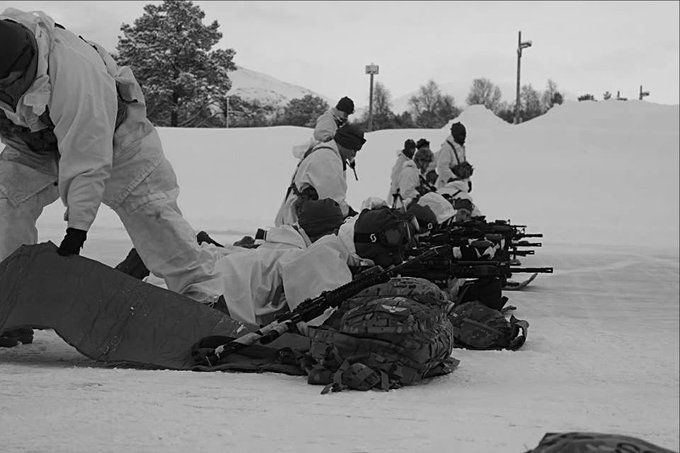
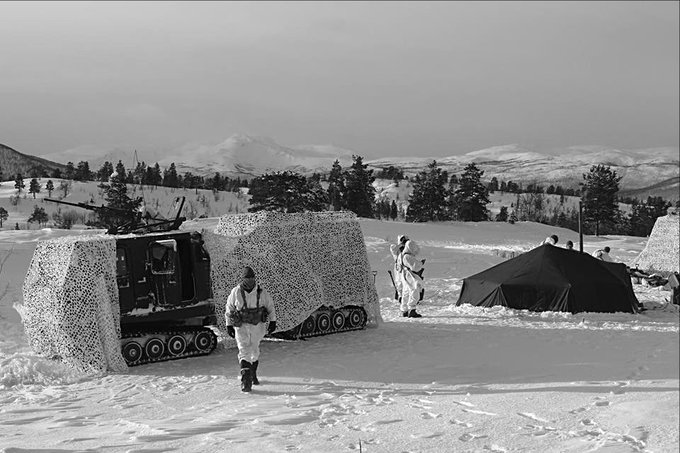
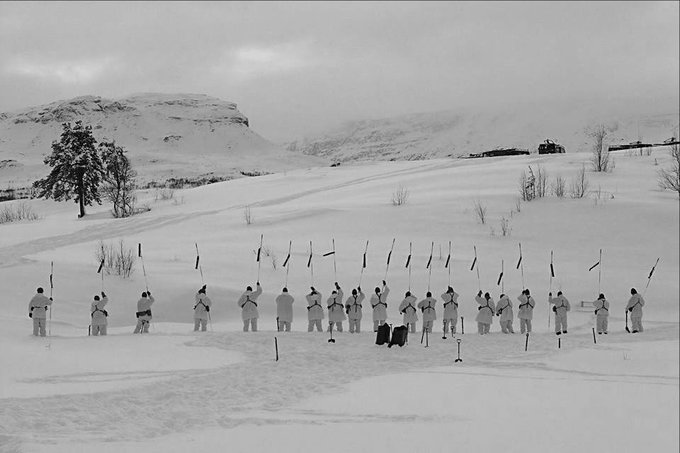
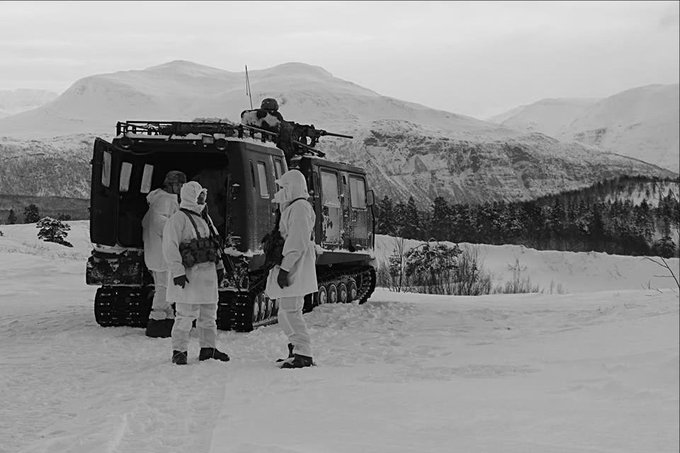
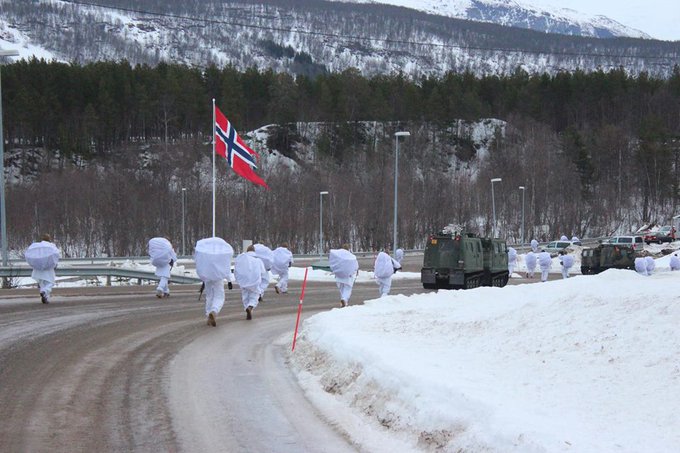
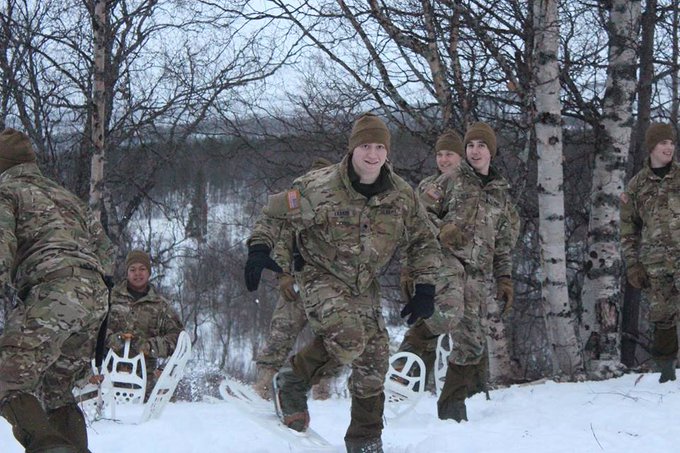
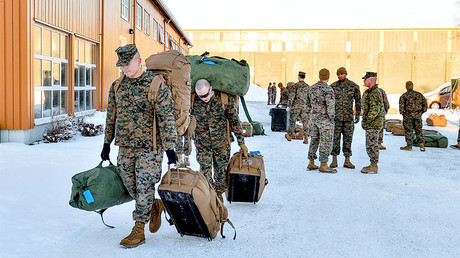
A total of 8,000 NATO soldiers have been deployed to the Finnmark region of northern Norway, 160-300 km from the Russian border, for a series of joint military exercises.

The Joint Viking 2017 exercises, which involve British, American and Norwegian troops, kicked off Monday and are expected to last until March 15. According to the Norwegian Armed Forces website, the exercises’ primary goals are to practice crisis management and the defense of Norway.

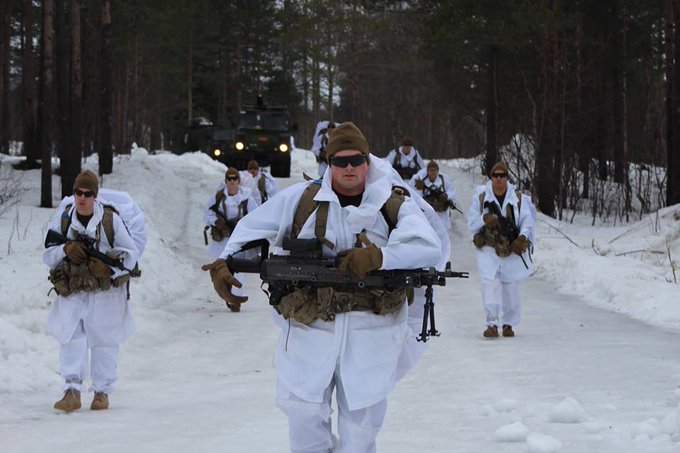
A total of 8,000 troops are taking part, including 700 soldiers from the US Marine Corps, US Army and the British Royal Marines, which have been integrated into Norwegian units. The British and American troops took part in preparatory exercises to acclimatize them to the harsh Norwegian weather.

View image on Twitter

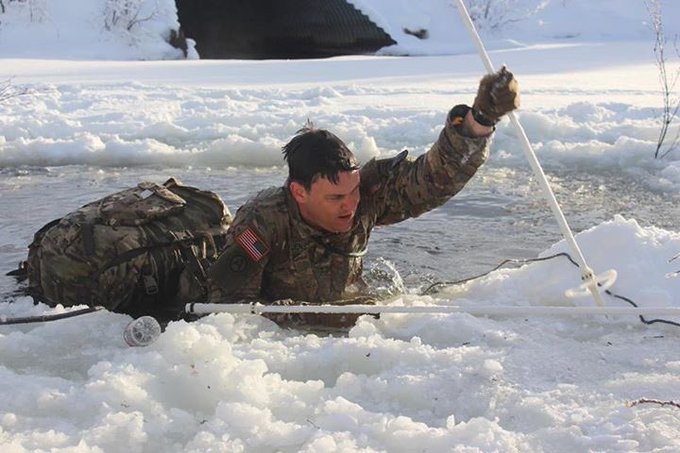
: Cpt. Thomas Huens, B Troop 1-91 CAV Cdr. Leads from the front testing the water in advance of his troopers.

View image on TwitterView image on TwitterView image on TwitterView image on Twitter

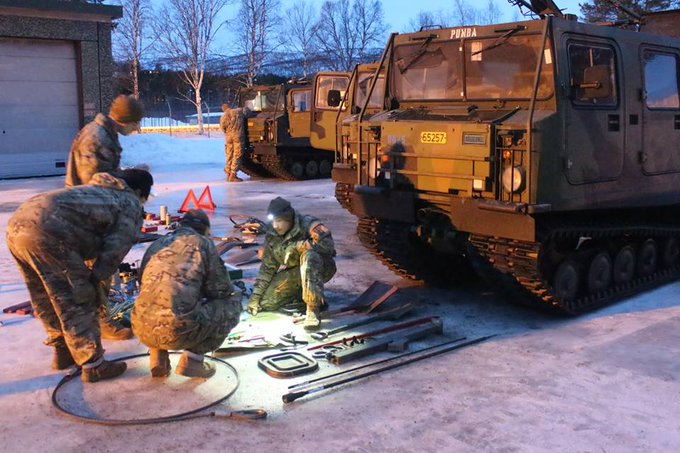
📸 : Soldiers are in Norway conducting Winter Warfare Training in preparation for .

For the duration of the exercise, drones have been banned from local airspace.

“The Armed Forces will have a lot of activity in the air, with fighter jets, helicopters and transport aircraft. To ensure safety in the air, we therefore introduced a drone ban,” military spokesman Ivar Moen told the Norwegian public radio station NRK.

In previous years, Joint Viking exercises have been held in Hordaland in 2013, Tromso in 2014, Finnmark in 2015 and Trøndelag in 2016. The previous exercise in Finnmark was seen as a provocation in Russia, where in response a large-scale exercise was launched in the Kola Peninsula.

This year, however, Moscow was notified of the planned maneuvers in advance, Moen told NRK.

In January, 300 US Marines from Camp Lejeune, North Carolina, were deployed to Norway. Both Norway and the US denied the notion that the deployment was meant to irk Russia as part of NATO’s wider campaign to oppose what it calls “Russian aggression” in Europe, by sending additional troops and weapons closer to the Russian border.

A founding member of NATO, Norway pledged not to host foreign forces to allay Moscow’s concerns that it could serve as a platform for a surprise attack. For decades, the Scandinavian country only allowed in other allies’ troops for training purposes.


Oslo dismissed the notion that the deployment goes against the old commitment, saying that American troops would be rotated rather than stationed permanently. NATO routinely applies the same reasoning to all its deployments in Eastern Europe as a way of circumventing the alliance’s agreement with Russia, which bans permanent deployments of “significant” forces near Russia.

https://www.rt.com/news/379641-8000-nato-exercise-russia-norway/

Protestors storm Kiev Cabinet of Ministers, demand Poroshenko impeachment [VIDEO]

March 6, 2017 – Fort Russ News –
RusVesna – translated by J. Arnoldski –
“Defrauded bank investors” and “civil activists” have stormed Ukraine’s Cabinet of Ministers and called on others to rally to them.
The protestors are demanding the impeachment of Ukrainian President Petro Poroshenko and the resignation of Prime Minister Vladimir Groysman. One of the activists, Yury Kleynos, has announced the beginning of a hunger strike. 
“The police are coming for us, but we are not afraid,” Kleynos said, “Join us. Because of the government’s bestial attitude towards the people, we demand the impeachment of President Poroshenko.”
Some of the protestors have their mouths taped shut and are holding signs with such slogans as “Poroshenko is a killer,” “For a people’s impeachment”, and “Groysman to Israel.” 

‘Ode to Joy,’ followed by chaos and despair

White Helmets promo concert in NY featured “Ode to Joy” by Beethoven, a favorite of Hitler.

Author’s points are well taken except he decries exclusion of Turkey from the EU. Now Erdogan’s government policies are on full display. which actually fits right in with the sordid, aggressive policies of the EU/NATO.

From the NY Times

DEC. 24, 2007

London

LAST week, European Union leaders put an end to a decade of diplomatic wrangling and signed the Treaty of Lisbon, which outlined a complete overhaul of the organization, including the creation of a permanent post of European Union president to represent Europe on the world stage. During the ceremony at Lisbon’s grandiose Jerónimos Monastery, a choir performed Beethoven’s “Ode to Joy” in the background. While the fourth movement of Beethoven’s Ninth Symphony, first performed in 1824, may seem an innocuous choice for the official anthem of the European Union (it was declared such in 1972), it actually tells much more than one would expect about Europe’s predicament today.

The “Ode to Joy” is more than just a universally popular piece of classical music that has become something of a cliché during the holiday season (especially, oddly, in Japan, where it has achieved cult status). It has also been, for more than a century, what literary theorists call an “empty signifier” — a symbol that can stand for anything.

In early 20th-century France, the Nobel laureate Romain Rolland declared it to be the great humanist ode to the brotherhood of all people, and it came to be called “the Marseillaise of humanity.” In 1938, it was performed as the high point of the Reichsmusiktage, the Nazi music festival, and was later used to celebrate Hitler’s birthday. In China during the Cultural Revolution, in an atmosphere of total rejection of European classics, it was redeemed by some as a piece of progressive class struggle.

In the 1950s and ’60s, when the West German and East German Olympic squads were forced to compete as a single team, gold medals were handed out to the strains of the “Ode to Joy” in lieu of a national anthem. It served as the anthem, too, for the Rhodesian white supremacist regime of Ian Smith. One can imagine a fictional performance at which all sworn enemies — Hitler and Stalin, Saddam Hussein and George W. Bush — for a moment forget their adversities and participate in the same magic moment of ecstatic musical brotherhood.

There is, however, a weird imbalance in this piece of music. In the middle of the movement, after we hear the main melody (the “joy” theme) in three orchestral and three vocal variations, something unexpected happens that has bothered critics for the last 180 years: at Bar 331, the tone changes totally, and, instead of the solemn hymnic progression, the same “joy” theme is repeated in the “marcia turca” ( or Turkish march) style, a conceit borrowed from military music for wind and percussion instruments that 18th-century European armies adopted from the Turkish janissaries.

The mode then becomes one of a carnivalesque parade, a mocking spectacle — critics have even compared the sounds of the bassoons and bass drum that accompany the beginning of the marcia turca to flatulence. After this point, such critics feel, everything goes wrong, the simple solemn dignity of the first part of the movement is never recovered.

But what if these critics are only partly correct — what if things do not go wrong only with the entrance of the marcia turca? What if they go wrong from the very beginning? Perhaps one should accept that there is something of an insipid fake in the very “Ode to Joy,” so that the chaos that enters after Bar 331 is a kind of the “return of the repressed,” a symptom of what was errant from the beginning.

If this is the case, we should thus shift the entire perspective and perceive the marcia as a return to normality that cuts short the display of preposterous portentousness of what precedes it — it is the moment the music brings us back to earth, as if saying: “You want to celebrate the brotherhood of men? Here they are, the real humanity …”

And does the same not hold for Europe today? The second stanza of Friedrich Schiller’s poem that is set to the music in “Ode to Joy,” coming on the heels of a chorus that invites the world’s “millions” to “be embraced,” ominously ends: “But he who cannot rejoice, let him steal weeping away.” With this in mind, one recent paradox of the marcia turca is difficult to miss: as Europe makes the final adjustments to its continental solidarity in Lisbon, the Turks, despite their hopes, are outside the embrace.

So, when in the forthcoming days we hear again and again the “Ode to Joy,” it would be appropriate to remember what comes after this triumphant melody. Before succumbing to the warm sentiment of how we are all one big family, I think my fellow Europeans should spare a thought for all those who cannot rejoice with us, all those who are forced to “steal weeping away.” It is, perhaps, the only way we’ll put an end to the rioting and car burnings and other forms of the Turkish march we now see in our very own cities.

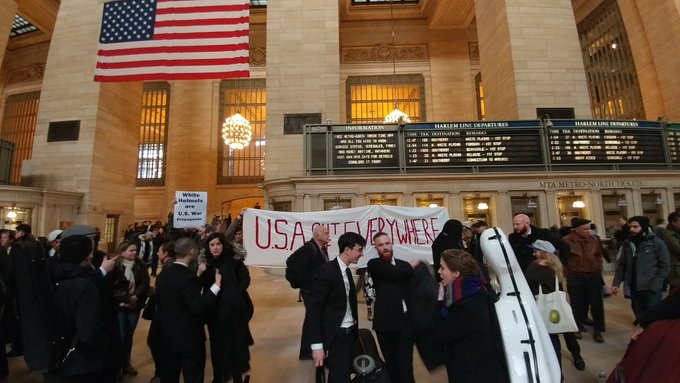
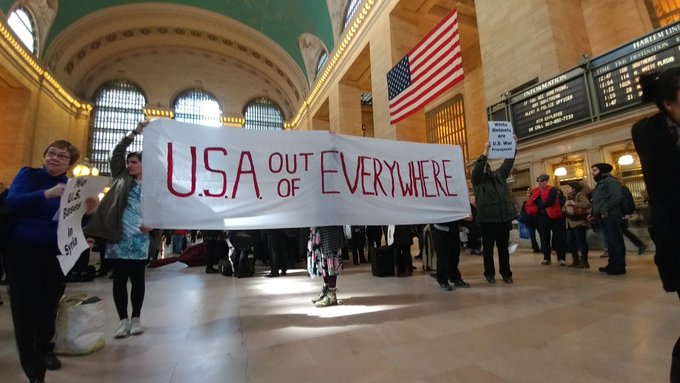
Anti-Syrian-war protest disrupts concert in Grand Central Station dedicated to so-called “White Helmets”(VIDEO)

This demonstrates that U.S. not just refuses to back down in its campaign against Syria, but instead is increasing in a hybrid warfare approach, with examples like Clooney’s film, the Academy Awards, and this concert in NY’s prominent Grand Central Station elevating the White Helmets. That open approach has advantages for peace and pro=Syria activists,  however — venues for educating the public about the situation there and the terrorist actions of the U.S. and its agents.

The U.S. government demonstrates that it is fixed on its course and will not stop until Syria is destroyed, utterly torn apart, and occupied by the West and its coalition partners. The iron fist inside the velvet glove — nothing has changed. Ignore the velvet glove, the smiles, the words of peace, the Hollywood approach; it is a magician’s trick, to distract while Syria is attacked.

From RT

Anti-Syrian-war protest disrupts White Helmets pop-up music tribute (VIDEO)

U.S. to deploy more Delta Force & SEALs for Middle East covert ops – report

From RT

US to deploy more Delta Force & SEALs for Middle East covert ops – report

Top British NATO General wants cyber-attacks to trigger article 5 collective response

From RT

https://www.rt.com/uk/379371-nato-cyber-attack-war/video/

March 3, 2017

NATO’s top European commander wants cyber-attacks to be considered a strong enough reason to trigger the alliance’s Article 5 which contains the principle of collective self-defense.

General Adrian Bradshaw, the Deputy Supreme Allied Commander Europe accused Moscow of cyber and informational attacks, telling the BBC the West needs “a grand strategy” to combat Russian “hybrid warfare.”

Currently, Article 5 declares that an “armed attack” against one or more NATO member states shall be considered an attack against all of them, leading to an appropriate collective response.

For Bradshaw, however, this definition is not broad enough to ensure the effective operation of the Alliance.

The West must respond by using all the tools at its disposal – economic, political, diplomatic as well as military – to deter Russian aggression”, the general reportedly said.

He wants the interpretation of Article 5 to be stretched to include other pretexts for collective self-defense other than an “armed attack”, which is what the wording of the article currently states.

Continue reading

EU not welcome: Serbian Parliament shouts down Mogherini [VIDEO]

From Fort Russ and RT

March 4, 2017 –
By J. Arnoldski –
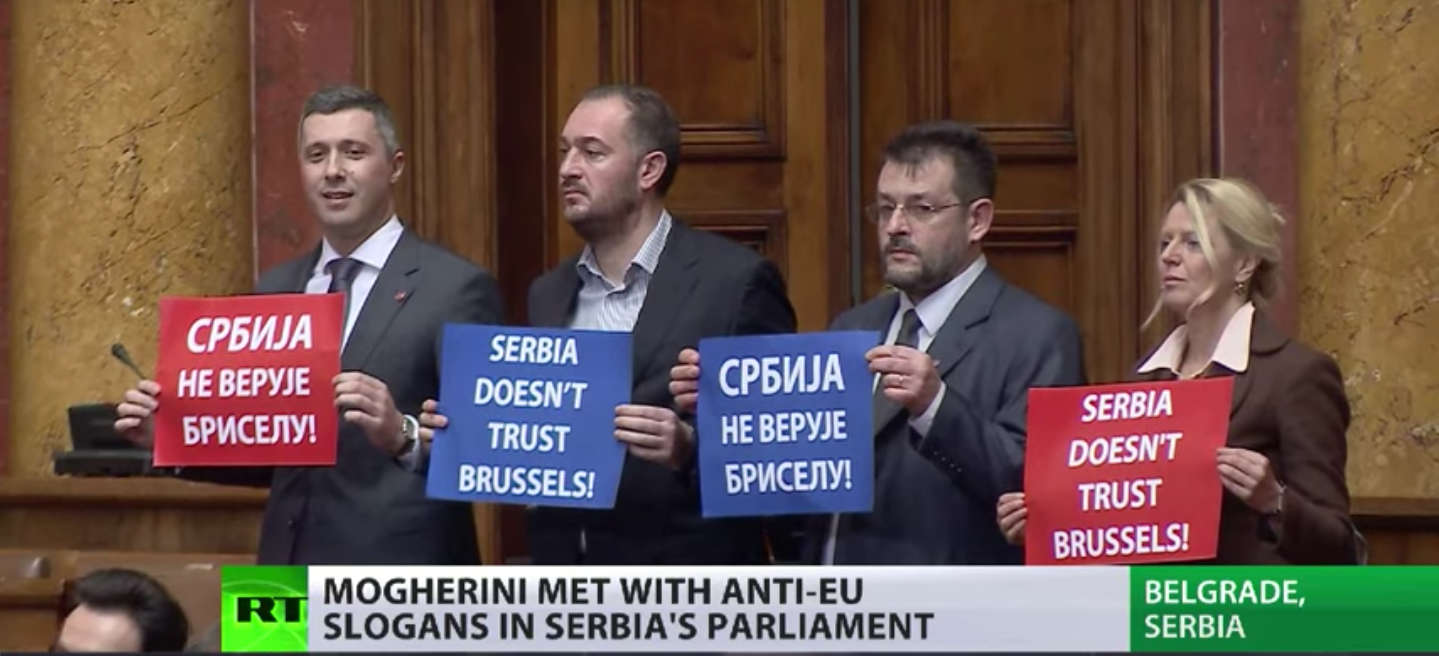
The European Union’s High Representative for Foreign Affairs and Security Policy, Federica Mogherini, was met with a “less than warm welcome” in the Serbian parliament on March 3rd amidst her tour of the Balkans. Chants of “Serbia! Russia! We don’t need the EU” left Mogherini sitting uneasily in her seat.
Political analyst John Bosnitch explained this event to RT as “a door slammed shut in her [Mogherini’s] face.” Calling the protest in the Serbian parliament a “fair bit of resistance”, Bosnitch emphasized, is “an understatement of the first calibre.”
“The message that she was given was: ‘Go away; the people of this region do not want to join the EU…and please don’t try and start a Hitler-style two-front war fighting the English and fighting the Serbs at the same time, because you’ll lose,'” Bosnitch clarified.
When asked by RT why Mogherini was met with such fierce rejection by Serbian representatives, Bosnitch posited that the EU is a “carbon copy” of NATO, the “most powerful, aggressive military force on the earth” that bombed Serbia in 1999 “without any legal grounds” and subsequently partitioned the country.
In Bosnitch’s words, “Hey guys, now that we’ve bombed you, divided you, impoverished you, and demonized you, we’d like to invite you to become a lower member of the EU” is the real translation of Mogherini’s attempt to coax Serbia into the union.
“There is no outlet for the EU in this battle,” Bosnitch says. In his opinion, even if the Serbian people “are dragged into the EU kicking and screaming”, they would contribute to the implosion of Brussels’ union just as much they would while remaining outside of the EU. In this spirit, Bosnitch likened Serbia’s resistance to “European integration” to Brexit.

“If they take Serbia in, they get a trojan horse. If they don’t get Serbia in, they have another force along with the English and Brexit ripping the EU apart,” Bosnitch concluded.

http://www.fort-russ.com/2017/03/eu-not-welcome-serbian-parliament.html

Another U.S. military toxic secret — the poisonous burn pits in Iraq and the role of Dick Cheney’s Kellog, Brown, and Root (KBR)

The VA denies Gulf War Illness and treatable mycoplasma infections which untreated can lead to crippling illness and death as well as being transmissible to spouses and children, denies Fukushima radiation sickness in sailors from the USS Ronald Reagan, denied Agent Orange health effects, denied atomic bomb testing radiation sickness, denies depleted uranium health effects, etc., etc., etc.
…the reality is that soldiers are just a name and a number, and they’re thrown away when the military machine is done with them
Global Research, February 27, 2017
Free Thought Project 19 February 2017
“The Poisoning of American Soldiers” in Iraq — They’re Dying — And the Media is Silent

The legacy of death and misery from the invasions of Iraq and Afghanistan continues today, and, once again, Dick Cheney plays a central role. A new book by Joseph Hickman, a former U.S. Marine and Army sergeant, titled “The Burn Pits: The Poisoning of America’s Soldiers” details how soldiers and local civilian populations were exposed to constant streams of toxic smoke from the burning of waste.

The infamous Kellog, Brown, and Root (KBR), which was a part of Dick Cheney’s corporate empire under Halliburton, operated about 250 burn pits which contributed to the $40 billion that Halliburton made during the Iraq occupation. “Every type of waste imaginable” was burned, including “tires, lithium batteries, asbestos insulation, pesticide containers, Styrofoam, metals, paints, plastic, medical waste and even human corpses.”

dick-cheney-burn-pits

This reprehensible practice proves yet again that nothing is sacred when it comes to the military machine.

Just as the U.S. laid waste to Vietnam’s human health and jungle environment with Agent Orange, it wrecked human health and environmental quality in Iraq. That country will suffer from this toxicity for decades, as evidenced by sharp increases in birth defects and cancer and leukemia rates.

Likewise, U.S. veterans and their families are bearing the brunt of this travesty.

The Burn Pits: The Poisoning of America’s Soldiers” begins with the story of a healthy young soldier sent to Iraq who was constantly exposed to smoke from burn pits. When he returned home with respiratory problems, the Veterans Administration (VA) denied him care, and he later developed brain cancer and died.

Those who do survive are having children with birth defects at a rate three times higher than normal, according to the book. The denial of medical coverage by the VA for burn pit-related illnesses is a central strategy in denying that burn pits even posed a health hazard.

Beau Biden, the son of vice president Joe Biden, died of brain cancer after serving in Iraq in the vicinity of burn pits. Even this tragedy, which is similar to many stories of exposure and death, never brought attention to the issue of burn pits.

Salon interviewed author Joseph Hickman, who provided even more shocking details, and how the Department of Defense (DoD) does all it can to keep this knowledge from the public.

I think the Department of Defense does its best to squash this story and so does Veterans Affairs. They really don’t want this out at all.

Hickman interviewed one former KBR employee who was very reluctant to even talk about burn pits for fear of repercussions, as he was harassed by KBR when he previously came forward about the issue. By using private contractors for such operations, the DoD facilitates these egregious assaults on human and environmental health because contractors are not held to the standards of the military.

This dependency on contractors feeds their tendency for carelessness. According to Hickman, the upper management said at one point, “If they’re going to investigate us over these burn pits, don’t worry about it. If we pull out, they can’t run this base.

The U.S. government, in its effort to conceal the impact of burn pits, even managed to influence a World Health Organization report that downplayed the effects. It stands in stark contrast to several independent researchers who found large increases in birth defects, leukemia, cancer and other carcinogenic diseased in populations living near burn pits.

There’s a large group of epidemiologists that absolutely believe that that report was influenced by the U.S. government. Dr. Mozhgan Savabieasfahani, a widely respected environmental toxicologist, has been there and seen the birth defects and how we literally destroyed that country with pollution. There are birth defects there that don’t even have medical names yet.

The evidence compiled by Hickman and presented in his book makes it downright criminal for the DoD and politicians to continue denying the issue. When veterans suffering from burn-pit illnesses contact their Congressmen, there is silence because they are in bed with the defense industry.

General David Petraeus and other top DoD officials have denied the health effects of burn pits, but veterans have no recourse because they can’t sue the government. There is a lawsuit against KBR, but the DoD will not acknowledge that the burn pits were misused.

While politicians and military brass issue patriotic platitudes about honoring those who serve their country, the reality is that soldiers are just a name and a number, and they’re thrown away when the military machine is done with them. Defense corporations reap billions as veterans and local populations suffer sickness and death.


Carla Stea: In memory of Vitali Churkin, Russia’s charismatic Ambassador to the UN

Global Research, March 03, 2017
28 February 2017
vitaly-churkin

Vitali Churkin succeeded in creating and sustaining a balance in the UN Security Council, a balance between East and West, a multipolar world crucial to global peace and economic justice.

On February 20, 2017 the shattering news reverberated throughout the United Nations, and the world:  the  charismatic and world renowned  Russian Ambassador to the United Nations, Vitali Churkin, was suddenly stricken in his office at the Russian Mission and pronounced dead upon arrival at Columbia Presbyterian Hospital. 

The New York City Medical Examiner failed to discover the cause of Ambassador Churkin’s sudden death, stating that the autopsy is inconclusive and ‘determining the cause and manner of his death requires further study, which could require weeks of further screenings.’  For ten years Churkin had illuminated the corridors of the United Nations, and  a surrealistic atmosphere of disbelief and incredulity now permeates the United Nations, as unanswered questions regarding Ambassador Churkin’s death increase.

Vitali Churkin’s colossal intellectual power prevailed over the crass propaganda and hypocrisy of his detractors at the UN Security Council.  In so doing, he restored the credibility of the UN Security Council, and restored the dignity and independence of the United Nations.  His moral force and courage, even in isolation,  towered above his detractors at the Security Council, and within the General Assembly.

His prodigious knowledge of the historic context and realities being distorted by his opponents was a formidable obstacle to their chronic attempts to hijack and deform both the Security Council, and the UN itself, into becoming a tool for geopolitical engineering antithetical to the very purposes for which the UN was established.

Following the first Persian Gulf War, authorized by Security Council Resolution 678, the United Nations had become regarded as an annex of the US State Department and the Pentagon.  Security Council Resolution 1973 reinforced that impression, and, indeed, when Lakhdar Brahimi, formerly Foreign Minister of Algeria and top United Nations envoy, was asked why UN offices were so often  bombed, he replied that the UN was becoming perceived as a “party to disputes.”

Churkin’s arrival at the UN, and the re-emergence of Russia as a world power, with the Presidency of Vladimir Putin, re-established the United Nations as a multipolar organization, and with the six vetoes cast by Vitali Churkin, the United Nations was prevented from further debasement, as those vetoes prohibited the UN endorsement of the barbaric slaughter of yet another country in the Middle East.  Vitali Churkin commanded the respect of even those attempting to discredit him, and he was admired by even those who hated him for his capacity to expose their duplicity.

More than 25 years ago I first met Vitali Churkin at his office in the Soviet Foreign Ministry in Moscow.  I had been invited to Russia by Vladimir Petrovsky, First Deputy Foreign Minister of the Soviet Union, and  I had been referred to Churkin by the International Editor of a major Soviet newspaper, who advised me that Mr. Churkin could solve an urgent problem I was confronting.

On the morning of December 21, 1991, Vitali Churkin immediately welcomed me to his office, assured me that he would take care of my problem – which he did with alacrity, and we then spoke for hours about subjects ranging from capitalism versus communism, my previous work in Santiago, Chile during the dictatorship of Augusto Pinochet, the consequences of the imminent dismembering of the Soviet Union, his close friendship with Boris D. Pyadyshev, the distinguished editor of the prestigious journal,  “Mezhdunarodnaya Zhizn,” and we discussed other subjects too numerous to mention.  Churkin’s presence was electrifying, his intellect dazzling, his warmth disarming and engaging, and he impressed me as a man who did not suffer fools gladly. We shared contempt for hypocrisy and double standards.  His personality could be described with two words:  formidable and unique.   But he was completely unpretentious, and retained that magnetic human warmth which charmed even the most dour opponents.

Two days after I first met Churkin,  Mikhail Gorbachev, Soviet President and General -Secretary of the Communist Party resigned, the Soviet Union collapsed, and an abyss opened, the catastrophic consequences of which would unfold throughout the ensuing decades.  But that freezing Moscow winter, with his world – (and ours, ultimately) disintegrating around him, Churkin’s steely discipline and good will guided the foreign press through the devastated terrain of the dying Soviet empire, as we instinctively shuddered at what was to come.

On January 31, 1992 we returned to the United Nations for the summit meeting of US President George H.W. Bush and Russian President Boris Yeltsin, held at Conference room 4 of the UN.  Prior to the meeting, he and I discussed my plans to return to Moscow, and following the boilerplate speeches of both the American and Russian Presidents, as they exited the chamber, with Churkin a member of that solemn entourage, he winked at me as they departed, a gesture revealing both his great sense of fun, and his utter disdain for stultifying bureaucratic restraint.

In the early weeks of February, 1992, I awaited the visa for my return to Moscow, which Alex, a Russian  foreign ministry official had promised to arrange.  After weeks sped by, without my Russian visa arriving at the Russian Consulate in Washington, I phoned Mr. Churkin in Moscow.  He immediately took my call, and I explained that Alex had not arranged for my return visa, as he had promised to do.  Mr. Churkin replied:  “I’m sure he will do as he promised, but I’ll look into it.” The following morning I received a telephone call from the Russian Consulate informing me that they had just received two visas for me!  That was typical of Churkin’s style:  he was extraordinarily effective, and totally sincere.

Following my return to Moscow in late February, 1992, Churkin informed me that he had been appointed Ambassador to Chile, which he regarded as a form of exile.  Andrei Kozyrev was now Foreign Minister.  Life in Moscow was becoming chaotic, and denial no longer shielded me from the reality of the collapse of the Soviet Union.  The deterioration of conditions of life following that collapse was inevitable and demoralizing, and, of course, only the beginning of what would become catastrophic.  Russia had been my sanctuary, following my exposure to fascism, in Chile, and, to certain elements of it in the USA, but that sanctuary in Moscow no longer existed.

On April 7, 1992, I wrote a long letter to Churkin to say good bye, and apologizing for having cut short my visit.  On April 8 we met again, at length, and Churkin tried to convince me to remain in Moscow.   That afternoon he spoke with sorrow  of the collapse of the socialist government of President Najibullah in Afghanistan, and I shared his grief, and perhaps we both, subliminally, at least, expected the disastrous consequences which ensued from the destruction of that last civilized and Soviet supported government in Afghanistan.  Churkin told me that he had just returned from Tbilisi, Georgia, where he had been meeting with Edouard Shevardnadze.  The conversation continued, and he offered to help me with my work.  Churkin ultimately succeeded in persuading me to stay in Moscow.

But, eventually, flashbacks and horrific memories of my experiences in Pinochet’s Chile, and elsewhere, and fear of the dire long-term consequences of the Soviet collapse continued troubling me, and in June  I finally left Russia, which, bitterly ruptured my friendship with Churkin.

Fifteen years later, unexpectedly,  I met Vitali Churkin again at the United Nations.   Miraculously, our friendship survived the preceding years of turmoil.  At times, we had argued ferociously, at times, incessantly.  But what we shared was indestructible.

Russia was being resuscitated as a world power, and Churkin was beginning his mastery of the United Nations environment.  On July  13, 2009, Churkin graciously invited me to participate in a roundtable celebration of the 100 year anniversary of the birth of Andrei  Gromyko, one of the founding fathers of the United Nations.  The meeting was held in Conference Room 8.

Participants included Henry Kissinger, Anatoly Gromyko, Ambassador William VandenHeuvel, Veronika Krasheninnikova and Alfred Ross.  When the translator failed to appear, Churkin blithely announced we would move to plan B, and speak in English, a language he commanded impeccably.  Gromyko’s son, Anatoly, summarized the history of Soviet diplomacy, and comments were requested of Ms. Krasheninnikova, one of Russia’s expert advisers who helped author the law requiring disclosure of the identity of funders of the many foreign organizations in Russia, a law she had observed in the USA, and which helped to protect Russia from pernicious and destabilizing “color revolutions.”  Ms. Krashenninikova then courteously invited Ambassador VandenHeuvel to contribute to the discussion.  Throughout that unforgettable morning, Vitaly Churkin glowed with pride at the splendid legacy of great Soviet diplomats who had helped to champion the cause of peace, economic justice, and a world based on humanitarian principles, above all.   That Gromyko roundtable seemed to be one of Churkin’s most joyous presentations.

Later, at a Vietnamese reception, to which I realized I was the only journalist invited, Ambassador Churkin came over to me and said:  “Carla, you were right all along.”  I was so astounded by his words I was unable to reply and ask him to specify about what, precisely, I had been “right all along,” and I’ll always regret that lost opportunity.

But Vitali Churkin attained his greatness of stature, that for which he will be remembered by the United Nations, and honored by history, following the UN Security Council’s ill advised and  reckless adoption of Resolution 1973, in 2011, authorizing, by “all necessary measures,” the barbarous NATO slaughter of Libya, one of the Arab world’s most progressive nations, an attack which pulverized that previously functioning state, and transformed it into an incubator of terrorism.  Thereafter, Churkin, indefatigably represented Russia’s categorical opposition to a UN sponsored attack on Syria, which would, otherwise, have been the third progressive Arab country destroyed  with collusion by the UN, and could, very likely, precipitate a World War.  Churkin was a great diplomat, but in his latter years at the UN, he emerged as a great statesman, transcending the technical limits of his position, at the zenith of his power.

Vitaly Churkin spearheaded the three famous “double vetoes” of Chapter VII draft resolutions which the dogs of war were attempting to force upon the UN.  And in this he was immeasurably strengthened by his friend and comrade, Li Baodong, China’s brilliant and noble Vice-Minister of Foreign Affairs, and formerly Ambassador to the UN.  Both Vitali Churkin and Li Baodong were intellectual aristocrats of the highest order.  When, together, they raised their arms to veto the draft war resolutions at the Security Council, spectators at the UN and worldwide gasped in awe at the enormity of their power to command peace and to halt in their lethal tracks the insane march of the merchants of death toward Armageddon. Again and again and again Churkin and Li Baodong cast double vetoes, repelling and defeating ravenous attempts to inflict on Syria the barbaric slaughter that had already been inflicted on Iraq and Libya.  Those moments were spellbinding.  Their triumphant double-vetoes were a legendary victory for peace and justice and a turning point in UN history, which laid the foundation for a progressive transformation of the global order.

Following Li Baodong’s transfer to Beijing, Churkin alone at the United Nations shouldered the huge burden of staving off  savage attacks on Syria, continuing to veto those draft resolutions that would have led, ominously and treacherously to ”regime change.”  As TASS so accurately described him, posthumously, “Churkin was like a rock against which were broken the attempts by our enemies to undermine what constitutes the glory of Russia.”  But he represented much more than that:  he was like a rock against which were broken the aggressive actions of neo-colonialists who attempted to mask their ruthless greed with sanctimonious and arrogant contrivances.  He exposed this prevarication.  But his was a Russian heroism – an unbreakable moral force reminiscent of Kutuzov at Borodino.

The deadly resurgence of Russophobia, a form of neo-McCarthyist fascism in America, a cancer infecting the Security Council and even the General Assembly reached ominous proportions recently, and an atmosphere targeting Russia as “fair game,” an atmosphere resembling the blood lust that precedes a lynching, and described by Chinese Ambassador Liu as “poisonous,” preceded the sixth and last veto cast by Ambassador Churkin.  China also cast a veto against this recent draft resolution,  with the Security Council again experiencing the titanic force of another double veto.  The date was December 5, 2016.  The Syrian Government had just recovered Aleppo.  Soon thereafter, the Russian Ambassador to Turkey was assassinated, followed by the death of the Russian Ambassador to India.

On February 21,  a Security Council meeting opened, commemorating the life and work of Ambassador Churkin.  One of the most moving and beautiful – and revealing – speeches was delivered by  Japanese Ambassador Koro Bessho who stated:  “I was deeply shocked and saddened by the news of the passing of Ambassador Vitaly Churkin.  I happened to meet him on Sunday (yesterday) at lunchtime, coincidentally, we were seated next to each other at a restaurant.  He was with his wife, I was with my wife, and we were all very happy at the time.  In fact, he had arrived a bit after I did, so I did not realize that he was there.  I suddenly heard a voice saying, ‘Koro, what do you recommend?’  I looked back and there was Vitaly, looking happy, looking very well and with his usual big smile.” According to Ambassador Bessho, he was ebullient, and evidently took a walk with his wife in the park afterward.  Within less than 24 hours Churkin was dead in his own office.  Three Russian Ambassadors have died in the line of duty within the past three months.

Like a great impresario, Vitali Churkin succeeded in creating and sustaining a balance in the UN Security Council, a balance between East and West, a multipolar world crucial to global peace and economic justice.  Churkin’s death destroys this balance, and leaves the Security Council, and the United Nations vulnerable to the manipulation and control by those member states and interests he succeeded in commanding and so skillfully held at bay.  Seldom is one person so indispensable.  But Vitali Churkin was such a person.  His star blazed brilliantly, but too briefly.