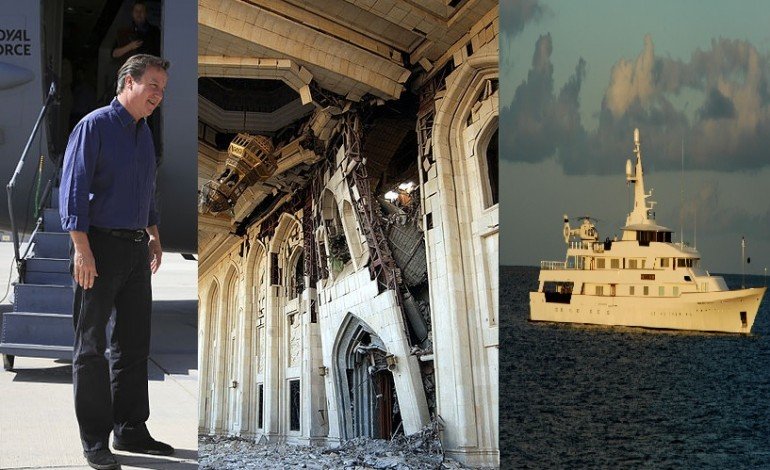
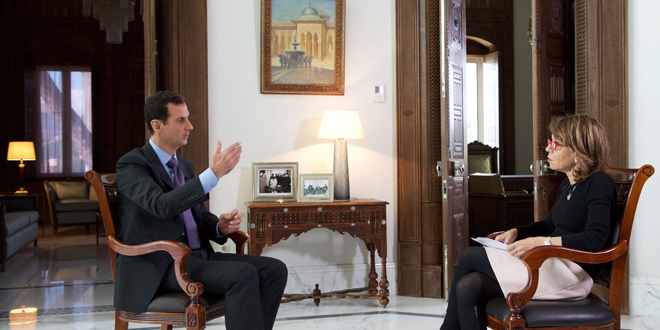
Damascus – President Bashar al-Assad gave an interview to The Sunday Times in which he said Britain and France have neither the will nor the vision on how to defeat terrorism and their airstrikes against ISIS will yield no results, but will rather be illegal and harmful in that they will help in spreading terrorism.
The following is the full text of the interview:
Question 1: Thank you for seeing us Mr President. As you know, the British government today will be voting on whether it will join the coalition airstrikes against ISIS. Is Britain right to join airstrikes against ISIS in Syria? And do you welcome its involvement; and will it make things worse or not make a change?
President Assad: If I want to let’s say, evaluate a book, I cannot take or single out a phrase from that book to evaluate the whole book. I have to look at the headlines, then the titles of the chapters and then we can discuss the rest of the book. So, what we are talking about is only an isolated phrase. If we want to go back to the headline, it is “the will to fight terrorism.” We know from the very beginning that Britain and France were the spearheads in supporting the terrorists in Syria, from the very beginning of the conflict. We know that they don’t have that will, even if we want to go back to the chapter on military participation with the coalition, it has to be comprehensive, it has to be from the air, from the ground, to have cooperation with the troops on the ground, the national troops for the interference or participation to be legal. It is legal only when the participation is in cooperation with the legitimate government in Syria. So, I would say they don’t have the will and they don’t have the vision on how to defeat terrorism.
And if you want to evaluate, let’s evaluate from the facts. Let’s go back to the reality on the ground. Since that coalition started its operation a year or so, what was the result? ISIS and al-Nusra and other like-minded organizations or groups, were expanding, expanding freely. What was the situation after the Russians participated in fighting terrorism directly? ISIS and al-Nusra started shrinking. So I would say, first they will not give any results. Second, it will be harmful and illegal, and it will support terrorism as what happened after the coalition started its operation a year or so, because this is like a cancer. You cannot cut the cancer. You have to extract it. This kind of operation is like cutting the cancer that will make it spread in the body faster.
Question 2: Are you saying, just to clarify two things, are you saying that the British, if the British join the intervention, that includes also the other coalition, with that intervention you see that is illegitimate from an international-law perspective?
President Assad: Definitely, definitely, we are a sovereign country. Look at the Russians, when they wanted to make this alliance against terrorism, the first thing they did was they started discussions with the Syrian government before anyone else. Then they started discussing the same issue with other governments. Then they came. So, this is the legal way to combat any terrorist around the world.
Britain and France helped in the rise of ISIS and al-Nusra in this region
Question 3: You say that France and Britain are responsible for the rise of terrorism here. But they were not responsible for the rise of ISIS, for example, is not that a little bit a harsh accusation?
President Assad: Let’s start from what Blair said. He said that invading Iraq led to the rise of ISIS. And we know that ISIS started publically, announcing itself as a state in Iraq in 2006, and the leader was Abu Mosaab al-Zerqawi. He was killed by American strikes; and they announced that they killed him. So, they know he existed and they know that IS in Iraq at that time had existed; and that it moved to Syria after the beginning of conflict in Syria because of the chaos that happened. So, they confess. British officials confessed, mainly Blair; and the reality is telling, that they helped in the rise of ISIS and al-Nusra in this region.

Question 4: In your view, does al-Qaida’s branch in Syria, Jabhat al-Nusra, pose an equal or a greater long-term threat to the West than ISIS? And as such, is Britain’s Prime Minister, Cameron, going after the wrong enemy? I.e. he is going after ISIS instead of going after al-Nusra.
President Assad: The whole question is about the structure, and the problem is not about the structure of the organization. It is about their ideology. They do not base their actions on the structure, they base them on their dark, Wahhabi deviated ideology. So, if we want to evaluate these two, the difference between the two, there is no difference because they have the same ideology. This is one aspect. The other aspect, if we want to talk about their grassroots, their followers, their members, you cannot have this distinction, because they move from one organization or one group to another. And that is why sometimes they fight with each other, for their vested interests, on a local and small scale. But in reality they are cooperating with each other on every level. So, you cannot tell which is more dangerous because this is one mentality. It is like if you say the first one is al-Qaida and the second one is al-Qaida. The difference is the label, and maybe some other trivial things.
Question 5: Last week, a key part of Cameron’s argument for extending UK airstrikes to Syria was a number that he used – 70 thousand moderate rebels – that he mentioned “don’t belong to extremist groups”, but are already on the ground, who the west can use to help them in the fight of ISIS. As far as you know, which groups are included in the 70 thousand? Are you aware of 70 thousand moderate rebels in Syria?
President Assad: Let me be frank and blunt about this. This is a new episode in a long series of David Cameron’s classical farce, to be very frank. This is not acceptable. Where are they? Where are the 70 thousand moderates that he is talking about? That is what they always talk about: moderate groups in Syria. This is a farce based on offering the public factoids instead of facts.
The Russians have been asking, since the beginning of their participation two months ago. They have said: where are those moderates? No one gave them an answer. Actually, since the beginning of the conflict in Syria, there were no moderate militants in Syria. All of them were extremists. And in order not to say I am just giving excuses and so on, go back to the internet, go back to the social networking sites. They uploaded their atrocities’ videos and pictures, with their faces and their rhetoric. They use swords, they do beheadings; they ate the heart of a dismembered innocent person and so on.
And you know, the confession of a criminal is the incontrovertible fact. So, those are the 70 thousand moderates he is taking about. It is like if we describe the terrorists who committed the attack in Paris recently, and before that in Charlie Hebdo, and before that in the UK nearly ten years ago, and in Spain before that, and the 11th of September in New York, to describe them as moderate opposition. That is not accepted anywhere in this world; and there is no 70 thousand, there is no 7 thousand, he does not have, maybe now ten of those.
Question 6: Not even the Kurds and the FSA for example, the free Syrian army?
President Assad: The Kurds are fighting the terrorists with the Syrian army, in the same areas.
Question 7: But they are also being supported and armed and trained and backed by the Americans to also launch, to fight …
President Assad: Mainly by the Syrian army, and we have the documents. We sent them armaments, because they are Syrian citizens, and they want to fight terrorism. We do the same with many other groups in Syria, because you cannot send the army to every part of Syria. So, it is not only the Kurds. Many other Syrians are doing the same.
Question 8: U.S. Secretary of state John Kerry said last Friday that the Syrian government could cooperate with the opposition forces against the ISIS even if president Assad is still in office, but he said that this would be so difficult if the opposition fighters, who have been fighting the Syrian president, don’t have a faith that the Syrian president will eventually leave power.
Kerry also said that concerning the timing of leaving office, the answer is it is not obvious whether he will have to leave.
Meanwhile, the French Foreign Minister Laurent Fabius told Le Progres Newspaper on Saturday that he no longer believes that President Assad’s departure is essential to any political transition in Syria, adding that the political transition does not mean that President Assad should step down before it but there should be future insurances.
My question: Do you intend to complete your presidential term until 2021 or do you expect a referendum or presidential elections prior to that date? And if so, when can these elections be held? And what can make you decide to hold them? And if they are held, is it certain that you will be running for election? What can influence your decision?
President Assad: The answer depends on the context of the question. If it is related to a settlement in Syria, then early elections have nothing to do with ending the conflict. This can only happen by fighting terrorists and ceasing Western and regional support for terrorists…Early elections will only be held as part of a comprehensive dialogue about future by the political powers and the civil society groups in Syria.
Thus, it is not about the will of the President, but rather the will of the Syrian people…It is about a political process. If this process is agreed on, then I have the right to run for elections like any other Syrian citizen…My decision in this case will be based on my ability to deliver on my commitments…and on whether I have the support of the Syrian people or not….Anyway, It is early to talk about this, because as you know, this process was not agreed upon yet.

Question 9: Do you think ISIS can be defeated by airstrikes alone?
You cannot defeat ISIS through airstrikes alone without cooperation with forces on the ground
President Assad: Did the coalition defeat them by airstrikes during the last year or so? It didn’t. Did the Americans achieve anything from the airstrikes in Afghanistan? They achieved nothing. Did they achieve anything in Iraq since the invasion in 2003? Nothing. You cannot defeat ISIS through airstrikes alone, without cooperation with forces on the ground. You cannot defeat them if you do not have buy-in from the general public and the government. They cannot defeat ISIS by airstrikes; they are going to fail again. The reality is telling.
Question 10: If the international coalition refuses, as it has so far, to coordinate with the Syrian Army, or with the local troops on the ground, what is your next plan? I mean do you have a plan B beyond what is going on? How do you plan to end this war?
President Assad: This coalition is illusive, it’s virtual, because it has not made any achievements in fighting terrorism on the ground in Syria. Since an illusion doesn’t exist, let’s not waste time with the ‘before and after.’ From the very beginning we started fighting terrorism irrespective of any global or world powers. Whoever wants to join us is welcome, and whether they join us or not, we are going to continue. This is our plan. It is the only plan we have and we will not change it.
Question 11: Are you calling on them to ask the Syrian government to coordinate and cooperate with the Syrian army and the Syrian air force in the fight against terrorists?
President Assad: We are very realistic. We know that they are not going to do so and that they don’t have the will. This is more about international law than anything else. Is it possible that western governments, or regimes, don’t know the basics of international law, that they don’t understand the meaning of a sovereign state or that they haven’t read the UN Charter? They have no respect for international law and we didn’t ask for their cooperation.
Question 12: But would you like them to?
President Assad: If they are ready – serious and genuine – to fight terrorism, we welcome any country or government, any political effort. In that regard we are not radical, we are pragmatic. Ultimately, we want to resolve the situation in Syria and prevent further bloodshed. That is our mission. So, it’s not about love or hate, accepting or not, it is about reality. Are they truly ready to help us fight terrorism, to stop terrorists coming into Syria through their surrogate governments in our region, or not? That is the real question. If they are ready, we will welcome them. This is not personal.
Question 13: Do you think it is possible for you, in Syria, and for your allies – Russia, Iran, Hezbollah and other allies – to defeat ISIS militarily; and if so, how long do you think it might take?
President Assad: The answer is based on two factors: our capabilities on the one hand, and the support the terrorists receive on the other. From our perspective, if you were to remove the support these groups get from various countries in our region and the West in general, it will take a matter of months to achieve our mission. It is not very complicated, the solution is very clear to us. However, these groups have unlimited support from these countries, which makes the situation drag on, makes it more complicated and harder to resolve. This means our mission will be achieved at a much higher price, which will ultimately be paid by Syrians.
Question 14: But there has already been a high price: over 200,000 people have been killed.
President Assad: You are right, and that is a consequence of the support I referred to.
Question 15: But a lot of it is also blamed on the Syrian government and the Syrian use of force, sometimes indiscriminate or unnecessary force in certain areas that has brought about a large number of people killed. How do you respond to that?
President Assad: First, all wars are bad. There is no such thing as a good war. In every war there are always too many innocent casualties. These are only avoidable by bringing that war to an end. So it is self-evident that wars anywhere in the world will result in loss of life. But the rhetoric that has been repeated in the West for a long time ignores the fact that from day one terrorists were killing innocent people, it also ignores that fact that many of the people killed were supporters of the government and not vice versa. As a government, our only countermeasure against terrorists is to fight them. There is no other choice. We cannot stop fighting the terrorists who kill civilians for fear of being accused by the West of using force.
Question 16: Let us talk about the role of Russia. How important has the role of Russia been? Was Syria about to fall had Russia not intervened when it did at the time?
Russia and Iran’s support played important part in Syria’s steadfastness against terrorism
President Assad: The Russian role is very important. It has had a significant impact on both the military and political arena in Syria. But to say that without this role, the government or the state would have collapsed, is hypothetical. Since the very beginning of the conflict in Syria, there were bets on the collapse of the government. First it was a few weeks, then it was a few months and then a few years. Every time it was the same wishful thinking. What is definite is that the Russian support to the Syrian people and government from the very beginning, along with the strong and staunch support of Iran, has played a very important part in the steadfastness of the Syrian state in the fight against terrorism.
Question 17: You mean the previous one, or the recent military intervention?
President Assad: No, the whole support; it is not only about their participation. Their support from the very beginning in all aspects: political, military and economic.
Question 18: How and why did Russian involvement come about now? And can you give us some details of the discussions between you and President Putin that brought it about? Who took the first step? Did you ask, or did they offer?
The Russians want to protect Syria, Iraq, the region, themselves and even Europe
President Assad: You will have to ask the Russians why they got involved. But from our perspective, since the Western coalition started in Syria, ISIS has expanded, al-Nusra has expanded and every other extremist and terrorist group has expanded and captured new territory in Syria and Iraq. The Russians clearly saw how this posed a threat to Syria, Iraq and the region in general, as well as to Russia and the rest of the world. We can see this as a reality in Europe today. If you read and analyse what happened in Paris recently and at Charlie Hebdo, rather than view them as separate incidences, you will realize something very important. How many extremists cells now exist in Europe? How many extremists did you export from Europe to Syria? This is where the danger lies. The danger is in the incubator. The Russians can see this very clearly. They want to protect Syria, Iraq, the region, themselves and even Europe. I am not exaggerating by saying they are protecting Europe today.
Question 19: So, did they come to you and say we would like to be involved? Or did you ask them: could you help us?
President Assad: It was an accumulative decision; it didn’t happen by me having this idea or them having another. As you know, our relationship with the Russians goes back more than five decades, and they have always had military staff in Syria: call them experts or by any other name. This cooperation accelerated and increased during the crisis. Their teams are here and can see the situation real-time with us. This kind of decision doesn’t start from the top down, but rather from the bottom up. There is a daily political and military discussion between our two countries. When it reached a presidential level, it was mature enough and ready for the decision to be made quickly.
Question 20: But there must have been a point when they said: we think, or with your agreement, we think that we should actually now physically get involved.
President Assad: Again, this was started at the lower levels. These officials jointly agreed that it was necessary to get involved and each party discussed it with their leaders. When it reached the stage of discussion between us, I mean between President Putin and I, we focused our discussions on the how. Of course this did not happen directly as we had not yet met and it’s impossible to discuss these issues on the phone. It was mediated through senior officials from both sides. That is what happened. In terms of procedure, I sent a letter to President Putin which included an invitation for their forces to participate.
Question 21: So you asked president Putin having been advised by your officials.
President Assad: Exactly, after we reached that point I sent President Putin a formal letter and we released a statement announcing that we had invited them to join our efforts. Let’s not forget that President Putin had already taken the step when he said he was willing to create a coalition. My response to this was that we are ready if you want to bring your forces to participate.
Question 22: So, what forces have been deployed? I am talking about Russian forces. There have been reports, for example, of a thousand ground troops plus Special Forces, is this correct? Is there anytime when you think that the Russians will be involved in Syria, not just by air but with ground troops as well?
President Assad: No, so far there is no such thing. There are no ground troops except for the personnel that they send with their military staff and airplanes to guard the airbase, and that is natural. They don’t have any ground troops fighting with Syrian forces at all.
Question 23: And there is no plan for that?
President Assad: We have not discussed that yet, and I don’t think we need it now, because things are moving in the right direction. The Russians may consider it with time or under different circumstances, but for the moment, this has not been discussed.
Question 24: There was a report, or a hint, that Syria might be receiving S-300 from the Russians, and the S-300 will allow Syria to protect its airspace. Is this something, for example, that Syria will use against the US-led coalition’s air force, even if Britain was involved, since their warplanes are in Syrian skies, as you said earlier, without official or sovereign permission. As Syria will receive S-300, then will it use this to impose, if you want, protection of its skies and impose a way to tell the coalition that you have to actually directly deal with us, or coordinate with us on the ground?
We will use any means available to us to protect our airspace
President Assad: That is our right and it is only to be expected that we prevent any airplane from violating our airspace. That is completely legal. We are going to use any means available to us to protect our airspace. It is not about that armament in particular. Any air defense we have is for that reason.
Question 25: Do you have that defense at the moment?
President Assad: No. So far we don’t have it.
Question 26: If you get that defense?
President Assad: Any defense systems we are going to have are for that purpose. If we are not going to protect our airspace, then why buy such armaments in the first place? That is self-evident.
Question 27: And if you get it …
President Assad: Not at the moment; it is not our priority now. Our priority is fighting the terrorists on the ground. This is the most important danger now. Of course we are keen to protect our airspace and prevent foreign interference in our internal affairs, militarily or other. But the priority now is to defeat the terrorists. By defeating the terrorists, some of whom are Syrians, we can move further in protecting the whole country from foreigners. It is a matter of priorities.
Question 28: But I meant about the actual coalition airplanes that are actually flying over Syria. So, that is not a priority either at the moment?
President Assad: No, not at the moment. At the moment the priority is fighting terrorism.
Question 29: If Saudi Arabia were to invite you for serious discussions on the future of Syria, would you accept such an invitation? Or have relations between Syria and Saudi Arabia been severely severed that you would never consider that?
President Assad: No, there is nothing impossible in politics. It is not about whether I accept or not, but rather about the policies of each government. What are their policies towards Syria? Are they going to keep supporting the terrorists or not? Are they going to continue playing their dangerous games in Syria, Yemen and other places? If they are ready and willing to change their policies, especially with regard to Syria, we don’t have a problem meeting with them. So it is not about the meeting or whether we go or not, the issue is their approach to what is happening in Syria.
Question 30: Do you expect any results from the talks in Vienna? And what would be the shape of any possible deal that you see coming out of Vienna?
President Assad: The most important clause in the Vienna communique is that the Syrians should come together to discuss the future of Syria. Everything else is an accessory. If you don’t have that main part, the accessories are of no use. So, the only solution is for us to come together as Syrians. Vienna itself is a meeting to announce intentions; it is not the actual process of siting down and discussing the future. So, the question is not what results from Vienna, but rather what we Syrians are able to achieve when we sit down together.
Question 31: But do you realize that some of the opposition’s leaders, and I’m talking about opposition figures who have been against taking up arms and what have you, but are also afraid of coming to Syria, because the moment they land in Syria, they will be arrested by the security officers and put in prison. And it has happened to others.
President Assad: No, it has never happened. There is an opposition in Syria, and they are free to do whatever they want.
Question 32: No, I mean the external opposition. For example, somebody like Haitham Mannaa, cannot come back.
President Assad: We have clearly stated that when there is a gathering in Syria, which they want to attend, we guarantee that they will not be arrested or held. We have said this many times. We don’t have any problems in this regard.

Question 33: Now, Saudi Arabia invited 65 figures, including opposition leaders, even rebel commanders, businessmen, religious figures for a meeting in Saudi Arabia to present a united front in preparation for the January Vienna talks. Yet, the Syrian government, which is the other major element in this whole thing for the future of Syria, has not been seen to be involved with the opposition. Are you conducting any talks with the opposition? Have you reached any consensus with them?
President Assad: We have direct channels with some opposition groups; but others cannot communicate with us because they are not allowed to do so by the governments that control them. From our perspective, we are open for discussions with every peaceful opposition party. We don’t have any problems. With regards to the meeting in Saudi Arabia, the Saudi’s have been supporting terrorism directly, publically and explicitly. That meeting will not change anything on the ground. Before the meeting and after the meeting Saudi Arabia has been supporting terrorists and will continue to do so. It is not a benchmark or a critical juncture to discuss. It will not change anything.
Question 34: Do you see that anytime, in the future, that in order to protect Syria, or in order to save Syria, or to get the Syria process moving, that you might see yourself sitting with certain groups, one group, or certain groups, that perhaps now you deem terrorist, but in the future, it might be feasible that you would agree to negotiate with them because it would do well for the future?
President Assad: We already have; since the very beginning one of the pillars of our policy, was to start a dialogue with all parties involved in the conflict, whether they were in Syria or not. We negotiated with many terrorist groups, not organizations – to be very precise, who wanted to give up their armaments, and return to normal life. These negotiations led to many amnesties being issued and has proven to be very successful in several areas. Furthermore, some of these fighters have joined the Syrian Army and are now fighting with our forces. So yes, we are sitting down with those who committed illegal acts in Syria, whether political or military, to negotiate settlements on the condition that they give up their arms and return to normal life. This doesn’t mean that we negotiate with terrorist organizations like ISIS, al-Nusra and others. This is what I meant by groups, those who want out of the fight, regret their choices and want to have their lives back.
Question 35: The rebels call them barrel bombs. You refuse to refer to them as barrel bombs. Irrespective of the name, these were indiscriminate. Do you accept that Syria used indiscriminate bombs in some areas, which resulted in the death of many civilians?
President Assad: Let us suppose that this part of the propaganda is true, which it isn’t. But for the sake of argument, let us ask the same question regarding the different attacks committed by the Americans and the British with their state-of-the-art airplanes and missiles in Afghanistan and in Iraq, not only after the invasion of Iraq in 2003, but also during the first Gulf war in 1990. How many civilians and innocent people were killed by those airstrikes with these very high precision missiles? They killed more civilians than terrorists. So, the issue is not these so-called barrel bombs and this evil president killing the good people who are fighting for freedom. This romantic image is not the case. It is about how you use your armaments, rather than the difference between so called barrel bombs and high precision missiles. It is about how you use these weapons, what kind of information you have and your intention. Do we have the will to kill innocent people? How is that possible when the state is defending them? By doing so, we are pushing them towards the terrorists. If we want to kill people, for any reason, innocent people or civilians, that will play directly into the hands of the terrorists. And this is against our interests. Are we going to shoot ourselves in the foot? That is not realistic and not logical. This propaganda cannot be sold anymore.
Question 36: Mr President, the final question. As president of the country, and you always lead the military and everything. Do you, even if by default, not bear responsibility for some of the things that happened in Syria?
President Assad: I’ve been asked this question many times especially by western media and journalists. The aim of the question is to corner me between two answers: if I were to say I was responsible, they would say look the President bears responsibility for everything that happened, if I were to say I am not responsible, they would say this is not true, you are the president, how can you not be responsible.
Question 37: Because you are the head, like in a family …
President Assad: Let me continue, that was only an introduction to my answer. It is very simple. Since the very beginning, we built our policy around two pillars, engaging in dialogue with everyone, and fighting terrorism everywhere in Syria. Now, if you want to talk about the responsibility, you have to discuss many aspects of the conflict, and the reason why we are here today in this difficult and dire situation in Syria. If I am to claim responsibility, do I also claim responsibility for asking the Qataris to pay the terrorists money? Or for the Saudis to fund their activities? Or for western governments allowing their terrorists to come to Syria? Do I claim responsibility for asking western governments to offer a political umbrella to those terrorists and label them as moderates? Or for the western embargos on the Syrian people? This is how we have to discuss it. We cannot simply say, that he takes responsibility or not. We have to talk about every part; we have to differentiate between the policy decisions and the practices, between the strategy and the tactics. So, it is very complicated to evaluate it. Additionally, if you want to evaluate who bears responsibility in Syria, it could happen at the end of the war, when you can investigate the whole story before, during and after.
Interviewer: Mr President, thank you very much.
The original source of this article is
SANA News





 Free Ukraine Now