Terrorist training in America: ISIS Colonel was trained in “counter-terrorism” by Blackwater and U.S. State Department for 11 years

Global Research, October 22, 2015
The Anti Media 11 June 2015
 A former police commander from Tajikistan was featured in an ISIS video recently where he admitted he was trained by the U.S. State Department and former military contractor Blackwater all the way up until last year.At a Blackwater facility in North Carolina, Col. Gulmurod Khalimov received “counter-terrorism training.”

“From 2003-2014 Colonel Khalimov participated in five counterterrorism training courses in the United States and in Tajikistan, through the Department of State’s Diplomatic Security/Anti-Terrorism Assistance program,” said US State Department spokeswoman Pooja Jhunjhunwala.

According to CNN’s fearmongering report,

“The program is intended to train candidates from participating countries in the latest counterterrorism tactics, so they can fight the very kind of militants that Khalimov has now joined.”

In the video he spoke in Russian, giving a speech perfect for a mainstream media report: “Listen, you American pigs, I’ve been to America three times. I saw how you train soldiers to kill Muslims…we will come to your homes and we will kill you.”

What kind of extensive training spans 11 years and what did this person actually learn? Why and how did this person receive Russian training while simultaneously being deeply connected to the U.S.?

If you need more proof that the U.S. government doesn’t have a strategy to deal with ISIS, here it is. It doesn’t get much more blatant than this. The group has captured billions of dollars in American-supplied military equipment, is expanding its territory despite the western world bombing it, and recently leaked documents prove the U.S. predicted — even encouraged — the creation of ISIS. All the while, U.S. trained fighters continue to join the ranks of the ‘Islamic State,’ using weapons that American taxpayers paid for, against other forces equipped with U.S. financed military equipment. Seems legit.

Israeli IDF Colonel leading ISIS terrorists is captured in Iraq

Global Research, October 22, 2015
Fars News Agency 22 October 2015
The security and popular forces have held captive an Israeli colonel,” a commander of Iraq’s popular mobilization forces said on Thursday.“The Zionist officer is ranked colonel and had participated in the Takfiri ISIL group’s terrorist operations,” he added.

Noting that he was arrested along with a number of ISIL terrorists, the commander said, “The Israeli colonel’s name is Yusi Oulen Shahak and is ranked colonel in Golani Brigade of the Zionist regime’s army with the security and military code of Re34356578765az231434.”

He said that the relevant bodies are now interrogating the Israeli colonel to understand the reasons behind his fighting alongside the ISIL forces and the presence of other Zionist officers among ISIL terrorists.

The Iraqi security forces said the captured colonel has already made shocking confessions.

Several ISIL militants arrested in the last one year had already confessed that Israeli agents from Mossad and other Israeli espionage and intelligence bodies were present in the first wave of ISIL attacks on Iraq and capture of Mosul in Summer 2014, but no ranking Israeli agent had been arrested.

Political and military experts told FNA that the capture of the Israeli colonel will leave a grave impact on Iraq’s war strategy, including partnership with Israeli allies.

In a relevant development in July, Iraqi volunteer forces announced that they had shot down a drone that was spying on the Arab country’s security forces in the city of Fallujah, Western Iraq.

Iraq’s popular forces reported that they had brought down a hostile surveillance aircraft over the Southeastern Fallujah in Anbar Province.

They said that the wreckage of the ISIL’s spy drone carried ‘Israel-Made’ labels.

This was not the first Israeli-made drone downed in Iraq.

In August an Israeli Hermes drone was shot down in the vicinity of Baghdad Airport.

Transcript of Vladimir Putin’s speech at the Valdai Club, October 22

Updated with information on the panel speakers.

President Putin’s speech was approximately 30 minutes long; the transcript is below is partial, only providing about 2/3 of it. The Kremlin website says “to be continued”, so hopefully the full transcript of his speech and answers to questions, as well as the remarks of the other speakers will be available soon. It would be helpful if names of the speakers are also listed, since the Valdai Club website does not have any information about the final panel or its moderator.

The video is translated into English, and some of the speakers speak English. The video is available here:
http://en.kremlin.ru/events/president/news/50548/videos
http://en.kremlin.ru/events/president/news/50548

This was a panel of speakers. In addition to President Putin, the other speakers were
–Speaker of the Islamic Consultative Council (parliament) of the Islamic Republic of Iran Ali Larijani,
–Former President of the Czech Republic Vaclav Klaus
–The last US Ambassador to the USSR Jack Matlock, Professor of Princeton University

The initial speaker was Andrey Bystritsky, Chairman of the Board of the Foundation for Development and Support of the Valdai Discussion Club, and the moderator was Professor Robert Legvold of Columbia University — an American.

Robert Legvold, unfortunately, was a surprising moderator choice, detracting from the overall discussion. A better choice would have been someone with an actual background in US foreign policy, from an independent point of view and with a respectful attitude. Anglo-American ignorance and bombast are so frequent in public, but there are other Americans who would have provided an intelligent and enlivening addition to the discussion and a humble attitude. A knowledge disconnect does not further the discussion.

And it is a Russian forum, after all. Valdai cannot sabotage its own aims by attempting to dialogue with those whose heads are in the sand if it wants to maintain legitimacy, advance the cause of peace, and advance the discussion past what is already well known. When a transcript of Legvold’s remarks becomes available, it will be posted on this website, along with some easily available resources to provide background on why Russia and other countries are correct in their assessment of American threat.

After speakers’ remarks, questions from the moderator and from the audience start about 1:24.

From en.Kremlin.ru

Vladimir Putin took part in the final plenary session of the 12th annual meeting of the Valdai International Discussion Club.

This topic of this year’s Valdai conference is Societies Between War and Peace: Overcoming the Logic of Conflict in Tomorrow’s World. In the period between October 19 and 22, experts from 30 countries have been considering various aspects of the perception of war and peace both in the public consciousness and in international relations, religion and economic interaction between states.

* * *

President of Russia Vladimir Putin: Colleagues, ladies and gentlemen,

Allow me to greet you here at this regular meeting of the Valdai International Club.

It is true that for over 10 years now this has been a platform to discuss the most pressing issues and consider the directions and prospects for the development of Russia and the whole world. The participants change, of course, but overall, this discussion platform retains its core, so to speak – we have turned into a kind of mutually understanding environment.

We have an open discussion here; this is an open intellectual platform for an exchange of views, assessments and forecasts that are very important for us here in Russia. I would like to thank all the Russian and foreign politicians, experts, public figures and journalists taking part in the work of this club.

This year the discussion focusses on issues of war and peace. This topic has clearly been the concern of humanity throughout its history. Back in ancient times, in antiquity people argued about the nature, the causes of conflicts, about the fair and unfair use of force, of whether wars would always accompany the development of civilisation, broken only by ceasefires, or would the time come when arguments and conflicts are resolved without war.

I’m sure you recalled our great writer Leo Tolstoy here. In his great novel War and Peace, he wrote that war contradicted human reason and human nature, while peace in his opinion was good for people.

True, peace, a peaceful life have always been humanity’s ideal. State figures, philosophers and lawyers have often come up with models for a peaceful interaction between nations. Various coalitions and alliances declared that their goal was to ensure strong, ‘lasting’ peace as they used to say. However, the problem was that they often turned to war as a way to resolve the accumulated contradictions, while war itself served as a means for establishing new post-war hierarchies in the world.

Meanwhile peace, as a state of world politics, has never been stable and did not come of itself. Periods of peace in both European and world history were always been based on securing and maintaining the existing balance of forces. This happened in the 17th century in the times of the se-called Peace of Westphalia, which put an end to the Thirty Years’ War. Then in the 19th century, in the time of the Vienna Congress; and again 70 years ago in Yalta, when the victors over Nazism made the decision to set up the United Nations Organisation and lay down the principles of relations between states.

With the appearance of nuclear weapons, it became clear that there could be no winner in a global conflict. There can be only one end – guaranteed mutual destruction. It so happened that in its attempt to create ever more destructive weapons humanity has made any big war pointless.

Incidentally, the world leaders of the 1950s, 1960s, 1970s and even 1980s did treat the use of armed force as an exceptional measure. In this sense, they behaved responsibly, weighing all the circumstances and possible consequences.

The end of the Cold War put an end to ideological opposition, but the basis for arguments and geopolitical conflicts remained. All states have always had and will continue to have their own diverse interests, while the course of world history has always been accompanied by competition between nations and their alliances. In my view, this is absolutely natural.

The main thing is to ensure that this competition develops within the framework of fixed political, legal and moral norms and rules. Otherwise, competition and conflicts of interest may lead to acute crises and dramatic outbursts.

We have seen this happen many times in the past. Today, unfortunately, we have again come across similar situations. Attempts to promote a model of unilateral domination, as I have said on numerous occasions, have led to an imbalance in the system of international law and global regulation, which means there is a threat, and political, economic or military competition may get out of control.

What, for instance, could such uncontrolled competition mean for international security? A growing number of regional conflicts, especially in ‘border’ areas, where the interests of major nations or blocs meet. This can also lead to the probable downfall of the system of non-proliferation of weapons of mass destruction (which I also consider to be very dangerous), which, in turn, would result in a new spiral of the arms race.

We have already seen the appearance of the concept of the so-called disarming first strike, including one with the use of high-precision long-range non-nuclear weapons comparable in their effect to nuclear weapons.

The use of the threat of a nuclear missile attack from Iran as an excuse, as we know, has destroyed the fundamental basis of modern international security – the Anti-Ballistic Missile Treaty. The United States has unilaterally seceded from the treaty. Incidentally, today we have resolved the Iranian issue and there is no threat from Iran and never has been, just as we said.

The thing that seemed to have led our American partners to build an anti-missile defence system is gone. It would be reasonable to expect work to develop the US anti-missile defence system to come to an end as well. What is actually happening? Nothing of the kind, or actually the opposite – everything continues.

Recently the United States conducted the first test of the anti-missile defence system in Europe. What does this mean? It means we were right when we argued with our American partners. They were simply trying yet again to mislead us and the whole world. To put it plainly, they were lying. It was not about the hypothetical Iranian threat, which never existed. It was about an attempt to destroy the strategic balance, to change the balance of forces in their favour not only to dominate, but to have the opportunity to dictate their will to all: to their geopolitical competition and, I believe, to their allies as well. This is a very dangerous scenario, harmful to all, including, in my opinion, to the United States.

The nuclear deterrent lost its value. Some probably even had the illusion that victory of one party in a world conflict was again possible – without irreversible, unacceptable, as experts say, consequences for the winner, if there ever is one.

In the past 25 years, the threshold for the use of force has gone down noticeably. The anti-war immunity we have acquired after two world wars, which we had on a subconscious, psychological level, has become weaker. The very perception of war has changed: for TV viewers it was becoming and has now become an entertaining media picture, as if nobody dies in combat, as if people do not suffer and cities and entire states are not destroyed.

Unfortunately, military terminology is becoming part of everyday life. Thus, trade and sanctions wars have become today’s global economic reality – this has become a set phrase used by the media. The sanctions, meanwhile, are often used also as an instrument of unfair competition to put pressure on or completely ‘throw’ competition out of the market. As an example, I could take the outright epidemic of fines imposed on companies, including European ones, by the United States. Flimsy pretexts are being used, and all those who dare violate the unilateral American sanctions are severely punished.

You know, this may not be Russia’s business, but this is a discussion club, therefore I will ask: Is that the way one treats allies? No, this is how one treats vassals who dare act as they wish – they are punished for misbehaving.

Last year a fine was imposed on a French bank to a total of almost $9 billion – $8.9 billion, I believe. Toyota paid $1.2 billion, while the German Commerzbank signed an agreement to pay $1.7 billion into the American budget, and so forth.

We also see the development of the process to create non-transparent economic blocs, which is done following practically all the rules of conspiracy. The goal is obvious – to reformat the world economy in a way that would make it possible to extract a greater profit from domination and the spread of economic, trade and technological regulation standards.

The creation of economic blocs by imposing their terms on the strongest players would clearly not make the world safer, but would only create time bombs, conditions for future conflicts.

The World Trade Organisation was once set up. True, the discussion there is not proceeding smoothly, and the Doha round of talks ended in a deadlock, possibly, but we should continue looking for ways out and for compromise, because only compromise can lead to the creation of a long-term system of relations in any sphere, including the economy. Meanwhile, if we dismiss that the concerns of certain countries – participants in economic communication, if we pretend that they can be bypassed, the contradictions will not go away, they will not be resolved, they will remain, which means that one day they will make themselves known.

As you know, our approach is different. While creating the Eurasian Economic Union we tried to develop relations with our partners, including relations within the Chinese Silk Road Economic Belt initiative. We are actively working on the basis of equality in BRICS, APEC and the G20.

The global information space is also shaken by wars today, in a manner of speaking. The ‘only correct’ viewpoint and interpretation of events is aggressively imposed on people, certain facts are either concealed or manipulated. We are all used to labelling and the creation of an enemy image.

The authorities in countries that seemed to have always appealed to such values as freedom of speech and the free dissemination of information – something we have heard about so often in the past – are now trying to prevent the spreading of objective information and any opinion that differs from their own; they declare it hostile propaganda that needs to be combatted, clearly using undemocratic means.

Unfortunately, we hear the words war and conflict ever more frequently when talking about relations between people of different cultures, religions and ethnicity. Today hundreds of thousands of migrants are trying to integrate into a different society without a profession and without any knowledge of the language, traditions and culture of the countries they are moving to. Meanwhile, the residents of those countries – and we should openly speak about this, without trying to polish things up – the residents are irritated by the dominance of strangers, rising crime rate, money spent on refugees from the budgets of their countries.

Many people sympathise with the refugees, of course, and would like to help them. The question is how to do it without infringing on the interests of the residents of the countries where the refugees are moving. Meanwhile, a massive uncontrolled shocking clash of different lifestyles can lead, and already is leading to growing nationalism and intolerance, to the emergence of a permanent conflict in society.

Colleagues, we must be realistic: military power is, of course, and will remain for a long time still an instrument of international politics. Good or bad, this is a fact of life. The question is, will it be used only when all other means have been exhausted? When we have to resist common threats, like, for instance, terrorism, and will it be used in compliance with the known rules laid down in international law. Or will we use force on any pretext, even just to remind the world who is boss here, without giving a thought about the legitimacy of the use of force and its consequences, without solving problems, but only multiplying them.

We see what is happening in the Middle East. For decades, maybe even centuries, inter-ethnic, religious and political conflicts and acute social issues have been accumulating here. In a word, a storm was brewing there, while attempts to forcefully rearrange the region became the match that lead to a real blast, to the destruction of statehood, an outbreak of terrorism and, finally, to growing global risks.

A terrorist organisation, the so-called Islamic State, took huge territories under control. Just think about it: if they occupied Damascus or Baghdad, the terrorist gangs could achieve the status of a practically official power, they would create a stronghold for global expansion. Is anyone considering this? It is time the entire international community realised what we are dealing with – it is, in fact, an enemy of civilisation and world culture that is bringing with it an ideology of hatred and barbarity, trampling upon morals and world religious values, including those of Islam, thereby compromising it.

We do not need wordplay here; we should not break down the terrorists into moderate and immoderate ones. It would be good to know the difference. Probably, in the opinion of certain experts, it is that the so-called moderate militants behead people in limited numbers or in some delicate fashion.

In actual fact, we now see a real mix of terrorist groups. True, at times militants from the Islamic State, Jabhat al-Nusra and other Al-Qaeda heirs and splinters fight each other, but they fight for money, for feeding grounds, this is what they are fighting for. They are not fighting for ideological reasons, while their essence and methods remain the same: terror, murder, turning people into a timid, frightened, obedient mass.

In the past years the situation has been deteriorating, the terrorists’ infrastructure has been growing, along with their numbers, while the weapons provided to the so-called moderate opposition eventually ended up in the hands of terrorist organisations. Moreover, sometimes entire bands would go over to their side, marching in with flying colours, as they say.

Why is it that the efforts of, say, our American partners and their allies in their struggle against the Islamic State has not produced any tangible results? Obviously, this is not about any lack of military equipment or potential. Clearly, the United States has a huge potential, the biggest military potential in the world, only double crossing [translation on video: a double gameis never easy. You declare war on terrorists and simultaneously try to use some of them to arrange the figures on the Middle East board in your own interests, as you may think.

It is impossible to combat terrorism in general if some terrorists are used as a battering ram to overthrow the regimes that are not to one’s liking. You cannot get rid of those terrorists, it is only an illusion to think you can get rid of them later, take power away from them or reach some agreement with them. The situation in Libya is the best example here.

Let us hope that the new government will manage to stabilise the situation, though this is not a fact yet. However, we need to assist in this stabilisation.

To be continued.

http://en.kremlin.ru/events/president/news/50548

Summary and excerpts of Vladimir Putin’s speech at Valdai Club, October 22, 2015

From Sputnik, 10-22-15

The 12th annual meeting of the club, titled “Societies Between War and Peace: Overcoming the Logic of Conflict in Tomorrow’s World” takes place of October 19-22 in the southern Russia’s city of Sochi.

While speaking at Thursday’s session, Russian President Vladimir Putin addressed a number of international issues.

Nuclear weapons

“The advent of nuclear weapons has made it clear that there can be no winners in a global conflict. There could be only one outcome — guaranteed mutual destruction,” Putin said during the annual Valdai International Discussion Club session.

“It turned out that the mankind, in an attempt to create more destructive weapons, has made ​​a big war meaningless. By the way, the generation of world leaders of the 50-60-70’s and even 80’s really considered the use of military force to be an exceptional measure,” the president added.

However, the restraining effect of nuclear weapons has been devalued in today’s world, he stressed.”Some may even have gained an illusion that in case of a world conflict, one side may emerge victorious without irreversible, unacceptable, as experts say, consequences for the winner,” Putin said.

Russia’s leader stressed that the dialogue on Strategic Arms Reduction Treaty should be continued, but the United States’ withdrawal from the Anti-Ballistic Missile (ABM) Treaty has made it difficult.

“Regarding the talks on strategic arms reduction, the dialogue must be continued. However, the unilateral withdrawal of the United States from the treaty, which is the cornerstone in terms of the balance of forces of international security, from the ABM Treaty, has put the entire system in a very, very difficult situation,” Putin said.

Iranian Nuclear Deal

“Today the Iranian nuclear problem has been solved. As we have said, Iran poses no threat and has never posed any,” Vladimir Putin said.

The fundamental basis of the modern international security — the ABM Treaty — has been destroyed under the pretext of the nuclear missile threat from Iran, Putin told reporters.

“The reason, which has apparently urged our US partners to create a missile defense system, has disappeared,” he added.Iran’s alleged threat was an attempt to mislead the world and tip the balance of world powers, Russia’s President stated. [He said the system is aimed at Russia. He talked about the installation in Romania and construction of one in Poland that both threaten Russia]

It’s extremely dangerous to impose one’s will on geopolitical rivals and allies with Iran being an apt example, Putin stressed.

International relations

While discussing political, military and economic competition in the world, the Russian president stressed they must be in line with moral norms and rules.

“It is crucial that this competition must be within the framework of certain political, legal, moral norms and rules. Otherwise the collision of interests is fraught with deep crises and dramatic failures,” Putin said.

“The global information space is being shaken by the wars today, so to speak. The only correct view and interpretation of events is aggressively being imposed, certain facts are being falsified or ignored. We have all become accustomed to labeling and creation of an image of the enemy,” Putin said the session of the annual Valdai International Discussion Club.

Russia and NATO

Russia is not concerned about the promotion of “democracy” near its borders, but by NATO’s military buildup near them, Vladimir Putin said. [This was in response to provocative comments by the moderator]

“All this, in my opinion, causes our legitimate concern and, of course, we need to work on this. We are prepared, in spite of all the difficulties; ready [to work] on the same acute issue of the missile defense system beginning with today,” Putin noted.

According to him, [it is] not “democratic values” approaching Russia’s frontiers [that] worry Moscow, but the Alliance’s military infrastructure’s advance.

Russia, following the example of Washington toward Moscow could speak of the need to democratize the United States….

“Is it possible to imagine that we would introduce an aim of the US democratization in our domestic law? It is at least impolite,” he elaborated.

According to him, it is difficult to agree with claims that the United States is not seeking to change Russia’s political system if the US legislation has a direct reference to a stated goal of democratizing our country. [Putin also referenced funding of organizations for this purpose.].

Military Force as Tool of International Politics

Military force remains and will continue to be a tool of international politics, Vladimir Putin noted.

“Military force, of course, remains and will undoubtedly continue to be a tool of international politics for a long time,” he said.

The Russian leader added that the question remained whether the force will be used “only when all other means are exhausted, when it is necessary to withstand common threats.”

Sanctions

“The United States is using bogus excuses, punishing severely everyone who dared to violate US unilateral sanctions. You know, this is probably not Russia’s business but as we are taking part in a discussion club, then I will ask you a question: Is it the way to treat allies? No this is the way to punish vassals that dared to act on their own, they are punished for bad behavior,” Putin said.

He added that European companies are suffering from such measures

Ukrainian Crisis

According to Vladimir Putin, the current situation in Ukraine is dangerous for Russia but it was not Moscow who created this crisis.

“It certainly poses threat to us, but was it us who created this situation? Russia’s position is that we… we accept any choice [of Ukrainian people] but we are against this kind of power change, it is bad for any country in the world and for a former Soviet state it is totally unacceptable,” Putin said at the Valdai International Discussion Club.

[Putin specifically called this power change a coup d’état].

Europe’s Migrant Crisis

Uncontrolled migration processes lead to the rise in nationalism and intolerance, permanent conflicts in the society, Russian President noted.

“A shocking, mass, uncontrolled collision of lifestyles may lead to the rise in nationalism and intolerance, emergence of a permanent in the society,” Putin said.

Economic Blocs

Non-transparent economic blocs economic blocs operating in secrecy lay grounds for future conflicts, Vladimir Putin stressed.

“Establishment of economic blocs by means of imposing conditions, will undoubtedly fail to make the world safer and will only plant time bombs in the soil for future conflicts,” Putin said at the Valdai International Discussion Club.

He added that it was necessary to “search for ways out and compromises, as only compromises can create a long-term system of relations in any sphere, including economy.”

The ISIL threat

The capture of Iraq’s capital Baghdad or Syria’s capital Damascus would give the Islamic State group a springboard for global expansion, Vladimir Putin said.

“Just think about it, in case of the capture of Damascus or Baghdad, the terrorists would practically gain the status of an official authority,” he elaborated.

“The international community should realize who we’re dealing with. An enemy, in fact, of civilization, humanity and world culture,” Putin added.

A clear distinction is needed between Islam and lies and hatred that terrorists spread under the guise of religion, he added.

“We need to clearly draw the line between lies and hatred spread by the militants under the guise of Islam and true Islam, with its values ​​of peace, family, good deeds, helping neighbors and respect for traditions,” Putin said.

Russia’s President stressed that Iraq and Syria must be freed from terrorists, these groups cannot be allowed to expand to other regions.

“What we think needs to be done to support the long-term settlement in the region is social, economic, and political revival. And ensuring, above all, that Syria and Iraq are freed from terrorists, and that these are prevented from moving their activity to other regions,” Putin said at the Valdai International Discussion Club.

In order to achieve this, all forces, including the two countries’ government armies, as well as Kurdish militia and various opposition groups, must unite in the fight against terrorism, the president said.

Syrian Crisis

Turning to the issue of Syrian settlement, Putin stated that it is “clear that a military victory will not itself solve all problems, but it will create conditions for the main thing: the start of a political process.”

Russia’s President noted that Washington’s goal in Syria is to overthrow the country’s president Bashar Assad, while Russia aims to help Damascus in its fight against terrorism.

“The US goal is to get rid of Assad. Probably so. Our goal is to defeat terrorism, fight terror, help President Assad defeat terror, thus creating conditions for the start, and, I hope, successful conclusion of the political settlement process. I believe this is the only right way,” Putin said at the Valdai International Discussion Club.

The president noted that Syria is in need of large-scale financial and humanitarian aid to “heal the wounds of war,” calling to begin work on creating roadmaps for the revival of the region and its infrastructure.

“Now it is necessary not to undermine, but to revive and strengthen public institutions in conflict zones,” Russia’s leader said.

Russia’s leader urged to separate terror threat from internal political problems in Syria.

“Of course, we believe that the Syrian conflict is not only about fight against terrorists and terror aggression, even though this terror aggression is evident and terrorists just want to take advantage of problems inside Syria. And one should separate terror threat from internal political problems,” he said.

“The Syrian leadership must establish a working contact with those opposition forces that are ready for this dialogue. And as I understood from my meeting with President [Bashar] Assad, he is ready for this dialogue,” Putin added.

Russia in Syria

Russia’s operation in Syria is carried out in accordance with international law, Vladimir Putin said, expressing hope that the airstrikes will have a positive impact and help create conditions for political settlement.

“After a request for support by Syria’s official authorities, we made a decision to begin a military operation in this country. Once again I underline: it is completely legitimate. It’s sole purpose is to promote peace,” he said.

The president added that he hopes Russian airstrikes will have “a positive impact on the situation” and help Damascus “create conditions for further action in regard to political settlement.”

Russia is being criticized for conducting airstrikes in Syria, but these critics never say which targets we must and must not hit, Russia’s leader said.

“We are being criticized for allegedly hitting wrong targets. Tell us which targets are correct, if you know. But they keep silence. Tell us which targets we must not hit — they also refuse to,” Putin said at the Valdai International Discussion Club.

Coordination of Anti-ISIL Operations

According to Russia’s President, Moscow and the West may soon begin exchanging information on the exact locations and movement of militants as part of an anti-terrorist operation in Syria.

“We see that in the framework of the anti-terrorism operation, gradually, though not as fast or actively as we would like, contacts are improving between defense departments,” Putin said.

Putin also stressed the importance of the Russian-US deal on flight safety in Syria, which was recently signed by the two countries.

“We are also close to beginning exchange of information with our Western colleagues on the positions and movements of militants,” he added.

The Valdai Club, established in 2004, aims to promote dialogue between the Russian and the international intellectual elite, and to foster independent, unbiased scientific analysis of political, economic and social events in Russia and the rest of the world.

http://sputniknews.com/politics/20151022/1028914471/putin-valdai-club-speech.html

Posted under Fair Use Rules.

Canada’s new prime minister pledges to withdraw fighter jets from Syria and Iraq strikes

The end of the Harper era.

From the BBC, October 21, 2015

Canadian Prime Minister-designate Justin Trudeau has confirmed he will withdraw Canadian fighter jets from the air strikes against Islamic State (IS) in Iraq and Syria.

He informed US President Barack Obama of his decision hours after leading his Liberal party to victory in the polls.

As part of his election campaign, Mr Trudeau pledged to bring home the CF-18 fighter jets that were deployed to the region until March 2016.

He has not yet given a timescale.

Justin Trudeau’s Liberals swept to power in Monday election, ending nearly a decade of Conservative rule under Stephen Harper.

Mr Trudeau, an ex-high-school teacher, is the eldest son of late Prime Minister Pierre Trudeau.

Jets and refugees

In his first telephone conversation with the US president as Canada’s prime minister-designate, Mr Trudeau informed Barack Obama that he would make good on his election promise to withdraw the fighter jets.

“I committed that we would continue to engage in a responsible way that understands how important Canada has a role to play in the fight against ISIL (Islamic State), but he (Barack Obama) understands the commitments I’ve made around ending the combat mission,” he told reporters in Ottawa on Tuesday.

However, he said he would keep Canadian military trainers in northern Iraq, the AFP news agency reports.

Mr Trudeau has also vowed to take in 25,000 Syrian refugees by the end of the year – a move previously rejected by his predecessor Stephen Harper, who took a much harder line on the issue.

http://www.bbc.com/news/world-us-canada-34589250
Posted under Fair Use Rules.


Project Censored’s Top 25 stories of 2014-2015

From Project Censored
The News that Didn’t Make the News

The Censored 2016 Yearbook is now available. http://www.projectcensored.org

It contains their selection of the top unreported or underreported stories of the year.

The presentation of the 2014-2015 Top 25 stories extends the tradition originated by Professor Carl Jensen and his Sonoma State University students in 1976, while reflecting how the expansion of the Project to include affiliate faculty and students from campuses across the country has made the Project even more diverse and robust. During this year’s cycle, Project Censored reviewed 203 Validated Independent News stories (VINs) representing the collective efforts of 191 college students and 31 professors from 18 college and university campuses that participate in our affiliate program.

For information on how to order the 2016 Yearbook, join their mailing list or contribute to their work, and read about the top stories,
http://www.projectcensored.org/category/top-25-of-2014-2015/?mc_cid=6c5290fd99&mc_eid=27e356d1b3

Project Censored does investigative reports in addition to producing the Yearbook. The latest are

“Private military companies in service to the transnational capitalist class”

Private Military Companies in Service to the Transnational Capitalist Class

“Domestic abuse victims being evicted for calling local police” http://www.projectcensored.org/domestic-abuse-victims-evicted-for-calling-police/

They produced a lengthy report in 2010 on electromagnetic weapons http://www.projectcensored.org/wp-content/uploads/2010/05/ElectromegnaticWeapons.pdf

This is a stellar organization.

America’s assault on wildlife


Wolves – a symbol of wildness.


The U.S. states of Idaho, Montana, Wyoming, and Colorado have adopted wolf elimination programs. Other states aren’t far behind. Bounties are put on wolves and other wild animals. Snipers in helicopters take out wolves. Poison and traps are also used. Wolf pups are killed or left orphaned to die. Wild animals are on the run from the assault.

Bison –their thundering herds resonated across the Great Plains until Americans invaded their territory. On horseback or leaning out the windows of hunting party trains, Americans shot them down until they nearly eliminated the bison from the land. All for sport, and perhaps a trophy set of horns or hide. Ranchers and hunters favor the elimination of bison. And restrictive laws mandate that bison are only safe if they stay inside park boundaries like Yellowstone National Park. If they stray outside park zones, they can be killed. There are reports that food is put out to intentionally lure them out of park land so they can “legally” be killed.

America’s love affair with guns and killing extends from invasions and wars against other countries, to the militarization of police, to the stalking and killing of wildlife. Many American hunters kill because it brings them pleasure, and they do not eat what they kill. One wonders what other sadistic and perverse pleasures they engage in.

The US military bases being built on rare and irreplaceable habitat at Okinawa and Jeju Island, destroying species, displacing human communities. US Navy exercises in the Gulf of Alaska during the whale migrating and breeding season. Pagan Island — the latest place to be taken for a weapons testing and training range by the US military. Considerations of the earth do not concern American and Pentagon policy makers and officials.

Coyotes, prairie dogs, mountain lions, Florida panthers (the last one reported killed recently), otters, wild horses, and many more constantly under assault in America.

Who killed Cecil the lion? An American from the state of Minnesota.

The quotes below –“smoke a pack a day.” “shoot, shovel and shut up” — could have easily been spoken by Pravy Sektor or Azov Battalion regarding humans. Racism against species.

America is afraid of wildness. Maybe it goes back to its strict Puritan, Catholic, and Masonic roots. Wildness is too free perhaps or too pleasurable or too natural. It can’t be controlled. Also wildness gets in the way of commerce – ranching and hunting. Wildness must be tamed and subjugated or eliminated by these people. That’s America’s foreign policy as well.

Idaho just killed 30 wolves, the latest in their all-out war against a dwindling population of wolves. One wonders who they will kill next if they wipe out native wolves.

Center for Biological Diversity has been fighting this assault for years, along with other organizations and many Americans protesting this senseless killing.

30 dead wolves — 29 shot, one trapped. That’s the total so far in Idaho’s grisly wolf-hunting season. In the past few weeks, 30 wolf families have been shattered.

And the anti-wolf zealots want more. They’re howling with glee. On Facebook groups like “The Only Good Wolf is a Dead Wolf,” they’ve been sharing photos of the bloody carcasses of their victims — egging each other on to “smoke a pack a day.” With as few as 550 wolves left in the entire state, these wolves are in danger of being wiped out by killers whose mantra is “shoot, shovel and shut up.”

The Center for Biological Diversity is in a running fight with these killers, who want to spread Idaho’s terror across every state where wolves are trying to recover. You can help us stop them with a donation to the Predator Defense Fund.

If we don’t stop them, the killers will hunt down wolf families from the Great Lakes to the Pacific, wiping them out for the second time in a century. They don’t want a single wolf family left in the wild, and their friends in Congress have their backs. The Center is currently fighting a slew of sneaky congressional “riders,” amendments that would end federal protection of wolves in states like Minnesota and Wyoming.

Wolves need the best defense possible, and the Center is there for them. In the past year, we succeeded in getting the wolf hunt cancelled in Wyoming, saving scores of wolves. We ended a disgusting wolf-killing “derby” contest on BLM federal land, and made Idaho’s wolf-hating governor, Butch Otter, abruptly end the mission of a bounty hunter the state had sent to kill packs in the Frank Church-River of No Return Wilderness.

http://www.biologicaldiversity.org/

The US government even has an agency called Wildlife Services which is particularly notorious.

Many Americans are horrified by these actions. Center for Biological Diversity, Prairie Dog Coalition, and other animal advocacy groups work to stop this: you can get email alerts to current news. Speak out to federal and state reps. Publicly boycott those states – such as Idaho, Wyoming, and Montana – that advocate this slaughter.

“You were wild once. Don’t let them tame you.” Stop the slaughter. Honor the wild.

Also:
Prairie Dog Coalition http://www.humanesociety.org/about/departments/prairie_dog_coalition/index.html

Gray wolf


“Where’s my grandfather’s farm?” Poles seek restitution from Ukraine

From Fort Russ
October 17, 2015 –
By J. Arnoldski

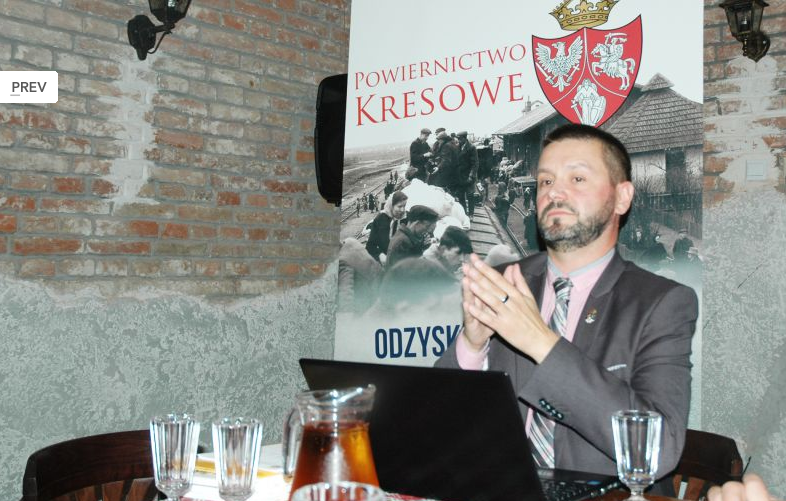
On October 16, 2015, the Polish organization “Powiernictwo Kresowe” (Borderland Trusteeship) held a meeting at the headquarters of the Association for Polish-Eastern Cooperation in Wroclaw, Poland to discuss legal problems arising from the annexation of Poland’s eastern lands, the “Kresy,” by Soviet Ukraine, Belarus, and Lithuania in 1939 and Ukraine’s new EU association agreement.
The open, informational meeting, led by Konrad Rekas, was attended by more than a dozen people and featured a presentation of Powiernictwo Kresowe’s mission, legal plans, and an open Q&A session.
 
Rekas opened the meeting by explaining that the organization seeks to legally assist those Poles who have not received recompense or restitution for property lost during the repatriation of Poles and annexation of Poland’s Kresy around the time of the Second World War. According to bilateral agreements at Yalta and Potsdam in 1944 between the Polish state and the Ukrainian Soviet Socialist Republic, the Polish state settled to reimburse Ukrainians for their lost property and repatriation to the USSR, and the Ukrainian state agreed to do the same for Poles, of which approximately 1.2 million were affected. However, for a number of political and economic reasons, in the past 71 years, a large portion of Poles have yet to receive any sort of the promised reimbursement. According to the organization, the total sum of potential restitution reaches up to 5 billion US dollars and up to 120-150,000 Poles are entitled to file claims. 
Since the 1990’s, there have been numerous legal cases filed and brought before the Constitutional Court of Poland and the European Court of Human Rights, but most cases have been rejected, and on December 4, 2015, the Polish constitutional court resolved that those affected have the right to only 15% of the current value of their lost property. Considering further the complications of dealing with Ukrainian judiciary organs, many have failed to achieve anything at all.
Powiernictwo Kresowe has launched an initiative to gather the data and documents of those Poles still demanding restitution, and legally assist them in filing cases with Ukrainian, Polish, and, if necessary, European level courts.
According to Mateusz Piskorski, a major proponent and political ally of the initiative, while precedent shows that the Polish state will avoid aiding such cases and has rejected many of them in an effort to maintain good relations with Kiev, there are no legal grounds for prohibiting individuals from opening lawsuits. Piskorski discussed this in greater detail in a recent interview with PolitNavigator.
The launch of this initiative comes on the heels of Ukraine’s signing of the EU association agreement, whose provisions included recognition of the need to settle property and heritage disputes with other states and individuals. Yet, in signing the same agreement, Ukraine simultaneously failed to take into consideration earlier resolutions, particularly agreements with Poland, on restitution issues dating from the Second World War.
Following the presentation, a lively Q&A session included individual participants’ retelling of their stories and legal qualms over achieving restitution for their families.
When asked why Powiernictwo Kresowe has no intentions of filing such special cases against Belarus, Rekas explained that Belarus has not signed any European association agreements which distort or annul previous, historical accords.
In response to another frequently asked question concerning whether or not contemporary Ukraine can be held responsible for the actions and agreements carried out under the auspices of the USSR, Rekas reminded that it was the Ukrainian Soviet Socialist Republic itself, a full member of the UN, which signed such agreements with Poland, and that, taking into consideration the territorial and other dimensions of the Ukrainian SSR which the contemporary Ukrainian state inherited, it is the rightful successor state to the Ukrainian SSR.
While the initiative of Powiernictwo Kresowe might appear to be restricted in importance to the individual legal cases of various sizes which it will aid, the demand of ordinary Poles’ for historical justice over Ukraine’s annexation of the Kresy carries significant geopolitical weight. As some analysts have suggested, the further collapse of the post-Maidan Ukrainian state might cause a vortex into which neighboring, traditionally connected states will be pulled, each bringing their own historical and geopolitical interests to the table. Poland’s potential interests in regaining or re-establishing influence in the Kresy, where Polish majorities and minorities were not only expelled but also subjected to genocide at the hands of Ukrainian Banderites, cannot be ruled out. As Piskorski stated in his interview with PolitNavigator, everything depends on the point of view of historical justice of the actors and their separate interests involved.
Organizations such as Powiernictwo Kresowe could play a lively, grassroots role in affecting, influencing, and possibly precipitating such a development, as well as possibly aid in draining Poroshenko’s blood-money budget.
(Pictures from the meeting are to follow upon official release)

Guerre en Syrie. L’incroyable transparence russe étonne, détonne et choque

14 octobre 2015

Alors que la coalition cache toujours ses actions, ce qui prouve qu’elle n’est pas sincère dans sa soi-disant lutte contre le terrorisme, Moscou ne cache rien. Ce qui pose un vrai problème à la coalition dont la deuxième nature est la propagande mensongère. La rhétorique belliqueuse coutumière de l’Otan se poursuit mais, elle n’est pas capable de riposter. Aidée par la propagande des médias mainstream, l’Otan tente en vain de faire croire qu’il y a de bons et de mauvais terrorists.

L’aviation russe a bombardé quarante « cibles terroristes » en Syrie au cours des dernières 24 heures, soit une baisse importante du nombre de raids aériens par rapport aux jours précédents, a annoncé mercredi le ministère russe de la Défense. Les bombardiers tactiques Su-34 et les avions d’appui au sol Su-24M et Su-25SM ont réalisé 41 sorties aériennes pour frapper « 40 cibles terroristes » dans les provinces d’Alep (nord), Idleb (nord-ouest), Lattaquié (nord-ouest), Hama (centre) et Deir Ezzor (est), a précisé le porte-parole du ministère, le général Igor Konachenkov. Les avions russes ont notamment visé « des infrastructures du groupe Etat islamique » (EI), a-t-il affirmé.

Les autres, ne pouvant justifier leurs sorties aériennes en Syrie ou en Irak sont choqués. En réalité, ils ne bombardent que le desert.

http://www.mamafrika.tv/blog/guerre-en-syrie-lincroyable-transparence-russe-etonne-detonne-et-choque/

Posted under Fair Use Rules.

Russia’s unbelievable transparency in Syria surprises, astonishes, shocks!

An Su-34

MAMAFRICA.TV
OCTOBER 14, 2015

October 17, 2015
Translated from French by Tom Winter

While the coalition always keeps the lid on what it does, which indicates its insincerity about its so-called struggle against terrorism, Moscow hides nothing. This poses a real difficulty for the coalition, whose second nature is mendacious propaganda.

The customary bellicose rhetoric of NATO continues its old ways, but [without details] it is not possible to rebut. Assisted by the propaganda of the mainstream media, NATO attempts in vain to make believe that there are good terrorists and bad terrorists.

Russian aviation has bombarded 40 “terrorist targets” in Syria in the course of the last 24 hours — a significant decrease compared to preceding days, the Russian defense minister announced Wednesday

General Igor Konachenkov, spokesman for the ministry, specified that tactical fighter bombers of the type Su-34, and ground attack machines, Su-24M and Su-25M, have completed 41 aerial sorties to strike “40 terrorist targets” in the provinces of Aleppo (north), Idleb (northwest), Hama (center), Latakia (northwest), and Deir Ezzor (east). The Russian jets have notably targeted “infrastructures of the group “Islamic State,” he added. 

The others, unable to justify their aerial sorties in Syria or in Iraq are shocked. Actually, they are not bombing anything but the desert.

______________________________________________________
Translator note: The original headline is just as emphatic as the above:
“L’incroyable transparence russe étonne, détonne et choque”

 I love it. INCROYABLE!