Ukraine’s grid under cyber-attack, according to Poroshenko

From Fort Russ
February 17, 2017
Sebastien HAIRON in Peuples-Libres-nouvelle-russie, translated by Tom Winter –

Le Figaro relays this despatch of Reuters which tells us that Russian hackers have broken in to Ukraine’s power grid! Really !

Except that in this case it is just once again the Kiev regime blaming Russia for Ukraine’s internal problems since the coming to power of the pro-Western putschist junta. Indeed, veterans of the army with the complicity of the neo-Nazi gang decided to organize a blockade of the Donbass on January 25 by blocking, in particular, the railways for the coal trains that deliver the coal essential to the operation of the Ukrainian power stations. Source: Pravda Ukraine

The state of Energy Emergency was set up by the Ukrainian government following this internal crisis. There would be only 14 to 100 days left of coal to allow their power stations to stay in operation.

The Figaro and Reuters (not the only ones) by relaying this vulgar propaganda worthy of a bad soap opera, thus absolve in advance the negligence into which Ukraine has fallen since the Kiev putsch of 2014. For if, unfortunately, some power stations were to cease functioning as a result of this blockade, all eyes will inevitably be directed against the ugly Russian hackers rather than against the Kiev regime.

They have been trotting out Russian hackers for months:

  1. Russian hackers elected Trump — at least in the mainstream press.
  2. Russian hackers are hijacking power stations in Ukraine.
  3. In France, Russian hackers broke into the site of Emmanuel Macron! Oh yes, this is the latest trendy joke!
  4. The Russian hackers will even threaten the elections in France and Germany!

Now that goes to show you how powerful these Russians are!

To get back to this blockade: who can make me believe that the police and the Ukrainian army can’t get this little mob off the railroad ??? RFI [Radio France International] Kiev is using these useful idiots to once again to clash with Russia and increase international pressure against Vladimir Putin. He is no longer a president, but an octopus!

http://www.fort-russ.com/2017/02/ukraines-power-emergency-russian-hackers.html

Who benefits if the power grid is shut down? Not Russia. Certainly not with the nuclear reactors next door. Russia has the most to lose.

So who benefits? This is a false flag.

Reuters:

Oleksandr Tkachuk, Ukraine’s security service chief of staff, said at a press conference that the attacks were orchestrated by the Russian security service with help from private software firms and criminal hackers, and looked like they were designed by the same people who created malware known as “BlackEnergy.”

…He said the attacks employed a mechanism dubbed “Telebots” to infect computers that control infrastructure.

Slovakian cyber-security firm ESET used the same name in December to identify the hacking group responsible for attacks on Ukraine’s financial sector and energy industries.

ESET said it believed that Telebots had evolved from BlackEnergy, a hacking group that attacked Ukraine’s energy industry starting in December 2015 [on December 23].

The December 23, 2015 attack was a highly coordinated attack on a day that the hackers perhaps deemed significant.  If so, that would indicate a EU or U.S. team responsible for the hack; they celebrate Christmas on December 24-25, and probably think everyone else does, too. Ukraine celebrates Christmas in January, and any Ukrainian and Russian would know that.

Other suspects are the oligarchs and their minions who fight against each other, and the militias in the West of Ukraine angling for control of Kiev.

The blockade and new internal productivity in Donbass

Reporter: About the new coal bed we opened, it seems that we don’t have anywhere to sell coal.

Alexander Zakharchenko: Why? We have our power plants that gladly accept this coal. We’ll get electric power and provide our homes with it. Our homes will be bright, warm, and comfortable…

Reporter: How long can we stand the blockade?

Zakharchenko: For 2 1/2 years we’ve already been living within the blockade…Despite whether there is or is not a blockade, they only make it worse for themselves. If idiocy were considered a sickness, everyone there already needs therapy.

…It’s their enterprises that are suffering. There is lack of spirit and lack of leaders.

Interview with Alexander Zakharchenko, leader of the DPR

From Fort Russ

February 17, 2017 – Fort Russ News –
– Christelle NEANT, in DONiPRESS, translated by Tom Winter
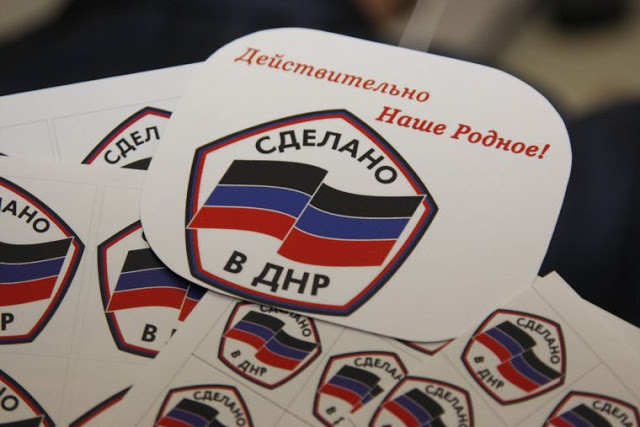
In small letters: “Truly our own.” In shield: “Made in the DPR”

For several weeks, neo-Nazis and other Ukrainian radicals have been blocking the rails that bring coal from Donbass to Ukraine. The coal necessary for the Ukrainian power stations providing about 40% of the country’s electricity. The Donbass alone supplies 37.5% of the coal used by these power stations.

Since the blockade has been total for five days, stockpiles at Ukrainian power plants now only cover 14 to 45 days of consumption, forcing the Ukrainian authorities to declare an energy emergency, and to consider rollng power outages to face the shortage.

The situation is so catastrophic that the EU has just brutally woken up and has called for an end to the commercial blockade of the Donbass.

Should we laugh or cry in the face of the very late awakening of the “European elites” in the face of a situation that has been going on for almost three years and whose radicalization has just revealed the whole danger, and not just for Ukraine?

For we must not deceive ourselves. If the EU reacts it is not for the beautiful eyes of the Ukrainians, that they do not care a fig about. No, if the EU reacts, it’s because the risk of collapse of the Ukrainian electricity grid would have terrible consequences for the neighboring countries, which are part of the EU, and would end up paying for the broken china of their Russiaphobic policies that border on the most profound idiocy.

Faced with this situation, the response of the leader of the RPD, Alexander Zakharchenko, is not lacking spice:

He wished to point out that the coal produced in the two peoples republics always had a secure outlet: the local market. The two republics have coal-fired power stations which supply them with electricity. Power plants that consume locally produced coal.

Continue reading

A documentary you’ll likely never see: “Ukraine on Fire” by Oliver Stone

Trailer

Neo-Nazis are being used by the Ukrainian Government,

“That whole process was headquartered in the US  Embassy” (former Ukraine president Yanukovitch)

Nobody should feel safe today… 

Global Research, February 14, 2017
Consortiumnews 13 February 2017
0

It is not very often that a documentary film can set a new paradigm about a recent event, let alone, one that is still in progress. But the new film Ukraine on Fire has the potential to do so – assuming that many people get to see it.

Usually, documentaries — even good ones — repackage familiar information in a different aesthetic form. If that form is skillfully done, then the information can move us in a different way than just reading about it.

A good example of this would be Peter Davis’s powerful documentary about U.S. involvement in Vietnam, Hearts and Minds. By 1974, most Americans understood just how bad the Vietnam War was, but through the combination of sounds and images, which could only have been done through film, that documentary created a sensation, which removed the last obstacles to America leaving Indochina.

Ukraine on Fire has the same potential and could make a contribution that even goes beyond what the Davis film did because there was very little new information in Hearts and Minds. Especially for American and Western European audiences, Ukraine on Fire could be revelatory in that it offers a historical explanation for the deep divisions within Ukraine and presents information about the current crisis that challenges the mainstream media’s paradigm, which blames the conflict almost exclusively on Russia.

Key people in the film’s production are director Igor Lopatonok, editor Alex Chavez, and writer Vanessa Dean, whose screenplay contains a large amount of historical as well as current material exploring how Ukraine became such a cauldron of violence and hate. Oliver Stone served as executive producer and conducted some high-profile interviews with Russian President Vladimir Putin and ousted Ukrainian President Viktor Yanukovych.

The film begins with gripping images of the violence that ripped through the capital city of Kiev during both the 2004 Orange Revolution and the 2014 removal of Yanukovich. It then travels back in time to provide a perspective that has been missing from mainstream versions of these events and even in many alternative media renditions.

A Longtime Pawn

Historically, Ukraine has been treated as a pawn since the late Seventeenth Century. In 1918, Ukraine was made a German protectorate by the Treaty of Brest Litovsk. Ukraine was also a part of the Molotov-Ribbentrop Pact of 1939 signed between Germany and Russia, but violated by Adolf Hitler when the Nazis invaded the Soviet Union in the summer of 1941.

German dictator Adolf Hitler

The reaction of many in Ukraine to Hitler’s aggression was not the same as it was in the rest of the Soviet Union. Some Ukrainians welcomed the Nazis. The most significant Ukrainian nationalist group, Organization of Ukrainian Nationalists (OUN), had been established in 1929. Many of its members cooperated with the Nazis, some even enlisted in the Waffen SS and Ukrainian nationalists participated in the massacre of more than 33,000 Jews at Babi Yar ravine in Kiev in September 1941. According to scholar Pers Anders Rudling, the number of Ukrainian nationalists involved in the slaughter outnumbered the Germans by a factor of 4 to 1.

But it wasn’t just the Jews that the Ukrainian nationalists slaughtered. They also participated in massacres of Poles in the western Ukrainian region of Galicia from March 1943 until the end of 1944. Again, the main perpetrators were not Germans, but Ukrainians.

According to author Ryazard Szawlowksi, the Ukrainian nationalists first lulled the Poles into thinking they were their friends, then turned on them with a barbarity and ferocity that not even the Nazis could match, torturing their victims with saws and axes. The documentary places the number of dead at 36,750, but Szawlowski estimates it may be two or three times higher.

OUN members participated in these slaughters for the purpose of ethnic cleansing, wanting Ukraine to be preserved for what OUN regarded as native Ukrainians. They also expected Ukraine to be independent by the end of the war, free from both German and Russian domination. The two main leaders in OUN who participated in the Nazi collaboration were Stepan Bandera and Mykola Lebed. Bandera was a virulent anti-Semite, and Lebed was rabidly against the Poles, participating in their slaughter.

After the war, both Bandera and Lebed were protected by American intelligence, which spared them from the Nuremburg tribunals. The immediate antecedent of the CIA, Central Intelligence Group, wanted to use both men for information gathering and operations against the Soviet Union. England’s MI6 used Bandera even more than the CIA did, but the KGB eventually hunted down Bandera and assassinated him in Munich in 1959. Lebed was brought to America and addressed anti-communist Ukrainian organizations in the U.S. and Canada. The CIA protected him from immigration authorities who might otherwise have deported him as a war criminal.

The history of the Cold War was never too far in the background of Ukrainian politics, including within the diaspora that fled to the West after the Red Army defeated the Nazis and many of their Ukrainian collaborators emigrated to the United States and Canada. In the West, they formed a fierce anti-communist lobby that gained greater influence after Ronald Reagan was elected in 1980.

Important History

This history is an important part of Dean’s prologue to the main body of Ukraine on Fire and is essential for anyone trying to understand what has happened there since the collapse of the Soviet Union in 1991. For instance, the U.S.-backed candidate for president of Ukraine in 2004 — Viktor Yushchenko — decreed both Bandera and Lebed to be Ukrainian national heroes.

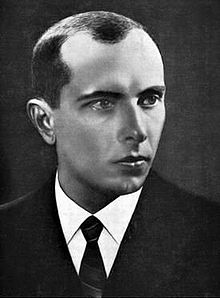
Stepan Bandera, a Ukrainian ultra-nationalist and Nazi collaborator.

Bandera, in particular, has become an icon for post-World War II Ukrainian nationalists. One of his followers was Dmytro Dontsov, who called for the birth of a “new man” who would mercilessly destroy Ukraine’s ethnic enemies.

Bandera’s movement was also kept alive by Yaroslav Stetsko, Bandera’s premier in exile. Stetsko fully endorsed Bandera’s anti-Semitism and also the Nazi attempt to exterminate the Jews of Europe. Stetsko, too, was used by the CIA during the Cold War and was honored by Yushchenko, who placed a plaque in his honor at the home where he died in Munich in 1986. Stetsko’s wife, Slava, returned to Ukraine in 1991 and ran for parliament in 2002 on the slate of Yushchenko’s Our Ukraine party.

Stetsko’s book, entitled Two Revolutions, has become the ideological cornerstone for the modern Ukrainian political party Svoboda, founded by Oleh Tyahnybok, who is pictured in the film calling Jews “kikes” in public, which is one reason the Simon Wiesenthal Center has ranked him as one of the most dangerous anti-Semites in the world.

Another follower of Bandera is Dymytro Yarosh, who reputedly leads the paramilitary arm of an even more powerful political organization in Ukraine called Right Sektor. Yarosh once said he controls a paramilitary force of about 7,000 men who were reportedly used in both the overthrow of Yanukovych in Kiev in February 2014 and the suppression of the rebellion in Odessa a few months later, which are both fully depicted in the film.

This historical prelude and its merging with the current civil war is eye-opening background that has been largely hidden by the mainstream Western media, which has downplayed or ignored the troubling links between these racist Ukrainian nationalists and the U.S.-backed political forces that vied for power after Ukraine became independent in 1991.

The Rise of a Violent Right

Continue reading

L’UE exhorte à lever le blocus commercial du Donbass

Sputnik

16.02.2017

Un blocus du Donbass au lieu d'une aide

Face à la perspective des coupures d’électricité tournantes en Ukraine, l’Union européenne s’est enfin aperçue du blocus commercial du Donbass, Kiev n’en recevant plus la houille anthracite absolument nécessaire pour les centrales ukrainiennes.

Le blocus commercial du Donbass viole les droits des Ukrainiens habitant sur les territoires qui échappent actuellement au contrôle de Kiev et risque de déclencher une crise énergétique dans le pays, prévient, dans un communiqué, la représentation de l’Union européenne en Ukraine, ajoutant que les organisateurs du blocus doivent le lever immédiatement.

« Le blocus du Donbass par l’Ukraine contredit l’approche inclusive envers les Ukrainiens habitant sur les territoires où les organes du pouvoir n’exercent pas provisoirement leurs fonctions. Les responsables du lancement du blocus doivent le lever immédiatement. Quant aux autorités, elles doivent régler ce problème au plus vite », lit-on dans le communiqué, cité par Sputnik.

Il s’agit en l’occurrence du blocus de la communication ferroviaire avec le Donbass qui se poursuit depuis fin janvier, quand un groupe d’anciens combattants des bataillons de volontaires, qui avaient participé aux hostilités dans le sud-est de l’Ukraine, et de députés de la Rada suprême (parlement ukrainien), a barré le trafic sur la ligne de chemin de fer. Les organisateurs du blocus ont affirmé que tout commerce avec les Républiques populaires autoproclamées de Donetsk (DNR) et de Lougansk (LNR) était illégal, et que toutes les marchandises transportées relevaient par conséquent de la contrebande.

Le blocus ferroviaire a débouché sur des problèmes de livraison de houille anthracite depuis le Donbass, engendrant des difficultés dans le secteur énergétique de l’Ukraine. Comme résultat, Kiev envisage d’ores et déjà des coupures d’électricité tournantes dans la plupart des régions du pays.

https://fr.sputniknews.com/international/201702161030122172-ue-blocus-donbass-levee-commerce-kiev/

Donbass coal blocked by Rada deputies, Kiev militia veterans; nuclear reactors at risk; EU urges lifting rail blockade of Donbass

In spite of the war by Kiev against the Donbass, the Donbass continues to ship coal to Kiev. Why? Because the Donbass people know it would be suicidal to stop. 

The Rada deputies and veterans are suicidal and don’t care if they take the whole country, the whole region, and really, the whole world with them. That’s what will happen if the nuclear reactors blow up due to a grid shutdown.

All the Ukrainian ultra-nationalist neo-Nazis in Canada and elsewhere will not escape that disaster. Neither will U.S. military, CIA, or State Department cookie deliverers, their children, or their loved ones, wherever they are. 

Those with sanity have to take control of this situation, and stop these mad people before they kill everything.

From Fort Russ

February 16, 2017 – Fort Russ News –
– Sputnik France, translated by Tom Winter –

“Donbass, the Heart of Russia.” 1921 poster has two coal miners at top, and the map serves well today to show how suicidal blocking the coal trains was.
This is Sputnik France’s illustration for this report.  “The EU urges lifting the Commercial blockade of Donbass.” And the picture’s hidden label reads “Instead of aid, blockade.”

Faced with the prospect of revolving power outages in Ukraine, the European Union has at last taken note of the commercial blockade of the Donbass, with Kiev no longer receiving the anthracite coal absolutely necessary for the Ukrainian power stations.

The commercial blockade of the Donbass
a) violates the rights of Ukrainians living in the territories that are currently beyond the control of Kiev, and
b) is likely to trigger an energy crisis in the country, warns the representation of the European Union in Ukraine, adding that the organizers of the blockade must immediately lift it.

The blockade of the railway connections with Donbass started at end of January, when a group of veterans of the volunteer battalions participating in the hostilities, with deputies of the Supreme Rada (Ukrainian parliament), blocked traffic on the railway line. 

The organizers of the blockade claimed that any trade with the self-proclaimed People’s Republics of Donetsk (DNR) and Lugansk (LNR) was illegal, and that all goods transported were therefore contraband.

The railway blockade has led to problems in getting anthracite coal from the Donbass, causing difficulties in Ukraine’s energy sector. As a result, Kiev is already considering revolving power cuts in most parts of the country.

http://www.fort-russ.com/2017/02/eu-urges-lifting-rail-blockade-of.html

NATO agrees to increase presence in Black Sea – Stoltenberg

From RT
February 16, 2017

NATO agrees increased presence in Black Sea – Stoltenberg

U.S. troops deployed to Bulgaria as NATO boosts Eastern European presence

From RT

February 15, 2017

US troops deployed to Bulgaria as NATO boosts Eastern European presence
US troops arrived in Bulgaria on Wednesday, with armored vehicles and heavy equipment to be shipped by the end of the week as part of NATO’s significant buildup in Eastern Europe, the Bulgarian Defense Ministry has said.

Around 120 US servicemen from Fort Carson, Colorado were accommodated at the Novo Selo military base in the east of the Black Sea country, according to Bulgarian officials.

“Joint drills and training at Novo Selo training range will be increased this year. The US army troops will be rotated for the drills,” the defense ministry said as cited by Reuters.

On Tuesday, tanks and hardware accompanied by another 500 American troops arrived in Romania.

The deployment is part of Atlantic Resolve, the operation to reassure NATO’s allies in the region following Russia’s reunion with Crimea and accusations of Moscow being involved in the Ukrainian conflict.

Russia has denied the claims.

Last summer, NATO members agreed to boost its NATO presence in Eastern Europe and the Baltic region to levels not seen since the Cold War – posting four rotating multinational battalions to Estonia, Latvia, Lithuania, and Poland.

In January, 2,800 pieces of US military hardware, including Abrams tanks, Paladin artillery, and Bradley fighting vehicles, and 4,000 troops arrived in Europe as part of the operation.

READ MORE: Spain plans to send 6 tanks & 350 troops to Latvia as part of NATO buildup – reports

The forces took part in drills in Poland and were then deployed across seven countries, including the Baltic States, Bulgaria, Romania, and Germany.

American troop deployment accelerated in the last months of the President Barack Obama’s presidency as his successor, Donald Trump, announced plans of mending relations with Moscow.

However, Trump’s rhetoric towards Russia has changed since he took office, with White House spokesman, Sean Spicer, saying on Tuesday that the new president “expects the Russian government to de-escalate violence in Ukraine and return Crimea” to Kiev.

READ MORE: ‘No incidents over Black Sea’: Russian MoD denies ‘unprofessional & unsafe’ flyby of USS Porter

On Wednesday, the new US Defense Secretary, James Mattis, who was on his first European visit, warned NATO allies that America will “moderate its commitment” to the alliance if other members don’t increase their financial contribution.

“No longer can the American taxpayer carry a disproportionate share of the defense of western values,” Mattis said.

But the Defense Secretary assured President Trump’s “strong support” for NATO, calling the block “a fundamental bedrock for the United States and for all the transatlantic community.”

Moscow has criticized the expansive NATO military buildup on its borders, saying it increases the risk of incidents and poses a threat to Russian national security.

“This deployment is, of course, a threat for us,” Russian Deputy Foreign Minister Aleksey Meshkov said last week, adding that “it is obvious that the steps by NATO gravely increase the risk of incidents.”

https://www.rt.com/news/377494-nato-bulgaria-us-troops/

Wikileaks releases ‘CIA espionage orders’ for 2012 French presidential election

From RT
February 16, 2017

Wikileaks has released three classified CIA espionage orders revealing details of an alleged seven-month long spying campaign by the agency ahead of the 2012 French presidential election.

The documents disclose that all of France’s major political parties were targeted for infiltration by the CIA’s human (“HUMINT”) and electronic (“SIGINT”) spies.

The CIA assessed that President Nicholas Sarkozy’s UMP party was not assured re-election and ordered officers to find out Sarkozy’s private deliberations “on the other candidates” as well as how he interacted with his advisors, according to the documents.

The agency also reportedly outlined orders specific to the UMP (Union for a Popular Movement), including obtaining the party’s “Strategic Election Plans” and gleaning private thoughts within the party on Sarkozy’s campaign strategies.

RELEASE: Full text of CIA orders targetting French presidential election including Hollande, Sarkozy & Le Pen https://wikileaks.org/cia-france-elections-2012/document/2012-CIA-FRANCE-ELECTION/ 9:54 AM – 16 Feb 2017

The agency also outlined orders specific to the UMP (Union for a Popular Movement), including obtaining the party’s “Strategic Election Plans” and gleaning private thoughts within the party on Sarkozy’s campaign strategies.

According to the papers, the CIA justification for seeking detailed information on the inner workings of the party was to assist “analysts assess and prepare US key policymakers” for the post-election French political landscape and the potential impact on US-France relations.

Another secret CIA order included in the leaks entitled, “Non Ruling Political Parties and Candidates Strategic Election Plans,” demands information on rising party leaders and emerging political parties.

The information sought ranged from party strategies, opinions on the US and efforts to reach out to other countries, including Germany, UK, Libya, Israel, Palestine, Syria and Cote d’Ivoire.

The CIA also requested details on how candidates were funded, their views on the French economy, and the Greek debt crisis the documents indicate. The agency was also interested in French political opinions on the German model of export-led growth and any specific proposals that would help solve the Eurozone crisis.

READ MORE: Thousands of dossiers on French presidential contenders available in archives – WikiLeaks

The documents indicate that the CIA operation initially ran for 10 months from November 21, 2011, to September 29, 2012, and continued after the April-May 2012 French presidential election and into the formation of the new government.

The revelations are contained within three alleged CIA tasking orders, totaling seven pages, and published by WikiLeaks as context for its forthcoming ‘CIA Vault 7 series’. Wikileaks began tweeting about the mysterious ‘Vault 7’ series earlier this month, sending speculation into overdrive online over what the cryptic tweets indicated.

https://www.rt.com/usa/377619-wikileaks-cia-election-france/

Former Congressman Dennis Kucinich says intelligence community schemed against Michael Flynn to undermine U.S.-Russia relations

Global Research, February 15, 2017
Cleveland.com 14 February 2017

Former Cleveland Democratic congressman Dennis Kucinich on Tuesday said that scheming by the intelligence community to perpetuate the Cold War is behind Michael Flynn’s resignation as national security adviser.

Flynn submitted his resignation to President Donald Trump on Monday night, after admitting that he inadvertently gave “incomplete information” to Vice President Mike Pence and others about phone calls he had with the Russian ambassador before Trump took office.

Subsequent reports said federal officials worried Flynn could be blackmailed because he inappropriately discussed the Obama administration’s sanctions against Russia for interfering in the 2016 election and didn’t tell Pence about it.

In a Tuesday morning interview with Fox Business, Kucinich expressed concern that Flynn’s telephone calls with Russian officials were intercepted by U.S. intelligence agencies and shared with the media.

He said members of the intelligence community want to reignite the Cold War  between the United States and Russia so the military, industrial and intelligence “axis” can “cash in.”

Kucinich argued it would be wrong to continue the Cold War, because the last one cost billions of dollars and “changed the quality of life in this country.”

“There’s something wrong going on here in the intelligence community,” said Kucinich, who urged Trump to take control, and find out where the information is coming from so he and the American people will know the truth.

“It’s early in the morning, it’s Valentine’s Day, but wake up America,” urged Kucinich, a former Democratic presidential candidate.

A game is being played with the security of our country. Pls watch & share this is important. http://www.foxbusiness.com/politics/2017/02/14/kucinich-pins-flynn-leak-on-intel-community-warns-another-cold-war.html 

Photo published for Kucinich Pins Flynn Leak on Intel Community, Warns of Another Cold War

Kucinich Pins Flynn Leak on Intel Community, Warns of Another Cold War

During an interview on the FOX Business Network’s Mornings with Maria, former Democratic presidential candidate Dennis Kucinich said the intelligence community was responsible for leaking information…

foxbusiness.com

U.S. used toxic depleted uranium in Syria

From RT
February 14, 2017

US admits using toxic depleted uranium against ISIS in Syria
A-10 Thunderbolt II. © SRA Greg L. Davis, USAF / Wikipedia

More than 5,000 rounds of depleted uranium (DU) ammunition were used in two attacks on Islamic State oil tankers in eastern Syria, the US military has confirmed. The US-led coalition previously pledged it would not use the controversial ordnance.

A spokesman for the US Central Command (CENTCOM) told Foreign Policy that 5,265 armor-piercing DU rounds were used in November 2015, during two air raids against Islamic State (IS, formerly ISIS/ISIL) oil tanker convoys in the Deir ez-Zor and Hasakah provinces in eastern Syria.

A-10 ground attack aircraft fired the projectiles from their 30mm rotating cannons, destroying about 350 tanker trucks, according to CENTCOM spokesman Major Josh Jacques.

Officials confirm the US used depleted uranium weapons on the battlefield in Iraq and Syria: http://www.stripes.com/news/middle-east/the-united-states-used-depleted-uranium-in-syria-1.453925 

Photo published for The United States used depleted uranium in Syria

The United States used depleted uranium in Syria

Officials have confirmed that the U.S. military, despite vowing not to use depleted uranium weapons on the battlefield in Iraq and Syria, fired thousands of rounds of the such munitions during two…

stripes.com

In March 2015, spokesman for the US-led coalition John Moore had explicitly ruled out the use of the controversial ammunition, saying that “US and coalition aircraft have not been and will not be using depleted uranium munitions in Iraq or Syria during Operation Inherent Resolve.” The Pentagon explained that armor-piercing DU rounds were not necessary because IS did not have the tanks it was designed to penetrate.

Investigative reporter Samuel Oakford first brought up the use of DU ammunition by the coalition in October 2016, when a US Air Force congressional liaison told Representative Martha McSally (R-Arizona) that A-10s flying missions over Syria had fired 6,479 rounds of “combat mix” on two occasions. The officer explained that a fifth of the “combat mix” consisted of high-explosive incendiary (HEI) rounds, while the rest were DU armor-piercers. [in other words, 4/5 DU]

The first attack took place on November 16, near Al-Bukamal in the Deir ez-Zor province, with four US planes destroying 46 vehicles. The strike took place entirely in Syrian territory. According to CENTCOM, 1,790 rounds of “combat mix” were used during the strike, including 1,490 rounds of DU.

<iframe width=”631″ height=”480″ src=”https://www.youtube.com/embed/ZQkG-RWxFfY&#8221; frameborder=”0″ allowfullscreen><!–iframe>

The second attack, on November 22, destroyed 293 oil tankers in the desert between Deir ez-Zor and Hasakah. On this occasion, the four A-10s fired 4,530 rounds – of which 3,775 were DU armor-piercers.

“The combination of Armored Piercing Incendiary (DU) rounds mixed with HEI rounds was used to ensure a higher probability of destruction of the truck fleet ISIS was using to transport its illicit oil,” Major Jacques told RT.

Depleted uranium is prized by the US military for exceptional toughness, which enables it to pierce heavy tank armor. However, airborne DU particles can contaminate nearby ground and water and pose a significant risk of toxicity, birth defects and cancer when inhaled or ingested by humans or animals.

The coalition’s promise not to use DU munitions in Iraq was made after an estimated one million rounds were used during the 1991 Gulf War and the 2003 invasion. Between Iraq and the Balkans, where they were also used in the 1990s, DU rounds have been blamed on a massive increase in cancer and birth defects.

These DU contaminated locations in pose a risk to civilian health and must be isolated and addressed as soon as conditions allow. https://twitter.com/airwars/status/831506092454723584