President al-Assad on White Helmets’ film: the West gave al Qaeda an Oscar – “unbelievable…an unprecedented event”

Global Research, March 11, 2017
SANA 11 March 2017
From the interview with China Phoenix TV:

Question 12: Mr. President, as you may be fully aware that the “White Helmets” took an Oscar this year for the best documentary short, but folks are saying that the truth about this “White Helmets” is not like what Netflix has presented, so what is your take on this?

President Assad: First of all, we have to congratulate al-Nusra for having the first Oscar! This is an unprecedented event for the West to give Al Qaeda an Oscar; this is unbelievable, and this is another proof that the Oscars, Nobel, all these things are politicized certificates, that’s how I can look at it. The White Helmets story is very simple; it is a facelift of al-Nusra Front in Syria, just to change their ugly face into a more humanitarian face, that’s it. And you have many videos on the net and of course images broadcasted by the White Helmets that condemn the White Helmets as a terrorists group, where you can see the same person wearing the white helmet and celebrating over the dead bodies of Syrian soldiers. So, that’s what the Oscar went to, to those terrorists. So, it’s a story just to try to prevent the Syrian Army during the liberation of Aleppo from making more pressure on the attacking and liberating the districts within the city that have been occupied by those terrorists, to say that the Syrian Army and the Russians are attacking the civilians and the innocents and the humanitarian people.

Full interview:

http://www.globalresearch.ca/president-al-assad-foreign-troops-coming-to-syria-without-permission-are-invaders/5579060

Syrian President al-Assad: “Foreign troops coming to Syria without permission are invaders” — in-depth interview

Global Research, March 11, 2017
SANA 11 March 2017

Damascus, SANA-President Bashar al-Assad said that the solution to the crisis in Syria should be through two parallel ways: the first one is to fight the terrorists, and this is our duty as government, to defend the Syrians and use any means in order to destroy the terrorists who’ve been killing and destroying in Syria, and the second one is to make dialogue.

The president added in an interview given to Chinese PHOENIX TV that any foreign troops coming to Syria without our invitation or consultation or permission, they are invaders, whether they are American, Turkish, or any other one.

Flowing is the full text of the interview:

Question 1:  Thank you Mr. President for having us here in Dimashq, the capital of Syria. I think this is the first interview you have with Chinese media after the national ceasefire and after so many fresh rounds of talks, both in Astana and in Geneva, and of course after US President Donald Trump’s inauguration, and these days, as we have seen, your troops are making steady progress in battlefields, but peace talks do not seem just as productive. So, as far as the Geneva talks is concerned, your chief negotiator, Mr. Jaafari, was trying hard to find out who should be sitting on the other side of the negotiation table. So, according to your idea, who should be sitting there?

President Assad: This is a very crucial question. If you want those negotiations to be fruitful, we have to ask “who is going to be sitting there?” I mean, there could be a lot of good people with good intentions, but the question is: who do they represent? That’s the question. In this situation, you have different groups, you have people who are, let’s say, patriotic, but they don’t represent anyone, they represent themselves. You have others who represent the terrorists, and you have terrorists on the table, and you have others who represent the agenda of foreign countries like Saudi Arabia, like Turkey, like France, UK and maybe the United States. So, it’s not a homogeneous meeting. If you want it to be fruitful, going back to the first point that I mentioned, it should be a real Syrian-Syrian negotiations. In spite of that, we went to that meeting because we think any kind of dialogue could be a good step toward the solution, because even those people who are terrorists or belonging to the terrorists or to other countries, they may change their mind and go back to their normality by going back to being real Syrians, detach themselves from being terrorists or agents to other groups. That’s why I say we didn’t expect Geneva to produce anything, but it’s a step, and it’s going to be a long way, and you may have other rounds, whether in Geneva or in Astana.

Question 2: But anyway, it is an intra-Syrian talks, right? But the matter of fact is, it is proxy dialogue. I mean, main parties do not meet and have dialogue directly.

President Assad: Exactly.

Journalist: Are you personally satisfied with the current negotiation format or mechanism?

Continue reading →

U.S. State Dept. urges coroner to keep Russian UN Ambassador Churkin’s cause-of-death secret

Global Research, March 11, 2017
ZeroHedge 10 March 2017

Following the unexpected death of 65-year-old Russian ambassador to the United Nations Vitaly Churkin, conspiracy theorists were stirred up as the ongoing Russophobic Deep State war combined with the deaths of nine Russian diplomats in the last year raised many coincident-questioning eyebrows. Now, as The Hill reports, pouring further fuel on that fire, the State Department asked the New York Medical Examiner not to publicly release information about Churkin’s cause of death.

“In order to comply with international law and protocol, the New York City Law Department has instructed the Office of Chief Medical Examiner to not publicly disclose the cause and manner of death of Ambassador Vitaly Churkin, Permanent Representative of the Russian Federation to the United Nations,”  Office of Chief Medical Examiner spokesman Julie Bolcer said, according to New York Times reporter Michael Grynbaum.

As outlined in formal requests from the United States Department of State, Ambassador Churkin’s diplomatic immunity survives his death. Further questions concerning this matter should be directed to the United States Department of State.

Initial reports suggested that there was no foul play involved in the incident and that Churkin died from cardiac arrest, but, as a reminder, Churkin was not alone among Russian diplomats who died of ‘heart attacks’:

1. You probably remember Russia’s Ambassador to Turkey, Andrei Karlov — he was assassinated by a police officer at a photo exhibit in Ankara on December 19.

2. On the same day, another diplomat, Peter Polshikov, was shot dead in his Moscow apartment. The gun was found under the bathroom sink but the circumstances of the death were under investigation. Polshikov served as a senior figure in the Latin American department of the Foreign Ministry.

3. Russia’s Ambassador to the United Nations, Vitaly Churkin, died in New York this past week. Churkin was rushed to the hospital from his office at Russia’s UN mission. Initial reports said he suffered a heart attack, and the medical examiner is investigating the death, according to CBS.

4. Russia’s Ambassador to India, Alexander Kadakin, died after a “brief illness January 27, which The Hindu said he had been suffering from for a few weeks.

5. Russian Consul in Athens, Greece, Andrei Malanin, was found dead in his apartment January 9. A Greek police official said there was “no evidence of a break-in.” But Malanin lived on a heavily guarded street. The cause of death needed further investigation, per an AFP report. Malanin served during a time of easing relations between Greece and Russia when Greece was increasingly critiqued by the EU and NATO.

6. Ex-KGB chief Oleg Erovinkin, who was suspected of helping draft the Trump dossier, was found dead in the back of his car December 26, according to The Telegraph. Erovinkin also was an aide to former deputy prime minister Igor Sechin, who now heads up state-owned Rosneft.

If we go back further than 60 days…

7. On the morning of U.S. Election Day, Russian diplomat Sergei Krivov was found unconscious at the Russian Consulate in New York and died on the scene. Initial reports said Krivov fell from the roof and had blunt force injuries, but Russian officials said he died from a heart attack. BuzzFeed reports Krivov may have been a Consular Duty Commander, which would have put him in charge of preventing sabotage or espionage.

8. In November 2015, a senior adviser to Putin, Mikhail Lesin, who was also the founder of the media company RT, was found dead in a Washington hotel room according to the NYT. The Russian media said it was a “heart attack,” but the medical examiner said it was “blunt force injuries.”

9. If you go back a few months prior in September 2016, Russian President Vladimir Putin’s driver was killed too in a freak car accident while driving the Russian President’s official black BMW  to add to the insanity.

If you include these three additional deaths that’s a total of nine Russian officials that have died over the past 2 years that WeAreChange.com’s Aaron Kesel knows of – he notes there could be more.

*  *  *

So why is the State Department now trying to keep Churkin’s cause of death from the public?

Nuclear danger: Donbass blockade organizers warn Kiev all Russian coal supplies may be blocked

This endangers the 19 nuclear reactors in Ukraine because the reactors rely on the electric grid for power to keep reactor cores and fuel rods cool. Without grid power and if there is no back-up power, reactors can explode and melt-down. Chernobyl had one reactor accident. Fukushima had 3 reactors melt down. 19 is unthinkable.

Beside the nuclear issue is the immense suffering of the Ukrainian people due to the energy shortage and the high costs imposed by the Kiev regime on the population for the energy they get. How many in Ukraine have died indirectly from this or actually frozen to death this winter? Will we ever know? 

From Sputnik News

11 March 2017

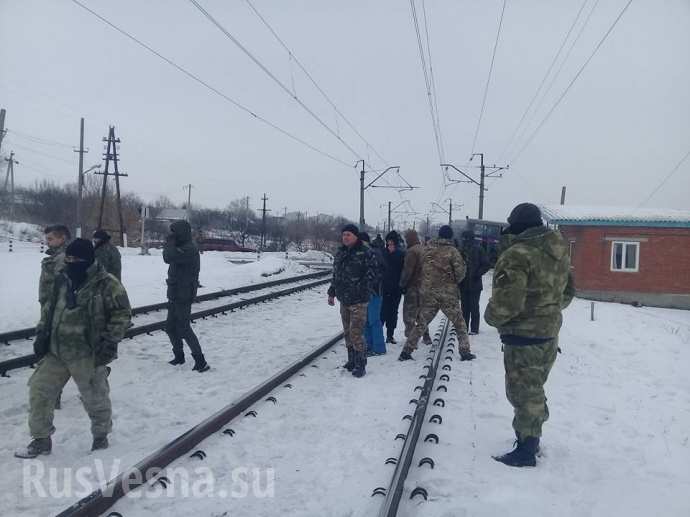
The organizers of the trade blockade in eastern Ukraine threaten to block all coal imports from Russia.

KIEV (Sputnik) — The organizers of the trade blockade in eastern Ukraine said Friday that they would block all coal imports from Russia beginning from April 2 in case Kiev failed to reach agreements on coal shipments from other countries by that time.

“We give the government time by April 2 to sign the contracts on coal supplies with countries which do not conduct warfare against Ukraine. We give the government time by April 2 to reconsider its trade policy with the aggressor country of Russia,” the blockade’s main organizer, Anatoliy Vynohrodsky, told reporters.

He added that beginning from April 2 the observation stations of the blockade organizers, which are to be established along all the railway transition posts, will begin the blockade’s active phase.

“First of all we will not let coal from Russia pass,” Vynohrodsky pointed out.

Vynohrodsky noted that concerning other supplies from Russia, the blockade organizers would “consult with the Ukrainian people.”In late January, a group of former participants of Ukraine’s military operation in Donbas, including several lawmakers, blocked traffic on several segments of freight rail lines running from the territories uncontrolled by Kiev. The blockade led to irregularities in supplies of anthracite coal from Donbass, leading to power shortages in Ukraine and prompting Kiev to declare an energy emergency.

Kiev’s authorities criticized the actions of the blockade organizers saying that coal shipments from Donbass were legal as coal producing plants located there had been paying taxes to the Ukrainian State Treasury Service. However, no efforts have been undertaken by the Kiev authorities to lift the blockage.

In January 2015, the Ukrainian parliament adopted a statement designating Russia as an aggressor country, as Kiev considered Russia being a party to the military conflict in Donbass. No evidence supporting this statement was provided.

Moscow denounced the statement. Russia repeatedly said it was not part to the Ukrainian conflict, had not provided military equipment to Donbass militia and was interested in the settlement of the Ukrainian crisis.

https://sputniknews.com/europe/201703111051470737-donbass-blockade-block-russia/

Ukrainian extremists threaten to sever the Donbass water and electricity

March 10, 2017 – Fort Russ News –
– RusVesna – Translated by James Harmon

If participants in the trade blockade of Donbass do not reach their goals, they plan to sever the supply of electricity and water to the republic to create “intolerable conditions”, typical of the inhumanity of extremist factions and fascists who lack humanitarian understanding of populations and their needs.
This was stated by the second commander of the dangerous and extremist battalion “Donbass”, Anatoly Vinogrodsky, a virulent ultranationalist and fascist sympathizer.
“We will close the supply of all goods, electricity and water, which will flow into the occupied territory, in order to organize unbearable conditions for the population, so they began to harass Zakharchenko and his minions”, Vinogrodsky stated bluntly.

NATO-trained and armed foreign mercenaries deploy against Donbass to back Kiev regime

March 10, 2017 – Fort Russ News –
– TzVezda – Translated by James Harmon

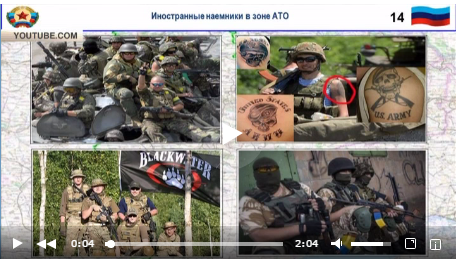
Several hundred foreign fighters were deployed to the line of contact in the Donbass, reporters learned at a briefing with spokesman of the People’s Militia of independant Lugansk People’s Republic, Andrei Marochko.
“According to available information, in the settlements located near the line of contact, several hundred mercenaries from Canada, the Baltic states, Poland and Georgia, armed with small arms and light armored vehicles were deployed” – said the representative of the People’s Militia.
According to Marochko, in various localities, placement of field mercenaries in field camps, where foreign military instructors train soldiers of the Armed Forces of Ukraine. They are armed with small arms, via NATO’s “unofficial” support.
Marochko said that mercenaries are preparing snipers whom are taught to perform conducting sweeps in urban environments, as well as training of subterfuge operation groups engaged in sabotage, which are planned to send later into the Donbass.

Russia suspended deliveries of diesel fuel to Ukraine

March 10, 2017 – Fort Russ News –
– RusVesna – Translated by James Harmon

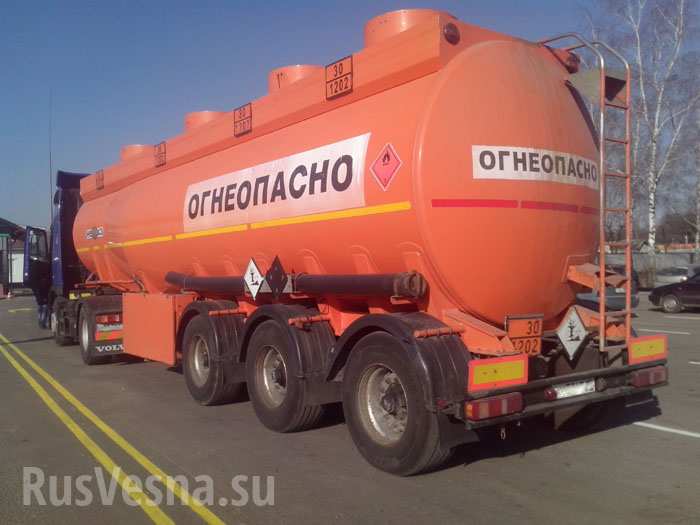
Pipeline deliveries of Russian diesel fuel in Ukraine have been suspended for a month due to the fact that the Federal Service for Technical and Export Control (FSTEC) has not carried out registration of necessary documents.
This was reported to “Interfax”, from sources in the industry.
Meanwhile, the press service of the Russian Ministry of Energy Agency stated that “the Russian Federation has no intergovernmental agreement on the supply of petroleum products in Hungary and Ukraine, the supply of diesel fuel in these areas are carried out by economic entities on the basis of economic feasibility. Respectively, discussion about the termination of deliveries of Russian Federation is incorrect. “
At the same time, the ministry added that according to “Transneft”, deliveries were suspended February 8, 2017 “in connection with the renegotiation of contracts for export of petroleum products.”
According to the press service of the Ministry of Energy, oil products intended for delivery to Ukraine, now redeployed in other areas, particularly in Primorsk and Novorossiysk (Russian locations).
The advisor to the President of “Transneft”, spokesman Igor Demin told “Interfax” that “Transneft” transports petroleum products at the request of the owners of the resource after the execution of the relevant documents for export. “In February of this year were bids from oil companies for export of diesel fuel to Ukraine. This month, export consignments had not been sent to us”, Demin stated.
The press service of NK “Rosneft”, which supplies these materials, reported that oil via Rosneft is “supplied to Ukraine and Hungary in accordance with the agreements with the partner company. The contract provides for the possibility of changing the volume of deliveries, depending on the request of the counterparty and the effectiveness of their implementation of the agreement – emphasized in the company.”
In early September 2016, Russia has suspended the supply of diesel fuel to Ukraine through the pipe as “Transneft” has received an order from the Central Energy Customs (ETC) with a message of cancellation directed by FSTEC. Russian conclusions complied with domestic participants of foreign economic activity in the oil supply.
In the middle of the month after the receipt of a monopoly, there was a  properly executed customs declaration of the ETC for the transportation of diesel fuel. The direction of supply for Ukraine were resumed. In September, the planned volume of gas supplies to Ukraine should make 156 thousand Tonnes if resumed.

Erdogan regime forces kill Syrian soldiers and border guards

March 10th, 2017 – Fort Russ News –
– Agencies – – translated by Samer Hussein –

Syrian military sources said forces of the Turkish dictator Recep Tayyip Erdogan bombarded the positions of the Syrian Army, in Manbij, western countryside of Aleppo later on Thursday. Several Syrian soldiers and border guards are said to be among the victims of the Turkish bombardment. According to one of the military sources, the goal of the Turkish regime is to disrupt the Syrian Army in its fight against terrorism.

Meanwhile, the commander of the US Central Command in the Middle East, Gen. Joseph Votel announced that Washington is currently taking steps in order to prevent a clash between the Turkish Forces and the US-backed Kurdish Forces in Syria. During the Senate hearing, Votel stressed that this will not be an easy task from diplomatic and military standpoint as it requires a lot of effort to reach a compromise that will be suitable for both sides. He also revealed that Pentagon is considering to arm the Gulf states with ballistic missiles.

Since August 2016 the Erdogan regime Forces are illegally invading Syria, under the guise of fighting against ISIS. The ground reports however, show that the Erdogan regime forces are stationed in Syria only to supply and train the terrorist groups and thus disrupt the Syrian army in its fight against the terrorist threat. Frequent attacks on Syrian civilian infrastructure and residential areas were also reported.

http://www.fort-russ.com/2017/03/erdogan-regime-forces-kill-syran.html

Ukrainian terrorist network unmasked: Lugansk reveals investigation results in Anashchenko & Givi murders

March 10, 2017 – Fort Russ News –
By J. Arnoldski –
Today, March 10th, two significant announcement have come out of Lugansk pertaining to Ukrainian terrorist operations in general and the assassinations of commanders Anashchenko and Givi in particular.
Igor Kornet, the Minister of Internal Affairs of the Lugansk People’s Republic, officially stated that the persons (no number is given) involved in the assassination of People’s Militia commander Oleg Anashchenko on February 4th have been arrested on the territory of the LPR. Kornet also confirmed that the suspects were servicemen of the Ukrainian army. 
“All of them are servicemen of the special forces of the Ukrainian Armed Forces who were deployed to Lugansk as part of saboteur-terrorist groups to commit terrorist acts on the orders of the Security Service of Ukraine. They are now being interrogated,” Kornet announced. 
The minister added that two weapons and ammunition caches, plus an explosive device, were uncovered by police during the investigation. Kornet stressed the significance of this discovery: “This stock and the type of weapons and equipment therein prove that the terrorist act committed by those now arrested is far from the only act of intimidation planned by Ukrainian special forces on the territory of the free republics.” 
Kornet’s statement on the Anashchenko case was immediately followed by a press statement of the LPR’s Minister of State Security, Leonid Pasechnik. According to Pasechnik, the ministry has discovered a special department within the Security Service of Ukraine, headed by Colonel Anatoly Sandursky, codenamed “Hutor”, which directly engages in organizing sabotage and terrorist activities in the people’s republics and the Russian Federation.
According to Pasechnik, Givi’s assassins were servicemen of the 8th special forces regiment of the Ukrainian Armed Forces under the command of Colonel Oleg Nechaev and the 8th regiment’s intelligence chief, Major Pavel Balov, codenamed “Kedr,” who is stationed in the city of Khmelnitsky in Ukraine. This specific unit is part of the larger terrorist operations division under investigation by Lugansk’s security forces.
“These people bear direct responsibility for this crime [the assassination of Givi] and other crimes committed in the LPR, DPR, and Russian Federation, for example in Crimea,” the LPR’s security minister emphasized.


Pasechnik added that at the present moment a detachment of the above-mentioned regiment numbering 120-150 troops is located in Starobelsk not far from Lugansk. The unit has been estimated to be divided into four saboteur-reconnaissance groups numbering 12 to 17 men each. 

“Still looking for Iraqi WMDs?” and other memorable quotes from Vitaly Churkin

From RusVesna.su

Februar 21, 2017

‘Still looking for Iraqi WMDs?’ & other most memorable quotes from Vitaly Churkin | Русская весна

On many occasions over the decade that he served as Russia’s ambassador to the UN, Vitaly Churkin has countered attacks by Western diplomats with a pointed turn of phrase. RT looks at six such moments from Churkin’s distinguished career.

The US envoy to the UN, Zalmay Khalilzad, received this response from Churkin on August 29, 2008, after he condemned Russia’s “invasion” of Georgia. \

The five-day conflict started when US-backed Georgian President Mikhail Saakashvili launched an attack on Russian peacekeepers in the breakaway region on South Ossetia. Russian forces responded by dismantling Georgia’s NATO-trained military, retreating from the country, and recognizing Ossetia’s independence.

This was Churkin’s reply to UK envoy Matthew Rycroft on February 3, 2017, after Rycroft called Russia’s position on Ukraine an “inversion of reality” and seconded new US Ambassador Nikki Haley’s demand for Russia to “return Crimea” to Ukraine.

“The people of Crimea quite clearly expressed their will in a referendum,” Churkin told Haley, pointing out that the US Constitution begins with the phrase, “We, the people.”

Churkin had this tongue-in-cheek retort for then US ambassador Samantha Power, after she spoke of meeting with the members of “Pussy Riot” on February 6, 2014. The self-described punk-rock activists gained notoriety in Russia and fame in the West after three of their members were arrested for a “performance” at Moscow’s Christ the Savior Cathedral in 2012.

That is how Churkin commented on Power’s emotional speech about the humanitarian situation in Aleppo, where the US-backed rebels were losing a battle to the Russian-backed Syrian Army, on December 13, 2016.

“Please, remember which country you represent. Please, remember the track record of your country,” Churkin told her.

That is how Churkin reacted to a report about the situation in Aleppo by Under-Secretary General for Humanitarian Affairs and Emergency Relief Coordinator Stephen O’Brien, on October 27, 2016.

“Give us one fact, please, or leave this kind of storytelling for the novel you may well write later,” the Russian envoy told O’Brien.

Speaking at the UN General Assembly on May 11, 2016, Churkin called on world leaders to remember the organization’s founding principles.

“One should not seek to expand their sphere of control, as it is happening as result of the unrestrained NATO expansion. One should not strive for military dominance, the way US aims to do by creating the global missile defense system,” he added.

“Instead, we should go back to the origins of sensible political thinking, to the slogan ‘the world is undivided,’ to the understanding that the wish to ensure your own security at the expense of others only undermines security globally.”

http://rusvesna.su/news/1487316685