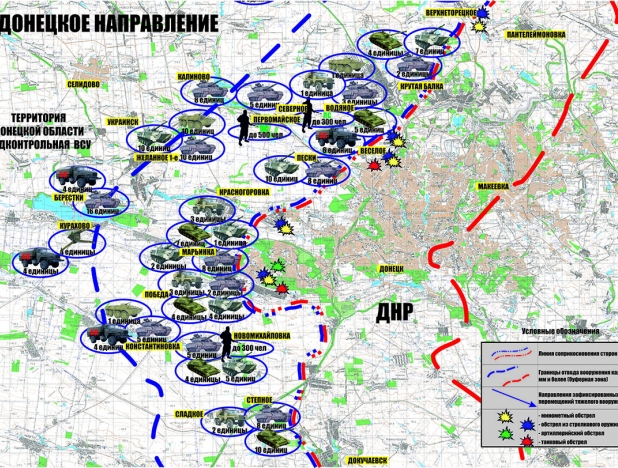
Donetsk People’s Republic: UAF might attempt May holiday offensive to encircle Donetsk

UAF = Ukrainian Armed Forces; ie. Kiev government troops

This is, of course, in complete violation of the Minsk Agreements, but did anyone seriously expect Ukraine or the U.S. or Europe to support then? Minsk was supported by France and Germany to allow the West to regroup, refortify, and refund their war, nothing more. The same thing they’ve done in Syria. When their side is losing, start talking “peace.”

From Fort Russ

April 30, 2016 –
Translated by J. Arnoldski
 
 
“DPR Defense Ministry: Punitive forces may try to “encircle Donetsk from below” over May holidays”
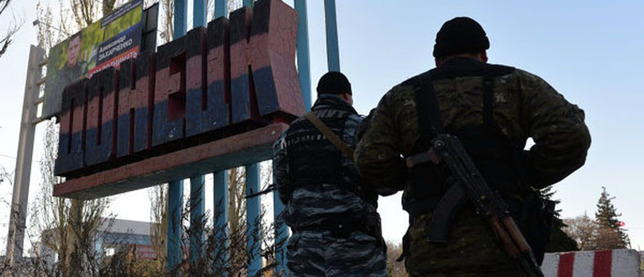
Ukrainian war criminals might try to strike at Donetsk with three tank battalions over the May holidays. This was reported by General Major Denis Sinenkov who heads the operational command of the Armed Forces of the DPR. He stressed that an offensive might begin on the territories which are currently being de-mined. 
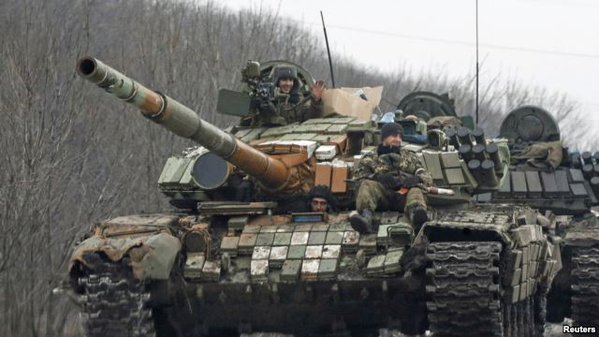
“We are preparing for various developments of the situation. Everyone is talking about the punishers’ preparation for aggressive operations and the intensification of the ‘ATO.’ [so-called Anti-Terrorist Operation] We believe that the main strike by the UAF will be at one area backed by three tank battalions. That is, a strike at the belly in order to encircle Donetsk from below,” Sinenkov said, also noting that attacks might happen in other districts – “in some places with less force, in some places as a distraction.” 
Sinenkov also stated that according to the republic’s intelligence services, the UAF is actively re-deploying and rotating the Nazi battalions on the front line of defense.

He stressed that the Ministry of Defense of the DPR “is aware of the location of tank battalions despite the fact the Ukrainian military command has attempted to hide them. We are ready to break their fist. The quicker the aggressor will go on an offensive, the sooner we will liberate our lands from this brown plague.”  

http://www.fort-russ.com/2016/04/dpr-uaf-might-attempt-may-holiday.html

A restless night in Donbass

From Fort Russ

Translated by Ollie Richardson for Fort Russ
24th February, 2016
 
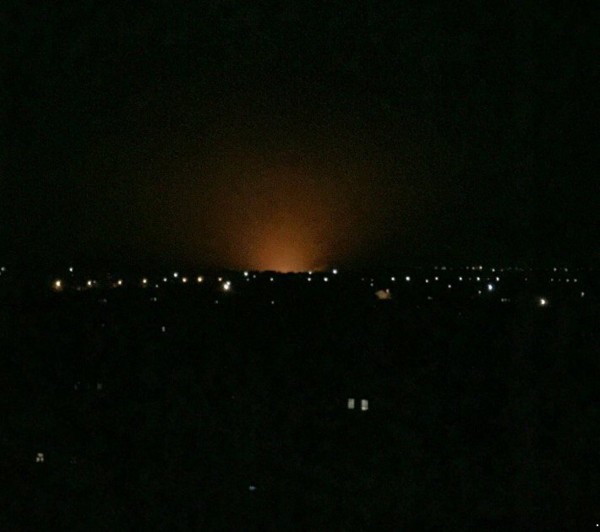
To be brief, it has begun. Indeed the fighting in Donbass has resumed. More precisely, the firing of weapons prohibited by the Minsk agreements. Again, after dark, Donetsk, Gorlovka, Makeyevka, Yasinovataya feels the charm of the “truce”. If before the shelling on the outskirts of the city we were informed by daily summaries from Basurin, now we hear for ourselves that there is almost nothing left of the ceasefire.
On Defender of the Fatherland Day, the Ukrainian army began to congratulate the armed forces of the Donetsk People’s Republic in the evening of the 22nd February. At approximately 18:00 the attack on the Yasinovataya post, Oktyabrsky, the Airport began.
“Now at 21:11 it’s all trembling and shaking in the vicinity of Donetsk. From 20:30 and at this minute in the area of Yasinovataya, near the post of the traffic police, there is an intense battle. You can hear small artillery and tanks. Apparently, UAF is trying to breach again. Bangs can be heard all across Yasinovataya. The windows are shaking. Thinking about the stairs into the basement. It hasn’t been like this for a long time”,- stated the reports from local residents.
It was the same in Gorlovka, which had suffered a lot before this.
“North Of Gorlovka. Zaytsevo. UAF infantry trying to come to the Northern suburbs of Gorlovka. A battle began, then flying shrapnel on our positions (and residents in homes and apartments) from large caliber mortars. They aim at sniper positions.”.
The same situation occurred already on 23rd February, but with greater intensity. The sounds of war can be heard even in the rear areas of Donetsk. Thunder. Trembling. Shaking. Frankly speaking, the situation is tense.
“The whole Western front is booming. Maryinka, Staromikhaylovk, Volvo center, Pesky, Spartak, the Airport, Gorlovka. The UAF use all possible weapons. Half an hour ago, in the outskirts of Staromikhaylovka thundered 6 explosions, which shook the entire city. The intensity of the fire increases with each passing hour.”
23.02.16 Yasinovataya
But there is something about this situation that is unlike the previous ones: the reaction of the people. Although all are incredibly scared during the attacks, all were waiting for them. Being under constant pressure, many panicked and believed those who tried to convince the locals that they were betrayed. The resumption of active hostilities instills hope that now the DPR and LPR armies will stop at nothing and will be able to push the enemy farther away from our cities. People believe in their defence, knowing that they will be able to give a worthy answer to the army of the occupier. The fact that the Ukrainian government is trying to divert people’s attention from the real problems and again to write off everybody in the war plays into the hands of DPR and LPR. A breach of silence, the Ukrainian side has untied the hands of the armies of the People’s Republic that will allow them to liberate the occupied territories. Let’s hope for it and believe in our soldiers.
Soon I’ll have photo reports from the places of attacks and shelling.
Alas, but it seems it will be an uneasy night.
P.S. A quote from the head of the DPR Alexander Zakharchenko :

“If Kiev will go on the offensive, then we’ll go on the counter. Where it will end — we’ll see…”

http://www.fort-russ.com/2016/02/a-restless-night-in-donbass.html

Donetsk SitRep: DPR under heavy artillery fire – 24.2

DONi Press

February 24, 2016

‘The situation on the contact line remains tense’, said Vice-Commander of Donetsk Army Eduard Basurin on Wednesday. ‘In the shellings the enemy used heavy 122mm and 152mm artillery’, Basurin said.

The Ukrainian military violated the ceasefire thirty-three times and shelled the territory of the Republic a hundred and forty-eight times. In the shellings the enemy used 122mm and 152mm artillery three times, 120mm mortars twenty times, 82mm mortars a hundred and four times, as well as infantry fighting vehicles, grenade launchers and small arms.

The Ukrainian punitors fired from the localities of Pesky, Nevelskoye, Zhovanka and Opytnoye at the localities of Zaytsevo, Zhabichevo, Staromikhaylovka, the area of the airport, the Volvo Centre, the Kuybyshevsky and Petrovsky districts of the city of Donetsk. The shellings were carried out from the positions of the 14th and 93rd separate mechanised brigades under command of Zhakun and Klochkov.

The intelligence of the DPR Armed Forces keeps registering the concentration of the enemy’s weapons and military equipment near the contact line:

– In Krasnogorovka (3 km away from the contact line) there was registered the arrival of four 120mm motorised artillery systems “Nona-C”;
– In Dzerzhinsk (2 km away from the contact line) the was registered the transportation of four tanks;
– In Vesyolaya Dolina (12 km away from the contact line) there was registered the arrival of eleven infantry fighting vehicles.

Besides, according to the OSCE mission’s report, in the sites of the Ukrainian weapons and equipment storage the observers documented the absence of ten tanks.

The Ukrainian military and political authorities continue to carry out activities on the preparation for the offensive, which is indicated by the facts of transporting artillery and equipment to the contact line. Zhakun and Klochkov continue to compete on who will become a bloody hero of Ukraine, shelling civilians and residential areas. We can state as a fact that in the Kuibyshev district of Donetsk two civilians were wounded in the shellings. That’s how the “defenders of the Motherland” betray their moral foundations, maiming civilians.

Vice-Commander Eduard Basurin, official translation by DONi News Agency

DONi News Bulletin

https://dnipress.com/en/posts/donetsk-sitrep-dpr-under-heavy-artillery-fire-24.2/

America threatens a protracted war, ‘ground operations’ in Syria — Interview with Russia’s Prime Minister Dimitri Medvedev

Global Research, February 15, 2016
euronews 14 February 2016
medvedev

Featured image: Russia’s PM Dimitri Medvedev

Transcript of the PM interview with Euro News. Emphasis by GR

Syria

Isabelle Kumar: Many thanks for being with us on The Global Conversation. The issue of Syria is dominating the international agenda. But we feel we could be reaching the turning point yet it’s unclear which way it is going to go. What do you think?

Dmitri Medvedev: You know, as I was heading to this conference, I had a feeling that the situation in this area is very complex and challenging because we have yet to come to an agreement with our colleagues and partners on key issues, including the creation of a possible coalition and military cooperation.

All interactions in this respect have been episodic so far. That said, I note that here, in Munich, Russian Foreign Minister Sergei Lavrov met with Secretary of State John Kerry, and other colleagues acting in various capacities later joined them. They agreed on what should be done in the short run. For this reason, I’m cautiously optimistic about the prospects for cooperation on this issue. Let me emphasise that this cooperation is critical, because unless we come together on this issue, there will be no end to the war in Syria, people will keep dying, the massive influx of refugees to Europe will continue, and Europe will have to deal with major challenges. Most importantly, we will be unable to overcome terrorism, which is a threat to the entire modern civilisation.

Isabelle Kumar: What precise military actions and other, in that case, is Russia prepared to take to help in this de-escalation of the conflict in Syria?

Dmitri Medvedev: Let me remind you the reasons behind Russia’s involvement in Syria. The first reason that compelled Russia to take part in this campaign is the protection of national interests. There are many fighters in Syria who can go to Russia at any time and commit terrorist attacks there. There are thousands of them in Syria.

Second, there is a legal foundation in the form of the request by President al-Assad. We will therefore take these two factors into account in our military decisions and, obviously, the developments in the situation. What matters most at this point is to agree on launching the talks between all the parties to the Syrian conflict. Another important thing is to coordinate a list of terrorist groups, since this issue has been a matter of endless debates on who’s good and who’s bad. This is the first point I wanted to make.

My second point is the following. I learned that Secretary of State John Kerry said that if Russia and Iran do not help, the US will be ready to join other countries in carrying out a ground operation. These are futile words, he should not have said that for a simple reason: if all he wants is a protracted war, he can carry out ground operations and anything else. But don’t try to frighten anyone. Agreements should be reached along the same lines as Mr Kerry’s conversations with Mr Lavrov, instead of saying that if something goes wrong, other Arab countries and the US will carry out a ground operation.

I’ve answered this question only recently. But let me reiterate that no one is interested in a new war, and a ground operation is a full-fledged, long war. We must bear this in mind.

“We want sound, advanced relations both with the United States and the European Union”

Assad’s future

Isabelle Kumar: Clearly, one of the key issues is the future of Syrian President Bashar al-Assad. Will Russia continue to support him at this crucial moment in time?

Dmitri Medvedev: Russia does not support President al-Assad personally, but maintains friendly relations with Syria as a country. These ties were built not under Bashar al-Assad, but back when his father, Hafez al-Assad, became president. This is my first point in this respect.

Second, we have never said that this is the main issue for us in this process. We simply believe that there is currently no other legitimate authority in Syria apart from Bashar al-Assad. He is the incumbent president, whether anyone likes it or not. Taking him out of this equation would lead to chaos. We have seen that on numerous occasions in the Middle East, when countries simply fell apart, as it happened with Libya, for example.

It is for that reason that he should take part in all the procedures and processes, but it should be up to the Syrian people to decide his destiny.

Syria’s future

Isabelle Kumar: Are you therefore already working on ideas of political transition now in Syria?

Dmitri Medvedev: I don’t think that we should go into too much detail on these issues. I’m talking about Russia, the European Union and the United States. We should focus on facilitating the launch of this process. We must make sure that everyone sits down at the negotiating table, in fact, make them talk to each other. Let’s be honest and recognise that it will be anything but simple given the parties involved. On one side, you have President al-Assad, supported by a part of society and the military, and, on the other side, the other part of society, often representing different confessions, people who don’t like al-Assad but have to sit with him at the same negotiating table. Nevertheless, they need to come to an agreement for the sake of keeping Syria united.

Ukraine crisis

Isabelle Kumar: I’d like now to switch focus and look at the conflict in Ukraine. We talk of the frozen conflict there with, it appears, renewed fighting in the east. What can Russia do to bring about the thaw in that conflict, to bring an end to this conflict?

Dmitri Medvedev: Well, understandably, the answer here is somewhat easier than in Syria’s case. It is not just because this conflict is not as brutal, but because there is a clear understanding of how to move forward – by implementing the Minsk Agreements.

They should be implemented fully and in their entirety by all the parties. In fact, Russia calls on all the parties to do so, both those in power in the southeast, and the Kiev authorities. It is not a matter of Russia having some disagreements with Kiev or mutual dislike.

It would be fair to say that most of the provisions that were the responsibility of southeast Ukraine have been fulfilled. Most importantly, hostilities have ceased almost completely. Unfortunately, some action takes place from time to time, but not often. Finding political and legal solutions in keeping with the Minsk Agreements has now become vital. Whose responsibility is it? Of course, it is Ukraine’s responsibility. If Ukraine regards the southeast as part of its territory, it is within the jurisdiction, competence and authority of the President, Parliament and Government of Ukraine.

Isabelle Kumar: If you meet President Poroshenko here, at the Munich security conference, what will you say to him?

Dmitri Medvedev: I haven’t seen him and, to be honest, I haven’t missed him. President Poroshenko is in contact with President Putin. There is no doubt that the main thing my colleagues should undertake is to do everything it takes to implement the Minsk Agreements. It would benefit them, as well as the Ukrainian state, which, no matter what anyone says, is a close, neighbouring country for Russia.

Crimea

Isabelle Kumar: Obviously, one of the major sticking points in this, for Ukraine, but also for the international community, is Crimea. Is the future of Crimea up for negotiation?

Dmitri Medvedev: No, there is no such issue for Russia. This issue was settled once and for all. Crimea is part of Russia. A referendum was held there, we amended the constitution. The Republic of Crimea and the city of Sevastopol are part of the Russian Federation.

Russia’s relations with the world

Isabelle Kumar: So the conflict in Syria, the situation in Ukraine has contributed to a real degradation of relations with Russia, with the EU and the US. Do you think a reset is possible?

Dmitri Medvedev: The question is how and for whose sake. If something is to be reset, it should be done on a fundamentally different basis. What kind of basis? Equitable, fair, solid basis for relations, considering that Russia is not the only nation that needs this – the European Union and the United States need it as well. We want sound, advanced relations both with the United States and the European Union.

The European Union is our most important trade partner, a group of countries located on the same continent as us, so we are bound by our shared European identity, history and values. These continuing tensions aren’t doing us any good. But if we are told that they no longer want us around, of course, the first steps towards reconciliation should be taken by those who initiated the alienation. As for us, we are ready to discuss any issues.

Russia’s economy

Isabelle Kumar: Well, one of the repercussions of the souring of relations has been the sanctions that have been imposed on Russia, which are hitting hard. How much of a priority is it for your government to get those sanctions lifted?

Dmitri Medvedev: They told us we were the bad guys and had to be punished. And then they made some calculations and began to weep: it turns out that for some reason it was hitting their own business.

We had a trade turnover with the European Union at 450 billion euros. It was 450 billion! Now it is down to 217 billion euros. Why don’t they ask the people in the EU who are employed by the various companies that used to make products for Russia – how do they like all of this?

Again, we are not the ones who started this, so it is not up to us to undo it. They have always been trying to intimidate us with some sanctions, which were introduced even in the Soviet period, many times. It never brought them anything but lost profits. What is happening now is no different. They will have to have the courage to say, guys, we’ll just scrap all this from day X, and could you please reciprocate by lifting your response measures as well. That would be the right approach.

Isabelle Kumar: So how are ordinary Russians feeling this economic crisis? Because the sanctions are contributing towards this, the falling oil prices are also contributing to this. What’s it like for ordinary Russians?

Dmitri Medvedev: Indeed, we aren’t in the best economic situation right now, with the dramatic fall in oil prices probably contributing the most to the overall state of the economy, to the decline in revenues. This is something we haven’t seen for 17 years. The current prices are comparable to those in 1998. Unfortunately, our budget remains very dependent on oil prices. Although the structure of revenues has been improving, in terms of the share of oil and other sources, but yes, it remains commodity-dependent to a great extent. This could not but affect the incomes and the general standing of our people with their jobs and their real incomes.

The sanctions have had some effect as well. This is obvious, since some of our companies, for example, lost the financing they used to have from European banks, which means they cannot grow, some of them anyway. Therefore, in this sense, the economic situation is not the easiest. But there is also a positive effect. The economy is healing, it is becoming less dependent on oil, and we have an opportunity to develop our own industry and agriculture.

Perhaps one of the advantages of these sanctions and our response measures is that we started concentrating harder on domestic agriculture, so, to a large extent, we are now satisfying our demand for food, while wheat, for example, is now exported in large quantities. In this sense, the sanctions have helped. But they probably didn’t help farmers in the European Union.

Isabelle Kumar: I was asking about the ordinary Russians and how this was affecting them. And we hear of possible social unrest as their lives become more and more difficult in Russia. Is that something you are concerned about?

Dmitri Medvedev: Of course, the government must first of all think about the social impact of economic changes and the economic situation. Frankly, we have been compelled to cut budget spending in many areas, but we never touched social spending, or the public sector wages and benefits.

Moreover, we even indexed pensions last year, and this year, too, maybe not completely, but we did. We will try to continue doing this in the future. That is, the government’s social spending is large, but it is inviolable. In this sense, we will try to do everything towards Russian citizens’ social wellbeing, to keep them as comfortable as possible under these conditions. It is truly a priority for the government.

Russia’s human rights record

Isabelle Kumar: If we take an international perspective once again, a black mark on Russia’s reputation is the issue of human rights and freedom of speech, which Russia seems to continually backslide on. Why is that?

Dmitri Medvedev: To be frank, we’ve always differed in our views on the situation with the freedom of expression and the media in Russia. We’ve often been criticised and we are still coming under criticism. We have our own position on the issue. Perhaps in Russia, the media are somewhat different, for example, from the European media.

There are historical differences and there are growth issues. I rarely watch TV or read newspapers in print and I receive virtually all of my information from the Internet. And over half of Russia’s population does the same. As you know, on the Internet, there is no regulation in this sense. All points of view are represented there, including, to put it bluntly, even extremist ones. So I believe it’s not serious to think that some people have no access to different kinds of information in today’s global world.

Litvinenko enquiry

Isabelle Kumar: Yes, but also it seems that dissidents are silenced. In Britain, as you know, there has been – the results of the inquiry into the murder of Alexander Litvinenko, which the inquiry said – it pointed the finger at President Vladimir Putin, saying that it was likely that he ordered that murder. Will you be pursuing the British Government on this? There was talk of you suing the British Government over this inquiry.

Dmitri Medvedev: You’ve mentioned some report by some retired judge, in which practically every paragraph and each section opens with the word “probably”. What is there to comment on? What is regrettable about this whole story is that the British Prime Minister and the Foreign Secretary comment on a report that abounds in words like “probably”.

This is reminiscent of a witch-hunt. When all is said and done, let it be on the conscience of the commentators. As for any legal action, this is simply ridiculous. We don’t need this and the Russian Federation will never sue any country over some foolish fabrications or funny films.

Highlights

Isabelle Kumar: Finally, Mr Prime Minister, you’ve held the post of prime minister and also held the presidency, so you’ve got an overview, a full perspective of the issues we’ve been talking about, but if I were to ask you about one of the highlights of the your time in power, could you say what that’s been?

Dmitri Medvedev: Well, there’ve been plenty. Both these posts are very serious and challenging. These eight years of my life – and it has been almost eight years – you know, it’s this constant drive. As for events, there have been plenty, both in Russia – very good ones for me personally, notable, major, and sometime tragic events, like the ones we’ve been talking about now, and international events.

After all, we have not only argued and quarrelled. We’ve also accomplished a thing or two. For example, at some point we agreed on a New Strategic Arms Reduction Treaty. That was not bad at all. The document was signed. It is in force. It is being implemented and therefore we can work together and agree on different things. There have been contacts with my colleagues, including here in Germany, as well as in other European countries. We have dealt with a lot of issues. All of this is remarkable and exciting. Maybe one day I’ll talk about this in detail. For the time being I continue working and this work is interesting.

Prime Minister, many thanks for joining us.

Kiev has amassed 238 tanks, 101 ceasefire violations over the past week — Basurin (Video)

From Fort Russ

7th December, 2015

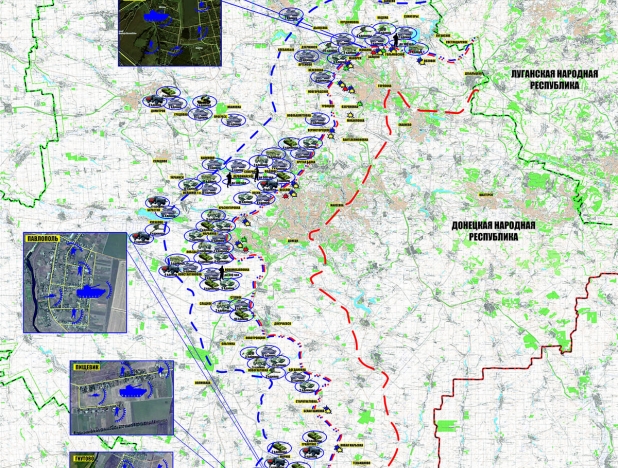
With Joe Biden and Victoria Nuland visiting Ukraine this week, it would seem they have brought some gifts with them – death and destruction. Towns such as Gorlovka are a 24/7 hot spot of action, with Pisky, Spartak and the New airport Terminal also receiving a daily barrage. The concern is that the UAF has regrouped since the Minsk II ceasefire agreement and has many new recruits and new toys from Washington. The map below shows how the UAF are approaching the contact line:
Maps courtesy of DONi News Agency

US-NATO starts new phase of training and equipping Ukrainian military, against Minsk

Global Research, November 29, 2015
TASS 26 November 2015
Ukraine Troops

The United States has launched a new phase of training of Ukrainian servicemen, a fact, which may have negative consequences for the future of the Donbas truce, Russian Foreign Ministry Spokesperson Maria Zakharova said on Thursday.

 She recalled that 300 US instructors from the 173rd US airborne brigade had trained three battalions – 780 people – for Ukraine’s National Guard in a period from April to November. “It is noteworthy that the training completed at a time when the situation on the line of contact in Donbas started getting worse and the newly trained people were apparently sent there,” Zakharova said.

“Now the Americans and their NATO colleagues, including the Lithuanians and Canadians, will train a new group of Ukrainian troopers. It is clear that such preparations are unlikely to deescalate tensions and may have a negative impact on the fragile truce in the country’s southeast,” the Russian diplomat stressed.

“The presence of foreign paratroopers and their weapons on the Ukrainian soil means gross violation of the Minsk package of measures, point 10 in particular, by the Kiev government,” Zakharova said adding that point 10 provides for the OSCE-monitored withdrawal of all foreign units, military vehicles and mercenaries from the Ukrainian territory.

“It does not say that this provision applies exclusively to (Ukraine’s) eastern provinces. The Kiev authorities unequivocally took a commitment which does not contain any reservations and concerns the entire territory under their control,” the Russian Foreign Ministry spokesperson said.

US Navy Captain Jeff Davis, a spokesperson for the US Department of Defense, has recently said that the United States is starting a second phase of training of the Ukrainian army and is planning to train and equip six army battalions, including one special operations unit.

Ukrainian troopers will undergo training according to the US Fearless Guardian program launched in 2014. At its first stage, the United States trained and equipped the National Guard units, which are subordinate to Ukraine’s Interior Ministry. Now, the US instructors will train army battalions.

Three hundred military instructors of the 173rd airborne brigade of the United States Army based in Vicenza, Italy, will undergo training at the Yavorovsky testing ground in the Lviv region, Western Ukraine. A special operations battalion will be prepared in the West Ukrainian city of Khmelnitsky.

Lugansk conference discusses Donbass vs. Crimea scenarios

From Fort Russ

September 21, 2015 –
NCN
Translated for Fort Russ by J. Arnoldski 

 
“Polish political scientist: Donbass clearly wants to become a second Crimea”
The polish political scientist Mateusz Piskorski participated in a conference in Lugansk, where his colleagues discussed the idea of the accession of Donbass to the Russian Federation. 
The leadership and people of the unrecognized Donetsk and Lugansk people’s republics are in favor of joining Russia if Kiev will continue to not abide by the Minsk agreements. The director of the European Center for Geopolitical Analysis, Mateusz Piskorski, stated to the National News Service this while participating in the Lugansk conference “The Path of Integrating Donbass into Russia.”
“Sooner or later, if the Ukrainian side will not be up to implementing the Minsk agreements and Kiev will continue to call the leadership and population of the DPR and LPR terrorists and separatists, then Donbass will not be left another exit other than joining the Russian Federation,” the Polish expert said.
This topic is not being discussed on a political level, but nevertheless it is a reflection of public opinion, Piskorski noted. According to him, the political scientists and participants of the conference were interested in understanding “whether Novorossiya will become a second Crimea for Russia, that is, acceding to Russia through a referendum, through direct democracy.” 
“At the conference in Lugansk, there were participants not only from the DPR and LPR, but also from Russia and European countries. In addition to political experts, politicians, in particular the head of the LP Igor Plotnitsky and the speaker of the parliament of the DPR, Denis Pushilin, attended,” Piskorski told the National News Service.
Let us recall that since April, 2014, Kiev is conducting the so-called anti-terrorist operation. Ukrainian security forces use armored vehicles and heavy artillery against disgruntled locals who are against the February coup and who held a referendum on secession from Ukraine. 
In more than a year of fighting, the local militia has managed to defend a part of the territory of the Donetsk and Lugansk regions, proclaiming there two republics which have so far not received international recognition.
A plan for settling the armed conflict was written in the Minsk agreements which implied the preservation of Donbass as part of Ukraine by granting the region a special status. 
According to the United Nations, nearly 8 thousand people have been killed over the course of the conflict. 

http://fortruss.blogspot.com/2015/09/lugansk-conference-discusses-donbass-vs.html

Angela Merkel’s affront to Russia and the gulf in German-Russian relations

By John Helmer
Posted on Naked Capitalism, May 19, 2015

How Angela Merkel Has Been Abandoned By John Kerry, Victoria Nuland, And Vladimir Putin

Angela Merkel, the German Chancellor, would do almost anything to get and keep power. That, in the opinion of powerful German bankers, includes making herself look ready for war with Russia in order to make her political rival, Frank-Walter Steinmeier, the coalition Foreign Minister and opposition leader in Berlin, look too weak to be electable when the German poll must be called by 2017. So, sources close to the Chancellery say, Merkel insulted President Vladimir Putin and all Russians to their faces last week. This week Victoria Nuland, the junior State Department official who told the chancellor to get fucked a year ago, was in Moscow, replacing Merkel with a settlement of the Ukraine conflict the Kremlin prefers.

“We are ready for this,” Foreign Minister Sergei Lavrov said last Thursday after meeting Secretary of State John Kerry. Referring to Nuland, Lavrov added: “we were not those who had suspended relations. Those, who had done it, should reconsider their stance….But, as usual, the devil is in the details.” Lavrov meant not one, but two devils, who have sabotaged every move towards a settlement of the Ukraine conflict since the start of 2014 – Nuland and Merkel.

Merkel’s Kaput! moment came on May 10, when she went to Moscow to lay a wreath at the Tomb of the Unknown Soldier. Deutsche Welle, the state German press agency, called it Merkel’s “compromise after she stayed away from a Russian military parade the day before.”

At the following press conference with Putin, Merkel said: “We have sought more and more cooperation in recent years. The criminal and illegal annexation of Crimea and the military hostilities in eastern Ukraine has led to a serious setback for this cooperation.” German sources say the word Merkel said, “verbrecherische” has rarely been used by her before; it carries the connotation in colloquial German of gangsterism — and of Nazism. “Merkel doesn’t seem to care what she says any longer,” a high-level German source says. “She exhibits more and more emotion these days, more irritation, and less care for what she says, and where. Putin understood exactly what she meant, and on the occasion she said it. He acted with unusual generosity not to react.”

The Kremlin transcript omitted Merkel’s remarks altogether. The Moscow newspapers ignored Merkel’s word and emphasized the positive Putin ones. “Our country fought not against Germany,” Putin replied to Merkel, “but against Nazi Germany. We never fought Germany, which itself became the Nazi regime’s first victim. We always had many friends and supporters there.”

US state radio followed with an attempt to endorse Merkel’s “verbrecherische”, and castigate the Kremlin for ignoring it. “An official interpreter at a Kremlin press conference has omitted a top Western leader’s stinging criticism of Russia’s annexation of Ukraine’s Crimea region”, Radio Free Europe/Radio Liberty reported on May 12.

Reporter Carl Schreck claimed he “is unclear whether the interpreter made a conscious call to soft-pedal Merkel’s rebuke, or simply missed the word…One person who certainly would have understood the German word for ‘criminal’ used by Merkel – ‘verbrecherisch’ — is Putin himself. The Russian leader, who was stationed in Dresden with the Soviet KGB in the 1980s, is a fluent German speaker and in the past has spoken with Merkel in her native language. Whether he heard the word might depend on what ear Putin was listening with. He sported an earpiece on his left ear, presumably to listen to the Russian-language interpreter. His right ear — the one closest to Merkel — was free of electronic accoutrements.”

Schreck – the word in German means fright or scare — was a reporter for the Moscow Times for several years before moving to Prague for the US government. On his own website he doesn’t explain his German background, or whether his Washington state upbringing included the German language. Compared to Putin, Schreck is a soft touch for the oligarch Mikhail Prokhorov. For him Schreck’s most sensitive question has been: “What do you look for in a woman?”

Verbrecherische isn’t the first instance of Merkel’s loose lips sinking her own ship. Last November she picked more aggressive German for impromptu remarks than were set down in the chancellery’s script. But that was in Australia, and Putin had already left the country. Merkel isn’t the only politician to say things in Australia which don’t count in the rest of the world.

The irony of Merkel’s May 10 attack on Putin is that Kremlin sources believe Putin has been the last of the officials on the Security Council to give Merkel the benefit of their strategic doubt. Yevgeny Primakov, Putin’s most experienced strategic advisor, has been telling him privately for months there is no prospect of salvaging the German-Russian entente while Merkel is chancellor, and no hope for the German opposition to break her grip in the short run.

In public, on January 15, Primakov said: “External changes that would favor Russia should not be expected anytime soon. It is doubtful that the sanctions will be cancelled in the near future. Betting on some politicians and European businessmen who speak against the sanctions is not realistic.” Primakov omitted the adjective German out of politeness. He and the Russian intelligence services regard Merkel as Washington’s patsy.

Two days after Merkel’s trip to Moscow, on May 12, Kerry met with Putin and Lavrov in Sochi. The Kremlin communique was minimal, acknowledging that “special focus” had been given to the Ukraine conflict. “The Russian side gave its assessments of the reasons behind the Ukrainian crisis, stating the key points of Russia’s position. It was stressed during the meeting that Russia strives to implement the Minsk Agreements in full and will do its utmost to support this process.”

By “reasons behind”, Putin and Lavrov meant Nuland and the Washington war party. Ahead of the Sochi meeting, the State Department spokesman had tried to play up Kerry, and downplay Nuland. “You can’t deal with diplomatic issues if you don’t do diplomacy,” the spokesman declared on May 11. On May 13, the spokesman was asked if “United States is ready to put pressure on Ukraine to fully implement Minsk II agreements”, and ducked the question.

On the next day, by the time Nuland was in Kiev meeting Prime Minister Arseny Yatseniuk and President Petro Poroshenko, the spokesman claimed the “United States’ full and unbreakable support for Ukraine’s government, sovereignty, and territorial integrity. We continue to stand shoulder to shoulder with the people of Ukraine and reiterate our deep commitment to a single Ukrainian nation, including Crimea, and all the other regions of Ukraine.”

Whatever devil can be read in these details, US Government statements indicate something new — there are now only two pairs of shoulders, Merkel’s having been shouldered aside. If there’s to be a settlement of the Ukraine conflict, it will be trilateral, according to the US, one between the US, Russia, and Ukraine. From the Russian point of view, it’s plain this means a deal between Russia and the US, with Nuland to keep the Ukrainian government in line.

Nuland has insisted that she was right beside Kerry in his meetings in Sochi. The press photographs have excluded her. The Kremlin, Lavrov and Kerry have spoken as if Nuland wasn’t there.

In Sochi Kerry also went to the trouble of showing Merkel how to behave in front of a memorial to the Russian dead in the war against Germany.

According to Kerry, “the war memorial here in Sochi [is] where more than 4,000 of the millions of courageous then-Soviets who died in World War II are buried. And it’s a very beautiful memorial and I was very moved by the young children who were there taking part in the ceremony. And I think Sergey and I both came away from this ceremony with a very powerful reminder of the sacrifices that we shared to bring about a safer world, and of what our nations can accomplish when our peoples are working together towards the same goal.”

Kerry also gave the regime in Kiev a warning of what not to interpret from anything Nuland may be saying. “If… President Poroshenko is advocating an engagement in a forceful effort at this time,” Kerry said in Sochi, “we would strongly urge him to think twice not to engage in that kind of activity, that that would put Minsk in serious jeopardy. And we would be very, very concerned about what the consequences of that kind of action at this time may be.”

http://www.state.gov/secretary/remarks/2015/05/242214.htm

Now that Nuland has been excluded from the decision-making of the big boys, her job was to go to Kiev to tell the smaller boys what the new US line is. Yatseniuk’s version of their talks – minus the customary photo opportunity – was that “the key topics of the talks were questions of overcoming Russian aggression and the implementation of the Minsk agreements, the implementation of economic reforms and the fight against corruption, as well as the assistance from the United States in these processes. Yatsenyuk and Nuland discussed the status of implementation of the program of cooperation with the International Monetary Fund, as well as the preparation for a free trade zone between Ukraine and the European Union from January 1, 2016.”

Poroshenko stuck to pledging allegiance: “coordination of our actions with the U.S. is vitally important,” is the only quote the presidential website posted from the meeting. Photo opportunities were also curtailed.

Nuland’s version, according to the US Embassy transcript, was to emphasize just how “eager [we are] to deepen our involvement in helping the parties achieve full implementation—everything from complete ceasefire and pullback on the line of control, to the political pieces, to the border pieces.” By “political pieces” Nuland meant the constitutional changes for eastern Ukraine Putin insists on and Kerry mentioned, while Nuland bit her tongue.

Nuland has also ignored Yatseniuk’s requests for more money because Washington will neither declare it’s in favour of a Ukrainian default on its US-held sovereign bonds at the end of this month, nor provide any money to stop it.

Instead, the US Treasury rolled out its former Secretary, Lawrence Summers, to announce that the International Monetary Fund (IMF) “has done as much as can reasonably be asked”. Summers, on the receiving end of Ukrainian oligarch Victor Pinchuk’s treasury (right), is this week omitting to call for fresh European Union money or contributions from the Ukrainian oligarchs.

Summers says he is also opposed to an offer of new American taxpayer money. Instead, his US Treasury plan is that “Ukraine’s creditors — led by the investment firm Franklin Templeton, but also with the support of a number of major US fund managers, who are sufficiently embarrassed by their selfish and unconstructive position that they avoid public identification — are playing hardball and refusing any write-offs. Understandably, if there are a substantial group of such free riders, other debt holders including the Russians will not accept writedowns… The IMF and national authorities should call out the recalcitrant creditors on their irresponsible behaviour.”

In Kiev Nuland put Merkel in her place, relegating her and the French to a single mention in last place in the process to decide the outcome of the Ukraine settlement. The US, she said in Kiev, is “in lockstep with our European allies and partners”. Lockstep means chain-gang — Germany must follow where the US leads. The Merkel Kaput! has been followed by the Merkel kibosh!

Dictionary note: Kaput started in French, when it meant losing in cards, and passed into English via the German kaputt during World War 1. Kibosh, disposed of in English, is derived from the Irish caidhp bháis, meaning death cap — the hood put on someone before execution, or the black cap worn by English judges when pronouncing the death sentence.


John Helmer, the longest continuously serving foreign correspondent in Russia, and the only western journalist to direct his own bureau independent of single national or commercial ties. Helmer has also been a professor of political science, and an advisor to government heads in Greece, the United States, and Asia. He is the first and only member of a US presidential administration (Jimmy Carter) to establish himself in Russia. Originally published at Dances with Bears

John Helmer: How Angela Merkel Has Been Abandoned By John Kerry, Victoria Nuland, And Vladimir Putin


US State Dept. chief Kerry strongly warns Poroshenko about attempting to retake Donbass and Crimea: “Think twice”

By Eric Zuesse
Posted on Global Research, May 19, 2015

On Tuesday, May 12th, U.S. Secretary of State John Kerry was asked at a press conference in Sochi Russia, to respond to Ukrainian President Petro Poroshenko’s recent statements promising renewed war against Donbass, which were made first on April 30th, “The war will end when Ukraine regains Donbass and Crimea,” and which were repeated on May 11th, by his saying, “I have no doubt, we will free the [Donetsk] Airport, because it is our land.” In other words, Poroshenko had repeatedly made clear that he plans a third invasion of Donbass, and, ultimately, also to invade and retake Crimea. (The Western press, however, had not reported any of these threats that were being made by Poroshenko.)

Kerry responded:

 I have not had a chance – I have not read the speech. I haven’t seen any context. I have simply heard about it in the course of today [which would be shocking if true]. But if indeed President Poroshenko is advocating an engagement in a forceful effort at this time, we would strongly urge him to think twice not to engage in that kind of activity, that that would put Minsk in serious jeopardy. And we would be very, very concerned about what the consequences of that kind of action at this time may be.”

For the rest of the article:

http://www.globalresearch.ca/obama-gave-up-on-ukraine-towards-a-plan-b-for-ukraine/5450396
Obama Gave Up on Ukraine? Towards a Plan B for Ukraine?

Link to press conference:
http://www.state.gov/secretary/remarks/2015/05/242214.htm


Kiev junta launches a large scale attack on Novorossia right in time for Russian Orthodox Easter

From Fort Russ

Russian Orthodox Easter is April 12.

April 9, 2015
Translated by Kristina Rus
Based on reports from Rusvesna

Ex-Minister of Defence of DPR Igor Strelkov:

“In general, we can say that the ceasefire is over – the entire front is under fire, including artillery. Shock troops of the enemy moved to the forefront.”

Donetsk under fire

War correspondent “Step” reports: 

Shells are whistling again over the cities of Donbass. In Donetsk the sirens of ambulances and emergency services are heard. Under fire: Kievsky district, Oktyabrsky village, Panfilov mine village, Gladkova, Severny, Putilovka.

The entire evening of April 9 there was a battle in the village of Spartak and near Peski. The punishers used artillery guns, tanks, mortars, heavy barreled artillery. Under the cover of artillery, the enemy attempted to seize the positions of the militia in Spartak and near the airport. During the battle, this attempt was severely suppressed.

Also suddenly the positions of the militia near the town of Yasynovataya were attacked. There was a battle using small arms. To the West of Petrovsky district of Donetsk working mortars are also heard, as well as grenade launchers and heavy machine guns.

From the occupied Volnovakha Dokuchayevsk was fired on. The outskirts of the city are under a heavy fire of the enemy, the people are hiding in shelters fearing the assault on the city by the punishers, who have assembled the biggest formation in this area of about 8 thousand people.

According to a resident of Dokuchayevsk, “Locals demand that the militia do not leave them alone and hold positions at any cost, women are hysterically crying, saying that Ukrainians will go into the city and start a massacre. Older women bless the passing trucks with soldiers and pray for the victory and a speedy liberation to the district from the Ukrainian troops”.

Over Donetsk about a dozen enemy drones were spotted, one of which was shot down near the Lidiyevka mine.

The militia is put on full alert and is ready for a full-scale attack of the enemy.

Shirokino

On April 9, 2015 near Mariupol in Shirokino there was a fierce battle. There were dead and wounded among the militia and the Ukrainian occupation troops.

Tanks approaching Donetsk

00:10. Donetsk.

From several directions at the moment, the occupants are pulling the tank columns to Donetsk.

In particular, a few dozen tanks approached the airport from the direction of Marinka and Avdeevka.


http://www.fortruss.blogspot.com/2015/04/kiev-junta-launches-large-scale-attack.html