Poland launches $42-billion war buildup

Sofia News Agency
February 16, 2015
Poland Embarks on Massive Spending to Overhaul Military Hardware

NATO member Poland, bordering conflict-torn Ukraine, has earmarked a whopping EUR 33.6 B in spending to modernise its armed forces.

The plans will bring Poland in line with NATO’s recommended defense spending target of 2% of gross domestic product, AFP said on Monday.

The planned overhaul over a decade calls for the purchase of new military hardware including anti-aircraft systems, an anti-missile system as well as combat drones, armored personnel carriers and submarines.

Poland’s shopping list also includes helicopters and cruise missiles for submarines and drones.

According to Polish officials, “the risk of the conflict in eastern Ukraine heating up remains” even though a ceasefire agreement between the government in Kiev and pro-Russian separatists was signed last week in Belarus’ capital Minsk.

“The possibility of a lasting peace still isn’t close,” AFP quoted Poland’s President Bronislaw Komorowski as saying last week.

…

Defence Minister Tomasz Siemoniak said last week that Poland was drawing up a long-term plan to shift some of its military strength towards its eastern border, closer to Ukraine and Russia, in response to Moscow’s involvement in Ukraine.


Source:

https://rickrozoff.wordpress.com/2015/02/18/poland-launches-42-billion-war-buildup/

NATO to establish Command Center in Lithuania within months

Xinhua News Agency February 18, 2015

NATO to establish command center in Lithuania in summer

VILNIUS: A NATO command center in Lithuania will be established in the summer, General Hans-Lothar Domrose, commander of Allied Joint Force Command Brunssum, said during his visit here on Tuesday.

The top general held discussions on security issues and NATO’s presence in the region with heads of the Lithuanian army.

According to Domrose, the final decision on command centers would be made by defense ministers from NATO member countries in June, but in terms of military preparedness Lithuania was ready.

“Today, I saw an excellent readiness for the establishment of NATO force integration unit in Lithuania. In my view, this staff in Lithuania will be established in the summer and will reach its full capacity this year,” the general was quoted as saying in a press release from the Ministry of National Defense of Lithuania.

“We are on the right track,” he added.

According to Domrose, around 40 officers will work at the command center, with around half of them being Lithuanians and others being sent from other NATO member countries.

Two weeks ago, defense ministers from NATO member countries agreed on posting international military staff in Lithuania and five other Central and Eastern European countries in response to new security threats in the region.

During his visit, Domrose emphasized that this year there will be more NATO military force exercises in the region. Military exercises are to be attended not only by U.S. soldiers but also by the forces of Portugal, Germany, the Netherlands and Hungary, according to Lithuania’s national television LRT.


https://rickrozoff.wordpress.com/2015/02/17/nato-to-establish-command-center-in-lithuania-within-months/

German military association demands massive armaments increase

Welt.de reports that Lieutenant Colonel André Wüstner, President of the Armed Forces Association, said, “Whoever wants peace must prepare for war.” [1]
——————————————————————————

From World Socialist Web Site, February 14, 2015
By Johannes Stern

Against the backdrop of the Ukraine crisis, leading German politicians and military leaders are demanding a massive rearmament of the army.

On Sunday, the president of the armed forces association [Bundeswehrverband], André Wüstner, attending the Munich Security Conference, declared: “Whoever wants freedom must be ready for war.” He has precisely the same view as the German government, namely that the conflict in Ukraine cannot be solved militarily, but that the army must prepare itself for any emergency.

The past year has shown “how quickly risks can turn into dangers,” said Wüstner. The situation in Ukraine, Syria and Iraq is dramatic, he said.

“For us, that means insisting that the army should be fully equipped—equipment caps passed by the previous legislature must be abolished! That begins with the weapons system and goes all the way to the personal equipment of the individual soldier.”

“To achieve complete preparation of the army for deployment”, he added, “we must raise the defense budget step by step in the next few years. Otherwise, we risk losing the trust of our allies that we have only just won back.”

Wüstner was referring to “global challenges” and the German role in NATO. Germany has a “payback responsibility” with regard to the army and NATO.

The lieutenant colonel complained, “Since 1990, the budget was restructured to save money at the expense of the army,” and demanded: “It is time for that to end—there have to be credible assurances of funding for deterrence and security!”

This year’s defense report raises similar demands and read like a blueprint for the rearmament of the army. In the forward, the parliamentary defense commissioner Hellmut Königshaus (Free Democratic Party, FDP) describes the year 2014 as “the year of truth” for the army. It is being rebuilt into an army capable of intervening worldwide, but is “stretched to the limit of its capacity.”

The first part of the report creates the impression that the German armed forces are a chronically underfinanced scrapheap in need of redevelopment and in urgent need of a massive increase in budgetary allotments.

In nearly all units, there are personnel problems: the anti-aircraft missile unit stationed in Turkish territory, the speedboat squadron, the U-boat squadron, the tactical air force squadron, the marine planes and the signals division.

With regard to large military equipment, the report says there are massive “inadequacies and deficits.” It mentions, for instance, the Eurofighter, the transport helicopter NH 90, the transport airplane Transall and the marine mine warfare systems. There are not enough armored personnel carriers, and barracks are dilapidated. Replacement parts for military equipment and adequate ammunition are also lacking. And the main gun used by the army, the G36, does not shoot accurately.

Wüstner and the defense report demand what the German government and NATO have wanted for a long time but have previously only formulated cautiously because of widespread popular opposition.

Defense Minister Ursula von der Leyen (Christian Democratic Union, CDU) said in her opening speech to the Munich Security Conference last weekend that Germany is working “very hard to bring the army’s weaponry and equipment into a condition that will allow us to maintain our role as enduring alliance partners.” NATO wants this to take place immediately. The military alliance has long demanded of its members that they raise their defense budgets to at least two percent of GDP. Recently, NATO Secretary General Jens Stoltenberg insisted that Germany set a good example.

Stoltenberg held talks with Chancellor Angela Merkel, Foreign Minister Frank-Walter Steinmeier and Defense Minister von der Leyen about increasing military funding during his inaugural visit to Berlin in January. He also presented his plans to the parliamentary committees for defense and foreign policy.

Germany is a “key country” on the continent and has an important leadership role to play, said Stoltenberg. Therefore it must set an example for other NATO countries with its military. The security situation is changing “and we must adjust ourselves to that,” the NATO secretary general said.

Like Wüstner and von der Leyen, Stoltenberg directly related his plans for armaments with Russia’s “confrontation course”. NATO must stock up its arsenal, because only on the basis of a “position of strength” is a dialog with Moscow possible.

However, the most important reason for the demand to build up the army is not the NATO insistence, but the end of German restraint in matters of foreign policy announced by President Gauck and the German government a year ago. In order to be able to intervene worldwide to defend German economic, geopolitical and security interests, they need an army that is well equipped and prepared.

The complaints of the defense report about the bad condition of the army evoke historical parallels. In 1933, minister of the army of the Reich, Werner von Blomberg, prepared a memorandum in which he called the state of the German army “hopeless.” Like the current defense report, Blomberg’s memorandum complained that there were inadequate personnel reserves, military equipment and ammunition. Not even the equipment guaranteed by the Versailles treaty was available to the marines. Armoured ships were not delivered and the air force was almost nonexistent.

The dramatic development that then followed is well known. At the end of the same year, the Nazi regime began a rapid rearmament of the army. Within a short time, the German weapons industry, which had shrunk dramatically in accordance with the Versailles peace treaty, became a powerful fighting force that began the Second World War in 1939, left large parts of Europe in ruins and led a brutal war of destruction against the Soviet Union.


http://www.wsws.org/en/articles/2015/02/14/bund-f14.html

http://www.globalresearch.ca/german-army-association-demands-massive-armaments-increase/5431282

[1] http://www.welt.de/politik/deutschland/article137224332/Deutschland-muss-auf-Krieg-vorbereitet-sein.html


“Loud Talk, Not Loud Deeds”–NATO aid to Ukraine

Posted on Fort Russ

By Alex Leshy, 2/16/2015
Translated from Russian by J.Hawk

I can’t characterize NATO’s position in any other way. A complete mess. The Secretary General says one thing, the supreme military commander something entirely opposite. While the heads of NATO member states say something different altogether. Which means that NATO has officially adopted a very curious position. Something along the lines of “we, as alliance will not give Ukraine any aid, but individual member states may make their own decisions. Any decisions.”

Officially that position is formulated as follows. The matter of arms supplies to Ukraine will not be raised at NATO level. This was announced by NATO SecGen Stoltenberg in an interview with Kommersant.

So the simple conclusion is that Ukraine will get no weapons. Instructors will appear. But only as instructors, and only very far away from the front line. Not that there will be much use from them, given their “effectiveness” at training Iraqis or Afghans. No successes anywhere. US military assistance is what is preventing their collapse. But as soon as the Americans start to “leave”, everything falls apart. The story of ISIS success is a perfect example.

Why would anyone expect something different? For example, German or US tanks? Which cost $6.2 million apiece?

During the summer of 2014 UAF had 600 perfectly fine tanks, while the militia had none. Did that help the UAF? On the other hand, let’s assume the UAF somehow could train its crews to operate NATO tanks. But how many would it expect to receive? The US has a total of 8725 M1 Abrams MBTs. UAF would need 600-700 vehicles to replenish their units. Does anyone seriously expect the US will simply give Ukraine 10% of its MBT fleet, which would cost $4.3 billion? Or perhaps 600 Leopard’s from the Bundeswehr, out of the total store of 1048 vehicles? There are also the French Leclercs, which total 776 [that’s the total number produced—the French army purchased only 400 of them]. Would France be willing to transfer virtually all of its heavy armor to Ukraine? Does anyone seriously believe that?

This does not even address the question of fuel and lubricants, which Ukraine likewise has in short supply, so that too would have to be imported, in other words, bought using hard currency which Ukraine doesn’t have. As a reminder, a single round of tank gun ammunition costs $25 thousand. In some cases it may be as low as $6-8 thousand. Still, that means a full load of 40 rounds costs a quarter of a million dollars minimum. And a single load can be easily expended in a single day. Even if you stretch it out over a week, it still means Ukraine would have to spend 150 million a week for tank ammunition. Or 450 million a month.

So I understand the NATO SecGen and the US president perfectly well. Supporting democracy is one thing, but are we going to gift them $4.3 billion worth of tanks, and then continue giving them half a billion a month worth of ammunition? For what? Just to watch as the Novorossia “radishes” blow up the expensive NATO tanks and then make selfies with the wrecks in the background? Well, to hell with Ukraine. And to hell with the money. But who will buy our “armored coffins” after that kind of advertising? Even the much praised and invincible Abrams tanks turned out not to be the wonderwaffles [a pun on the German word “wunderwaffe”, meaning wonder weapon] their marketing claimed. Even in the hands of skilled US crews. To say nothing of local crews. While the T-72s spat upon by the Western media are operating quite effectively. Even in the hands of local crews.

So would France want to turn over its entire tank fleet to Ukraine, only to then watch all potential buyers steer clear of them in the future. No thanks. But that’s politics. Loud words are no less important than loud deeds. Therefore when it comes to words the entire Western world is lined up shoulder to shoulder, full of readiness to help, support, strengthen, and supply. But when it comes to deeds…NATO already said noooo, not us. But hey, if individual countries want to help, that’s fine because democracy is sacred. We just can’t see any individual members do anything serious. For example, there have been many discussions about the Polish Dana152mm SP howitzers [actually a Czech design, though also used by the Polish Army] that have started last year, all these talks and so far not a single Dana had been seen in Ukraine. Not even a single blurry photograph. There are photos of everything else. Even of drunk US instructors asleep on the grass. But not of the Danas. So it would seem there no Danas in Ukraine. There were discussions, but that’s as far as things got.

In conclusion, it seems to me that Kiev’s hopes to get Western weapons and other “state of the art” stuff are about as likely to be fulfilled as the expectations that the EU will immediately open its borders to Ukrainians in February 2014.

J.Hawk’s Comment: I could only add that NATO countries have no guarantees the equipment they supply would not end on the international arms market. Which would be an even greater embarrassment than seeing it being destroyed on the Donbass.


http://alex-leshy.livejournal.com/456913.html
NATO-Ukraine Relationship: What is the best way of doing nothing?

http://www.fortruss.blogspot.com/2015/02/loud-talk-not-loud-deeds-nato-aid-to.html


The US-sponsored neo-Nazi coup d’etat in Ukraine — an act of war

Otan nazisme

The NATO logo has a right-turning and  a left-turning swastika in the four pointed star.

How much of the NATO war agenda is a recycled and updated German/U.S. Wall Street war agenda?
——————————————————————————

From Global Research

Violence and bloodshed continues to rock Ukraine as factions compete in the power vacuum of February 2014  coup in Kiev.

As the country struggles to find its way forward, however, it finds itself in the crosshairs of a NATO war agenda that has been unfolding for years.

This is the GRTV Feature Interview with our special guest, Professor Michel Chossudovsky. This GRTV program was first aired on March 21, 2014

This is the first Neo-Nazi government of the post war period.

Who are the architects of this Neo-Nazi government.

They claim to be Neoliberals, yet they support neo-Nazis.


http://www.globalresearch.ca/the-neoliberal-neo-nazi-coup-detat/5431339

Vladimir Putin’s interview with Egyptian newspaper Al-Ahram

Posted on The Kremlin, February 9, 2015

Excerpt:
In the run-up to his visit to the Arab Republic of Egypt, Vladimir Putin gave an interview to the Al-Ahram daily newspaper…

QUESTION: How would you assess the situation in Ukraine and around it? What do you think will be the most appropriate way out of the Ukrainian crisis?

VLADIMIR PUTIN: I would like to remind Egyptian readers that the Ukrainian crisis was not caused by the Russian Federation. It has emerged in response to the attempts of the USA and its western allies who considered themselves ‘winners’ of the cold war to impose their will everywhere. Promises of non-expansion of the NATO to the East (given yet to the Soviet authorities) have turned out to be hollow statements. We have seen how NATO’s infrastructure was moving closer and closer towards Russian borders and how Russian interests were being ignored.

Moreover, in the framework of the EU Eastern Partnership Program there have been attempts to tear states which had been parts of the former USSR off Russia and to prompt them to make an artificial choice “between Russia and Europe.” The Ukrainian crisis has become a high point of these negative trends. We repeatedly warned the USA and its western allies about harmful consequences of their interference in Ukrainian domestic affairs but they did not listen to our opinion.

Last February the USA and a number of EU member states supported the coup d’état in Kiev. The ultranationalists who seized the power using military force put the country on the edge of disruption and started the fratricidal war.

Unfortunately, today we can see how the ‘war party’ in Kiev actively supported from the outside continues its attempts to push the Ukrainian people over the edge of a catastrophe. The situation in Donbas has aggravated dramatically. Ukrainian security forces resumed the bombing of Donetsk, Lugansk and other residential areas in the region. They are building up their military presence there. The “new wave” of mass mobilization has been announced in the country; there are calls for “taking revenge” after summer “military failures” and for a forceful “Ukrainization of Donbas.”

Ukraine is militarizing rapidly. We can judge by the statistics: in 2014, the Ukrainian military budget increased by almost 41 percent. This year, according to preliminary data, it will more than triple and reach more than $3 billion – which is about 5 percent of the country’s GDP. And this is happening when its economy supported mostly with international, including Russian, funds is in rather deplorable situation.

We certainly feel worried. We hope that common sense will prevail. Russia strongly calls for a comprehensive and exclusively peaceful settlement of the Ukrainian crisis based on the Minsk agreements which were largely achieved owing to the initiative and efforts of the Russian side.

The most important condition for the stabilization of the situation is immediate cease-fire and ending of a so called ‘anti-terrorist’, but in fact punitive, operation in the south-east of Ukraine. Kiev’s attempts to exert economic pressure on Donbas and disrupt its daily life only aggravate the situation. This is a dead-end track, fraught with a big catastrophe.

It is evident that the crisis will continue until the Ukrainians themselves agree with each other. Until the unbridled radicalism and nationalism are finished with, and the society is consolidated around positive values and genuine interests of Ukraine. To achieve this, Kiev authorities need to listen to their people, find a common language and reach an agreement with all political forces and regions of the country. They need to elaborate such constitutional state system formula that would provide for a safe and comfortable living for all citizens with human rights being fully observed.

In the meantime, it is necessary to do one’s utmost to make all the parties to the conflict gather around the negotiating table. In this context, the Russian side stands for forging sustainable and direct contacts between Kiev and Donetsk and Lugansk, for continued work within the Contact Group. On our part, we intend to actively contribute to that process.

For the full interview with questions on many topics:

http://eng.kremlin.ru/transcripts/23575

Bulgarian protesters denounce planned NATO base

From Stop NATO

Press TV
February 9, 2015

Bulgarian protesters censure NATO base plans

Bulgarian protesters have held a demonstration to condemn the government’s plan to allow the setting up of a NATO military command base on the country’s soil.

The demonstrators assembled in front of the presidency building in the capital city of Sofia on Sunday and later marched to the parliament, carrying banners that bore anti-EU and NATO messages.

“25 years of American democracy – robbery, ruin, destruction of the state,” read one banner.

The demonstrators also called for the resignation of Bulgarian President Rosen Plevneliev.

The protest came after NATO Secretary-General Jens Stoltenberg announced earlier this month that NATO would immediately be establishing command and control units in six eastern European states, including Bulgaria.

The Western military block has over the past year increased its presence and conducted several drills in Eastern Europe amid the crisis in Ukraine. In 2014, NATO forces held some 200 military exercises with Stoltenberg promising that such maneuvers would continue.

Russia has also condemned NATO’s exercises and military buildup toward its borders on numerous occasions.

https://rickrozoff.wordpress.com/2015/02/09/bulgarian-protesters-denounce-planned-nato-base/

NATO Chief: Military cohesion needed to “prevent new age of disorder”

From Stop NATO

U.S. Department of Defense
February 9, 2015
Unity Will Prevent New Age of Disorder, NATO Chief Says
By Jim Garamone

[Perhaps Stoltenberg meant to employ the verbs create, spread or maintain for “prevent.”]

WASHINGTON: Solidarity is needed to prevent a new age of disorder, NATO Secretary General Jens Stoltenberg said yesterday in Munich.

“History is not written in advance,” the secretary general said at the annual Munich Security Conference. “We can prevent an age of disorder if we have the will. We can keep the international order that has served us so well if we stand up for its rules and if we stand up for each other.”

Last year marked a turning point for European security and the global order, he said. In Europe, Russia annexed Crimea and is seeking to destabilize Ukraine. Russian President Vladimir Putin is seeking to intimidate the Baltic republics, Poland, Romania and Georgia.

“North Africa and the Middle East are also in turmoil,” Stoltenberg said. “States are breaking up, and conflict is at our borders. Extremism is fueling barbaric violence across the region and inspiring terrorism on our own streets.”

Maintaining Order

But the international order can be maintained if like-minded nations stick together, he said.

One of the tools, he said, is NATO — the most successful international security pact in history. “Since its foundation, NATO has been a resolute guardian of the international order,” Stoltenberg said. “That order is being challenged, and we must do our utmost to protect it.”

NATO must change to address the threats of the 21st century, and it must maintain and increase its strength, the secretary general said…

NATO and allied forces must be ready to deploy at a moment’s notice and must be able to deter any threat from any direction, Stoltenberg said, including countering the so-called “hybrid warfare” that Russia has used in Ukraine.

‘We Cannot Do More With Less Forever’

This is going to require resources, the secretary general said, noting that since the end of the Cold War, European defense spending has fallen steadily. “We cannot do more with less forever,” he added.

At NATO’s summit in Wales, alliance leaders agreed to increase defense spending as their nations’ economies grow. “It cannot be done overnight,” Stoltenberg said, “but it can be done.”

…

“We are stepping up our support for Jordan, and Iraq has asked us to help improve its defense capacity,” he added. “In this way, we can project stability without deploying large numbers of troops, because most of the time, it will be more effective to help countries look after their own security.”

NATO Chief: Military Cohesion Needed To “Prevent New Age Of Disorder”

February 6 NATO meeting heightens danger of war with Russa

NATO leaders continue to lie about Russian aggression when even the Ukrainian military says there are no Russian troops in Ukraine. It is NATO aggression, pushing against Russian borders, arming neighboring countries, conducting constant military exercises in those countries, and arming and equipping the Ukrainian military to conduct genocidal operations against the Ukrainian people.

By Johannes Stern, February 5, 2015
World Socialist Web Site

NATO defense ministers are meeting in Brussels today to consolidate the military alliance against Russia, increasing the risk of a direct military confrontation between nuclear-armed powers.

NATO sources have revealed plans to establish a long-term presence in Eastern Europe, according to a report in the Frankfurter Allgemeine Sonntagszeitung (FAS). So-called NATO “Force Integration Units” will be established in Estonia, Latvia, Lithuania, Poland, Romania and Bulgaria. There are also plans to deploy such a unit in Hungary at a later time.

The units will consist of 40 soldiers each. They will be tasked with preparing exercises for a new NATO rapid response force and coordinating military activities in emergencies. Germany, which is spearheading the operation this year, intends to deploy a total of 25 soldiers within the units.

The ground troops of the rapid response force are to consist of a brigade of some 5,000 soldiers. The goal is for their most flexible units to have the capability to move to a new location within 48 hours. The entire brigade will be trained and equipped to be able to move to a new location within a week. The leadership of the operation will rotate yearly between NATO member countries.

According to the FAS, NATO defense ministers have already decided on the equipment to be provided during the “test phase,” which is to last until the beginning of next year. Starting in April, a company of German paratroopers will supplement American units that have been stationed in the Baltic States and Poland since last year.

Two weeks ago, the FAS revealed that NATO defense ministers will convene the Nuclear Planning Group (NPG) at the beginning of today’s meeting to discuss “the nuclear threat scenario from Russia in the past few months.”

Unlike previous years, according to the FAS, this will not merely be a routine meeting. An analysis of threat scenarios worked out at NATO headquarters will be presented to the defense ministers. Afterwards, the ministers “will for the first time discuss the consequences for the nuclear strategy of the alliance.” A separate consultation session is planned with France, which is not a member of the NPG.

NATO’s nuclear simulations underscore the fact that the imperialist powers are ready to risk nuclear war in order to force Russia to its knees. In the past week, a number of prominent figures, including former Soviet head of state Mikhail Gorbachev, have warned of the danger of a Third World War if NATO, led by the United States, continues to take aggressive measures against Russia.

Under conditions of escalating fighting between troops of the Western-backed Kiev regime and pro-Russian separatists in eastern Ukraine, Gorbachev warned of a “hot war” that “could well inevitably turn into an atomic war.”

On Sunday, the Süddeutsche Zeitung quoted the Russian military expert Yevgeny Buchinsky, who warned that, in response to an offensive against the Donbass by Kiev,

“Russia will have to intervene, and then, bluntly speaking, to take Kiev. Then NATO would be in a difficult situation. Then you would have to start World War III, which no one wants.”

In spite of such warnings, the imperialist powers and their proxies in Kiev are escalating the conflict. On Monday, the New York Times revealed that the Obama administration is considering sending advanced weapons to Kiev. The newspaper listed high-ranking current and former administration officials and military officers who are pushing for such a move.

The Times report triggered opposition among sections of the European elite. The Süddeutsche Zeitung wrote that a decision by Washington to arm the Kiev regime with offensive weapons would be taken by Russia as the equivalent of a declaration of war. Russian officials and German Chancellor Angela Merkel spoke against any such move during a visit to Hungary.

Washington intends to use today’s NATO meeting to bring the member states into line behind its provocative and reckless course. At the beginning of the week, Alexander Vershbow, a former US ambassador to Russia and currently the deputy secretary general of NATO, referred to “Russian aggression” in Ukraine as a “game changer in European security.”

He emphasized the necessity of deploying rapid response troops in Eastern Europe, extending NATO’s reach in the east, and arming the Ukrainian military. Referring to Ukraine, Georgia and Moldova, all former Soviet republics, he said,

“The more stable they are, the more secure we are. So helping Ukraine, Georgia and Moldova—to strengthen their military forces, reform their institutions and modernize their economies—is not an act of generosity, it is in our fundamental strategic interest.”

He added,

“NATO is doing its part. To help Ukraine to modernize and reform its armed forces, we have launched five trust funds to assist in areas like command and control, logistics, cyber defense and military medicine. We are sending more advisors to Kiev and will be carrying out exercises with Ukraine’s armed forces. And we are helping Moldova and Georgia to strengthen their defense capacity in similar ways, and, in Georgia’s case, to help it prepare for future membership in the Alliance.”

At the end of his speech, Vershbow warned:

“This time around, having chosen our course, we must stick to it. We must stay united, stay firm and increase the costs to Russia of its aggression.”

Meanwhile, voices in favor of arming Ukraine are growing louder. Michael Gahler (Germany’s Christian Democratic Union—CDU), who is the spokesman on security policy for the European People’s Party in the European Union parliament, spoke in favor of sending weapons to Ukraine in an interview on Deutschlandfunk radio.

Wolfgang Ischinger, leader of the Munich Security Conference, which takes place this weekend, has adopted the same line. On ZDF Television he spoke in favor of the “announcement of possible weapons shipments” to Ukraine. “Sometimes one needs to use pressure to enforce peace,” he declared. While he cautioned that Germany should not send weapons, he said he could “imagine that other members of the alliance would want to do this.”

Ukrainian President Petro Poroshenko, whose regime was brought to power nearly a year ago by a fascist-led putsch backed by the US and Germany, and has since waged a brutal war against the population of eastern Ukraine, made an appearance yesterday in Kharkiv, which is near the border with Russia and the contested areas. He said that “we will need lethal weapons, and I am sure that foreign weapons will be sent to Ukraine.” He continued: “I don’t have any doubt that the US and other partners will provide help with lethal weapons so that Ukraine will be able to defend itself.”

Poroshenko will take part in the Munich Security Conference along with 20 other heads of state and 60 foreign and defense ministers. He is meeting with US Secretary of State John Kerry in Kiev today.

Source:
http://www.wsws.org/en/articles/2015/02/05/nato-f05.html

Re-posted on
http://www.globalresearch.ca/nato-meeting-in-brussels-heightens-danger-of-war-with-russia/5429695

Ukraine: “We target civilians.” Separatists: “Their targeting maps prove it.”

Eric Zuesse. 1 Feb. 2015
Posted on Fort Russ

The pro-regime Ukrainian TV station Hromandske TV — which is funded by the U.S. Government, the Dutch Government, and George Soros (via his International Renaissance Foundation or ‘Fund’) —  has reported that the Ukrainian Government is specifically targeting civilians to die in the Donbass region in the former Ukraine’s southeast. It’s being done in order “to clean the cities.”
This is open acknowledgement that the operation, which the U.S. is financing (and Ukraine is bankrupt so it can never reimburse its donors), is actually an ethnic-cleansing campaign.
Previously, on Hromadske TV, a proponent of doing just that (ethnic cleansing) was interviewed. He said: “If we take, for example, just the Donetsk oblast, there are approximately 4 million inhabitants, at least 1.5 million of which are superfluous. … Donbass must be exploited as a resource, which it is. … The most important thing that must be done — no matter how cruel it may sound — is that there is a certain category of people that must be exterminated.”
Here is how it’s done:
[9 September 2014, from Slavyangrad, pro-separatists’ clips are shown, taken from pro-Ukrainian-Government telecasts]
Video of Commander of the Ukrainian Government’s volunteer battalion ’Shaktarsk,’ Ruslan Onishchenko:
“Our mission, being employees of the Ministry of the Interior, is to clean the cities, after the army has ‘worked’ this territory with aircraft, artillery and heavy military equipment. This is a normal tactical approach to warfare.”
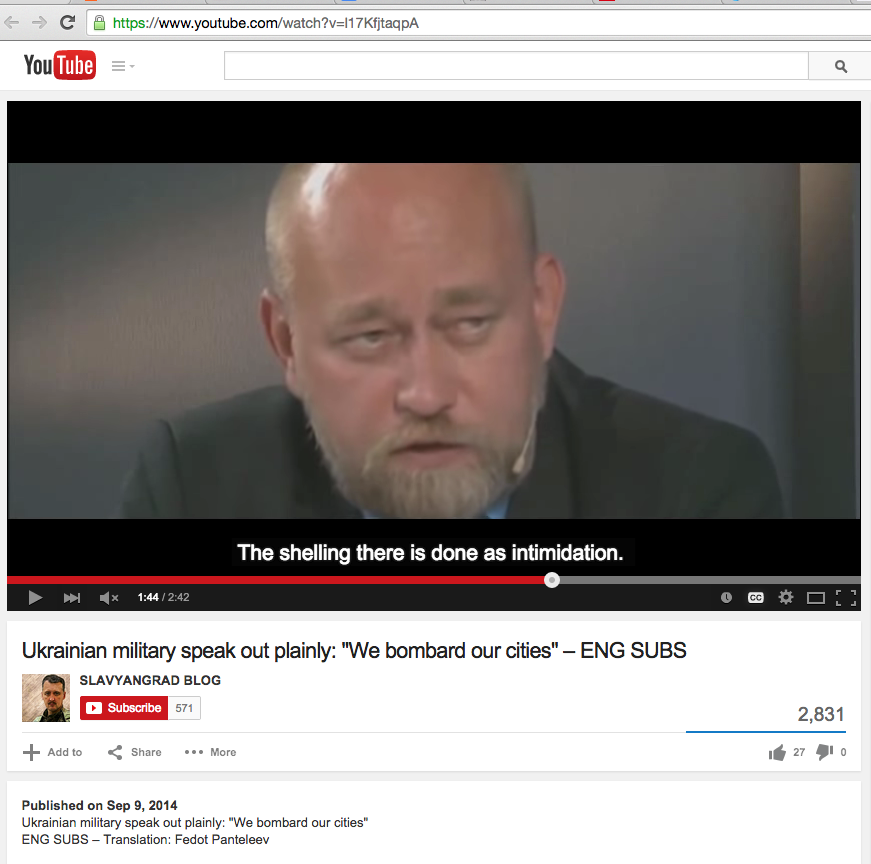
Retired Col. General Vladimir Ruban, interviewed on the pro-Ukrainian-Government Hromadske TV, then says:
“I want to offer the Ukrainian artillerists medals, to those who shell the city [Donetsk], the houses and the civilian population,
… for they [artillerists] have deserved it [medals], both because of the accuracy and inaccuracy.
… It’s one thing if attack groups or any mobile mortar troops drive through the city and shoot,
… but if the artillery units fired from the airport [i.e., from the distance], then no one can claim that the separatists shoot themselves [i.e., that the people who are being killed in the city are victims of separatist troops mistakenly hitting passers-by when aiming at Government troops. He is saying that artillerists will clearly get the blame, whereas street-fighters can always blame the ‘terrorists.’].
… The shelling there is done as intimidation, … not just object destruction, but intimidation [to get the population to flee to nearby Russia]. The civilian population is intimidated by a chaotic bombardment of different objects. There are many shells that plug directly into the streets or vegetable gardens [and so make the very ground on which these people live terrifying to them].
TERVIEWER: This refers to those that didn’t explode?
ANSWER:  Yes, … there are many of those, … shells that fail to detonate. But Gorlowka has been fortunate to have not yet been totally eradicated from the face of the earth, along with the civilian population.
INTERVIEWER: You mean that the city is bombarded violently? ANSWER: Gorlowka was shelled by our troops, [even] as I went there for the prisoner exchange. Although  it was known that I was there, they [our troops] kept up the bombardment of Gorlowka. 

General Ruban might not have known it at the time of his interview, but on February 1st, Life News in Russia bannered “Militia DNR: Ukrainian Army Uses US Missiles,” and reported that in Gorlovka were found “shells that do not belong to Ukrainian artillery, and even more so do not use Soviet or post-Soviet military equipment. According to their hypothesis, the weapons are from NATO. Deputy brigade commander Army DNR [Donetsk People’s Republic] callsign ‘Biker’ showed shells and said that …  this is a special projectile 155 caliber self-propelled artillery of the M109 A1 American production, which is used by NATO countries.” Furthermore,
“The presence of foreigners in their army and radio intercepts confirms our intelligence when we hear in interceptions, phrases in English and Polish.”
Germany’s Bild, and Britain’s Mail, are also among the international news organizations that have previously reported on American mercenaries, including the former notorious Blackwater organization, ‘advising’ the Ukrainian army in this war.  The finding of U.S. military provisions on the battlefields in Donbass is, furthermore, routine; but U.S. soldiers, like Russian ones, are probably not fighting there. Ukraine is only a proxy war between the two major nuclear powers, not yet a direct war between them.
Within just the past few days, further video evidence was uploaded which indicates that the targeting of civilians is a central purpose of the U.S.-funded Ukrainian war campaign.

[29 January 2015] The journalists of Ren TV [a major Russian network, privately owned by Russian aristocrats] today received the first documentary evidence that residential areas of Donbass [the rebelling region of the former Ukraine; the farthest-east part of Ukraine, shown here in the darkest purple] are being targeted. Although Kiev may claim that ‘stray shells’ hit a hospital or a kindergarten, we have found on the front line that is being left behind by departing Ukrainian soldiers, artillery maps, where the targets were restaurants, cafeterias and shops. Here is an exclusive report by our correspondent Valentin Trushin from the former UAF’s [Ukrainian Armed Forces} trenches:
This is a field near the village of Ozeryanovka, from which recently was a Ukrainian battery firing at Gorlovka:
… [The rebel soldier says that many of these abandoned tanks and other weapons are undamaged, and ‘They will say tomorrow that Russia supplied them to us, but it’s actually their equipment that will be repaired if necessary but will be used at war against them.’ Views of Government-destroyed Gorlovka are shown.]
… In the [rebel-]destroyed dugouts were found … notebooks of cannon commanders, maps. The documents show that shelling of the city [by the Government] was not random, but deliberate. The coordinates of the targets are shown. For examples, one is a restaurant, another a cafeteria or a market where no militiamen were stationed.
… Here are their target-maps,
… irrefutable evidence of war crimes.  
Little over a month ago, a rebel commander explained why the Ukrainian armed forces are losing:
[13 Dec. 2014, from Cassad TV in Crimea, run by a man whom the U.S. aristocracy describe as being a far-right Marxist] 
“How the Elite UA [Ukrainian Army] Troops Were Defeated by the Militia. Interview with Commander Kedr” (head of the anti-Ukrainian-Government Semyonovka battalion in the outskirts of Slovyansk):
How did you manage to defeat them?
ANSWER: The most surprising thing is that they were eliminated by the [rebel] militias, who haven’t graduated from any military academies. Many of them haven’t even served in the army before. The majority of them had only for the very first time recently taken weapons in their hands [they hadn’t previously owned or used even a gun]. I think that victory … [resulted from] … the high motivation of our troops, and it was guaranteed by the high morale, the example that was being given by the commanders who were taking part in the fight themselves. It provided such a result. Good trophies [weapons] were captured then, … [and it even] happened before the Ilovaisk cauldron [when the enemy was encircled], and at a time when the situation was very difficult for the militias themselves, … [so] there was only one injured soldier from our side in that battle, but from the enemy’s side were killed 15-12 men, practically all of them [that were fighting]. … Six [of them] were taken captive. [The battlefield is shown with enemy corpses].
… Our unit arrived to collect the corpses of two of their shot-down pilots. But the enemy managed to save one of their pilots. I repeat: Our troops weren’t professional military but people like miners and trolley-bus drivers.
[3:17] I’d say to Ukrainian mothers that our soldiers have nowhere to retreat from their own land, while the enemy have a chance to turn around and go home. 
[4:14: video is shown of the enemy’s combat ration.] It’s an American combat ration.
The actual reason why this southeast-Ukrainian ethnic-cleansing campaign is necessary for Obama, who installed the current regime in Ukraine, is that, if it is not done, and, if the people who lived and voted in the Donbass region (Ukraine’s far-east) were still to remain there and allowed to vote there as being citizens of Ukraine, then they would vote at least 90% against the regime’s candidates, and for moderates, because, even before the regime had started to exterminate these people, they had voted 90% for Viktor Yanukovych in the last democratic Ukraine-wide Presidential election (which was back in 2010), and he was the very same man whom Obama overthrew. Now, after this extermination-campaign, the vote there against the Obama stooges would be virtually 100% — not just 90%.
In other words: Obama needs to get rid of those people. They can die, or else they can flee to Russia, but Obama needs them gone from Ukraine.
As regards why Obama had wanted their land to begin with, it was because unless the gas and other assets in the ground there can be privatized or sold off by the Ukrainian Government to pay its debts, the Ukrainian Government will go bankrupt and become an enormous drag on everyone who had previously lent to it, including the U.S., IMF, EU, World Bank, and others (ironically including even Russia).
Now that the situation is becoming increasingly clear that this land will not be able to be controlled by the Ukrainian Government, Obama’s best bet (in terms of his objectives) is to allow the war simply to end with Ukraine’s defeat, so that no more good money will go to Ukraine after the previous bad money is thus lost, but just cut the losses and bring this truncated and rabidly anti-Russian western half of Ukraine into NATO for the goal that is, apparently, Obama’s top foreign-policy objective: surrounding Russia with U.S. nuclear missiles and with regimes that hate Russia, in order to get Russia’s capitulation to America’s aristocracy.
Vladimir Putin wants Donbass to instead remain a part of Ukraine, as a counter-weight there against the rabidly anti-Russian voters in Ukraine’s western region, so as to produce yet another Yanukovych-like leadership in Ukraine and thus reduce the likelihood of a global nuclear war (which would be Russia’s only alternative if Obama were to succeed in his surround-Russia-with-missiles plan).
After all: John Fitzgerald Kennedy didn’t like it when the Soviet Union in 1962 tried to place nuclear missiles in just one location near the U.S.: Cuba. For Putin, Ukraine is like a nuclear Cuba was to America, but more like around ten nuclear Cubas, in Russia’s case. For Ukraine to join NATO would, perhaps, alone be sufficient threat to Russia so as to produce an immediate Russian nuclear attack against the U.S. and other NATO nations (a pre-emptive Russian attack, against us). The insane ones there would be the U.S. and any nation that supports it — the nations that then are clearly aiming to ‘conquer’ Russia. The U.S., under Kennedy, refused to stand for it in reverse; and Russia, under Putin or any other leader, shouldn’t stand for it, either. NATO needs to end, immediately. It had started as an anti-communist club, and was then valid; but what it was and is after the end of the Soviet Union, is the greatest threat to the entire world. It is now nothing but an anti-Russian club: not just insane, but also evil.
So: that’s the reason why the United States has been supporting (and, until now, even demanding) an ethnic-cleansing campaign in the former Ukraine. It’s part of the evil and supremely dangerous insanity that is NATO.
 
—————
Investigative historian Eric Zuesse is the author, most recently, of  They’re Not Even Close: The Democratic vs. Republican Economic Records1910-2010,  and of  CHRIST’S VENTRILOQUISTS: The Event that Created Christianity.