The launching of the European missile defense system (Aegis) by the United States in May has repeatedly been criticized by Russia as an attempt by the US to take away first mover advantage in the event that the US ever decided to attack.
While Russia has already indicated that the deployment of of Iskander missile systems would be one certain response to neutralize the anti-ballistic missile defense system, Russia has wasted no time in developing future responses.
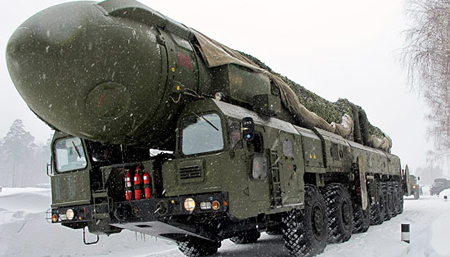
Russia’s new Yu-74 ultra-maneuverable hypersonic glide vehicles may be the next response that will be unveiled. Russia has been developing hypersonic weapons during the past few years, and as Sputnik reports, those weapons would have a speed between 3,840 mph (Mach 5), and 7,680 mph (Mach 10). The system uses sophisticated technologies for maneuvering against a wide range of missile defense systems, and allows precise and rapid delivery of warheads.
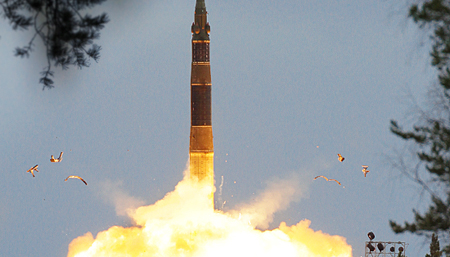
Although the system specifications are top secret, reports say that the gliders are developed to be loaded onto onto Russia’s RS-28 Sarmat, the state of the art heavy liquid propelled ICBM which is currently being developed for the Russian Army. The RS-28, which has been given the codename “Satan” by NATO, has been in development since 2009 and is alleged to render all current missile defense systems obsolete.
Designed to carry up to 24 nuclear-loaded Yu-74 gliders, each Sarmat ballistic missile will be able to hit any target located within a 6.2 thousand mile radius in one hour. Each glider can be equipped with a nuclear warhead, electronic warfare (EW) applications (disruption of communication systems), or false target simulators.
“These features guarantee penetration of any existing and prospective missile defense system of a potential adversary. By adopting such systems, Russia’s Strategic Missile Forces will significantly increase their efficiency” said one analyst.
Last year, Russia conducted a series of tests of the Yu-71 hypersonic attack aircraft. The Yu-71 is part of a secret missile program codenamed “Project 4202″, and the during the tests the glider was said to reach speeds of up to 7,000 mph. Furthermore, Russia has reportedly successfully tested the Yu-74 as well. The glider was launched from the Dombarovsky missile base in the Orengburg region and hit a target located at Kura Missile Test Range in northern Kamchatka region, the Russian far east.
French journalist Victor Ayoli noted that Russia is taking NATO’s saber rattling in Eastern Europe very seriously and will do whatever it takes to secure Russia’s borders.
“Russians are ordinary people. They are afraid of war and they really want to avoid it. The last one cost [the Soviets] more than twenty-eight million lives. But once lured into war, they fight it to the bitter end. This unique trait of the Russian national character the West has misunderstood countless times in the last 1,000 years,” Ayoli emphasized.
* * *
As the US led NATO continues to play around with Russia, it is crystal clear that when Russia announced that it will respond to NATO’s actions “Totally Asymmetrically“, they very well meant it.
We, the undersigned, are Russians living and working in the USA. We have been watching with increasing anxiety as the current US and NATO policies have set us on an extremely dangerous collision course with the Russian Federation, as well as with China. Many respected, patriotic Americans, such as Paul Craig Roberts, Stephen Cohen, Philip Giraldi, Ray McGovern and many others have been issuing warnings of a looming a Third World War. But their voices have been all but lost among the din of a mass media that is full of deceptive and inaccurate stories that characterize the Russian economy as being in shambles and the Russian military as weak—all based on no evidence. But we—knowing both Russian history and the current state of Russian society and the Russian military, cannot swallow these lies. We now feel that it is our duty, as Russians living in the US, to warn the American people that they are being lied to, and to tell them the truth. And the truth is simply this:
If there is going to be a war with Russia, then the United States
will most certainly be destroyed, and most of us will end up dead.
Let us take a step back and put what is happening in a historical context. Russia has suffered a great deal at the hands of foreign invaders, losing 22 million people in World War II. Most of the dead were civilians, because the country was invaded, and the Russians have vowed to never let such a disaster happen again. Each time Russia had been invaded, she emerged victorious. In 1812 Nepoleon invaded Russia; in 1814 Russian cavalry rode into Paris. On June 22, 1941, Hitler’s Luftwaffe bombed Kiev; On May 8, 1945, Soviet troops rolled into Berlin.But times have changed since then. If Hitler were to attack Russia today, he would be dead 20 to 30 minutes later, his bunker reduced to glowing rubble by a strike from a Kalibr supersonic cruise missile launched from a small Russian navy ship somewhere in the Baltic Sea. The operational abilities of the new Russian military have been most persuasively demonstrated during the recent action against ISIS, Al Nusra and other foreign-funded terrorist groups operating in Syria. A long time ago Russia had to respond to provocations by fighting land battles on her own territory, then launching a counter-invasion; but this is no longer necessary. Russia’s new weapons make retaliation instant, undetectable, unstoppable and perfectly lethal.
Thus, if tomorrow a war were to break out between the US and Russia, it is guaranteed that the US would be obliterated. At a minimum, there would no longer be an electric grid, no internet, no oil and gas pipelines, no interstate highway system, no air transportation or GPS-based navigation. Financial centers would lie in ruins. Government at every level would cease to function. US armed forces, stationed all around the globe, would no longer be resupplied. At a maximum, the entire landmass of the US would be covered by a layer of radioactive ash. We tell you this not to be alarmist, but because, based on everything we know, we are ourselves alarmed. If attacked, Russia will not back down; she will retaliate, and she will utterly annihilate the United States.
The US leadership has done everything it could to push the situation to the brink of disaster. First, its anti-Russian policies have convinced the Russian leadership that making concessions or negotiating with the West is futile. It has become apparent that the West will always support any individual, movement or government that is anti-Russian, be it tax-cheating Russian oligarchs, convicted Ukrainian war criminals, Saudi-supported Wahhabi terrorists in Chechnya or cathedral-desecrating punks in Moscow. Now that NATO, in violation of its previous promises, has expanded right up to the Russian border, with US forces deployed in the Baltic states, within artillery range of St. Petersburg, Russia’s second-largest city, the Russians have nowhere left to retreat. They will not attack; nor will they back down or surrender. The Russian leadership enjoys over 80% of popular support; the remaining 20% seems to feel that it is being too soft in opposing Western encroachment. But Russia will retaliate, and a provocation or a simple mistake could trigger a sequence of events that will end with millions of Americans dead and the US in ruins.
Unlike many Americans, who see war as an exciting, victorious foreign adventure, the Russians hate and fear war. But they are also ready for it, and they have been preparing for war for several years now. Their preparations have been most effective. Unlike the US, which squanders untold billions on dubious overpriced arms programs such as the F-35 joint task fighter, the Russians are extremely stingy with their defense rubles, getting as much as 10 times the bang for the buck compared to the bloated US defense industry. While it is true that the Russian economy has suffered from low energy prices, it is far from being in shambles, and a return to growth is expected as early as next year. Senator John McCain once called Russia “A gas station masquerading as a country.” Well, he lied. Yes, Russia is the world’s largest oil producer and second-largest oil exporter, but it is also world’s largest exporter of grain and nuclear power technology. It is as advanced and sophisticated a society as the United States. Russia’s armed forces, both conventional and nuclear, are now ready to fight, and they are more than a match for the US and NATO, especially if a war erupts anywhere near the Russian border.
But such a fight would be suicidal for all sides. We strongly believe that a conventional war in Europe runs a strong chance of turning nuclear very rapidly, and that any US/NATO nuclear strike on Russian forces or territory will automatically trigger a retaliatory Russian nuclear strike on the continental US. Contrary to irresponsible statements made by some American propagandists, American antiballistic missile systems are incapable of shielding the American people from a Russian nuclear strike. Russia has the means to strike at targets in the USA with long-range nuclear as well as conventional weapons.
The sole reason why the USA and Russia have found themselves on a collision course, instead of defusing tensions and cooperating on a wide range of international problems, is the stubborn refusal by the US leadership to accept Russia as an equal partner: Washington is dead set on being the “world leader” and the “indispensable nation,” even as its influence steadily dwindles in the wake of a string of foreign policy and military disasters such as Iraq, Afghanistan, Libya, Syria, Yemen and the Ukraine. Continued American global leadership is something that neither Russia, nor China, nor most of the other countries are willing to accept. This gradual but apparent loss of power and influence has caused the US leadership to become hysterical; and it is but a small step from hysterical to suicidal. America’s political leaders need to be placed under suicide watch.
First and foremost, we are appealing to the commanders of the US Armed Forces to follow the example of Admiral William Fallon, who, when asked about a war with Iran, reportedly replied “not on my watch.” We know that you are not suicidal, and that you do not wish to die for the sake of out-of-touch imperial hubris. If possible, please tell your staff, colleagues and, especially, your civilian superiors that a war with Russia will not happen on your watch. At the very least, take that pledge yourselves, and, should the day ever come when the suicidal order is issued, refuse to execute it on the grounds that it is criminal. Remember that according to the Nuremberg Tribunal “To initiate a war of aggression… is not only an international crime; it is the supreme international crime differing only from other war crimes in that it contains within itself the accumulated evil of the whole.” Since Nuremberg, “I was just following orders” is no longer a valid defense; please don’t be war criminals.
We also appeal to the American people to take peaceful but forceful action to oppose any politician or party that engages in irresponsible, provocative Russia-baiting, and that condones and supports a policy of needless confrontation with a nuclear superpower that is capable of destroying America in about an hour. Speak up, break through the barrier of mass media propaganda, and make your fellow Americans aware of the immense danger of a confrontation between Russia and the US.
There is no objective reason why US and Russia should consider each other adversaries. The current confrontation is entirely the result of the extremist views of the neoconservative cult, whose members were allowed to infiltrate the US Federal government under President Bill Clinton, and who consider any country that refuses to obey their dictates as an enemy to be crushed. Thanks to their tireless efforts, over a million innocent people have already died in the former Yugoslavia, in Afghanistan, in Iraq, Libya, Syria, Pakistan, the Ukraine, Yemen, Somalia and in many other countries—all because of their maniacal insistence that the USA must be a world empire, not a just a regular, normal country, and that every national leader must either bow down before them, or be overthrown. In Russia, this irresistible force has finally encountered an immovable object. They must be forced to back down before they destroy us all.
We are absolutely and categorically certain that Russia will never attack the US, nor any EU member state, that Russia is not at all interested in recreating the USSR, and that there is no “Russian threat” or “Russian aggression.” Much of Russia’s recent economic success has a lot to do with the shedding of former Soviet dependencies, allowing her to pursue a “Russia first” policy. But we are just as certain that if Russia is attacked, or even threatened with attack, she will not back down, and that the Russian leadership will not “blink.” With great sadness and a heavy heart they will do their sworn duty and unleash a nuclear barrage from which the United States will never recover. Even if the entire Russian leadership is killed in a first strike, the so-called “Dead Hand” (the “Perimetr” system) will automatically launch enough nukes to wipe the USA off the political map. We feel that it is our duty to do all we can to prevent such a catastrophe.
What Zuesse describes is a duplicitous enemy, one who masquerades with pretty words and distracting gestures as a friend, while planning your downfall.
Actions speak louder than mere words, and U.S. President Barack Obama has now acted, not only spoken. His action is to refuse to discuss with Russian President Vladimir Putin, Russia’s biggest worry about recent changes in America’s nuclear strategy — particularly a stunning change that is terrifying Putin.
On Sunday June 5th, Reuters headlined “Russia Says U.S. Refuses Talks on Missile Defence System”, and reported that, “The United States has refused Russian offers to discuss Washington’s missile defence programme, Russian Deputy Defence Minister Anatoly Antonov was quoted as saying on Sunday, calling the initiative ‘very dangerous’.”
Russia’s concern is that, if the “Ballistic Missile Defense” or “Anti Ballistic Missile” system, that the United States is now just starting to install on and near Russia’s borders, works, then the United States will be able to launch a surprise nuclear attack against Russia, and this system, which has been in development for decades and is technically called the “Aegis Ashore Missile Defense System”, will annihilate the missiles that Russia launches in retaliation, which will then leave the Russian population with no retaliation at all, except for the nuclear contamination of the entire northern hemisphere, and global nuclear winter, the blowback from America’s onslaught against Russia, which blowback some strategists in the West say would be manageable probems for the U.S. and might be worth the cost of eliminating Russia.
That theory, of a winnable nuclear war (which in the U.S. seems to be replacing the prior theory, called “M.A.D.” for Mutually Assured Destruction) was first prominently put forth in 2006 in the prestigious U.S. journal Foreign Affairs, headlining “The Rise of Nuclear Primacy” and which advocated for a much bolder U.S. strategic policy against Russia, based upon what it argued was America’s technological superiority against Russia’s weaponry and a possibly limited time-window in which to take advantage of it before Russia catches up and the opportunity to do so is gone.
Paul Craig Roberts was the first reporter in the West to write in a supportive way about Russia’s concerns that Barack Obama might be a follower of that theory. One of Roberts’s early articles on this was issued on 17 June 2014 and headlined “Washington Is Beating The War Drums”, where he observed that “US war doctrine has been changed. US nuclear weapons are no longer restricted to a retaliatory force, but have been elevated to the role of preemptive nuclear attack.”
Russia’s President Vladimir Putin has tried many times to raise this issue with President Obama, the most recent such instance being via a public statement of his concern, made on May 27th. Apparently, the public statement by Antonov on June 5th is following up on that latest Putin effort, by Antonov’s announcement there that Obama now explicitly refuses to discuss Putin’s concerns about the matter.
The fact that these efforts on the part of the Russian government are via public media instead of via private conversations (such as had been the means used during the Cuban Missile Crisis in 1962, when the shoe was on the other foot and the U.S. President was concerned about the Soviet President’s installation of nuclear missiles 90 miles from the U.S. border) suggests that Mr. Obama, unlike U.S. President John Fitzgerald Kennedy in 1962, refuses to communicate with Russia, now that the U.S. is potentially in the position of the aggressor.
Russia is making its preparations, just in case it will (because of the Aegis Ashore system) need to be the first to attack. However, some knowledgeable people on the subject say that Russia will never strike first. Perhaps U.S. President Obama is proceeding on the basis of a similar assumption, and this is the reason why he is refusing to discuss the matter with his Russian counterpart. However, if Mr. Obama wishes to avoid a nuclear confrontation, then refusing even to discuss the opponent’s concerns would not be the way to go about doing that. Obama is therefore sending signals to the contrary — that he is preparing a nuclear attack against Russia — simply by his refusal to discuss the matter. In this case, his action of refusal is, itself, an answer to Putin’s question, like slamming the door in Putin’s face would be. It’s a behavioral answer, instead of a merely verbal one.
On Friday, May 27th, Russia’s President Vladimir Putin again asserted that American President Barack Obama lies when saying that the reason America’s anti-ballistic missile (“ABM”) or Ballistic Missile Defense (“BMD”) system is being installed in Romania, and will soon be installed in Poland, is to protect Europe from Iranian missiles that don’t even exist and that Obama himself says won’t exist because of Obama’s deal with Iran. Putin is saying: I know that you are lying there, not being honest. You’re aiming to disable our retaliatory capacity here, not Iran’s. I’m not so dumb as to believe so transparent a lie as your assurances that this is about Iran, not about Russia.
Putin says that ABMs such as America is installing, disable a country’s (in this case, Russia’s) ability to retaliate against a blitz invasion — something increasingly likely from NATO now as NATO has extended right up to Russia’s very borders — and that Russia will not allow this disabling of Russia’s retaliatory forces.
He said that “NATO fend us off with vague statements that this is no threat to Russia … that the whole project began as a preventive measure against Iran’s nuclear program. Where is that program now? It doesn’t exist. … We have been saying since the early 2000s that we will have to react somehow to your moves to undermine international security. No one is listening to us.”
In other words, he is saying that the West is ignoring Russia’s words, and that therefore Russia will, if this continues, respond by eliminating the ABM sites before they become fully operational. To do otherwise than to eliminate any fully operational ABM system on or near Russia’s borders would be to leave the Russian people vulnerable to a blitz attack by NATO, and this will not be permitted.
He said: “At the moment the interceptor missiles installed have a range of 500 kilometers, soon this will go up to 1000 kilometers, and worse than that, they can be rearmed with 2400km-range offensive missiles even today, and it can be done by simply switching the software, so that even the Romanians themselves won’t know.”
In other words: Only the Americans, who have designed and control the ABM system, will be able to know if and when Russia is left totally vulnerable. Not even the Romanians will know; and Putin says, “Russia has ‘no choice’ but to target Romania” — and later Poland, if they follow through with their plans to do the same.
By implication, Putin is saying that, whereas he doesn’t need to strike Romania’s site immediately, he’ll need to do it soon enough to block the ABM system’s upgrade that will leave Russia vulnerable to attack and (because of the fully functional ABM) with no ability on Russia’s part to counter-strike.
He is saying: Remove the ABM system, or else we’ll have to do it by knocking it out ourselves.
Putin knows that according to the Article Five, “Mutual Defense,” provision of the NATO Treaty, any attack against a NATO member, such as Romania, is supposed to elicit an attack by all NATO members against the nation that is attacking. However, Putin is saying that, if NATO is going to be attacking Russia, then it will be without any fully operational ABM system, and (by implication) that Russia’s response to any such attack will be a full-scale nuclear attack against all NATO nations, and a nuclear war resulting which will destroy the planet by unleashing all the nuclear weaponry of both sides, NATO and Russia.
Putin is saying that either Romania — and subsequently Poland — will cancel and nullify their cooperation with U.S. President Obama’s ABM installation, or else there will be a surgical strike by Russia against such installation(s), even though that would likely produce a nuclear attack against Russia by NATO, and a counter-strike nuclear attack by Russia against NATO.
When Putin said “No one is listening to us” on the other side, the NATO side, Putin meant: I don’t want to have to speak by means of a surgical strike to eliminate a NATO ABM system, but that’s the way I’ll ‘speak’ if you are deaf to words and to reason and to common decency.
He will not allow the Russian people to become totally vulnerable to a nuclear attack by the United States and its military allies. He is determined that, if NATO attacks Russia, then it will be game-over for the entire world, not only for Russia.
He is saying to Obama and to all of NATO: Please hear and understand my words, and be reasonable, because the results otherwise will be far worse for everyone if you persist in continuing to ignore my words.
This article was first published in July 2013. North Korea is not a threat to global security. The threat of nuclear war largely emanates from the US under the doctrine of pre-emptive nuclear (self-defense) against both nuclear and non-nuclear states.
While the Western media portrays North Korea’s nuclear weapons program as a threat to Global Security, it fails to acknowledge that the US has being threatening North Korea with a nuclear attack for more than half a century.
On July 27, 2013, Armistice Day, Koreans in the North and the South will be commemorating the end of the Korean war (1950-53). Unknown to the broader public, the US had envisaged the use of nuclear weapons against North Korea at the very outset of the Korean War in 1950. In the immediate wake of the war, the US deployed nuclear weapons in South Korea for use on a pre-emptive basis against the Democratic People’s Republic of Korea (DPRK) in violation of the July 1953 Armistice Agreement.
Michel Chossudovsky’s keynote address at the 60th anniversary commemoration of the end of the Korean war, Seoul, South Korea, July 26, 2013
“The Hiroshima Doctrine” applied to North Korea
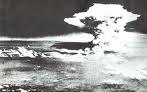
US nuclear doctrine pertaining to Korea was established following the bombings of Hiroshima and Nagasaki in August 1945, which were largely directed against civilians.
The strategic objective of a nuclear attack under the “Hiroshima doctrine” was to trigger a “massive casualty producing event” resulting in tens of thousands of deaths. The objective was to terrorize an entire nation, as a means of military conquest. Military targets were not the main objective: the notion of “collateral damage” was used as a justification for the mass killing of civilians, under the official pretence that Hiroshima was “a military base” and that civilians were not the target.
In the words of President Harry Truman:
“We have discovered the most terrible bomb in the history of the world. … This weapon is to be used against Japan … [We] will use it so that military objectives and soldiers and sailors are the target and not women and children. Even if the Japs are savages, ruthless, merciless and fanatic, we as the leader of the world for the common welfare cannot drop that terrible bomb on the old capital or the new. … The target will be a purely military one… It seems to be the most terrible thing ever discovered, but it can be made the most useful.” (President Harry S. Truman, Diary, July 25, 1945)
“The World will note that the first atomic bomb was dropped on Hiroshima a military base. That was because we wished in this first attack to avoid, insofar as possible, the killing of civilians..” (President Harry S. Truman in a radio speech to the Nation, August 9, 1945).
[Note: the first atomic bomb was dropped on Hiroshima on August 6, 1945; the Second on Nagasaki, on August 9, on the same day as Truman’s radio speech to the Nation]
Nobody within the upper echelons of the US government and military believed that Hiroshima was a military base, Truman was lying to himself and to the American public. To this day the use of nuclear weapons against Japan is justified as a necessary cost for bringing the war to an end and ultimately “saving lives”.
US Nuclear Weapons Stockpiled and Deployed in South Korea
Barely a few years after the end of the Korean War, the US initiated its deployment of nuclear warheads in South Korea. This deployment in Uijongbu and Anyang-Ni had been envisaged as early as 1956.
It is worth noting that the US decision to bring nuclear warheads to South Korea was in blatant violation of Paragraph 13(d) of the Armistice Agreement which prohibited the warring factions from introducing new weapons into Korea.
The actual deployment of nuclear warheads started in January 1958, four and a half years after the end of the Korean War, “with the introduction of five nuclear weapon systems: the Honest John surface-to-surface missile, the Matador cruise missile, the Atomic-Demolition Munition (ADM) nuclear landmine, and the 280-mm gun and 8-inch (203mm) howitzer.” (See The nuclear information project: US Nuclear Weapons in Korea)
The Davy Crockett projectile was deployed in South Korea between July 1962 and June 1968. The warhead had selective yields up to 0.25 kilotons. The projectile weighed only 34.5 kg (76 lbs). Nuclear bombs for fighter bombers arrived in March 1958, followed by three surface-to-surface missile systems (Lacrosse, Davy Crockett, and Sergeant) between July 1960 and September 1963. The dual-mission Nike Hercules anti-air and surface-to-surface missile arrived in January 1961, and finally the 155-mm Howitzer arrived in October 1964. At the peak of this build-up, nearly 950 warheads were deployed in South Korea.
Four of the weapon types only remained deployed for a few years, while the others stayed for decades. The 8-inch Howitzer stayed until late 1991, the only weapon to be deployed throughout the entire 33-year period of U.S. nuclear weapons deployment to South Korea. The other weapons that stayed till the end were the air delivered bombs (several different bomb types were deployed over the years, ending with the B61) and the 155-mm Howitzer nuclear artillery. (Ibid)
Officially the US deployment of nuclear weapons in South Korea lasted for 33 years. The deployment was targeted against North Korea as well as China and the Soviet Union.
This composite image shows the LGM-30G Minuteman intercontinental ballistic missile (ICBM) (L) and the LG-118A Peacekeeper missile(R). (AFP Photo/US DoD)
South Korea’s Nuclear Weapons Program
Concurrent and in coordination with the US deployment of nuclear warheads in South Korea, the ROK had initiated its own nuclear weapons program in the early 1970s. The official story is that the US exerted pressure on Seoul to abandon their nuclear weapons program and “sign the Treaty on the Non-Proliferation of Nuclear Weapons (NPT) in April 1975 before it had produced any fissile material.” (Daniel A. Pinkston, “South Korea’s Nuclear Experiments,” CNS Research Story, 9 November 2004, http://cns.miis.edu.]
The ROK’s nuclear initiative was from the outset in the early 1970s under the supervision of the US and was developed as a component part of the US deployment of nuclear weapons, with a view to threatening North Korea.
Moreover, while this program was officially ended in 1978, the US promoted scientific expertise as well as training of the ROK military in the use of nuclear weapons. And bear in mind: under the ROK-US CFC agreement, all operational units of the ROK are under joint command headed by a US General. This means that all the military facilities and bases established by the Korean military are de facto joint facilities. There are a total of 27 US military facilities in the ROK (See List of United States Army installations in South Korea – Wikipedia)
The Planning of Nuclear Attacks against North Korea from the Continental US and from Strategic US Submarines
According to military sources, the removal of US nuclear weapons from South Korea was initiated in the mid 1970s. It was completed in 1991:
The nuclear weapons storage site at Osan Air base was deactivated in late 1977. This reduction continued over the following years and resulted in the number of nuclear weapons in South Korea dropping from some 540 in 1976 to approximately 150 artillery shells and bombs in 1985. By the time of the Presidential Nuclear Initiative in 1991, roughly 100 warheads remained, all of which had been withdrawn by December 1991. (The nuclear information project: withdrawal of US nuclear weapons from South Korea)
According to official statements, the US withdrew its nuclear weapons from South Korea in December 1991.
This withdrawal from Korea did not in any way modify the US threat of nuclear war directed against the DPRK. On the contrary: it was tied to changes in US military strategy with regard to the deployment of nuclear warheads. Major North Korean cities were to be targeted with nuclear warheads from US continental locations and from US strategic submarines (SSBN) rather than military facilities in South Korea:
After the withdrawal of [US] nuclear weapons from South Korea in December 1991, the 4th Fighter Wing at Seymour Johnson Air Force Base has been tasked with nuclear strike planning against North Korea. Since then, strike planning against North Korea with non-strategic nuclear weapons has been the responsibility of fighter wings based in the continental United States. One of these is the 4th Fighter Wing at Seymour Johnson Air Force Base in North Carolina. …
“We simulated fighting a war in Korea, using a Korean scenario. … The scenario…simulated a decision by the National Command Authority about considering using nuclear weapons….We identified aircraft, crews, and [weapon] loaders to load up tactical nuclear weapons onto our aircraft….
With a capability to strike targets in less than 15 minutes, the Trident D5 sea-launched ballistic missile is a “mission critical system” for U.S. Forces Korea. Ballistic Missile Submarines and Long-Range Bombers
In addition to non-strategic air delivered bombs, sea-launched ballistic missiles onboard strategic Ohio-class submarines (SSBNs) patrolling in the Pacific appear also to have a mission against North Korea. A DOD General Inspector report from 1998 listed the Trident system as a “mission critical system” identified by U.S. Pacific Command and U.S. Forces Korea as “being of particular importance to them.”
Although the primary mission of the Trident system is directed against targets in Russia and China, a D5 missile launched in a low-trajectory flight provides a unique very short notice (12-13 minutes) strike capability against time-critical targets in North Korea. No other U.S. nuclear weapon system can get a warhead on target that fast. Two-three SSBNs are on “hard alert” in the Pacific at any given time, holding Russian, Chinese and North Korean targets at risk from designated patrol areas.
Long-range strategic bombers may also be assigned a nuclear strike role against North Korea although little specific is known. An Air Force map (see below) suggests a B-2 strike role against North Korea. As the designated carrier of the B61-11 earth penetrating nuclear bomb, the B-2 is a strong candidate for potential nuclear strike missions against North Korean deeply buried underground facilities.
As the designated carrier of the B61-11 earth penetrating nuclear bomb [with an explosive capacity between one third and six times a Hiroshima bomb] and a possible future Robust Nuclear Earth Penetrator, the B-2 stealth bomber could have an important role against targets in North Korea. Recent upgrades enable planning of a new B-2 nuclear strike mission in less than 8 hours. (Ibid)
“Although the South Korean government at the time confirmed the withdrawal, U.S. affirmations were not as clear. As a result, rumors persisted for a long time — particularly in North and South Korea — that nuclear weapons remained in South Korea. Yet the withdrawal was confirmed by Pacific Command in 1998 in a declassified portion of the CINCPAC Command History for 1991.” (The nuclear information project: withdrawal of US nuclear weapons from South Korea, emphasis added))
The Bush Administration’s 2001 Nuclear Posture Review: Pre-emptive Nuclear War
The Bush administration in its 2001 Nuclear Posture Review established the contours of a new post 9/11 “pre-emptive” nuclear war doctrine, namely that nuclear weapons could be used as an instrument of “self-defense” against non-nuclear states
“Requirements for U.S. nuclear strike capabilities” directed against North Korea were established as part of a Global Strike mission under the helm of US Strategic Command Headquarters in Omaha Nebraska, the so-called CONPLAN 8022, which was directed against a number of “rogue states” including North Korea as well as China and Russia.
On November 18, 2005, the new Space and Global Strike command became operational at STRATCOM after passing testing in a nuclear war exercise involving North Korea.
Current U.S. Nuclear strike planning against North Korea appears to serve three roles: The first is a vaguely defined traditional deterrence role intended to influence North Korean behavior prior to hostilities.
This role was broadened somewhat by the 2001 Nuclear Posture Review to not only deter but also dissuade North Korea from pursuing weapons of mass destruction.
Why, after five decades of confronting North Korea with nuclear weapons, the Bush administration believes that additional nuclear capabilities will somehow dissuade North Korea from pursuing weapons of mass destruction [nuclear weapons program] is a mystery. (Ibid, emphasis added)
Who is the Threat? North Korea or the United States?
The asymmetry of nuclear weapons capabilities between the US and the DPRK must be emphasised. According to ArmsControl.org (April 2013) the United States:
“possesses 5,113 nuclear warheads, including tactical, strategic, and non-deployed weapons.”
According to the latest official New START declaration, out of more than 5113 nuclear weapons,
“the US deploys 1,654 strategic nuclear warheads on 792 deployed ICBMs, SLBMs, and strategic bombers…”ArmsControl.org (April 2013).
Moreover, according to The Federation of American Scientists the U.S. possesses 500 tactical nuclear warheads. (ArmsControl.org April 2013)
In contrast the DPRK, according to the same source:
“has separated enough plutonium for roughly 4-8 nuclear warheads. North Korea unveiled a centrifuge facility in 2010, buts ability to produce highly-enriched uranium for weapons remains unclear.”
According to expert opinion:
“there is no evidence that North Korea has the means to lob a nuclear-armed missile at the United States or anyone else. So far, it has produced several atomic bombs and tested them, but it lacks the fuel and the technology to miniaturize a nuke and place it on a missile” ( North Korea: What’s really happening – Salon.com April 5, 2013)
According to Siegfried Hecker, one of America’s pre-eminent nuclear scientists:
“Despite its recent threats, North Korea does not yet have much of a nuclear arsenal because it lacks fissile materials and has limited nuclear testing experience,” (Ibid)
The threat of nuclear war does not emanate from the DPRK but from the US and its allies.
The Democratic People’s Republic of Korea, the unspoken victim of US military aggression, has been incessantly portrayed as a war mongering nation, a menace to the American Homeland and a “threat to World peace”. These stylized accusations have become part of a media consensus.
Meanwhile, Washington is now implementing a $32 billion refurbishing of strategic nuclear weapons as well as a revamping of its tactical nuclear weapons, which according to a 2002 Senate decision “are harmless to the surrounding civilian population.”
These continuous threats and actions of latent aggression directed against the DPRK should also be understood as part of the broader US military agenda in East Asia, directed against China and Russia.
It is important that people across the land, in the US, Western countries, come to realize that the United States rather than North Korea or Iran is a threat to global security.
Translated by Ollie Richardson for Fort Russ 3rd January, 2016 Tvzvezda
Let’s be clear – a nuclear war, at least between the two countries, will lead to unpredictable global shocks. And the obsession with Americans about “the local use of nuclear weapons” is utter nonsense and a utopia. It is, figuratively speaking, like a splash from a glass of water in the face of an opponent, from which a strong wind blows. There are other popular comparisons, but the meaning of it is already understood: the response will be adequate.
In fact, on the topic of the adequacy of the response, if the US suddenly decided to apply the same preventive nuclear strike on Russia, naively believing that they will be left without retribution, they will not remain. Even if all of a sudden (well, fictionally speaking) they destroyed all the command posts of the Russian army , the “Perimeter” system will take action.
Much is known about its past, and even the fact of its “funeral”, celebrated in the U.S., was recorded in the media. But “Perimeter”, dubbed in the West as “Dead hand” and in Japan “Hand from the grave”, unbeknownst to many, was “resurrected” in 2009, but now it is changed beyond absolute recognition to foreign intelligence services.
“Perimeter” was originally the system of independent management of the Strategic Missile forces. The system called for the creation of such technologies and softwares that allow in all conditions, even the most disadvantaged, to bring an order of missile launches directly to the starting team. According to the creators of the “Perimeter” system, it could produce the preparation and launch of missiles, even if everyone was dead and no one was around to give the order.
“Perimeter” was to engage in the regular collection and processing of huge volumes of information. From all sorts of sensors, it received different information: status of communication with the superior command post, the radiation situation in the surrounding area, registered nuclear explosions etc… The system had the ability to analyze the changing military and political situation in the world; The system has the ability to analyze the changes in the military and political situation in the world and independently evaluate commands received over a certain period of time. On this basis it can be concluded that in the world that something is wrong. When the system believed that it was its time, it would activate and run the command to prepare missile launches.
In this case, “Perimeter” could not begin active operations in peacetime. Even if there was no communication and the entire fire-fighting crew has left the starting position, there were still other settings that blocked the system. That is, the system itself will not release spontaneously for no apparent danger.
But if the control panel receives signals of threat, if it is clear that the country has undergone a massive attack, – here, the “Perimeter” would not blunder and would automatically use the full potential of retaliation.
We’re talking about the “Perimeter” system in the past tense for the reason that its original purpose is only known. Its current use is beyond a secret. We only know that in a modified version of this shock component of the strategic missile forces is an inevitable retribution. And not only because of the possibility to strike back, when, figuratively speaking, the world will plunge into darkness and chaos. Most importantly, this retaliation is simply impossible to deflect due to technical capabilities of strategic purpose.
The “Perimeter” system is still the only “doomsday device” existing in the world , a weapon of guaranteed retaliation, the existence of which is officially confirmed. And the USA are well aware of this.
If we talk about the concept of the system “Perimeter”, it is intended to guarantee a start-up order of ballistic missiles in case of a crushing blow by a foe on the territory of our country, which will be destroyed by all units of the strategic missile forces command, who are able to order a retaliatory strike.
The “Perimeter” system is so classified that the principle of its work itself is unknown. And only a few men of the highest military-political leadership of Russia are informed about new qualities and capabilities of “Perimeter”. It’s safe to say that among them are the President of the country Vladimir Putin, Defense Minister Sergei Shoigu and commander of the strategic missile forces Sergei Karakaev. However, they do not necessarily participate in activating the “Perimeter”. The “All systems go” system takes over automatically.
In essence, the “Perimeter” system is an alternative command system for all military branches, which are armed with nuclear warheads (SNF –Strategic nuclear forces). It is a backup system in case key nodes of the command system “Kazbek” – the so-called “nuclear briefcase” that holds all the codes for the enactment of the nuclear system – and communication lines of the strategic missile forces are destroyed by the first blow.
In order to ensure the implementation of its role, the system was originally designed to be fully automatic, and in the case of a massive attack, it is able to independently act without human intervention, being able to decide on a retaliatory strike.
It is clear that in the West the very existence of this system in Russia (formerly the Soviet Union) is called immoral. In the US, however, the right to a pre-emptive nuclear strike on any state is reserved. But a deadly return of fire to them is somehow alarming. That’s nice as it is like a deterrent, giving real guarantees if a potential enemy fails to grasp the concept of a preventive crushing blow, which benefits us. And at the Pentagon they are well aware of this, and therefore burn with anger.
“The deterrent is a compelling force,” considers the Director of the Center for analysis of strategies & technologies Ruslan Pukhov. “The proverbial arms race that existed between the USSR and the USA allowed our country to get the right security at the expense of a powerful military potential, including in the nuclear sphere. Now no one will dare to speak with Russia from a position of strength, knowing that the response will be devastating for any opponent. And it’s good that we have such a potential. But this is not the full potential of the Russian army, which in recent years has reached a whole new level of armaments. Including information technologies that have already affirmed our involvement in the Syrian conflict, where the apparent success of our operation has been acknowledged even by our enemies. And the “Perimeter” system is like a battleship, which stands on the side, but is always ready for action.”
From open sources it is known that the upgraded “Perimeter” system was replaced for combat duty in 2011. All other secrets are hidden under the stamp of secrecy.
By Dr. Paul Craig Roberts Global Research, March 26, 2015
According to news reports and to this appeal by Kristoferis Voishka, the pro-American government installed in Lithuania is persecuting Lithuanians who dissent from the anti-Russian propaganda that is driving Washington’s NATO puppets to war with Russia. Unlike their puppet government, Lithuanians understand that war with Russia means that Lithuania on the front line will be utterly destroyed, a result that would not bother Washington in the least, just as Washington is undisturbed when its forces obliterate weddings, funerals, and children’s soccer games.
What is Lithuania? To Washington it is a nothing.
Kristoferis Voiska runs an alternative Internet news site in Lithuania. Not long ago he interviewed me, and the interview appeared in both Lithuanian newspapers and on his Internet news program in video form. I found him to be sincere and well informed. I advised him that interviewing me would bring trouble for him, and he already was aware of that.
As I have said so many times, Americans are the worst informed people on the planet.
They are unaware of the growing momentum toward war with Russia. The presstitute media throughout Europe, especially in the Baltic states and Poland, is hard at work creating in people’s minds the fear of a Russian invasion. The orchestrated fear then provides the basis for the American puppet governments to beg troops and tanks and missiles from Washington, and the US military/security complex, counting its profits, is pleased to comply.
But what Russia sees is a threat, not a money-making opportunity for the US military/security complex and payoffs to the corrupt Lithuanian and Polish governments, which are increasingly perceived as neo-nazi like the government that Washington bestowed on Ukraine.
The situation is dangerous, as I keep telling you, a message that some are too weak to accept.
If you care to show support for Kristoferis and the independent media in Lithuania, send emails to tautiniai.socialistai@yandex.ru
In about one week I will be 76 years old. I was born in 1939 as World War II was unfolding as the direct consequence of the Versailles Treaty that broke every promise President Woodrow Wilson made to Germany in exchange for the end of World War I.
I remember as a child Cold War nuclear attack drills in elementary school during which we would cower under our school desks. We were issued dog tags with our blood type just like the dog tags ripped by their comrades off US soldiers killed in the war movies by Germans or Japs (no longer a permissible word) and sent home to the dead GI’s family.
To us it was more romantic than scary. We loved wearing the dog tags. I have no idea what happened to mine. They must be collectors’ items by now.
I have seen a lot. As kids playing war–in those days you could have toy guns without being shot down by the police who are protecting us–we reveled in America’s World War victories. We understood, thanks to our parents and grandparents, that the Red Army won the war against Germany, but we Americans beat the heartless Japs.
That was enough. We knew that the US was tough.
I was 14 when the Korean War broke out. We expected to win, of course, and our expectations, we thought, were proven correct when General MacArthur’s amphibious landings rolled up the North Korean army. But what MacArthur and Washington had overlooked is that China and the Soviet Union were not about to accept a US victory.
Before Americans could cheer, the Third World Chinese Army rolled in and pushed the conquerors of Japan back town to the tip of South Korea. It was a humiliating defeat for American arms. In his dispute with President Truman about the conduct of the war, MacArthur, America’s most famous general, was removed from command.
Washington accepted defeat in Korea and again in Viet Nam where a 500,000 US force consisting of US Army, Marines, and Special Forces was defeated by a Third World guerrilla army.
To these defeats we can add Afghanistan and Iraq. After 14 years of killing, the Taliban controls most of the country. Jihadist have carved a new state out of parts of Syria and Iraq. The Middle East reeks of American defeat. Just like Korea. Just like Viet Nam.
Despite these facts insouciant Americans and their crazed rulers in Washington imagine that the US is a Uni-Power, the world’s only superpower against whom no country can stand. Arrogance, ignorance, and hubris are leading the US into conflict with Russia and China, either of which can destroy the US with ease. And Europe as well. And the stupid bought-and-paid-for Japanese government, a total non-entity, a disgrace to the Japanese people, a collection of well-paid American puppets.
Any American or NATO army sent to attack Russia will be destroyed almost instantly. Washington cannot accept the loss of prestige from defeat and would take the war nuclear. Life on earth would end.
The only conclusion that informed analysis supports is that Washington is the greatest threat to life on earth. Washington is a greater threat than global warming. Washington is a greater threat than the exhaustion of mineral energy sources. Washington is a greater threat than the rise in world and US poverty from Washington’s policy to enrich the few at the expense of the many.
The only possible conclusion is that unless Washington collapses from its economic house of cards or is abandoned by its NATO puppet states, Washington will destroy life on earth.
Washington is the greatest evil that the world has ever faced. There is no good in Washington. Only evil.
From the Committee for the Republic:
_________________________ Empire Salon
with
Professor Ted Postol
“Missile Defense & the Rising Danger of Nuclear War with Russia”
____________________
Tuesday, March 3, 2015 6:30 p.m.
___________________________
1575 I Street NW
ASAE Building
Marriott Conference Center
(parking available in building)
Washington DC
___________________________
RSVP:
James@CommitteefortheRepublic.org
___________________________
The nation’s leading missile defense expert, MIT Professor Ted Postol, claims that the US missile defense program is the biggest and most dangerous scientific fraud in the history of modern American science.
Postol argues that a balanced assessment of the costs and benefits of missile defense isn’t possible without an honest technical and military assessment. He can provide such an assessment. Postol believes that the US missile defense program has come to threaten the very security its advocates claim to protect.
The Committee for the Republic considers Postol’s charges to have such serious implications at a time of rising tensions in US-Russian relations that it has asked its chairman, Chas Freeman, to examine his claims with him in public.
Missile defense is aggressively promoted by an unholy alliance of government, industry, and academia: Raytheon, Lockheed-Martin, Boeing, MIT, National Academy of Sciences and both the Democratic and Republican parties. The program has taken on a life of its own. Postol’s appearance is an opportunity to explore the confluence of political competition, the private sector opportunity to make large profits without product performance standards, and academic opportunism to gain favor with large government and industrial funders.
In 2009, after initially expressing skepticism, President Obama reversed himself by announcing what he claimed is a new and radical approach to missile defense. Postol will explain why the radars in this system cannot properly track warheads and the interceptors cannot knock them down. Postol points out that the Missile Defense Agency agency has repeatedly misrepresented to Congress that long-range missile defenses can tell the difference between warheads and simple decoys. He will review the case that the agency has been rigging experiments and lying to Congress, allies, and Russia.
Postol will show that Obama has abandoned his long-standing commitment to a world free of nuclear weapons by committing the nation to an ambitious trillion-dollar nuclear modernization program. Obama’s nuclear modernization seeks to create the capability to fight and win a nuclear war with Russia. Postol argues that the US missile defense program is destabilizing nuclear deterrence in ways that raise the risk of nuclear war and has contributed to the downward spiral in the US-Russian relationship. He will show that this failure of leadership started with the Clinton Administration and was eagerly carried forward by the Bush and Obama Administrations. The nuclear arms race is back. Most Americans imagined it had ended with the Cold War.
Postol is far from alone in his concern about these developments. The Bulletin of the Atomic Scientists has just advanced its famous Doomsday Clock to three minutes to midnight, indicating a level of danger exceeded only in 1953 after the US and Russia exploded their first hydrogen bombs. It notes that “the United States and Russia have embarked on massive programs to modernize their nuclear triads “thereby undermining existing nuclear weapons treaties.”
—————————–
The Committee for the Republic is a citizen-based, non-partisan, nonprofit organization founded in 2003. The Committee sponsors speakers monthly on challenges to the American Republic, including the military-industrial complex, too-big-to-fail banks, campaign finance, and U.S. competitiveness. For questions or requests email James@Committeefortherepublic.org
Committee for the Republic
1320 18th Street, NW
Washington, DC 20036
April 24 – April 26 in New York, NY: Peace and the Planet Conference and Rally * April 24/25 – An international peace, justice and environmental conference * April 26 – A major international rally, march to the United Nations and peace festival
August 6 – 9 in Santa Fe, NM: Campaign Nonviolence National Conference (Aug 6 – Mark the 70th anniversary of the U.S. atomic bombing of Hiroshima with the annual sackcloth and ashes peace vigil and call for nuclear disarmament near the National Labs. Aug 9 – Mark the 70th anniversary of the U.S. atomic bombing of Nagasaki with the annual sackcloth and ashes peace vigil and call for nuclear disarmament near the National Labs.)
August 6 in Hiroshima, Japan: “August 6, 2015 will be the 70th anniversary of the bombing [of Hiroshima]. Annually, there are events such as the Hiroshima Peace Memorial Ceremony, with guest speakers, and the Lantern Floating Ceremony, in which lanterns float on the river as petitions for peace. Additional special events for the 70th anniversary are to be announced.”
August 9 in Nagasaki, Japan: [August 9, 2015 will be the 70th anniversary of the bombing of Nagasaki. Commemoration events are held annually and, as with Hiroshima, it is expected that additional special events for the 70th anniversary are to be announced.]
A unique, two-day symposium at which an international panel of leading experts in disarmament, political science, existential risk, anthropology, medicine, nuclear weapons and other nuclear issues will be held at The New York Academy of Medicine on Feb 28- March 1, 2015.
The public is welcome.
A project of The Helen Caldicott Foundation
The Symposium: The Dynamics of Possible Nuclear Extinction.
Russia and the U.S. possess 94% of the 16,400 nuclear weapons in the global nuclear arsenal. The U.S. maintains its first strike winnable nuclear war policy, and both countries have raised their nuclear arsenals to a higher state of alert because of the situation in the Ukraine. Furthermore it has just been announced that the administration has plans to replace every nuclear warhead and their delivery systems via ship, submarine, missile and plane, at a cost of one trillion dollars over the next thirty years.
This symposium to be held by The Helen Caldicott Foundation will address the following issues:
. What are the human and technological factors that could precipitate a nuclear war between Russia and the U.S., how many times have we come close to nuclear war and how long will our luck hold?
. What are the ongoing technological and financial developments relevant to the nuclear weapons arsenals of the US and Russia?
. What problems are associated with lateral proliferation of nuclear weapons via strenuous corporate marketing of nuclear technology?
. What are the medical and environmental consequences of either a small or large scale nuclear war?
. What are the underlying philosophical, political, and ideological dynamics that have brought life on earth to the brink of extinction?
. How can we assess this situation from an anthropological perspective?
. What is the pathology within the present political situation that could lead us to extinction?
. How can this nuclear pathology be cured?
Moderated by: Day One: Kennette Benedict, Bulletin of the Atomic Scientists Day Two: To be announced
The Presenters (confirmed speakers, speaking order may change):
Session 1 Seth Baum– Global Catastrophic Risk Institute, will address the catastrophic risk of nuclear war Max Tegmark– Professor of physics at MIT and author of “Our Mathematical Universe”, will discuss artificial intelligence and the risk of automation accidentally triggering a nuclear war.
Session 2 Hans Kristensen – Federation of American Scientists, will address the current size of the global nuclear arsenals Bill Hartung– Center for International Policy, will discuss the inordinate power and pathological dynamics exercised by the US military industrial complex Greg Mello -Los Alamos Study Group, the role and funding of the nuclear weapons laboratories inherent within the US nuclear armament dilemma John Feffer – Institute of Policy Studies will compare the money spent on the US military industrial complex compared with the paltry amount spent on the prevention of global warming Bruce Gagnon – Global Network Against Weapons and Nuclear Power in Space, will elucidate the ongoing and dangerous militarization of space
Session 3 Bob Alvarez – Institute of Policy Studies, will discuss lateral proliferation and describe how a small nuclear exchange could trigger a global holocaust
Session 4 Steven Starr– Senior Scientist PSR, Clinical Laboratory Science Program Director, University of Missouri. Nuclear War: An Unrecognized Mass Extinction Event Waiting to Happen. Holly Barker – Department of Anthropology, University of Washington, Medical, Teratogenic and Genetic pathology related to US nuclear testing in the Marshall Islands. Alan Robock – Distinguished Professor, Dept. of Environmental Sciences. Rutgers University, will outline his pioneering work on Nuclear Autumn, Nuclear Famine, and Nuclear Winter. Lynn Eden – author of Whole World on Fire, will discuss the enormous issue ignored by the Pentagon of the effect of the holocaust of firestorms following nuclear war.
Session 5 Janne Nolan – Elliott School of International Affairs will outline the underlying psychological pathology of the nuclear warriors Mike Lofgren – author of Anatomy of the Deep State, will describe the underlying pathology of US capitalism leading to this current tenuous nuclear situation Susi Snyder– (IKV Pax Christi, the Netherlands), Contributor to 2014 report DON’T BANK ON THE BOMB
Session 6 Hugh Gusterson – Professor of Anthropology and Sociology, George Mason University will describe his anthropological research after spending one year at the Los Alamos Labs. Robert Sheer – author of STAR WARRIORS will describe his research into the young men who do the research on nuclear weapons development at Lawrence Livermore Labs
Session 7 Noam Chomsky, Institute Professor and Professor of Linguistics, MIT will present the pathology within the present political system that could induce extinction
Session 8 Dave Krieger – Nuclear Age Peace Foundation on what can we do? How the Marshall Islanders are speaking truth to power. Tim Wright – Campaign Director of the International Campaign to Abolish Nuclear Weapons (ICAN) – some potential and exciting solutions Helen Caldicott – President of The Helen Caldicott Foundation – An urgent prescription for survival
9.30 – 9.50 (to be confirmed)
9.50 – 10.10 Seth Baum – Global Catastrophic Risk Institute – The Catastrophic Risk of Nuclear War
10.10 – 10.30 Max Tegmark – Professor of Physics, MIT – Artificial Intelligence and the Risk of Accidental Nuclear War.
10.30 – 11.00 Q&A
11.00 – 11.30 Tea and Coffee
11.30 – 11.50 Alan Robock – Distinguished Professor, Department Environmental Sciences, Rutgers University – Nuclear Famine and Nuclear Winter: Climatic Effects of Nuclear War- Catastrophic Threats to the Global Food Supply
11.50 – 12.10 Bill Hartung – Center for International Policy – Inordinate Power and Pathological Dynamics of the Military Industrial Complex
12.10 – 12.30 Mike Lofgen – Author of Anatomy of the Deep State – US Capitalism Relating to the Tenuous Nuclear Situation
12.30 – 1.00 Q&A
1.00 – 2.00 Lunch
Afternoon Session
2.00 – 2.20 Greg Mello – Los Alamos Study Group – The Role and Funding of the US Nuclear Weapons Labs
2.20 – 2.40 Hans Kristensen – Federation of American Scientists – The Current Size of the World’s Nuclear Arsenals
2.40 – 3.00 Bruce Gagnon – Global Network Against Weapons and Nuclear Power in Space – The Ongoing and Dangerous Militarization of Space
3.00 – 3.20 Bob Alvarez – Institute of Policy Studies – Lateral Proliferation Could Trigger a Global Nuclear Holocaust
3.20 – 4.00 Q&A
4.00 – 6.00 On The Beach – film
DAY TWO: Sunday, March 1
Morning Session
9.00 – 9.15 Opening remarks– (to be confirmed)
8.15 – 9.35 Steven Starr – Associate of the Nuclear Age Peace Foundation, a board member and senior scientist for Physicians for Social Responsibility – An Unrecognized Mass Extinction Event Waiting to Happen
9.35 – 9.55 Holly Barker – Department Anthropology, University of Washington –Medical, Teratogenic and Genetic Pathology Related to US Nuclear Testing in the Marshall Islands
9.55 – 10.15 John Feffer – Institute of Policy Studies – Comparison of Spending on US Military Industrial Complex ND Prevention of Global Warming
10.15 – 10.54 Q&A
10.45 – 11.15 Tea and Coffee
11.15 – 11.35 Lynn Eden – Author Whole World on Fire – Holocaust Firestorms Following Nuclear War, Ignored by Pentagon Calculations
11.35 – 11.55 Janne Nolan – Elliot School of International Affairs – Psychological Pathology of the Nuclear Warriors
11.55 – 12.15 Mike Lofgren – Author of Anatomy of the Deep State – US Capitalism Relating to the Tenuous Nuclear Situation
12.15 – 12.45 Q&A 12.45 – 1.45 Lunch
Afternoon Session
1.45 – 2.05 Susie Snyder – IKV Pax Christi, the Netherlands – Don’t Bank on the Bomb
2.05 – 2.25 Hugh Gusterson – Professor Anthropology at George Washington University – Anthropological Research at Los Alamos Labs
2.25 – 2.45 Robert Scheer – Author of Star Warriors – Data on Young Men Researchers at Lawrence Livermore Labs
2.45 – 3.15 Q&A
3.15 – 3.45 Tea and Coffee
3.45 – 4.05 Noam Chomsky – Institute Professor and Professor of Linguistics MIT – Pathology within the Existing Political System that could lead to Nuclear War
4.05 – 4.25 David Krieger – President Nuclear Age Peace Foundation – The Law Zero Lawsuits Brought by the Marshall Islands
4.25 – 4.45 Tim Wright – Campaign Director International Campaign to Abolish Nuclear Weapons ICAN – Some New and Exciting Solutions
4.45 – 5.00 Helen Caldicott – President Helen Caldicott Foundation – While There’s Life There’s Hope






 Free Ukraine Now