From RT
speech
An analysis of Obama’s speech at the UN, September 28
Global Research, September 29, 2015
Addressing the United Nations General Assembly on Monday, President Barack Obama portrayed himself and the US government as the preeminent defenders of international law and diplomacy. He did so even as the catastrophic consequences of the illegal wars of aggression he has overseen continued to send waves of refugees fleeing the ruins of entire countries—including Afghanistan, Iraq, Libya, Syria and Yemen—and as Washington took new steps to turn Eastern Europe into a militarized zone for eventual war against Russia.
With his trademark hypocrisy and contempt for the intelligence of his audience, Obama hailed “an international system that imposes a cost on those who choose conflict over cooperation.” He proclaimed his support for the “international principles that helped constrain bigger countries from imposing our will on smaller ones,” and denounced those who maintain “that might makes right; that strong states must impose their will on weaker ones; that the rights of individuals don’t matter; and that in a time of rapid change, order must be imposed by force.”
This from a man who asserts the right of his government to launch “preemptive” wars against any country or group deemed hostile to Washington’s drive for hegemony over the oil-rich Middle East and the rest of the world; who has killed untold thousands in drone missile assassinations; waged an unprovoked war against Libya and murdered its leader, Gaddafi; and armed and financed a sectarian civil war using Al Qaeda-linked killers as its proxy force, turning Syria into a chamber of horrors.
The main focus of Obama’s remarks was Syria, where the debacle of US policy had become so pronounced that Obama was obliged to pull back from his previous demand for the immediate removal of Syrian President Bashar al-Assad. He has proposed talks with the Baathist regime’s main allies, Russia and Iran, on a “managed transition” that would likely retain elements of the current government while eventually easing Assad out of power.
Later on Monday, Obama met with Russian President Putin to discuss the possibility of engineering such a settlement of the four-and-a-half-year war. It was the first formal face to face meeting between the two since 2013, when the White House cancelled discussions with Putin in retaliation for Moscow’s decision to grant NSA whistleblower Edward Snowden temporary asylum. That was followed by a freeze on all high-level talks after the US-sponsored and fascist-led coup last year that overthrew Ukraine’s pro-Russian president, Viktor Yanukovych. Since it installed the ultra-nationalist and fascistic regime in Kiev, Washington has backed a brutal assault on pro-Russian separatists in eastern Ukraine that has killed thousands and devastated entire cities.
The US finds its position in Syria and the broader region severely weakened, despite the mass killing in the country—estimated at 200,000 deaths in a country with a population of 23 million—caused by the sectarian civil war instigated by Washington and its regional allies, Turkey and the semi-feudal sheikdoms of Saudi Arabia and Qatar. Iraq’s announcement Sunday that it had signed an agreement with Syria, Iran and Russia to share intelligence and coordinate security in the battle against Islamic State forces in Syria and Iraq appeared to take Washington by surprise.
It was preceded by a series of developments exposing Washington’s failure to create a non-jihadist “moderate” force to fight both ISIS and Assad. These included the resignation of the top US commander in the anti-ISIS war; congressional testimony by a leading general admitting that after more than a year and the expenditure of hundreds of millions of dollars, the US had trained “four or five” fighters; reports that the ranks of ISIS fighters were rising despite months of US and coalition bombing; and other reports that forces trained by the US in Turkey had defected or turned over their weapons to Al Qaeda’s Syrian affiliate, the al-Nusra Front.
Moreover, recent weeks have seen an increase in Russian military support to the Assad regime, which Washington has been unable to block.
The net result of Washington’s reckless and murderous war for regime-change in Syria has been to turn the country into yet another geopolitical flashpoint where US and allied military forces face off against those of Russia, raising the very real danger of an armed clash and the eruption of a wider war between nuclear armed powers. On the eve of the UN assembly, France began its own bombing campaign in Syria, making clear that it was prepared to attack forces allied with Assad, potentially including Russian forces, as well as ISIS. Britain is lining up to begin bombing the country later this year.
It would be a dangerous mistake to believe that Washington’s decision to seek talks with Russia and Iran means the US is backing off from the use of military violence. On the contrary, with its economic and diplomatic position weakening, the response of American imperialism will be to ratchet up its bullying and military aggression.
This was clear from Obama’s speech. He denounced the main targets of US aggression, calling Assad a “tyrant,” accusing Russia of violating “the sovereignty and territorial integrity” of Ukraine, implied that China was attacking “the basic principles of freedom of navigation and the free flow of commerce” in the South China Sea and singled out Iran for continuing to “deploy violent proxies to advance its interests.” The chief backer of tyrants in the Middle East, violator of national sovereignty and territorial integrity in Ukraine, threat to freedom of navigation in East Asia and deployer of violent proxies is, of course, the United States.
In the midst of his cynical paean to the international law and diplomacy, Obama issued an unambiguous threat to any nation that dared to get in America’s way, declaring: “I lead the strongest military that the world has ever known, and I will never hesitate to protect my country and our allies, unilaterally and by force where necessary.”
The preparations for a US military escalation against both Syria and Russia are well underway. Last week, Washington Post columnist David Ignatius reported that discussions are being held between US military officials and leaders of the Kurdish People’s Protection Units (YPG) in Syria for Washington to step up its military support, including close air support for YPG fighters on the ground.
Powerful factions within the US ruling elite and state are opposed to any talks with Russia or Iran and are demanding the creation of so-called “safe havens” policed by US and allied forces in Syria and an all-out drive for regime-change.
At the same time, the Pentagon and CIA are stepping up their war preparations against Russia. The upcoming US-NATO Trident Juncture 2015 war games, the largest held since the dissolution of the Soviet Union, are designed to prepare Western forces to engage in hybrid warfare operations in the Baltic region and beyond.
Last week, an article appeared in Foreign Policy magazine with the title: “The Pentagon is Preparing New War Plans for a Baltic Battle Against Russia.” The article stated, “For the first time since the collapse of the Soviet Union, the US Department of Defense is reviewing and updating its contingency plans for armed conflict with Russia.”
Finally, the US is planning to upgrade its nuclear arsenal in Europe with highly sophisticated B61-12 guided nuclear bombs, each one of which is more than three times as powerful as the atomic bomb that killed over 130,000 people in Hiroshima.
For decades, US imperialism has sought to overcome the decline in its global economic position by relying on its military supremacy. In response to its latest setbacks in the Middle East, this tendency will only be expressed with greater brutality and recklessness.
Transcript of President Vladimir Putin’s Victory Day speech: 70th Anniversary of “Victory in the Great Patriotic War”
Speech at military parade on Red Square in Moscow to mark the 70th anniversary of Victory in the 1941–1945 Great Patriotic War.
Dear veterans,
Distinguished guests,
Comrade soldiers and seamen, sergeants and sergeant majors, midshipmen and warrant officers,
Comrade officers, generals and admirals,
I congratulate you all on the 70th Anniversary of Victory in the Great Patriotic War!
Today, when we mark this sacred anniversary, we once again appreciate the enormous scale of Victory over Nazism. We are proud that it was our fathers and grandfathers who succeeded in prevailing over, smashing and destroying that dark force.
Hitler’s reckless adventure became a tough lesson for the entire world community. At that time, in the 1930s, the enlightened Europe failed to see the deadly threat in the Nazi ideology.
Today, seventy years later, the history calls again to our wisdom and vigilance. We must not forget that the ideas of racial supremacy and exclusiveness had provoked the bloodiest war ever. The war affected almost 80 percent of the world population. Many European nations were enslaved and occupied.
The Soviet Union bore the brunt of the enemy’s attacks. The elite Nazi forces were brought to bear on it. All their military power was concentrated against it. And all major decisive battles of World War II, in terms of military power and equipment involved, had been waged there.
And it is no surprise that it was the Red Army that, by taking Berlin in a crushing attack, hit the final blow to Hitler’s Germany finishing the war.
Our entire multi-ethnic nation rose to fight for our Motherland’s freedom. Everyone bore the severe burden of the war. Together, our people made an immortal exploit to save the country. They predetermined the outcome of World War II. They liberated European nations from the Nazis.
Veterans of the Great Patriotic War, wherever they live today, should know that here, in Russia, we highly value their fortitude, courage and dedication to frontline brotherhood.
Dear friends,
The Great Victory will always remain a heroic pinnacle in the history of our country. But we also pay tribute to our allies in the anti-Hitler coalition.
We are grateful to the peoples of Great Britain, France and the United States of America for their contribution to the Victory. We are thankful to the anti-fascists of various countries who selflessly fought the enemy as guerrillas and members of the underground resistance, including in Germany itself.
We remember the historical meeting on the Elbe, and the trust and unity that became our common legacy and an example of unification of peoples – for the sake of peace and stability.
It is precisely these values that became the foundation of the post-war world order. The United Nations came into existence. And the system of the modern international law has emerged.
These institutions have proved in practice their effectiveness in resolving disputes and conflicts.
However, in the last decades, the basic principles of international cooperation have come to be increasingly ignored. These are the principles that have been hard won by mankind as a result of the ordeal of the war.
We saw attempts to establish a unipolar world. We see the strong-arm block thinking gaining momentum. All that undermines sustainable global development.
The creation of a system of equal security for all states should become our common task. Such system should be an adequate match to modern threats, and it should rest on a regional and global non-block basis. Only then will we be able to ensure peace and tranquillity on the planet.
Dear friends,
We welcome today all our foreign guests while expressing a particular gratitude to the representatives of the countries that fought against Nazism and Japanese militarism.
Besides the Russian servicemen, parade units of ten other states will march through the Red Square as well. These include soldiers from Armenia, Azerbaijan, Belarus, Kazakhstan, Kyrgyzstan and Tajikistan. Their forefathers fought shoulder to shoulder both at the front and in the rear.
These also include servicemen from China, which, just like the Soviet Union, lost many millions of people in this war. China was also the main front in the fight against militarism in Asia.
Indian soldiers fought courageously against the Nazis as well.
Serbian troops also offered strong and relentless resistance to the fascists.
Throughout the war our country received strong support from Mongolia.
These parade ranks include grandsons and great-grandsons of the war generation. The Victory Day is our common holiday. The Great Patriotic War was in fact the battle for the future of the entire humanity.
Our fathers and grandfathers lived through unbearable sufferings, hardships and losses. They worked till exhaustion, at the limit of human capacity. They fought even unto death. They proved the example of honour and true patriotism.
We pay tribute to all those who fought to the bitter for every street, every house and every frontier of our Motherland. We bow to those who perished in severe battles near Moscow and Stalingrad, at the Kursk Bulge and on the Dnieper.
We bow to those who died from famine and cold in the unconquered Leningrad, to those who were tortured to death in concentration camps, in captivity and under occupation.
We bow in loving memory of sons, daughters, fathers, mothers, grandfathers, husbands, wives, brothers, sisters, comrades-in-arms, relatives and friends – all those who never came back from war, all those who are no longer with us.
A minute of silence is announced.
Minute of silence.
Dear veterans,
You are the main heroes of the Great Victory Day. Your feat predestined peace and decent life for many generations. It made it possible for them to create and move forward fearlessly.
And today your children, grandchildren and great-grandchildren live up to the highest standards that you set. They work for the sake of their country’s present and future. They serve their Fatherland with devotion. They respond to complex challenges of the time with honour. They guarantee the successful development, might and prosperity of our Motherland, our Russia!
Long live the victorious people!
Happy holiday!
Congratulations on the Victory Day!
Hooray!
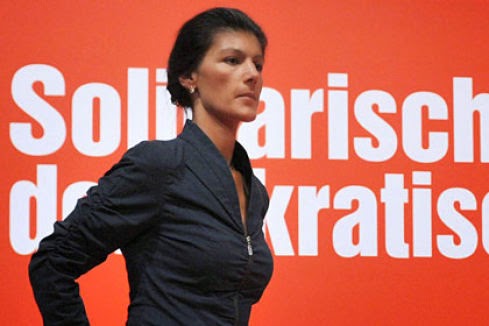
Bundestag speech by MP Sahra Wagenknecht: EU policy has destroyed Ukraine and damaged Europe
Posted on Fort Russ
March 19, 2015
April 9, 2015
Translated from German by Tom Winter
Mr President, honored ladies and gentlemen, Frau Chancellor.
At your best times, German foreign policy had two priorities: Unity for Europe and a good neighbor policy with Russia. It should give you food for thought, Frau Merkel, if you would listen,
[Volker Kauder: That’s rude!]
that nationalism and strife in Europe, during your ten years in office, are thriving like never before, and as regards Russia, a policy of outreach has given way to a new Cold War.
[Applause from the Left]
Not long ago, the head of the influential think-tank Stratfor, with striking bluntness, explained the US interest in Europe: The chief interest of the United States is to prevent coordination between Germany and Russia, since, literally “united they are the only power that can threaten us,” i.e. threaten the US.
This perceived threat to US interests has been achieved successfully for the foreseeable future. That started as the EU tried to get countries out of their economic and political cooperation with Russia in the framework of the Eastern Partnership.
[Claudia Roth, Greens: That’s absurd!]
Frau Merkel, naturally this was aimed at Russia, but it was also contrary to the interests of the countries involved. You, not Russia, pushed them to the either-or.
[Applause from the Left]
Resultantly Ukraine has lost the great part of its industry. Today, the country is a bankrupt state, where people go hungry, shiver, and have salaries lower than people have in Ghana.
But the confrontation with Russia has not only destroyed Ukraine, it has damaged all of Europe. It is, in fact, an open secret that the United States is stirring the conflict with Russia on economic grounds. When the US administration talks about Human Rights, they’re actually meaning drilling rights or mining rights. Right now in Ukraine there is in view a hell of a lot of shale gas to frack.
[Applause from the Left]
If now, in the framework of the Energy Union of other pipeline routes, we’re talking increasing independence from Russian gas, then you should tell the people in honesty what that means: increasing dependence on much more expensive and ecologically devastating US fracked gas. I do not consider that a responsible view.
[Applause from the Left]
The list is long, Frau Merkel, of earlier chief politicians who criticise your Russia policy. In that list we find the names of your predecessors Gerhard Schroeder, Helmut Kohl, Helmut Schmidt, and even Hans-Dietrich Genscher. Perhaps this is what led to your backing off. In any case, it is correct, that you, with French President Hollande, took the initiative: Minsk II has really led to significantly fewer deaths there in recent weeks than in the weeks and months preceding; the door to a peaceful solution has been opened.
[Applause from the Left]
This is naturally an important new situation, and you, Frau Bundeskanzlerin, and the French President deserve recognition.
[Tino Sorge, CDU/CSU: Then say so from time to time!]
However, the person that the peace and security in Europe depend on must now go forward, with follow-through, and with backbone. This is naturally a problem, since follow-through and backbone haven’t exactly been your strong suit.
[Applause from the Left; grumblings from CDU/CSU]
Of course, it is not acceptable, when the shooting persists from the ranks of the insurgents,
[Tino Sorge: Not acceptable!]
but when Ukrainian troops — or the Nazi battalions fighting for them — keep right on shooting, then it is quite less unacceptable, and no critical word from you is heard.
[Applause from the Left]
Why do you not come forward with words of censure when the Ukrainian regime, notwithstanding its foreseeable bankruptcy, budgets four times as much for arms as it did last year? This doesn’t assure us that the road to peace has any actual support in the Ukrainian regime!
Furthermore, the US and Britain sending military advisors and delivering weapons is not a matter of supporting the peace process, but of torpedoing it. But do you now envision sanctions against the US and Britain? I believe that this whole business of sanctions was a huge mistake through which Europe shot itself in the foot. The sanctions should not be extended.
[Applause from the Left]
We do not need any more tanks. We do not need a 3,000-man NATO intervention troop in Eastern Europe, that protects nobody, but instead puts all Europe further at risk.
[Applause from the Left]
Helmut Schmidt got it right when he warned already in 2007, that, when it comes to world peace, there is far less risk from Russia than from America, and that NATO is only a tool for maintaining US/American hegemony. And if that is correct, then we are left with one set conclusion: that Europe must finally make policy separate from, and independent of, the United States.
[Applause from the Left]
Mr Juncker has put forward the thesis, that we need a European Army to show that we are in earnest about defending European values against Russia. This shows just one thing, how very far we have come from what the founding fathers of European Union wanted.
[Applause from the Left]
Back then it was all about — as you yourself have often said — peace, democracy, and solidarity. Never again should nationalism and hatred separate the lands of Europe. But to defend these values, no armed battalions are needed!
If you want to defend democracy, Frau Merkel, then see to it that the lands of Europe are at last ruled by elected governments rather than financial markets, not by the one-time investment banker Mario Draghi, and, further, not by you.
[Applause from the left; interjection from Michael Grosse-Bromer: Disassociate yourself from the violence right now. That would be a big step!]
If you want democracy, then stop the so-called Free Trade Agreements, stop the TTIP that would make elected governments just a farce.
[Applause from the Left]
That would be the defending of European values! That would be a defence of democracy, exposing these unspeakable TTIP negotiations and comparable dealings.
If you want to see a unified Europe, then stop humiliating other countries and imposing programs that rob the young generations of their future.
[Manuel Sarrazin, Greens, “You’re right with Greece!”]
Stop prescribing so-called structural reforms in Europe, that only lead to growing inequality and an ever growing low-wage sector.
Here in Germany meanwhile, in consequence of these policies, three million people, in spite of having a job, are so poor they can’t stay warm, haven’t enough to eat — let alone afford going on a vacation! Instead of trying to explain this export-bashing policy, it is high time — and very much in Europe’s interest — to correct it. And it is not least the German wage-dumping that is stifling the other countries of the monetary union.
[Applause from the Left]
Finance Minister Schaeuble has recently instructed the Greek government: “Yeah, governing is always just a rendezvous with reality.”
[Michael Grosse-Broemer (CDU/CSU): Right! Max Straubinger (CDU/CSU): And so it is!]
So one can only say “That would be good” well, that would be a good thing when the German government could only experience its own rendezvous with reality. Because it was not Syriza, but instead, the sister parties to the CDU/CSU and SPD that over the decades stacked up the huge deficits, so that they and the upper crust could stuff their pockets.
[Applause from the Left]
The reality is also that under the protectorate of the troika that you still treasure so much, whose criminal activities you can see in the documentary by Harald Schuman, the Greek debt just got bigger and the Greek billionaires got richer.
And you want to keep it up? Then I can only say “Good night!”
And if you want our money back, get it from those that took it, and that was not the nurses, nor the Greeks on pensions: it was the international banks and the Greek Upper Crust. It’s from these you could help the Greek government recover its money.
Who advances credit to one already overloaded with debt will never see his money again, but the responsibility is on you, Frau Merkel, and you, Mr. Schaeuble, and not on the new Greek government which is now hardly two months in office.
As for the whole debate over possible reparations, I can only say that, no matter how the question gets juridically evaluated, the least one should expect from the German State is some minimum of sensibility in dealing with the issue.
[Applause, Left; laughter, CDU/CSU]
I must say, you still laugh. That is sad. In view of how German occupiers ravaged Greece, and that a million Greek men and women lost their lives in this dark chapter of German history, I find the flip remarks from you, Mr. Schaeuble, and from you, Mr. Kauder, simply disrespectful, and I am ashamed.
[Applause from the Left as well as from Juergen Tritten, cries from CDU/CSU: Oh!]
In order to recall that the unrolling of history also goes the other way, may I, in closing, quote from the speech of Richard von Weizsaecker on the occasion of the 40th anniversary of the Liberation — I am just finishing, Mr. President — the speech concerned principally Russia and Eastern Europe, but it naturally also holds good for Greece:
“When we think about what our eastern neighbors had to suffer during the war, we understand better that balance, easing up, and a peaceful neighborhood with these lands abide as the central given of German foreign policy. What matters, is that both sides remember, and that both sides have respect for the other.”
Yes, only when we remember, and only when we respect each other — only then will we get back a policy of being good neighbors, both inside the EU, and with Russia.
[Sustained applause from the Left]
http://www.fortruss.blogspot.com/2015/04/wagenknecht-eu-policy-has-destroyed.html
Vladimir Putin’s legendary speech at 2007 Munich Security Conference
A commenter stated that this speech has been taken down numerous times. Apparently, there was also a Q&A with reporters after the speech. These versions are just the speech.
Here are two versions.
Full speech — poorer video quality
https://www.youtube.com/watch?v=frDYKeP1hnM
30:46
—————————————————————-
Part 1-4 — good video quality
https://www.youtube.com/watch?v=ZlY5aZfOgPA
https://www.youtube.com/watch?v=ZewZnZ13X-Q
https://www.youtube.com/watch?v=vf90nezYKwY
https://www.youtube.com/watch?v=VyBzNR-x6l8
How Vladimir Putin blocked the U.S. “pivot to Asia”
Posted on CounterPunch, March 8, 2015
By Mike Whitney
“The collapse of the Soviet Union removed the only constraint on Washington’s power to act unilaterally abroad…. Suddenly the United States found itself to be the Uni-power, the ‘world’s only superpower.’ Neoconservatives proclaimed ‘the end of history.’”
— Paul Craig Roberts, former Assistant Secretary of the US Treasury
“Don’t blame the mirror if your face is crooked.”
— Russian proverb
On February 10, 2007, Vladimir Putin delivered a speech at the 43rd Munich Security Conference that created a rift between Washington and Moscow that has only deepened over time. The Russian President’s blistering hour-long critique of US foreign policy provided a rational, point-by-point indictment of US interventions around the world and their devastating effect on global security. Putin probably didn’t realize the impact his candid observations would have on the assembly in Munich or the reaction of powerbrokers in the US who saw the presentation as a turning point in US-Russian relations. But, the fact is, Washington’s hostility towards Russia can be traced back to this particular incident, a speech in which Putin publicly committed himself to a multipolar global system, thus, repudiating the NWO pretensions of US elites. Here’s what he said:
“I am convinced that we have reached that decisive moment when we must seriously think about the architecture of global security. And we must proceed by searching for a reasonable balance between the interests of all participants in the international dialogue.”
With that one formulation, Putin rejected the United States assumed role as the world’s only superpower and steward of global security, a privileged position which Washington feels it earned by prevailing in the Cold War and which entitles the US to unilaterally intervene whenever it sees fit. Putin’s announcement ended years of bickering and deliberation among think tank analysts as to whether Russia could be integrated into the US-led system or not. Now they knew that Putin would never dance to Washington’s tune.
In the early years of his presidency, it was believed that Putin would learn to comply with western demands and accept a subordinate role in the Washington-centric system. But it hasn’t worked out that way. The speech in Munich merely underscored what many US hawks and Cold Warriors had been saying from the beginning, that Putin would not relinquish Russian sovereignty without a fight. The declaration challenging US aspirations to rule the world, left no doubt that Putin was going to be a problem that had to be dealt with by any means necessary including harsh economic sanctions, a State Department-led coup in neighboring Ukraine, a conspiracy to crash oil prices, a speculative attack of the ruble, a proxy war in the Donbass using neo-Nazis as the empire’s shock troops, and myriad false flag operations used to discredit Putin personally while driving a wedge between Moscow and its primary business partners in Europe. Now the Pentagon is planning to send 600 paratroopers to Ukraine ostensibly to “train the Ukrainian National Guard”, a serious escalation that violates the spirit of Minsk 2 and which calls for a proportionate response from the Kremlin. Bottom line: The US is using all the weapons in its arsenal to prosecute its war on Putin.
Last week’s gangland-style murder of Russian opposition leader, Boris Nemtsov, has to be considered in terms of the larger geopolitical game that is currently underway. While we may never know who perpetrated the crime, we can say with certainly that the lack of evidence hasn’t deterred the media or US politicians from using the tragedy to advance an anti-Putin agenda aimed at destabilizing the government and triggering regime change in Moscow. Putin himself suggested that the killing may have been a set-up designed to put more pressure on the Kremlin. The World Socialist Web Site summed up the political implications like this: Continue reading
NATO Secretary General: Warplanes over Baltic states, warships off coast, troops on ground
This is sheer lunacy.
North Atlantic Treaty Organization
Febuary 18, 2015
Opening remarks
By NATO Secretary General Jens Stoltenberg at the joint press point with the Latvian President
Thank you, Mr. President, for your warm welcome. We just had an excellent discussion.
I want to commend Latvia for the leading role you are playing in European affairs.
You currently hold the EU Presidency.
You play a key role in NATO’s eastern defences. And you have kindly offered to host one of our new command and control units on your territory. All these contributions are very welcome.
I want to reassure you that NATO stands shoulder to shoulder with Latvia.
The Alliance’s responsibility is to protect and defend each and every Ally against any threat. And NATO’s support for its eastern Allies, including Latvia, was confirmed at the recent NATO Defence Ministers’ meeting in Brussels.
Here, more progress was made in implementing our Readiness Action Plan, including establishing an enhanced NATO response force and a very high readiness Spearhead Force.
In addition we continue with assurance measures.
NATO aircraft continue to police Baltic skies. NATO ships continue to patrol the Baltic Sea.
NATO forces continue to exercise on the ground.
During these challenging times, it is important that NATO Allies spend more on defence, and spend better.
And again I want to commend Latvia for your commitment to raise defence expenditure in line with the pledge that we made in Wales.
Mr. President, I thank Latvia for all your work during these difficult times.
We also spoke about the conflict in Ukraine.
The Minsk agreement is the best opportunity for a lasting peaceful solution.
What really matters now is implementation of the ceasefire and the Minsk agreement.
Today I am deeply concerned by the deteriorating situation in and around Debaltseve.
The refusal of the separatists to respect the cease-fire threatens the agreement.
As does their denial of access to the area for the OSCE monitors.
Russian forces, artillery and air defence units as well as command and control elements are still active in Ukraine.
Russia has supported the separatists with forces, training and advanced weapons.
And there has been a steady buildup of tanks and armoured vehicles across the border from Russia to Ukraine.
I urge Russia to end its support for the separatists.
And withdraw its forces and military equipment from eastern Ukraine in accordance with the Minsk agreement.
The separatists should halt all attacks immediately.
And allow OSCE monitors full access.
I support the call by the UN Security Council to all parties to implement their Minsk commitments.
We continue to believe that this agreement is the best way forward to a political solution to the conflict in Ukraine.
Source:
Alexander Mercouris: Putin just made the most important speech of his career. The West should listen more closely
For President Putin’s speech at the Valdai Club, October 24, 2014:
https://freeukrainenow.org/2014/10/27/russian-president-vladimir-putins-speech-at-the-valdai-club-october-24-2014/
From Russia Insider, October 29, 2014
By Alexander Mercouris
What he really wants are stability, rules, and a global balance of power – traditional conservative ideas. He thinks the rest of the world needs to rein-in out-of-control US global activism.
Last Friday, Vladimir Putin delivered the single most important speech on foreign policy since he became President in 2000. Mikhail Gorbachev said he thought it was the best, and most significant speech Putin has ever made.
In it he charted a clear course for Russia, defining its place in international affairs and setting out the principles and objectives of its foreign policy.
The response of the western political and media elite has been pitifully inadequate. The speech has attracted surprisingly little attention. The emphasis has been not on what Putin said about Russia or international relations in general but on what he specifically said about the US.
Western commentary wrongly but overwhelmingly treats the speech as simply a critique of US foreign policy (a “diatribe”) with Putin hypocritically condemning a US foreign policy he feels is targeted against him. Behind this is the assumption that the speech is Putin’s defiant response to the US sanctions policy imposed on Russia since the start of the Ukrainian crisis even though the actual speech barely touches on this question.
Putin did have a lot to say about US foreign policy and what he said was very critical. However to focus purely on that part of the speech is to fail to do it justice and to ignore its very coherent intellectual framework.
Putin came across a very different person from the aggressive expansionist and nationalist demagogue and gambler of western commentary. It is also different from the Putin some other people want him to be. Anyone looking to Putin to lead some great crusade against the US is on the evidence of this speech going to be disappointed. As some have noticed, what he actually wants from the US is not conflict but cooperation.
Putin’s vision of the international system is a profoundly conservative one – a fact he actually admitted himself after the speech in answer to a question. Running like a thread throughout the speech is a typical conservative’s yearning for stability and mistrust of change, a wish for a predictable rule based system in which the sovereign rights of nations are respected and in which change when it happens is contained and managed and never encouraged.
Since Putin’s concern is for stability, an aspect of his vision, which would be instantly familiar to an old style European conservative but which is totally alien to a modern western liberal, is that it is totally value neutral. Where westerners today habitually divide nations into democracies and dictatorships and decide their attitudes to them on that basis, Putin treats them all the same, considering their domestic arrangements to be something for them to worry about.
Underpinning everything is a belief in the need for an orderly system preserved by a balance of power. For Putin, the USSR’s greatest contribution was precisely in that by providing a counter weight to the US it secured international stability. Much of the speech is a lament for the loss of the counterweight provided by the USSR.
The part of the speech that criticises US foreign policy draws on these assumptions: the US became intoxicated by the unexpected position it achieved as a result of the USSR’s collapse and rather than acting to preserve the stability of the international system went instead on a rampage through a sequence of violent unilateral actions designed to reshape the world according to its image and interests and in order to perpetuate its dominance.
In the process order and stability have been thrown away and the result is violence and chaos. Putin recites the list: Kosovo, Iraq, Afghanistan (where he traces the story back to US support for jihadism against the Soviet army in the 1980s), Libya, Syria and now Ukraine, pointing out that none of these places is better off than it was before the US began to take an interest in them.
In a striking phrase that may cause offence in the US Putin compares the US to a nouveaux riche fecklessly squandering away the windfall.
The speech also shows where Putin wants to position Russia. In another striking phrase Putin says that he wants Russia to assume leadership of nothing save possibly the defence of international law.
Running like a thread through the speech is a deep commitment to international law interpreted in the most conservative way on the basis of legal documents, treaty texts and Court decisions. The creative efforts of (as Putin would put it) self-interested western reinterpretation of international law (such as R2P) are spurned as rationalisations for violating it.
By contrast Putin’s response to Western criticism of his Crimean policy is to defend it in the most traditional way by citing the UN Charter and the International Court of Justice’s Advisory Opinion on Kosovo.
Putin’s training as a lawyer is an aspect of his background that few in the west are aware of. Judging from his words, it is at least as formative as was his service in the KGB.
This is a vision of Russia as the sheet anchor of the international system, acting together with its allies China and the other BRICS states to restrain the US where possible, rescuing the US from its follies whilst upholding international law, world order and stability.
It is a vision European statesmen of the nineteenth century would have instantly recognised but which political leaders in the US and Europe today barely understand, which is one reason why his speech is little understood.
It is a vision that is very popular in Russia, a country with a history of turmoil where order and stability are highly prized. It is also arguably a vision that corresponds with Russia’s interests. As an emerging economy Russia needs a stable and orderly international environment to allow space for its economy to develop.
Importantly throughout the speech Putin made it repeatedly clear that economic development remains for Russia an overriding priority and that the government would take no retaliatory action that might get in the way.
It is also a vision that is likely to be very popular around the world outside the Western camp, where governments and people have become increasingly wary of western interference in their affairs.
In the west, and in the US especially, it will inevitably be seen as a challenge.
Alexander Mercouris is a writer on international affairs with a special interest in Russia and law. He has written extensively on the legal aspects of NSA spying and events in Ukraine in terms of human rights, constitutionality and international law. He worked for 12 years in the Royal Courts of Justice in London as a lawyer, specializing in human rights and constitutional law.
His family has been prominent in Greek politics for several generations. He is a frequent commentator on television and speaker at conferences. He resides in London.
 Free Ukraine Now