Units of the U.S. army entered Syria from Turkey

From Fort Russ

Translated by Ollie Richardson for Fort Russ
26th November, 2015

Tvzvezda

50 soldiers of the U.S. army crossed the border of Syria from Turkey and occupied the Syrian town of Ein al-Arab. It was reported by RIA Novosti with reference to the channel “al-Mayadeen”. According to the Agency, the military moved past a checkpoint on the Turkish-Syrian border.

“About 50 soldiers and officers of the American army arrived in Ein al-Arab to support the Kurds in the fight against ISIS”, — stated in the message.

According to TV, the soldiers of the U.S. army crossed the Turkish-Syrian border through the checkpoint “BINAR”, some soldiers had reached the town of Kamishli.

Russia destroys Turkish truck convoy headed for Syrian militants

From Fort Russ

Cassad News
November 26, 2015

Translated from Russian by Tom Winter
With additional photos supplied by Fort Russ

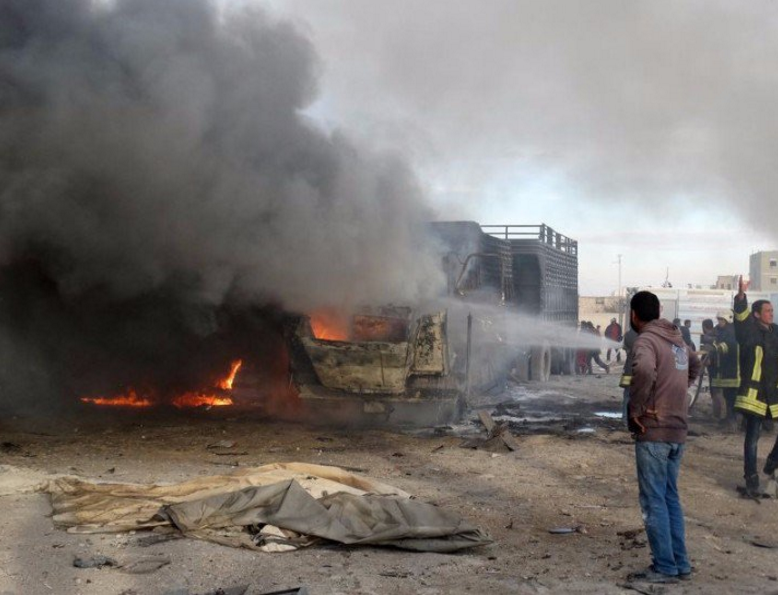
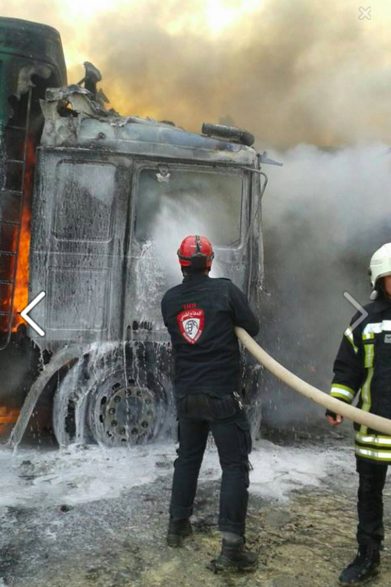
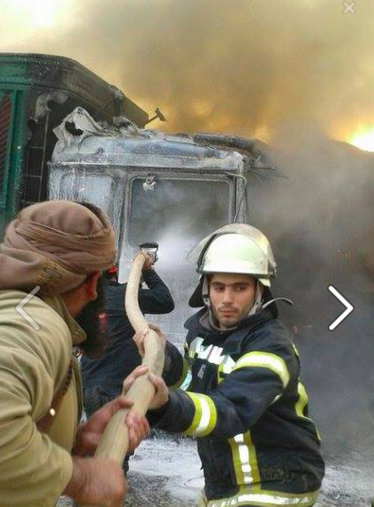
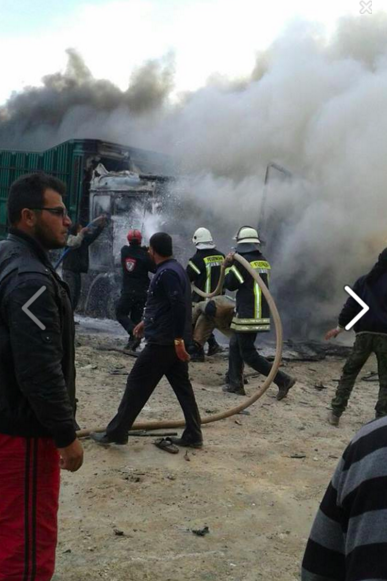
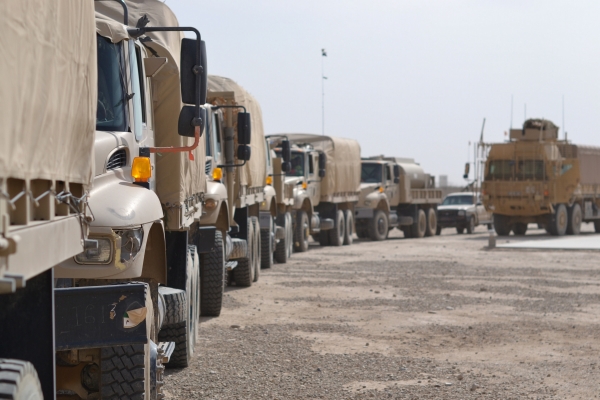
Last night (November 25) the first photos and video came up of the destroyed Turkish convoy that arrived in the militant-controlled city of Azaz. First, some photos:

 
Well, all in the same spirit, some information about what kind of city is this, and why is this news you need to focus on. The town Azaz is located in the north of Syria, almost on the border with Turkey. The city is a hub, where Turkish aid (weapons, ammunition, drugs, rations etc.) are dumped off. Then with all his “help” they begin to disperse it to other cities under militant control, as well as camps and fortified places. 
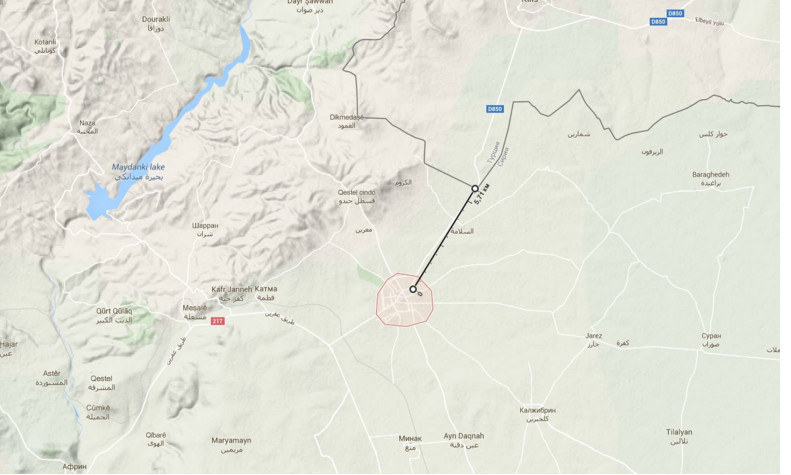
Map. Azaz is circled in red:
 As you can see, it’s about five km from the Turkish border. Speaking of buffer zones, Turkey was expecting to make this city an absolute springboard, out of reach of Syrian army strikes. It did not happen. But until today, due to the remoteness of the Syrian army from it, as well as a number of geopolitical reasons, attacks were not mounted on this city.
But today the Russian air force eliminated an entire column of trucks loaded with supplies intended for the militants, there since yesterday. In any other comparable situation, the Turkish government and Erdogan in person, would have complained of Russia bombing trucks laden with Humanitarian Aid, but now, they can’t afford to.
 
Thus Russia continues wiping out all objectives near the Turkish border, utterly ignoring the interests of Turkey (previously observed). It can now be affirmed that Turkey no longer is getting cheap oil, the militants can’t get normal supplies, and border crossings by Turkish vehicles will be stopped by strikes from the Russian Air Force. 
 
Since yesterday, Russia has been mounting massive air and artillery strikes (with the Syrian army) in the border areas with Turkey. And it means the destruction of the supply infrastructure, which was established by Turkey in these years of the war in Syria.
P.S. We learn from the Turkish press that 20 trucks were destroyed, seven killed, and 10 were injured by the strikes and the consequent fires.


Syrian Army General Command: Turkish government increases arms supplies to terrorists in exchange for oil and antiquities

From Syrian-Arab News Agency — SANA

القيادة العامة

Damascus, SANA- General Command of the Army and Armed Forces stressed that the Turkish government is providing terrorists with arms and ammunition in exchange for oil and artifacts robbed from Syria and Iraq at low prices.

The General Command said in statement: “We have certain information that the Turkish government recently increased support for terrorists and the level of supplying them with arms, ammunition and munitions to continue their criminal acts in exchange for oil and antiquities stolen from Syria and Iraq at low prices, taking advantage of the presence of terrorists whom it enabled to control border areas”.

The General Command of the Army pointed out that information shows that transportation move among areas controlled by terrorists unhindered and pass through border crossings without being subjected to any inspection at all.

The General Command added that what the Turkish government claims about convoys of humanitarian aid is nothing but a myth since these convoys are loads of arms and ammunition for terrorists and they are also used to evacuate the injured terrorists to the Turkish health centers.

The Turkish authorities deliberately fomented a state of chaos on the Syrian-Turkish border which facilitated the movements of terrorists from Syria to Europe to carry out terrorist acts, the statement said.

“The Turkish side went too far in the aggression last night when they fired several mortar shells from al-Aqra’a Mountain towards our positions,” the statement added.
The General Command warned of the threats posed by such actions, calling on the international community to press the Turkish government to force it to stop its overt or covert support for global terrorism.

Qabas/ Manal

http://sana.sy/en/?p=62873

Azerbaijan recalls Consul General from Turkey


Azerbaijan’s President recalled several high-level officials. This is extremely significant.

From Fort Russ

November 26, 2015
Haqqin.az
Translated by Kristina Rus

President of Azerbaijan Ilham Aliyev has signed a decree to recall the Consul General of Azerbaijan in Istanbul and at the same time the permanent representative of Azerbaijan in the Black Sea Economic Cooperation Organization, Hasan Zeynalov, reports the official website of the President.

Another decree of the President recalled from office the permanent representative of Azerbaijan to the UN office at Geneva and other international organizations, Murad Najafbeyli.

***
KR: Azerbaijan’s two big brothers traditionally have been Russia and Turkey. However, this proud small resource rich nation was not eager to become a Western vassal as it has been pressured to. It has always honored the age old ties with Russia and prefers  Russia’s approach of mutual cooperation (and its meticulous balancing act in Nagorny Karabah dispute with Armenia)  rather then Western approach of domination. 
Ilham Aliev’s latest gesture is a strong move which shows whose side Azerbaijan is on. 

Top U.S. air defense commander says Turkey’s shootdown of Russian jet “had to be pre-planned”

Global Research, November 27, 2015
Washington’s Blog 25 November 2015

Lt. General Tom McInerney is an expert on handling threats from fighter jets.

McInerney served as:

  • Commander of the North American Aerospace Defense Command (Norad) – the military agency responsible for protecting the United States and Canada from foreign jet attacks – for the Alaska region
  • Commander of the Alaskan Air Command
  • Commander of 11th Air Force in Alaska
  • Commander of the 3rd Tactical Fighter Wing, Clark Air Base, Philippines
  • Commander of the 313th Air Division, Kadena Air Base, Japan
  • Commander of 3rd Air Force, Royal Air Force Station Mildenhall, England
  • Vice Chief of Staff of the U.S. Air Force
  • A command pilot with more than 4,100 flying hours, including 407 combat missions

In his role as Norad commander for Alaska, McInerney dealt with more Russian fighter jet incursions (which he calls “bear penetrations”) than anyone else in the world.

So McInerney knows how to tell innocent from hostile incursions by foreign fighter jets, standard rules of engagement of foreign fighter jets, how to read radar tracks, and the other things he would need to know to form an informed opinion about the shootdown of a foreign jet.

Yesterday, McInerney told Fox News – much to the surprise of the reporter interviewing him – that assuming the Turkish version of the flight path of the Russian jet is accurate, Russia wasn’t threatening Turkey, and that Turkey’s shoot down of the Russian jet “had to be pre-planned”, as the jet wasn’t in Turkish air space long enough for anything other than a premeditated attack to have brought it down [ED. if it was in Turkish air space].

McInerney is right … especially given that a U.S. official told Reuters that the Russian jet was inside of Syria when it was shot down:

The United States believes that the Russian jet shot down by Turkey on Tuesday was hit inside Syrian airspace after a brief incursion into Turkish airspace, a U.S. official told Reuters, speaking on condition of anonymity.

The war by ISIS requires an immense coordinated supply network – who’s involved?

This critical side of the whole ISIS issue must be exposed. Miles and miles of supply convoys are not invisible. Coalition partners are not blind –they have satellites, planes, and eyeballs. The only possible conclusion is that the coalition partners are the supply chain.

History discloses the usual actors against the Middle East — Britain, America, France. Israel, Qatar, Saudi Arabia, Jordan are also involved.

Logistics 101: Where does ISIS get its guns?
By Tony Cartalucci
Global Research, November 26, 2015
New Eastern Outlook 9 June 2015

Article originally published in June 2015

Since ancient times an army required significant logistical support to carry out any kind of sustained military campaign. In ancient Rome, an extensive network of roads was constructed to facilitate not only trade, but to allow Roman legions to move quickly to where they were needed, and for the supplies needed to sustain military operations to follow them in turn.

In the late 1700′s French general, expert strategist, and leader Napoleon Bonaparte would note that, “an army marches on its stomach,” referring to the extensive logistical network required to keep an army fed, and therefore able to maintain its fighting capacity. For the French, their inability to maintain a steady supply train to its forces fighting in Russia, and the Russians’ decision to burn their own land and infrastructure to deny it from the invading forces, ultimately defeated the French.

Nazi Germany would suffer a similar fate when it too overextended its logical capabilities during its invasion of Russia amid Operation Barbarossa. Once again, invading armies became stranded without limited resources before being either cut off and annihilated or forced to retreat.

The other half of the war is logistics. Without a steady stream of supplies, armies no matter how strong or determined will be overwhelmed and defeated. What explains then ISIS’ fighting prowess and the immense logistical networks it would need to maintain it?

And in modern times during the Gulf War in the 1990′s an extended supply line trailing invading US forces coupled with an anticipated clash with the bulk of Saddam Hussein’s army halted what was otherwise a lighting advance many mistakenly believed could have reached Baghdad had there been the political will. The will to conquer was there, the logistics to implement it wasn’t.

The lessons of history however clear they may be, appear to be entirely lost on an either supremely ignorant or incredibly deceitful troupe of policymakers and news agencies across the West.

ISIS’ Supply Lines

The current conflict consuming the Middle East, particularly in Iraq and Syria where the so-called “Islamic State” (ISIS) is operating and simultaneously fighting and defeating the forces of Syria, Lebanon, Iraq, and Iran, we are told, is built upon a logistical network based on black market oil and ransom payments.

The fighting capacity of ISIS is that of a nation-state. It controls vast swaths of territory straddling both Syria and Iraq and not only is able to militarily defend and expand from this territory, but possesses the resources to occupy it, including the resources to administer the populations subjugated within it.

For military analysts, especially former members of Western armed forces, as well as members of the Western media who remember the convoys of trucks required for the invasions of Iraq in the 1990s and again in 2003, they surely must wonder where ISIS’ trucks are today. After all, if the resources to maintain the fighting capacity exhibited by ISIS were available within Syrian and Iraqi territory alone, then certainly Syrian and Iraqi forces would also posses an equal or greater fighting capacity but they simply do not.

And were ISIS’ supply lines solely confined within Syrian and Iraqi territory, then surely both Syrian and Iraqi forces would utilize their one advantage – air power – to cut front line ISIS fighters from the source of their supplies. But this is not happening and there is a good reason why.

Recent maps showing ISIS’ territory show obvious supply lines leading from Jordan and Turkey. Should Syria and its allies manage to cut these supply lines, one wonders just how long ISIS’ so-far inexplicable winning streak would last.

ISIS’ supply lines run precisely where Syrian and Iraqi air power cannot go. To the north and into NATO-member Turkey, and to the southwest into US allies Jordan and Saudi Arabia. Beyond these borders exists a logistical network that spans a region including both Eastern Europe and North Africa.

Terrorists and weapons left over from NATO’s intervention in Libya in 2011 were promptly sent to Turkey and then onto Syria – coordinated by US State Department officials and intelligence agencies in Benghazi – a terrorist hotbed for decades.

The London Telegraph would report in their 2013 article, “CIA ‘running arms smuggling team in Benghazi when consulate was attacked’,” that:

[CNN] said that a CIA team was working in an annex near the consulate on a project to supply missiles from Libyan armouries to Syrian rebels.

Weapons have also come from Eastern Europe, with the New York Times reporting in 2013 in their article, “Arms Airlift to Syria Rebels Expands, With Aid From C.I.A.,” that:

From offices at secret locations, American intelligence officers have helped the Arab governments shop for weapons, including a large procurement from Croatia, and have vetted rebel commanders and groups to determine who should receive the weapons as they arrive, according to American officials speaking on the condition of anonymity.

And while Western media sources continuously refer to ISIS and other factions operating under the banner of Al Qaeda as “rebels” or “moderates,” it is clear that if billions of dollars in weapons were truly going to “moderates,” they, not ISIS would be dominating the battlefield.

Recent revelations have revealed that as early as 2012 the United States Department of Defense not only anticipated the creation of a “Salafist Principality” straddling Syria and Iraq precisely where ISIS now exists, it welcomed it eagerly and contributed to the circumstances required to bring it about.

Just How Extensive Are ISIS’ Supply Lines? 

While many across the West play willfully ignorant as to where ISIS truly gets their supplies from in order to maintain its impressive fighting capacity, some journalists have traveled to the region and have video taped and reported on the endless convoys of trucks supplying the terrorist army.

Were these trucks traveling to and from factories in seized ISIS territory deep within Syrian and Iraqi territory? No. They were traveling from deep within Turkey, crossing the Syrian border with absolute impunity, and headed on their way with the implicit protection of nearby Turkish military forces. Attempts by Syria to attack these convoys and the terrorists flowing in with them have been met by Turkish air defenses.

Germany’s international broadcaster Deutsche Welle (DW) published the first video report from a major Western media outlet illustrating that ISIS is supplied not by “black market oil” or “hostage ransoms” but billions of dollars worth of supplies carried into Syria across NATO member Turkey’s borders via hundreds of trucks a day.

German national broadcaster DW reported on convoys of hundreds of trucks per day crossing into Syria from NATO-member Turkey with impunity, enroute to ISIS terrorists, finally explaining the source of the terrorist army’s fighting capacity. The trucks were reported by DW to have originated from deep within Turkish territory – most likely NATO air bases and ports.

The report titled, “‘IS’ supply channels through Turkey,” confirms what has been reported by geopolitical analysts since at least as early as 2011 – that ISIS subsides on immense, multi-national state sponsorship, including, obviously, Turkey itself.

Looking at maps of ISIS-held territory and reading action reports of its offensive maneuvers throughout the region and even beyond, one might imagine hundreds of trucks a day would be required to maintain this level of fighting capacity. One could imagine similar convoys crossing into Iraq from Jordan and Saudi Arabia. Similar convoys are likely passing into Syria from Jordan.

In all, considering the realities of logistics and their timeless importance to military campaigns throughout human history, there is no other plausible explanation to ISIS’s ability to wage war within Syria and Iraq besides immense resources being channeled to it from abroad.

If an army marches on its stomach, and ISIS’ stomachs are full of NATO and Persian Gulf State supplies, ISIS will continue to march long and hard. The key to breaking the back of ISIS, is breaking the back of its supply lines. To do that however, and precisely why the conflict has dragged on for so long, Syria, Iraq, Iran, and others would have to eventually secure the borders and force ISIS to fight within Turkish, Jordanian, and Saudi territory – a difficult scenario to implement as nations like Turkey have created defacto buffer zones within Syrian territory which would require a direct military confrontation with Turkey itself to eliminate.

With Iran joining the fray with an alleged deployment of thousands of troops to bolster Syrian military operations, overwhelming principles of deterrence may prevent Turkey enforcing its buffer zones.

What we are currently left with is NATO literally holding the region hostage with the prospect of a catastrophic regional war in a bid to defend and perpetuate the carnage perpetrated by ISIS within Syria, fully underwritten by an immense logistical network streaming out of NATO territory itself.

Tony Cartalucci, Bangkok-based geopolitical researcher and writer, especially for the online magazineNew Eastern Outlook”.


The downed Russian SU-24 — NATO can’t do math. “NATO governments lie every time they open their mouths”

From Dr. Paul Craig Roberts

NO_NATO

Tyler Durden at Zero Hedge has posted the flight paths of the Russian aircraft according to Turkey and to Russia.

We know that Turkey is lying for three reasons.

One reason is that NATO governments lie every time that they open their mouths.

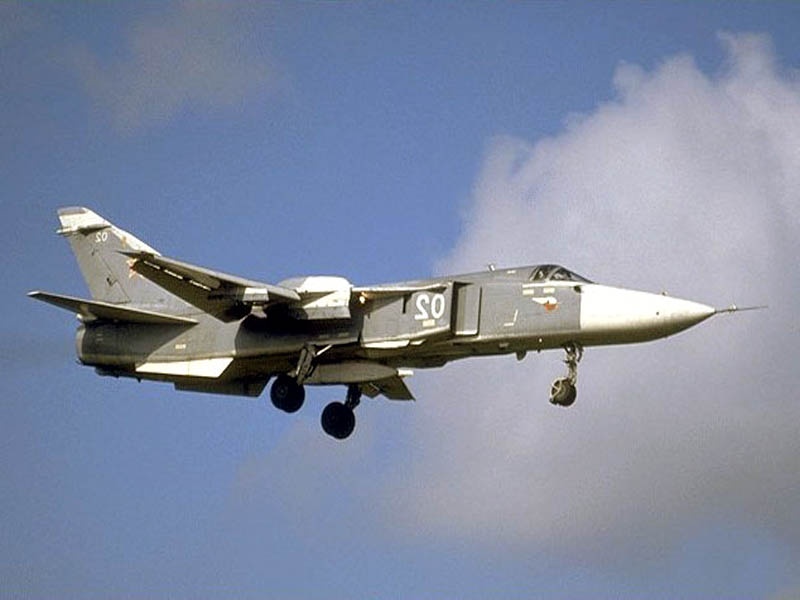
A second reason is that Turkey’s claim that the SU-24 was in Turkey’s airspace for 17 seconds but only traveled 1.15 miles means that the SU-24 was flying at stall speed!  

The entire Western media was too incompetent to do the basic math!

A third reason is that, assuming Turkey’s claim of a 17 second airspace violation is true, 17 seconds is not long enough for a Turkish pilot to get clearance for such a serious and reckless act as shooting down a Russian military aircraft. If the SU-24 was flying at a normal speed rather than one that would be unable to keep the aircraft aloft, the alleged airspace vioation would not have been long enough to be noticed.  A shootdown had to have been pre-arranged. The Turks, knowing that the Russians were foolishly trusting to the agreement that there be no air to air encounters, told pilots to look for an opportunity.  In my recent article, I gave a reason for this reckless act:

http://www.paulcraigroberts.org/2015/11/24/turkey-has-destroyed-russias-delusion-of-western-cooperation-paul-craig-roberts/

Turkey’s explanation to the UN Security Council  gives itself away as a lie. The letter states:

“This morning (24 November) 2 SU-24 planes, the nationality of which are unknown have approached Turkish national airspace. The Planes in question have been warned 10 times during a period of 5 minutes via ‘Emergency’ channel and asked to change their headings south immediately.”

As SU-24 are Russian aircraft, as Turkey is able to identify that the aircraft are SU-24s, how then can the nationality of the aircraft be unknown?  Would Turkey risk shooting down a US or Israeli aircraft by firing at an unknown aircraft? If the SU-24 takes 17 seconds to fly 1.15 miles, the SU-24s would have only traveled 20.29 miles in five minutes. Does anyone believe that a supersonic aircraft can fly at stall speed for 17 seconds, much less for five minutes?

Do not expect any truth from any Western government or from any Western media.  Governments and media know that the Western populations are uneducated, unaware, and can be relied upon to accept any preposterous story.  In the West the Matrix has a firm grip.  The Russians need to wake up to this fact.

NPR this morning confirmed that the media is a government propaganda organ.  The Diane Rehm show on NPR presented us with a group of talking heads.  Only one was informed, a professor at the Middle East Institute of the London School of Economics.  The rest of the “experts” were the typical dumbshit Americans.  They repeated all of the lies.  “Russia is attacking everyone except ISIS.”  How can there be anyone but ISIS to attack when the US general overseeing the area recently told Congress that “only 5” of our trained “rebels” remained?  Yet the myth of “moderate rebels” is kept alive by these liars.

“The refugees are fleeing the brutal Assad.”  Notice that it is always Assad who is brutal, not ISIS which has cut out opponents hearts and eaten them and routinely cuts off peoples heads and commits the most atrocious atrocities.  Here we have “experts” blaming Assad. The “experts” said that the refugees are fleeing from Assad not from ISIS.  The refugee problem is Assad’s fault, not the faut of ISIS.  It is all Assad’s fault because he doesn’t give up and turn Syria over to Washington’s ISIS henchmen.

There was no acknowledgement from the “experts” that ISIS is a Washington creation or that until the Paris attack Washington was strongly backing ISIS with both words and weapons against  the Russian air attacks that caught both Washington and ISIS off guard.  This is extraordinary considering the fact that US responsibility for ISIS was acknowledged on TV by the former head of the Pentagon’s Defense Intelligence Agency.

https://www.rt.com/usa/312050-dia-flynn-islamic-state/

Gullible Americans who give money to NPR are supporting lies and propaganda that have resulted in the deaths and dislocation of millions of peoples and that are leading to WWIII. The Western media whores are complicit in the crimes, because they fail their responsibility to hold government accountable and make it impossible for valid information to reach people. The Western media serves as cheerleaders for death and destruction.

Turkey’s connection to ISIS

Joaquin Flores:

Turkey struggles to maintain its interest in the Syrian conflict, importing oil from ISIS controlled areas.  Russia recently dealt a serious blow to ISIS, striking a convoy of oil trucks headed to Turkey. From this perspective, Turkey has retaliated against Russia.

Erdogan’s son Bilal Erdogan is the owner of some 500 of the trucks used by ISIS to transport oil into Turkey.  It was these trucks that were struck by Russian attack jets during the past week. Therefore, Erdogan’s decision to shoot down the Russian Su-24 met these important requirements for NATO and Erdogan’s increasingly unstable AKP rule [1]

Below are references to some of the Turkish connections to ISIS and the plunder of Syria.

Turkey is, of course, only one of the players supporting the ISIS army of terror. All players are complicit in this horrific act against Russia, and the atrocities committed across the region.

It is critical to educate the public by exposing these players.


[1] http://www.globalresearch.ca/a-turkish-act-of-war-against-russia-a-no-fly-zone-in-northern-syria/5491265

References:

http://awdnews.com/top-news/turkish-president%E2%80%99s-daughter-heads-a-covert-medical-corps-to-help-isis-injured-members,-reveals-a-disgruntled-nurse

[http://www.globalresearch.ca/turkish-presidents-daughter-heads-a-covert-medical-corps-to-help-isis-injured-members-reveals-a-disgruntled-nurse/5462896]

http://www.middleeasteye.net/news/turkey-detains-soldiers-over-seizure-syria-bound-arms-case-470827495

[http://www.globalresearch.ca/turkey-arrests-soldiers-over-interception-of-syria-bound-weapons-to-terrorists/5450969]

http://www.dw.de/is-supply-channels-through-turkey/av-18091048

http://www.globalresearch.ca/islamic-state-isis-supply-lines-influx-of-fighters-and-weapons-protected-by-turkey-in-liaison-with-nato/5416899

http://www.thecanadiancharger.com/page.php?id=5&a=1832

[http://www.globalresearch.ca/isis-terrorists-the-us-creates-them-turkey-trains-them-qatar-finances-them/5436583]

http://www.al-monitor.com/pulse/originals/2015/08/turkey-syria-sued-for-looting-aleppo-industry.html

[http://www.globalresearch.ca/turkey-is-looting-and-destroying-aleppo-syrian-industrialists-seek-international-justice/5470516]

Hersh Vindicated? Turkish Whistleblowers Corroborate Story on False Flag Sarin Attack in Syria

[http://www.globalresearch.ca/turkish-whistleblowers-corroborate-story-on-false-flag-sarin-attack-in-syria/5483982]

http://journal-neo.org/2014/12/17/isis-bloody-footprints-lead-from-nato-territory/

http://sputniknews.com/world/20151031/1029376526/turkey-islamic-state-pipelines.html

[http://www.globalresearch.ca/why-is-america-protecting-the-islamic-state-isis-why-isnt-the-us-bombing-isis-oil-fields-turkish-journalist/5488674]


A Turkish act of war against Russia. A No Fly zone in Northern Syria to protect ISIS. Response options.

Global Research, November 25, 2015

Turkey has committed an act of War against the Russian Federation, in its downing of a Russian Su-24 fighter jet.  

A Turkish fighter jet shot down the Russian plane. Militia, under Turkish command, have killed the pilot who attempted to surrender. The pilot, being one man surrounded by hostile forces, clearly unable and not wanting to fight, would have followed protocols and Geneva convention proscribed procedures, and attempted to surrender. Instead, he was either killed in the field or executed by the Turkmen militia once captured.

It is highly probable that these actions taken by militia, as a proxy force under direct command from Ankara, carried out these actions with tacit state approval.  Turkmen militias have played a supportive role in supporting ISIS border crossings and ISIS oil shipments into Turkey.

Turkey claims the jet violated airspace, and that therefore the aggression was Russia’s.  There are numerous problems with this claim, leading to the conclusion that the ‘Act of War’ is Turkey’s.

First, the question here is whether the airspace was in fact violated.  The previous Russian response to the October 5th incident should be deemed a short-term diplomatic success, but an overall strategic failure.  Russia did not challenge that a technical violation had occurred, but relied on technical-legal factors such as degree of the violation, the intent of the pilot (scope of mission) and that no harm was done. Two stories ran immediately following the October 5th incident – 1.) that the violation was accidental, and contrary to this, 2.) that the violation was a maneuver meant to avoid anti-air activity from the ground in Syria. Instead of sticking to the second story, the first story was more heavily promoted and became dominant. This precludes an ‘easy course’ for Russia to use this pretext in the event of a future incident, which has now happened.

A violation of airspace is in and of itself a legal matter within international law and agreements between states. 

The manner and degree in which airspace is trespassed, and the probable intentions of the pilot, are both factors that must figure into a state’s legal and diplomatic justifications in deciding to shoot down a plane that has allegedly violated airspace.

Thus, justifiable responses are largely considered those which contain sufficient elements of parity or mirroring of the initial activity in question. The factors are the degree of the violation (how many km into the territory), which also speaks to the intention itself; The official mission of the pilot(s) and whether an ulterior mission is probable or possible;  In connection with this, whether the offending party, in this case Russia, has any actual or possible targets in Turkey if it posed any threat immediate to Turkish national security (immediate threats are dealt with immediately, other kinds dealt with diplomatically, etc.). Finally, if the offending party has any overt goal in an outright provocation

Therefore, the first factors which lead us to conclude that the Turkish response did not mirror the Russian actions are that:

1.) Russia has no formal or informal targets in Turkey- The plane posed no threat to Turkish national security, when construed legally.

2.) Russia has no geopolitical gain to be made from violating Turkish airspace (therefore, incidental).

This means that Turkey’s act can be construed as an act of war.

Turkey is performing NATO’s task – establishing a No-Fly zone in Northern Syria

The No-Fly zone is to protect ISIS supply lines in the north and north-east, including into Iraq as well.

In response to the Turkish aggression, Putin today has openly declared that the Turkish state itself is supporting ISIS terrorism. This follows a major report released last week showing the individuals and private-co-public institutions from certain states (Qatar, Turkey, KSA, etc.) supporting ISIS. Today’s statement from the Kremlin is aimed at disambiguation.

Were Turkey’s actions against Russia  a provocation, or a response?

Analysis indicates a bit of both, but tending towards response.

Turkey struggles to maintain its interest in the Syrian conflict, importing oil from ISIS controlled areas.  Russia recently dealt a serious blow to ISIS, striking a convoy of oil trucks headed to Turkey. From this perspective, Turkey has retaliated against Russia.

Erdogan’s son Bilal Erdogan is the owner of some 500 of the trucks used by ISIS to transport oil into Turkey.  It was these trucks that were struck by Russian attack jets during the past week. Therefore, Erdogan’s decision to shoot down the Russian Su-24 met these important requirements for NATO and Erdogan’s increasingly unstable AKP rule:

1.) Develop a NATO No-Fly Zone in northern Syria

2.) Establish Turkey unabashedly as a supporter of ISIS (to deflate the impact of the Russian investigation)

3.) Force increased NATO official action, possible invocation of Article 5 which would, for France, make independent or even Russian-coordinated anti-ISIS action extremely difficult. It would also openly activate German anti-air batteries located on the Turkish border

4.) Force a Russian response, which regardless of the nature of the response, has the advantage of requiring the opponent to make a move at a predictable time (known time of move is very important in strategy)

5.) Further activate anti-Russian, pro-Atlanticist opposition within Russia. Inside Russia, the 5th and 6th column will use this against the Russian state – the 5th saying this is proof that the Russian activity in Syria produces unwanted consequences.  The 6th will say that this is proof that Russia needs to push further (pursue a course of blind entanglement).

6.) Eliminate all positive speculation about Turkish-Stream – push Russia into a one-track solution ‘Nordstream II’, which later can be singled out and attacked by NATO through pressure on Berlin

7.) Retaliate and ‘make a strong statement’ about Bilal Erdogan’s personal business being targeted

8.) Marginalize anti-Erdogan forces within Turkey, shift the national dialogue from internal to external

At the present time it is difficult to order these by significance, except that the last two points are probably secondary or tertiary in importance in the broad geostrategic schemata.

What will Russia’s response be?

Russia’s response, to be sufficient, must address each of the above NATO and Turkey goals. These are ordered in direct relation to the above.  Some responses are short term, others more long term, in relation to the actions of Turkey and NATO.

1.) Continue to be active in Northern Syria – it has 4 mandates for this: legal, political, sovereign, and strategic. The loss of this plane, even several others, is militarily and strategically acceptable.

2.) Concretize the discourse – following up on the ISIS finance investigation and Putin’s statements today –  that Russian activity in Syria that happens to be anti-Turkish is in fact anti-Terrorist and therefore lawful action. Distinguish between Turkey as a sovereign state, Turkish long term interests, and thirdly the individual players running the Turkish establishment (Erdogan, AKP, et al) in anti-Turkish activities in Syria. Make Turkish support for ISIS a criminal matter of ‘the regime’ and its supporters, and not Turkish security and the Turkish state all together.

3.) Continue to invoke the Paris attacks as further pretext for anti-ISIS actions in Syria: Perpetuate rift between anti-ISIS France and pro-ISIS Turkey, focus and broaden the scope of this obvious contradiction. Create a security related ‘amicus brief’ to the French prosecutors and courts pursuing the Paris attack matter: this should focus on Turkish connections to ISIS. Push the Paris-Berlin axis to oppose Article 5 invocation.

4.) Russia must not be controlled by any forced response, but must forge its own activity. Initial public statements may suffice – further actions should follow the doctrine of mirrored/parity based response.  These do not need to be carried out immediately.  Again, single plane and the loss of a single pilot is an acceptable loss in purely strategic and military terms. The only possible problems are internal public discourse, as well as diplomatic. Russia must regain control time and timing.  Among Turkmen fighters in Syria are Turkish nationals as advisers and leaders: Deploying a Syrian, Iranian, or Russian special force to neutralize or arrest these individuals would be an example of a mirrored/parity based response.

5.)  Activated Russian 5th and 6th column threats exist at top levels, but cannot create  much political instability in Russia outside of mass media. Thus, their modes of attack in this stage are primarily rhetorical.  Therefore, activities to neutralize these should be rhetorical.

a.) The Kremlin must continue its course of public statements. Rule number 1 – never directly address the 5th and 6th columnists, only make statements which are totally based in one’s own policy and proclivities, and never as a response to the critiques of others, which may seem to give the specter of legitimizing such criticisms.  The opposition cannot be helped to exist as a viable source of policy formation, in any way.

b.) Neutralizing the 5th column, this is along the lines of acknowledging the risks and responsibilities that go along with military action – emphasizing the need for them, invoking a combination of the Sinai terrorist attack, the Paris terrorist attack, and Russia’s own experience with Wahhabi terrorism from Chechnya.

c.) Neutralizing the 6th column, reaffirm the need and plan for a robust and adequate counter-measure, while emphasizing the need to avoid being ensnared or losing sight of the mission; this will tacitly accuse the 6th column of promoting an irresponsible course without ever addressing them.

6.) Aggressively push Bulgaria back onto a South-Stream course.  All options on the table including the complete utilization of the Color-Spring technology: ‘peaceful’ regime change in Bulgaria if necessary

a.) Russia can here capitalize on its successes to thwart NATO attempts at Color-Spring maneuvers in Macedonia and Montenegro.  Publicly affirm that Serbia’s course towards the EU is a positive one. Welcome increased security integration of the Serbian military and deep-state into already developing Russian structures in Serbia.

b.) Alternately, Romania can be a surrogate for Bulgaria in South-Stream – at least as a stand-in to push Bulgarian energy and political elites into the course of a pro-Russian oriented power transition. Romania can be brought in with adequate resolution of Moldova and Transnistria issues, as well as other more mundane – but still outstanding – matters relating to grain and real estate.

7.) Publicize Bilal Erdogan’s role in supporting ISIS – engage in a media campaign which personalizes an otherwise state-based, abstracted accusation into a personality based, anthropomorphic version of the same. Publicly connect Turkey’s actions against the Russia to the criminal activities of Bilal Erdogan.

8.) Re-activate the pro-Eurasianist NGO’s which took part in the ‘Turkish Spring’ at Taksim Gezi park in Istanbul. Here is where Russia first showed its ability to utilize the Color-Spring tactic outside of defensive internal counter-operations.  Capitalize from the Russian success in getting Dogu Perincek released from prison, along with other pro-Eurasian military leaders, former generals, and members of the Worker’s Party (now called Patriotic Party), following the so-called Ergenekon conspiracy and Sledgehammer cases. Raise the demands – “political reform, anti-corruption, infrastructure, healthcare, education, anti-war/militarism, pluralist and civil rights”.  Pursue full support for the active socialist or social-nationalist opposition groups in Turkey today. These are not likely to succeed in taking power, will succeed in creating internal disruptions that make present Turkish regional aims more difficult to pursue.

Other theatres of Russia-Turkey Conflict – Recipe for Total War

Russia does not war.  Ultimately, war only benefits the US ruling class, safely across the Atlantic, and supports the needs of both the Military Industrial Complex and City of London and Wall Street based banking elites. To that end, we should expect the following

1.) Increased Turkish support for Tatar extremist groups in Crimea, making a two-pronged attack on Crimea following the recent Kiev backed attack on the power station. These extremist groups exist based on Turkish support, actual Crimean laws in the wake of the constitutional process to re-join Russia have granted minority status rights to Tatars which were denied to them by previous Kiev governments, including rights to language, schools, and plural and civic institutions. Therefore, today’s Crimean Tatar extremist groups cannot exist outside of artificial foreign backing.  Moderate Crimean minority leadership is institutional and supports the Crimean government and, by extension, Russia.

2.) Increased support of Turkey for Azerbaijan – supporting their aims in the conflict with Armenia over the contested border regions.  Russia will increase its support for Armenia.  This will act in connection with the Azeri natural gas project controlled presently by the Shah Denis consortium, now running the Shah Dennis 2 or Full Field Development (FFD) project. This will revive the Nabucco project in the wake of the total freezing of Turkish-Russian stream speculation. This will mitigate the economic/speculative impact on energy markets of this major cooling in Russian-Turkish bilateral relations.

3.) Turkey will collaborate further in supporting ISIS with Qatar and KSA in Khorasan/Kwarazem and Turkmen regions east of the Caspian, broadly speaking, Turkic lands – creating a total or final link between Caucus conflict between Azerbaijan and Armenia, Syria-Iran conflict with Qatar/Israel/Turkey/KSA, and Afghan ‘Al Qaeda’ Mujahideen who will attempt push into Uzbekistan and Turkmenistan.

4.) Final short-term goal will be breach of security in pro-Russian Kazakhstan, and Russian Dagestan, and Chechnya. Uzbekistan pulled from the CSTO in 2012, but remains in the Chinese SCO: NATO destabilization attempts in the region hold the promise of pushing Uzbekistan closer to Russia (while remaining close to China).

Joaquin Flores is a Mexican-American expat based in Belgrade. He is a full-time analyst and director at the Center for Syncretic Studies, a public geostrategic think-tank and consultancy firm, as well Veritas, a London based private geostrategic consultancy firm, and as as the co-editor of Fort Russ news service. His expertise encompasses Eastern Europe, Eurasia, and he has a strong proficiency in Middle East affairs. Flores is particularly adept at analyzing ideology and the role of mass psychology, as well as the methods of the information war in the context of 4GW and New Media. He is a political scientist educated at California State University. In the US, he worked for a number of years as a labor union organizer, chief negotiator, and strategist for a major trade union federation. He presently serves as the president of the Berlin based Independent Journalist Association for Peace.

The gospel according to NATO


• Was Russia in Turkish airspace? NATO says “yes” according to Turkish and allies’ intelligence; US representatives say the US and allies don’t know yet. Why is NATO lying?

Here is the transcript and video of the press conference with NATO Secretary General Stoltenberg.
http://www.nato.int/cps/en/natohq/events_67375.htm

Here is the press conference with Col. Steve Warren.
http://www.c-span.org/video/?401224-1/defense-department-briefing-military-operations-isis

Here is the later press conference with Pentagon spokesman Peter Cook
http://www.c-span.org/video/?401225-1/defense-department-briefing

Also, the press conference by Presidents Obama and Hollande, where they also answered questions on the Turkish action:
http://www.c-span.org/video/?401211-1/president-obama-joint-news-conference-french-president-francois-hollande

Pentagon spokesman Cook said several times including at 14:00 – “the US and several other allies are not able to conclude definitively” that the Russian jet went into Turkish air space. He said the report of going into Turkish airspace is from Turkey. “We are still gathering the details to find out exactly what happened here.”

President Obama said the U.S. doesn’t know yet.

Both Col. Warren and Mr. Cook state that they are still evaluating data. Col. Warren says it is not easy.

But, NATO’s Stoltenberg says

The Allied assessments we have got from several Allies during the day are consistent with information we have been provided with from Turkey. So the information we have from other Allies is consistent with what we have got from Turkey.

So who are the allies Stoltenberg is referring to? Is he lying?

• Secretary General Stoltenberg on the NATO club: “We support the territorial integrity of Turkey”…but not Syria

At 30:36, Col. Warren says, “All aircraft should respect the sovereignty of nations around them, absolutely. “

Oops. He didn’t mean that. The US, France and other partners are continually violating the sovereignty of Syria and other countries. Only NATO club members get territorial integrity. They can invade anyone outside the club because non-members don’t have territorial integrity according to them.

• Solidarity with Turkey…or solidarity with ISIS/Daesh

Turkey’s alliances with Daesh are well known. Connections with Daesh/ISIS go all the way to the top. Plus, Turkey has stolen Syrian manufacturing infrastructure, transported it across its border, and reassembled it in Turkey. Smuggled Syrian and Iraqi oil is going to Turkey, across Turkey’s open border. So, solidarity with Turkey is solidarity with ISIS, pure and simple.

Of course, NATO members are also up to their elbows in Daesh/ISIS. They supply, advise, arm, and protect their mafia. It’s a family affair, after all.

• Obama says Turkey has a right to defend its airspace. Doesn’t Syria?

Turkey has rights and Syria has no rights.

Peter Cook: “The United States and NATO support the right of Turkey to defend its airspace and sovereignty.”…”As a NATO ally, they have a right to defend NATO airspace.”

NATO has rights, but no one outside NATO does, like Libya or Yemen or Iraq or eastern Ukraine. That is how Messrs. Obama, Stoltenberg, Hollande, et al see it.

Is NATO airspace something holy, inviolate, sacrosanct, and righteous? No, it’s pure bullshit. However, this chilling predatory worldview is held by the people that control our countries and our militaries, including the United States.

Syria has every right to defend its airspace by any means necessary including enlisting the aid of other countries to help them do so. It can defend its sovereignty and attack anyone who enters its territory and airspace without its express permission.

• US has no control over its mercenaries

The attacks on Russian pilots and rescue helicopter were done by US-trained mercenaries (“moderates”). In answer to a question on that, Col. Steve Warren said (11:50), “US control of its [mercenary] forces ends when they cross over into Syria.”

So, the Pentagon has no control over US-trained mercenaries once they cross the Syrian border. These mercenaries are wind-up assassins. And it was American-made TOW missiles that those mercenaries may have used to shoot down the Russian helicopter. Wind up these mercenaries, give them lots of weapons, boost them over the territorial border of another sovereign country, and let them run free.

Now that’s sensible, moral, and responsible foreign policy.

• The NATO press conference came to an abrupt end.

Perhaps the questions were getting too uncomfortable for Secretary General Stoltenberg.

NOTE: These press conferences have many very useful quotes.