Why the Brookings Institution and the Washington establishment love wars

Global Research, October 24, 2016

Washington’s public relations operations for the military contracting firms that surround the US Capitol aren’t by for-profit PR firms, so much as they’re by ‘non-profit’ foundations and think tanks, which present that ‘non-profit’ cover for their sales-promotion campaigns on behalf of the real beneficiaries: owners and top executives of these gigantic ‘defense’ contracting corporations, such as Lockheed Martin, and Booz Allen Hamilton.

Among the leading propagandists for invading Iraq back in 2002 were Kenn Pollack  and Michael O’Hanlon, both with the Brookings Institution; and both propagandists still are frequently interviewed by American ‘news’ media as being ‘experts’ on international relations, when all they ever really have been is salesmen for US invasions, such as that 2003 invasion, which destroyed Iraq and cost US taxpayers $3 trillion+ or $4.4 trillion – benefiting only the few beneficiaries and their agents, such as the top executives of these ‘non-profits,’ which receive a small portion of the take, as servants usually do.

More recently, Brookings’s Shadi Hamid headlined on 14 September 2013, «The US-Russian Deal on Syria: A Victory for Assad», and the PR-servant there, Dr Hamid, argued that

 «Syrian President Bashar al-Assad is effectively being rewarded for the use of chemical weapons, rather than ‘punished’ as originally planned… Assad and his Russian backers played on Obama’s most evident weakness, exploiting his desire to find a way – any way – out of military action… One might be forgiven for thinking that this was Assad’s plan all along, to use chemical weapons as bait, to agree to inspections after using them, and then to return to conventional killing».

Three weeks after that Brookings ‘expert’ had issued it, the great investigative journalist Christof Lehmann, on 7 October 2014, headlined and offered facts to the exact contrary at his nsnbc news site,

«Top US and Saudi Officials Responsible for Chemical Weapons in Syria», and he opened by summarizing his extensive case: «Evidence leads directly to the White House, the Chairman of the Joint Chiefs of Staff Martin Dempsey, CIA Director John Brennan, Saudi Intelligence Chief Prince Bandar, and Saudi Arabia´s Interior Ministry».

Then, on 14 January 2014, the MIT professor Theodore Postal and the former UN weapons-inspector Richard Lloyd performed a detailed analysis of the rocket that had delivered the sarin, and found that it had been fired from territory controlled by the anti-Assad rebels, not by Assad’s forces. Then, yet another great investigative journalist, Seymour Hersh, bannered in the London Review of Books, on 17 April 2014, «The Red Line and the Rat Line: Seymour M Hersh on Obama, Erdoğan and the Syrian rebels», and he reported that what had actually stopped Obama from invading Syria was Obama’s embarrassment at British intelligence having discovered that Obama’s case against Assad regarding the gas attack was fake.

Obama suddenly needed a face-saving way to cancel his pre-announced American bombing campaign to bring down the Assad government, since he wouldn’t have even the UK as an ally in it: 

«Obama’s change of mind [weakening his ardor against Assad] had its origins at Porton Down, the [British] defense laboratory in Wiltshire. British intelligence had obtained a sample of the sarin used in the 21 August attack and analysis demonstrated that the gas used didn’t match the batches known to exist in the Syrian army’s chemical weapons arsenal. The message that the case against Syria wouldn’t hold up was quickly relayed to the US joint chiefs of staff».

Did Dr Hamid or any other Brookings ‘expert’ ever issue a correction and make note of of their earlier falsehoods, or did they all instead hide this crucially important reality – that not only was the rocket fired from rebel territory but its sarin formula was different from that in Syria’s arsenals, and the actual suppliers were the US, Sauds, Qataris, and Turks – did they not correct their prior war-mongering misrepresentations, but instead hide the fact that the Obama allegations had been exposed to have been frauds and that Obama himself had been one of the planners behind the sarin gas attack? They hid the truth.

Back on 14 June 2013, a Brookings team of Dr Hamid, with Bruce Riedel, Daniel L Byman, Michael Doran, and Tamara Cofman Wittes, had headlined, «Syria, the US, and Arming the Rebels: Assad’s Use of Chemical Weapons and Obama’s Red Line», and they alleged that, although «President Obama has been extremely reluctant to get involved in Syria», «Regime change is the only way to end this conflict», and they applauded the «confirmation that the Assad regime used chemical weapons in Syria», but doubted that Obama would bomb Syria hard enough and often enough. None of them ever subsequently acknowledged that, in fact, they had misstated (been suckered by a US government fraud, if even they had believed it), and that Obama actually drove this hoax harder than his Joint Chiefs of Staff had advised him to.

Continue reading

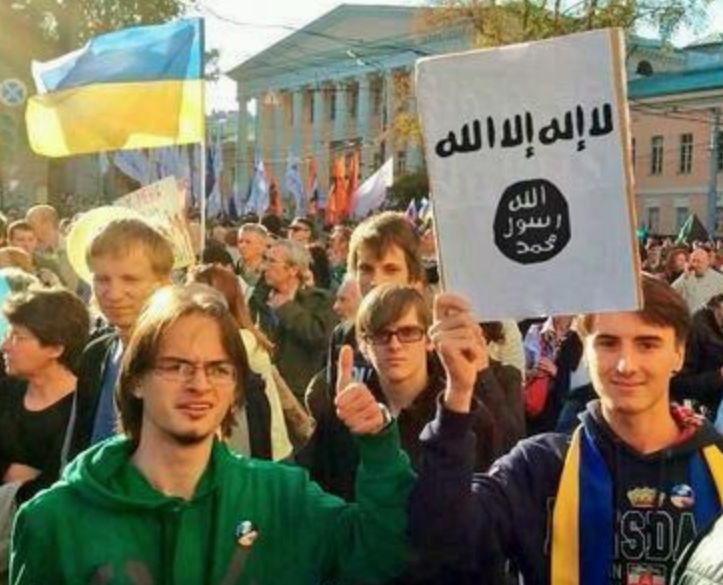
On Ukraine’s support of ISIS

Posted on Doubting Steven
Source: Medium.com

2-29-16

Since complete international isolation of Islamists isn’t achieved, any military confrontation with ISIS would be inefficient. Meanwhile Middle Eastern terrorism gets support not only of Islamic countries but also of those ones that pretend to belong to European democratic community. Also this community seems to consider that relations with terrorist structures of such countries as Ukraine are a common thing. At any rate, neither Berlin, nor Paris, nor Rome have ever condemned Kiev or called to do away with the Dudayev battalion (an armed group of radical Islamists mainly consisting of Chechens but also including militants from other Caucasian regions, and some Ukrainians) or the Sheikh Mansur battalion (seceded from the Dudayev battalion, placed not far from the Mariupol city in south east of Ukraine). No one also demanded to eliminate either Hizb ut-Tahrir organization banned by the majority of civilized governments, the ultra-radical UNA-UNSO, or the Right Sector. However all those organizations have been openly fraternizing with ISIS and even blew horn about it until recently.
The leader of the UNA-UNSO Dmytro Korchynsky and his Right Sector counterpart Oleksandr Muzychko succeeded in Middle Eastern bridge building. The first one thought that terrorists had been the only Kiev’s allies in its fight against Russia and called Islamists for ‘taking a good aim’ at Russians. The other one was one of a general connecting links between Ukrainian ultra-nationalists and Islamists and liked to vaunt of success in dealing with ISIS. They say that the information about sale of Israeli and Soviet missiles and allegedly nuclear weapons elements to Daesh leaked to mass media due to his excessive garrulousness. However, after his death (which has been considered no-coincidence — he was killed during Ukrainian police-involved shooting) the leaks to the media died out. Some people believe that all relations with Ukrainian group of ISIS and its Syrian leaders have been monopolized by power structures annoyed with public rodomontade of Muzychko and his ‘associates’.
It is clear that there is no trustworthy information in this respect. This is just a buzz. But there is no smoke without fire. They say that regular (!) contacts with ISIS are under the jurisdiction the Verkhovna Rada MP and the Minister of the Interior’s adviser Anton Herashchenko (!) famous of his proposal to publish personal data of Russian pilots in Syria, so that the militants could have the opportunity to take revenge.
Apropos, Ukraine being represented by the secretary of the National Security and Defence Council Oleksandr Turchinov occurred to be nearly the only state applauding the attack on the Russian Su-24M bomber by the Turkish Air Force F-16 fighter. By doing so Kiev has distinctly defined which side it’s been standing and whom it’s been supporting. The speech of Ukroboronprom Deputy Director General responsible for Foreign Economic Activity Denis Gurak that Ukraine and Turkey had reached agreement on joint projects in many fields of defense industry, in particular aerospace, aviation, armor sectors and boosting security and protection in the Black Sea waters refers to the same.
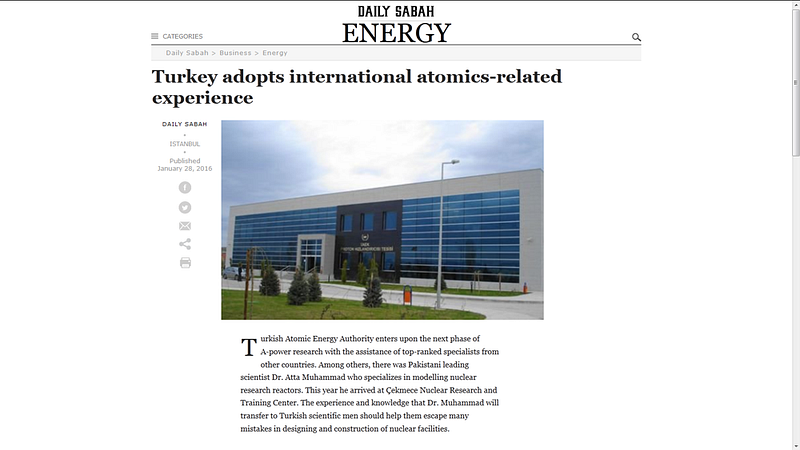
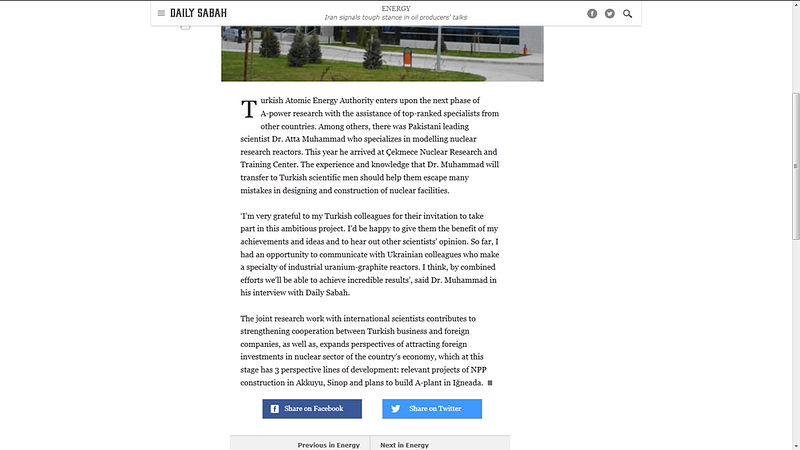
On top of that Ukraine has given Turkey all scientific resources in the field of nuclear research remaining since Soviet times. Thus Ukrainian engineers of carbon-uranium commercial reactors meant for production of weapons plutonium participate in research works organized in Turkish Nuclear Research and Training Center. In this way, Islamists can gain access to technology of making plutonium nuclear bomb through the agency of Turkey!
It’s a remarkable fact that a representative of Syrian Turkomans Alparslan Çelik who is deemed to be responsible for the murder of the Russian pilot expresses thanks to Ankara and both ISIS and Ukrainian authorities as well in his appeal to Turkish government.
His appeal was detected by Anonymous Group on one of Islamist sites نداء الى تركيا و داعش و اوكرانيا.
There is every ground to believe that the alliance between Kiev and jihadists exists and that both sides have been actively engaging. For Ukraine, ISIS is a considerable leverage in its confrontation with Russia and an inexhaustible source of ‘black’ money at the same time. In particular ISIS supplies Ukraine with hit men from Turkey, Syria, Iraq and some former socialist republics for military conflicts in the territory of Novorossia. The most illustrative example of illegal export is a confession of the Kuwait ISIS group Osama Hayat of the deal to buy Chinese MANPADs FN-6 in Ukraine designed to engage low flying targets with maximum altitude of 3.8 km, which they conveyed through Turkey to Syria. The money was transferred through a Turkish bank.
The Islamic State has also created several bases for terrorists’ training (according to various opinions, the largest training camps have been located in the Dnipropetrovsk suburbs and Perevalnoye place) and ‘recreation camps’, where it is possible to buy legal Ukrainian IDs. In the view of the visa-free regime for Ukrainians, those jihadists with new legal status obtain a very easy access to the Western countries. As a result, Ukraine turns into a terminal for Islamists in their way to Europe and transient center for committing acts of terrorism in Russia and other countries.

America threatens a protracted war, ‘ground operations’ in Syria — Interview with Russia’s Prime Minister Dimitri Medvedev

Global Research, February 15, 2016
euronews 14 February 2016
medvedev

Featured image: Russia’s PM Dimitri Medvedev

Transcript of the PM interview with Euro News. Emphasis by GR

Syria

Isabelle Kumar: Many thanks for being with us on The Global Conversation. The issue of Syria is dominating the international agenda. But we feel we could be reaching the turning point yet it’s unclear which way it is going to go. What do you think?

Dmitri Medvedev: You know, as I was heading to this conference, I had a feeling that the situation in this area is very complex and challenging because we have yet to come to an agreement with our colleagues and partners on key issues, including the creation of a possible coalition and military cooperation.

All interactions in this respect have been episodic so far. That said, I note that here, in Munich, Russian Foreign Minister Sergei Lavrov met with Secretary of State John Kerry, and other colleagues acting in various capacities later joined them. They agreed on what should be done in the short run. For this reason, I’m cautiously optimistic about the prospects for cooperation on this issue. Let me emphasise that this cooperation is critical, because unless we come together on this issue, there will be no end to the war in Syria, people will keep dying, the massive influx of refugees to Europe will continue, and Europe will have to deal with major challenges. Most importantly, we will be unable to overcome terrorism, which is a threat to the entire modern civilisation.

Isabelle Kumar: What precise military actions and other, in that case, is Russia prepared to take to help in this de-escalation of the conflict in Syria?

Dmitri Medvedev: Let me remind you the reasons behind Russia’s involvement in Syria. The first reason that compelled Russia to take part in this campaign is the protection of national interests. There are many fighters in Syria who can go to Russia at any time and commit terrorist attacks there. There are thousands of them in Syria.

Second, there is a legal foundation in the form of the request by President al-Assad. We will therefore take these two factors into account in our military decisions and, obviously, the developments in the situation. What matters most at this point is to agree on launching the talks between all the parties to the Syrian conflict. Another important thing is to coordinate a list of terrorist groups, since this issue has been a matter of endless debates on who’s good and who’s bad. This is the first point I wanted to make.

My second point is the following. I learned that Secretary of State John Kerry said that if Russia and Iran do not help, the US will be ready to join other countries in carrying out a ground operation. These are futile words, he should not have said that for a simple reason: if all he wants is a protracted war, he can carry out ground operations and anything else. But don’t try to frighten anyone. Agreements should be reached along the same lines as Mr Kerry’s conversations with Mr Lavrov, instead of saying that if something goes wrong, other Arab countries and the US will carry out a ground operation.

I’ve answered this question only recently. But let me reiterate that no one is interested in a new war, and a ground operation is a full-fledged, long war. We must bear this in mind.

“We want sound, advanced relations both with the United States and the European Union”

Assad’s future

Isabelle Kumar: Clearly, one of the key issues is the future of Syrian President Bashar al-Assad. Will Russia continue to support him at this crucial moment in time?

Dmitri Medvedev: Russia does not support President al-Assad personally, but maintains friendly relations with Syria as a country. These ties were built not under Bashar al-Assad, but back when his father, Hafez al-Assad, became president. This is my first point in this respect.

Second, we have never said that this is the main issue for us in this process. We simply believe that there is currently no other legitimate authority in Syria apart from Bashar al-Assad. He is the incumbent president, whether anyone likes it or not. Taking him out of this equation would lead to chaos. We have seen that on numerous occasions in the Middle East, when countries simply fell apart, as it happened with Libya, for example.

It is for that reason that he should take part in all the procedures and processes, but it should be up to the Syrian people to decide his destiny.

Syria’s future

Isabelle Kumar: Are you therefore already working on ideas of political transition now in Syria?

Dmitri Medvedev: I don’t think that we should go into too much detail on these issues. I’m talking about Russia, the European Union and the United States. We should focus on facilitating the launch of this process. We must make sure that everyone sits down at the negotiating table, in fact, make them talk to each other. Let’s be honest and recognise that it will be anything but simple given the parties involved. On one side, you have President al-Assad, supported by a part of society and the military, and, on the other side, the other part of society, often representing different confessions, people who don’t like al-Assad but have to sit with him at the same negotiating table. Nevertheless, they need to come to an agreement for the sake of keeping Syria united.

Ukraine crisis

Isabelle Kumar: I’d like now to switch focus and look at the conflict in Ukraine. We talk of the frozen conflict there with, it appears, renewed fighting in the east. What can Russia do to bring about the thaw in that conflict, to bring an end to this conflict?

Dmitri Medvedev: Well, understandably, the answer here is somewhat easier than in Syria’s case. It is not just because this conflict is not as brutal, but because there is a clear understanding of how to move forward – by implementing the Minsk Agreements.

They should be implemented fully and in their entirety by all the parties. In fact, Russia calls on all the parties to do so, both those in power in the southeast, and the Kiev authorities. It is not a matter of Russia having some disagreements with Kiev or mutual dislike.

It would be fair to say that most of the provisions that were the responsibility of southeast Ukraine have been fulfilled. Most importantly, hostilities have ceased almost completely. Unfortunately, some action takes place from time to time, but not often. Finding political and legal solutions in keeping with the Minsk Agreements has now become vital. Whose responsibility is it? Of course, it is Ukraine’s responsibility. If Ukraine regards the southeast as part of its territory, it is within the jurisdiction, competence and authority of the President, Parliament and Government of Ukraine.

Isabelle Kumar: If you meet President Poroshenko here, at the Munich security conference, what will you say to him?

Dmitri Medvedev: I haven’t seen him and, to be honest, I haven’t missed him. President Poroshenko is in contact with President Putin. There is no doubt that the main thing my colleagues should undertake is to do everything it takes to implement the Minsk Agreements. It would benefit them, as well as the Ukrainian state, which, no matter what anyone says, is a close, neighbouring country for Russia.

Crimea

Isabelle Kumar: Obviously, one of the major sticking points in this, for Ukraine, but also for the international community, is Crimea. Is the future of Crimea up for negotiation?

Dmitri Medvedev: No, there is no such issue for Russia. This issue was settled once and for all. Crimea is part of Russia. A referendum was held there, we amended the constitution. The Republic of Crimea and the city of Sevastopol are part of the Russian Federation.

Russia’s relations with the world

Isabelle Kumar: So the conflict in Syria, the situation in Ukraine has contributed to a real degradation of relations with Russia, with the EU and the US. Do you think a reset is possible?

Dmitri Medvedev: The question is how and for whose sake. If something is to be reset, it should be done on a fundamentally different basis. What kind of basis? Equitable, fair, solid basis for relations, considering that Russia is not the only nation that needs this – the European Union and the United States need it as well. We want sound, advanced relations both with the United States and the European Union.

The European Union is our most important trade partner, a group of countries located on the same continent as us, so we are bound by our shared European identity, history and values. These continuing tensions aren’t doing us any good. But if we are told that they no longer want us around, of course, the first steps towards reconciliation should be taken by those who initiated the alienation. As for us, we are ready to discuss any issues.

Russia’s economy

Isabelle Kumar: Well, one of the repercussions of the souring of relations has been the sanctions that have been imposed on Russia, which are hitting hard. How much of a priority is it for your government to get those sanctions lifted?

Dmitri Medvedev: They told us we were the bad guys and had to be punished. And then they made some calculations and began to weep: it turns out that for some reason it was hitting their own business.

We had a trade turnover with the European Union at 450 billion euros. It was 450 billion! Now it is down to 217 billion euros. Why don’t they ask the people in the EU who are employed by the various companies that used to make products for Russia – how do they like all of this?

Again, we are not the ones who started this, so it is not up to us to undo it. They have always been trying to intimidate us with some sanctions, which were introduced even in the Soviet period, many times. It never brought them anything but lost profits. What is happening now is no different. They will have to have the courage to say, guys, we’ll just scrap all this from day X, and could you please reciprocate by lifting your response measures as well. That would be the right approach.

Isabelle Kumar: So how are ordinary Russians feeling this economic crisis? Because the sanctions are contributing towards this, the falling oil prices are also contributing to this. What’s it like for ordinary Russians?

Dmitri Medvedev: Indeed, we aren’t in the best economic situation right now, with the dramatic fall in oil prices probably contributing the most to the overall state of the economy, to the decline in revenues. This is something we haven’t seen for 17 years. The current prices are comparable to those in 1998. Unfortunately, our budget remains very dependent on oil prices. Although the structure of revenues has been improving, in terms of the share of oil and other sources, but yes, it remains commodity-dependent to a great extent. This could not but affect the incomes and the general standing of our people with their jobs and their real incomes.

The sanctions have had some effect as well. This is obvious, since some of our companies, for example, lost the financing they used to have from European banks, which means they cannot grow, some of them anyway. Therefore, in this sense, the economic situation is not the easiest. But there is also a positive effect. The economy is healing, it is becoming less dependent on oil, and we have an opportunity to develop our own industry and agriculture.

Perhaps one of the advantages of these sanctions and our response measures is that we started concentrating harder on domestic agriculture, so, to a large extent, we are now satisfying our demand for food, while wheat, for example, is now exported in large quantities. In this sense, the sanctions have helped. But they probably didn’t help farmers in the European Union.

Isabelle Kumar: I was asking about the ordinary Russians and how this was affecting them. And we hear of possible social unrest as their lives become more and more difficult in Russia. Is that something you are concerned about?

Dmitri Medvedev: Of course, the government must first of all think about the social impact of economic changes and the economic situation. Frankly, we have been compelled to cut budget spending in many areas, but we never touched social spending, or the public sector wages and benefits.

Moreover, we even indexed pensions last year, and this year, too, maybe not completely, but we did. We will try to continue doing this in the future. That is, the government’s social spending is large, but it is inviolable. In this sense, we will try to do everything towards Russian citizens’ social wellbeing, to keep them as comfortable as possible under these conditions. It is truly a priority for the government.

Russia’s human rights record

Isabelle Kumar: If we take an international perspective once again, a black mark on Russia’s reputation is the issue of human rights and freedom of speech, which Russia seems to continually backslide on. Why is that?

Dmitri Medvedev: To be frank, we’ve always differed in our views on the situation with the freedom of expression and the media in Russia. We’ve often been criticised and we are still coming under criticism. We have our own position on the issue. Perhaps in Russia, the media are somewhat different, for example, from the European media.

There are historical differences and there are growth issues. I rarely watch TV or read newspapers in print and I receive virtually all of my information from the Internet. And over half of Russia’s population does the same. As you know, on the Internet, there is no regulation in this sense. All points of view are represented there, including, to put it bluntly, even extremist ones. So I believe it’s not serious to think that some people have no access to different kinds of information in today’s global world.

Litvinenko enquiry

Isabelle Kumar: Yes, but also it seems that dissidents are silenced. In Britain, as you know, there has been – the results of the inquiry into the murder of Alexander Litvinenko, which the inquiry said – it pointed the finger at President Vladimir Putin, saying that it was likely that he ordered that murder. Will you be pursuing the British Government on this? There was talk of you suing the British Government over this inquiry.

Dmitri Medvedev: You’ve mentioned some report by some retired judge, in which practically every paragraph and each section opens with the word “probably”. What is there to comment on? What is regrettable about this whole story is that the British Prime Minister and the Foreign Secretary comment on a report that abounds in words like “probably”.

This is reminiscent of a witch-hunt. When all is said and done, let it be on the conscience of the commentators. As for any legal action, this is simply ridiculous. We don’t need this and the Russian Federation will never sue any country over some foolish fabrications or funny films.

Highlights

Isabelle Kumar: Finally, Mr Prime Minister, you’ve held the post of prime minister and also held the presidency, so you’ve got an overview, a full perspective of the issues we’ve been talking about, but if I were to ask you about one of the highlights of the your time in power, could you say what that’s been?

Dmitri Medvedev: Well, there’ve been plenty. Both these posts are very serious and challenging. These eight years of my life – and it has been almost eight years – you know, it’s this constant drive. As for events, there have been plenty, both in Russia – very good ones for me personally, notable, major, and sometime tragic events, like the ones we’ve been talking about now, and international events.

After all, we have not only argued and quarrelled. We’ve also accomplished a thing or two. For example, at some point we agreed on a New Strategic Arms Reduction Treaty. That was not bad at all. The document was signed. It is in force. It is being implemented and therefore we can work together and agree on different things. There have been contacts with my colleagues, including here in Germany, as well as in other European countries. We have dealt with a lot of issues. All of this is remarkable and exciting. Maybe one day I’ll talk about this in detail. For the time being I continue working and this work is interesting.

Prime Minister, many thanks for joining us.

French documentary unmasking Euromaidan airs on TV

Global Research, February 04, 2016
Oriental Review 3 February 2016

The hard-hitting documentary by Paul Moreira “Ukraine, les masques de la révolution” [Ukraine: Masks of the Revolution], released on Monday night by Canal+, created a turmoil both in Ukraine and France well before the premiere.

On Sunday the Ukrainian Foreign Ministry reported in Facebook that their Ambassador in France had sent an outraged letter to Canal+ where he condemned  the documentary as a “a pamphlet at the height of the worst disinformation traditions” “using primitive methods of journalistic manipulation, including the handling of comments of respondents, distorted in translation and facts and purely fabricated images“. The same day Le Monde doubled the pressure on Canal+.

Paul Moreira has calmly and respectfully responded to his critics by a detailed post translated into English here. To the credit of Canal Plus’ management, the documentary was screened in time:

(the English subtitles are available)

Please watch it attentively. And let’s try to understand why it has infuriated the Kiev regime

To be fair, the masterpiece did not reveal anything new.

So far there were a lot of separate investigations by international organizations, NGOs, concerned individuals etc on different aspects of the “Revolution of Dignity“: who actually killed the “heavenly hundred, what happened in Odessa in May 2014, what is going on in the zone of “anti-terrorist operation” in the South-East of Ukraine, where are the “Russian troops” and where are the Western mercenaries there… But most of them were successfully ignored by the mainstream Western media, stick to their comfortable myths about Euromaidan.

The principal danger of Paul Moreira’s heartbreaking 50-minutes long documentary is that it exposed all critically important lies and silenced facts about “Revolution of Dignity” and its agents in a concentrated form at the established French TV channel.

Paul Moreira did not do anything but showed a simple and honest truth – there was no dignity in that “revolution”. There is no “free civilizational choice” and “independent and legitimate authorities” in today’s Ukraine. There are gangsters licensed to kill and rob, psychopaths and criminals in the “democratic parliament”, parallel Nazi-inspired army, foreign officials who manipulate the political process in a sovereign country, media under total nationalist control etc. His argumentation and picture are so evident, eloquent and bright that there is no reasonable way to refute them. Here is the cause of hysteria and calls to ban (which paradoxically has triggered unprecedented public attention to the movie far beyond France) – they understand that an open and fair discussion would lead further undesirable revelations against the interim rulers in Kiev.

One more pleasant outcome of this story is that the rumors about clinical death of the independent journalism in the West are apparently somewhat exaggerated…

Ukraine to cancel free healthcare and close “extra” hospitals

A death sentence for many Ukrainians.

From Fort Russ

Translated by Ollie Richardson for Fort Russ
21st January, 2016
Donetskiy


In the near future Kiev will cancel free medicine in Ukraine. The Ministry of Health will present a reform strategy and will announce the tariffs for paid medicine.
This was reported by the Ukrainian edition of “Vesti”.
The reform implies that only a minimal amount of free services will remain, the rest will have involve payment. A trip to the doctor, for example, will cost 100-150 USD.
The strategy of reform proposes to repeal article 49 of the Constitution, which guarantees Ukrainians free medicine.
“The first thing that was suggested was to issue a minimum insurance package that will be paid for by the state budget. It will be available to all. But for seniors, children, students and disabled people there will be a lot more money available than for the able. Those who are employed should be insured by employers. In addition, they will be able to buy health insurance,” said one of the advocates of reform, Chairman of CF “Patients of Ukraine” Dmytro Sherembey.
At a minimum the package will include simple tests and vaccinations, the cost of treatment of diabetes, HIV and mental illness.
“Ambulances and delivery will also be free for everyone. But dentistry, non-urgent surgery — all paid, I see no other way,” said another member of the expert Council on reform, Andriy Huk.
On the agenda is another component of the reform — reducing the number of hospitals.
“Why does one city need a city and regional maternity ward? They can grow in size, and some can vacate so that, for example, private clinics can be opened. This will create specialized centres. Maybe you come with pain in the ear, but it turns out you have a swollen lymph node and you need to enter another specialist clinic, for example. There will be vouchers for travel from one hospital to another or for finding another solution,” said the officials.

French lawyer asks every MP to impeach Hollande for war crimes in Donetsk, Syria

Why not President Obama, Vice President Biden, and Senator John McCain?

From Fort Russ

Deposition of Anna Touve

  Egalité-Reconciliation, December 11, 2015
  Translated from French by Tom Winter, December 18, 2015

Original title: Impeachment procedure, François Hollande, President of the Republic:
Communiqué of Master Viguier and testimony of victims

Here is the press release of Damien Viguier, Esq. 
Criminal policy in Syria and Donbass: Hollande impeachment Paris, December 11, 2015 – 

Two women, victims in Syria and in Donbass, speaking through their lawyer, have addressed a request to each French parliamentarian to bring François Hollande before the High Court. 

One of these two women, the one from Syria, was raped in front of her husband, the other, a resident of Donbass, saw her house blown up in a bombing that killed her husband and two of her children, and wounded her two other children, and made her lose an arm. 

These criminal acts are the direct consequences of the actions of François Hollande. One tenth of parliamentarians either House may take the initiative for impeachment proceedings against François Hollande by filing a Motion for a resolution calling for a session of the High Court.

MPI TV broadcast Mr. Viguier’s the call to impeach Francois Hollande: 

Video
Master Damien Viguier interrogates a young Syrian woman who was kidnapped, beaten, and raped by “moderate rebels,” supported and armed by France:
Master Damien Viguier interrogates a young mother from Ukrainian Donbass whose family was decimated by the shells of the “loyalist” army supported by France:
Master Damien Viguier sent the following letter to MPs: 
Sir, 
I appeal to the representative of the nation, in the name of Madame Anna Touve, a Ukrainian national, civilian residing in Donetsk, and in the name of a young woman, also a civilian, residing in Damascus (Syria), who, for understandable reasons, remains anonymous. On May 26, 2015 in Gorlovka (Donbass) Touve, Anna lost her husband and two of her children in the explosion of shells fired by the militias of the Kiev regime.

Seriously injured, she lost her left arm. As for the young Syrian woman, she was assaulted in 2013, at her home, raped and tortured in the presence of her husband by so-called rebels against the Syrian regime.

My two clients are the victims of a certain conception of international relations. In accordance with the principles of law, it is the senior military or political officials who must be punished, and by the State to which they belong.

Regarding Donbass, François Hollande has supported and encouraged a de facto regime that took power illegally, by violence, in Kiev. And therefore he bludgeoned any attempt at liberation on the part of the eastern regions of Ukraine. He does not cease encouraging abuses against the people of Donbass.

Regarding Syria, this same François Hollande, since taking office, has unceasingly kept up the offensive against the Syrian state. He has acknowledged arms shipments to the “rebels.” 

And the statements of his foreign minister, including “the Al-Nusra Front did a good job,” statement, were said by the administrative courts, to note the foreign policy of France.

These facts correspond to the definition that is given of crimes against peace, and of a crime of war. And there is certainly a case of complicity in the crimes committed. The question arises, before history, of our responsibility to all, confronted as we are with the atrocities committed by those who clearly abuse their position and turn aside from the mission that has been entrusted to them.

According to Article 68 of the Constitution, and the Organic Law of November 24, 2014, in the case of breach of the duties of a President of the Republic, manifestly incompatible with the exercise of a mandate, a High Court may order the dismissal of the head of state. The initiative for this procedure is yours: one tenth of the parliamentarians of one or the other chamber deposit on the desk of their assembly a reasoned resolution for impeachment and calling the High Court to a meeting.

Therefore Anna Touve and the young Syrian woman appeal to you and urge you, Mr Deputy, kindly take the initiative. For them, yes, but for all the civilians, the wounded, the prisoners, the women, the children, the elderly, who are suffering in their flesh because of a criminal policy of boundless cynicism and utter unscupulousness that certain politicians are conducting.

I stand at your entire dispositon, to provide you with all clarifications and any details that you consider useful. I beg you to accept, Sir, the assurances of my highest consideration. 

                                        — Damien Viguier

Translator note: There are many applauding comments, e.g. “Nixon got dumped for 100 times less”

http://www.fortruss.blogspot.com/2015/12/french-lawyer-asks-every-mp-to-impeach.html

Ukraine is preparing to seize over 400 km of DPR’s border with Russia

From Fort Russ

Translated by Ollie Richardson for Fort Russ
16th December, 2015
Tvzvezda 

Ukraine intends to establish control over the border of the self-proclaimed Donetsk People’s Republic with Russia. An appropriate plan was developed by the state border service of the country. This was stated by the head of the department Viktor Nazarenko in an interview to the Agency “Interfax-Ukraine”.
According to him, Ukrainian border guards, together with Ukrainian armed forces and law enforcement authorities, are preparing to seize 409.4 km of land in South East Ukraine.
“We are preparing to take control of the site, which we have no control over, it’s 409,3 km. We drafted a plan, discussed it at the Board, and we must be ready for it. It is a difficult task we must perform. I noted that in this question we will also operate closely with the Armed forces and other law enforcement agencies,” – said Nazarenko.
Previously, Donetsk media reported that the national guard of Ukraine is preparing the invasion of the DPR and moved its military equipment to the contact line. Scouting of the Republic confirmed the fact of accumulation of armored vehicles from the Donetsk and Horlivka directions, and in the village of Pioneer.

http://www.fortruss.blogspot.com/2015/12/ukraine-is-preparing-to-seize-over-400.html

Vladimir Putin talks to Interfax and Anadalu; Syria, lack of U.S. cooperation, Ukraine, TTP and TTIP

From the Kremlin

In the run-up to the G20 summit, Vladimir Putin gave an interview to Russia’s Interfax news agency and Turkish Anadolu Agency.

November 13, 2015

Question: During the 2008–2009 global financial crisis, the G20 became a popular format, a platform for solving global problems. Do you think that it still plays the same role? What problems that could really be solved in this format rather than in statements or declarations do you think are the most pressing today?

President of Russia Vladimir Putin: The role of the G20 in the global economic and financial governance is becoming increasingly important. Thanks to the decisions made by the G20, we have managed to create conditions not only for coping with the consequences of the 2008‑2009 crisis, but also for enhancing sustainability and transparency of the global financial markets.

However, nowadays, global economy is still unstable and cannot get onto a path towards sustainable and balanced development. In this context, the work that the G20 does is especially needed.

First and foremost, it is necessary to continue improving the international monetary and financial system; to impartially and equally redistribute quotas and voting shares among IMF members in favour of those developing economies that have gained greater weight; to improve the efficiency and legitimacy of the Fund’s activities. Besides, we see more often how politically motivated restrictions are imposed on the entry of sovereign borrowers and companies into the global financial markets. We consider G20 to be the main platform for dialogue on all of these issues.

The reform of international tax rules launched at the G20 Summit in St Petersburg is another important issue. The Base Erosion and Profit Shifting (BEPS) Action Plan should be finally adopted in Antalya. The next step is to introduce in practice the new rules in the G20 countries and beyond.

I would like to highlight such an important achievement made this year by the G20 as the development by our countries of investment strategies, which include specific commitments to encourage domestic demand through investment. Thus, the initiatives launched by Russia during its G20 Presidency have translated into practice.

Question: Western sanctions have substantially challenged Russia’s ability to attract funds from the Western capital markets. In these circumstances the ‘tilt towards the East’ seemed reasonable, however, it feels as though the East itself is reluctant to replace the West as a source of external capital for developing Russian economy. Is this notion right?

Vladimir Putin: Let me stress that Russia pursues multidimensional foreign policy. We seek to have as many equal partners as possible both in the West and in the East.

Russia’s geography and history determines the Asia-Pacific dimension as one of our foreign policy priorities. Therefore, cooperation between Russia and the Asia-Pacific region is a strategic and long-term one. It is worth mentioning that this region is the linchpin of global economy and politics. The Asia-Pacific region accounts for about 60 percent of global GDP, fifty percent of international trade and direct cross-border investment. Obviously, the role of this region in global affairs will be growing and we do take it into account.

As for the restrictive measures imposed against Russia in March 2014, they have, indeed, complicated the process of attracting investments from certain Western markets. Nevertheless, our domestic banking sector proved its resilience to external shocks. We managed to keep Russian stock market attractive. CEOs of the major multinational companies admit that investing in Russia’s economy is promising.

Obviously, cooperation with Asian partners in attracting funds gains special relevance in the current situation. In 2015, approximately 90 percent of investments in the Russian market came from Asia. Several large Russian enterprises are financed by China and we analyse the prospects of public borrowings from China. International investment mechanisms have been developed – the New Development Bank BRICS and Asian Infrastructure Investment Bank, each with an authorised capital of $100 billion. Pooled funds and investment platforms have been created with China, India, South Korea and the Gulf states to channel foreign investments into the real sector of Russia’s economy.

In order to strengthen our cooperation, we are streamlining taxation of profits from project financing in Russia and also propose new promising initiatives. Many opportunities for cooperation are now available under our programmes for developing Siberia and the Far East, which have been presented, among other things, in September 2015 at the first Eastern Economic Forum in Vladivostok, including the creation of Priority Development Areas (PDAs) and a free port in Vladivostok that would enjoy preferential tax and administrative regimes, modernisation of the Trans-Siberian and the Baikal-Amur mainline railways, the revival of the Northern Sea Route, and building the Power of Siberia pipeline.

Question: Did you expect such unanimous negative reaction in the West, in particular, the NATO countries, some of which are major Russian partners, to the start of the Russian Aerospace Forces’ operation in Syria, and is it possible that the Western partners’ negative reaction would affect the time frame of Russia’s military operation in Syria? Is there any risk that Russia could be dragged into a long-term conflict in Syria and how much will the costs of carrying out this operation affect the Russian Federation budget, which has been already cut?

Vladimir Putin: We officially informed the US and NATO leadership of the start of military actions in a reasonable time.

We hoped at least for the natural in such cases close military and expert coordination with the US‑led Global Coalition to Counter ISIL, even taking into account all the fundamental differences between the Russian and US approaches to the Syrian crisis.

However, the reaction of the United States and Western partners was quite restrained, although it would seem obvious that ISIL and other similar extremist groups operating in Syria represent a clear common threat to our countries.

We still have not managed to go beyond the joint approval of the Memorandum of Understanding on Prevention of Flight Safety Incidents in the Course of Operations in Syria, and even then with a reservation by the US that by no means such interaction should be regarded as the normalisation of military contacts, which were frozen on the US initiative.

The United States has been also reluctant to respond positively to our proposal to sign a special agreement for the rescue of military aircraft crews, notwithstanding the fact that at the time when the US operation in Afghanistan started, we immediately responded to their similar request.

Neither have we received any response to our request to provide Russia with relevant US intelligence data for planning operations of our Russian Aerospace Forces in Syria, although we have repeatedly asked the United States for such information.

However, in the course of our activities, we are ready to take into account any reliable information on the location of terrorist groups. We have even worked together with the Free Syrian Army (FSA). The Russian aviation has conducted several strikes on the targets identified by the FSA. We excluded areas, which had been indicated by FSA commanders as being under their control. By the way, this fact proves once again that we are not bombing the so‑called moderate opposition or the civilian population.

We are ready to cooperate with Washington despite the fact that the US operations in Syria are in violation of international law – without the resolution of the UN Security Council, without the request from the official Syrian government.

As for the time frame of the operation in Syria, a clear objective is set before the Russian forces – they should provide air support for the Syrian army’s offensive against the terrorists, that is why the duration of stay of our servicemen will be determined solely depending on the time this objective is achieved.

And the last thing. Our activities in Syria as well as potential risks and consequences have been carefully calculated many times, and all the resources needed for the operation, both financial and technological, have been allocated in advance.

Question: At the G20 meetings with the Western leaders the settlement of the situation in Southeast Ukraine might be touched upon along with other issues. Taking into account the decision of the DPR (Donetsk People’s Republic) and LPR (Lugansk People’s Republic) to put off local elections until 2016, does it mean that the implementation of other items of the Minsk Agreements would be automatically prolonged as well? Are you concerned that procrastination in implementing the Minsk Agreements could bring about another frozen conflict close to Russian borders similar to the Transnistrian issue? You have repeatedly mentioned that Kiev does not comply with the Minsk Agreements, including its economic part. Does it mean that Russia is now actually responsible for supporting Donbass?

Vladimir Putin: The decision of Donetsk and Lugansk to put off the local elections until next year is a last-choice measure. They could have been held this year, had Kiev fulfilled strictly the Minsk Agreements of February 12 and agreed with the DPR and LPR on organising the elections, and also enacted the Law on the special status of Donbass in its original form.

Now, when a ceasefire in the region has finally been established, it is important that the parties to the conflict start looking for the points of contact together so that they can move on towards their common goal. They need to learn to listen to each other and hear each other. Compromise solutions depend on this.

Given the fact that the hostilities have ceased and cases of shelling are rare, it is unclear why would the US Congress adopt resolutions making it possible to provide Ukraine with lethal weapons. The question arises as to whether there is a desire to spark a war or provoke hostilities.

I would not overdramatize the delay in implementing the Minsk Agreements. Despite some difficulties, they are being implemented and, which is most important, their provisions, principles and logic are not questioned. We are talking simply about technical prolongation of the time frame.

However, the threat of Donbass turning into another frozen conflict is still there. It stems from Kiev’s policy, which continues to strengthen the blockade of the Southeast and has stopped the supply of food and money there. Kiev has eliminated the banking system there and is blocking exports.

I would like to recall that, during the talks as far back as in September 2014, the parties to the conflict agreed not only on a ceasefire, but also on the steps to restore livelihoods in the region. It was fixed that a programme for economic revival of Donbass should be adopted. This issue was discussed last February in Minsk, where our partners from the Normandy Four group – Germany and France – agreed to provide technical assistance in the recovery of the banking and financial infrastructure in the conflict-affected areas.

It is fair to say that there is certain progress. The parties restored railway communication, making it possible now to deliver Donbass coal to other regions of Ukraine. Works are underway to restore energy supply. Ways to restore water supply are also being analysed.

Russia, for its part, continues to support Donbass, which is in a difficult humanitarian situation. Since August 2014, more than 50,000 tonnes of humanitarian aid has been delivered there. First of all, we think about people that were abandoned by Kiev authorities and put to the brink of survival. It is our duty to provide them with the necessary assistance.

Question: The US and the EU have imposed sanctions against Russia. But despite Western countries’ criticism, Turkey continues to maintain its economic and political ties with Moscow. In this context, what future do you see for Russian-Turkish relations? To what extent do the differences on the Syrian issue affect the bilateral relations?

Vladimir Putin: While the US and the European Union unilaterally introduced sanctions, Turkey took an independent stand. Such an independent policy pursued by Ankara to meet its national foreign policy interests deserves great respect.

Such a pragmatic approach opens up new horizons for the development of Russian-Turkish relations – first of all, their business dimension. Turkey is our major partner in foreign economic collaboration. Last year our bilateral trade exceeded $31 billion. We have been building up industrial cooperation by implementing major projects in construction, light industry, metallurgy and agriculture. We focus primarily on such knowledge-intensive and hi-tech industries as energy – including nuclear power – and telecommunications. Tourism is another important field of collaboration. Last year over 3.3 million Russian citizens visited Turkish resorts. But generally, the potential for our trade and economic interaction is far from being fully unlocked.

It is true that the two countries have different views on the ways to resolve the crisis in Syria. But the important thing is that Russia and Turkey share the same priorities – we both stand for settling the situation in the region and effectively combating terrorism. With this in mind, the existing differences should not hamper our bilateral relations. On the contrary, in looking for the common ground, we draw upon vast experience of constructive cooperation between our countries.

Question: Last December, you made a state visit to Turkey during which, among other things, the launch of the TurkStream project was announced. Since then, no progress in its implementation has been observed, and there has also been certain information that the pipeline capacity would be halved and only two instead of four strings would be built. What are the reasons behind the project’s downsizing? Does it have anything to do with some serious political discords between Russia and Turkey, or is it for economic reasons alone?

Vladimir Putin: I cannot agree with your opinion that the TurkStream is slowing down. Such a large-scale project cannot be developed and agreed overnight. There are many legal, technical and economic, technological and organisational issues – including the number of the pipeline strings taking into account the actual need in gas acquisition and pumping volumes – which we have to decide together with our Turkish colleagues. The better we resolve these issues, the faster and with fewer risks and resources we will be able to implement our plans and ensure an uninterrupted delivery of Russian gas directly to Turkish consumers. The main thing is that this project is fully in the interests of both Russia and Turkey. We are one on this with my Turkish colleague Recep Tayyip Erdogan.

We passed our ideas on the bilateral intergovernmental agreement, which should provide legal basis for project implementation, to the Turkish side last July. We expect that the new Turkish government would be able to organise work on the key aspects of the above-mentioned agreement in a short period of time.

The pace of the negotiation process has been definitely affected by the political situation on the eve of the elections in Turkey. We understood that and did not force the events.

It is known that the EU and Bulgaria torpedoed the implementation of the South Stream and did not let us implement this project. Though it was clearly in the interests of Bulgaria and the entire southern Europe. The TurkStream would make it possible to deliver the Russian natural gas to the border between Turkey and Greece, virtually to the border of the EU. European consumers would be able to buy it there. But the countries that refused to take part in constructing the new pipeline would have to count lost profits.

I would like to note that we will continue to be a strategic and reliable energy supplier to Turkey and Europe, and that we have everything necessary for this.

Question: On Syria, Russia maintains that only the Syrian people can determine the future of Syria and Bashar al‑Assad. Which road map does Russia propose to settle the Syrian crisis? How do you see the future of that country? Was the resignation of Bashar al‑Assad from the post of president discussed at the meeting in Moscow? Did you make an arrangement with the United States to launch the operation in Syria?

Besides, Western countries have repeatedly accused Russia that the aircraft of its Aerospace Forces bomb not only the Islamic State and Jabhat al‑Nusra but also other groups in Syria. Do you think that all armed groups currently fighting in Syria against al-Assad’s army are terrorists?

Vladimir Putin: Indeed, from the very outset we have insisted, and we still insist today, that it is the Syrian people who should determine its future. It is good to know that at the Vienna talks on Syria on October 30, foreign ministers of seventeen states and representatives of the United Nations and the European Union supported this approach and expressed it in their final statement as their collective opinion.

As for the elaboration of a detailed road map to settle the conflict in Syria, that is not our task. The map should be developed and adopted by the Syrians themselves. Yet, we have a few ideas about how external forces could help the Syrians to defeat the terrorists and resolve the crisis. At present, the Russian diplomacy is actively advancing these proposals. They are not a dogma; rather they encourage the partners to continue a serious dialogue. Its constructive nature would to a large extent determine how successful we would be in translating the proposals into decisive joint actions which would help defeat ISIL and restore Syria as a unified, sovereign and secular state, create safe living conditions for everyone regardless of their ethnicity or faith, and open prospects for social and economic revival of the country. Let me repeat it once again – only the Syrians themselves should choose their future and their government leaders.

We were guided by this very logic – the logic of international law – when receiving Syrian President Bashar al‑Assad in Moscow. Let’s think how legitimate or ethical would it be if we invited the leader of a friendly state to Moscow and demanded him/her to resign? Syria is a sovereign country and Bashar al‑Assad is its President elected by the people. So do we have any right to discuss such issues with him? Of course, we do not. Only those who believe in their exceptionality allow themselves to act in such a shameless manner and impose their will on others.

It is based on the official request from the Syrian government that Russia is carrying out a military operation involving its Aerospace Forces in Syria. Let me repeat once again that the main purpose of this operation is not to support President al-Assad but to fight international terrorism. They are constantly trying to accuse us of bombing the so-called ‘moderate’ opposition but no evidence was provided so far. Moreover, we are already cooperating with that ‘moderate’ opposition, including the Free Syrian Army (FSA). The Russian aviation has attacked several targets indicated by the FSA.

To make the fight against terrorism more effective, the global community needs to develop a common framework as to whom to consider terrorists. It is not about the name of an organisation, which can seem quite ‘innocent,’ it is about whether it uses terrorist methods. So we need to compile a single list of extremist organisations. And Russia has already submitted its suggestions on this account – this was done during the Vienna meeting of the Syrian Support Group.

Question: It is expected that there would be a discussion on combating international terrorism at the G20 Summit under the Turkish Presidency. What do you think of the Turkish Presidency in the G20? What are you planning to put on the Antalya Summit agenda? Has the schedule of bilateral meetings on the sidelines of the G20 Summit been set?

Vladimir Putin: Indeed, at the proposal of the Turkish Presidency, the fight against terrorism and the problem of refugees will be discussed at the G20 Summit. This is not surprising. In our opinion, there is a direct relationship between these issues and the Summit’s agenda. Sustainable development, economic growth, global trade expansion, investments, and employment greatly depend on how successful the international community is in responding to today’s most urgent challenge – terrorism, and the problem of refugees that stems from chaos and violence. Hundreds of thousands of refugees are already in Europe and other countries, who are trying to save their lives and the lives of their close ones, and still more are on their way.

I am sure that the coming discussion would contribute to the practical solution of these issues and would be backed by a final document reflecting our common approaches to combating terrorism and resolving the refugee crisis.

As for the work of the Summit itself, we propose focusing the G20 on tackling major financial and economic problems, for example, measures for sustainable and balanced economic growth, and strengthening the stability of the financial system.

At the Summit, we will discuss the implementation of what our countries endorsed last year – the Growth Strategies and Country Employment Plans, the reform of international tax rules and promoting investments and decisions on financial regulation.

I expect that in Antalya we will manage to substantively discuss the future of the world trade and existing mechanisms of multilateral trade and economic cooperation. We will exchange our views on the prospects of creating closed integration associations in the Asia-Pacific region and in the Atlantic (I mean the Trans‑Pacific Partnership – on October 5, 2015, it was announced that the agreement was reached, 12 countries participate in the Partnership – Australia, Brunei, Vietnam, Canada, Chile, Japan, Malaysia, Mexico, New Zealand, Peru, Singapore, the United States – and the Transatlantic Trade and Investment Partnership that is a proposed agreement between the European Union and the United States). We are concerned that the process of their creation is not transparent for business circles and for the public both in the member states and in their economic partners. It is in our common interests to make sure that these associations indeed supplement the multilateral trade system, work for the development of all economies in the world and do not produce new barriers and risks.

We have high expectations for the WTO Ministerial Conference that will take place in Nairobi in December. We hope that it will contribute to the strengthening of the multilateral trade system and propose concrete steps to finalise the Doha Round of trade negotiations.

We will focus our attention on sustainable development, as well as climate change. The UN summit for the adoption of the post‑2015 development agenda has recently finished in New York. Now, the world is looking forward to the UN Climate Change Conference that will be held in Paris in December 2015 and, hopefully, a new agreement on climate will be adopted.

On the whole, we are satisfied with the Turkish G20 Presidency which managed to preserve the succession in complying with the decisions taken at the G20 summits in Saint-Petersburg and Brisbane, add new ideas to the current agenda, including establishing the Women‑20 and launching the World SME Forum.

The first G20 Energy Ministers Meeting in the history of the G20 has become an important Turkish initiative. At the meeting, the ministers discussed access to modern energy in Sub-Saharan Africa, improved energy efficiency and development of renewable energy sources, and most importantly, promotion of investments into energy infrastructure development and introduction of clean technology.

As for the schedule of bilateral meetings, it is now being formed. I intend to meet with the President of the People’s Republic of China, presidents of Turkey, the Republic of South Africa and Argentina, the prime ministers of the United Kingdom, Italy and Japan. Before the start of the G20 Antalya Summit, we will traditionally hold an informal meeting of the BRICS leaders where Russia currently holds chair. We will compare notes on the key issues of the G20 agenda and important international and regional problems.

http://en.kremlin.ru/events/president/news/50682

Ukrainian radicals in NATO uniforms killed in Syria

From Fort Russ

October 24, 2015
Segodnia.ru
Translated by Kristina Rus
Oleg Petrovsky

While pro-Kiev media compete with each other in the horrifying forecasts of the fate of Russia in its participation in the operation to destroy the “Islamic state”, the world was stunned by the news of the appearance of Ukrainians among the terrorists.

The press service of the Defense Ministry of the Syrian Arab Republic (SAR) reported that in the liberated villages of Kafr- Azhus and Kafr-Delba were found the remains of two militants, sporting the symbols of Ukraine.

“A detailed study of the skin of corpses showed the presence on one of them of a tattoo on the shoulder of the right arm in the form of a stylized coat of arms of Ukraine, with an upward sword in the center”… “Dead militants were of European appearance. One had “straw” color hair, light blue (grey) eyes, fair skin with traces of old pigmentation on the shoulders, characteristic of one-two month old sunburn. The other had brown hair, bright blue eyes, light, not tanned skin, indicating his recent arrival to the region”…

The most notable is the fact that “both corpses had uniform of mixed type with a predominance of elements of NATO ground troops used in desert and semi-desert areas… On the left shoulder in place of the stripes they wore khaki chevrons, depicting the Trident amid a stylized bicolor flag with horizontal bands.

The environment in which these corpses have been discovered suggests that the militants wore their symbols openly, showing that they belong to the ethnic group of Ukrainians”…

Investigation about the circumstances of these specified findings have been started. But now “the analysis of the data showed the presence of openly operating Ukrainian militants in the ISIS terrorist group“. 

“The situation is not conducive to peace on the Syrian land and undermines the trust built over the years. In addition, aiding terrorists by individual citizens of Ukraine, creates for this country a threat to national security, expressed in the possible export of extremist activity to its territory”.

Well, I guess the fate of the two parts of the one Slavic people is closely connected, even if at the other “end” of the Earth they met facing each other…

The engineer of Reaganomics comes to Ukraine: What now?

From Fort Russ

By: Yevgeniy Pasishnichenko –

Translated for Fort Russ by: Paul Siebert –

The engineer of Reaganomics comes to Ukraine: what should we expect?   The regime of Pinochet in Chile gives us some clues …

People not only in “independent” Ukraine, but around the world laugh at the outright impotence of the current regime, which is not capable of managing the country. A few days ago a new figure was added to the large group of “foreign Ukrainians”, who in fact, are running the country. Now an American economist Arthur Laffer has been appointed as an advisor to the ex-American Minister of Finance of Ukraine Natalie Ann Yaresko. What can we expect from him?

Author of the theory of “supply-side economics” will oversee Ukraine’s taxation. In his days “the newly appointed Ukrainian” was economic advisor to the US President Ronald Reagan and the British Prime Minister Margaret Thatcher. This news requires time for serious reflection. But something can be said now.

People are already making jokes about the foreigners in Ukraine: 1. Saakashvili is frolicking in Odessa; 2. Abromavic has saddled the trade; 3. Kvitashvili promises European medical treatment for everyone; 4. Natalie Ann Yaresko counts Ukrainian money … And now Laffer is beginning to collect Ukraine’s taxes.

Arthur Betz Laffer is an interesting person. He was born on August 14, 1940 in Youngstown, Ohio. Laffer earned a B.A. in Economics from Yale University (1962) and an M.B.A. (1965) and a Ph.D. in Economics (1971) from Stanford University. In 1971 he became a Doctor of Philosophy with a degree in “economics”. Until mid-1980s he worked as a tenured professor of the Graduate School of Business at the University of Chicago and the Marshall School of Business. In 2008, he was named a Distinguished University Professor of Economics by Mercer University in Georgia. Laffer became well known during the reign of Reagan, when he became a member of the presidential council on economic policy.

His name is associated with, a very sad for ordinary Americans, era of Reaganomics – an economic policy of the American government based on constant “credit stimulation”, reduction of social expenditures (they increased significantly only in the defense industry) and taxes, reduction of the state influence on the economy and deregulation of financial markets.

All this led to serious problems. In seven years the National debt of the United States tripled, soaring to 2.8 trillion dollars. Social stratification increased dramatically during the Reagan era. The number of Americans living below the poverty line increased to nearly 32 million. Homeless became a real scourge in the major cities …

The theory of Milton Friedman of the University of Chicago, revered by the current advisor to the Minister of Finance of Ukraine, brought a lot of troubles to many countries. An example of what can result from realization of this theory into practice is the situation in Chile, when in 1973 President Salvador Allende was overthrown with the help of the CIA and dictator General Pinochet came to power.

In order to “reform” the country’s economy Pinochet summoned the so called “Chicago boys” from the United States – 30 Chileans who studied economics at the University of Chicago, in which Laffer was playing an important role and who developed a “special program”. What came of it?

At first, they managed to lowered inflation and at the same time caused a rise in unemployment from 9.1 to 18.7 percent. In just one year (from 1974 to 1975) the GDP of Chile fell by 12.9 per cent. It was the most severe since the 30s depression in the country. In 1976 there was a slight increase in economic indicators, which was called the “Chilean economic miracle”. But the final result turned out to be a grim one. The economy of once prosperous country still cannot overcome the effects of this “miracle.”

From 1973 to 1987 the main indicator of living standards (GDP per capita) in Chile fell by 6.4 percent. People became totally impoverished. An average worker in 1989 was living worse than in 1970. Half of the population was below the poverty line and one third of Chileans were in a desperate situation. The UN began to speak openly about the humanitarian catastrophe.

Around Santiago and other large cities mega slums sprung up. They were the camps of the hungry. Life in them was maintained only due to free soup kitchens organized by international volunteers. By 1988, the number of Chileans who did not have permanent housing had grown from 27 to 40 percent. There was an enormous income inequality between the rich and the poor. Representatives of seventy-nine richest households were receiving nearly 47 percent of the national income! ..

In Ukraine the situation for 75-year-old American is a convenient one. In 24 years of independence the country has developed an oligarchic economy, in which several dozen families own 86 percent of the national wealth. There are horizontal ties, logistics, methods of budget’s milking, embezzlement, fusion of big business and power. Everything seems to be good, but the taxation is a mess. At the request of the Ukrainian government Laffer has come to the country to “restore order” and “to harmonize the situation” in this field.
 
The Ukrainian oligarchic authorities (that is the proper name to call them, because even the president is an oligarch) have no motivation to improve the lives of ordinary citizens. They are interested only in their own well-being. Hence the merger of the state and big business. This is the true cause of the corrupt nature of Ukraine’s economy. The tax system of Ukraine is working to preserve the budgetary trough in the interests of domestic billionaires and transnational profiteers. 
 
However, sometimes the system experiences malfunctions with subsequent unrest, strikes, demonstrations, Maidan. It seems so that Laffer was invited to Kiev to repair the already functioning mechanism for robbing the people, including by international financial corporations. It is impossible to expect something different from the engineer of Reaganomics.