More on Macedonia: Scenario of a Ukraine style protest movement and coup d’etat?

Victoria Nuland was charged with conspiring in this attempted coup. Here is an earlier post: http://www.strategic-culture.org/news/2015/02/16/nuland-attempts-kiev-version-2-skopje.html
On this website at https://freeukrainenow.org/2015/02/24/victoria-nuland-attempts-another-coup-kiev-version-2-0-in-macedonia/

From Independent Macedonia

Additional details from the investigation over Zoran Verusevski, the former head of Macedonia UBK State Security agency, reveal that he was discussing the possibility of a Ukrainian style protests that would bring down the Government in Macedonia and bring the opposition SDSM party in power.

Verusevski, who held high positions in the security services appointed by SDSM, is charged, together with SDSM leader and several others, of trying to blackmail the Government to bring SDSM into the ruling coalition, and also of cooperating with foreign intelligence agencies.

Former Head of UBK State Security Agency Zoran Verusevski. Photo: Dnevnik

Police confiscated Verusevski’s computers and other electronic devices when he was arrested in mid­January, and since, several leaks from the investigation revealed details about his correspondence with Zaev and with Gjorgji Lazarevski, another former high ranking UBK official who is also charged. Zaev confirmed some of the leaks as authentic. Several media outlets reported on Saturday about a cache of Skype messages exchanged between Verusevski and Lazarevski, in which the two former security officials are mentioning Ukraine, as a political disturbance scenario that they could develop in Macedonia. In one message Lazarevski says that SDSM leader Zaev should move his “old behind” and be more like Vitaly Klichko, the Ukrainian boxer who energized the Maidan protests.

Verusevski responds that Zaev does not have the credibility, because “an amnestied politician is like a released pedophile”. Zaev was amnestied in 2008 by then President and leading SDSM politician Branko Crvenkovski over the charges that as mayor of the city of Strumica he allowed a corrupt real­ estate deal that benefited him and his business associates. In another batch of Skype messages, Verusevski says “Ukraine has collapsed”, with Lazarevski replying that “we are not far behind”, only to add that “SDSM doesn’t have the capacity for a coup”. An earlier leak from their correspondence showed Verusevski and Lazarevski discussing that what they are preparing could lead to a civil war in Macedonia.

The two are charged with recruiting an UBK surveillance system technician Zvonko Kostovski to wiretap phones from leading Government and opposition officials, and of preparing English language reports they then gave to a foreign intelligence service, which paid them substantially. Verusevski is charged with joining forces with Zaev, and planning to use the cache of information his rogue spy ring has gathered in an attempt to pressure VMRO-­DPMNE leader and Prime Minister Nikola Gruevski into bringing SDSM to the Government. Gruevski responded by asking the Public Prosecutor’s office to investigate the case, and currently Zaev and Verusevski are charged, while Zaev is holding press conferences at which he is presenting audio files he claims prove corruption and election irregularities perpetrated by VMRO-­DPMNE officials. VMRO-­DPMNE insists that the material is taken out of context and fabricated.

Verusevski had a day long hearing at the Prosecutor’s office on Friday, with the entirety of the evidence gathered against him presented, likely for the first time. Zvonko Kostovski was already sentenced to three years in prison, in exchange for his confession, the details of which were likely presented before Verusevski on Friday as well.

The fear that political and inter-­ethnic tensions could appear as result of the political situation was often discussed by commentators on both sides. Macedonia experienced an armed insurgency by ethnic Albanian rebels in 2001, which ended with international mediation and a political agreement. That insurgency was preceded by a 2000 wiretapping scandal in which then opposition leader Branko Crvenkovski blamed then VMRO’-DPMNE leader and Prime Minister Ljubco Georgievski of mass wiretapping, and presented transcripts of conversations he allegedly got from insiders in the UBK service. Crvenkovski’s source was never revealed, as the country became engulfed in the 2001 insurgency, with commentators close to VMRO­DPMNE saying that, both in 2000 and in 2015, Verusevski was the main source of the wiretapping charges.

Copyright the Independent, Macedonia 2015

http://m.independent.mk/view_news.php?id=15869

http://www.globalresearch.ca/macedonia-scenario-of-a-ukraine-style-protest-movement-and-coup-detat/5439397

Robert Parry: The victory of ‘perception management’

An exceptional and critically important article.

From Consortium News, December 28, 2014
By Robert Parry

Special Report: In the 1980s, the Reagan administration pioneered “perception management” to get the American people to “kick the Vietnam Syndrome” and accept more U.S. interventionism, but that propaganda structure continues to this day getting the public to buy into endless war, writes Robert Parry.

To understand how the American people find themselves trapped in today’s Orwellian dystopia of endless warfare against an ever-shifting collection of “evil” enemies, you have to think back to the Vietnam War and the shock to the ruling elite caused by an unprecedented popular uprising against that war.

While on the surface Official Washington pretended that the mass protests didn’t change policy, a panicky reality existed behind the scenes, a recognition that a major investment in domestic propaganda would be needed to ensure that future imperial adventures would have the public’s eager support or at least its confused acquiescence.
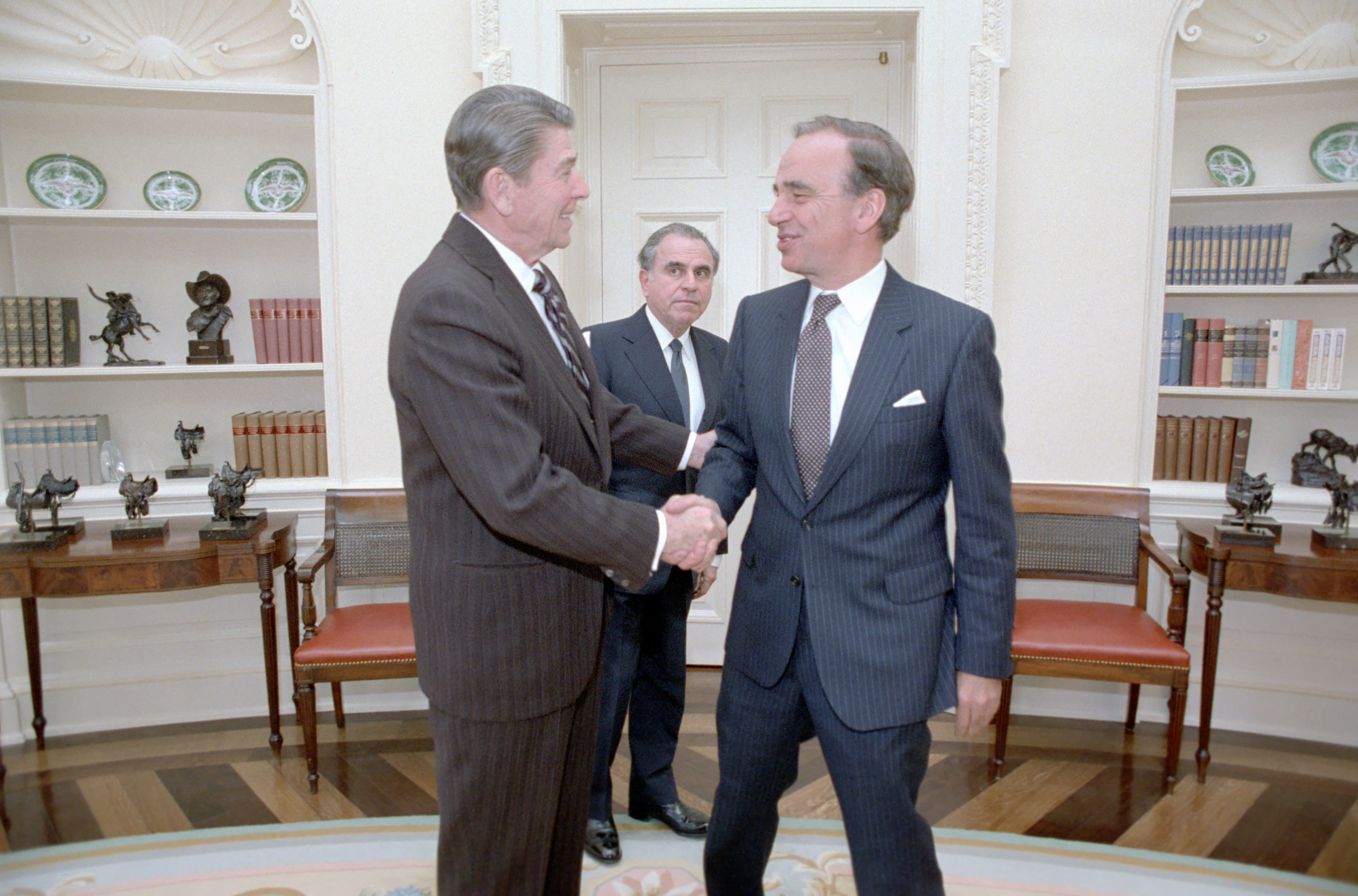
President Ronald Reagan meeting with media magnate Rupert Murdoch in the Oval Office on Jan. 18, 1983, with Charles Wick, director of the U.S. Information Agency, the the background. (Credit: Reagan presidential library)

President Ronald Reagan meeting with media magnate Rupert Murdoch in the Oval Office on Jan. 18, 1983, with Charles Wick, director of the U.S. Information Agency, in the background. (Photo credit: Reagan presidential library)

This commitment to what the insiders called “perception management” began in earnest with the Reagan administration in the 1980s but it would come to be the accepted practice of all subsequent administrations, including the present one of President Barack Obama.

In that sense, propaganda in pursuit of foreign policy goals would trump the democratic ideal of an informed electorate. The point would be not to honestly inform the American people about events around the world but to manage their perceptions by ramping up fear in some cases and defusing outrage in others – depending on the U.S. government’s needs.

Thus, you have the current hysteria over Russia’s supposed “aggression” in Ukraine when the crisis was actually provoked by the West, including by U.S. neocons who helped create today’s humanitarian crisis in eastern Ukraine that they now cynically blame on Russian President Vladimir Putin.

Yet, many of these same U.S. foreign policy operatives – outraged over Russia’s limited intervention to protect ethnic Russians in eastern Ukraine – are demanding that President Obama launch an air war against the Syrian military as a “humanitarian” intervention there.

In other words, if the Russians act to shield ethnic Russians on their border who are being bombarded by a coup regime in Kiev that was installed with U.S. support, the Russians are the villains blamed for the thousands of civilian deaths, even though the vast majority of the casualties have been inflicted by the Kiev regime from indiscriminate bombing and from dispatching neo-Nazi militias to do the street fighting.

In Ukraine, the exigent circumstances don’t matter, including the violent overthrow of the constitutionally elected president last February. It’s all about white hats for the current Kiev regime and black hats for the ethnic Russians and especially for Putin.

But an entirely different set of standards has applied to Syria where a U.S.-backed rebellion, which included violent Sunni jihadists from the start, wore the white hats and the relatively secular Syrian government, which has responded with excessive violence of its own, wears the black hats. But a problem to that neat dichotomy arose when one of the major Sunni rebel forces, the Islamic State, started seizing Iraqi territory and beheading Westerners.

Faced with those grisly scenes, President Obama authorized bombing the Islamic State forces in both Iraq and Syria, but neocons and other U.S. hardliners have been hectoring Obama to go after their preferred target, Syria’s President Bashar al-Assad, despite the risk that destroying the Syrian military could open the gates of Damascus to the Islamic State or al-Qaeda’s Nusra Front.

Lost on the Dark Side

You might think that the American public would begin to rebel against these messy entangling alliances with the 1984-like demonizing of one new “enemy” after another. Not only have these endless wars drained trillions of dollars from the U.S. taxpayers, they have led to the deaths of thousands of U.S. troops and to the tarnishing of America’s image from the attendant evils of war, including a lengthy detour into the “dark side” of torture, assassinations and “collateral” killings of children and other innocents.

But that is where the history of “perception management” comes in, the need to keep the American people compliant and confused. In the 1980s, the Reagan administration was determined to “kick the Vietnam Syndrome,” the revulsion that many Americans felt for warfare after all those years in the blood-soaked jungles of Vietnam and all the lies that clumsily justified the war.

So, the challenge for the U.S. government became: how to present the actions of “enemies” always in the darkest light while bathing the behavior of the U.S. “side” in a rosy glow. You also had to stage this propaganda theater in an ostensibly “free country” with a supposedly “independent press.”

From documents declassified or leaked over the past several decades, including an unpublished draft chapter of the congressional Iran-Contra investigation, we now know a great deal about how this remarkable project was undertaken and who the key players were.

Perhaps not surprisingly much of the initiative came from the Central Intelligence Agency, which housed the expertise for manipulating target populations through propaganda and disinformation. The only difference this time would be that the American people would be the target population.

For this project, Ronald Reagan’s CIA Director William J. Casey sent his top propaganda specialist Walter Raymond Jr. to the National Security Council staff to manage the inter-agency task forces that would brainstorm and coordinate this “public diplomacy” strategy.

Many of the old intelligence operatives, including Casey and Raymond, are now dead, but other influential Washington figures who were deeply involved by these strategies remain, such as neocon stalwart Robert Kagan, whose first major job in Washington was as chief of Reagan’s State Department Office of Public Diplomacy for Latin America.

Now a fellow at the Brookings Institution and a columnist at the Washington Post, Kagan remains an expert in presenting foreign policy initiatives within the “good guy/bad guy” frames that he learned in the 1980s. He is also the husband of Assistant Secretary of State for European Affairs Victoria Nuland, who oversaw the overthrow of Ukraine’s elected President Viktor Yanukovych last February amid a very effective U.S. propaganda strategy.

During the Reagan years, Kagan worked closely on propaganda schemes with Elliott Abrams, then the Assistant Secretary of State for Latin America. After getting convicted and then pardoned in the Iran-Contra scandal, Abrams reemerged on President George W. Bush’s National Security Council handling Middle East issues, including the Iraq War, and later “global democracy strategy.” Abrams is now a senior fellow at the Council on Foreign Relations.

These and other neocons were among the most diligent students learning the art of “perception management” from the likes of Raymond and Casey, but those propaganda skills have spread much more widely as “public diplomacy” and “information warfare” have now become an integral part of every U.S. foreign policy initiative.

A Propaganda Bureaucracy

Declassified documents now reveal how extensive Reagan’s propaganda project became with inter-agency task forces assigned to develop “themes” that would push American “hot buttons.” Scores of documents came out during the Iran-Contra scandal in 1987 and hundreds more are now available at the Reagan presidential library in Simi Valley, California.

What the documents reveal is that at the start of the Reagan administration, CIA Director Casey faced a daunting challenge in trying to rally public opinion behind aggressive U.S. interventions, especially in Central America. Bitter memories of the Vietnam War were still fresh and many Americans were horrified at the brutality of right-wing regimes in Guatemala and El Salvador, where Salvadoran soldiers raped and murdered four American churchwomen in December 1980.

The new leftist Sandinista government in Nicaragua also was not viewed with much alarm. After all, Nicaragua was an impoverished country of only about three million people who had just cast off the brutal dictatorship of Anastasio Somoza.

So, Reagan’s initial strategy of bolstering the Salvadoran and Guatemalan armies required defusing the negative publicity about them and somehow rallying the American people into supporting a covert CIA intervention inside Nicaragua via a counterrevolutionary force known as the Contras led by Somoza’s ex-National Guard officers.

Reagan’s task was made tougher by the fact that the Cold War’s anti-communist arguments had so recently been discredited in Vietnam. As deputy assistant secretary to the Air Force, J. Michael Kelly, put it, “the most critical special operations mission we have … is to persuade the American people that the communists are out to get us.”

At the same time, the White House worked to weed out American reporters who uncovered facts that undercut the desired public images. As part of that effort, the administration attacked New York Times correspondent Raymond Bonner for disclosing the Salvadoran regime’s massacre of about 800 men, women and children in the village of El Mozote in northeast El Salvador in December 1981. Accuracy in Media and conservative news organizations, such as The Wall Street Journal’s editorial page, joined in pummeling Bonner, who was soon ousted from his job.

But these were largely ad hoc efforts. A more comprehensive “public diplomacy” operation took shape beginning in 1982 when Raymond, a 30-year veteran of CIA clandestine services, was transferred to the NSC.

A slight, soft-spoken New Yorker who reminded some of a character from a John le Carré spy novel, Raymond was an intelligence officer who “easily fades into the woodwork,” according to one acquaintance. But Raymond would become the sparkplug for this high-powered propaganda network, according to a draft chapter of the Iran-Contra report.

Though the draft chapter didn’t use Raymond’s name in its opening pages, apparently because some of the information came from classified depositions, Raymond’s name was used later in the chapter and the earlier citations matched Raymond’s known role. According to the draft report, the CIA officer who was recruited for the NSC job had served as Director of the Covert Action Staff at the CIA from 1978 to 1982 and was a “specialist in propaganda and disinformation.”

“The CIA official [Raymond] discussed the transfer with [CIA Director] Casey and NSC Advisor William Clark that he be assigned to the NSC as [Donald] Gregg’s successor [as coordinator of intelligence operations in June 1982] and received approval for his involvement in setting up the public diplomacy program along with his intelligence responsibilities,” the chapter said.

“In the early part of 1983, documents obtained by the Select [Iran-Contra] Committees indicate that the Director of the Intelligence Staff of the NSC [Raymond] successfully recommended the establishment of an inter-governmental network to promote and manage a public diplomacy plan designed to create support for Reagan Administration policies at home and abroad.”

During his Iran-Contra deposition, Raymond explained the need for this propaganda structure, saying: “We were not configured effectively to deal with the war of ideas.”

One reason for this shortcoming was that federal law forbade taxpayers’ money from being spent on domestic propaganda or grassroots lobbying to pressure congressional representatives. Of course, every president and his team had vast resources to make their case in public, but by tradition and law, they were restricted to speeches, testimony and one-on-one persuasion of lawmakers.

But things were about to change. In a Jan. 13, 1983, memo, NSC Advisor Clark foresaw the need for non-governmental money to advance this cause. “We will develop a scenario for obtaining private funding,” Clark wrote. (Just five days later, President Reagan personally welcomed media magnate Rupert Murdoch into the Oval Office for a private meeting, according to records on file at the Reagan library.)

As administration officials reached out to wealthy supporters, lines against domestic propaganda soon were crossed as the operation took aim not only at foreign audiences but at U.S. public opinion, the press and congressional Democrats who opposed funding the Nicaraguan Contras.

At the time, the Contras were earning a gruesome reputation as human rights violators and terrorists. To change this negative perception of the Contras as well as of the U.S.-backed regimes in El Salvador and Guatemala, the Reagan administration created a full-blown, clandestine propaganda network.

In January 1983, President Reagan took the first formal step to create this unprecedented peacetime propaganda bureaucracy by signing National Security Decision Directive 77, entitled “Management of Public Diplomacy Relative to National Security.” Reagan deemed it “necessary to strengthen the organization, planning and coordination of the various aspects of public diplomacy of the United States Government.”

Reagan ordered the creation of a special planning group within the National Security Council to direct these “public diplomacy” campaigns. The planning group would be headed by the CIA’s Walter Raymond Jr. and one of its principal arms would be a new Office of Public Diplomacy for Latin America, housed at the State Department but under the control of the NSC.

CIA Taint

Worried about the legal prohibition barring the CIA from engaging in domestic propaganda, Raymond formally resigned from the CIA in April 1983, so, he said, “there would be no question whatsoever of any contamination of this.” But Raymond continued to act toward the U.S. public much like a CIA officer would in directing a propaganda operation in a hostile foreign country.

Raymond fretted, too, about the legality of Casey’s ongoing involvement. Raymond confided in one memo that it was important “to get [Casey] out of the loop,” but Casey never backed off and Raymond continued to send progress reports to his old boss well into 1986. It was “the kind of thing which [Casey] had a broad catholic interest in,” Raymond shrugged during his Iran-Contra deposition. He then offered the excuse that Casey undertook this apparently illegal interference in domestic politics “not so much in his CIA hat, but in his adviser to the president hat.”

As a result of Reagan’s decision directive, “an elaborate system of inter-agency committees was eventually formed and charged with the task of working closely with private groups and individuals involved in fundraising, lobbying campaigns and propagandistic activities aimed at influencing public opinion and governmental action,” the draft Iran-Contra chapter said. “This effort resulted in the creation of the Office of Public Diplomacy for Latin America and the Caribbean in the Department of State (S/LPD), headed by Otto Reich,” a right-wing Cuban exile from Miami.

Though Secretary of State George Shultz wanted the office under his control, President Reagan insisted that Reich “report directly to the NSC,” where Raymond oversaw the operations as a special assistant to the President and the NSC’s director of international communications, the chapter said.

“Reich relied heavily on Raymond to secure personnel transfers from other government agencies to beef up the limited resources made available to S/LPD by the Department of State,” the chapter said. “Personnel made available to the new office included intelligence specialists from the U.S. Air Force and the U.S. Army. On one occasion, five intelligence experts from the Army’s 4th Psychological Operations Group at Fort Bragg, North Carolina, were assigned to work with Reich’s fast-growing operation.”

A “public diplomacy strategy paper,” dated May 5, 1983, summed up the administration’s problem. “As far as our Central American policy is concerned, the press perceives that: the USG [U.S. government] is placing too much emphasis on a military solution, as well as being allied with inept, right-wing governments and groups. …The focus on Nicaragua [is] on the alleged U.S.-backed ‘covert’ war against the Sandinistas. Moreover, the opposition … is widely perceived as being led by former Somozistas.”

The administration’s difficulty with most of these press perceptions was that they were correct. But the strategy paper recommended ways to influence various groups of Americans to “correct” the impressions anyway, removing what another planning document called “perceptional obstacles.”

“Themes will obviously have to be tailored to the target audience,” the strategy paper said.

Casey’s Hand

As the Reagan administration struggled to manage public perceptions, CIA Director Casey kept his personal hand in the effort. On one muggy day in August 1983, Casey convened a meeting of Reagan administration officials and five leading ad executives at the Old Executive Office Building next to the White House to come up with ideas for selling Reagan’s Central American policies to the American people.

Earlier that day, a national security aide had warmed the P.R. men to their task with dire predictions that leftist governments would send waves of refugees into the United States and cynically flood America with drugs. The P.R. executives jotted down some thoughts over lunch and then pitched their ideas to the CIA director in the afternoon as he sat hunched behind a desk taking notes.

“Casey was kind of spearheading a recommendation” for better public relations for Reagan’s Central America policies, recalled William I. Greener Jr., one of the ad men. Two top proposals arising from the meeting were for a high-powered communications operation inside the White House and private money for an outreach program to build support for U.S. intervention.

The results from the discussions were summed up in an Aug. 9, 1983, memo written by Raymond who described Casey’s participation in the meeting to brainstorm how “to sell a ‘new product’ – Central America – by generating interest across-the-spectrum.”

In the memo to then-U.S. Information Agency director Charles Wick, Raymond also noted that “via Murdock [sic] may be able to draw down added funds” to support pro-Reagan initiatives. Raymond’s reference to Rupert Murdoch possibly drawing down “added funds” suggests that the right-wing media mogul had been recruited to be part of the covert propaganda operation. During this period, Wick arranged at least two face-to-face meetings between Murdoch and Reagan.

In line with the clandestine nature of the operation, Raymond also suggested routing the “funding via Freedom House or some other structure that has credibility in the political center.” (Freedom House would later emerge as a principal beneficiary of funding from the National Endowment for Democracy, which was also created under the umbrella of Raymond’s operation.)

As the Reagan administration pushed the envelope on domestic propaganda, Raymond continued to worry about Casey’s involvement. In an Aug. 29, 1983, memo, Raymond recounted a call from Casey pushing his P.R. ideas. Alarmed at a CIA director participating so brazenly in domestic propaganda, Raymond wrote that “I philosophized a bit with Bill Casey (in an effort to get him out of the loop)” but with little success.

Meanwhile, Reich’s Office of Public Diplomacy for Latin America (S/LPD) proved extremely effective in selecting “hot buttons” that would anger Americans about the Sandinistas. He also browbeat news correspondents who produced stories that conflicted with the administration’s “themes.” Reich’s basic M.O. was to dispatch his propaganda teams to lobby news executives to remove or punish out-of-step reporters – with a disturbing degree of success. Reich once bragged that his office “did not give the critics of the policy any quarter in the debate.”

Another part of the office’s job was to plant “white propaganda” in the news media through op-eds secretly financed by the government. In one memo, Jonathan Miller, a senior public diplomacy official, informed White House aide Patrick Buchanan about success placing an anti-Sandinista piece in The Wall Street Journal’s friendly pages. “Officially, this office had no role in its preparation,” Miller wrote.

Other times, the administration put out “black propaganda,” outright falsehoods. In 1983, one such theme was designed to anger American Jews by portraying the Sandinistas as anti-Semitic because much of Nicaragua’s small Jewish community fled after the revolution in 1979.

However, the U.S. embassy in Managua investigated the charges and “found no verifiable ground on which to accuse the GRN [the Sandinista government] of anti-Semitism,” according to a July 28, 1983, cable. But the administration kept the cable secret and pushed the “hot button” anyway.

Black Hats/White Hats

Repeatedly, Raymond lectured his subordinates on the chief goal of the operation: “in the specific case of Nica[ragua], concentrate on gluing black hats on the Sandinistas and white hats on UNO [the Contras’ United Nicaraguan Opposition].” So Reagan’s speechwriters dutifully penned descriptions of Sandinista-ruled Nicaragua as a “totalitarian dungeon” and the Contras as the “moral equivalent of the Founding Fathers.”

As one NSC official told me, the campaign was modeled after CIA covert operations abroad where a political goal is more important than the truth. “They were trying to manipulate [U.S.] public opinion … using the tools of Walt Raymond’s trade craft which he learned from his career in the CIA covert operation shop,” the official admitted.

Another administration official gave a similar description to The Miami Herald’s Alfonso Chardy. “If you look at it as a whole, the Office of Public Diplomacy was carrying out a huge psychological operation, the kind the military conduct to influence the population in denied or enemy territory,” that official explained. [For more details, see Parry’s Lost History.]

Another important figure in the pro-Contra propaganda was NSC staffer Oliver North, who spent a great deal of his time on the Nicaraguan public diplomacy operation even though he is better known for arranging secret arms shipments to the Contras and to Iran’s radical Islamic government, leading to the Iran-Contra scandal.

The draft Iran-Contra chapter depicted a Byzantine network of contract and private operatives who handled details of the domestic propaganda while concealing the hand of the White House and the CIA. “Richard R. Miller, former head of public affairs at AID, and Francis D. Gomez, former public affairs specialist at the State Department and USIA, were hired by S/LPD through sole-source, no-bid contracts to carry out a variety of activities on behalf of the Reagan administration policies in Central America,” the chapter said.

“Supported by the State Department and White House, Miller and Gomez became the outside managers of [North operative] Spitz Channel’s fundraising and lobbying activities. They also served as the managers of Central American political figures, defectors, Nicaraguan opposition leaders and Sandinista atrocity victims who were made available to the press, the Congress and private groups, to tell the story of the Contra cause.”

Miller and Gomez facilitated transfers of money to Swiss and offshore banks at North’s direction, as they “became the key link between the State Department and the Reagan White House with the private groups and individuals engaged in a myriad of endeavors aimed at influencing the Congress, the media and public opinion,” the chapter said.

The Iran-Contra draft chapter also cited a March 10, 1985, memo from North describing his assistance to CIA Director Casey in timing disclosures of pro-Contra news “aimed at securing Congressional approval for renewed support to the Nicaraguan Resistance Forces.”

The chapter added: “Casey’s involvement in the public diplomacy effort apparently continued throughout the period under investigation by the Committees,” including a 1985 role in pressuring Congress to renew Contra aid and a 1986 hand in further shielding the Office of Public Diplomacy for Latin America from the oversight of Secretary Shultz.

A Raymond-authored memo to Casey in August 1986 described the shift of the S/LPD office – where Robert Kagan had replaced Reich – to the control of the Bureau of Inter-American Affairs, which was headed by Assistant Secretary of State Elliott Abrams, who had tapped Kagan for the public diplomacy job.

Even after the Iran-Contra scandal unraveled in 1986-87 and Casey died of brain cancer on May 6, 1987, the Republicans fought to keep secret the remarkable story of the public diplomacy apparatus. As part of a deal to get three moderate Republican senators to join Democrats in signing the Iran-Contra majority report, Democratic leaders agreed to drop the draft chapter detailing the CIA’s domestic propaganda role (although a few references were included in the executive summary). But other Republicans, including Rep. Dick Cheney, still issued a minority report defending broad presidential powers in foreign affairs.

Thus, the American people were spared the chapter’s troubling conclusion: that a secret propaganda apparatus had existed, run by “one of the CIA’s most senior specialists, sent to the NSC by Bill Casey, to create and coordinate an inter-agency public-diplomacy mechanism [which] did what a covert CIA operation in a foreign country might do. [It] attempted to manipulate the media, the Congress and public opinion to support the Reagan administration’s policies.”

Kicking the Vietnam Syndrome

The ultimate success of Reagan’s propaganda strategy was affirmed during the tenure of his successor, George H.W. Bush, when Bush ordered a 100-hour ground war on Feb. 23, 1991, to oust Iraqi troops from Kuwait, which had been invaded the previous August.

Though Iraqi dictator Saddam Hussein had long been signaling a readiness to withdraw – and Soviet President Mikhail Gorbachev had negotiated a withdrawal arrangement that even had the blessings of top U.S. commanders in the field – President Bush insisted on pressing ahead with the ground attack.

Bush’s chief reason was that he – and his Defense Secretary Dick Cheney – saw the assault against Iraq’s already decimated forces as an easy victory, one that would demonstrate America’s new military capacity for high-tech warfare and would cap the process begun a decade earlier to erase the Vietnam Syndrome from the minds of average Americans.

Those strategic aspects of Bush’s grand plan for a “new world order” began to emerge after the U.S.-led coalition started pummeling Iraq with air strikes in mid-January 1991. The bombings inflicted severe damage on Iraq’s military and civilian infrastructure and slaughtered a large number of non-combatants, including the incineration of some 400 women and children in a Baghdad bomb shelter on Feb. 13. [For details, see Consortiumnews.com’s “Recalling the Slaughter of Innocents.”]

The air war’s damage was so severe that some world leaders looked for a way to end the carnage and arrange Iraq’s departure from Kuwait. Even senior U.S. military field commanders, such as Gen. Norman Schwarzkopf, looked favorably on proposals for sparing lives.

But Bush was fixated on a ground war. Though secret from the American people at that time, Bush had long determined that a peaceful Iraqi withdrawal from Kuwait would not be allowed. Indeed, Bush was privately fearful that the Iraqis might capitulate before the United States could attack.

At the time, conservative columnists Rowland Evans and Robert Novak were among the few outsiders who described Bush’s obsession with exorcising the Vietnam Syndrome. On Feb. 25, 1991, they wrote that the Gorbachev initiative brokering Iraq’s surrender of Kuwait “stirred fears” among Bush’s advisers that the Vietnam Syndrome might survive the Gulf War.

“There was considerable relief, therefore, when the President … made clear he was having nothing to do with the deal that would enable Saddam Hussein to bring his troops out of Kuwait with flags flying,” Evans and Novak wrote. “Fear of a peace deal at the Bush White House had less to do with oil, Israel or Iraqi expansionism than with the bitter legacy of a lost war. ‘This is the chance to get rid of the Vietnam Syndrome,’ one senior aide told us.”

In the 1999 book, Shadow, author Bob Woodward confirmed that Bush was adamant about fighting a war, even as the White House pretended it would be satisfied with an unconditional Iraqi withdrawal. “We have to have a war,” Bush told his inner circle of Secretary of State James Baker, national security adviser Brent Scowcroft and Gen. Colin Powell, according to Woodward.

“Scowcroft was aware that this understanding could never be stated publicly or be permitted to leak out. An American president who declared the necessity of war would probably be thrown out of office. Americans were peacemakers, not warmongers,” Woodward wrote.

The Ground War

However, the “fear of a peace deal” resurfaced in the wake of the U.S.-led bombing campaign. Soviet diplomats met with Iraqi leaders who let it be known that they were prepared to withdraw their troops from Kuwait unconditionally.

Learning of Gorbachev’s proposed settlement, Schwarzkopf also saw little reason for U.S. soldiers to die if the Iraqis were prepared to withdraw and leave their heavy weapons behind. There was also the prospect of chemical warfare that the Iraqis might use against advancing American troops. Schwarzkopf saw the possibility of heavy U.S. casualties.

But Gorbachev’s plan was running into trouble with President Bush and his political subordinates who wanted a ground war to crown the U.S. victory. Schwarzkopf reached out to Gen. [Colin] Powell, chairman of the Joint Chiefs of Staff, to make the case for peace with the President.

On Feb. 21, 1991, the two generals hammered out a cease-fire proposal for presentation to the NSC. The peace deal would give Iraqi forces one week to march out of Kuwait while leaving their armor and heavy equipment behind. Schwarzkopf thought he had Powell’s commitment to pitch the plan at the White House.

But Powell found himself caught in the middle. He wanted to please Bush while still representing the concerns of the field commanders. When Powell arrived at the White House late on the evening of Feb. 21, he found Bush angry about the Soviet peace initiative. Still, according to Woodward’s Shadow, Powell reiterated that he and Schwarzkopf “would rather see the Iraqis walk out than be driven out.”

In My American Journey, Powell expressed sympathy for Bush’s predicament. “The President’s problem was how to say no to Gorbachev without appearing to throw away a chance for peace,” Powell wrote. “I could hear the President’s growing distress in his voice. ‘I don’t want to take this deal,’ he said. ‘But I don’t want to stiff Gorbachev, not after he’s come this far with us. We’ve got to find a way out’.”

Powell sought Bush’s attention. “I raised a finger,” Powell wrote. “The President turned to me. ‘Got something, Colin?’,” Bush asked. But Powell did not outline Schwarzkopf’s one-week cease-fire plan. Instead, Powell offered a different idea intended to make the ground offensive inevitable.

“We don’t stiff Gorbachev,” Powell explained. “Let’s put a deadline on Gorby’s proposal. We say, great idea, as long as they’re completely on their way out by, say, noon Saturday,” Feb. 23, less than two days away.

Powell understood that the two-day deadline would not give the Iraqis enough time to act, especially with their command-and-control systems severely damaged by the air war. The plan was a public-relations strategy to guarantee that the White House got its ground war. “If, as I suspect, they don’t move, then the flogging begins,” Powell told a gratified president.

The next day, at 10:30 a.m., a Friday, Bush announced his ultimatum. There would be a Saturday noon deadline for the Iraqi withdrawal, as Powell had recommended. Schwarzkopf and his field commanders in Saudi Arabia watched Bush on television and immediately grasped its meaning.

“We all knew by then which it would be,” Schwarzkopf wrote. “We were marching toward a Sunday morning attack.”

When the Iraqis predictably missed the deadline, American and allied forces launched the ground offensive at 0400 on Feb. 24, Persian Gulf time.

Though Iraqi forces were soon in full retreat, the allies pursued and slaughtered tens of thousands of Iraqi soldiers in the 100-hour war. U.S. casualties were light, 147 killed in combat and another 236 killed in accidents or from other causes. “Small losses as military statistics go,” wrote Powell, “but a tragedy for each family.”

[Editor: This was only the beginning of casualties as Gulf War Illness surfaced. Destroying the lives of veterans, their family members, and non-Iraq soldiers, this ground war ended up being very costly for American soldiers, affecting even those who had never left the States, but unpacked  contaminated gear shipped home from Iraq. The Veterans Administration and the military establishment have denied their crippling and often fatal illnesses. A bioweapon organism, mycoplasma fermentans incognitus, with a United States patent, was discovered in many of these ill veterans. It is contageous.

 A simple treatment with the antibiotic doxycycline over a series of months often can eradicate the organism. However, if not eradicated, it can cause organ failure and death. Though the VA discovered the presence of this organism in a high percentage of ill veterans it tested, it has buried the information and refused to treat veterans and their families. It has often prescribed psychiatric drugs instead.

The excellent HBO film “Thanks of a Grateful Nation” covers some of this story.

Veterans have had no information, no diagnostic help, and no relief except from independent sources. Drs. Garth and Nancy Nicholson have been lead researchers and advocates for veterans and members of the public who have contracted this very serious disease — http://www.immed.org/index.htm. They have saved many people’s lives.]

On Feb. 28, the day the war ended, Bush celebrated the victory. “By God, we’ve kicked the Vietnam Syndrome once and for all,” the President exulted, speaking to a group at the White House. [For more details, see Robert Parry’s Secrecy & Privilege.]

So as not to put a damper on the post-war happy feelings, the U.S. news media decided not to show many of the grisliest photos, such as charred Iraqi soldiers ghoulishly still seated in their burned-out trucks where they had been incinerated while trying to flee. By that point, U.S. journalists knew it wasn’t smart for their careers to present a reality that didn’t make the war look good.

Enduring Legacy

Though Reagan’s creation of a domestic propaganda bureaucracy began more than three decades ago – and Bush’s vanquishing of the Vietnam Syndrome was more than two decades ago – the legacy of those actions continue to reverberate today in how the perceptions of the American people are now routinely managed. That was true during last decade’s Iraq War and this decade’s conflicts in Libya, Syria and Ukraine as well as the economic sanctions against Iran and Russia.

Indeed, while the older generation that pioneered these domestic propaganda techniques has passed from the scene, many of their protégés are still around along with some of the same organizations. The National Endowment for Democracy, which was formed in 1983 at the urging of CIA Director Casey and under the supervision of Walter Raymond’s NSC operation, is still run by the same neocon, Carl Gershman, and has an even bigger budget, now exceeding $100 million a year.

Gershman and his NED played important behind-the-scenes roles in instigating the Ukraine crisis by financing activists, journalists and other operatives who supported the coup against elected President Yanukovych. The NED-backed Freedom House also beat the propaganda drums. [See Consortiumnews.com’s “A Shadow Foreign Policy.”]

Two other Reagan-era veterans, Elliott Abrams and Robert Kagan, have both provided important intellectual support for continuing U.S. interventionism around the world. Earlier this year, Kagan’s article for The New Republic, entitled “Superpowers Don’t Get to Retire,” touched such a raw nerve with President Obama that he hosted Kagan at a White House lunch and crafted the presidential commencement speech at West Point to deflect some of Kagan’s criticism of Obama’s hesitancy to use military force.

A New York Times article about Kagan’s influence over Obama reported that Kagan’s wife, Assistant Secretary of State Victoria Nuland, apparently had a hand in crafting the attack on her ostensible boss, President Obama.

According to the Times article, the husband-and-wife team share both a common world view and professional ambitions, Nuland editing Kagan’s articles and Kagan “not permitted to use any official information he overhears or picks up around the house” – a suggestion that Kagan’s thinking at least may be informed by foreign policy secrets passed on by his wife.

Though Nuland wouldn’t comment specifically on Kagan’s attack on President Obama, she indicated that she holds similar views. “But suffice to say,” Nuland said, “that nothing goes out of the house that I don’t think is worthy of his talents. Let’s put it that way.”

Misguided Media

In the three decades since Reagan’s propaganda machine was launched, the American press corps also has fallen more and more into line with an aggressive U.S. government’s foreign policy strategies. Those of us in the mainstream media who resisted the propaganda pressures mostly saw our careers suffer while those who played along moved steadily up the ranks into positions of more money and more status.

Even after the Iraq War debacle when nearly the entire mainstream media went with the pro-invasion flow, there was almost no accountability for that historic journalistic failure. Indeed, the neocon influence at major newspapers, such as the Washington Post and the New York Times, only has solidified since.

Today’s coverage of the Syrian civil war or the Ukraine crisis is so firmly in line with the State Department’s propaganda “themes” that it would put smiles on the faces of William Casey and Walter Raymond if they were around today to see how seamlessly the “perception management” now works. There’s no need any more to send out “public diplomacy” teams to bully editors and news executives. Everyone is already onboard.

Rupert Murdoch’s media empire is bigger than ever, but his neocon messaging barely stands out as distinctive, given how the neocons also have gained control of the editorial and foreign-reporting sections of the Washington Post, the New York Times and virtually every other major news outlet. For instance, the demonizing of Russian President Putin is now so total that no honest person could look at those articles and see anything approaching objective or evenhanded journalism. Yet, no one loses a job over this lack of professionalism.

The Reagan administration’s dreams of harnessing private foundations and non-governmental organizations have also come true. The Orwellian circle has been completed with many American “anti-war” groups advocating for “humanitarian” wars in Syria and other countries targeted by U.S. propaganda. [See Consortiumnews.com’s “Selling ‘Peace Groups’ on US-Led Wars.”]

Much as Reagan’s “public diplomacy” apparatus once sent around “defectors” to lambaste Nicaragua’s Sandinistas by citing hyped-up human rights violations now the work is done by NGOs with barely perceptible threads back to the U.S. government. Just as Freedom House had “credibility” in the 1980s because of its earlier reputation as a human rights group, now other groups carrying the “human rights” tag, such as Human Rights Watch, are in the forefront of urging U.S. military interventions based on murky or propagandistic claims. [See Consortiumnews.com’s “The Collapsing Syria-Sarin Case.”]

At this advanced stage of America’s quiet surrender to “perception management,” it is even hard to envision how one could retrace the many steps that would lead back to the concept of a democratic Republic based on an informed electorate. Many on the American Right remain entranced by the old propaganda theme about the “liberal media” and still embrace Reagan as their beloved icon. Meanwhile, many liberals can’t break away from their own wistful trust in the New York Times and their empty hope that the media really is “liberal.”

To confront the hard truth is not easy. Indeed, in this case, it can cause despair because there are so few voices to trust and they are easily drowned out by floods of disinformation that can come from any angle – right, left or center. Yet, for the American democratic Republic to reset its goal toward an informed electorate, there is no option other than to build institutions that are determinedly committed to the truth.

Investigative reporter Robert Parry broke many of the Iran-Contra stories for The Associated Press and Newsweek in the 1980s. You can buy his latest book, America’s Stolen Narrative, either in print here or as an e-book (from Amazon and barnesandnoble.com). You also can order Robert Parry’s trilogy on the Bush Family and its connections to various right-wing operatives for only $34. The trilogy includes America’s Stolen Narrative. For details on this offer, click here.

A few of the informative comments under the original article:

MarkinPNW

This “Perception Management” is nothing knew. The argument has been made persuasively that the attack on Pearl Harbor actually resulted from a deliberate and successful campaign by FDR to change or “manage” the mass opinions or “Perceptions” of the US electorate from strongly pro-peace and anti-war (what could be called a “Great War syndrome” from the stupid and useless devastation of WW1) to all out pro-war for US involvement in WW2, by provoking the Japanese and refusing all peace negotiations with the Japanese who desperately were trying to avoid war.

In reference to “Orwellian Dystopia”, Orwell’s novels “Animal Farm” and “1984” were based in large part on Orwell’s experience in the Spanish Civil War and WW2, respectively.

hp

The ripened fruit of the pervert Freud’s pervert nephew Edward Bernays.

Jacob

“In the 1980s, the Reagan administration pioneered ‘perception management’ to get the American people to ‘kick the Vietnam Syndrome’ and accept more U.S. interventionism, . . .” 

The management of public perception within the U.S. regarding its imperialistic/colonial ambitions goes back much further than the 1980s. The Committee on Public Information, also known as “the Creel Commission,” was the likely model Reagan wanted to imitate. The purpose of the CPI was to convince the American public, which was mostly anti-war, to support America’s entry into the European war, also known as WWI. The CPI was in official operation from 1917 to 1919 during the Woodrow Wilson administration. But the paradigm for the use of mass propaganda to alter public perceptions is the Congregatio de propaganda fide (The Office for the Propagation of the Faith), a 1622 Vatican invention to undermine the spread of Protestantism by managing public perceptions on religious and spiritual matters.


The Victory of ‘Perception Management’


Breedlove’s bellicosity: Berlin alarmed by aggressive NATO stance on Ukraine — Spiegel

Spiegel, March 8, 2015
By Matthias Gebauer, Christiane Hoffmann, Marc Hujer, Gordon Repinski, Matthias Schepp, Christoph Schult, Holger Stark and Klaus Wiegrefe

—————————————————————-

Top NATO commander General Philip Breedlove has raised hackles in Germany with his public statements about the Ukraine crisis.

US President Obama supports Chancellor Merkel’s efforts at finding a diplomatic solution to the Ukraine crisis. But hawks in Washington seem determined to torpedo Berlin’s approach. And NATO’s top commander in Europe hasn’t been helping either.

It was quiet in eastern Ukraine last Wednesday. Indeed, it was another quiet day in an extended stretch of relative calm. The battles between the Ukrainian army and the pro-Russian separatists had largely stopped and heavy weaponry was being withdrawn. The Minsk cease-fire wasn’t holding perfectly, but it was holding.

On that same day, General Philip Breedlove, the top NATO commander in Europe, stepped before the press in Washington. Putin, the 59-year-old said, had once again “upped the ante” in eastern Ukraine — with “well over a thousand combat vehicles, Russian combat forces, some of their most sophisticated air defense, battalions of artillery” having been sent to the Donbass. “What is clear,” Breedlove said, “is that right now, it is not getting better. It is getting worse every day.”

German leaders in Berlin were stunned. They didn’t understand what Breedlove was talking about. And it wasn’t the first time. Once again, the German government, supported by intelligence gathered by the Bundesnachrichtendienst (BND), Germany’s foreign intelligence agency, did not share the view of NATO’s Supreme Allied Commander Europe (SACEUR).

The pattern has become a familiar one. For months, Breedlove has been commenting on Russian activities in eastern Ukraine, speaking of troop advances on the border, the amassing of munitions and alleged columns of Russian tanks. Over and over again, Breedlove’s numbers have been significantly higher than those in the possession of America’s NATO allies in Europe. As such, he is playing directly into the hands of the hardliners in the US Congress and in NATO.

The German government is alarmed. Are the Americans trying to thwart European efforts at mediation led by Chancellor Angela Merkel? Sources in the Chancellery have referred to Breedlove’s comments as “dangerous propaganda.” Foreign Minister Frank-Walter Steinmeier even found it necessary recently to bring up Breedlove’s comments with NATO General Secretary Jens Stoltenberg.

The ‘Super Hawk’

But Breedlove hasn’t been the only source of friction. Europeans have also begun to see others as hindrances in their search for a diplomatic solution to the Ukraine conflict. First and foremost among them is Victoria Nuland, head of European affairs at the US State Department. She and others would like to see Washington deliver arms to Ukraine and are supported by Congressional Republicans as well as many powerful Democrats.

Indeed, US President Barack Obama seems almost isolated. He has thrown his support behind Merkel’s diplomatic efforts for the time being, but he has also done little to quiet those who would seek to increase tensions with Russia and deliver weapons to Ukraine. Sources in Washington say that Breedlove’s bellicose comments are first cleared with the White House and the Pentagon. The general, they say, has the role of the “super hawk,” whose role is that of increasing the pressure on America’s more reserved trans-Atlantic partners.

German Chancellor Angela Merkel and US President Barack Obama after a Feb. 9 meeting in Washington: Increasing pressure on America’s more reserved trans-Atlantic partners.

A mixture of political argumentation and military propaganda is necessary. But for months now, many in the Chancellery simply shake their heads each time NATO, under Breedlove’s leadership, goes public with striking announcements about Russian troop or tank movements. To be sure, neither Berlin’s Russia experts nor BND intelligence analysts doubt that Moscow is supporting the pro-Russian separatists. The BND even has proof of such support.

But it is the tone of Breedlove’s announcements that makes Berlin uneasy. False claims and exaggerated accounts, warned a top German official during a recent meeting on Ukraine, have put NATO — and by extension, the entire West — in danger of losing its credibility.

There are plenty of examples. Just over three weeks ago, during the cease-fire talks in Minsk, the Ukrainian military warned that the Russians — even as the diplomatic marathon was ongoing — had moved 50 tanks and dozens of rockets across the border into Luhansk. Just one day earlier, US Lieutenant General Ben Hodges had announced “direct Russian military intervention.”

Senior officials in Berlin immediately asked the BND for an assessment, but the intelligence agency’s satellite images showed just a few armored vehicles. Even those American intelligence officials who supply the BND with daily situation reports were much more reserved about the incident than Hodges was in his public statements. One intelligence agent says it “remains a riddle until today” how the general reached his conclusions.

Much More Cautious

“The German intelligence services generally appraise the threat level much more cautiously than the Americans do,” an international military expert in Kiev confirmed.

At the beginning of the crisis, General Breedlove announced that the Russians had assembled 40,000 troops on the Ukrainian border and warned that an invasion could take place at any moment. The situation, he said, was “incredibly concerning.” But intelligence officials from NATO member states had already excluded the possibility of a Russian invasion. They believed that neither the composition nor the equipment of the troops was consistent with an imminent invasion.

The experts contradicted Breedlove’s view in almost every respect. There weren’t 40,000 soldiers on the border, they believed, rather there were much less than 30,000 and perhaps even fewer than 20,000. Furthermore, most of the military equipment had not been brought to the border for a possible invasion, but had already been there prior to the beginning of the conflict. Furthermore, there was no evidence of logistical preparation for an invasion, such as a field headquarters.

Breedlove, though, repeatedly made inexact, contradictory or even flat-out inaccurate statements. On Nov. 18, 2014, he told the German newspaper Frankfurter Allgemeine Zeitung that there were “regular Russian army units in eastern Ukraine.” One day later, he told the website of the German newsmagazine Stern that they weren’t fighting units, but “mostly trainers and advisors.”

He initially said there were “between 250 and 300” of them, and then “between 300 and 500.” For a time, NATO was even saying there were 1,000 of them.

The fact that NATO has no intelligence agency of its own plays into Breedlove’s hands. The alliance relies on intelligence gathered by agents from the US, Britain, Germany and other member states. As such, SACEUR has a wide range of information to choose from.

Influencing Breedlove

On Nov. 12, during a visit to Sofia, Bulgaria, Breedlove reported that “we have seen columns of Russian equipment — primarily Russian tanks, Russian artillery, Russian air defense systems and Russian combat troops — entering into Ukraine.” It was, he noted, “the same thing that OSCE is reporting.” But the OSCE had only observed military convoys within eastern Ukraine. OSCE observers had said nothing about troops marching in from Russia.

Breedlove sees no reason to revise his approach. “I stand by all the public statements I have made during the Ukraine crisis,” he wrote to SPIEGEL in response to a request for a statement accompanied by a list of his controversial claims. He wrote that it was to be expected that assessments of NATO’s intelligence center, which receives information from all 33 alliance members in addition to partner states, doesn’t always match assessments made by individual nations. “It is normal that not everyone agrees with the assessments that I provide,” he wrote.

He says that NATO’s strategy is to “release clear, accurate and timely information regarding ongoing events.” He also wrote that: “As an alliance based on the fundamental values of freedom and democracy, our response to propaganda cannot be more propaganda. It can only be the truth.” (Read Breedlove’s full statement here.)

The German government, meanwhile, is doing what it can to influence Breedlove. Sources in Berlin say that conversations to this end have taken place in recent weeks. But there are many at NATO headquarters in Brussels who are likewise concerned about Breedlove’s statements. On Tuesday of last week, Breedlove’s public appearances were an official item on the agenda of the North Atlantic Council’s weekly lunch meeting. Several ambassadors present criticized Breedlove and expressed their incredulity at some of the commander’s statements.

The government in Berlin is concerned that Breedlove’s statements could harm the West’s credibility. The West can’t counter Russian propaganda with its own propaganda, “rather it must use arguments that are worthy of a constitutional state.” Berlin sources also say that it has become conspicuous that Breedlove’s controversial statements are often made just as a step forward has been made in the difficult negotiations aimed at a political resolution. Berlin sources say that Germany should be able to depend on its allies to support its efforts at peace.

Pressure on Obama

German foreign policy experts are united in their view of Breedlove as a hawk. “I would prefer that Breedlove’s comments on political questions be intelligent and reserved,” says Social Democrat parliamentarian Niels Annen, for example. “Instead, NATO in the past has always announced a new Russian offensive just as, from our point of view, the time had come for cautious optimism.” Annen, who has long specialized in foreign policy, has also been frequently dissatisfied with the information provided by NATO headquarters. “We parliamentarians were often confused by information regarding alleged troop movements that were inconsistent with the information we had,” he says.

The pressure on Obama from the Republicans, but also from his own political camp, is intense. Should the ceasefire in eastern Ukraine not hold, it will likely be difficult to continue refusing Kiev’s requests for shipments of so-called “defensive weapons.” And that would represent a dramatic escalation of the crisis. Moscow has already begun issuing threats in anticipation of such deliveries. “Any weapons deliveries to Kiev will escalate the tensions and would unhinge European security,” Nikolai Patrushev, secretary of Russia’s national security council, told the Russian newspaper Komsomolskaya Pravda on Wednesday.

Although President Obama has decided for the time being to give European diplomacy a chance, hawks like Breedlove or Victoria Nuland are doing what they can to pave the way for weapons deliveries. “We can fight against the Europeans, fight against them rhetorically,” Nuland said during a private meeting of American officials on the sidelines of the Munich Security Conference at the beginning of February.

In reporting on the meeting later, the German tabloid Bild reported that Nuland referred to the chancellor’s early February trip to Moscow for talks with Putin as “Merkel’s Moscow stuff.” No wonder, then, that people in Berlin have the impression that important power brokers in Washington are working against the Europeans. Berlin officials have noticed that, following the visit of American politicians or military leaders in Kiev, Ukrainian officials are much more bellicose and optimistic about the Ukrainian military’s ability to win the conflict on the battlefield. “We then have to laboriously bring the Ukrainians back onto the course of negotiations,” said one Berlin official.

Nuland Diplomacy

Nuland, who is seen as a possible secretary of state should the Republicans win back the White House in next year’s presidential election, is an important voice in US policy concerning Ukraine and Russia. She has never sought to hide her emotional bond to Russia, even saying “I love Russia.” Her grandparents immigrated to the US from Bessarabia, which belonged to the Russian empire at the time. Nuland speaks Russian fluently.

She is also very direct. She can be very keen and entertaining, but has been known to take on an undiplomatic tone — and has not always been wrong to do so. Mykola Asarov, who was prime minister under toppled Ukrainian President Viktor Yanukovych, recalls that Nuland basically blackmailed Yanukovych in order to prevent greater bloodshed in Kiev during the Maidan protests. “No violence against the protesters or you’ll fall,” Nuland told him according to Asarov. She also, he said, threatened tough economic and political sanctions against both Ukraine and the country’s leaders. According to Asarov, Nuland said that, were violence used against the protesters on Maidan Square, information about the money he and his cronies had taken out of the country would be made public.

Nuland has also been open — at least internally — about her contempt for European weakness and is famous for having said “Fuck the EU” during the initial days of the Ukraine crisis in February of 2014. Her husband, the neo-conservative Robert Kagan, is, after all, the originator of the idea that Americans are from Mars and Europeans, unwilling as they are to realize that true security depends on military power, are from Venus.

When it comes to the goal of delivering weapons to Ukraine, Nuland and Breedlove work hand-in-hand. On the first day of the Munich Security Conference, the two gathered the US delegation behind closed doors to discuss their strategy for breaking Europe’s resistance to arming Ukraine.

On the seventh floor of the Bayerischer Hof hotel in the heart of Munich, it was Nuland who began coaching. “While talking to the Europeans this weekend, you need to make the case that Russia is putting in more and more offensive stuff while we want to help the Ukrainians defend against these systems,” Nuland said. “It is defensive in nature although some of it has lethality.”

Training Troops?

Breedlove complemented that with the military details, saying that moderate weapons aid was inevitable — otherwise neither sanctions nor diplomatic pressure would have any effect. “If we can increase the cost for Russia on the battlefield, the other tools will become more effective,” he said. “That’s what we should do here.”

In Berlin, top politicians have always considered a common position vis-a-vis Russia as a necessary prerequisite for success in peace efforts. For the time being, that common front is still holding, but the dispute is a fundamental one — and hinges on the question of whether diplomacy can be successful without the threat of military action. Additionally, the trans-Atlantic partners also have differing goals. Whereas the aim of the Franco-German initiative is to stabilize the situation in Ukraine, it is Russia that concerns hawks within the US administration. They want to drive back Moscow’s influence in the region and destabilize Putin’s power. For them, the dream outcome would be regime change in Moscow.

A massive troop training range is located in Yavoriv in western Ukraine near the Polish border. During Soviet times, it served as the westernmost military district in the Soviet Union. Since 1998, though, it has been used for joint exercises by Ukrainian forces together with the United States and NATO. Yavoriv is also the site where US soldiers want to train members of the Ukrainian National Guard for their future battle against the separatists. According to the Pentagon’s plans, American officers would train the Ukrainians on how to use American artillery-locating radar devices. At least that’s what US Army in Europe commander Lt. Gen. Hodges announced in January.

The training was actually supposed to start at the beginning of March. Before it began, however, President Obama temporarily put it on hold in order to give the ceasefire agreement reached in Minsk a chance. Still, the hawks remain confident that they will soon come a step closer to their goal. On Tuesday, Hodges said during an appearance in Berlin that he expects the training will still begin at some point this month.


http://www.spiegel.de/international/world/germany-concerned-about-aggressive-nato-stance-on-ukraine-a-1022193.html

http://www.strategic-culture.org/news/2015/03/08/breedloves-bellicosity-berlin-alarmed-aggressive-nato-stance-ukraine.html


Posted under Fair Use Rules.

John Pilger on modern fascism and the lies of America’s warmongers

Why the rise of fascism is again the issue
By John Pilger
February 26, 2015

ukraine-riots-33

The recent 70th anniversary of the liberation of Auschwitz was a reminder of the great crime of fascism, whose Nazi iconography is embedded in our consciousness. Fascism is preserved as history, as flickering footage of goose-stepping blackshirts, their criminality terrible and clear. Yet in the same liberal societies, whose war-making elites urge us never to forget, the accelerating danger of a modern kind of fascism is suppressed; for it is their fascism.

“To initiate a war of aggression…,” said the Nuremberg Tribunal judges in 1946, “is not only an international crime, it is the supreme international crime, differing only from other war crimes in that it contains within itself the accumulated evil of the whole.”

Had the Nazis not invaded Europe, Auschwitz and the Holocaust would not have happened. Had the United States and its satellites not initiated their war of aggression in Iraq in 2003, almost a million people would be alive today; and Islamic State, or ISIS, would not have us in thrall to its savagery. They are the progeny of modern fascism, weaned by the bombs, bloodbaths and lies that are the surreal theatre known as news.

Like the fascism of the 1930s and 1940s, big lies are delivered with the precision of a metronome: thanks to an omnipresent, repetitive media and its virulent censorship by omission. Take the catastrophe in Libya. Continue reading

Azerbaijan should be very afraid of Victoria Nuland

[Victoria Nuland’s] role in the Ukrainian events forever marks her as an agent for US-supported regime change in the former Soviet sphere, and her visit anywhere in that space should be seen as the bad omen that it is.

By Andrew Korybko, March 1, 2015
Posted on Oriental Review

The US’ Assistant Secretary of State for European and Eurasian Affairs, Victoria Nuland, visited Baku on 16 February as part of her trip to the Caucasus, which also saw her paying stops in Georgia and Armenia. While Azerbaijan has had positive relations with the US since independence, they’ve lately been complicated by Washington’s ‘pro-democracy’ rhetoric and subversive actions in the country. Nuland’s visit, despite her warm words of friendship, must be looked at with maximum suspicion, since it’s not known what larger ulterior motives she represents on behalf of the US government.

A Bad Omen

Nuland is most infamously known for her “Fuck the EU!” comment that was uncovered during a secretly recorded conversation with the American Ambassador in Ukraine, Geoffrey Pyatt. The two were conspiring to build a new Ukrainian government even before democratically elected (but unpopular and corrupt) president Viktor Yanukovich was overthrown by the US-supported EuroMaidan coup. Nuland played a direct role in events, not only behind the scenes, but also on the streets, since she proudly handed out cookies and other foodstuffs to the ‘protesters’ that would violently seize power just over two months later. Her role in the Ukrainian events forever marks her as an agent for US-supported regime change in the former Soviet sphere, and her visit anywhere in that space should be seen as the bad omen that it is.

Like Husband, Like Wife

Normally an individual’s personal life doesn’t have any bearing on their professional one, but in the case of Nuland, it’s the opposite because her husband is the leading neo-conservative thinker Robert Kagan. He and his ilk are known for their expertise in exploiting foreign geography to maximize US power, regardless of the regional cost. Also, he previously referred to Azerbaijan in 2006 as a “dictatorship” and said the US will “pay the price” for dealing with it when responding to a user-submitted Q&A session with the Financial Times:

“During the Cold War, both Europeans and Americans had to compromise with dictators around the world in order to weaken the Soviet Union and communism. What would be, in your view Mr Kagan, the new sort of compromises that the US government is willing to make to defeat terrorism?
Corneliu, Bucharest

Robert Kagan: Clearly we are making such kinds of compromises all over the place in the war on terrorism, although I must say I doubt they are proving very useful.

We are turning a mostly blind eye to the Mubarak dictatorship in Egypt, despite much rhetoric to the contrary, as well in Saudi Arabia. We have been forgiving of the dictatorships in Azerbaijan and Kazakhstan. Nor have we been very critical of the Putin dictatorship in Russia, no matter how many people he assassinates.

This is all largely in the service of the war on terror. During the Cold War I actually believed that we wrong to support so many dictators, for it often did not help but hurt in the struggle against communism, in addition to being a violation of the principles we were struggling to defend.

I am equally unpersuaded today that our support for these dictatorships will help us fight terrorism, and once again we pay the price of moral and ideological inconsistency.”

revolution-starts-in-the-streets-110007-500-381_large_0Given the ideological context in which Nuland likely sees eye-to-eye on with her husband, plus her experience in instigating the Color Revolution in Ukraine, it is not likely that she came to Baku with positive intentions, or even with a positive image of the country in her mind. This is all the more so due to the recent scandal over Radio Free Europe/Radio Liberty.

Foreign Agent, Domestic Punishment

The US-government-sponsored information agency was closed down at the end of December under accusations that it was operating as a foreign agent. While the US has harshly chided the Azeri government for this, at the end of the day, it remains the country’s sovereign decision and right to handle suspected foreign agents as it sees fit. Azerbaijan’s law is similar to Russia’s, in that entities receiving foreign funds must register as foreign agents, and interestingly enough, both of these laws parallel the US’ own 1938 Foreign Agents Registration Act (FARA). Continue reading

Washington stalks its next victim, sends color revolution expert “male Nuland” to Kyrgyzstan

From Oriental Review, March 5, 2015
By Andrew Korybko

Charge-Miles

Image: Richard Miles a.k.a father of Color Revolution

One of the most prominent Color Revolution experts in America’s coup d’état toolkit has been hurriedly recalled from retirement for immediate deployment to Kyrgyzstan. Richard Miles, the engineer of the first Color Revolution in Serbia and the Rose Revolution in Georgia, has been appointed as charge d’affaires in Kyrgyzstan until a new ambassador is confirmed by the Senate, because the former one, Pamela Spratlen, has been reassigned as the US Ambassador to Uzbekistan. While it is not known how long Miles will remain in Kyrgyzstan, which will be the Eurasian Union’s weakest economy when it joins in May of this year, ordinary citizens there already suspect that foul play is being planned against their country and have protested his arrival. Given that Miles’ track record of regime change makes him worthy of the ‘Male Nuland’ moniker, it’s appropriate to investigate what tricks the US may be up to in Central Asia, and how it may be trying to force the Ukrainian scenario onto Russia’s southern doorstep.

“The Male Nuland”

Richard Miles has kept a relatively low profile throughout the years and hasn’t garnered the notoriety that his ideological protégé Nuland has, but this doesn’t mean that he’s any less dangerous for the countries he visits. In fact, since he’s the individual who spearheaded the Color Revolution tactic in the first place, he can even be referred to as a ‘proto Nuland’, owing to his ‘successes’ in Serbia and Georgia that helped make EuroMaidan possible in the first place. While he was no longer the American Ambassador to Yugoslavia when the 2000 Bulldozer Revolution overthrow Slobodan Milosevic, he certainly paved the way for its implementation during his work over the three years prior, including overseeing the NATO War on Serbia. As regards Georgia, he served as US Ambassador from 2002-2005 and repeated the Belgrade template in Tbilisi.

Afterwards, he became the Executive Director for the Open World Leadership Center for most of 2006, during which he fostered the creation of thousands of pro-American ‘leaders’ in the former Soviet Union. To Center’s own mission statement concisely describes the type of work that it does:

“Begun as a pilot program in 1999 and established as a permanent agency in late 2000, the Center conducts the first and only international exchange agency in the U.S. Legislative Branch and, as such, has enabled more than 17,000 current and future leaders from Azerbaijan, Georgia, Kazakhstan, Kyrgyzstan, Moldova, Russia, Ukraine, Tajikistan, and Turkmenistan to meaningfully engage and interact with Members of Congress, Congressional staff, and thousands of other Americans, many of whom are the delegates’ direct professional counterparts.”

The above statement can be read as an admission that the Center’s purpose is to create pro-American proxies that can seamlessly interact with and do the bidding of their Washington patrons, thereby essentially making it an NGO front for the US intelligence community’s cultivation of Color Revolution assets. The organization doesn’t hide the fact that its purpose is to promote American interests and profit, brazenly bragging that:

“Open World offers an extraordinary “bang for the buck” in terms of efficiency, cost-effectiveness, and value. The Center boasts an overhead rate of about 7 percent, every grant contains cost-shared elements, and more than 75 percent of our appropriation is plowed back into the American economy every year. The Center might best be described as both a mini-stimulus plan as well as a true international exchange program.”

Bearing in mind Miles’ experience in running this Color Revolution recruitment front, as well as his contribution to managing two ‘successful’ regime change operations in Serbia and Georgia, he can easily be identified as one of the most dangerous people in the US deep state establishment, and the fact that he was recalled from retirement to urgently take the ‘temporary’ post in Kyrgyzstan during these tense geopolitical times must absolutely be seen as a warning about Washington’s nefarious intentions.

Uzbekistan’s Role In The US’ Central Asian Strategy

While Washington is poised to destabilize Kyrgyzstan, it’s showing strong signals that it’s ready to do the opposite in neighboring Uzbekistan, and has been reingratiating itself with Tashkent over the past couple of years in a bid to shore up what it intends to become its Lead From Behind proxy in the region. Continue reading

Victoria Nuland lied to US Congress this week — phantom Russian hoards in Ukraine

This hearing is available on C-Span for those who can stomach it: http://www.c-span.org/video/?324656-1/victoria-nuland-testimony-us-policy-toward-ukraine-Russia

This hearing dramatically shows the state of United States leaders — their willful ignorance, their staunch prejudices, their pompous outrage, their narrow education, and their appetite for war against Russia. The hearing played like theatre — completely orchestrated.

By Stephen Lendman, March 7, 2015
Posted on Global Research

On March 4, Nuland addressed House Foreign Affairs Committee members.

She called murdered US-funded, Boris Nemtsov a “freedom fighter, Russian patriot and friend.”

She absurdly called Ukraine “central to our 25 year Transatlantic quest for a ‘Europe whole, free and at peace.’ ”

Fact: Washington wants Ukraine used as a dagger against Russia’s heartland – with menacing US bases on its borders threatening is sovereign independence.

Nuland called US planned and implements year ago Maidan violence using well-trained Nazi thugs “peaceful protest(s) by ordinary Ukrainians.”

“They braved frigid temperatures, brutal beatings and sniper bullets…Ukraine began to forge a new nation…holding free and fair election…and undertaking deep and comprehensive economic and political reforms.”

Fact: US-deposed President Viktor Yanukovych’s police showed remarkable restraint.

Fact: Washington-supported Nazi thugs bore full responsibility for beatings, sniper killings and other violence.

Fact: Ukrainian parliamentary and presidential elections were farcical – with no legitimacy whatever.

Fact: So-called economic reforms involve crushing hardships on already impoverished Ukrainians in return for loan-shark-of-last-resort IMF blood money.

Fact: No responsible political reforms exist. None are planned. It bears repeating. Ukraine is a US-installed fascist dictatorship.

Nuland lied claiming

“enhance(d) (Ukrainian) transparency in public procurement, reduce(d) government inefficiency and corruption, (laws) making the banking system more transparent, and measures to improve the climate for business and…foreign investment.”

Ukrainian banking is a black hole of grand theft. State farmland and enterprises are being sold to Western predators at fire sale prices.

Corruption is worse than ever. Government and military officials are stealing everything they can get their dirty hands on – at the expense of imposing crushing austerity on deeply impoverished millions.

Hyperinflation grips the country. The “breadbasket” of Europe can’t feed its people. Rationing was imposed.

Energy prices skyrocketed to unaffordable levels. Ukraine symbolizes humanitarian disastrous conditions wherever America shows up.

Nuland recited a litany of Big Lies about the “new Ukraine,” – a Nazified menace to its people

Claiming it’s “building a peaceful, democratic, independent” nation is polar opposite truth.

She aimed the worst of her rant at Russia and Donbass freedom fighters.

She lied about Crimea “under illegal occupation” – ignoring near Crimean unanimity to reverse a historic mistake and rejoin Russia.

She turned truth on its head claiming

“(i)n eastern Ukraine, Russia and its separatist puppets unleashed unspeakable violence and pillage.”

“MH17 was shot down. Hundreds of Russian heavy weapons and troops poured across the border, fueling the conflict.”

“Sixteen Russian uninspected ‘humanitarian convoys’ entered Ukraine in violation of agreements with the Ukrainian government, the ICRC and the international community.”

“Donetsk airport was obliterated…Debaltseve, a key rail hub beyond the ceasefire lines, fell to separatist and Russian forces six days after Minsk was signed…”

“This is a manufactured conflict controlled by the Kremlin, fueled by Russian tanks and heavy weapons; financed at Russian taxpayers’ expense and costing the lives of young Russians…”

Fact: Kiev collaboratively with Washington launched naked aggression against Donbass residents wanting democratic rights everyone deserves – wanting to live free from the scourge of fascism.

Fact: No Russian hoards “poured across (Ukraine’s) border.” Kiev’s own military chief said so.

No evidence whatever shows Russian involvement. None exists except photos exposed as fakes.

Fact: Washington and Kiev bear full responsibility for unleashing unspeakable violence against Donbass residents.

Fact: One or more Ukrainian warplanes downed MH17- a US/Kiev false flag. Russia and rebels had nothing to do with it.

Fact: Russia is the only nation delivering vitally needed humanitarian aid – inspected by ICRC representatives.

Fact: Minsk ceasefire terms included nothing about Debastseve.

Fact: Washington and Kiev “manufactured” Donbass’ conflict – not Moscow or rebels.

Not a single House Foreign Affairs Committee member challenged Nuland’s obvious and outrageous Big Lies.

They accepted them as gospel. They let an unindicted war criminal insult them.

Russia and rebels are consistently and wrongfully blamed for US/Kiev crimes.

Obama wants war, not peace. He wants unchallenged control over America’s newest colony. He wants it pillaged for profit.

He wants it as a stepping-stone toward long sought regime change in Russia – replacing its sovereign independence with pro-Western puppet governance.

Stephen Lendman lives in Chicago. He can be reached at lendmanstephen@sbcglobal.net . His new book as editor and contributor is titled “Flashpoint in Ukraine: US Drive for Hegemony Risks WW III.” http://www.claritypress.com/LendmanIII.html Visit his blog site at sjlendman.blogspot.com. Listen to cutting-edge discussions with distinguished guests on the Progressive Radio News Hour on the Progressive Radio Network. It airs three times weekly: live on Sundays at 1PM Central time plus two prerecorded archived programs.


http://www.globalresearch.ca/victoria-nuland-lied-to-us-congress-about-phantom-russian-hoards-in-ukraine/5435233


U.S. to use private contractors to supply weapons and soldiers to Ukraine – hacker group

From Sputnik News, February 28, 2015

Washington plans to use Western private military contractors to deliver weapons to Ukraine. Once arms are delivered, these companies will send their “volunteers” who will come to make good use of these weapons.

The United States plans to use private military contractors to deliver arms to Kiev, Ukrainian hacker group CyberBerkut reports.

“We, CyberBerkut, got access to files stored on the electronic device that belonged to an employee of the private military contractor “Green Group”, who recently visited Kiev with a US military delegation. The documents reveal that the United States is still mulling over the idea of supplying lethal weapons to Kiev, but first, it would like to gain the support of its European allies.” – said the statement published on CyberBerkut website.Washington plans to use Western private military contractors to deliver weapons to Ukraine. These companies, of course, would deliver arms “voluntarily”, out of kindness. Moreover, once weapons are delivered to Ukraine, these companies will send volunteers to come and fight against Donbas forces in Eastern Ukraine, CyberBerkut says.

CyberBerkut is a group of anonymous hackers who oppose the current government in Kiev. The group has already done a few high-profile hacks that changed the course of conversation about the situation in Ukraine. Victoria Nuland’s famous words “F**k the EU!” and her secret plot to assemble a post-coup government in Kiev became public after CyberBerkut leaked the recording. The group also leaked information about snipers at the Maidan Square, shooting indiscriminately at both police and protesters last year. Last month, CyberBerkut obtained classified information that exposed massive casualties and terrible morale among Kiev forces attacking eastern Ukraine.

Source:
http://sputniknews.com/military/20150228/1018889209.html#ixzz3TOyddx4x

Also:
Hackers Leak US Document Scans With Plans to Supply Weapons to Kiev

Victoria Nuland and Robert Kagan – partners in world destruction

A background article on marriage partners Robert Kagan – influential neo-conservative, Senior Fellow at Brookings Institute, member of Project for a New American Century – and Victoria Nuland – Assistant Secretary of State and international troublemaker. Through their marriage and partnership, they have created crisis, pain, and death in the world.

No family in the history of the United States, with the possible exception of John Foster and Allen Dulles, has had more blood on its hands than have the Kagans. And it is this family that is today helping to ratchet up the Cold War on the streets of Kyiv.

Since this article was written, more has come to light about Nuland’s involvement in Ukraine, her war-hyping work in Europe, and now her involvement in an aborted coup in Macedonia. Also, it is no surprise that  Brookings Institution has produced a report advocating lethal military aid to Ukraine [1]. Thank you to Wayne Madsen for this probing article.

From Strategic Culture Foundation
By Wayne Madsen, December 12, 2013______________

During America’s many overseas wars, volunteer women of the United Services Organization (USO), a group designed to boost the morale of U.S. troops in combat zones, served coffee and doughnuts to American soldiers. These women, called “doughnut dollies,” were on the scene in the South Pacific, Korea, and Vietnam.

The U.S. Assistant Secretary of State for European and Eurasian Affairs, Victoria Nuland, has reprised the role of the “Doughnut Dolly” by distributing snacks to anti-government protesters on Maidan square in central Kyiv. Armed with a white plastic shopping bag full of biscuits, Nuland was trying to boost the morale of the protesters in what has become a virtual proxy war between the United States and Russia. Control of Ukraine by NATO has long been a gleam in the eye of American neo-conservative war hawks like Arizona Republican Senator John McCain who followed Nuland by a day among the Maidan protesters.

Following the election of Barack Obama to the presidency in 2008, many Americans believed that the age of the neo-cons was over. Neo-cons, nostalgic for the Cold War, put their own imprimatur on the George W. Bush presidency by having it adopt all the principles of neocon policy dogma, most notably a document known as the Project for the New American Century or “PNAC.” With fresh policy guidance from within the neo-con policymaking lairs of the American Enterprise Institute, Heritage Foundation, Hudson Institute, and the Jewish Institute for National Security Affairs, neocons like Dick Cheney, Donald Rumsfeld, Richard Perle, Douglas Feith, Scooter Libby, and Robert Kagan set about to plunge the United States into senseless wars in Iraq, Afghanistan, and beyond in a never-ending “global war on terrorism.”

Kagan, although not as well-known as the others, continues to steer America into foreign policy fiascos such as U.S. involvement in the domestic affairs of Ukraine. Kagan has an ace-in-the-hole in stirring up tensions in Ukraine because his wife is none other than Victoria Nuland…

Nuland’s career has been one of ensuring that the underpinnings of the Cold War never completely died out in Europe. Her State Department career began as the chief of staff to President Bill Clinton’s Deputy Secretary of State and close friend, Strobe Talbott. It was under Talbott that Nuland helped completely fracture Yugoslavia and ensured that the U.S. slanted against the interests of Russia’s ally, Serbia. After helping to lord over the final end of Yugoslavia, Nuland moved to develop U.S. foreign policy for the former Soviet Union. Ukraine landed right in the middle of Nuland’s target scope.

After the Clinton administration, Nuland went on to become Vice President Dick Cheney’s principal foreign policy adviser. Impressed with her anti-Russian and neo-con stance, Cheney recommended Nuland to be the U.S. ambassador to NATO. After the Bush administration, Nuland ensured that the neo-con apparatchiks continued to have a say in the new president’s foreign policy. Nuland was appointed as the special envoy for Conventional Armed Forces in Europe in a further bid to confront Russia. Secretary of State Hillary Clinton appointed Nuland as her press spokesman after Philip J. Crowley was forced to resign after he publicly complained about the military prison treatment of Army Private Bradley Manning, arrested and jailed for releasing classified State Department cables to WikiLeaks. Nuland, unlike Crowley, would ensure that neo-con swagger would dominate Mrs. Clinton’s State Department. That swagger became abundantly clear in the CIA’s coup against President Manuel Zelaya in Honduras, the U.S.-led overthrow of Muammar Qaddafi in Libya, and U.S. support for uprisings in Egypt and Tunisia.

Nuland would survive the controversy over the October 2012 attack on the U.S. diplomatic mission/CIA facility in Benghazi, Libya. Initially, many conservative Republicans criticized Nuland for her role in providing ambassador to the UN Susan Rice with “talking points” explaining away the failure of the U.S. to protect the compound from an attack that killed U.S. ambassador Christopher Stevens and three other U.S. personnel. All it took was a tap on the shoulder from Nuland’s husband Kagan and his influential friends in the neo-con hierarchy for the criticism of his wife to stop. And stop it did as Nuland was confirmed, without Republican opposition, to be the new Assistant Secretary of State for European and Eurasian Affairs, a portfolio that gave her a clear mandate to interfere in the domestic policies of Ukraine and other countries, including Russia itself.

Kagan began laying the groundwork for his wife’s continued presence in a Democratic administration when, in 2007, he switched sides from the Republicans and aligned with the Democrats. This was in the waning days of the Bush administration and, true to form, neo-cons, who politically and family-wise hail from Trotskyite chameleons, saw the opportunity to continue their influence over U.S. foreign policy.

With the election of Obama in 2008, Kagan was able to maintain a PNAC presence, through his wife, inside the State Department. Kagan, a co-founder of PNAC, monitors his wife’s activities from his perch at the influential Brookings Institution. And it was no surprise that McCain followed Nuland to Maidan Square. Kagan was one of McCain’s top foreign policy advisers in the 2008 campaign, even though he publicly switched to the Democrats the year before. Kagan ensured that he kept a foot in both parties. Although McCain was defeated by Obama in 2008, Kagan’s influence was preserved when his wife became a top foreign policy adviser to Obama. The root of this control by neo-cons of the two major U.S. political parties is the powerful Israel Lobby and is the reason why in excess of 95 percent of neo-cons are also committed Zionists.

Kagan’s writings and pronouncements from Brookings have had a common thread: anti-Vladimir Putin rhetoric and a strong desire to see Ukraine and Georgia in NATO, Bashar al Assad falling in Syria and thus eliminating a Russian ally, no further expansion of Shanghai Cooperation Organization membership and the eventual collapse of the counter-NATO organization, and the destabilization of Russia’s southern border region by radical Salafists and Wahhabists funded by Saudi Arabia and Qatar. Qatar, not coincidentally, hosts a Brookings Institution office that advises the Qatari government.

But dominance of U.S. foreign policy does not end with Nuland and her husband. Kagan’s brother, Fred Kagan, is another neo-con foreign policy launderer. Residing at the American Enterprise Institute, Fred Kagan was an “anti-corruption” adviser to General David Petraeus. Kagan held this job even as Petraeus was engaged in an extra-marital affair, which he corruptly covered up. Fred Kagan’s wife is Kimberly Kagan. She has been involved in helping to formulate disastrous U.S. policies for the military occupations of Iraq and Afghanistan. Fred and Kimberly have also worked on U.S. covert operations to overthrow the government of Iran. No family in the history of the United States, with the possible exception of John Foster and Allen Dulles, has had more blood on its hands than have the Kagans. And it is this family that is today helping to ratchet up the Cold War on the streets of Kyiv.

Victoria Nuland is, indeed, the proper “Doughnut Dolly” for the paid George Soros, U.S. Agency for International Development, National Endowment for Democracy, and Freedom House provocateurs on Maidan Square. Political prostitutes representing so many causes, from nationalistic Ukrainian fascists to pro-EU globalists, require a symbol. There is no better symbol for the foreign-made “Orange Revolution II” than the biscuit-distributing Victoria Nuland. Her unleavened biscuits have found the hungry mouths of America’s “Three Stooges” of ex-boxer and political opportunist Vitaly Klitschko, globalist Arseny Yatsenyuk, and neo-Nazi Oleg Tyagnibok.

[1] http://www.brookings.edu/research/reports/2015/02/ukraine-independence-russian-aggression


http://www.strategic-culture.org/news/2013/12/18/meet-neocon-doughnut-dolly-victoria-nuland.html

Neo-Nazi military organization linked to NATO involved in Maidan sniper attacks

Originally from 21st Century Wire and Global Research
Reprinted November 20, 2014
By F. William Engdahl

This article was first published in March 2014

The events in Ukraine since November 2013 are so astonishing as almost to defy belief. An legitimately-elected (said by all international monitors) Ukrainian President, Viktor Yanukovich, has been driven from office, forced to flee as a war criminal after more than three months of violent protest and terrorist killings by so-called opposition.

His “crime” according to protest leaders was that he rejected an EU offer of a vaguely-defined associate EU membership that offered little to Ukraine in favor of a concrete deal with Russia that gave immediate €15 billion debt relief and a huge reduction in Russian gas import prices. Washington at that point went into high gear and the result today is catastrophe.

A secretive neo-nazi military organization reported linked to NATO played a decisive role in targeted sniper attacks and violence that led to the collapse of the elected government.

But the West is not finished with destroying Ukraine. Now comes the IMF with severe conditionalities as prerequisite to any Western financial help.

After the famous leaked phone call of US Assistant Secretary of State Victoria Nuland (photo, left) with the US Ambassador in Kiev, where she discussed the details of who she wanted in a new coalition government in Kiev, and where she rejected the EU solutions with her “Fuck the EU” comment,[1] the EU went it alone. Germany’s Foreign Minister, Frank-Walter Steinmeier proposed that he and his French counterpart, Laurent Fabius, fly to Kiev and try to reach a resolution of the violence before escalation. Polish Foreign Minister, Radoslaw Sikorski was asked to join. The talks in Kiev included the EU delegation, Yanukovich, the three opposition leaders and a Russian representative. The USA was not invited.[2]

The EU intervention without Washington was extraordinary and reveals the deeping division between the two in recent months. In effect it was the EU saying to the US State Department, “F*** the US,” we will end this ourselves.

After hard talks, all major parties including the majority of protesters, agreed to new presidential elections in December, return to the 2004 Constitution and release of Julia Tymoshenko from prison. The compromise appeared to end the months long chaos and give a way out for all major players.

The diplomatic compromise lasted less than twelve hours. Then all hell broke loose.

Snipers began shooting into the crowd on February 22 in Maidan or Independence Square. Panic ensued and riot police retreated in panic according to eyewitnesses. The opposition leader Vitali Klitschko withdrew from the deal, no reason given. Yanukovich fled Kiev.[3]

The question unanswered until now is who deployed the snipers? According to veteran US intelligence sources, the snipers came from an ultra-right-wing military organization known as Ukrainian National Assembly – Ukrainian People’s Self-Defense (UNA-UNSO).


IMAGE: Members of UNA-UNSO marching in Lviv.

Strange Ukraine ‘Nationalists’

The leader of UNA-UNSO, Andriy Shkil, ten years ago became an adviser to Julia Tymoshenko. UNA-UNSO, during the US-instigated 2003-2004 “Orange Revolution”, backed pro-NATO candidate Viktor Yushchenko against his pro-Russian opponent, Yanukovich. UNA-UNSO members provided security for the supporters of Yushchenko and Julia Tymoshenko on Independence Square in Kiev in 2003-4.[4]

UNA-UNSO is also reported to have close ties to the German National Democratic Party (NDP). [5]

Ever since the dissolution of the Soviet Union in 1991 the crack-para-military UNA-UNSO members have been behind every revolt against Russian influence. The one connecting thread in their violent campaigns is always anti-Russia. The organization, according to veteran US intelligence sources, is part of a secret NATO “GLADIO” organization, and not a Ukraine nationalist group as portrayed in western media. [6]

According to these sources, UNA-UNSO have been involved (confirmed officially) in the Lithuanian events in the Winter of 1991, the Soviet Coup d’etat in Summer 1991, the war for the Pridnister Republic 1992, the anti-Moscow Abkhazia War 1993, the Chechen War, the US-organized Kosovo Campaign Against the Serbs, and the August 8 2008 war in Georgia. According to these reports, UNA-UNSO para-military have been involved in every NATO dirty war in the post-cold war period, always fighting on behalf of NATO. “These people are the dangerous mercenaries used all over the world to fight NATO’s dirty war, and to frame Russia because this group pretends to be Russian special forces. THESE ARE THE BAD GUYS, forget about the window dressing nationalists, these are the men behind the sniper rifles,” these sources insist. [7]

If true that UNA-UNSO is not “Ukrainian” opposition, but rather a highly secret NATO force using Ukraine as base, it would suggest that the EU peace compromise with the moderates was likely sabotaged by the one major player excluded from the Kiev 21 February diplomatic talks—Victoria Nuland’s State Department.[8] Both Nuland and right-wing Republican US Senator John McCain have had contact with the leader of the Ukrainian opposition Svoboda Party, whose leader is openly anti-semitic and defends the deeds of a World War II Ukrainian SS-Galicia Division head.[9] The party was registered in 1995, initially calling itself the “Social National Party of Ukraine” and using a swastika style logo. Svoboda is the electoral front for neo-nazi organizations in Ukraine such as UNA-UNSO.[10]

One further indication that Nuland’s hand is shaping latest Ukraine events is the fact that the new Ukrainian Parliament is expected to nominate Nuland’s choice, Arseny Yatsenyuk, from Tymoshenko’s party, to be interim head of the new Cabinet.

Whatever the final truth, clear is that Washington has prepared a new economic rape of Ukraine using its control over the International Monetary Fund (IMF).

IMF plunder of Ukraine Crown Jewels

Now that the “opposition” has driven a duly-elected president into exile somewhere unknown, and dissolved the national riot police, Berkut, Washington has demanded that Ukraine submit to onerous IMF conditionalities.

In negotiations last October, the IMF demanded that Ukraine double prices for gas and electricity to industry and homes, that they lift a ban on private sale of Ukraine’s rich agriculture lands, make a major overhaul of their economic holdings, devalue the currency, slash state funds for school children and the elderly to “balance the budget.” In return Ukraine would get a paltry $4 billion.

Before the ouster of the Moscow-leaning Yanukovich government last week, Moscow was prepared to buy some $15 billion of Ukraine debt and to slash its gas prices by fully one-third. Now, understandably, Russia is unlikely to give that support. The economic cooperation between Ukraine and Moscow was something Washington was determined to sabotage at all costs.

This drama is far from over. The stakes involve the very future of Russia, the EU-Russian relations, and the global power of Washington, or at least that faction in Washington that sees further wars as the prime instrument of policy.

Writer F. William Engdahl is a geopolitical analyst and the author of “Full Spectrum Dominance: Totalitarian Democracy in the New World Order”.

Notes

[1] F. William Engdahl, US-Außenministerium in flagranti über Regimewechsel in der Ukraine ertappt, Kopp Online.de, February 8, 2014, accessed in http://info.kopp-verlag.de/hintergruende/enthuellungen/f-william-engdahl/us-aussenministerium-in-flagranti-ueber-regimewechsel-in-der-ukraine-ertappt.html

[2] Bertrand Benoit, Laurence Norman and Stephen Fidler , European Ministers Brokered Ukraine Political Compromise: German, French, Polish Foreign Ministers Flew to Kiev, The Wall Street Journal, February 21, 2014, accessed in http://online.wsj.com/news/articles/SB10001424052702303636404579397351862903542?mg=reno64-wsj&url=http%3A%2F%2Fonline.wsj.com%2Farticle%2FSB10001424052702303636404579397351862903542.html

[3] Jessica Best, Ukraine protests Snipers firing live rounds at demonstrators as fresh violence erupts despite truce, The Mirror UK, February 20, 2014, accessed in http://www.mirror.co.uk/news/world-news/ukraine-protests-snipers-firing-live-3164828

[4] Aleksandar Vasovic , Far right group flexes during Ukraine revolution, Associated Press, January 3, 2005, Accessed in http://community.seattletimes.nwsource.com/archive/?date=20050103&slug=ukraine03

[5] Wikipedia, Ukrainian National Assembly Ukrainian National Self Defence, Wikipedia, the free encyclopedia, accessed in http://en.wikipedia.org/wiki/Ukrainian_National_Assembly_%E2%80%93_Ukrainian_National_Self_Defence

[6] Source report, Who Has Ukraine Weapons, February 27, 2014, private to author.

[7] Ibid.

[8] Max Blumenthal, Is the US backing neo-Nazis in Ukraine?, AlterNet February 25, 2014, accessed in

http://www.salon.com/2014/02/25/is_the_us_backing_neo_nazis_in_ukraine_partner/