Valdai Club, October 22, 2015: President Putin’s full remarks

One excerpt from former Ambassador Jack Matlock about missile defense and President Putin’s response is priceless:

Vladimir Putin: In this respect, since this is a discussion club, I would like to ask Mr Ambassador what he thinks of the USA’s unilateral withdrawal from the ABM Treaty.

Jack Matlock: I was personally opposed to that withdrawal and I take your point. I would say that I don’t think that any subsequent plans for the sort of deployments were or could be a threat to Russian systems. But in general, I am not a supporter of ABM systems. I would point out that I think the main source of that is not to threaten Russia but to secure employment in the United States. A lot comes from the military-industrial complex and the number of people it employs.

Vladimir Putin: Mr Ambassador, I find your arguments unconvincing. I have the greatest respect for your experience and diplomatic skills, of which you have given us a flawless demonstration, avoiding a direct answer. Well, you did answer my question, but not without some embellishments.

One should not create jobs when the result of this activity threatens all of humanity. And if developing new missile defence systems is about creating jobs, why create them in this particular area? Why not create jobs in biology, pharmaceuticals, or in high-tech sectors not related to arms production?

On the question of whether this poses a threat to Russia or not, I can assure you that US security and strategic arms specialists are fully aware that this does threaten Russia’s nuclear capability, and that the whole purpose of this system is to reduce the nuclear capabilities of all countries but the USA itself to zero. We’ve been hearing arguments this whole time about the Iranian nuclear threat, but as I said in my remarks before, our position was always that there was no such threat, and now not only we but the entire international community share this view.

The United States initiated the signing of an agreement with Iran on settling the Iranian nuclear issue. We actively followed and supported our US and Iranian partners on the road to a common decision and this agreement has now come into force and Iran has agreed to send its enriched uranium out of the country. So if there is no Iranian nuclear problem, why develop a missile defence system? You could stop the project, but not only has the project not stopped, on the contrary, new tests and exercises are taking place. These systems will be in place in Romania by the end of the year and in Poland by 2018 or 2020.

From the Kremlin.ru

This topic of this year’s Valdai conference is Societies Between War and Peace: Overcoming the Logic of Conflict in Tomorrow’s World. In the period between October 19 and 22, experts from 30 countries have been considering various aspects of the perception of war and peace both in the public consciousness and in international relations, religion and economic interaction between states.

* * *

President of Russia Vladimir Putin: Colleagues, ladies and gentlemen,

Allow me to greet you here at this regular meeting of the Valdai International Club.

It is true that for over 10 years now this has been a platform to discuss the most pressing issues and consider the directions and prospects for the development of Russia and the whole world. The participants change, of course, but overall, this discussion platform retains its core, so to speak – we have turned into a kind of mutually understanding environment.

We have an open discussion here; this is an open intellectual platform for an exchange of views, assessments and forecasts that are very important for us here in Russia. I would like to thank all the Russian and foreign politicians, experts, public figures and journalists taking part in the work of this club.

This year the discussion focusses on issues of war and peace. This topic has clearly been the concern of humanity throughout its history. Back in ancient times, in antiquity people argued about the nature, the causes of conflicts, about the fair and unfair use of force, of whether wars would always accompany the development of civilisation, broken only by ceasefires, or would the time come when arguments and conflicts are resolved without war.

I’m sure you recalled our great writer Leo Tolstoy here. In his great novel War and Peace, he wrote that war contradicted human reason and human nature, while peace in his opinion was good for people.

True, peace, a peaceful life have always been humanity’s ideal. State figures, philosophers and lawyers have often come up with models for a peaceful interaction between nations. Various coalitions and alliances declared that their goal was to ensure strong, ‘lasting’ peace as they used to say. However, the problem was that they often turned to war as a way to resolve the accumulated contradictions, while war itself served as a means for establishing new post-war hierarchies in the world.

Meanwhile peace, as a state of world politics, has never been stable and did not come of itself. Periods of peace in both European and world history were always been based on securing and maintaining the existing balance of forces. This happened in the 17th century in the times of the so-called Peace of Westphalia, which put an end to the Thirty Years’ War. Then in the 19th century, in the time of the Vienna Congress; and again 70 years ago in Yalta, when the victors over Nazism made the decision to set up the United Nations Organisation and lay down the principles of relations between states.

With the appearance of nuclear weapons, it became clear that there could be no winner in a global conflict. There can be only one end – guaranteed mutual destruction. It so happened that in its attempt to create ever more destructive weapons humanity has made any big war pointless.

Incidentally, the world leaders of the 1950s, 1960s, 1970s and even 1980s did treat the use of armed force as an exceptional measure. In this sense, they behaved responsibly, weighing all the circumstances and possible consequences.

Speech at the Meeting of the Valdai International Discussion Club

The end of the Cold War put an end to ideological opposition, but the basis for arguments and geopolitical conflicts remained. All states have always had and will continue to have their own diverse interests, while the course of world history has always been accompanied by competition between nations and their alliances. In my view, this is absolutely natural.

The main thing is to ensure that this competition develops within the framework of fixed political, legal and moral norms and rules. Otherwise, competition and conflicts of interest may lead to acute crises and dramatic outbursts.

We have seen this happen many times in the past. Today, unfortunately, we have again come across similar situations. Attempts to promote a model of unilateral domination, as I have said on numerous occasions, have led to an imbalance in the system of international law and global regulation, which means there is a threat, and political, economic or military competition may get out of control.

What, for instance, could such uncontrolled competition mean for international security? A growing number of regional conflicts, especially in ‘border’ areas, where the interests of major nations or blocs meet. This can also lead to the probable downfall of the system of non-proliferation of weapons of mass destruction (which I also consider to be very dangerous), which, in turn, would result in a new spiral of the arms race.

We have already seen the appearance of the concept of the so-called disarming first strike, including one with the use of high-precision long-range non-nuclear weapons comparable in their effect to nuclear weapons.

The use of the threat of a nuclear missile attack from Iran as an excuse, as we know, has destroyed the fundamental basis of modern international security – the Anti-Ballistic Missile Treaty. The United States has unilaterally seceded from the treaty. Incidentally, today we have resolved the Iranian issue and there is no threat from Iran and never has been, just as we said.

The thing that seemed to have led our American partners to build an anti-missile defence system is gone. It would be reasonable to expect work to develop the US anti-missile defence system to come to an end as well. What is actually happening? Nothing of the kind, or actually the opposite – everything continues.

Recently the United States conducted the first test of the anti-missile defence system in Europe. What does this mean? It means we were right when we argued with our American partners. They were simply trying yet again to mislead us and the whole world. To put it plainly, they were lying. It was not about the hypothetical Iranian threat, which never existed. It was about an attempt to destroy the strategic balance, to change the balance of forces in their favour not only to dominate, but to have the opportunity to dictate their will to all: to their geopolitical competition and, I believe, to their allies as well. This is a very dangerous scenario, harmful to all, including, in my opinion, to the United States.

The nuclear deterrent lost its value. Some probably even had the illusion that victory of one party in a world conflict was again possible – without irreversible, unacceptable, as experts say, consequences for the winner, if there ever is one.

In the past 25 years, the threshold for the use of force has gone down noticeably. The anti-war immunity we have acquired after two world wars, which we had on a subconscious, psychological level, has become weaker. The very perception of war has changed: for TV viewers it was becoming and has now become an entertaining media picture, as if nobody dies in combat, as if people do not suffer and cities and entire states are not destroyed.

Unfortunately, military terminology is becoming part of everyday life. Thus, trade and sanctions wars have become today’s global economic reality – this has become a set phrase used by the media. The sanctions, meanwhile, are often used also as an instrument of unfair competition to put pressure on or completely ‘throw’ competition out of the market. As an example, I could take the outright epidemic of fines imposed on companies, including European ones, by the United States. Flimsy pretexts are being used, and all those who dare violate the unilateral American sanctions are severely punished.

You know, this may not be Russia’s business, but this is a discussion club, therefore I will ask: Is that the way one treats allies? No, this is how one treats vassals who dare act as they wish – they are punished for misbehaving.

Last year a fine was imposed on a French bank to a total of almost $9 billion – $8.9 billion, I believe. Toyota paid $1.2 billion, while the German Commerzbank signed an agreement to pay $1.7 billion into the American budget, and so forth.

We also see the development of the process to create non-transparent economic blocs, which is done following practically all the rules of conspiracy. The goal is obvious – to reformat the world economy in a way that would make it possible to extract a greater profit from domination and the spread of economic, trade and technological regulation standards.

The creation of economic blocs by imposing their terms on the strongest players would clearly not make the world safer, but would only create time bombs, conditions for future conflicts.

The World Trade Organisation was once set up. True, the discussion there is not proceeding smoothly, and the Doha round of talks ended in a deadlock, possibly, but we should continue looking for ways out and for compromise, because only compromise can lead to the creation of a long-term system of relations in any sphere, including the economy. Meanwhile, if we dismiss that the concerns of certain countries – participants in economic communication, if we pretend that they can be bypassed, the contradictions will not go away, they will not be resolved, they will remain, which means that one day they will make themselves known.

As you know, our approach is different. While creating the Eurasian Economic Union we tried to develop relations with our partners, including relations within the Chinese Silk Road Economic Belt initiative. We are actively working on the basis of equality in BRICS, APEC and the G20.

The global information space is also shaken by wars today, in a manner of speaking. The ‘only correct’ viewpoint and interpretation of events is aggressively imposed on people, certain facts are either concealed or manipulated. We are all used to labelling and the creation of an enemy image.

The authorities in countries that seemed to have always appealed to such values as freedom of speech and the free dissemination of information – something we have heard about so often in the past – are now trying to prevent the spreading of objective information and any opinion that differs from their own; they declare it hostile propaganda that needs to be combatted, clearly using undemocratic means.

Unfortunately, we hear the words war and conflict ever more frequently when talking about relations between people of different cultures, religions and ethnicity. Today hundreds of thousands of migrants are trying to integrate into a different society without a profession and without any knowledge of the language, traditions and culture of the countries they are moving to. Meanwhile, the residents of those countries – and we should openly speak about this, without trying to polish things up – the residents are irritated by the dominance of strangers, rising crime rate, money spent on refugees from the budgets of their countries.

Many people sympathise with the refugees, of course, and would like to help them. The question is how to do it without infringing on the interests of the residents of the countries where the refugees are moving. Meanwhile, a massive uncontrolled shocking clash of different lifestyles can lead, and already is leading to growing nationalism and intolerance, to the emergence of a permanent conflict in society.

Colleagues, we must be realistic: military power is, of course, and will remain for a long time still an instrument of international politics. Good or bad, this is a fact of life. The question is, will it be used only when all other means have been exhausted? When we have to resist common threats, like, for instance, terrorism, and will it be used in compliance with the known rules laid down in international law. Or will we use force on any pretext, even just to remind the world who is boss here, without giving a thought about the legitimacy of the use of force and its consequences, without solving problems, but only multiplying them.

We see what is happening in the Middle East. For decades, maybe even centuries, inter-ethnic, religious and political conflicts and acute social issues have been accumulating here. In a word, a storm was brewing there, while attempts to forcefully rearrange the region became the match that lead to a real blast, to the destruction of statehood, an outbreak of terrorism and, finally, to growing global risks.

A terrorist organisation, the so-called Islamic State, took huge territories under control. Just think about it: if they occupied Damascus or Baghdad, the terrorist gangs could achieve the status of a practically official power, they would create a stronghold for global expansion. Is anyone considering this? It is time the entire international community realised what we are dealing with – it is, in fact, an enemy of civilisation and world culture that is bringing with it an ideology of hatred and barbarity, trampling upon morals and world religious values, including those of Islam, thereby compromising it.

We do not need wordplay here; we should not break down the terrorists into moderate and immoderate ones. It would be good to know the difference. Probably, in the opinion of certain experts, it is that the so-called moderate militants behead people in limited numbers or in some delicate fashion.

In actual fact, we now see a real mix of terrorist groups. True, at times militants from the Islamic State, Jabhat al-Nusra and other Al-Qaeda heirs and splinters fight each other, but they fight for money, for feeding grounds, this is what they are fighting for. They are not fighting for ideological reasons, while their essence and methods remain the same: terror, murder, turning people into a timid, frightened, obedient mass.

In the past years the situation has been deteriorating, the terrorists’ infrastructure has been growing, along with their numbers, while the weapons provided to the so-called moderate opposition eventually ended up in the hands of terrorist organisations. Moreover, sometimes entire bands would go over to their side, marching in with flying colours, as they say.

Why is it that the efforts of, say, our American partners and their allies in their struggle against the Islamic State has not produced any tangible results? Obviously, this is not about any lack of military equipment or potential. Clearly, the United States has a huge potential, the biggest military potential in the world, only double crossing is never easy. You declare war on terrorists and simultaneously try to use some of them to arrange the figures on the Middle East board in your own interests, as you may think.

It is impossible to combat terrorism in general if some terrorists are used as a battering ram to overthrow the regimes that are not to one’s liking. You cannot get rid of those terrorists, it is only an illusion to think you can get rid of them later, take power away from them or reach some agreement with them. The situation in Libya is the best example here.

Let us hope that the new government will manage to stabilise the situation, though this is not a fact yet. However, we need to assist in this stabilisation.

We understand quite well that the militants fighting in the Middle East represent a threat to everyone, including Russia. People in our nation know what terrorist aggression means and know what the bandits in the North Caucasus have done. We remember the bloody terrorist attacks in Budennovsk, Moscow, Beslan, Volgograd and other Russian cities. Russia has always fought terrorism in all its forms, consistently advocating for truly unifying the global community’s efforts to fight this evil. That is why we made our suggestion to create a broad anti-terror coalition, which I recently voiced in my speech at the United Nations.

After Syria’s official authorities reached out to us for support, we made the decision to launch a Russian military operation in that nation. I will stress again: it is fully legitimate and its only goal is to help restore peace. I am sure that the Russian service members’ actions will have the necessary positive effect on the situation, helping Syria’s official authorities create the conditions for subsequent actions in reaching a political settlement and stage pre-emptive strikes against terrorists that threaten our nation, Russia. Thus, we help all nations and peoples who are certainly in danger if these terrorists return home.

Here is what we believe we must do to support long-term settlement in the region, as well as its social, economic and political revival. First of all, free Syria and Iraq’s territories from terrorists and not let them move their activities to other regions. And to do that, we must join all forces – the Iraqi and Syrian regular armies, Kurdish militia, various opposition groups that have actually made a real contribution to fighting terrorists – and coordinate the actions of countries within and outside of the region against terrorism. At the same time, joint anti-terrorist action must certainly be based on international law.

Second, it is obvious that a military victory over the militants alone will not resolve all problems, but it will create conditions for the main thing: a beginning of a political process with participation by all healthy, patriotic forces of the Syrian society. It is the Syrians who must decide their fate with exclusively civil, respectful assistance from the international community, and not under external pressure through ultimatums, blackmail or threats.

The collapse of Syria’s official authorities, for example, will only mobilise terrorists. Right now, instead of undermining them, we must revive them, strengthening state institutions in the conflict zone.

I want to remind you that throughout its history, the Middle East has often been an arena for clashes between various empires and powers. They redrew boundaries and reshaped the region’s political structure to suit their tastes and interests. And the consequences were not always good or beneficial for the people living there. Actually, no one even asked their opinion. The last people to find out what was happening in their own nations were the people living in the Middle East.

Of course, this begs the question: isn’t it time for the international community to coordinate all its actions with the people who live in these territories? I think that it’s long overdue; these people – like any people – should be treated with respect.

The involvement in the process of political settlement of the Muslim clergy, leaders of Islam and heads of Muslim nations is crucial. We count on their consolidated position and assistance, as well as their moral authority. It is very important to protect people, especially youth, against the destructive effects of the ideology of the terrorists, who are trying to use them as cannon fodder, nothing more. We need to distinguish clearly between genuine Islam, whose values are peace, family, good deeds, helping others, respecting traditions, and the lies and hatred that the militants sow under the guise of Islam.

Fourth, we currently need to develop a roadmap for the region’s economic and social development, to restore basic infrastructure, housing, hospitals and schools. Only this kind of on-site creative work after eliminating terrorism and reaching a political settlement can stop the enormous flow of refugees to European nations and return those who left to their homelands.

It is clear that Syria will need massive financial, economic and humanitarian assistance in order to heal the wounds of war. We need to determine the format within which we could do this work, getting donor nations and international financial institutions involved. Right now, Syria’s problems are being discussed at the UN and other international organisations, and within the framework of interstate relations. It’s true that for now, we are not always able to reach an understanding and it is painfully difficult to abandon might-have-been expectations and unjustified calculations, but nevertheless, there is some progress.

We see that contacts are being gradually established between military departments within the anti-terrorist operation framework, although not as actively and quickly as we might like. Approval of the Russian-American document on safety guidelines for the two countries’ military aircraft flying missions over Syria is a serious step in the right direction.

We are also close to starting an exchange of information with our western colleagues on militants’ positions and movements. All these are certainly steps in the right direction. What’s most important is to treat one another as allies in a common fight, to be honest and open. Only then can we guarantee victory over the terrorists.

For all the drama of its current situation, Syria can become a model for partnership in the name of common interests, resolving problems that affect everyone, and developing an effective risk management system. We already had this opportunity after the end of the Cold War. Unfortunately, we did not take advantage of it. We also had the opportunity in the early 2000s, when Russia, the US and many other nations were faced with terrorist aggression and unfortunately, we were unable to establish a good dynamic for cooperating then, either. I will not return to that and the reasons for why we were unable to do this. I think everyone knows already. Now, what’s important is to draw the right lessons from what happened in the past and to move forward.

I am confident that the experience we acquired and today’s situation will allow us to finally make the right choice – the choice in favour of cooperation, mutual respect and trust, the choice in favour of peace.

Thank you very much for your attention. (Applause.)

<…>

[The other panelists spoke. Then moderator Robert Legvold spoke. Here are his remarks in italics]

Robert Legvold: Thank you, Ambassador Matlock. Thank you for reminding us of what was necessary and what worked in ending the Cold War and in many respects, what’s missing in our own day at this point.

Now, what is expected to happen, in a moment I will turn to our speakers and allow them to exchange ideas, raise some questions among themselves, then I will turn to you for your questions.

But before that, if you will forgive me and if you will indulge me, let me begin the conversation with a general point that leads to a question. And what I, what I say in the next moments will be frank. And I defend myself in doing so by quoting you, President Putin, when you spoke to the Munich Security Conference in 2007 when you said, “This conference’s structure allows me to avoid excessive politeness and the need to speak in a roundabout, pleasant but empty diplomatic terms.”

If that’s the way I defend myself, that’s the way I urge you to ask your questions for this to be a genuinely productive exchange.

This meeting has been about a troubled world. The challenges that this troubled world is delivering for us, many of them intensely, some are well summarized in the comments by our speakers up to this point. And Valdai is about developing ideas, the struggle in order to begin addressing those challenges.

I would argue — and here forgive my focus on my own country, the United States — that of the troubled relationships in the world, in the context of this troubled world, the one that is the most important, not merely to my country and to Russia, is the US-Russia relationship — the one that’s the most important of the troubled relationships to the outside world.

In thinking about this, yesterday one of the particularly successful panels I thought was the one on the role of diplomacy in dealing with the challenges that we face now. Ambassador Richard Burt introduced the notion that it’s more than diplomacy. It’s even more broadly the question of statecraft. And diplomacy and statecraft – he wasn’t talking only about ambassadors or even foreign ministers. He was also talking about national leaders.

He of the five qualities finished, after identifying prudence and courage and creativity, finished with empathy. That if you’re going to succeed in statecraft, it has to, it has to be manifest in a capacity to empathize with the other side. That doesn’t mean agree with the other side, as he made plain. It is a question or a challenge of putting yourself in the other side’s shoes if you’re going to be effective in dealing with the other side.

And he finished by saying the problem today is a deficit of empathy.

And I think he was speaking particularly about the deficit or the lack of empathy in the US-Russia relationship at this point.

I would add to that, and this is the thrust of my point – there is something that is a prerequisite even for exercising empathy effectively, and that is that you understand the other side accurately.

And I think that’s what is missing at this point.

Instead we have narratives that each of us is operating with in Washington and more broadly, in our media, and in Moscow, and more broadly, in your media — a national leadership with, from my point of view, fundamentally warped narratives of what’s guiding the way in which we’re dealing with one another.

The result of this is the fundamental feature of the US relationship right now, if it has a resemblance, it is to the early years of the original Cold War, not even the later years of the original Cold War.

And that is, each side is assigning, if not exclusive blame for the deterioration in the relationship, the disrepair of the relationship, then by far, the majority of the responsibility. The blame is attached to the other side, and the interest in the interaction, the dance that we’ve done together that brought us to this point, is missing from the relationship right now.

This is one of the frank portions of what I have to say. On the Russian side, the understanding that I think many have on the outside is at this point the Russian interpretation of US foreign policy is not merely that over these years, it has been misguided and created the problems that you, Mr. President, have summarized in sharp terms on many occasions, going back to that 2007 speech in Munich, but that more recently, it is not just misguided policy, but it is malevolent policy. And the US foreign policy today is designed, in the case of Russia, to do genuine harm to Russia’s foreign policy interests, to contain Russia, to roll Russia back, to reduce its influence and to damage its strategic interests and stakes, both more broadly and within the immediate neighborhood. But even beyond that, that it is now a case of a US policy committed to regime change within Russia itself, having followed a policy of regime change in US strategic interests from, from the color revolutions to Iraq, to Libya, and then would be in Syria and now Ukraine in this context.

This is not something that I pull out of thin air. This was essentially the theme of Nikolai Patrushev’s [Secretary of Security Council of the Russian Federation] interview in Rossiyskaya Gazeta a year ago [October 2014].[i] It is directly the notion of regime change as a part of US foreign policy that was in foreign minister Lavrov’s address to the Council on Foreign Defense Policy a month later in November. Uh, that’s on the Russian side.

My own view, and others from various positions, US and otherwise, can agree or disagree with it, is this is a misreading of what is the fundamental impulse behind US policy toward Russia. You can criticize many aspects about the Obama policy, but I wouldn’t do it in those terms.

On the US side, there is an equal distortion in terms of the narratives that I’m referring to. Within the administration itself, I think that most, not all, certainly not the Secretary of State and most of the time, I think, not the President himself, are persuaded that what I’ve just summarized as the Russian view of US policy indeed exists.

The Obama administration believes that’s the attitude within Russia at this point and of your government. Their view, however, is that they do not sense any responsibility for having produced it, and they’re having difficulty explaining why it exists. But they come to the conclusion that, as a result, there’s very little they can do to change it, and therefore, there’s very little that they’re going to be able to do by way of cooperation or moving in the directions that several of you, including you, President Putin, exhorted should happen between the two sides.

There is a larger part of the public, and, I think, the US Congress and the media that has a starker view and narrative which I think is fundamentally distorted. And that is, the problem is not out of the interaction between the United States and Russia or how we got here over however many years you want to look at, but there is essentially, first of all, the result of Russian behaviour, especially within the context of the Ukrainian crisis. And that is a product — not of, as I said, international relations, Russia’s reaction to the outside world, the interaction –it is a function of the nature of the Russian political system and regime. And Russian behavior is determined not by that interaction with the outside world, but by what they would argue are the requirements of the Russian leadership and government as it is currently structured: a need for external enemies, a need to prevent democracy from creeping toward Russian borders, even an alternative source of legitimacy if there are economic difficulties in the country.

Now from my point of view, this is fundamentally wrong. But it is probably more widespread than even the first interpretation that I offered.

Now I make these points because I believe that before you’re going to be able to make any progress toward achieving common ground and a common approach on the issues that we’re talking about, the hard issues, because surely we ought to have a common goal at this point, and acting together in dealing with ISIS, and surely we should be beginning to make progress in what Jack Matlock referred to at the end, and I did earlier and you did, President Putin, in your comments, beginning to bring some order to this nuclear world. It leads to, and I apologize for having been this windy at the outset, it leads to two questions.

First of all, the sheer practical question, and this is to President Putin, is this a mischaracterization in the way in which you, if you as you say in Russian “—“ see the challenge posed by the US administration?

But beyond that, if there is validity to what I’m describing, that is, that the narratives that we’re working with fundamentally get in the way of achieving the kind of cooperation that you want to see and that I think our leadership wants to see and other governments want to see, how do we begin moving in another direction? Or to put it in a phrase, how do we begin changing the trajectory at this very basic level?

Vladimir Putin: First of all, let me thank everyone who spoke. I think this was all very substantive and interesting, and I am very pleased to see that our discussion has spice and substance to it rather than being all dry talk.

Let’s not dig around now in the distant past. When it comes to who is to blame for the Soviet Union’s collapse, I think that internal reasons were the primary cause, of course, and in this sense, Mr Ambassador was right. The inefficiency of the former Soviet Union’s political and economic systems was the main cause of the state’s collapse.

But who gave this process a helping hand is another matter. I don’t think that our geopolitical adversaries were standing around idle, but internal reasons were nonetheless the primary cause. Mr Ambassador, as I understand it, was debating with me from afar, and now here, face to face, when he said that, unlike me, he does not consider the collapse of the Soviet Union one of the twentieth century’s great tragedies. For my part, I continue to insist that this was a tragedy, above all a humanitarian tragedy. This is what I was saying.

The Soviet collapse left 25 million Russians abroad. This just happened overnight and no one ever asked them. I repeat my argument that the Russian people became the world’s biggest divided nation, and this was unquestionably a tragedy. That is not to mention the socioeconomic dimension. The Soviet collapse brought down the social system and economy with it. Yes, the old economy was not very effective, but its collapse threw millions of people into poverty, and this was also a tragedy for individual people and families.

Now, on the question of continuing strategic offensive arms limitation talks, you are right to say that we do need to continue this dialogue. But at the same time, I cannot say that Russia and the United States have done nothing here. We did conclude a new treaty on limiting strategic offensive arms and set goals for limiting this type of weapons. However, the USA’s unilateral withdrawal from the ABM Treaty, which was the cornerstone for preserving the balance of power and international security, has left this whole system in a serious and complicated state.

In this respect, since this is a discussion club, I would like to ask Mr Ambassador what he thinks of the USA’s unilateral withdrawal from the ABM Treaty.

Jack Matlock: I was personally opposed to that withdrawal and I take your point. I would say that I don’t think that any subsequent plans for the sort of deployments were or could be a threat to Russian systems. But in general, I am not a supporter of ABM systems. I would point out that I think the main source of that is not to threaten Russia but to secure employment in the United States. A lot comes from the military-industrial complex and the number of people it employs.

Vladimir Putin: Mr Ambassador, I find your arguments unconvincing. I have the greatest respect for your experience and diplomatic skills, of which you have given us a flawless demonstration, avoiding a direct answer. Well, you did answer my question, but not without some embellishments.

One should not create jobs when the result of this activity threatens all of humanity. And if developing new missile defence systems is about creating jobs, why create them in this particular area? Why not create jobs in biology, pharmaceuticals, or in high-tech sectors not related to arms production?

On the question of whether this poses a threat to Russia or not, I can assure you that US security and strategic arms specialists are fully aware that this does threaten Russia’s nuclear capability, and that the whole purpose of this system is to reduce the nuclear capabilities of all countries but the USA itself to zero. We’ve been hearing arguments this whole time about the Iranian nuclear threat, but as I said in my remarks before, our position was always that there was no such threat, and now not only we but the entire international community share this view.

The United States initiated the signing of an agreement with Iran on settling the Iranian nuclear issue. We actively followed and supported our US and Iranian partners on the road to a common decision and this agreement has now come into force and Iran has agreed to send its enriched uranium out of the country. So if there is no Iranian nuclear problem, why develop a missile defence system? You could stop the project, but not only has the project not stopped, on the contrary, new tests and exercises are taking place. These systems will be in place in Romania by the end of the year and in Poland by 2018 or 2020.

As I can tell you, and the specialists know, the missile defence deployment sites can be used effectively for stationing cruise missile attack systems. Does this not create a threat for us? Of course it does, and it changes the very philosophy of international security. If one country thinks that it has created a missile defence shield that will protect it from any strikes or counter-strikes, it has its hands free to use whatever types of weapons it likes, and it is this that upsets the strategic balance. You have worked on arms agreements in the past and have achieved some amazing results. I can but take off my hat to you and congratulate you on this. You and your Russian partners have had some great successes, but what is happening now cannot fail to worry us. I am sure that you would agree with this in your heart. Essentially, you admitted as much when you said that you did not support the USA’s unilateral withdrawal from the treaty.

Now, on the subject of Ukraine, and on the idea that this creates dangers for us, yes, of course it creates dangers, but was it we who created this situation? Remember the year when Mr Yanukovych lost the election and Mr Yushchenko came to power? Look at how he came to power. It was through a third round of voting, which is not even in the Ukrainian Constitution’s provisions. The Western countries actively supported this. This was a complete violation of the Constitution. What kind of democracy is this? This is simply chaos. They did it once, and then did it again in even more flagrant form with the change of regime and coup d’état that took place in Ukraine not so long ago.

Russia’s position is not that we oppose the Ukrainian people’s choice. We are ready to accept any choice. Ukraine genuinely is a brotherly country in our eyes, a brotherly people. I don’t make any distinction between Russians and Ukrainians. But we oppose this method of changing the government. It is not a good method anywhere in the world, but it is completely unacceptable in the post-Soviet region, where, to be frank, many former Soviet republics do not yet have traditions of statehood and have not yet developed stable political systems. In this context, we need to take great care of what we do have and help it to develop. We were ready to work even with the people who came to power as a result of that unconstitutional third round back then. We worked with Mr Yushchenko and Ms Timoshenko, though they were considered to be completely pro-Western politicians – I think this is not an accurate label in general, but this was the way they were viewed. We met with them, travelled to Kiev, received them here in Russia. Yes, we sometimes had fierce debates on economic matters, but we did work together.

But what are we supposed to do when faced with a coup d’état? Do you want to organise an Iraq or Libya here? The US authorities have not hidden the fact that they are spending billions there. The authorities have said directly in public that they have spent $5 billion on supporting the opposition. Is this the right choice?

Another of our colleagues said that it is wrong to interpret things as suggesting that the United States seeks to change the political system and government in Russia. It is hard for me to agree with that argument. The United States has a law that concerns Ukraine, but it directly mentions Russia, and this law states that the goal is democratisation of the Russian Federation. Just imagine if we were to write into Russian law that our goal is to democratise the United States, though in principle we could do this, and let me tell you why.

There are grounds for this. Everyone knows that there were two occasions in US history when a president came to power with the votes of the majority of the electoral college members but the minority of voters. Is this democratic? No, democracy is the people’s power, the will of the majority. How can you have someone elected to the country’s highest office by only a minority of voters? This is a problem in your constitution, but we do not demand that you change your constitution.

We can debate all of this forever, but if you have a country writing such things into its domestic laws and financing the domestic opposition [of another country]… Having an opposition is a normal thing, but it must survive on its own resources, and if you have a country openly spending billions on supporting it, is this normal political practice? Will this help to build a spirit of trust at the interstate level? I don’t think so.

Now, on the subject of democracy moving closer to our borders. (Laughter). You seem to be an experienced person. Do you imagine we could be opposed to having democracy on our borders? What is it you call democracy here? Are you referring to NATO’s move towards our borders? Is that what you mean by democracy? NATO is a military alliance. We are worried not about democracy on our borders, but about military infrastructure coming ever closer to our borders. How do you expect us to respond in such a case? What are we to think? This is the issue that worries us.

You know what is at the heart of today’s problems? I will share it with you, and we will certainly make public the document I want to refer to now. It is a record of the discussions between German politicians and top Soviet officials just before Germany’s reunification. It makes for very interesting reading, just like reading a detective story.

One prominent German political figure of the time, a leader in the Social Democratic Party, said during the talks with the senior Russian officials – I can’t quote him word for word, but I remember the original closely enough – he said, “If we don’t reach agreement now on the principles for Germany’s reunification and Europe’s future, crises will continue and even grow after Germany’s reunification and we will not end them but only face them again in new forms.” Later, when the Soviet officials got into discussion with him, he was surprised and said, “You’d think I am defending the Soviet Union’s interests – reproaching them for their short-sighted views it seems – but I’m thinking about Europe’s future.” And he turned out to be absolutely right.

Mr Ambassador, your colleagues did not reach agreements then on the basic principles of what would follow Germany’s reunification: the question of prospective NATO membership for Germany, the future of military infrastructure, its forms and development, and the coordination of security issues in Europe. Oral agreements were reached back then, but nothing was put on paper, nothing fixed, and so it went from there. But as you all recall from my speech in Munich, when I made this point, back then, the NATO Secretary General gave the oral assurance that the Soviet Union could be sure that NATO – I quote – would not expand beyond the eastern borders of today’s GDR. And yet the reality was completely different. There were two waves of NATO expansion eastwards, and now we have missile defence systems right on our borders too.

I think that all of this raises legitimate concerns in our eyes, and this is something we certainly need to work on. Despite all the difficulties, we are willing to work together. On the serious issue of missile defence, we have already made past proposals and I say again that we could work together as a threesome – the USA, Russia, and Europe. What would this kind of cooperation entail? It would mean that all three parties agree together on the direction missile threats are coming from, and have equal part in the system’s command and in other secondary matters. But our proposals met with a refusal. It was not we who did not seek cooperation, but others who refused us.

Now we face the serious issue of what is happening in Syria, and I am sure this will be the subject of further discussion. We hear criticism that we are supposedly striking the wrong targets. I said recently, speaking in Moscow, “Tell us what are the right targets to hit if you know them,” but no, they don’t tell us. So we ask them to tell us which targets to avoid, but they still don’t answer us.

We have this excellent movie, Ivan Vasilyevich Changes Profession. The Russian audience knows it well. One of the movie’s characters says to the other, “How am I supposed to understand what you’re saying if you don’t say anything?” Fortunately, at the military level at least, as I said before, we are starting to say something to each other and come to some agreements. The circumstances oblige us to do so.

The military people are the most responsible it seems, and I hope that if they can reach agreements, we will be able to reach agreements at the political level too.

Thank you.

<…>

Vladimir Putin: How effective will our operations in Syria be?

How can I give a certain answer to such questions? The only thing that is certain is an insurance policy. We are acting in accordance with our convictions and with the norms of international law. We hope that coordinated action between our strike aircraft and the other military systems being used, coordinated with the Syrian army’s offensive, will produce positive results. I believe and our military also think that results have already been achieved.

Is this enough to be able to say that we have defeated terrorism in Syria? No, big efforts are still needed before we will be able to make such an assertion. A lot of work is still needed, and let me stress that this must be joint work.

We do not want to start finger-pointing now, but let me say nonetheless that over the nearly 18 months that a US-led coalition has been carrying out airstrikes, with more than 11 countries taking part and more than 500 strikes against various targets, there is no result yet, and this is a clear fact. What result can we speak of if the terrorists have reinforced their presence in Syria and Iraq, dug in deeper in the territory they had already taken, and expanded their presence? In this sense, it seems to me that our colleagues have not achieved any effective results as yet.

The first operations between our armed forces and the Syrian armed forces have produced results, but this is not enough. It would be wonderful if we united forces, everyone who genuinely wants to fight terrorism, if all the region’s countries and the outside powers, including the United States, came together on this. In essence, this is just what we proposed.

We proposed that a military delegation come to Moscow first, and then I said that we were ready to send a high-level political delegation headed by Russia’s Prime Minister to discuss political questions. But our proposal was given a refusal. True, our American colleagues did then provide explanations at the ministerial level, saying that there had been some misunderstanding and that the road is open, that we can take this road and should think about how to unite our efforts.

Now, the foreign ministers of the USA, Russia, Saudi Arabia, and Turkey will meet. I think that other countries in the region should join this process too, countries whose involvement is essential if we want to settle this issue. I am thinking of Iran, primarily. We have already said this many times before. But it is a start at this stage to have the foreign ministers meet to discuss things. As for our Iranian partners, we are in close contact with them on this matter, and Iran makes its own significant contribution to a settlement.

On the question of Syria’s partition, I think this would be the worst-case scenario. It is an unacceptable option because it would not help to resolve the conflict but would instead only serve to increase and prolong it. This would become a permanent conflict. If Syria were partitioned into separate territories, they would inevitably fight between themselves without end and nothing positive would come out of this.

On the matter of whether al-Assad should go or not, I have said many times already that I think it wrong to even ask this question. How can we ask and decide from outside whether this or that country’s leader should stay or go. This is a matter for the Syrian people to decide. Let me add though that we must be certain that government is formed on the basis of transparent democratic procedures. We can talk of having some kind of international monitoring of these procedures, including election procedures, but this must be objective monitoring, and most importantly, it must not have a bias in favour of any one country or group of countries.

Finally, on how we see the political process, let me give a general outline now, but let me say at the same time that it is the Syrians themselves who must formulate this process, its principles and final goals, what they want and how they will achieve it. By the Syrians themselves, I am referring to the lawful government and the opposition forces. Of course, we take the view that the root causes of the conflict in Syria are not just the fight against terrorism and terrorist attacks, though terrorist aggression is clear and the terrorists are simply taking advantage of Syria’s internal difficulties. We need to separate the terrorist threat from the internal political problems. Certainly, the Syrian government must establish working contact with those opposition forces that are ready for dialogue. I understood from my meeting with President al-Assad the day before that he is ready for such dialogue.

<…>

Vladimir Putin: I can tell you, I watch the video reports after the strike and they make an impression. Such a quantity of ammunition goes off there that it flies practically all the way up to the planes. You get the impression that they have collected arms and ammunition from throughout the entire Middle East. They have put together a colossal amount of arms. You can’t help but wonder where they get the money from. It’s really a tremendous amount of firepower they’ve accumulated. Now, of course, it is less than it was. The Syrian army really is making gains with our support. The results are modest for now, but they are there, and I am sure that there will be more.

<…>

Vladimir Putin: (responding to a question on possible Russian participation in an operation in Iraq) We have no such plans and cannot have them because the Iraqi government has not made any such request of us. We are providing assistance to Iraq in the form of arms supplies. This is something we were already doing, and we make our contribution to fighting terrorism in Iraq this way – by supplying weapons and ammunition. But the Iraqi government has not made any request for other aid, though we work together with them not just through supplies of arms and military equipment, but through information exchanges too.

As you know, it was in Baghdad that Iran, Syria, Russia and Iraq established an information centre, where we exchange information and set the main directions in the fight against terrorism, including against the Islamic State, but we have no plans to expand military operations involving Russia’s Aerospace Forces.

<…>

Vladimir Putin: The aim of Russia’s military operations and diplomatic efforts in this area is to fight terrorism and not to mediate between representatives of the different currents of Islam. We value equally our Shiite friends, our Sunni friends, and our Alawite friends. We do not make distinctions between them.

We have very good relations with many countries where the Sunni branch of Islam is dominant. We also have very good relations with majority Shiite countries, and we therefore make no distinction between them. Let me say again that our sole and primary aim is to fight terrorism.

At the same time, we are aware of the realities on the ground. Of the 34, I think (it’s around that number, anyway), cabinet members in Syria, more than half are Sunnis, and Sunnis are just as broadly represented in the Syrian army as in the government. Syria was always primarily a secular state, after all.

But let me say again that we are aware of the real circumstances we are working in, and of course, if our actions could help to give discussion between the different religious groups a more civilised, good-neighbourly and friendly nature and help to settle various conflicts and unite efforts in the fight against terrorism, we would consider our mission fulfilled.

<…>

Vladimir Putin: I was wondering to myself just now whether to say this or not. Let me raise the curtain a little on our talks with President al-Assad. I asked him, “How would you react if we see that there is an armed opposition in Syria today that is ready to genuinely fight terrorism, fight the Islamic State, and we were to support their efforts in this fight against terrorism just as we are supporting the Syrian army?” He said, “I think it would be positive.” We are reflecting on this now and will try, if it all works out, to translate these agreements into practical steps.

<…>

Vladimir Putin (responding to a question on Russia’s role in the future world): The answer is simple: in the modern world, in the near future and, I think, in the more distant future, the role and significance of any state in the world will depend on the level of a particular nation’s economic development. It will depend on how modern the economy is and how much it strives toward the future, the extent to which it is based on the newest technologies, and how quickly it adopts the new technological order.

And here, I am not talking about the territory, population, or military component – all that is very important, and without it, a nation cannot claim to hold one of the leading positions in the world. But in this respect, the economy and its development as well as the economic growth rates based on the new technological foundation lie at the heart of everything.

I feel that Russia has every chance of becoming one of the leaders, in the sense of having a high level of education among the population and a high level of fundamental science development. We have many problems here. We have always had them and will continue to have them – the same as other nations. But we are giving more and more attention not only to reviving fundamental and applied science, but also giving new momentum to developing these important areas. If we take into account these circumstances and absolutely natural competitive advantages, then Russia will certainly play a notable role.

I think it’s very difficult to identify a specific ranking. This is not an athletic competition, however, it is entirely clear to me that Russia has good prospects and a strong future – but it will certainly involve developing relations with our neighbours. First and foremost, these are our closest neighbours, partners and allies within such organisations as the Eurasian Economic Union and the Collective Security Treaty Organisation (CSTO).

This includes developing relations with neighbours like China, the nation with which we have the highest turnover, at over $80 billion. And, of course, a great nation like India. And we certainly cannot imagine our development without developing relations with Europe.

Christian culture lies at the foundation of our unity, but we also have an advantage in that nearly 20% of our population is Muslim, and in this respect, we can be a link between many of our partners and the Islamic world. And, of course, we count on developing relations with the United States – if our partners will want it.

<…>

Vladimir Putin (responding to a question on the possibility of air defence missile systems in the hands of the Syrian opposition): This is an entirely valid question, I do not see anything here that could be translated into another category of wrong questions, and I will answer very pragmatically.

As far as we know – although it would be great if I am mistaken – the American military are already providing anti-tank and anti-armour weapons systems and are training gunners. I think this is a major mistake. I believe that this weaponry will certainly fall into the hands of terrorist organisations.

Moreover, as you know, our American colleagues simply chose to airdrop weapons and ammunition in certain areas. Who will receive this weaponry and ammunition? Who will use it? Against whom? There is no certainty; I simply know 100% that nobody can be certain of this, including those who do it. Even if it initially makes it into the right hands, tomorrow, it might and very likely will end up in the hands of ISIS or Jabhat al-Nusra or other similar organisations. I feel this is a big mistake.

Is it possible to transfer anti-aircraft weapons or MANPADs? I hope not, because American leaders, although we disagree on many positions, are nevertheless sensible people and realise that these weapons could end up in the hands of those who will aim them against the American pilots who also fly over Syria – granted, they’re doing it unlawfully, but still do it. And I think at least this should stop them from transferring this kind of weaponry.

As for certain types of aircraft – I have flown on them, I know what they are. Overall, I’m surprised that pilots are doing this. With those G-forces you can hardly move your head. And they need to not only control the aircraft but also control the weapons. Because the strikes are primarily made visually. The G-forces you experience with the aircraft’s sharp declines and rapid ascents are enormous; you can only move your fingers. This is the highest level of aerobatics, figuratively speaking. And these people certainly deserve our respect.

Our service members in Syria, of course, are fighting terrorism and in this respect, protect the interests of the Syrian people, but not only that. First and foremost, they protect the interests of Russia and the Russian people. They are striking the militants and militant groups that are a threat to our nation. Of course, they are risking their health and their lives. And in this regard, they are all heroes, but they chose this profession of their own free will. It was their choice. I am proud of them.

There is one more thing I want to say. Fifty years ago, I learnt one rule in the streets of Leningrad: if the fight is inevitable, be the first to strike. And I assure you, the treat of terrorist strikes against Russia has not become greater or less due to our actions in Syria. It was already there and it still is, unfortunately. We were not taking any action in Syria. What caused the terrorists to strike the railway station in Volgograd? Nothing. Simply their people-hating mentality, their attitude toward people’s lives, the fight against Russia itself. And so it is better for us to fight them there, as I already said, rather than await them here.

<…>

Vladimir Putin: Regarding the Minsk Agreements. I believe (and I have already said this) that there is no other way if we want to achieve lasting peace in the southeast of Ukraine and restore the country’s territorial integrity, there is no other way but to comply with the Minsk Agreements. Can Germany play a positive part here? It can.

I believe that the Federal Chancellor of Germany and the President of France are being sufficiently objective today, and though it is obvious that for political reasons they support the current Kiev authorities, in my opinion they have a sufficiently fair assessment of the situation. They already have the understanding that the problems that have accumulated there are not only black and white – it is much more complicated.

I spoke about this in New York at the meeting with my American colleague and partner – the President of the United States of America. I said that without the participation of Europe and the United States it would hardly be possible to resolve the situation. There is no point in accusing Russia of non-compliance or failure to motivate the authorities of the unrecognised republics in the southeast of Ukraine to some action to implement the Minsk Agreements, if the Kiev authorities fail to comply with the key terms of those agreements. And the Kiev authorities are not in compliance.

This is no secret, it is something we often speak about, but I will say again what I mean when I say that the Kiev authorities are not complying with the Minsk Agreements.

The first thing that needs to be done to achieve a political settlement is amending the Constitution of Ukraine, this is stated directly in the Minsk Agreements, it is important: upon agreement – as it says – with these territories, the unrecognised republics. The authorities in Kiev amended the Constitution without any agreement with these unrecognised republics, insisting that they have reached agreement with the Venice Commission. Fine, but the Minsk Agreements say nothing about the Venice Commission, they require agreement with Donbass – something that has not been reached.

Second. The amendments should be permanent. Actually, they are made in transitional provisions, and in our view this means that it is a temporary measure. Our opponents speak of the opposite. How exactly was the Constitution amended? In essence the law on special status for these territories has been added to it, which has already been passed. When I ask what law is that, the German Chancellor, the French President and the Ukrainian President all confirm this is the law that the Ukrainian Rada has already passed. I asked if this was permanent, and they said it was.

So then, I ask them if they know that the law was passed for only three years, and one year has already passed, and Mr Poroshenko confirmed this. My European partners expressed their view that if the law was added to the Constitution, it should be permanent, but then this should be fixed in the Constitution.

Next. There was an argument about elections in the unrecognised republics. The Minsk Agreements say the Rada should pass a law on elections and they should be held in accordance with Ukrainian law. However, this law should also be agreed upon with these unrecognised republics. They sent in their proposals three times, but received no reply.

Moreover, the law that was passed says clearly that it will not apply to elections on these territories. Then what should they do? That is why they declared they would hold the elections on their own. We have managed to convince both territories to postpone the elections. We agreed that the law should be drafted together with Kiev. But this has to be done.

Finally, the Minsk Agreements say clearly: within 30 days of their signing the Rada should pass a resolution to introduce a law on special status. As I have said, it was passed by the Rada earlier. What did our partners in Kiev do? They approved the resolution passed by the Rada and formally, they were in compliance with the Minsk Agreements.

At the same time, without agreement with Donbass they passed another article – article 10 of that law that says that it would only come into effect after the elections there, in other words they again put it off. These are simply manipulations. This is exactly what I said to my Ukrainian partner. These are nothing more but manipulations. Formally, they seem to have complied. As the classics of Marxism-Leninism used to say, correct in form but mockery in essence.

Finally, they should pass a law on amnesty. If everyone keeps telling us that the elections have to be conducted in line with OSCE standards, they should not forget that OSCE standards envisage one important condition of the election campaign: nobody can be criminally persecuted, while all the leaders of the Lugansk and Donetsk people’s republics are under criminal persecution. However, this is something everyone agrees on – both our American and European partners: that the law on amnesty needs to be passed. It has not been passed.

The Minsk Agreements say this directly. The reference to the fact that it is covered in the law on special status does not work because the law is not in effect. A reference to having it covered in the law on future elections does not work either because there is no such law. There should be a separate amnesty law. I doubt that anyone here would say this is impossible. This is an international standard – you cannot have elections where people with active or passive voting rights are subject to criminal persecution.

There are a number of other issues, but they are not being resolved; the ball, so to speak, is on the side of the Kiev authorities. This needs to be done and it can only be done by the Kiev Government and the Kiev President together with their European and American partners, not with Moscow. I apologise for taking such a long time, but I had to make my position clear.

<…>

Vladimir Putin: The first question deals with the crisis, problems in the economy and its development.

As we all know from the forecasts of respectable international organisations, including economic and political ones, like the UN, the World Bank and the IMF, the global economy is not developing at the rate we all dreamed of. In this sense, the entire world economy is experiencing problems.

Russia’s economy is experiencing several problems at once, going through a number of trials. These have to do not only with the limitations that are often mentioned, the politicised limitations on the economy, the so-called sanctions, which do play a certain part, though not a decisive one. The most important factor limiting growth, reducing economic growth rates is of course the fall in prices of our traditional exports. However all this does not apply to Russia alone – it concerns practically all developing markets. The Russian market is also affected, though possibly slightly less than some other developing markets are if we look at statistics.

What should we do? You have already said it yourself and mentioned that here in Russia we frequently and consistently speak of the need to diversify the economy, making it more diversified focusing on high technology sectors. True, progress here is slow. Is there anything positive happening here? There is. Here is an illustration. If, say, some 5–7 years ago the oil-and-gas sector accounted for 14 percent of the GDP, today its share in Russia’s GDP, in the national economy is 9 percent.

For comparison, I would like to say that the oil-and-gas sector, say, in Saudi Arabia accounts for 45 percent, if I remember correctly, while in some states of the Gulf it reaches 50 percent, while in Venezuela it is 30 percent, and in this country it is 9 percent. As you see, the difference is great. For the first time, despite all the difficulties we encountered in the last quarter – unexpectedly for us, maybe, but such was the effect of our efforts, and I will explain about the efforts in a moment – we saw a growth in engineering product exports against the overall drop in production in this sector of the economy. However, exports of engineering products have grown.

What are the current problems? The thing is that our economy, having come across this situation on the external market, is not structurally ready to maintain the required growth rates. Certain industries were affected and we believe this requires special attention. I will tell you what we are doing here. Primarily, this is the industry. In some branches, the drop reaches 10 and more percent. This causes special concern, but we know what to do here as well. Finally, we need to focus on the national currency, something the Central Bank is doing quite confidently.

In this connection, I believe that those experts and Government members who say that we have passed the peak of the crisis are right. Now we need to focus on the factors I have just mentioned, on supporting the most affected sectors – this includes construction, engineering, car manufacturing and some high-tech construction branches. For this purpose the Government has allocated an additional 150 billion rubles, another 300 billion rubles have been allocated to agriculture; therefore, there is sufficient financial support.

We have to carry on with the work we have been doing over the past years. The Central Bank, as I said, is doing its part to stabilise the national currency – another factor that allows us to say we have achieved certain stability. The exchange rate of the national currency does fluctuate along with the changing oil prices, but overall it has stabilised. We are maintaining a positive trade balance despite all the difficulties.

The Central Bank has rather significant gold and currency reserves – over $370 billion. We have significant reserves in the Government funds – over $70 billion in one reserve fund and $74 billion in another one. True, the way we are structuring the tactics of our economic development, we will be cutting into those a little, but nevertheless, by the end of 2018 I am certain we will have sufficient Government reserves in addition to those of the Central Bank.

Over the previous period, the previous quarter, the budget deficit was only 1.5 percent. Inflation is going down: last month it was 0.5 percent, I believe, the end-of-year figure will be significant, around 11.9 or possibly 12 percent. However, we proceed from the assumption that in the following years there will be a downward trend. Actually, the trend has begun and we need to maintain it.

Generally, we will try to maintain the macroeconomic indices using a very conservative approach to budget spending, bearing in mind that salaries have gone down a little in real terms. I am certain they will grow along with economic growth. However, with this in view we need to switch over (we will be making appropriate legal decisions now) to a more targeted approach to social support. This is a rough set of instruments that we intend to use to ensure further diversification and economic growth rates that we clearly need.

Now about Syria. You said the goal of the USA is to get rid of al-Assad, while Russia’s goal is to support al-Assad, right? It may be true that the USA have the goal to get rid of al-Assad. Our goal is to combat terrorism and to help President al-Assad gain victory over terrorism, which in turn would create conditions for the beginning and, hopefully, successful implementation of a political settlement. I believe this is the only right way out.

——————————————

[i] http://www.theguardian.com/world/2014/oct/24/sp-ukraine-russia-cold-war
http://www.rg.ru/2014/10/15/patrushev.html

http://en.kremlin.ru/events/president/news/50548

G20 press conference of Vladimir Putin: ISIS oil convoys “stretching for dozens of kilometers”, ISIS funding from 40 countries including G20

Vladimir Putin answered journalists’ questions after the G20 summit.

Vladimir Putin answered journalists’ questions after the G20 summit.

On ISIS funding:

We have established that financing is coming from 40 countries, including G20 countries. We discussed this issue.

On ISIS oil trade and how easy it is to strike ISIS:

I also showed our colleagues satellite images and aerial photographs that show very clearly the scale of this illegal trade in oil and petroleum products. You see columns of refuelling vehicles stretching for dozens of kilometres in lines so long that from a height of 4,000–5,000 metres they vanish over the horizon. It really looks more like an oil pipeline system.

On Ukraine’s $3 billion debt to Russia:

Our partners from the IMF have been convincing us that we could accept to restructure Ukraine’s debt of $3 billion, which was to have been paid by the end of next month, the end of this year… We were asked to defer this payment of $3 billion to next year. I said that we are ready to accept a deeper restructuring with no payment this year, a payment of $1 billion next year, $1 billion in 2017, and $1 billion in 2018. But our partners are sure that Ukraine’s solvency will grow and that we can be sure of receiving $3 billion next year. If this is the case, they see no risk in providing guarantees for this credit.

We have asked for such guarantees either from the United States government, the European Union, or one of the big international financial institutions. We hope that this matter will be settled by the start of December this year, given the International Monetary Fund’s work timetable.

If our partners are that certain that Ukraine’s solvency will improve, persuade us that this is so, and believe this themselves, let them provide guarantees. If they cannot provide guarantees, this means that they do not believe in the Ukrainian economy’s future. I think this would not be good for them if this is so, and if they are trying to convince us of something that is not in fact the case, this would not be good for our Ukrainian partners either.

We think that this proposal is a realistic possibility and we see no problems in sharing the risks with our partners.

On fighting ISIS, US-led coalition, and Syrian opposition groups:

Question: Mr President, we frequently hear your western partners accuse Russia’s Aerospace Forces of hitting targets in Syria that are not ISIS, but are so-called moderate opposition groups. Did their opinion change over the course of the summit? What were you feeling during the discussions?

And the second part of the question. The US-led anti-ISIS operation did not succeed in degrading ISIS. What difference do you see between Russia’s actions in Syria and those of the US-led coalition, from a military standpoint?

Vladimir Putin: In general, this criticism was practically not voiced. It’s hard to even criticise us. They tell us, “You’re hitting the wrong targets!” Then we say, “Tell us where we should strike, give us the targets!” But they don’t give them to us. “Then tell us where we shouldn’t hit.” And they don’t tell us that, either. How, then, can we be criticised?

You know, I don’t want to sneer at this. Strangely enough, they have their own reasons for it. And one of them, I will tell you point blank, is that they are afraid to give us a list of territories not to strike, because they fear that this is exactly where we will strike, that we will deceive them. It seems they judge us based on their own notions of decency.

But I can confirm that right now (on the battlefield, so to speak), we have established contacts with some (not all, of course) of the uncompromising, even armed Syrian opposition groups; they themselves asked us not to strike the territories they control. We have reached these agreements and are fulfilling them.

Moreover, this part of the armed opposition believes that it is possible to begin active operations against terrorist organisations – against ISIS first of all – with our support from the air. And we are prepared to provide that support. If this happens, it will mean that President al-Assad’s army on one side and the armed opposition on the other are fighting their common enemy. It seems to me that this can become a good foundation for subsequent work and a platform for political settlement.

…now is not the time to assess who is better or worse, or look for reasons why the previous steps have been more or less effective. Right now, we need to look forward and join forces in the fight against this common threat.

The full press conference on November 16 from Kremlin.ru:

President of Russia Vladimir Putin: Good evening, friends, ladies and gentlemen,

Before we start these questions and answers, I want to thank the President of Turkey, Mr Erdogan, and all of our Turkish colleagues for the very professional organisation of the G20 summit. They created a very good, trusting and open atmosphere in which to work and discuss the issues that were the whole point of our getting together.

I want to thank Turkey’s people for their welcoming attitude to our work and the help that we received at practically every step.

Question: It would seem that fighting terrorism was one of the summit’s main subjects of discussion. We know that there will be no resolving this problem unless we take more effective steps to prevent the financing of terrorism. Were any concrete measures discussed at the summit? What was the line of discussion on these measures, and did you reach any agreements?

Continue reading

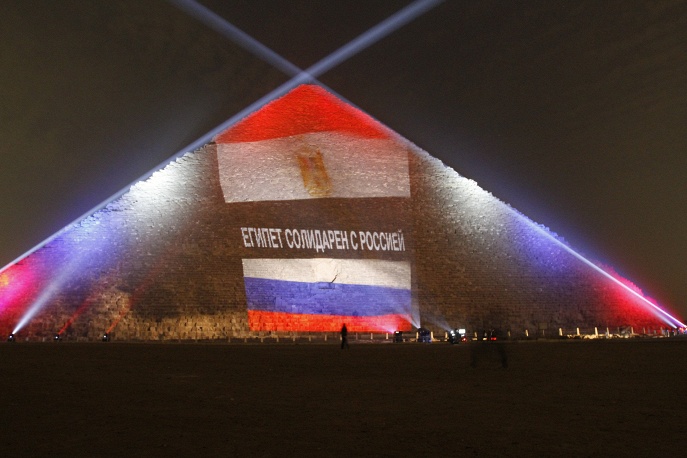
Egypt leads the world by example honoring victims of France, Russia and Lebanon at the Great Pyramids

From Fort Russ

“Egypt stands with Russia”


November 16, 2015
TASS

Translated by Kristina Rus

The Great pyramid was painted in the colors of the flags of Russia, France and Lebanon

According to the Minister of Tourism of Egypt, Hisham Zaazou, this is an action of solidarity with all peoples of the world who suffer from terrorism
CAIRO, November 16./Corr. TASS Dina Pyanykh, Dmitry Tarasov/.

Ancient Egyptian pyramids were illuminated Sunday night in the colors of the flags of Russia, France and Lebanon in solidarity with these countries that lost their citizens under tragic circumstances.

Egyptian authorities decided to hold a memorial at the Giza plateau in Cairo at the foot of the Great pyramids in memory of the victims of the A321 crash on the Sinai Peninsula in Egypt on October 31, terrorist attacks in Beirut on November 12, and Paris on November 13. Although the investigation of the crash is not yet completed and official results are not announced, one of the prevailing theories is that the plane broke up in the air to pieces from an explosion, not connected with technical condition of the plane. Some experts believe that the cause of the death of 224 people on board was a terrorist attack. Terrorist attacks claimed the lives of 129 people in Paris and 44 – the day before in Beirut.

As stated by the Minister of Tourism of Egypt, Hisham Zaazu, “this is an action of solidarity with all peoples of the world who suffer from terrorism, including France and Lebanon, as well as Russia, in memory of the victims of the tragic disaster”.

According to the Minister of Affairs of Antiquities of Egypt, Mamdouh al-Damati, with their action at the pyramids the Egyptians want to convey to the world “the message that they are against terrorism, stand with the peoples of France and Lebanon who had been subjected to inhuman attacks, as well as with Russia and families of the victims of the tragic plane incident”.

“We have repeatedly reiterated that we stand united with the entire world in the fight against terror which does not differentiate between religions and nationalities and which itself does not have a religion or homeland,” – he added in an interview with TASS.

The pyramid of Cheops – the largest at Giza, became the screen for the message of solidarity in Russian, French and Arabic on the background of flags of the three states. The crowds lighted candles and honored the memory of the untimely deceased with a minute of silence.

http://www.fortruss.blogspot.com/2015/11/egypt-leads-world-by-example-honoring.html

Syrian Army closes in on M5 highway

From Fort Russ

By Ollie Richardson for Fort Russ
13th November, 2015

The strategic Aleppo-Idlib highway, the M5, is on the horizon for the Syrian Arab Army just west of Al Hadher. Since the capture of the Keweires airbase in Aleppo, the momentum has not stopped, with various villages being captured:
  • Al-Hadher 
  • Al-Eis + hill 
  • Tel Hadiya 
  • Banes. 
  • Tel Bajir 
  • Birnah 
  • Al-Barqoum

Of course, the Russian airstrikes have made this advance possible by driving the Takfiri rats backwards away from the Highway, with al-Nusra vehicles going up in smoke. With this section of the highway secured, Obama’s goons will lose a key supply route, and will suffer a huge blow to morale. Of course, this will anger Turkey too who cannot smuggle weapons to their proxies so easily either. With the recent suicide attacks in Beirut – one would imagine Hezbollah’s determination will be amplified somewhat.

Here is an example from October of an airstrike in Teir Maalah, a village nearby the M5 highway.

<iframe width=”600″ height=”500″ src=”https://www.youtube.com/embed/iX0rAcFlFFU&#8221; frameborder=”0″ allowfullscreen><!–iframe>
SAA storming Al-Eis:

Vladimir Putin talks to Interfax and Anadalu; Syria, lack of U.S. cooperation, Ukraine, TTP and TTIP

From the Kremlin

In the run-up to the G20 summit, Vladimir Putin gave an interview to Russia’s Interfax news agency and Turkish Anadolu Agency.

November 13, 2015

Question: During the 2008–2009 global financial crisis, the G20 became a popular format, a platform for solving global problems. Do you think that it still plays the same role? What problems that could really be solved in this format rather than in statements or declarations do you think are the most pressing today?

President of Russia Vladimir Putin: The role of the G20 in the global economic and financial governance is becoming increasingly important. Thanks to the decisions made by the G20, we have managed to create conditions not only for coping with the consequences of the 2008‑2009 crisis, but also for enhancing sustainability and transparency of the global financial markets.

However, nowadays, global economy is still unstable and cannot get onto a path towards sustainable and balanced development. In this context, the work that the G20 does is especially needed.

First and foremost, it is necessary to continue improving the international monetary and financial system; to impartially and equally redistribute quotas and voting shares among IMF members in favour of those developing economies that have gained greater weight; to improve the efficiency and legitimacy of the Fund’s activities. Besides, we see more often how politically motivated restrictions are imposed on the entry of sovereign borrowers and companies into the global financial markets. We consider G20 to be the main platform for dialogue on all of these issues.

The reform of international tax rules launched at the G20 Summit in St Petersburg is another important issue. The Base Erosion and Profit Shifting (BEPS) Action Plan should be finally adopted in Antalya. The next step is to introduce in practice the new rules in the G20 countries and beyond.

I would like to highlight such an important achievement made this year by the G20 as the development by our countries of investment strategies, which include specific commitments to encourage domestic demand through investment. Thus, the initiatives launched by Russia during its G20 Presidency have translated into practice.

Question: Western sanctions have substantially challenged Russia’s ability to attract funds from the Western capital markets. In these circumstances the ‘tilt towards the East’ seemed reasonable, however, it feels as though the East itself is reluctant to replace the West as a source of external capital for developing Russian economy. Is this notion right?

Vladimir Putin: Let me stress that Russia pursues multidimensional foreign policy. We seek to have as many equal partners as possible both in the West and in the East.

Russia’s geography and history determines the Asia-Pacific dimension as one of our foreign policy priorities. Therefore, cooperation between Russia and the Asia-Pacific region is a strategic and long-term one. It is worth mentioning that this region is the linchpin of global economy and politics. The Asia-Pacific region accounts for about 60 percent of global GDP, fifty percent of international trade and direct cross-border investment. Obviously, the role of this region in global affairs will be growing and we do take it into account.

As for the restrictive measures imposed against Russia in March 2014, they have, indeed, complicated the process of attracting investments from certain Western markets. Nevertheless, our domestic banking sector proved its resilience to external shocks. We managed to keep Russian stock market attractive. CEOs of the major multinational companies admit that investing in Russia’s economy is promising.

Obviously, cooperation with Asian partners in attracting funds gains special relevance in the current situation. In 2015, approximately 90 percent of investments in the Russian market came from Asia. Several large Russian enterprises are financed by China and we analyse the prospects of public borrowings from China. International investment mechanisms have been developed – the New Development Bank BRICS and Asian Infrastructure Investment Bank, each with an authorised capital of $100 billion. Pooled funds and investment platforms have been created with China, India, South Korea and the Gulf states to channel foreign investments into the real sector of Russia’s economy.

In order to strengthen our cooperation, we are streamlining taxation of profits from project financing in Russia and also propose new promising initiatives. Many opportunities for cooperation are now available under our programmes for developing Siberia and the Far East, which have been presented, among other things, in September 2015 at the first Eastern Economic Forum in Vladivostok, including the creation of Priority Development Areas (PDAs) and a free port in Vladivostok that would enjoy preferential tax and administrative regimes, modernisation of the Trans-Siberian and the Baikal-Amur mainline railways, the revival of the Northern Sea Route, and building the Power of Siberia pipeline.

Question: Did you expect such unanimous negative reaction in the West, in particular, the NATO countries, some of which are major Russian partners, to the start of the Russian Aerospace Forces’ operation in Syria, and is it possible that the Western partners’ negative reaction would affect the time frame of Russia’s military operation in Syria? Is there any risk that Russia could be dragged into a long-term conflict in Syria and how much will the costs of carrying out this operation affect the Russian Federation budget, which has been already cut?

Vladimir Putin: We officially informed the US and NATO leadership of the start of military actions in a reasonable time.

We hoped at least for the natural in such cases close military and expert coordination with the US‑led Global Coalition to Counter ISIL, even taking into account all the fundamental differences between the Russian and US approaches to the Syrian crisis.

However, the reaction of the United States and Western partners was quite restrained, although it would seem obvious that ISIL and other similar extremist groups operating in Syria represent a clear common threat to our countries.

We still have not managed to go beyond the joint approval of the Memorandum of Understanding on Prevention of Flight Safety Incidents in the Course of Operations in Syria, and even then with a reservation by the US that by no means such interaction should be regarded as the normalisation of military contacts, which were frozen on the US initiative.

The United States has been also reluctant to respond positively to our proposal to sign a special agreement for the rescue of military aircraft crews, notwithstanding the fact that at the time when the US operation in Afghanistan started, we immediately responded to their similar request.

Neither have we received any response to our request to provide Russia with relevant US intelligence data for planning operations of our Russian Aerospace Forces in Syria, although we have repeatedly asked the United States for such information.

However, in the course of our activities, we are ready to take into account any reliable information on the location of terrorist groups. We have even worked together with the Free Syrian Army (FSA). The Russian aviation has conducted several strikes on the targets identified by the FSA. We excluded areas, which had been indicated by FSA commanders as being under their control. By the way, this fact proves once again that we are not bombing the so‑called moderate opposition or the civilian population.

We are ready to cooperate with Washington despite the fact that the US operations in Syria are in violation of international law – without the resolution of the UN Security Council, without the request from the official Syrian government.

As for the time frame of the operation in Syria, a clear objective is set before the Russian forces – they should provide air support for the Syrian army’s offensive against the terrorists, that is why the duration of stay of our servicemen will be determined solely depending on the time this objective is achieved.

And the last thing. Our activities in Syria as well as potential risks and consequences have been carefully calculated many times, and all the resources needed for the operation, both financial and technological, have been allocated in advance.

Question: At the G20 meetings with the Western leaders the settlement of the situation in Southeast Ukraine might be touched upon along with other issues. Taking into account the decision of the DPR (Donetsk People’s Republic) and LPR (Lugansk People’s Republic) to put off local elections until 2016, does it mean that the implementation of other items of the Minsk Agreements would be automatically prolonged as well? Are you concerned that procrastination in implementing the Minsk Agreements could bring about another frozen conflict close to Russian borders similar to the Transnistrian issue? You have repeatedly mentioned that Kiev does not comply with the Minsk Agreements, including its economic part. Does it mean that Russia is now actually responsible for supporting Donbass?

Vladimir Putin: The decision of Donetsk and Lugansk to put off the local elections until next year is a last-choice measure. They could have been held this year, had Kiev fulfilled strictly the Minsk Agreements of February 12 and agreed with the DPR and LPR on organising the elections, and also enacted the Law on the special status of Donbass in its original form.

Now, when a ceasefire in the region has finally been established, it is important that the parties to the conflict start looking for the points of contact together so that they can move on towards their common goal. They need to learn to listen to each other and hear each other. Compromise solutions depend on this.

Given the fact that the hostilities have ceased and cases of shelling are rare, it is unclear why would the US Congress adopt resolutions making it possible to provide Ukraine with lethal weapons. The question arises as to whether there is a desire to spark a war or provoke hostilities.

I would not overdramatize the delay in implementing the Minsk Agreements. Despite some difficulties, they are being implemented and, which is most important, their provisions, principles and logic are not questioned. We are talking simply about technical prolongation of the time frame.

However, the threat of Donbass turning into another frozen conflict is still there. It stems from Kiev’s policy, which continues to strengthen the blockade of the Southeast and has stopped the supply of food and money there. Kiev has eliminated the banking system there and is blocking exports.

I would like to recall that, during the talks as far back as in September 2014, the parties to the conflict agreed not only on a ceasefire, but also on the steps to restore livelihoods in the region. It was fixed that a programme for economic revival of Donbass should be adopted. This issue was discussed last February in Minsk, where our partners from the Normandy Four group – Germany and France – agreed to provide technical assistance in the recovery of the banking and financial infrastructure in the conflict-affected areas.

It is fair to say that there is certain progress. The parties restored railway communication, making it possible now to deliver Donbass coal to other regions of Ukraine. Works are underway to restore energy supply. Ways to restore water supply are also being analysed.

Russia, for its part, continues to support Donbass, which is in a difficult humanitarian situation. Since August 2014, more than 50,000 tonnes of humanitarian aid has been delivered there. First of all, we think about people that were abandoned by Kiev authorities and put to the brink of survival. It is our duty to provide them with the necessary assistance.

Question: The US and the EU have imposed sanctions against Russia. But despite Western countries’ criticism, Turkey continues to maintain its economic and political ties with Moscow. In this context, what future do you see for Russian-Turkish relations? To what extent do the differences on the Syrian issue affect the bilateral relations?

Vladimir Putin: While the US and the European Union unilaterally introduced sanctions, Turkey took an independent stand. Such an independent policy pursued by Ankara to meet its national foreign policy interests deserves great respect.

Such a pragmatic approach opens up new horizons for the development of Russian-Turkish relations – first of all, their business dimension. Turkey is our major partner in foreign economic collaboration. Last year our bilateral trade exceeded $31 billion. We have been building up industrial cooperation by implementing major projects in construction, light industry, metallurgy and agriculture. We focus primarily on such knowledge-intensive and hi-tech industries as energy – including nuclear power – and telecommunications. Tourism is another important field of collaboration. Last year over 3.3 million Russian citizens visited Turkish resorts. But generally, the potential for our trade and economic interaction is far from being fully unlocked.

It is true that the two countries have different views on the ways to resolve the crisis in Syria. But the important thing is that Russia and Turkey share the same priorities – we both stand for settling the situation in the region and effectively combating terrorism. With this in mind, the existing differences should not hamper our bilateral relations. On the contrary, in looking for the common ground, we draw upon vast experience of constructive cooperation between our countries.

Question: Last December, you made a state visit to Turkey during which, among other things, the launch of the TurkStream project was announced. Since then, no progress in its implementation has been observed, and there has also been certain information that the pipeline capacity would be halved and only two instead of four strings would be built. What are the reasons behind the project’s downsizing? Does it have anything to do with some serious political discords between Russia and Turkey, or is it for economic reasons alone?

Vladimir Putin: I cannot agree with your opinion that the TurkStream is slowing down. Such a large-scale project cannot be developed and agreed overnight. There are many legal, technical and economic, technological and organisational issues – including the number of the pipeline strings taking into account the actual need in gas acquisition and pumping volumes – which we have to decide together with our Turkish colleagues. The better we resolve these issues, the faster and with fewer risks and resources we will be able to implement our plans and ensure an uninterrupted delivery of Russian gas directly to Turkish consumers. The main thing is that this project is fully in the interests of both Russia and Turkey. We are one on this with my Turkish colleague Recep Tayyip Erdogan.

We passed our ideas on the bilateral intergovernmental agreement, which should provide legal basis for project implementation, to the Turkish side last July. We expect that the new Turkish government would be able to organise work on the key aspects of the above-mentioned agreement in a short period of time.

The pace of the negotiation process has been definitely affected by the political situation on the eve of the elections in Turkey. We understood that and did not force the events.

It is known that the EU and Bulgaria torpedoed the implementation of the South Stream and did not let us implement this project. Though it was clearly in the interests of Bulgaria and the entire southern Europe. The TurkStream would make it possible to deliver the Russian natural gas to the border between Turkey and Greece, virtually to the border of the EU. European consumers would be able to buy it there. But the countries that refused to take part in constructing the new pipeline would have to count lost profits.

I would like to note that we will continue to be a strategic and reliable energy supplier to Turkey and Europe, and that we have everything necessary for this.

Question: On Syria, Russia maintains that only the Syrian people can determine the future of Syria and Bashar al‑Assad. Which road map does Russia propose to settle the Syrian crisis? How do you see the future of that country? Was the resignation of Bashar al‑Assad from the post of president discussed at the meeting in Moscow? Did you make an arrangement with the United States to launch the operation in Syria?

Besides, Western countries have repeatedly accused Russia that the aircraft of its Aerospace Forces bomb not only the Islamic State and Jabhat al‑Nusra but also other groups in Syria. Do you think that all armed groups currently fighting in Syria against al-Assad’s army are terrorists?

Vladimir Putin: Indeed, from the very outset we have insisted, and we still insist today, that it is the Syrian people who should determine its future. It is good to know that at the Vienna talks on Syria on October 30, foreign ministers of seventeen states and representatives of the United Nations and the European Union supported this approach and expressed it in their final statement as their collective opinion.

As for the elaboration of a detailed road map to settle the conflict in Syria, that is not our task. The map should be developed and adopted by the Syrians themselves. Yet, we have a few ideas about how external forces could help the Syrians to defeat the terrorists and resolve the crisis. At present, the Russian diplomacy is actively advancing these proposals. They are not a dogma; rather they encourage the partners to continue a serious dialogue. Its constructive nature would to a large extent determine how successful we would be in translating the proposals into decisive joint actions which would help defeat ISIL and restore Syria as a unified, sovereign and secular state, create safe living conditions for everyone regardless of their ethnicity or faith, and open prospects for social and economic revival of the country. Let me repeat it once again – only the Syrians themselves should choose their future and their government leaders.

We were guided by this very logic – the logic of international law – when receiving Syrian President Bashar al‑Assad in Moscow. Let’s think how legitimate or ethical would it be if we invited the leader of a friendly state to Moscow and demanded him/her to resign? Syria is a sovereign country and Bashar al‑Assad is its President elected by the people. So do we have any right to discuss such issues with him? Of course, we do not. Only those who believe in their exceptionality allow themselves to act in such a shameless manner and impose their will on others.

It is based on the official request from the Syrian government that Russia is carrying out a military operation involving its Aerospace Forces in Syria. Let me repeat once again that the main purpose of this operation is not to support President al-Assad but to fight international terrorism. They are constantly trying to accuse us of bombing the so-called ‘moderate’ opposition but no evidence was provided so far. Moreover, we are already cooperating with that ‘moderate’ opposition, including the Free Syrian Army (FSA). The Russian aviation has attacked several targets indicated by the FSA.

To make the fight against terrorism more effective, the global community needs to develop a common framework as to whom to consider terrorists. It is not about the name of an organisation, which can seem quite ‘innocent,’ it is about whether it uses terrorist methods. So we need to compile a single list of extremist organisations. And Russia has already submitted its suggestions on this account – this was done during the Vienna meeting of the Syrian Support Group.

Question: It is expected that there would be a discussion on combating international terrorism at the G20 Summit under the Turkish Presidency. What do you think of the Turkish Presidency in the G20? What are you planning to put on the Antalya Summit agenda? Has the schedule of bilateral meetings on the sidelines of the G20 Summit been set?

Vladimir Putin: Indeed, at the proposal of the Turkish Presidency, the fight against terrorism and the problem of refugees will be discussed at the G20 Summit. This is not surprising. In our opinion, there is a direct relationship between these issues and the Summit’s agenda. Sustainable development, economic growth, global trade expansion, investments, and employment greatly depend on how successful the international community is in responding to today’s most urgent challenge – terrorism, and the problem of refugees that stems from chaos and violence. Hundreds of thousands of refugees are already in Europe and other countries, who are trying to save their lives and the lives of their close ones, and still more are on their way.

I am sure that the coming discussion would contribute to the practical solution of these issues and would be backed by a final document reflecting our common approaches to combating terrorism and resolving the refugee crisis.

As for the work of the Summit itself, we propose focusing the G20 on tackling major financial and economic problems, for example, measures for sustainable and balanced economic growth, and strengthening the stability of the financial system.

At the Summit, we will discuss the implementation of what our countries endorsed last year – the Growth Strategies and Country Employment Plans, the reform of international tax rules and promoting investments and decisions on financial regulation.

I expect that in Antalya we will manage to substantively discuss the future of the world trade and existing mechanisms of multilateral trade and economic cooperation. We will exchange our views on the prospects of creating closed integration associations in the Asia-Pacific region and in the Atlantic (I mean the Trans‑Pacific Partnership – on October 5, 2015, it was announced that the agreement was reached, 12 countries participate in the Partnership – Australia, Brunei, Vietnam, Canada, Chile, Japan, Malaysia, Mexico, New Zealand, Peru, Singapore, the United States – and the Transatlantic Trade and Investment Partnership that is a proposed agreement between the European Union and the United States). We are concerned that the process of their creation is not transparent for business circles and for the public both in the member states and in their economic partners. It is in our common interests to make sure that these associations indeed supplement the multilateral trade system, work for the development of all economies in the world and do not produce new barriers and risks.

We have high expectations for the WTO Ministerial Conference that will take place in Nairobi in December. We hope that it will contribute to the strengthening of the multilateral trade system and propose concrete steps to finalise the Doha Round of trade negotiations.

We will focus our attention on sustainable development, as well as climate change. The UN summit for the adoption of the post‑2015 development agenda has recently finished in New York. Now, the world is looking forward to the UN Climate Change Conference that will be held in Paris in December 2015 and, hopefully, a new agreement on climate will be adopted.

On the whole, we are satisfied with the Turkish G20 Presidency which managed to preserve the succession in complying with the decisions taken at the G20 summits in Saint-Petersburg and Brisbane, add new ideas to the current agenda, including establishing the Women‑20 and launching the World SME Forum.

The first G20 Energy Ministers Meeting in the history of the G20 has become an important Turkish initiative. At the meeting, the ministers discussed access to modern energy in Sub-Saharan Africa, improved energy efficiency and development of renewable energy sources, and most importantly, promotion of investments into energy infrastructure development and introduction of clean technology.

As for the schedule of bilateral meetings, it is now being formed. I intend to meet with the President of the People’s Republic of China, presidents of Turkey, the Republic of South Africa and Argentina, the prime ministers of the United Kingdom, Italy and Japan. Before the start of the G20 Antalya Summit, we will traditionally hold an informal meeting of the BRICS leaders where Russia currently holds chair. We will compare notes on the key issues of the G20 agenda and important international and regional problems.

http://en.kremlin.ru/events/president/news/50682

Congresswoman calls U.S. effort to oust Assad “illegal,” accuses CIA of backing terrorists

Global Research, November 01, 2015
Zero Hedge 31 October 2015

One point we’ve been particularly keen on driving home since the beginning of Russian airstrikes in Syria is that The Kremlin’s move to step in on behalf of Bashar al-Assad along with Vladimir Putin’s open “invitation” to Washington with regard to joining forces in the fight against terrorism effectively let the cat out of the proverbial bag. 

That is, it simply wasn’t possible for the US to explain why the Pentagon refused to partner with the Russians without admitting that i) the government views Assad, Russia, and Iran as a greater threat than ISIS, and ii) Washington and its regional allies don’t necessarily want to see Sunni extremism wiped out in Syria and Iraq.

Admitting either one of those points would be devastating from a PR perspective. No amount of Russophobic propaganda and/or looped video clips of the Ayatollah ranting against the US would be enough to convince the public that Moscow and Tehran are a greater threat than the black flag-waving jihadists beheading Westerners and burning Jordanian pilots alive in Hollywood-esque video clips, and so, The White House has been forced to scramble around in a desperate attempt to salvage the narrative. 

Well, it hasn’t worked.

With each passing week, more and more people are beginning to ask the kinds of questions the Pentagon and CIA most assuredly do not want to answer and now,  US Congresswoman Tulsi Gabbard is out calling Washington’s effort to oust Assad both “counterproductive” and “illegal.” In the following priceless video clip, Gabbard accuses the CIA of arming the very same terrorists who The White House insists are “our sworn enemy” and all but tells the American public that the government is lying to them and may end up inadvertently starting “World War III.”


Wikileaks Ucraina: McCain e Saakashvili stanno complottando…

Di Come Don Chisciotte 

…PER ABBATTERE UN AEREO AMERICANO E DARE LA COLPA ALLA RUSSIA

19-mikheil-saakashviliPrefazione di Gordon Duff, Senior Editor di Veterans Today
veteranstoday.com

Quella che segue è una trascrizione che abbiamo ricevuto da alcuni amici russi. E’ stata pubblicata dal sito FortRuss e non è stata verificata. Non possiamo dire che sia tutto vero ma certo è che, ben conoscendo i personaggi coinvolti, questi comportamenti li abbiamo già ripetutamente osservati. Potrete trarne una vostra personale opinione.

Wikileaks Ucraina tradotta dal russo da Kristina Rus

“M.”: Mikhail Saakashvili, ex Presidente della Georgia ed attuale Governatore della regione ucraina di Odessa.
“K.”: David Kezerashvili, ex comandante della Polizia Finanziaria e Ministro della Difesa della Georgia. Ricercato per appropriazione indebita di fondi statali.
“G.”: Anton Gerashenko, Deputato del partito ucraino ‘Fronte Popolare’ e segretario del comitato ‘Verkhovnaya Rada’. Consigliere del Ministro degli Interni Arsen Avakov, resident-agent dei servizi segreti statunitensi.
“R.”: Ramzan Machelikashvili, cugino di Ruslan Machelikashvili, detto Seyfullakh, è il famigerato ‘comandante sul campo’ sia dello Stato Islamico che dell’unità speciale anti-aerea. Ha ricevuto una formazione specifica nell’’Anti-Terrorist Operation Zone’ [Donbass].

M. – Fatelo entrare ……. siediti, David. Ricorda che tutto deve essere fatto per tempo, secondo quanto abbiamo concordato. Ne comprendi senz’altro l’importanza! Aspetta un secondo, attivo l’anti-sorveglianza …..

McCain ha confermato il piano. Come già sai è tutto a posto. Abbiamo ottenuto la copertura dal Senato degli Stati Uniti. In Siria i russi devono essere colpiti altrimenti, se si mettono d’accordo con gli americani, getteranno l’Ucraina in una discarica. Il Donbass è in una fase di stallo e anche il progetto Transnistria è sospeso. Se si va avanti in questo modo ‘abbiamo chiuso’! Dobbiamo accelerare le cose, in Siria. Avete preparato i nostri ragazzi?

K. – Sì, è tutto fatto. Oggi volano ad Antalya e poi vanno in Siria. Hanno ricevuto una buona formazione e trascineranno tutti con il loro spirito. Questi sono i nostri Kistintsy [ceceni georgiani che vivono nella Gola di Pankisi, in Georgia], dei ragazzi veramente tosti. Ramzan Machelikashvili è stato nominato comandante, gli altri quattro gli obbediscono. Sparano con tutte le armi e sono dei professionisti della contraerea. Sono in attesa di istruzioni specifiche.

M. – Date a Ramzan questo numero di telefono e questo cellulare. All’arrivo è necessario che invii un messaggio all’uomo di Warren, un agente della CIA, che li andrà a prendere. I Turchi sono stati avvertiti e permetterà il loro passaggio. In breve, l’agente di Steve Warren [Direttore dell’ufficio-stampa del Pentagono] sa tutto e parla russo. Dopo l’incontro Ramzan dovrebbe consegnargli il cellulare. Lo disattiverà.

K. – E’ tutto chiaro, ma per quanto riguarda le attrezzature e le armi?

M. – Aspetta, aspetta! Devo prendere la chiamata da Gerashchenko.

[M. parla con G.]

M. – Ciao Anton! I nostri ragazzi partiranno oggi. E’ tutto pronto?

G. – Mikhail, è tutto a posto laggiù! ….. Non si sente bene ….. ecco, ora puoi sentirmi di nuovo. Avakov [Ministro ucraino degli Interni] ha trasportato tutto, ci sono cinque missili antiaereo ‘Willow’ e ‘Needle S’ , il pieno di munizioni e di attrezzature. I cannoni antiaereo sono per strada. Non appena passeranno il confine il tuo capotribù – com’è che si chiama? – Ash-Shushani, incontrerà i ragazzi e li porterà sul luogo concordato.

M. – Eccellente! Eccellente! Bé, parlerò con te più tardi.

[M. interrompe la conversazione telefonica con G. e parla di nuovo con K]

M. – David! Tutto ciò che serve loro è già sul posto e, quando il materiale attraverserà la frontiera, lo riceveranno. Lì saranno accolti da Tarhan Batirashvili. Lo sapete chi è, vero? Ha una grande influenza nello Stato Islamico. Tutti i ceceni passano attraverso di lui, il suo soprannome è Ash-Shushani. Anche il cugino di Ramzan, Ruslan Machelikashvili, andrà ad incontrarli. Gli americani mi hanno detto che è un criminale spietato.

Bene. Tutto il gruppo sarà presto a Latakia, nella zona di Al-Nusra. L’obbiettivo è quello di abbattere un aereo americano. Riceveranno informazioni sui voli, c’è un curdo locale per questo scopo. Il piano è veramente fantastico! L’aereo americano sarà abbattuto dai militari russi. E’ questo ciò che sarà raccontato, che l’obiettivo è stato abbattuto da un missile russo. La scena sarà divertente, tutto il mondo ne parlerà.

Dopodiché il gruppo andrà ad Hasaka, una città vicina alla zona curda, e distruggerà un loro villaggio. Anche questa volta saranno incolpati i Russi. Come risposta i curdi abbatteranno un aereo russo con gli Stingers. L’obiettivo è quello di mettere contro americani e russi, in Siria. I turchi ce ne saranno grati, hanno promesso di ‘dare la sveglia’ ai Tartari della Crimea.

Dopo che in Siria tutto sarà stato fatto, vedrai se gli americani non porteranno le loro truppe in Ucraina e se tutti i nostri progetti non cominceranno ad essere operativi! McCain è in attesa delle nostre azioni altrimenti Obama non alzerà le chiappe. Le elezioni sono in arrivo e [senza quelle azioni] non farebbe niente. Vedi? Anche Poroshenko ha cominciato a scodinzolare davanti a Putin.

K. – Non lo so Misha. Il piano è tuo, sei tu quello che lo conosce meglio. Spiegherò tutto ai ragazzi e li manderò laggiù. E’ fantastico che Tarhan Batirashvili possa incontrarli, lui sa com’è che si combatte e supervisionerà il tutto. Molto tempo fa lo accettai nell’esercito. Sua madre è kistinka e suo padre è un georgiano.

M. – Quello che ho detto è di fare tutto per tempo, date ad ognuno dei cinque ragazzi 10.000 dollari e 20.000 dollari al padre di Tarhan, Ahmet.

K. – I ragazzi li ho già pagati e la mia gente consegnerà i 20.000 dollari a Tbilisi. Ma Machelikashvili è in attesa nella reception. Vuoi scambiare un paio di parole con lui?

M. – Certo! ….. Sveta, c’è un uomo con la barba che è venuto con David, si chiama Ramzan, fallo entrare.

S. – Lo faccio subito Mikhail.

M. – Come stai Ramzan! Come vanno le cose?

R. – Batono Misha! Siamo pronti a tutto [batono è un titolo onorifico georgiano].

M. – Molto bene! La pace nel mondo dipende da te! Io e Dato [?] supporteremo in tutto voi e le vostre famiglie.

R. – Grazie. David è molto utile. Dopo aver completato le operazioni in Siria ti riporteremo indietro [al potere], in Georgia. Sarà questo il nostro prossimo obbiettivo. Faremo saltare in aria l’intera Georgia, se necessario!

M. – Grazie Ramzan, arriverà quel tempo, ma per ora dobbiamo prenderci cura dell’Ucraina. Dato ti spiegherà, tutto è pronto. I ragazzi che verranno ad incontrarvi [in Siria] sono tuo cugino Ruslan, Aslan Margoshvili, Tarhan Batirashvili ed altri. Sarai in buone mani. Salutami gli altri ragazzi e state attenti. Prenditi cura di te.

R. – Mi fai sentire meglio, Misha batono. Non sapevo che avrei incontrato mio cugino. Faremo tutto al 100%. Pensavo che Tarhan fosse morto, avevo sentito che era ‘saltato’ insieme a El-Baghdadi. Inshallah, egli è ancora vivo.

M. – Prendi, Ramzan! E’ un pugnale, un mio regalo.

R. – Che Allah ti protegga, batono Misha! Non disonoreremo noi stessi e porteremo tutto a termine, te lo giuro!

K. – Ok Ramzan, aspettami nella sala d’attesa, io verrò presto!

[R. esce e M. ricomincia a parlare con K.]

M. – Ramzan è veramente un duro, vero? Dimmi, i conti in Svizzera sono già disponibili?

K. – Il Tribunale ha chiuso tutti i miei casi ed i conti sono ora disponibili, bisogna solo presentare i documenti alla banca. Adeishvili è stato molto utile. I suoi ragazzi hanno fatto ogni cosa per bene presso la ‘Corte’. Ho mandato loro dei soldi, ma dovremo inviargliene di più.

M. – Anche Kama deve ancora essere pagato. Avevi detto che avevi trasferito tutte le azioni agli uomini di Kakha [Kaladze, Ministro dell’Energia della Georgia] e che la questione era chiusa. Che c…o ho fatto di sbagliato per buttare via i miei soldi in questo modo!

K. – Non gridare! Te l’ho già detto, ho dato il 35% [delle azioni] delle attività portuali e delle infrastrutture per il petrolio. Ho dato il 10% [delle azioni] del gas e ho aggiunto il 10% per Bezhuashvili. In caso contrario non sarebbero stati d’accordo. E in Tribunale hanno fatto tutto loro. Per Meishvili, Shavliashili e Levna Murusidze devo inviare il cinquanta [percento, non viene detto di che cosa], a loro non ho ancora dato niente, prima devo pagare i Giudici del mio caso. Ti ho detto tutto in anticipo. In caso contrario avrei avuto un giudizio come quello di Ugulava e sarebbe stato bloccato l’accesso ai conti [Giorgi Ugulava, un politico già Sindaco di Tblisi].

M. – Vadano a farsi fottere con le loro madri, quelle pu…ne! Questi fottutissimi magistrati hanno venduto a Kolomoisky il video [Igor Kolomoisky, oligarca e politico ucraino]. Il Penguin lo ha preso e ha fatto pubblicare le foto di quel fr…io di Bacho [Bachana Akhalaia, già Ministro dell’Interno georgiano]. Per questo motivo tutte le azioni che avevamo previsto contro la Gazprom e in difesa di ‘Rustavi 2’ [canale televisivo privato georgiano] hanno dovuto essere fermate. L’ho detto mille volte. Rimuovete questo Kardav [?] oppure pagatelo, questo bastardo. Anche Ilham [Ilham Aliyev, Presidente azero] potrebbe risentirsi e farci fuori dalla SOCAR [State Oil Company of Azerbaijan Republic]. La questione deve essere risolta in un qualche modo. Quando vai a Zurigo?

K. – Intanto manderò i nostri ragazzi. Io domani andrò a Kiev e da lì in Svizzera. Dopo andrò a Baku, dove ci sarà da affrontare la questione della SOCAR.

M. – Fai attenzione ai nostri ragazzi di Pankisi [località georgiana di confine], fa in modo che siano felici. E’ questa la cosa più importante in questo momento. Non appena avremo tracciato un solco fra Mosca e Washington ci trasferiremo senza problemi a Kiev. Ok a dopo!

….. aspetta, aspetta. Sono contento di essermi ricordato. Tina ci ha detto che i suoi familiari hanno bisogno di un aiuto per le elezioni a Sagarejo [città georgiana]. I nostri ragazzi stanno facendo di tutto e Tina coinvolgerà anche i militari, ma Azersky Muganlo è fondamentale. Il nostro deputato, Azik, ti contatterà e quando arrivi a Baku egli verrà a trovarti. Dagli i soldi per corrompere il mufti Muganloisk. Chiedete un aiuto anche all’elite di Baku. [A Sagarejo] c’è una cagna, Iniashvili, che non deve vincere le elezioni. La supportano i Senatori della California, ma non me ne frega molto.

Hai capito cosa devi fare? Prima di andare a Kiev incontra Adeishvili, egli ti spiegherà tutti i dettagli.

K. – Sì, lascia che Zura [Adeishvili] mi spieghi tutto. Sono in ballo tante cose, potrei perdermi. Ho bisogno del suo aiuto.

M. – Bene. Non appena i ragazzi partono fammelo sapere, devo informare McCain. Sta aspettando!

K. Ok, Misha! Devo andare, c’è molto da fare.


Fonte: ww.veteranstoday.com

Link: http://www.veteranstoday.com/2015/10/30/ukrainian-wikileaks-mccain-and-saakashvili-are-plotting-to-shoot-down-american-plane-in-syria-to-blame-russia-transcript

30.10.2015

http://www.comedonchisciotte.net/modules.php?name=News&file=article&sid=4475

Operation Northwoods — Pentagon planned to carry out terrorism and blame Cuba

False-flag terrorism — repeatedly done by the United States. This is the pattern John McCain and the CIA are following in plotting against Russia, Syria, Ukraine, and other countries. Here it was done against Cuba.

This article came out four months before September 11, 2001.

————————————————————-

From ABC News

U.S. Military Wanted to Provoke War With Cuba

By DAVID RUPPE
New York, May 1, 2001

In the early 1960s, America’s top military leaders reportedly drafted plans to kill innocent people and commit acts of terrorism in U.S. cities to create public support for a war against Cuba.

Code named Operation Northwoods, the plans reportedly included the possible assassination of Cuban émigrés, sinking boats of Cuban refugees on the high seas, hijacking planes, blowing up a U.S. ship, and even orchestrating violent terrorism in U.S. cities.

The plans were developed as ways to trick the American public and the international community into supporting a war to oust Cuba’s then new leader, communist Fidel Castro.

America’s top military brass even contemplated causing U.S. military casualties, writing: “We could blow up a U.S. ship in Guantanamo Bay and blame Cuba,” and, “casualty lists in U.S. newspapers would cause a helpful wave of national indignation.”

Details of the plans are described in Body of Secrets (Doubleday), a new book by investigative reporter James Bamford about the history of America’s largest spy agency, the National Security Agency. However, the plans were not connected to the agency, he notes.

The plans had the written approval of all of the Joint Chiefs of Staff and were presented to President Kennedy’s defense secretary, Robert McNamara, in March 1962. But they apparently were rejected by the civilian leadership and have gone undisclosed for nearly 40 years.

“These were Joint Chiefs of Staff documents. The reason these were held secret for so long is the Joint Chiefs never wanted to give these up because they were so embarrassing,” Bamford told ABCNEWS.com.

“The whole point of a democracy is to have leaders responding to the public will, and here this is the complete reverse, the military trying to trick the American people into a war that they want but that nobody else wants.”

Gunning for War

The documents show “the Joint Chiefs of Staff drew up and approved plans for what may be the most corrupt plan ever created by the U.S. government,” writes Bamford.

The Joint Chiefs even proposed using the potential death of astronaut John Glenn during the first attempt to put an American into orbit as a false pretext for war with Cuba, the documents show.

Should the rocket explode and kill Glenn, they wrote, “the objective is to provide irrevocable proof … that the fault lies with the Communists et all Cuba [sic].”

The plans were motivated by an intense desire among senior military leaders to depose Castro, who seized power in 1959 to become the first communist leader in the Western Hemisphere — only 90 miles from U.S. shores.

The earlier CIA-backed Bay of Pigs invasion of Cuba by Cuban exiles had been a disastrous failure, in which the military was not allowed to provide firepower. The military leaders now wanted a shot at it.

“The whole thing was so bizarre,” says Bamford, noting public and international support would be needed for an invasion, but apparently neither the American public, nor the Cuban public, wanted to see U.S. troops deployed to drive out Castro.

Reflecting this, the U.S. plan called for establishing prolonged military — not democratic — control over the island nation after the invasion.

“That’s what we’re supposed to be freeing them from,” Bamford says. “The only way we would have succeeded is by doing exactly what the Russians were doing all over the world, by imposing a government by tyranny [???exactly where was Russia doing this all over the world?], basically what we were accusing Castro himself of doing.”

‘Over the Edge’

The Joint Chiefs at the time were headed by Eisenhower appointee Army Gen. Lyman L. Lemnitzer, who, with the signed plans in hand made a pitch to McNamara on March 13, 1962, recommending Operation Northwoods be run by the military.

Whether the Joint Chiefs’ plans were rejected by McNamara in the meeting is not clear. But three days later, President Kennedy told Lemnitzer directly there was virtually no possibility of ever using overt force to take Cuba, Bamford reports. Within months, Lemnitzer would be denied another term as chairman and transferred to another job.

The secret plans came at a time when there was distrust in the military leadership about their civilian leadership, with leaders in the Kennedy administration viewed as too liberal, insufficiently experienced and soft on communism. At the same time, however, there were real concerns in American society about their military overstepping its bounds.

There were reports U.S. military leaders had encouraged their subordinates to vote conservative during the election.

And at least two popular books were published focusing on a right-wing military leadership pushing the limits against government policy of the day.

The Senate Foreign Relations Committee published its own report on right-wing extremism in the military, warning a “considerable danger” in the “education and propaganda activities of military personnel” had been uncovered. The committee even called for an examination of any ties between Lemnitzer and right-wing groups. But Congress didn’t get wind of Northwoods, says Bamford.

“Although no one in Congress could have known at the time,” he writes, “Lemnitzer and the Joint Chiefs had quietly slipped over the edge.”

Even after Lemnitzer was gone, he writes, the Joint Chiefs continued to plan “pretext” operations at least through 1963.

One idea was to create a war between Cuba and another Latin American country so that the United States could intervene. Another was to pay someone in the Castro government to attack U.S. forces at the Guantanamo naval base — an act, which Bamford notes, would have amounted to treason. And another was to fly low level U-2 flights over Cuba, with the intention of having one shot down as a pretext for a war.

“There really was a worry at the time about the military going off crazy and they did, but they never succeeded, but it wasn’t for lack of trying,” he says.

After 40 Years

Ironically, the documents came to light, says Bamford, in part because of the 1992 Oliver Stone film JFK, which examined the possibility of a conspiracy behind the assassination of President Kennedy.

As public interest in the assassination swelled after JFK’s release, Congress passed a law designed to increase the public’s access to government records related to the assassination.

The author says a friend on the board tipped him off to the documents.

Afraid of a congressional investigation, Lemnitzer had ordered all Joint Chiefs documents related to the Bay of Pigs destroyed, says Bamford. But somehow, these remained.

“The scary thing is none of this stuff comes out until 40 years after,” says Bamford.

http://abcnews.go.com/US/story?id=92662

James Bamford is a former investigative reporter for ABC News.

Posted under Fair Use Rules.

Michael Parenti: What the US did to Iraq prior to 9-11 and why the US did it

Defying the Sanctions: A Flight to Iraq
January 2001
[written 8 months before 9-11]

Upon disembarking from the Olympic Airways plane that brought me to Iraq in November 2000, I could see some of the effects of the Western-imposed sanctions. What was once a busy international airport is now a desolate strip. Two lonely planes sit as if abandoned on the vast tarmac. There are no airport personnel to speak of, no baggage carts or utility vehicles, not even any visible security. On a wall inside the empty terminal is a handmade sign in Arabic and imperfect English; it reads: “Down USA.” A large portrait of Saddam Hussein gazes down upon us. His image can be found along the road to the city, in the hotel, and on various public buildings.

 I am part of an international delegation of Greeks, Britons, Canadians, and Americans. Included are journalists, peace advocates, and members of the Greek parliament. Margarita Papandreou, former first lady of Greece and devoted political activist, leads the group. It is an especially moving moment for her. It has been her dream for ten years to be able to fly directly to Baghdad. And ours is the first flight to Iraq by a state-owned commercial airline from the West in defiance of US/UN sanctions. The Iraqi officials who greet us do not try to hide how pleased they are about our arrival. “Your presence is a statement against the inhuman means used against us. Iraq is a prosperous country capable of fulfilling the basic needs of the people but we are being prevented from doing so by the UN sanctions,” one of them says. “Feel free to go anywhere and speak to anyone.”

Killing Iraq

Most Americans do not know that Saddam Hussein was put into power by a CIA-engineered coup to stop the Iraqi revolution—which he did by massacring the communists and the left-wing of his own Baath party. But in time Saddam proved to be a disappointment to his mentors in Washington. Instead of becoming the comprador ruler who opened his country to free-market capital penetration on terms that were thoroughly favorable to Western investors, he devoted a substantial portion of Iraq’s export earnings to human services and economic development. In 1972, Iraq nationalized its oil industry, and was immediately denounced by US leaders as a “terrorist” nation.

Before the six weeks of air attacks known as the Gulf War (which ended in February 1991), Iraq’s standard of living was the highest in the Middle East. Iraqis enjoyed free medical care and free education. Literacy had reached about 80 percent. Most Iraqi youth were educated up through secondary school. University students of both genders received scholarships to study at home and abroad. In the eyes of Western leaders, Saddam was that penultimate evil, an economic nationalist, little better than a communist. He would have to be taught a lesson. His country needed to be bombed back into the Third World from which it was emerging.

The high explosive tonnage delivered upon Iraq during the Gulf War was more than twice the combined Allied air offensive of World War II. Within the first few days of bombing, there was no running water in the country. More than 90 percent of Iraq’s electrical capacity was destroyed. Its telecommunication systems, including television and radio stations, were demolished, as were its flood control, irrigation, sewage treatment, water purification, and hydroelectic systems. Farm herds and poultry farms suffered heavy losses. US planes burned wheat and grain fields with incendiary bombs, and hit hundreds of schools, hospitals, rail stations, bus stations, air-raid shelters, mosques, and historic sites. Factories that produced textiles, cement, chlorine, petrochemicals, and phosphate were hit repeatedly. So were the refineries, pipelines, and storage tanks of Iraq’s oil industry. Iraqi civilians and soldiers fleeing Kuwait were slaughtered by the thousands on what became known as the “Highway of Death.” Also massacred were Iraqi soldiers who tried to surrender to US forces on a number of occasions. In all, some 200,000 Iraqis were killed in those six weeks. Nearly all US planes, Ramsey Clark notes, “employed laser-guided depleted-uranium missiles, leaving 900 tons of radioactive waste spread over much of Iraq with no concern for the consequences to future life.”

Our delegation got a grim glimpse of the war’s aftermath. We visited the Al-Amerya bomb shelter where over four hundred civilians, mostly women and children were incinerated by two US missiles. Blackened ossified body parts, including a child’s hand can still be seen melded into the ceiling. Along one wall is the irradiated shadow of a woman holding a baby in her arms, a ghoulish fresco created by the heat blast of the missiles. The shadow of another figure can be seen on the cement floor. The shelter has been made into a shrine, with candles, plastic flowers, and pictures of the victims. The guide notes that US reconnaissance saw civilians using the shelter on a nightly basis during the early days of the bombing, yet it was still chosen as a target.

In the ten years of “peace” since February 1991, an additional 400 tons of explosives have been dropped on Iraq, three hundred people have been killed and many hundreds wounded. The United States and United Kingdom, with the participation of France, imposed a no-fly zone over the northern region of the country, ostensibly to protect the Kurds. This newly found humanitarian concern did not extend to the Kurds residing on the Turkish side of the border. The next year, another no-fly zone was imposed in the south, reputedly to protect Shiite settlements, effectively dividing the country into three parts. By 1998, the French had withdrawn from both zones, but US and British air attacks on military and civilian targets have continued almost on a daily basis, including strafing raids against Iraqi agricultural developments. Baghdad’s repeated protests to the United Nations have gone unheeded. Since 1998, three members of the Security Council—Russia, China, and France; and various nonpermanent members have condemned the raids as illegal and unauthorized by the Security Council.

To drive the point home to us, on the second day of our visit, US warplanes fired four missiles at the village of Hmaidi in the southern province of Basra, one of which struck the Ali Al-Hayaini school, wounding four children and three teachers. Several homes were also hit.

Picking Up the Pieces

Despite the years of bombings and the even greater toll on human life taken by the sanctions, visitors to Baghdad do not see a city in ruins. Much of the wreckage has been cleared away, much has been repaired. In our hotel there is running water throughout the day, hot water in the morning. Various streets in Baghdad are lined with little stores, surprisingly well-stocked with household appliances, hardware goods, furniture, and clothes (much of which has a second-hand look).

We see no derelicts or homeless people on the streets of Baghdad, no prostitutes or ragged bands of abandoned children, though there are occasional youngsters eager to shine shoes or solicit spare change. But even they seem to be well-fed and decently clothed. Obviously, despite all the destruction wrought by the sanctions, Iraq still has not undergone sufficient free-market “structural adjustment.”

A British member of our delegation who has made more than a dozen trips to Iraq over the past decade sees some changes for the better. A few years ago, the cars all looked like “death traps”; tires were patched beyond recognition, windows were cracked, and doors were falling off the hinges, she tells me. Now the Iraqis seem to have procured vehicles that are in better repair. In addition, large swaths of the city used to be shrouded in complete darkness; now there are lights just about everywhere, though mostly on the dim side. There are more shops with more goods, “although 70 percent of the people can’t buy anything.” Still, “people used to feel hopelessly isolated and now there seems to be more hope and better morale,”[and the worst was to come in two years — Shock and Awe] she concludes.

The Silent Cries of Children

 Not everyone shows better morale. It is said that the most depressed officials in Iraq can be found in the Ministry of Health, not surprisingly given the tragedies they confront. Aside from the 200,000 Iraqis slaughtered during the Gulf War, an additional 1.5 million civilians have died since 1991 as a result of the sanctions, according to UNICEF reports and the Red Cross, many from what normally would be treatable and curable illnesses. Of these victims, 600,000 are children under 5 years of age. Maternal mortality rates have more than doubled, and 70 percent of Iraqi women suffer from anemia. Given the tons of depleted uranium used during the Allied attacks, cancer rates have skyrocketed: the childhood leukemia rate is now the highest in the world. Most of the leukemia increase is in southern Iraq where the bombing was heaviest.

We visit a children’s hospital in Baghdad. The familiar sight of skeletal-looking infants, racked with diseases that make it impossible for them to retain or digest nutrients are no longer evident. Such dying children still can be found in parts of Iraq but not at this hospital. Instead we encounter something equally ominous: children suffering from acute forms of multiple malignancies. Shrouded mothers stand by the beds like mournful sentinels, their eyes filled with unspoken grief. The journalists, photographers, and TV crews in our delegation descend upon these sad people, clicking and flashing away with that intrusive irreverence that is the press’s modus operandi. A mother weeps quietly against the wall. One of the doomed children smiles up at us—which almost causes me to start weeping.

Things are getting worse, a doctor tells us; more and more children are turning up with leukemia. The medical staff is overwhelmed. One doctor says he sees three hundred patients in three hours: “We cannot treat them properly.” Some of the hospital rooms are lined with incubators that contain what look like premature births. These turn out to be infants who are the products of depleted uranium, born with serious deformities and malfunctions, urgently in need of surgical intervention. The hospital lacks the special instruments needed to operate on infants, not to mention ordinary medications, anesthetics, antibiotics, bandages, intravenous sets, and diagnostic equipment. Iraq’s excellent national health care system, with its universal coverage, is now in shambles because of the embargo.

Things were supposed to get better when the sanctions were eased in 1996, allowing Iraq to make “oil for food” sales. Since then, $32 billion in oil was sold abroad but only $8 billion worth of materials has reached Iraq, less than $5 or $6 a month per person. Another $10 billion has been allocated for “war compensation,” in effect forcing the Iraqis to pay the costs incurred by the UN aggressors when destroying Iraq. Another $11 billion in cash sits in Western banks. Worse still, many essential things needed to rebuild the infrastructure—including the technological, medical, educational, communicational, and industrial systems of the nation—are still not available. Under the deleterious “dual use” doctrine, many vital commodities and materials needed for humanitarian and civilian purposes are banned because they conceivably could also be used by the military: computers, components for electrical transmitters and water pumps, even glycerin tablets needed for heart ailments. (It would take millions of glycerin tablets mixed with nitrogen to make one small explosive.)

The Foreign Minister Speaks

 Iraq’s Minister of Foreign Affairs, Tariq Aziz, a calm congenial man, meets with our delegation. [Tariq Aziz died June 5, 2015, in prison, convicted on trumped up charges. His abusive treatment in prison included being denied visitation, adequate food, and access to medication. His imprisonment and death at the hands of the U.S. and “interim” Iraq vassal government are chronicled here] In clear and precise English, he makes the following points: Before 1990, the United Nations had placed sanctions upon only a few nations, such as Rhodesia and South Africa, on a voluntary basis. “It was left to the countries themselves and the world to implement those sanctions or not implement them.” Hence the effects were mild. But since 1990,US leaders with their so-called New World Order have imposed the severest embargo, “encircling Iraq with warships and airplanes that prevent even ordinary trips and ordinary cargoes.” As with the sanctions against Yugoslavia, the minister notes, this policy has created a lot of suffering. “Therefore, when we say that this embargo is an international issue, it’s not just anti-American propaganda. It’s the truth. And it is quit horrid.” The collapse of the Soviet Union has created a different international scene, he adds. With the end of the Cold War, “a new hot war and warm war” has been imposed on many nations, with Iraq as a prime target.

 In spite of all the reports made by United Nations agencies themselves “informing the Security Council about the sufferings of the Iraqi people, and the deaths of so many children, and the deterioration of the Iraqi economy,” Aziz reminds us, there is no likelihood of any change in UN policy on sanctions because of the Security Council veto wielded by the United States and Britain. Still the people of Iraq have not been merely passive victims. They have “refused to yield to American pressure and American blackmail.” In addition, there is “the will of other peoples, the free women and men in this world” who refuse to support injustice and imperialism. After ten years, US propaganda “is wearing thin,” and “a lot of facts have become known to the peoples of the world” bringing a dramatic increase in support for Iraq—as measured by the growing number of air flights from various nations in defiance of the sanctions. Not only Iraq but its trading partners have sustained substantial commercial losses because of the ten-year embargo. In 2000, more than 1,500 international companies from forty-five countries participated in the Iraqi trade fair. So, for both moral and legitimate commercial reasons, “the embargo is beginning to crack.”

Ten years ago, concludes Aziz, we were told: history is over; from now on we will live according to the diktat of US leaders in a Pax Americana. And those who do not accept this are “rogue nations.” But US leaders are beginning to realize “that this new imperialism is not working. . . . Despite all its power, the United States is not God. It’s not the Almighty. It’s an imperialist force.” And “when a nation succeeds in refusing the dictate of imperialists, [and] succeeds in preserving its sovereignty, and its independence and dignity, that is an achievement.” Aziz’s closing plea was that we not rely on “the manipulated media” of the United States, Britain and Canada. “One of the basic human rights is that you have the right to make your own judgment, not to buy judgments made by others that might not be honest and true. So I hope that you will use this short visit to know what is going on in this country and what the realities are.”

The “Realities”

On the closing day of our trip, members of our delegation lay plans to carry on the battle against sanctions. These include: lobbying the UN Compensation Committee, which refuses to release the $11 billion in Iraqi oil-for-food earnings; joining with Women’s International League for Peace and Freedom, and other NGOs to lobby the UN Security Council; lobbying the UN Human Rights Commission in Geneva and the parliament of the European Union; lobbying elected representatives and religious leaders in various countries; and sending messages through the Internet.

The sanctions wall is not about to crumble but it is showing cracks. In 1998 Scott Ritter, chief UN weapons inspector in Iraq since 1991, resigned and accused the US government of undercutting UN weapons inspectors. Meanwhile US leaders and the press continued to portray Iraq as bent on nuclear aggression, despite the fact that Baghdad cooperated fully with UN inspectors who scoured the country in a vain search for weapons of mass destruction or the capacity to build them.

Also in 1998, Denis Halliday, UN Assistant Secretary General and Humanitarian Coordinator in Iraq, resigned in protest of what the sanctions were doing to that country. In early 2000, Hans von Sponeck, UN Humanitarian Coordinator in Iraq and Jutta Burghart, head of UN World Food Program in Baghdad, resigned in protest of the sanctions.

Still, the State Department and the US media continue to blame Saddam, not the sanctions, for the misery endured by the Iraqi people. The claim that sanctions hurt ordinary Iraqis “is outweighed by the sad truth that Saddam Hussein is determined to keep portions of his population in poverty,” intones a Washington Post editorial reprinted in the International Herald Tribune (November 14, 2000). The Iraqi leader, the Post assures us, is a “warmongering dictator” who needs to be contained by a still more severe application of sanctions. Upon being selected as the new US Secretary of State in December 2000, General Colin Powell echoed this position, announcing that he would strive to “reenergize” the sanctions against Iraq.

 The Iraqi leadership could turn US policy completely around by uttering just two magic words: “free market.” All they would have to do is invite the IMF and World Bank into Iraq, eliminate free education and free medical care, abolish the minimal food ration that goes to every Iraqi, abolish the housing subsidies and transportation subsidies, and hand over the country’s oil industry to the corporate cartels. To lift the sanctions, Iraq must surrender to the tender mercies of the free-market paradise as Yugoslavia has recently done under the newly minted, Western-sponsored president, Kostunica, and as so many other nations have done. Until then, Iraq will continue to be designated a “rogue nation” by those policymakers in Washington who themselves are the meanest profit-driven, power-mongering rogues on earth.

*     *     * Michael Parenti’s most recent books are To Kill a Nation: The Attack on Yugoslavia (Verso) and History as Mystery (City Lights).


http://www.michaelparenti.org/DefyingSanctions.html

Russian passenger jet crashes in Sinai, killing all 224 on board; search and salvage mission underway

Nothing is known yet about why the plane went down. All passengers and crew were killed. It was flying from  Egypt to Russia.

Several planeloads of Russian specialists have flown to Egypt to take part in the search and salvage. The black boxes have been recovered. Officials plan to begin flying the remains of passengers that have been found back to Russia today.

Today, Sunday, is a national day of mourning in Russia for this tragedy.

Check RT.com for updates on the situation