Author: admin
American propaganda success: 60% of Japanese youth believe the atomic bomb was dropped by the USSR
From Fort Russ
September 6, 2015
Radio Komsomolskaya Pravda
Translated by Kristina Rus
Mikhail Delyagin (a prominent Russian author, politician and economist): When we take offence at the Japanese about their inadequacy on the Kuril islands, our offence is directed at the wrong target. We must remember about the Americans. They suppress everything they don’t like in Japan without any sentiments. This is hegemony and domination and it brings its fruits.
If you go to the museum of the atomic bombing of Hiroshima and Nagasaki you will not find a mention of who dropped the atomic bomb. It’s not there.
Host: It fell by itself…
Delyagin: A bomb fell by itself, a bomb was dropped, but by whom – sorry, you are not supposed to know.
Morevover, there is sociological research, which shows that over 60% of Japanese youth under 26 believe that the atomic bomb was dropped on Japan by the USSR.
Host: For some reason I am not surprised…
Delyagin: They are convinced about it. This is a real achievement of American propaganda, of American domination.
Now I have a printout from Wikipedia in front of me. A printout in Russian, but it presents an American view. Even though it is free and it gets edited multiple times.
It reports that the Japanese made the decision to capitulate only after the USSR brought in the troops and started a war and after the report about the second bomb in Nagasaki. Only after that the Japanese capitulated.
The Malaysian MH17 crash investigation; Dutch, Australian, UK govts are withholding evidence
Global Research, September 16, 2015
Dances with Bears 13 September 2015

The Dutch Government has decided to launch a missile attack on Moscow in October. By suppressing all evidence obtained from the bodies of victims of the crash of Malaysian Airlines MH17, officials of the Dutch Safety Board and associated Dutch military officers, police and prosecutors are preparing to release a report on the crash with a gaping hole in its veracity.
At the same time, and apparently unknown in The Netherlands, an Australian coroners’ report on the identification and forensic testing of the bodies carried out in The Netherlands reveals post-mortem evidence to show that in their public statements the Dutch government officials have been lying about metal evidence they claim to have found. This evidence has not only been buried with the passengers’ remains. It has been buried by the Dutch Government and by coroners in the UK and Australia, who are now legally required to investigate independently what caused the deaths of citizens in their jurisdiction. All are withholding the CT scans, X-rays, autopsy and other post-mortem results, including metallurgical assays, the documentation of which accompanied the coffins of the aircraft’s victims from The Netherlands to their homelands.
Washington wants “regime change” in Ecuador: “What is the CIA planning before Ecuador’s 2017 elections?”
The United States does not lack institutions that continue to conspire, and that’s why I am using this gathering to announce that we have decided to expel USAID from Bolivia” Bolivian President Evo Morales
Washington wants Ecuador’s President Rafael Correa removed from power. Washington says it is concerned about the freedom of the press in Ecuador because their non-government organization ‘Fundamedios’ funded and supported by United States Agency for International Development (USAID), the National Endowment for Democracy (NED) and Freedom House among others is in the process of being shut down by the Correa government. According to Telesur’s report on September 10th “Fundamedios engaged “partisan political activities” by sharing material on its social media accounts, publishing articles unrelated to its stated mission and inserting itself into political debates in the country”which according to the National Secretariat of Communication or ‘Secom’ is prohibited under Ecuadorian law. The White House released a press statement on the same day:

We are very concerned about the increasing restrictions on freedom of expression and freedom of association in Ecuador, particularly the Ecuadorian government’s September 8 decision to initiate legal steps intended to dissolve Fundamedios, a non-governmental organization that monitors and defends press freedom.
An active civil society and tolerance of dissenting views are vital components of any democracy. We share international concern over the Ecuadorian government’s efforts to silence critical voices and deny its citizens access to a diversity of information and ideas. Freedom House, Human Rights Watch, the Committee to Protect Journalists, among others, have all spoken out in opposition to the government’s latest action against Fundamedios.
According to TeleSur ‘Fundamedios’ is funded by the NED and USAID:
The work of the organization mostly consists of issuing “alerts” regarding alleged attacks against journalists in Ecuador. The organization is funded in part through a US$84,000 grant from the U.S.-funded National Endowment for Democracy. U.S. Ambassador to Ecuador Adam Namm told El Telegrafo that Fundamedios received US$300,000 in 2012 from USAID, which is receives its funds from the U.S. government
USAID and NED are in the business of “Democracy Promotion” which uses public money (from U.S. taxpayers) for secretive operations with the intention to support pro-U.S. governments with the help of political and social movements abroad. The goal is regime change.
Why Washington wants Correa Removed from Power

Since 2009, the world has seen what the Obama administration has done to sovereign nations in the name of democracy. Libya, Honduras and the Ukraine are some of the recent examples of U.S. foreign policy that has only proved to be disastrous on many levels. Ecuador would be added to Obama’s list of countries ripe for regime change.
First, Correa is a staunch ally of Latin America’s leftist governments of Bolivia, Venezuela, Nicaragua, Argentina and Brazil who are critical of U.S. Foreign policy. What makes matters worse for Washington was the closure of the Manta Air Force Base in 2009, a promise made by Correa in a 2006 campaign.
Washington wants a new government in Ecuador to reopen the Manta Air Force Base for surveillance and the so-called “War on Drugs”. In 2008, the New York Times reported that President Correa fired high ranking military officials who were loyal subjects of Washington:
Mr. Correa — who this month dismissed his defense minister, army chief of intelligence and commanders of the army, air force and joint chiefs — said that Ecuador’s intelligence systems were “totally infiltrated and subjugated to the C.I.A.” He accused senior military officials of sharing intelligence with Colombia, the Bush administration’s top ally in Latin America
The New York Times admitted that Correa’s administration is a challenge for U.S. policy makers regarding the “War on Drugs” and its presence in Latin America:
The gambit also poses a clear challenge to the United States. For nearly a decade, the base here in Manta has been the most prominent American military outpost in South America and an important facet of the United States’ drug-fighting efforts. Some 100 antinarcotics flights leave here each month to survey the Pacific in an elaborate cat-and-mouse game with drug traffickers bound for the United States.
But many Ecuadoreans have chafed at the American presence and the perceived challenge to the country’s sovereignty, and Mr. Correa promised during his campaign in 2006 to close the outpost
Reuters’ also reported in 2007 what Correa had said about the possibility of renewing the lease to the U.S. military“We’ll renew the base on one condition: that they let us put a base in Miami — an Ecuadorean base,” Correa said in an interview during a trip to Italy. “If there’s no problem having foreign soldiers on a country’s soil, surely they’ll let us have an Ecuadorean base in the United States.” Correa did make a good point.
Another reason Correa is on Washington’s “hit list” involves Wikileaks. Its founder Julian Assange was granted political asylum in an Ecuadorian embassy in London because he feared that if he ended up in U.S. custody over the secret files he released from Chelsea Manning to the world, could have him face an unfair trial in a U.S. courtroom. Ecuador granted Assange political asylum status where he still remains to this day. Neoconservative and former Presidential contender Sarah Palin said that Assange is an “anti-American operative with blood on his hands…Why was he not pursued with the same urgency we pursue al Qaeda and Taliban leaders?” Palin was saying that Julian Assange is in the same league as Al Qaeda so killing him is justified. Ecuador did take a stand to protect the life and liberty of Julian Assange, something Washington does not take lightly.
Ecuador’s Lawsuit against Big Oil
Litigation and various lawsuits against Chevron-Texaco has been going on for more than two decades which oil drilling operations which occurred between 1972 and 1990 in the Amazon as RT News reported in 2013:
Ecuador’s foreign ministry announced on Friday that the US has seemingly denied visas to a delegation that was set to travel to the UN General Assembly in New York to present their case regarding an ongoing dispute against Chevron-Texaco. According to the ministry’s official announcement, the visas for the five Ecuadorian nationals were returned by the US Embassy in Quito “without any explanation.”
That group was to present testimony during a special event at the UN regarding the ecological impact caused by Chevron-Texaco’s oil operations in the Amazon rainforest region of Ecuador – which contaminated two million hectares, according to the country’s government. At stake is a US$19 billion judgment awarded by an Ecuadorean court against Chevron for cleanup and ecological damage, which is currently being fought at The Hague.
Correa in Washington’s Crosshairs
 From alliances with anti-Washington governments to the closure of the Manta Air Force Base, to protecting Julian Assange and a lawsuit against Chevron-Texaco for environmental damages to the Amazon, Correa is a target for regime change. Just remember back in history when the CIA orchestrated a coup against Ecuadorian President Carlos Julio Arosemena simply because he criticized the U.S. government and supported the Cuban revolution led by Fidel Castro. Correa has done a lot more to diminish U.S. power in Latin America than any other president in its current history.
Correa has accused the Central Intelligence Agency (CIA) earlier this year of “being increasingly involved in the political opposition with the avowed aim of dragging the country into chaos” and weaken the Ecuadorian government by “a series of coordinated nationwide protests.” Something Correa should be familiar with, after all the CIA attempted a coup in 2010 under Obama’s watch. One of the key reasons of the attempted coup by the Ecuadorian police was the Public Service Organic Law signed in 2010. It was designed to place regulations on public service workers namely the police and military and create a standard base of compensation instead of receiving their bonuses from foreign sources (the U.S. government) under Ecuadorian law. The main problem before the law was passed was that the police of Ecuador was receiving bonuses from the US embassy to spy on Ecuadorian politicians and others who were considered opponents of Washington.
Interestingly, Presidential hopeful Hillary Clinton was in Ecuador in June of that year to convince Correa to join the“Dark Side” but ultimately failed. U.S. Ambassador at the time was Heather Hodges who was assigned to disrupt and weaken the Correa government through USAID which contributed $40 million. The Ecuadorian police, military officials, USAID, NED, the CIA and a former president and a puppet of Washington during the Bush years, Lucio Gutiérrez who was ousted by the Ecuadorian people who demanded his resignation were all behind the coup plot.
Obama has 16 Months Left in Office
Will the Obama administration authorize another coup between now and 2016? It is Obama’s last 16 months in office since the first coup attempt. Correa knows he is on Washington’s “hit list” following his actions on Fundamedios who claim the freedom of speech is threatened as Washington threatens Julian Assange for exposing their crimes in Afghanistan and Iraq by killing of tens of thousands of civilians, which they tried to keep secret. Washington is consistent when it ignores the sovereignty of nations and bypasses international law on a regular basis.
Recently, the Confederation of Indigenous Nationalities of Ecuador (Conaie) and various trade unions called for a nationwide strike against the government, but many indigenous organizations opposed it. Telesur reported that WikiLeaks published diplomatic cables from the U.S. embassy in Ecuador from 2005 and 2006 that suggest members of CONAIE were interested in talking to U. S. Representatives within their own ranks including Vice President Santiago de la Cruz and Congressman Jorge Guaman who according to one cable “expressed interest in open dialogue.”Members of CONAIE also “asked the U.S. government to intervene with the president to get Conaie representatives back in these government institutions.” De La Cruz is described as “very interested in the possibility of visiting the U.S. on an exchange program,” and that he “appeared eager to engage in dialogue” with the U.S. Wikileaks also released documents on Auki Tituana, a member of Pachakutik who also seemed interested.
Although representatives in both organizations have shown an interest in meeting with U.S. officials, other members are not so keen on the idea including Luis Macas, head of CONAIE. This is a positive sign that members within these indigenous organizations do not want to meet with U.S. diplomats. Macas “has advised his organization to avoid dialogue with the U.S. government.” According to the cables “There appears to be division within the ranks of Pachakutik and (Conaie) on the level of interaction they should have with the Embassy”.
In 2007, Correa was an anti-neoliberal advocate was voted into power and has brought Ecuador political and economic stability. One other issue Washington is concerned about is what Correa said about the “Dollarization” of the Ecuadorian economy; he said it was a “technical error” after pro-US president Jamil Mahuad adopted the U.S. dollar in 2000. Correa did acknowledge that it is a difficult process to move out of the U.S. dollar at this time, however, he does support a regional South American currency that would allow Ecuador to move out of the dollar which is something U.S. officials’ do not like to hear especially when the dollar is about to lose its reserve currency status.
What is the CIA planning before Ecuador’s elections in 2017?
It is important to note that if a presidential recall vote were to take place in Ecuador today at least 60% of the people would vote for Correa according to the main-stream media’s ‘CNN Spanish’ poll this past June. Correa proposed constitutional reforms including two bills that would increase inheritance and capital gains taxes on the ultra-wealthy. Anti-government protests followed, which later turned violent. That is something Washington wants to see more of right before Ecuador’s 2017 presidential elections.
Copyright © Timothy Alexander Guzman, Silent Crow, 2015
Reprinted under Fair Use Rules
Worldwide “Rethink September 11” event this weekend
From Memory Hole Blog
Live Now Via YouTube Below

As the 14th anniversary of the events of September 11, 2001, approaches, a group of notable researchers will be presenting important information on Friday and Saturday, September 11th and 12th, 2015, about 9/11 and its relation to recent “terrorist” events in North America, and what the 9/11 Commission did not tell us. The events of 9/11 have caused many to raise considerable questions about what happened on that fateful day and how the events were used to justify wars of aggression that continue to destabilize the world.
The broadcast can be viewed on RethinkSeptember11.com from anywhere around the world and we encourage viewers to submit questions and comments in real-time using social media. The broadcast will feature personalities such as Kevin Ryan, Cynthia McKinney, Graeme MacQueen, Daniele Ganser, David Johnson, and James Corbett.
We are requesting all concerned citizens to spread the word and to view the broadcast. Your support is appreciated!
– Rethink September 11th Team
Schedule for Friday, September 11th, 2015
6:00 pm Toronto / 3:00 pm California / 11:00 pm UK / 3:00 am India – Introduction by Bev Collins
6:05 pm Toronto / 3:05 pm California / 12:05 AM Switzerland – Daniele Ganser: “What is the strategy of tension?”
6:45 pm Toronto / 3:45 pm California – Anthony Hall: “9/11 Truth to 9/11 Reality”
7:25 pm Toronto / 4:45 pm California – Barrie Zwicker: “Real Politik: Next Month’s Canadian Federal Election & 9/11”
8:05 pm Toronto / 5:25 pm California – Graeme MacQueen: “The War on Terror and the Intimidation of Legislatures in Canada and the U.S.”
8:45 pm Toronto / 6:05 pm California – Graeme MacQueen, Anthony Hall, & Barrie Zwicker Group Dialogue
9:25 pm Toronto / 6:45 pm California – Closing remarks by Bev Collins
Schedule for Saturday, September 12th, 2015
Part 1
11 am Toronto / 8 am California / 5 pm UK / 8 pm India – Introduction by Bev Collins
11:05 am Toronto / 8:05 am California – 12:05 am Japan – James Corbett: “The Financial Aspects and Cover-up of 9/11”
11:45 am Toronto / 8:45 am California – Kevin Ryan: “The Importance of the 9/11 Myth to Solving the 9/11 Crimes”
Part 2
4:00 pm Toronto / 1:00 pm California – Introduction by Bev Collins
4:05 pm Toronto / 1:05 pm California – Cynthia McKinney: “9/11, the Deep State, and the need for a Global Movement”
4:45 pm Toronto / 1:45 pm California – David Johnson: “The Vision for the 15th Anniversary of 9/11”
5:25 pm Toronto / 2:25 pm California – Closing remarks by Bev Collins
http://memoryholeblog.com/2015/09/11/worldwide-rethink-september-11-event-begins-tonight/
False reports of Russian military intervention in Syria
By Stephen Lendman
Global Research, September 04, 2015
After numerous US-led Western reports of nonexistent “Russian aggression” in Ukraine, how could anyone believe its military intervened in Syria – especially when Kremlin spokesman Dmitry Peskov (speaking for Putin) categorically denied it, and no verifiable evidence refutes him.
Believe nothing Western media claim, Peskov stressed. “(T)his issue has never been discussed in any way” – nor has Assad asked for direct Russian involvement.
Commenting on an earlier statement by Russian airborne troops commander Vladimir Shamanov, Peskov added: There ought to be no doubts that Russian airborne troops will fulfill any order from their-commander-in chief” Vladimir Putin.
“(U)se of Russian military aircraft in Syria is out of the question at the moment. The issue is not looked at now.”
Commenting from Eastern Economic Forum in Vladivostok, Putin said “(w)e consider various possibilities (about confronting the Islamic State, but military operations aren’t) yet on our agenda.”
“We will hold consultations with our Syrian friends and the countries of the region. (W)e are providing (Assad) with a rather serious support and equipment and training forces with armament” – nothing more so far.
His comments were in the context of fighting Islamic State and other takfiri terrorists. He explained months of US air strikes did nothing to deter them – plenty to destroy Syrian infrastructure and kill noncombatant civilians in harm’s way.
Putin wants to create an anti-terrorist coalition – cooperatively with regional and Western countries, he said, so far unable to agree on a common approach to resolving Syria’s conflict.
“We are not imposing anything,” Putin stressed. “(W)e are ready to contribute to (an) intra-Syrian dialogue.” Assad is Syria’s legitimate leader – overwhelmingly reelected in June 2014 in a process international observers called open, free and fair.
Russia opposes outside interference in the internal affairs of other countries. Under core international law, it’s illegal except in self-defense if attacked and authorized by Security Council members.
On September 1, Sergey Lavrov told International State Institute of International Relations students
“(n)ow (Western leaders) are trying like previously for eliminating Saddam Hussein and Muammar Gaddafi to give the top priority on Syria to the resignation of Bashar Assad saying he is illegitimate. But he is very legitimate.”
Syrians alone have the right to choose who’ll lead them and hold parliamentary seats – not outside powers.
The reliable Saker web site provides important information about Russia and geopolitical issues. Commenting on recent reports in two separate articles (here and here) alleging Moscow’s military intervention in Syria, he said don’t expect it there or anywhere else.
On the one hand, acting unilaterally is illegal. Security Council members alone can authorize intervention. On the other, popular internal Russian support is lacking.
“It is one thing to defend your own country or your own citizens (when attacked) and quite another to intervene” in another nation’s conflict hundreds of miles away, said The Saker.
Russia is legally justified in aiding Assad by “sending advisors, sharing intelligence and supplying weapons.” Unilateral direct military intervention in another country is another matter entirely.
Moscow learned a “painful” lesson in Afghanistan. What began in the 1980s as a “limited military intervention” became protracted conflict and bitter defeat. It wants no repeat decades later.
The Saker cited Russia’s Federal Law N61-F3 “On Defense”, Section IV, Article 10, Para 2. It states the mission of the Russian Armed Forces is to “repel aggression against the Russian Federation, the armed defense of the integrity and inviolability of the territory of the Russian Federation, and to carry out tasks in accordance with international treaties of the Russian Federation” – nothing else.
Russia’s Constitution, Chapter IV, Article 80, Para 2 states:
“The President of the Russian Federation shall be guarantor of the Constitution of the Russian Federation, of the rights and freedoms of man and citizen.”
“According to the rules fixed by the Constitution of the Russian Federation, he shall adopt measures to protect the sovereignty of the Russian Federation, its independence and state integrity, ensure coordinated functioning and interaction of all the bodies of state power.”
Unlike America, Russia isn’t the world’s policeman and doesn’t operate this way, The Saker explained. It doesn’t wage endless wars of aggression anywhere – or maintain a global empire of bases, used as launching points for premeditated conflicts.
Syria is Obama’s war. So are Afghanistan and Iraq inherited from George Bush, Libya, Donbass, Yemen and partnered with Israel’s anti-Palestinian crusade on his own, as well as covert destabilizing efforts against various other countries.
America is the greatest threat to world peace. Humanity’s survival depends on stopping its madness.
Stephen Lendman lives in Chicago. He can be reached at lendmanstephen@sbcglobal.net.
His new book as editor and contributor is titled “Flashpoint in Ukraine: US Drive for Hegemony Risks WW III.”
http://www.claritypress.com/LendmanIII.html
Visit his blog site at sjlendman.blogspot.com.
Listen to cutting-edge discussions with distinguished guests on the Progressive Radio News Hour on the Progressive Radio Network.
It airs three times weekly: live on Sundays at 1PM Central time plus two prerecorded archived programs.
Copyright © Stephen Lendman, Global Research, 2015
http://www.globalresearch.ca/false-reports-of-russian-military-intervention-in-syria/5473792
In Syria, Putin calls Obama’s bluff, Russia joins war against the “Islamic State” (ISIS)
Global Research, September 03, 2015
According to German Economic News (September 1st, based on reports from ynetnews and others), Russia’s President Vladimir Putin has apparently decided to establish in Syria a military base with thousands of soldiers and sufficient air power to do in Syria what the Obama Administration won’t, which is to defeat ISIS and the other jihadists.
On the same day, washingtonsblog bannered, “Former CIA Boss and 4-Star General: U.S. Should Arm Al Qaeda,” and linked to several sources indicating that not only David Petraeus favors arming Al Qaeda, but much of the American establishment (who have sponsored Petraeus’s entire career) also does. The British aristocracy likewise does. In fact, that academic propaganda-piece, The Russia Challenge, discusses “the stark choices Western governments face in their policies towards Russia,” while it says nothing about “the stark choices” that Russia now faces in its policies toward the U.S. aristocracy, and toward Britain’s and other U.S-allied aristocracies.
That British academic propaganda-piece comes from Chatham House, otherwise called the Royal Institute of International Affairs, which, since early in the 20th Century, has been allied in the U.S. with the Rockefellers’ and Morgans’ Council on Foreign Relations, and, post-WWII, also with the Bilderberg group, and with the Rockefellers’ Trilateral Commission (which brought the Japanese aristocracy into the overall U.S.-led plan for global conquest).
However, there are additionally many other front-organizations for this operation, such as the Brookings Institution. Brookings has always championed American empire, and I reported even recently on a Brookings ‘study’ of this type, by headlining “Brookings Wants More Villages Firebombed in Ukraine’s ‘Anti Terrorist Operation’.”(It’s actually an operation against the residents of the part of Ukraine that had voted 90%+ for the Ukrainian leader whom the Obama Administration had just overthrown. The residents there had refused to accept Obama’s imposed regime.) The intended defeat of Russia is to come not only in the competition over oil and gas (such as between the Arabic oil potentates and Russia), but also by extending NATO right up to Russia’s borders, such as by installing next-door in Ukraine a rabidly anti-Russian government, via a coup in February 2014. (John Fitzgerald Kennedy didn’t like it when Nikita Khrushchev tried something similar against the United States in 1962. It was called “the Cuban Missile Crisis.”) The evidence is clear and overwhelming, though almost entirely absent in U.S. ‘news’ media, that America’s aristocracy place vastly higher priority upon defeating Russia than upon defeating Islamic jihad. (The implicit message to the families of America’s 9/11 victims is: “Just get lost.” But that subtle message from the aristocrats isn’t on America’s ‘news,’ either. Only their PR is.)
In fact, I provided essential background for this development, on August 16th, headlining “How & Why the U.S. Media Do Propaganda Against Russia.” This is a position by the U.S. “Establishment,” which is the entire network of think tanks and other fronts that are financed by the U.S. aristocracy (tax-free, moreover, to the aristocrats who finance these operations) so as to conquer Russia in order that the U.S. aristocracy will win unchallengeable global control, over every other nation’s aristocracy. I documented there that not only the Republican Party but the Obama-Clinton or “Establishment” wing of the Democratic Party, have been fully in agreement with Mitt Romney’s infamous 2012 statement against Russia, which Obama publicly condemned at the time, that, “this is, without question, our number one geopolitical foe”; and Obama’s very public attack against that statement helped him win the 2012 election, though Obama’s second Administration has actually been carrying out Romney’s policy there.
Obama has many cheerleaders in this global-conquest program, such as his advisor Zbigniew Brzezinski, who is proud to have helped start today’s Islamic jihad movement in order to defeat the Soviet Union. After the Soviet Union ended, Brzezinski’s hatred of Russians drove him to continue on as if it hadn’t. The war against “communism” has turned out to have been just a cover-story for these aristocrats’ war for global control, somewhat like the war against Islamic jihadists later morphed into a war against the residents of Ukraine’s pro-Russian far-east. Brzezinski was born to Polish nobility, and he retains that hatred from his childhood, which is why he has been so useful to America’s aristocrats, in order to help make the defeat of Russia into a “bipartisan” issue, and not merely an issue for Romney and the great bulk of America’s aristocrats, who are Republicans.
Basically, what Putin is apparently doing here is to go beyond the theatrics of Western aristocracies, the aristocracies that are led by America’s, and finally now to lay down the gauntlet, in Syria, against Islamic jihad. As I have previously documented, Islamic jihad is financed virtually entirely by multimillion-dollar individual contributions not only by the Saudi royal family, but also by the royals of the other Arabic oil countries.
Without that constant flow of funds, the Sauds’ operation on their own side for global empire would collapse. Theirs is to be an Islamic global empire, much like America’s Dominionist Christions have (though far less successfully) aspired to creating a global Christian empire. Ever since 1945, the U.S. aristocracy and the Saudi royal family have been united together. Increasingly in the decades after the end of communism, the only thing that remains after the beast of “The Cold War” is the skeleton of expanding the American aristocracy’s empire, still married to the skeleton of the Sauds’ imperial ambitions. It could become an Earth-killing embrace: skeletons all-around and everywhere.
In one of the rare mainstream U.S. news reports about the unity between Arabic royals and the international Islamic jihad movement, America’s PBS “Frontline” documented that Islamic jihad is taught in schools that are financed by the Saudi royal family.
If the current report in German Economic News is true, then America’s President Obama will need to reassess his entire foreign policy, which has — overtly now, during his second Administration (after he had successfully fooled the American public to think that he didn’t agree with Romney) — been virtually obsessed with defeating Russia.
The U.S. regime has even bragged about its ability to stir up fear against Russia around the world.
America’s alliance with the Islamic jihad movement seems now to be directly challenged by Putin. If Obama is to continue his effort to replace the secular Shiite Syrian regime by an Islamic Sunni regime (one that will be controlled by the Sauds, and/or by the Qatari royal family the Thanis), the U.S. will then face the prospect of war against Russia, much as Obama has already built in Ukraine via his 2014 coup there, which is still prohibited from being reported about in the West — except via a few independent authentic news media (the few that aren’t controlled by aristocrats), which few (such as you are now reading) are allowed because they have only small audiences. As with the samizdat literature during the former Soviet Union, the truth is thus marginalized in the now overwhelmingly fascist-controlled, U.S.-dominated, West.
For further background on this, see my August 13th report, “Meet the ‘Moderates’ the U.S. Is Supporting in Syria: They’re al-Qaeda.”
Investigative historian Eric Zuesse is the author, most recently, of They’re Not Even Close: The Democratic vs. Republican Economic Records, 1910-2010, and of CHRIST’S VENTRILOQUISTS: The Event that Created Christianity.
Copyright © Eric Zuesse, Global Research, 2015
Applying Shih knowledge to the present situation and struggle
From ITCCS.org
By Kevin Annett
August 15, 2015
Whoever grasps and holds onto the essential energy (shih) of a situation will control the outcome of any battle and the fate of any opponent, no matter how powerful they are. – Sun Tzu, The Art of War
Men always begin revolutions with their eyes fixed on the past. – Frederich Engels
What is nothing has been chosen to bring to nothing all the things that are. – 1 Corinthians 1:28
…………………..
Imagine for a moment the present global tyranny not simply as a visible system of corporatism, violence and corruption, but as a vast energy transfer, sucking the wealth, vitality and life from billions of people and the biosphere itself into one massive machine. Call that machine whatever you like; its nature and behavior is geared towards a single purpose, and that is the absorption of life into itself. It is one enormous feeder, and we are its morsels.
To first understand this simple truth equips us inwardly to stop this insatiable complex and our participation in it, far better than can mere political analysis. But understanding alone does not free us to act.
All interactions in our universe involve an essential energy that guides the movement of every particle, and determines every outcome. Sun Tzu called this energy “shih”; Plato saw it as a pre-existing essence behind the mask of appearances. Some like to call it God. Regardless of its nomenclature, this Source that binds our reality is like a mighty river that can either sweep us along helplessly, or be utilized by us to alter reality. Every ruler understands this simple fact, even while the rest of us have been trained not to grasp it, and thereby are kept eyeless in a harness held by a few.
Those who understand and utilize this “shih” are able to control the thoughts and actions of the multitudes of humanity only as long as the latter are devoid of their own access to shih. The primary means of stripping humanity of attaining its normally inherent shih power is by using fear and trauma based conditioning at a very young age to cause people to habitually surrender and defer at every level to some “higher” external power, and thereby transfer their own particle of shih to that power.
Such an unending energy transfer from the many to the few is the basis of all elite rule in our world. And yet such a system is inherently unstable, since following Natural Law, the nature of shih as with any energy system is to disseminate equally and be held in common, and not privately: a fact that invalidates as contrary to the natural order all individual rule, whether by kings, presidents, popes or corporate oligarchies.
We know from our own experience that the loss of shih from the many to the few is not simply unnatural and disharmonious; it is so constant and systemic that it cannot be resisted by individual effort alone, since our individuality has been conditioned to operate habitually rather than consciously. We think like we eat – automatically – and therefore without shih. For instance, when faced with political repression by the government, our first reflex is to surrender our shih once again to them by “pressuring” them to give us justice through ritualized protest and petitioning, relying on their courts and government.
We do not seem capable of shifting our attention away from the existing “authorities” simply because we have no working experience of self-government: of what our own shih actually is. And thus like any lost child, we cannot try to change our world without continually deferring to the “powers that be”, whether that be a sympathetic judge, or a “progressive” politician, or even a spiritual adviser. Our imprinted slavery makes it impossible for us to collectively reclaim ourselves, and our world.
Erasing a conditioned imprint may begin within the individual, but it is not manifested individualistically; for collectivity is the nature of universal shih, which binds all phenomena in a “mutual garment of destiny and interconnectedness”.
In any successful revolution, the personal awakening of individuals inexorably causes a collective ripple effect in many other hearts and minds that generates a new kind of “group shih”: one that is unalterably opposed to the shih of the rulers. This new energy system is a living and working counter-culture that draws energy and power away from the rulers and their system, and returns it to the multitude of people, provided the latter can hold onto it as a group by retaining their own new and separate identity.
The very nature and purpose of our struggle today is to achieve precisely such a new energy transfer, and allow all of humanity to reclaim their natural shih and the collective liberty that it bestows. This purpose must continually guide our thoughts, words and deeds.
Applying Shih Knowledge to our Present Situation
The Chinese general Sun Tzu, writing thousands of years ago, had the best practical understanding of how such an awareness of the essential energy behind reality can and must be used in concrete struggles, especially in war and politics. “Nothing is permanent in life except conflict and change” he wrote in his Art of War. “One either masters the shih of one’s opponent or is mastered by it.”
If we set aside our western philosophical bias that dualistically separates matter from spirit, we recognize that Sun Tzu is accurately describing the dance that occurs in any conflict with an adversary. As he writes,
“Enemies, like all opposites, are mutually dependent on one another, being part of a greater unity and purpose. Thus, enemies are defeated not by their destruction but by their absorption into that greater whole.”
Two years ago, the Ghouta chemical attacks: US-backed false flag? Killing Syrian children to justify a “humanitarian” military intervention. Where is the outage?
From Global Research
By Julie Lévesque and Prof Michel Chossudovsky
August 21, 2015
Today, August 21st commemorates the East Ghouta False Flag Chemical Attacks (August 21, 2013), which were used to build up a pretext by the Obama administration and its NATO allies to launch a humanitarian war against Syria, on the grounds that the Syrian government was killing their own people. This event was part of the build up towards the launching of Obama’s bombing campaign against Syria and Iraq on the grounds that it was “going after the ISIS”.
This article was first published in September 2014.
The chemical attacks which took place in East Ghouta on August 21, 2013 could be the most horrific false flag operation in history.
To date, available evidence indicates that numerous children were killed by “opposition rebels”, their bodies manipulated and filmed with a view to blaming the Syrian government for the attacks, thus sparking outrage and galvanizing worldwide public opinion in favor of another bloody, imperial US-led war.
While confirming the use of chemical weapons against civilians, the UN report has failed to identify the authors of the attacks:
Instead of a non-politicized investigation and lab analysis, the UN investigation of alleged nerve-gas attacks inside Syria was led by Professor Ake Sellstrom, a man of mystery who keeps a veil of secrecy around his research and political-military relationships…
This cosmetic veneer of Swedish neutrality has been deftly exploited by Israel and NATO to perpetrate falsehoods throughout Sellstrom’s work for the UN, including denial of the chemical-and-biological causes for “Gulf War Syndrome” and the shipments of U.S. chemical weapons to the Saddam Hussein regime…
What is publicly known about Sellstrom is that the biochemist heads the European CBRNE Center [Center for advanced Studies of Societal Security and Vulnerability, in particular major incidents with (C)hemical, (B)iological, (R)adiological, (N)uclear and (E)xplosive substances], at Umea University in northern Sweden, which is sponsored by the Swedish Defense Ministry (FOI)…
Umea University is deeply involved in joint research with Technion (Israel Institute of Technology), the Haifa-based university that provides state-of-art technology to the Israel Defense Force (IDF) and its intelligence agencies. Several departments, which are involved in joint Israeli research, participate in multidisciplinary studies at Sellstrom’s CBRNE center…
American ambassador to the UN Samantha Power made emphatically clear that the “nerve gas used in Syria was more concentrated than the nerve gas in Iraq.” Her statement should be rephrased as: “Saddam may have trans-shipped U.S.-supplied nerve gas into Syria, but it wasn’t our nerve gas used against Syrian civilians.”
That is the essential point of the Sellstrom report: To take Washington off the hook for being the major supplier of nerve gas precursors, formulations, delivery technology and storage systems to the Middle East, including Israel, Egypt, Libya, Iraq and very possibly Syria (during the Clinton era of good will).
The UN report of chemical weapons on Syria lacks basic credibility due to the duplicitous record of its chief inspector, Ake Sellstrom, who is politically and financially compromised at every level. (Yoichi Shimatsu, The Sellstrom Report: The United Nations’ Syria Inspector Shills for NATO and Israel)
A day before the release of the UN Mission report, another carefully documented report by Mother Agnes Mariam de la Croix and the International Support Team for Mussalaha in Syria (ISTEAMS) was released with minimal media coverage. (To read the full report in pdf click here large pdf slow download)
Its findings are unequivocal: the videos used by the US and its allies as evidence to blame the Syrian government were staged.
The study says:
From the moment when some families of abducted children contacted us to inform us that they recognized the children among those who are presented in the videos as victims of the Chemical Attacks of East Ghouta, we decided to examine the videos thoroughly…
Our first concern was the fate of the children we see in the footages. Those angels are always alone in the hands of adult males that seem to be elements of armed gangs. The children that trespassed remain without their families and unidentified all the way until they are wrapped in the white shrouds of the burial. Moreover our study highlights without any doubt that their little bodies were manipulated and disposed with theatrical arrangements to figure in the screening.
If the studied footages were edited and published to exhibit pieces of evidence to accuse the Syrian State of perpetrating the chemical attacks on East Ghouta, our discoveries incriminate the editors and actors of forged facts through a lethal manipulation of unidentified children. (Mother Agnes Mariam de la Croix and the International Support Team for Mussalaha in Syria (ISTEAMS), The Chemical Attacks in East Ghouta Used to Justify a Military Intervention in Syria)
Mahdi Darius Nazemroaya who examined the report writes:
The independent ISTEAMS study contradicts the assertions of the Obama Administration and the entire US Intelligence Community […] through simple observations of the video material that has been put forward as evidence by the United States.
The ISTEAMS report does not deny that chemical weapons were used or that innocent Syrians have been killed. What the study does is logically point out through its observations that there is empirical evidence that the sample of videos that the US Intelligence Community has analyzed and nominated as authentic footage has been stage-managed. This is an important finding, because it refutes the assertions of the representatives of the US Intelligence agencies who testified that the videos they authenticated provide evidence that a chemical weapons attack by the Syrian government took place in East Ghouda. (Mahdi Darius Nazemroaya, Look With Your Own Eyes: The Videos of the Chemical Attacks in Syria Show Tampered Scenes)
A lot of things do not add up in the footage presented by the US government.
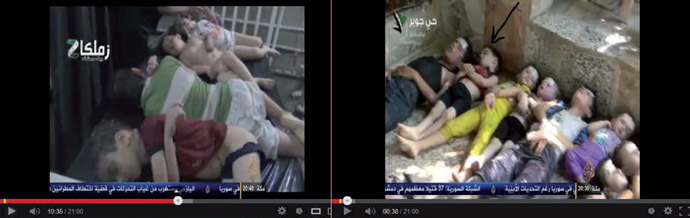
The same little boy in red is in two different locations
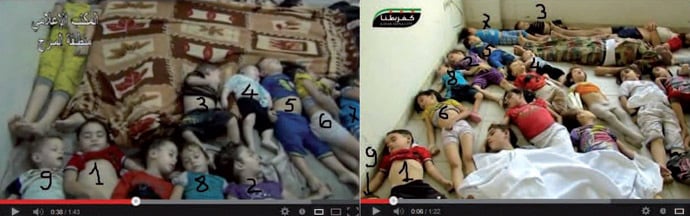
At least nine of these children appear in different footage from different locations
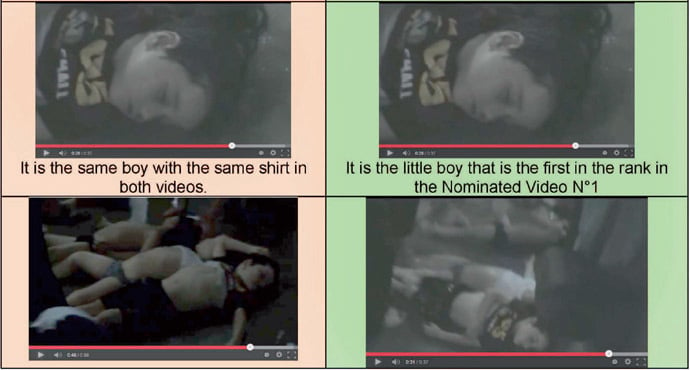
A little boy that appears in two different videos with two different scenarios
Among a series of important findings, the ISTEAMS report notes that even though the attacks are said to have killed up to 1400 people, mostly children appear in the videos and several corpses are shown in different videos said to have been shot in various locations.
While this report seriously challenges the assertion that the Syrian government was behind the attacks, it was not covered by the Western mainstream media, toeing the imperial line and parroting Washington’s claims, which still lack evidence and credibility.
In addition, some controversy arose pertaining to allegations that the rebels were responsible for the attacks and used chemical weapons provided by Saudi intelligence. Dale Gavlak, the co-author of an article containing these allegations, now wants to dissociate herself from the article and is facing threats. Her career is in jeopardy:
The MintPress article, published on 29th August, through interviews with rebels, family members, and villagers in Eastern Ghouta, alleges that elements within the opposition were responsible for the alleged chemical weapons attack on 21st August, and that those chemical munitions had been supplied through Saudi intelligence chief, Prince Bandar bin Sultan…
Dale is under mounting pressure for writing this article by third parties. She notified MintPress editors and myself on August 30th and 31st via email and phone call, that third parties were placing immense amounts of pressure on her over the article and were threatening to end her career over it. She went on to tell us that she believes this third party was under pressure from the head of the Saudi Intelligence Prince Bandar himself, who is alleged in the article of supplying the rebels with chemical weapons.
On August 30th, Dale asked MintPress to remove her name completely from the byline because she stated that her career and reputation was at risk. She continued to say that these third parties were demanding her to disassociate herself from the article or these parties would end her career. On August 31st, I notified Dale through email that I would add a clarification that she was the writer and researcher for the article and that Yahya [Ababneh] was the reporter on the ground, but did let Gavlak know that we would not remove her name as this would violate the ethics of journalism. (Phil Greaves, Syria: Controversy surrounding MintPress Chemical Weapons Ghouta Report)
The information according to which Saudi intelligence was allegedly implicated in the Ghouta chemical attacks was mentioned by a UN official who wished to remain anonymous:
A senior United Nations official who deals directly with Syrian affairs has told Al-Akhbar that the Syrian government had no involvement in the alleged Ghouta chemical weapons attack: “Of course not, he (President Bashar al-Assad) would be committing suicide.”
When asked who he believed was responsible for the use of chemical munitions in Ghouta, the UN official, who would not permit disclosure of his identity, said:“Saudi intelligence was behind the attacks and unfortunately nobody will dare say that.” The official claims that this information was provided by rebels in Ghouta…
The UN official’s accusations mirror statements made earlier this year by another senior UN figure Carla del Ponte, who last May told Swiss TV in the aftermath of alleged CW attacks in Khan al-Asal, Sheik Maqsood and Saraqeb that there were “strong, concrete suspicions but not yet incontrovertible proof,” that rebels had carried out the attack. Del Ponte also observed that UN inspectors had seen no evidence of the Syrian army using chemical weapons, but added that further investigation was necessary. (Sharmine Narwani and Radwan Mortada, Questions Plague UN Syria Report. Who was behind the East Ghouta Chemical Weapons Attack?)
All of the above leads us to believe that this attack was one of the most horrific crimes committed in modern history, a diabolical staged operation which consisted in killing small children, producing fake video footage and photo ops of the corpses, all of which was intended to fabricate a pretext for military intervention under a humanitarian mandate.
The mainstream media which has obfuscated these crimes bear a heavy burden of responsibility. The New York Times has smeared the findings of Mother Agnes and her team, accusing her of “defending the regime” and “playing the Christian card”. The NYT casually dismisses the evidence that the videos are fake. Read the ISTEAMS Report and then judge for yourself.
The war criminals who designed and launched this diabolical staged operation must face justice.
Procedures in the United Nations Security Council directed against the Syrian government must be suspended.
We invite our readers to consult the ISTEAMS Report, as well as the following GR articles and video production: Please share these articles and the ISTEAMS report!
GRTV VIDEO: How the Syrian Chemical Weapons Videos Were StagedBy , September 19, 2013
The Full ISTeam Report The Chemical Attacks in East Ghouta Used to Justify a Military Intervention in Syria, Mother Agnes Mariam and the International Support Team for Mussalaha in Syria (ISTEAMS), Geneva, 15 September 2013 [pdf slow download]
The Chemical Attacks in East Ghouta Used to Justify a Military Intervention in SyriaBy , September 16, 2013
One Nun Puts the US Intel Community to Shame Over “Stage-Managed” Syria Footage By , September 24, 2013
Syria: Fabricating Chemical Lies. Who is Behind the East Ghouta Attacks? By , September 17, 2013
The Sellstrom Report: The United Nations’ Syria Inspector Shills for NATO and Israel By , September 18, 2013
The Syria Chemical Weapons Attack: Human Rights Watch is Manipulating the Facts By , September 24, 2013
Saudi Arabia’s “Chemical Bandar” behind the Chemical Attacks in Syria? By , September 06, 2013
Syria: Controversy surrounding MintPress Chemical Weapons Ghouta Report By , September 22, 2013
Copyright © Julie Lévesque and Prof Michel Chossudovsky, Global Research, 2015
Posted under Fair Use Rules.
Offener Brief von Sahra Wagenknecht an die Bundeskanzlerin: ändern Sie Ihre Politik. Bevor es zu spät ist.
Bild, 10.07.2015
»Hören Sie auf, immer neues Steuergeld zu verbrennen!
BILD veröffentlicht das vollständige Schreiben an Angela Merkel
Von FRANZ SOLMS-LAUBACH
Die Griechen haben geliefert, jetzt ist die EU dran…
Griechenland hat eine neue Reform-Liste vorgelegt und bittet um ein Hilfspaket in Höhe von mehr als 53 Milliarden Euro bis Ende 2018. Die Entscheidung darüber soll jetzt schnell gefällt werden – spätestens bis zum Sonntagabend.
Dadurch wächst auch der Druck auf Bundeskanzlerin Angela Merkel (60, CDU), sich für den Grexit oder für ein Hilfsprogramm für Athen zu entscheiden.
In diese Debatte mischt sich jetzt die stellvertretende Fraktionsvorsitzende der Linkspartei, Sahra Wagenknecht (45), ein.
Sie ergreift in einem offenen Brief an die Bundeskanzlerin, der BILD exklusiv vorliegt, Partei für die griechische Schwesterpartei der Linken und für Syriza-Chef Alexis Tsipras (40).
In ihrem Brandbrief wirft Wagenknecht Kanzlerin Merkel einen eklatanten Rechtsbruch bei der Schulden-Haftung für Griechenland vor.
BILD veröffentlicht das vollständige Schreiben an die Bundeskanzlerin:
„Sehr geehrte Frau Bundeskanzlerin,
Europa ist in schlechter Verfassung. Überall zahlen die fleißigen Normalverdiener die meisten Steuern und die wirklich Reichen drücken sich. Viele Arbeitnehmer können von ihrem Job nicht mehr gut leben. Auch in Deutschland. Nach einem harten Arbeitsleben droht oft eine dürftige Rente. Aber die Vermögen der Millionäre sind hoch wie nie. In ganz Europa haben die Staaten hohe Schulden, weil sie verantwortungslosen Bankern und Spekulanten die Verluste abgenommen haben.
Besonders hoch sind die Schulden des griechischen Staates. Eine korrupte politische Klasse hat sich hier gemeinsam mit griechischen Oligarchen und den internationalen Banken über viele Jahre schamlos bereichert. Besonders seit Einführung des Euro wurde Party gefeiert. Viele kleinere und mittlere Unternehmen dagegen hat die neue Währung, die für Griechenland viel zu hart war, vom Markt gefegt.
2010 war Griechenland pleite. Es war schon damals klar, dass es seine Schulden nicht zurückzahlen kann. Trotzdem haben Sie, Frau Bundeskanzlerin, 2010 die Weichen dafür gestellt, dass Deutschland und die anderen Euroländer die Haftung für die griechischen Schulden übernommen haben. Sie haben damit Banken und Hedge Fonds vor Milliardenverlusten bewahrt. Für die europäischen Steuerzahler dagegen, die nie gefragt wurden, war diese Entscheidung ein fataler Fehler. Es war von vornherein klar, dass ein großer Teil unseres Geldes verloren sein wird. Zusammen mit anderen Abgeordneten der Linken habe ich Sie damals im Bundestag darauf hingewiesen. Sie wollten das nicht hören.
Mittlerweile hat Deutschland in Griechenland über 60 Milliarden Euro im Feuer. Weil Sie, Frau Bundeskanzlerin, ihren Fehler nicht eingestehen wollten, wurden immer neue Kredite vergeben, um Griechenland zu ermöglichen, damit alte Schulden zu bezahlen. So wurde der Schein der Zahlungsfähigkeit aufrechterhalten. Bei einem Unternehmen würde man so etwas Konkursverschleppung nennen. Verbunden wurden die Kredite mit Auflagen, die Griechenland noch tiefer in die Krise geführt haben. Die kleinen Leute haben gelitten, die griechischen Oligarchen wurden noch reicher.
Heute wird in Griechenland 25 Prozent weniger produziert als im Jahr 2010. Es wird nicht mehr investiert, die junge Generation hat keine Perspektive. Obwohl der griechische Staat seine Ausgaben um fast ein Viertel gekürzt hat, mehr als jedes andere europäische Land, sind die Schulden nicht gesunken. Sie sind höher denn je.
Trotzdem wollten Sie, Frau Bundeskanzlerin, vor dem griechischen Referendum noch einmal 15 Milliarden Euro europäischer Steuergelder dafür einsetzen, dass Athen alte Schulden bezahlen kann. Mit neuen Schulden. Ihre einzige Auflage war, dass die griechische Regierung sich verpflichtet, die Politik der letzten Jahre fortzusetzen.
Auch die Steuerzahler in Deutschland können den Griechen dankbar sein, dass sie diesen Vorschlag mit ihrem souveränen „Nein“ vom Tisch gefegt haben. Es ist an der Zeit, dass Sie den Menschen reinen Wein einschenken. Hören Sie auf, immer neues Steuergeld zu verbrennen, um zu verschleiern, dass ein Großteil unseres bereits ausgegebenen Geldes weg ist. Irgendwann kommt die Wahrheit doch auf den Tisch. Je später, desto teurer wird es für uns alle.
Griechenland braucht kein neues „Hilfspaket“, um wieder nur alte Schulden mit neuen Schulden zu bezahlen. Griechenland braucht einen Schuldenschnitt. Es muss zumindest für die nächsten drei bis fünf Jahre von dem Druck befreit werden, Zinsen und Tilgungen zu bezahlen, die es aus eigener Kraft ohnehin nicht zahlen kann. Griechenland braucht auch nicht noch mehr soziale Einschnitte, sondern Investitionen und eine kräftige Vermögensabgabe zulasten seiner Oligarchen. Notwendig ist eine Entflechtung der griechischen Wirtschaft, in der heute etwa 800 steinreiche Familienclans über handfeste Monopole verfügen und die Preise diktieren. Das wären Reformen, die das Land voranbringen würden, aber nicht weitere Rentenkürzungen, Mehrwertsteuererhöhungen und Privatisierungen.
Sie sollten sich erinnern: auch der deutsche Wiederaufbau wurde durch einen großzügigen Schuldenschnitt ermöglicht. Nach dem zweiten Weltkrieg wurden Deutschland zwei Drittel seiner alten Schulden erlassen. Erst dadurch konnte das Wirtschaftswunder durchstarten. Auch bei den Griechen hatten wir damals Schulden, die nie zurückgezahlt wurden.
Frau Bundeskanzlerin, ändern Sie Ihre Politik. Bevor es zu spät ist.
Sahra Wagenknecht“
Posted under Fair Use Rules.

