G20 press conference of Vladimir Putin: ISIS oil convoys “stretching for dozens of kilometers”, ISIS funding from 40 countries including G20

Vladimir Putin answered journalists’ questions after the G20 summit.

Vladimir Putin answered journalists’ questions after the G20 summit.

On ISIS funding:

We have established that financing is coming from 40 countries, including G20 countries. We discussed this issue.

On ISIS oil trade and how easy it is to strike ISIS:

I also showed our colleagues satellite images and aerial photographs that show very clearly the scale of this illegal trade in oil and petroleum products. You see columns of refuelling vehicles stretching for dozens of kilometres in lines so long that from a height of 4,000–5,000 metres they vanish over the horizon. It really looks more like an oil pipeline system.

On Ukraine’s $3 billion debt to Russia:

Our partners from the IMF have been convincing us that we could accept to restructure Ukraine’s debt of $3 billion, which was to have been paid by the end of next month, the end of this year… We were asked to defer this payment of $3 billion to next year. I said that we are ready to accept a deeper restructuring with no payment this year, a payment of $1 billion next year, $1 billion in 2017, and $1 billion in 2018. But our partners are sure that Ukraine’s solvency will grow and that we can be sure of receiving $3 billion next year. If this is the case, they see no risk in providing guarantees for this credit.

We have asked for such guarantees either from the United States government, the European Union, or one of the big international financial institutions. We hope that this matter will be settled by the start of December this year, given the International Monetary Fund’s work timetable.

If our partners are that certain that Ukraine’s solvency will improve, persuade us that this is so, and believe this themselves, let them provide guarantees. If they cannot provide guarantees, this means that they do not believe in the Ukrainian economy’s future. I think this would not be good for them if this is so, and if they are trying to convince us of something that is not in fact the case, this would not be good for our Ukrainian partners either.

We think that this proposal is a realistic possibility and we see no problems in sharing the risks with our partners.

On fighting ISIS, US-led coalition, and Syrian opposition groups:

Question: Mr President, we frequently hear your western partners accuse Russia’s Aerospace Forces of hitting targets in Syria that are not ISIS, but are so-called moderate opposition groups. Did their opinion change over the course of the summit? What were you feeling during the discussions?

And the second part of the question. The US-led anti-ISIS operation did not succeed in degrading ISIS. What difference do you see between Russia’s actions in Syria and those of the US-led coalition, from a military standpoint?

Vladimir Putin: In general, this criticism was practically not voiced. It’s hard to even criticise us. They tell us, “You’re hitting the wrong targets!” Then we say, “Tell us where we should strike, give us the targets!” But they don’t give them to us. “Then tell us where we shouldn’t hit.” And they don’t tell us that, either. How, then, can we be criticised?

You know, I don’t want to sneer at this. Strangely enough, they have their own reasons for it. And one of them, I will tell you point blank, is that they are afraid to give us a list of territories not to strike, because they fear that this is exactly where we will strike, that we will deceive them. It seems they judge us based on their own notions of decency.

But I can confirm that right now (on the battlefield, so to speak), we have established contacts with some (not all, of course) of the uncompromising, even armed Syrian opposition groups; they themselves asked us not to strike the territories they control. We have reached these agreements and are fulfilling them.

Moreover, this part of the armed opposition believes that it is possible to begin active operations against terrorist organisations – against ISIS first of all – with our support from the air. And we are prepared to provide that support. If this happens, it will mean that President al-Assad’s army on one side and the armed opposition on the other are fighting their common enemy. It seems to me that this can become a good foundation for subsequent work and a platform for political settlement.

…now is not the time to assess who is better or worse, or look for reasons why the previous steps have been more or less effective. Right now, we need to look forward and join forces in the fight against this common threat.

The full press conference on November 16 from Kremlin.ru:

President of Russia Vladimir Putin: Good evening, friends, ladies and gentlemen,

Before we start these questions and answers, I want to thank the President of Turkey, Mr Erdogan, and all of our Turkish colleagues for the very professional organisation of the G20 summit. They created a very good, trusting and open atmosphere in which to work and discuss the issues that were the whole point of our getting together.

I want to thank Turkey’s people for their welcoming attitude to our work and the help that we received at practically every step.

Question: It would seem that fighting terrorism was one of the summit’s main subjects of discussion. We know that there will be no resolving this problem unless we take more effective steps to prevent the financing of terrorism. Were any concrete measures discussed at the summit? What was the line of discussion on these measures, and did you reach any agreements?

Continue reading

Vladimir Putin talks to Interfax and Anadalu; Syria, lack of U.S. cooperation, Ukraine, TTP and TTIP

From the Kremlin

In the run-up to the G20 summit, Vladimir Putin gave an interview to Russia’s Interfax news agency and Turkish Anadolu Agency.

November 13, 2015

Question: During the 2008–2009 global financial crisis, the G20 became a popular format, a platform for solving global problems. Do you think that it still plays the same role? What problems that could really be solved in this format rather than in statements or declarations do you think are the most pressing today?

President of Russia Vladimir Putin: The role of the G20 in the global economic and financial governance is becoming increasingly important. Thanks to the decisions made by the G20, we have managed to create conditions not only for coping with the consequences of the 2008‑2009 crisis, but also for enhancing sustainability and transparency of the global financial markets.

However, nowadays, global economy is still unstable and cannot get onto a path towards sustainable and balanced development. In this context, the work that the G20 does is especially needed.

First and foremost, it is necessary to continue improving the international monetary and financial system; to impartially and equally redistribute quotas and voting shares among IMF members in favour of those developing economies that have gained greater weight; to improve the efficiency and legitimacy of the Fund’s activities. Besides, we see more often how politically motivated restrictions are imposed on the entry of sovereign borrowers and companies into the global financial markets. We consider G20 to be the main platform for dialogue on all of these issues.

The reform of international tax rules launched at the G20 Summit in St Petersburg is another important issue. The Base Erosion and Profit Shifting (BEPS) Action Plan should be finally adopted in Antalya. The next step is to introduce in practice the new rules in the G20 countries and beyond.

I would like to highlight such an important achievement made this year by the G20 as the development by our countries of investment strategies, which include specific commitments to encourage domestic demand through investment. Thus, the initiatives launched by Russia during its G20 Presidency have translated into practice.

Question: Western sanctions have substantially challenged Russia’s ability to attract funds from the Western capital markets. In these circumstances the ‘tilt towards the East’ seemed reasonable, however, it feels as though the East itself is reluctant to replace the West as a source of external capital for developing Russian economy. Is this notion right?

Vladimir Putin: Let me stress that Russia pursues multidimensional foreign policy. We seek to have as many equal partners as possible both in the West and in the East.

Russia’s geography and history determines the Asia-Pacific dimension as one of our foreign policy priorities. Therefore, cooperation between Russia and the Asia-Pacific region is a strategic and long-term one. It is worth mentioning that this region is the linchpin of global economy and politics. The Asia-Pacific region accounts for about 60 percent of global GDP, fifty percent of international trade and direct cross-border investment. Obviously, the role of this region in global affairs will be growing and we do take it into account.

As for the restrictive measures imposed against Russia in March 2014, they have, indeed, complicated the process of attracting investments from certain Western markets. Nevertheless, our domestic banking sector proved its resilience to external shocks. We managed to keep Russian stock market attractive. CEOs of the major multinational companies admit that investing in Russia’s economy is promising.

Obviously, cooperation with Asian partners in attracting funds gains special relevance in the current situation. In 2015, approximately 90 percent of investments in the Russian market came from Asia. Several large Russian enterprises are financed by China and we analyse the prospects of public borrowings from China. International investment mechanisms have been developed – the New Development Bank BRICS and Asian Infrastructure Investment Bank, each with an authorised capital of $100 billion. Pooled funds and investment platforms have been created with China, India, South Korea and the Gulf states to channel foreign investments into the real sector of Russia’s economy.

In order to strengthen our cooperation, we are streamlining taxation of profits from project financing in Russia and also propose new promising initiatives. Many opportunities for cooperation are now available under our programmes for developing Siberia and the Far East, which have been presented, among other things, in September 2015 at the first Eastern Economic Forum in Vladivostok, including the creation of Priority Development Areas (PDAs) and a free port in Vladivostok that would enjoy preferential tax and administrative regimes, modernisation of the Trans-Siberian and the Baikal-Amur mainline railways, the revival of the Northern Sea Route, and building the Power of Siberia pipeline.

Question: Did you expect such unanimous negative reaction in the West, in particular, the NATO countries, some of which are major Russian partners, to the start of the Russian Aerospace Forces’ operation in Syria, and is it possible that the Western partners’ negative reaction would affect the time frame of Russia’s military operation in Syria? Is there any risk that Russia could be dragged into a long-term conflict in Syria and how much will the costs of carrying out this operation affect the Russian Federation budget, which has been already cut?

Vladimir Putin: We officially informed the US and NATO leadership of the start of military actions in a reasonable time.

We hoped at least for the natural in such cases close military and expert coordination with the US‑led Global Coalition to Counter ISIL, even taking into account all the fundamental differences between the Russian and US approaches to the Syrian crisis.

However, the reaction of the United States and Western partners was quite restrained, although it would seem obvious that ISIL and other similar extremist groups operating in Syria represent a clear common threat to our countries.

We still have not managed to go beyond the joint approval of the Memorandum of Understanding on Prevention of Flight Safety Incidents in the Course of Operations in Syria, and even then with a reservation by the US that by no means such interaction should be regarded as the normalisation of military contacts, which were frozen on the US initiative.

The United States has been also reluctant to respond positively to our proposal to sign a special agreement for the rescue of military aircraft crews, notwithstanding the fact that at the time when the US operation in Afghanistan started, we immediately responded to their similar request.

Neither have we received any response to our request to provide Russia with relevant US intelligence data for planning operations of our Russian Aerospace Forces in Syria, although we have repeatedly asked the United States for such information.

However, in the course of our activities, we are ready to take into account any reliable information on the location of terrorist groups. We have even worked together with the Free Syrian Army (FSA). The Russian aviation has conducted several strikes on the targets identified by the FSA. We excluded areas, which had been indicated by FSA commanders as being under their control. By the way, this fact proves once again that we are not bombing the so‑called moderate opposition or the civilian population.

We are ready to cooperate with Washington despite the fact that the US operations in Syria are in violation of international law – without the resolution of the UN Security Council, without the request from the official Syrian government.

As for the time frame of the operation in Syria, a clear objective is set before the Russian forces – they should provide air support for the Syrian army’s offensive against the terrorists, that is why the duration of stay of our servicemen will be determined solely depending on the time this objective is achieved.

And the last thing. Our activities in Syria as well as potential risks and consequences have been carefully calculated many times, and all the resources needed for the operation, both financial and technological, have been allocated in advance.

Question: At the G20 meetings with the Western leaders the settlement of the situation in Southeast Ukraine might be touched upon along with other issues. Taking into account the decision of the DPR (Donetsk People’s Republic) and LPR (Lugansk People’s Republic) to put off local elections until 2016, does it mean that the implementation of other items of the Minsk Agreements would be automatically prolonged as well? Are you concerned that procrastination in implementing the Minsk Agreements could bring about another frozen conflict close to Russian borders similar to the Transnistrian issue? You have repeatedly mentioned that Kiev does not comply with the Minsk Agreements, including its economic part. Does it mean that Russia is now actually responsible for supporting Donbass?

Vladimir Putin: The decision of Donetsk and Lugansk to put off the local elections until next year is a last-choice measure. They could have been held this year, had Kiev fulfilled strictly the Minsk Agreements of February 12 and agreed with the DPR and LPR on organising the elections, and also enacted the Law on the special status of Donbass in its original form.

Now, when a ceasefire in the region has finally been established, it is important that the parties to the conflict start looking for the points of contact together so that they can move on towards their common goal. They need to learn to listen to each other and hear each other. Compromise solutions depend on this.

Given the fact that the hostilities have ceased and cases of shelling are rare, it is unclear why would the US Congress adopt resolutions making it possible to provide Ukraine with lethal weapons. The question arises as to whether there is a desire to spark a war or provoke hostilities.

I would not overdramatize the delay in implementing the Minsk Agreements. Despite some difficulties, they are being implemented and, which is most important, their provisions, principles and logic are not questioned. We are talking simply about technical prolongation of the time frame.

However, the threat of Donbass turning into another frozen conflict is still there. It stems from Kiev’s policy, which continues to strengthen the blockade of the Southeast and has stopped the supply of food and money there. Kiev has eliminated the banking system there and is blocking exports.

I would like to recall that, during the talks as far back as in September 2014, the parties to the conflict agreed not only on a ceasefire, but also on the steps to restore livelihoods in the region. It was fixed that a programme for economic revival of Donbass should be adopted. This issue was discussed last February in Minsk, where our partners from the Normandy Four group – Germany and France – agreed to provide technical assistance in the recovery of the banking and financial infrastructure in the conflict-affected areas.

It is fair to say that there is certain progress. The parties restored railway communication, making it possible now to deliver Donbass coal to other regions of Ukraine. Works are underway to restore energy supply. Ways to restore water supply are also being analysed.

Russia, for its part, continues to support Donbass, which is in a difficult humanitarian situation. Since August 2014, more than 50,000 tonnes of humanitarian aid has been delivered there. First of all, we think about people that were abandoned by Kiev authorities and put to the brink of survival. It is our duty to provide them with the necessary assistance.

Question: The US and the EU have imposed sanctions against Russia. But despite Western countries’ criticism, Turkey continues to maintain its economic and political ties with Moscow. In this context, what future do you see for Russian-Turkish relations? To what extent do the differences on the Syrian issue affect the bilateral relations?

Vladimir Putin: While the US and the European Union unilaterally introduced sanctions, Turkey took an independent stand. Such an independent policy pursued by Ankara to meet its national foreign policy interests deserves great respect.

Such a pragmatic approach opens up new horizons for the development of Russian-Turkish relations – first of all, their business dimension. Turkey is our major partner in foreign economic collaboration. Last year our bilateral trade exceeded $31 billion. We have been building up industrial cooperation by implementing major projects in construction, light industry, metallurgy and agriculture. We focus primarily on such knowledge-intensive and hi-tech industries as energy – including nuclear power – and telecommunications. Tourism is another important field of collaboration. Last year over 3.3 million Russian citizens visited Turkish resorts. But generally, the potential for our trade and economic interaction is far from being fully unlocked.

It is true that the two countries have different views on the ways to resolve the crisis in Syria. But the important thing is that Russia and Turkey share the same priorities – we both stand for settling the situation in the region and effectively combating terrorism. With this in mind, the existing differences should not hamper our bilateral relations. On the contrary, in looking for the common ground, we draw upon vast experience of constructive cooperation between our countries.

Question: Last December, you made a state visit to Turkey during which, among other things, the launch of the TurkStream project was announced. Since then, no progress in its implementation has been observed, and there has also been certain information that the pipeline capacity would be halved and only two instead of four strings would be built. What are the reasons behind the project’s downsizing? Does it have anything to do with some serious political discords between Russia and Turkey, or is it for economic reasons alone?

Vladimir Putin: I cannot agree with your opinion that the TurkStream is slowing down. Such a large-scale project cannot be developed and agreed overnight. There are many legal, technical and economic, technological and organisational issues – including the number of the pipeline strings taking into account the actual need in gas acquisition and pumping volumes – which we have to decide together with our Turkish colleagues. The better we resolve these issues, the faster and with fewer risks and resources we will be able to implement our plans and ensure an uninterrupted delivery of Russian gas directly to Turkish consumers. The main thing is that this project is fully in the interests of both Russia and Turkey. We are one on this with my Turkish colleague Recep Tayyip Erdogan.

We passed our ideas on the bilateral intergovernmental agreement, which should provide legal basis for project implementation, to the Turkish side last July. We expect that the new Turkish government would be able to organise work on the key aspects of the above-mentioned agreement in a short period of time.

The pace of the negotiation process has been definitely affected by the political situation on the eve of the elections in Turkey. We understood that and did not force the events.

It is known that the EU and Bulgaria torpedoed the implementation of the South Stream and did not let us implement this project. Though it was clearly in the interests of Bulgaria and the entire southern Europe. The TurkStream would make it possible to deliver the Russian natural gas to the border between Turkey and Greece, virtually to the border of the EU. European consumers would be able to buy it there. But the countries that refused to take part in constructing the new pipeline would have to count lost profits.

I would like to note that we will continue to be a strategic and reliable energy supplier to Turkey and Europe, and that we have everything necessary for this.

Question: On Syria, Russia maintains that only the Syrian people can determine the future of Syria and Bashar al‑Assad. Which road map does Russia propose to settle the Syrian crisis? How do you see the future of that country? Was the resignation of Bashar al‑Assad from the post of president discussed at the meeting in Moscow? Did you make an arrangement with the United States to launch the operation in Syria?

Besides, Western countries have repeatedly accused Russia that the aircraft of its Aerospace Forces bomb not only the Islamic State and Jabhat al‑Nusra but also other groups in Syria. Do you think that all armed groups currently fighting in Syria against al-Assad’s army are terrorists?

Vladimir Putin: Indeed, from the very outset we have insisted, and we still insist today, that it is the Syrian people who should determine its future. It is good to know that at the Vienna talks on Syria on October 30, foreign ministers of seventeen states and representatives of the United Nations and the European Union supported this approach and expressed it in their final statement as their collective opinion.

As for the elaboration of a detailed road map to settle the conflict in Syria, that is not our task. The map should be developed and adopted by the Syrians themselves. Yet, we have a few ideas about how external forces could help the Syrians to defeat the terrorists and resolve the crisis. At present, the Russian diplomacy is actively advancing these proposals. They are not a dogma; rather they encourage the partners to continue a serious dialogue. Its constructive nature would to a large extent determine how successful we would be in translating the proposals into decisive joint actions which would help defeat ISIL and restore Syria as a unified, sovereign and secular state, create safe living conditions for everyone regardless of their ethnicity or faith, and open prospects for social and economic revival of the country. Let me repeat it once again – only the Syrians themselves should choose their future and their government leaders.

We were guided by this very logic – the logic of international law – when receiving Syrian President Bashar al‑Assad in Moscow. Let’s think how legitimate or ethical would it be if we invited the leader of a friendly state to Moscow and demanded him/her to resign? Syria is a sovereign country and Bashar al‑Assad is its President elected by the people. So do we have any right to discuss such issues with him? Of course, we do not. Only those who believe in their exceptionality allow themselves to act in such a shameless manner and impose their will on others.

It is based on the official request from the Syrian government that Russia is carrying out a military operation involving its Aerospace Forces in Syria. Let me repeat once again that the main purpose of this operation is not to support President al-Assad but to fight international terrorism. They are constantly trying to accuse us of bombing the so-called ‘moderate’ opposition but no evidence was provided so far. Moreover, we are already cooperating with that ‘moderate’ opposition, including the Free Syrian Army (FSA). The Russian aviation has attacked several targets indicated by the FSA.

To make the fight against terrorism more effective, the global community needs to develop a common framework as to whom to consider terrorists. It is not about the name of an organisation, which can seem quite ‘innocent,’ it is about whether it uses terrorist methods. So we need to compile a single list of extremist organisations. And Russia has already submitted its suggestions on this account – this was done during the Vienna meeting of the Syrian Support Group.

Question: It is expected that there would be a discussion on combating international terrorism at the G20 Summit under the Turkish Presidency. What do you think of the Turkish Presidency in the G20? What are you planning to put on the Antalya Summit agenda? Has the schedule of bilateral meetings on the sidelines of the G20 Summit been set?

Vladimir Putin: Indeed, at the proposal of the Turkish Presidency, the fight against terrorism and the problem of refugees will be discussed at the G20 Summit. This is not surprising. In our opinion, there is a direct relationship between these issues and the Summit’s agenda. Sustainable development, economic growth, global trade expansion, investments, and employment greatly depend on how successful the international community is in responding to today’s most urgent challenge – terrorism, and the problem of refugees that stems from chaos and violence. Hundreds of thousands of refugees are already in Europe and other countries, who are trying to save their lives and the lives of their close ones, and still more are on their way.

I am sure that the coming discussion would contribute to the practical solution of these issues and would be backed by a final document reflecting our common approaches to combating terrorism and resolving the refugee crisis.

As for the work of the Summit itself, we propose focusing the G20 on tackling major financial and economic problems, for example, measures for sustainable and balanced economic growth, and strengthening the stability of the financial system.

At the Summit, we will discuss the implementation of what our countries endorsed last year – the Growth Strategies and Country Employment Plans, the reform of international tax rules and promoting investments and decisions on financial regulation.

I expect that in Antalya we will manage to substantively discuss the future of the world trade and existing mechanisms of multilateral trade and economic cooperation. We will exchange our views on the prospects of creating closed integration associations in the Asia-Pacific region and in the Atlantic (I mean the Trans‑Pacific Partnership – on October 5, 2015, it was announced that the agreement was reached, 12 countries participate in the Partnership – Australia, Brunei, Vietnam, Canada, Chile, Japan, Malaysia, Mexico, New Zealand, Peru, Singapore, the United States – and the Transatlantic Trade and Investment Partnership that is a proposed agreement between the European Union and the United States). We are concerned that the process of their creation is not transparent for business circles and for the public both in the member states and in their economic partners. It is in our common interests to make sure that these associations indeed supplement the multilateral trade system, work for the development of all economies in the world and do not produce new barriers and risks.

We have high expectations for the WTO Ministerial Conference that will take place in Nairobi in December. We hope that it will contribute to the strengthening of the multilateral trade system and propose concrete steps to finalise the Doha Round of trade negotiations.

We will focus our attention on sustainable development, as well as climate change. The UN summit for the adoption of the post‑2015 development agenda has recently finished in New York. Now, the world is looking forward to the UN Climate Change Conference that will be held in Paris in December 2015 and, hopefully, a new agreement on climate will be adopted.

On the whole, we are satisfied with the Turkish G20 Presidency which managed to preserve the succession in complying with the decisions taken at the G20 summits in Saint-Petersburg and Brisbane, add new ideas to the current agenda, including establishing the Women‑20 and launching the World SME Forum.

The first G20 Energy Ministers Meeting in the history of the G20 has become an important Turkish initiative. At the meeting, the ministers discussed access to modern energy in Sub-Saharan Africa, improved energy efficiency and development of renewable energy sources, and most importantly, promotion of investments into energy infrastructure development and introduction of clean technology.

As for the schedule of bilateral meetings, it is now being formed. I intend to meet with the President of the People’s Republic of China, presidents of Turkey, the Republic of South Africa and Argentina, the prime ministers of the United Kingdom, Italy and Japan. Before the start of the G20 Antalya Summit, we will traditionally hold an informal meeting of the BRICS leaders where Russia currently holds chair. We will compare notes on the key issues of the G20 agenda and important international and regional problems.

http://en.kremlin.ru/events/president/news/50682

Nato-Front bröckelt: Slowakei begrüßt Russland-Intervention in Syrien

Deutsche Wirtschafts Nachrichten  | 

Die russische Intervention in Syrien hat nun auch zu einem Riss in der Nato geführt: Mit der Slowakei stellt sich erstmals ein Nato-Staat an die Seite der Russen. Außenminister Steinmeier versucht unterdessen, den Iran und Saudi-Arabien an einen Tisch zu bekommen, um eine diplomatische Lösung voranzubringen.  

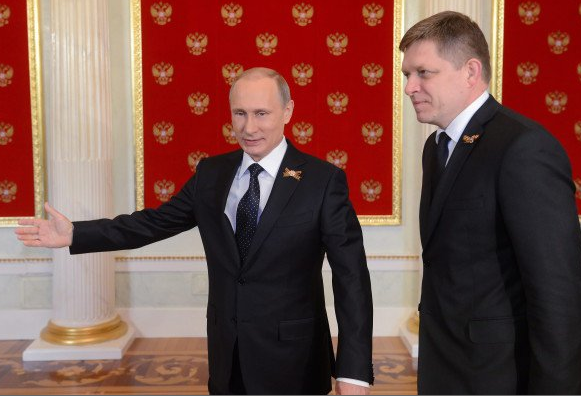
Der russische Präsident Wladimir Putin mit dem slowakischen Premier Robert Fico, Moskau im Mai 2015. (Foto: EPA/RIA NOVOSTI POOL)

Der Ministerpräsident des Nato-Mitgliedslandes Slowakei, Robert Fico, lehnt das russische Eingreifen in den Syrien-Konflikt nicht grundsätzlich ab. «Ob nun ein amerikanischer Angriff auf Ziele des Islamischen Staates oder ein russischer Angriff erfolgreich ist, in beiden Fällen gilt das gleiche», sagte der Sozialdemokrat am Samstag im slowakischen Rundfunk. Er habe keine ideologischen Scheuklappen. Nach Ansicht Ficos ist zur Lösung des Konflikts in dem Land zudem eine Einbeziehung des langjährigen Machthabers Baschar al-Assad nötig.

Russland setzte am Wochenende seine Luftangriffen gegen die IS fort. «Erstens verteidigen wir unsere nationalen Interessen, und zweitens haben wir die Zustimmung der örtlichen Führung», sagte Regierungschef Dmitri Medwedew in einem Interview des russischen Staatsfernsehens. Medwedew ging auch leicht auf Distanz zu Präsident Assad: «Er ist der legitime Präsident, aber wir kämpfen dort nicht für einen bestimmten Politiker. Wer Syrien führt, soll das Volk entscheiden», sagte er in dem am Samstag ausgestrahlten Gespräch. Die Russen haben bereits zu Beginn ihrer Militärschläge gesagt, dass sie Assad nicht um jeden Preis stützen wollen. Sie lehnen jedoch das völkerrechtswidrige Ansinnen ab, ein gewähltes Staatsoberhaupt durch militärische Gewalt von außen zu stürzen.

Dem Verteidigungsministerium in Moskau zufolge flog die russische Luftwaffe innerhalb von 24 Stunden rund 40 neue Angriffe in Syrien. «Dabei wurden 49 Ziele von Terroristen zerstört», sagte Generalmajor Igor Konaschenkow. Die Terrormiliz Islamischer Staat (IS) habe wegen der Bombardements ihre Taktik geändert und «dezentralisiere» nun Munitionslager und Kommandostellen. Die Kampfjets hätten trotzdem zahlreiche Stellungen entdeckt und vernichtet, meinte Konaschenkow.

Außenminister Frank-Walter Steinmeier hat den Iran zur Mitwirkung bei den Bemühungen um ein Ende des Syrien-Kriegs aufgefordert. «Mein Wunsch ist, dass der Iran seinen Einfluss in der Regierung und auf Assad und seine Umgebung nutzt, damit wir erste Schritte hin zu einer Deeskalation in Syrien gehen», sagte Steinmeier am Samstag bei einem Besuch in Teheran.

Alle Versuche, das Land zusammen mit anderen Regionalmächten wie die Türkei und Saudi-Arabien zu Syrien-Friedensgesprächen zu bewegen, hatten bislang keinen Erfolg. Am Sonntag will Steinmeier nach Saudi-Arabien weiterreisen, dem wichtigsten Gegenspieler des Irans in der Region. Parallel dazu reist Bundeskanzlerin Angela Merkel in die Türkei.

Irans Außenminister Mohammed Dschawad Sarif zeigte sich für eine Mitwirkung bei der Suche nach einer Friedenslösung für Syrien grundsätzlich offen. Sein Land sei zu einer «konstruktiven Rolle» und auch zu Gesprächen mit allen Nachbarn bereit.

Steinmeier appellierte an beide, die bisherige Sprachlosigkeit zu überwinden: «Jeder Akteur in der Region hat eine Verantwortung, die über das nationale Interesse hinaus geht. Diese Verantwortung ist wichtiger als Ehrgeiz und nationaler Stolz.»

Mit Blick auf Irans Rolle in Syrien sagte Steinmeier: «Es ist kein Geheimnis, dass unsere Position nicht in jeder Hinsicht deckungsgleich sind. Aber wir haben ein gemeinsames Interesse daran, dass das Morden ein Ende findet und dass Syrien als Staat erhalten bleibt.» Sarif sagte zu Assads Zukunft, in der Vergangenheit habe man sich zu sehr auf das Schicksal von «Individuen» konzentriert. Besser wäre es jedoch, sich um den Erhalt der staatlichen Institutionen zu kümmern. «Das Volk wird entscheiden, wer in Syrien am Anfang sein wird und wer am Ende.»

http://deutsche-wirtschafts-nachrichten.de/2015/10/18/nato-front-broeckelt-slowakei-begruesst-russland-intervention-in-syrien/

Posted under Fair Use Rules.

NATO front crumbles: Slovakia welcomes Russian intervention in Syria

From Fort Russ

Russian President Putin with Slovak Premier Fico in Moscow
Fico’s view: it is necessary to include Bashar al Assad to resolve the conflict in Syria

Deutsche Wirtschafts Nachrichten
October 18, 2015
Translated from German by Tom Winter

The Russian intervention in Syria has now led to a rift in NATO with Slovakia becoming the first NATO country to side with the Russians. German Foreign Minister Steinmeier, meanwhile, tries to get Iran and Saudi Arabia to the table to promote a diplomatic solution.

But the Prime Minister of NATO member country Slovakia, Robert Fico, is not wedded to the Russian intervention in principle: “Whether an American attack or a Russian attack on ISIS targets is now successful, in either case it counts the same,” the Social Democrat said Saturday on Slovak Radio. He has no ideological blinkers. According to Fico’s view it is necessary to include longtime ruler Bashar al Assad to resolve the conflict in the country.

Russia continued its airstrikes against ISIS through the weekend. “First, we are defending our national interests, and second, we have the approval of the local leadership,” said Prime Minister Dmitry Medvedev in an interview with Russian state television.

Medvedev also slightly distanced himself from President Assad: “He is the legitimate president, but we aren’t fighting there for a particular politician. Who leads Syria — the people should decide,” he said in the interview broadcast on Saturday.

The Russians have already said at the beginning of their military strikes that they do not intendf to support Assad no matter what. However, they reject the overthrow of an elected head of state by military force from outside, as a breach of International Law.

According to the Defense Ministry in Moscow the Russian Air Force flew about 40 new attacks in Syria in 24 hours. “…in which 49 terrorist targets were destroyed,” said Major General Igor Konaschenkov.

The terrorist militia Islamic State (IS) have changed their tactics because of the bombing and are now having to decentralize ammunition dumps and command posts. The fighter jets discovered and destroyed several positions anyway, said Konaschenkov.

Foreign Minister Frank-Walter Steinmeier called on Iran to cooperate in the efforts to end the war in Syria. “My desire is that Iran use its influence on the government, and on Assad and his circle so we can take the first steps towards a de-escalation in Syria,” Steinmeier said on Saturday during a visit to Tehran.

All attempts to move Iran, along with other regional powers such as Turkey and Saudi Arabia, to Syrian peace talks, so far have been fruitless. On Sunday, Steinmeier will travel to Saudi Arabia, the main opponent of Iran in the region. At the same time German Chancellor Angela Merkel travels to Turkey.

Iranian Foreign Minister Mohammad Javad Zarif showed himself to be open, in principle, to participation in the search for a peaceful solution for Syria. His country was ready for a “constructive role” and also to hold talks with all its neighbors.

Steinmeier appealed to both to overcome the previous lack of discussion: “Every player in the region has a responsibility that goes beyond the national interest. This responsibility is more important than ambition and national pride. “

With a view to Iran’s role in Syria Steinmeier said: “It’s no secret that our position is not congruent in all respects. But we have a common interest in ensuring that the killing comes to an end and that Syria will remain as a state.” Zarif said that when it comes to Assad’s future, in the past we have focused too much on the fate of individuals. It would be better to take care of the preservation of the state institutions. “The people in Syria will decide who will be there at the beginning and who at the end.”

Your translator cannot resist a comment on Steinmeier’s assertion that Syria remain as a state: unlike some governments, Germany is thinking ahead realizing what will happen if the “rebels” win.

Putin: U.S. accuses Russia, yet stonewalls requests for information; some Western ‘partners’ have ‘mush for brains’

From Kremlin.ru
Vladimir Putin took part in the 7th Russia Calling! Investment Forum organised by VTB Capital.
October 13, 2015

Excerpt [the transcript is somewhat different than the on-video translation; also, there were additional questions to and answers from President Putin on Syria and Ukraine, but they are not yet transcribed]:

This excerpt starts at approx. 45:23 on the video.

Question [from Geoff Cutmore, CNBC]: Over the weekend, US President Obama called into question your leadership over Syria. He said that you are propping up an ally rather than going after ISIS. He also said you are running down the economy here. Can I ask you, how do you respond to President Obama’s comments and what would you say to international investors who are dissuaded from putting money into the Russian economy because of such remarks? Thank you.

Vladimir Putin: You know, as we say in Russia, everything has been thrown into one pile. What does the situation with ISIS in Syria have to do with investments in Russia? Although, of course, everything in the world is interconnected. There is no direct connection, but ultimately, of course, everything is interconnected.

First of all, I do not want to debate with anyone right now, but I will note that we are not striving for some sort of leadership in Syria. There can only be one leader in Syria: the Syrian people. We strive to make our input in the fight against terrorism, which is dangerous for the United States, Russia, European nations and the entire world, without any exceptions.

I will point out that all our actions, as I have said before, are in strict compliance with the UN Charter and international law – unlike our colleagues from the so-called international coalition led by the United States, which is acting without UN Security Council resolutions and without invitation by the Syrian authorities. Over this time (operations by international forces headed by the United States – or if we put it simply, the actions by the US – have been underway by over a year), they have engaged 11 nations in bombing, with over 500 strikes on Syrian territory, spending half a billion dollars, and that’s only officially, to train Free Syrian Army fighters to fight against ISIS. We know the result: there is none, there’s no result.

Now, it has been reported that the Free Syrian Army is being supplied with ammunition via aircraft. Where is this Free Syrian Army? If they simply discharge or dump the ammunition and weaponry somewhere from the air, how can we know that it won’t all get into the hands of ISIS, as this happened during training of the Free Syrian Army personnel and arming it – what are the guarantees? After all, this was just done, this just happened, and just now, the United States admitted that the action failed. And now, they are simply throwing ammunition somewhere. To whom? This is not a rhetorical question.

Now, we often hear that our pilots are bombing the wrong targets, not ISIS. First of all, we briefed US leadership in advance, although the United States has never done this. We were the first to do this out of respect and a desire to establish a working relationship. Now they tell us, “No, first, we are not ready to cooperate with you, and second, you are bombing the wrong targets.” We said at the military level, appealed and asked, “Give us the targets that you are 100% certain to be terrorists.” The replied, “No, we are not ready to do that.” So then, we thought about it and asked another question: “Then tell us, where shouldn’t we be bombing?” No response there either. So then, what should we be doing? This is no joke, I did not make this up, this is what happened. Just recently, we said to the Americans, “Tell us the facilities we should strike.” There was no response. How can we work jointly then? Do you have an answer? I don’t have one either, yet.

I think that some of our partners are simply confused [translated elsewhere as “have mush for brains” (1)] and do not have a clear understanding of what is really happening on the ground, nor what goals they want to achieve. But we will insistently work to ensure that the efforts in the fight against international terrorism are joint efforts, and the result is clear, expected, and aimed at fighting international terror, to eliminate this threat for all of us.

As for investments, as I already said, I do not feel the two are related, but when I was just telling you about how these events occurred; I had said from the very beginning that nobody ever warned against such actions. Whereas we did. This speaks to the fact that we want to work together, and whoever wants to work with us in the spheres of security, counter-terrorism and economics is welcome.

The theme of the plenary session was “Building Long-term Cooperation and Developing Opportunities for Economic Growth.” The discussion focused on ways of adapting the Russian economy to the changing macroeconomic conditions that open up new opportunities for strengthening the Eurasian Economic Union and creating strategic integrational projects within the framework of the Silk Route Economic Belt, as well as other issues of importance for the Russian and global economies.

The video url is http://static.kremlin.ru/media/events/video/en/video_low/hekWYcaE4JaSJfMEmRXMBOptiqMOd6K7.mp4

http://en.kremlin.ru/events/president/news/50498

(1) http://www.newsmax.com/Newsfront/putin-syria-mush-brains/2015/10/13/id/695942/

Sukhois obliterate Daesh command centers; Western press in a frenzy

Screen grab from video released by Russian Ministry of Defense
Even faced with the Islamic State, the West would rather lose Syria and other countries of the region rather than support the pro-Assad policy of Moscow.
 
In Novorossia Today
October 3, 2015
Translated from French by Tom Winter
 
Russian roulette in Syria: Putin plans six moves ahead.
[Your translator would have written Russian CHESS in Syria…]
Even faced with the Islamic State, the West would rather lose Syria and other countries of the region rather than support the pro-Assad policy of Moscow.
These last days, the Russians have managed to surprise the Americans three times over. First, in upping their military support to the regime of Bashar Al-Assad. Next when they opened a coordination center jointly with Russia, Syria, Iran and Iraq in Bagdad, for sorting out the assignments for the four countries. The last and the biggest surprise was what the Americans have called “pouring gas on the fire,” when Moscow launched air operations against the jihadists in Syria, notifying Washington one hour in advance of the strikes.
A more or less lucid examination of the mid-eastern context, with the Shia-Sunni Israeli-Paestinian tensions, would have shown that betwixt two evils, Russia has chosen the lesser.
Either Russia would have left Da’esh to propagate itself beyond the Mid-east; for, once the Syrian regime had fallen the Jihadists would be in Russia and in post- soviet countries, obliging Moscow to get involved in land operations even in the heart of the country, with all the consequences that would ensue. Or Russia aids the legitimate government of Assad by equipping the Syrian troops on the ground, and bombarding the Da’esh positions.
 
The success of the Russian strikes are undeniable. Since September 30, an Islamic State command center has been obliterated in the Aleppo province and another one in the town of Raqa, while the one American strike did in — two excavators.
The polemics keep on swelling around the effectiveness of the actions of the coalition of 62 countries … Myriam Benraad, a specialist in Middle East, researcher at Sciences Po in Paris [with a doctorate in political science], gave us her view of the conflict that is again becoming more international: “The Middle East is a trap for all who set foot there. It is a quagmire, a powder keg. My essential hope for the Russian engagement in Syria is that it may revive much more serious negotiations between Russia, the United States, and the other actors in the region to decide the fate of Assad and what can get put back together in political terms. At the time of the Gulf War, the Russians and Americans were closely coordinated to respond multilaterally around the Iraqi crisis. These US-Soviet agreements of the time, in the period of the cold war, were aimed at giving birth to a collective security managed by the UN, but were betrayed by the Americans (for the war in Iraq, 2003 and Libya in 2011).
“The Russian involvement in Syria is a response to unilateralism. It’s obvious. Sergei Lavrov has said it a few times over. And Americans are paying the price. Other countries, such as Venezuela, have raised their voice, saying that the United States cannot keep on behaving as they have been doing over the past 25 years. I think those Russian-US tensions, with the Ukrainian crisis behind, can finally result in a dialogue between Washington and Moscow. “
Meanwhile, the Russian Air Force had scarcely gotten the order from president Vladimir Putin to attack the terrorists in Syria when the western press fell into an inquisitorial frenzy. Accusing Russia of “flying to the aid of her ally Assad on the pretext of fighting terrorism” the big western media have spread out their choir of photos and videos showing Syrian victims among the civilians. But these men, women and infants covered in blood that denounce the “ferocious Russians” are nothing but fakes. The photos were taken September 28 (See above). With scarce a smile, and steel nerves, the Russian foreign minister Sergei Lavrov condemned the information war and underlined that its releases were premeditated.
The scandal was, moreover, far from unhorsing the Americans whose positions in the Middle East seem undermined by Moscow. Washington has asked the Iraqi authorities not to send the information that the United States communicates to Baghdad to “third countries” — namely Russia.
Why put a spoke in the wheel for the Sukhoi planes in Syria when the chairman of the US General Staff is prepared to cooperate tactically with Russian forces? And now Moscow could initiate air strikes against the Islamic State in Iraq, if the authorities of that country so request. A low blow for the US, the UK, France, Germany, Qatar, Saudi Arabia and Turkey, who respond with a joint statement calling on Russia to stop air strikes … One more proof that Vladimir Putin is on track …
Comment: What a lot must be at stake for the U.S. and allies, that they are so focused on eliminating Assad and installing a “friendly” regime.

Starikov: Russia is forcing the Americans to destroy their own project in its infancy

From Fort Russ

September 30, 2015
Translated by Kristina Rus

Russian author, historian and politician Nikolay Starikov explains what happened today like no one else at today’s meeting with fans and supporters. 

Starikov:

Even cats don’t get born on their own and such high-profile terrorist organisations, packaged with beautiful Hollywood promos don’t appear on their own. Of course, it is a project, the same project of the global banking elite. as once was Adolf Hitler, and before that where the Bolsheviks-Trotskyists, who have destroyed the Russian empire and were going to crush the neighboring states.

Islamic state is a can opener in the hands of the global elite, with which it was planning to destroy the world order, as it is.

You know, often when we talk about WWII, a question comes to mind, why did the English have to bring Hitler to power, if they were the strongest ones? Well, in order to be the strongest, you must destroy your competition. And Hitler was brought to power in order to destroy the USSR, which not only grew economically, but presented an alternative of a social order, which was a death sentence.   

Lets remember the post-war USSR, when there was a constant dropping of prices which completely contradicts the market economy. Stalin did it, And did it yearly. And he would strangle this financially oriented economy with his price drops. It had to be prevented. This was Hitler’s task. 

Today’s Islamic State is a tool to prevent the growth of China, Russia, and Europe getting out of control. 

A big war is needed. Chaos is needed. It will help solve the problem of dropping consumption in the entire world.

War is needed for many reasons. Americans create the Islamic state. 

Note, two years ago no one knew about this Islamic state. There was Al Qaida  and Syrian opposition. Remember the Free Syrian Army, where is it today? Is it so free, that it has dissipated on its own?

Imagine, you have the Bandera “Forest brothers” in the woods, and suddenly they self-organize in the woods and become “The Red Guard.” It is impossible. Either they are the “Forest brothers” or the “Red Guard”.  They can be one thing or the other. One cannot transform into the other on its own. 

In order to create this instrument of destroying the world order you must destroy statehood. 

First the destruction of states is a standard path of the global banking elite, which I am writing about in my book “Power”.

Second, how can you create this force, if you have states everywhere? You have the states of Iraq and Syria. You cannot create 100 thousand militants on the territory of Iraq. Therefore you have to get rid of the Iraqi state. Either it has to be completely absent as in Lybia, or be nominal, occupying two blocks in Baghdad. It is weakened and destroyed.

And here is Syria. It also has to be destroyed, but it doesn’t surrender. This is where the hate towards Assad comes from. This is why they keep repeating, Assad must go – in order to destroy the state.

Instead they create a quazi-state structure, which they pump with money and weapons and sent it towards Afghanistan. By the way there is fighting going on right now for Kunduz, which is on the border with Tajikistahn. They are preparing a bridgehead for the invasion. Everything is going according to plan. 

They have to finish off Assad.

100 thousand fled to Europe, and how many refugees are in the camps?  A few million. If they cannot get to Europe, where will they go? You can hire them for cheap into your army, for example ISIS. People have no options, the infrastructure has been destroyed, there is nowhere to live, and here you are offered a salary!

This mess they want to send through Afghanistan to Central Asia. To destroy the Central Asian states. Which I and many others wrote about several years ago.

Further they will strike Russia and China.

Today several thousand Uighur militants are fighting for ISIS. This is the force that will be blowing up China.

You have to understand the logic of the Unites States. They gave birth to this instrument, but they need to let it grow. 

They say “We are going to fight it”. They create a coalition, and as a result of this battle ISIS spreads to a huge territory. 

Here is a question, are they fighting them? 

In Afghanistan they were fighting with drugs. As a result the drug production grew 42 times. So ISIS will grow 42 times too. They are not fighting themselves, and not letting anyone fight it.

What are American strikes on the positions of militants? Do we know who they are bombing? I hope they know who they are bombing. They could be bombing the Syrian army. And if anything, they will say: “Ooops, sorry”. We said, we are sorry!

When they are there, ISIS can freely grow. 

What is Russia doing? Understating, that this threat is coming for us, of course we have to fight there, but how? Not by bringing ground troops. Instructors, heavy equipment, aviation, but no ground troops. There are Syrian and Kurd ground troops.  

The surrounding states see what’s going on. They are not stupid. They understand that his hurricane will sweep all the sovereign states. In Saudi Arabia there is a war on the border.

Do you think Saudi Arabia is happy, no they would rather drink cocktails and pump oil. At that moment comes Russia and says, guys we will clean this up, fold ISIS, we will pretend we don’t know it was created by the US. But we will liquidate it. All we want from you is help. 

A week before Putin’s speech the Israeli prime minister, the Saudi king, the king of Jordan, why did they all fly to Putin? Because the fire is under their feet. 

Everyone pretends they don’t know where ISIS came from. 

When we brought our instructors and weapons there, Americans ended up in a difficult situation. Their monopoly on fighting ISIS was destroyed. We said let’s fight it, and they say, we are already fighting, we will not  

Why are you flying here, bombing whatever you want?

If you don’t do that, we will fight ISIS ourselves.

Americans lost the opportunity to bomb anyone they want on the Syrian territory. If they fly they can get shot down, saying “Why din’t you coordinate with us? You flew into the territory of the Syrian army and they shot down your plane. We would have told you the Syrian army is there

Now they will try to torpedo this. If someone starts to pound the bandits, they are in a situation as if England and France were forced to destroy Hitler in 1938. Russia is forcing them to destroy their own project. This is the essence of it. 

Today’s approval of our Federation Council to use force abroad is simply a legal formality. It doesn’t mean our troops will go there. They would love to suck us into a ground war, but we won’t go for it. We will get money from the surrounding states. Syria will give us the soldiers. And everyone will be happy to get over with this ISIS. And Americans will be forced to repeat, yes, what a terrible organization.

We buried their project before it has entered a mature stage.

This is what’s happening there today. 

http://fortruss.blogspot.com/2015/09/starikov-russia-is-forcing-americans-to.html

Russia begins bombing ISIS

Translated by Kristina Rus

MOSCOW, September 30  — RIA News. Russian Air and Space forces began conducting air operations with targeted strikes on the terrorists from the “Islamic state” in Syria, said the official representative of the Defense Ministry, major general, Igor Konashenkov.

“In accordance with the decision of the commander-in-chief of the Armed Forces of the Russian Federation, Vladimir Putin, the Russian planes of the Air and Space forces (VKS) today began conducting air operations with point strikes on ground targets of ISIS terrorists on the territory of the Syrian Arab Republic,” – he told reporters.

Konashenkov also said that the Russian defense minister, army general Sergei Shoigu informed his colleagues in the CSTO that during the air operations in Syria, the Russian VKS aircraft strike military equipment, communications, vehicles, weapons, ammunition and fuel warehouses of ISIS terrorists.

On Wednesday the President of Russia Vladimir Putin submitted to the Federation Council a request for the approval to use the armed forces abroad. The Federation Council issued permission. The head of the Kremlin administration Sergei Ivanov told journalists that Syria’s President Bashar al-Assad appealed to the Russian Federation with the request for military assistance. Ivanov stressed the actions of the Russian armed forces abroad only pertain to air operations.

The use of military personnel in ground operations is out of question.

Assad and Syrian opposition plan to sign a ceasefire in Prague

From Fort Russ

September 30, 2015
TASS
Translated by Kristina Rus

“They are already beginning to call this document the “Prague Declaration”, – said the President of the Czech Republic

 The talks, which aim to conclude a truce between the government of President Bashar al-Assad and the opposition in Geneva, will continue for several months, after which the parties intend to sign the corresponding agreement in Prague, on Tuesday said the Czech President Milos Zeman to the journalists at the UN headquarters in New York.

“Then (after negotiations) a cease-fire agreement, satisfying both sides of the conflict, will be signed in Prague,” – he said.

“They (the Syrians – TASS) are already starting to call this document the “Prague Declaration”, – he stressed. – On the other hand, I want to be a realist and therefore expect that the Geneva talks will continue for several months. So the “Prague Declaration” is visible only on the horizon”.

Zeman on Tuesday met in New York with Syrian foreign Minister Walid Muallem, a meeting with representatives of the Syrian opposition was also planned, who themselves asked the President about it, but it did not take place “because of transportation issues” in New York’s Manhattan.

“I expressed a desire to support their proposal (the signing of the agreement in Prague – TASS), if the agreement will be concluded with representatives of the democratic opposition. I can’t imagine the agreement with terrorist organizations such as Islamic state or Al Qaeda -, said the Czech leader.

Putin’s “Line in the Sand”: No “Regime Change” in Syria

Global Research, September 17, 2015

“Obama administration officials, who have been negotiating with Turkey for months, said Thursday that they had reached an agreement for manned and unmanned American warplanes to carry out aerial attacks on Islamic State positions from air bases at Incirlik and Diyarbakir. The agreement was described by one senior administration official as a “game changer.” New York Times, July 23, 2015

The Syrian war can be divided into two parts: The pre-Incirlik period and the post-Incirlik period. The pre-Incirlik period is roughly the four year stretch during which US-backed Islamic militias and al Qaida-linked groups fought the Syrian army with the intention of removing President Bashar al Assad from power. This first phase of the war ended in a draw.

The post-Incirlik period looks like it could produce an entirely different outcome due to the fact that the US will be able to deploy its drones and warplanes from a Turkish airbase (Incirlik) that’s just 15 minutes flying-time from Syria. That will boost the number of sorties the USAF can able to carry out while increasing the effectiveness of its jihadi forces on the ground which will conduct their operations under the protection of US air cover. This will greatly improve their chances for success.

The New York Times calls the Incirlik deal a “game-changer” which is an understatement. By allowing US F-16s to patrol the skies over Syria, Washington will impose a de facto no-fly zone over the country severely limiting Assad’s ability to battle the US-backed militias that have seized large swaths of the countryside and are now descending on Damascus. And while the war cannot be won by airpower alone, this new tactical reality tilts the playing field in favor the jihadis. In other words, the Incirlik agreement changes everything.

putin-assad_2577178b

The Obama administration now believes that regime change is within its reach. Yes, they know it will require some back-up from US Special Forces and Turkish combat troops, but it’s all doable.  This is why Obama has shrugged off Russia’s plan for forming a coalition to defeat ISIS.  The US doesn’t have to compromise on these matters because, after all, it has a strategically-located airbase from which it can protect its proxy-army, bomb cross-border targets, and control the skies over Syria. All Obama needs to do is intensify the war effort, put a little more pressure on Assad, and wait for the regime to collapse. This is why we should expect a dramatic escalation as we begin Phase 2 of the conflict.

Russian President Vladimir Putin knows this, which is why he’s sending more weapons, supplies and advisors to Syria. He’s signaling to Washington that he knows what they’re up to and that he’ll respond if they carry things too far. In an interview with Russia’s state Channel 1, Putin said, “We have our ideas about what we will do and how we will do it in case the situation develops toward the use of force or otherwise. We have our plans.”

The administration is very nervous about Putin’s plans which is why they keep probing to see if they can figure out what he has up his sleeve. Just days ago,  Secretary of State John Kerry phoned his Russian counterpart Sergei Lavrov to express his concerns about “an imminent enhanced Russian military buildup” in Syria. The call was a clumsy attempt to trick Lavrov into volunteering information that might shed light on what Moscow intends to do if Washington goes ahead with its regime change strategy.  But Russia’s foreign minister didn’t take the bait. He stuck to his script and didn’t tell Kerry anything he didn’t already know.

But the fact is, Putin is not going to allow Assad to be removed by force. It’s that simple. Obama and his advisors suspect this, but they are not 100 percent certain so they keep looking for confirmation one way or the other. But Putin is not going to provide a clear answer because he doesn’t want to tip his hand or appear confrontational. But that doesn’t mean he’s not resolute. He is, and Washington knows it. In effect, Putin has drawn a line in the sand and told the US that if they cross that line, there’s going to trouble.

So it’s up to Obama really. He can either seek a peaceful solution along the lines that Moscow has recommended or push for regime change and risk a confrontation with Russia. Those are the two choices.

Unfortunately, Washington doesn’t have an “off” switch anymore, so changing policy is really not in the cards. Instead, the US war machine will continue to lumber ahead erratically until it hits an impasse and sputters to a halt. Once again, the immovable object will prevail over the unstoppable force (as it did in Ukraine), albeit at great cost to the battered people of Syria, their nation and the entire region.

Keep in mind, that the imperial plan for Syria is subtler than many people realize. As the Brookings Institute’s Michael E. O’Hanlon states in his piece titled “Deconstructing Syria: A new strategy for America’s most hopeless war”:

The plan… would not explicitly seek to overthrow him (Assad), so much as deny him control of territory that he might still aspire to govern again. The autonomous zones would be liberated with the clear understanding that there was no going back to rule by Assad or a successor. In any case, Assad would not be a military target under this concept, but areas he currently controls… would be. And if Assad delayed too long in accepting a deal for exile, he could inevitably face direct dangers to his rule and even his person.” (“Deconstructing Syria: A new strategy for America’s most hopeless war”, Michael E. O’Hanlon, Brookings Institute)

This is the basic plan: To seize major cities and large parts of the countryside,  disrupt supply-lines and destroy vital civilian infrastructure, and to progressively undermine Assad’s ability to govern the country. The ultimate goal is to break the state into a million disconnected enclaves ruled by armed mercenaries, al Qaida-linked affiliates, and local warlords. This is Washington’s diabolical plan for Syria. It is strikingly similar to the Zionist plan to “effect the division of the whole area into small states by the dissolution of all existing Arab states.” (“The Zionist Plan for the Middle East”, Israel Shahak) In fact, it is virtually identical.

It’s clear that Obama is emboldened by the Incirlik deal and believes that, with Turkey’s help, he can achieve US imperial ambitions in Syria. But it’s not going to happen.  Russia, Iran and Hezbollah are prepared to defend their ally Assad and stop Washington dead-in-its-tracks.  Obama will have succeeded in destroying another sovereign nation and scattering its people across the Middle East and Europe. But the US mission will fall short of its original objectives. There will be no regime change in Syria. Putin, Nasrallah and Khamenei will make sure of it.

Mike Whitney lives in Washington state. He is a contributor to Hopeless: Barack Obama and the Politics of Illusion (AK Press). Hopeless is also available in a Kindle edition. He can be reached at fergiewhitney@msn.com.