State Department tells Americans not to travel to Crimea or Donbass

From Fort Russ

Translated by Ollie Richardson for Fort Russ
15th December, 2015
Tvzvezda

The U.S. State Department has asked Americans not to travel to Crimea and the Donetsk and Lugansk regions of Ukraine. Those who currently dwell there are recommended by experts to urgently return home, or, in the very least, to leave the territories. The State Department has extended the warning against travel to these regions until July 2016.
The main threat to U.S. citizens comes from the forces of the militia. They, according to diplomats, can detain and even kidnap Americans in Crimea and in Donbass. “In addition, the government of Ukraine has stated that foreigners, including U.S. citizens who enter Ukraine from Russia through the territory of the separatist control will not be allowed to pass through checkpoints in government-controlled territory,” notes the state Department.
As a reminder, in April of last year the Ukrainian authorities waged war against the self-proclaimed Donetsk and Lugansk national republics. According to the United Nations, victims of the armed conflict reached more than 9 thousand people. To resolve the crisis in Donbass, a variety of ways are being tried, including meetings of the contact group in Minsk, which after a year already regulate three documents outlining specific steps to de-escalate the conflict.

Interview with Igor Plotnitsky, head of Lugansk People’s Republic, on the future and the present

From Fort Russ

October 15, 2015 –
RusVesna
Translated for Fort Russ by J. Arnoldski 

 
“Igor Plotnitsky: If the people of the LPR’s will is to vote for joining Russia, we won’t oppose this – exclusive interview with head of the republic for ‘Russian Spring’”
A “Russian Spring” correspondent, along with his colleague from “Ukraina.ru”, Aleksandr Chalenko, chatted with the head of the Lugansk People’s Republic about the prospects of LPR’s integration with Russia and the forthcoming issuing of Russian passports. 
 
In September, on the website of the Lugansk Information Center, the head of the Perevalsky district of the LPR, Vitaly Mikhailov, said that he was approached by residents of the district with the idea of creating a movement for the accession of LPR to Russia. What is your attitude towards this initiative? How would you respond to a possible plebiscite if Lugansk residents initiated it?
Government is primarily an instrument which the people not only can, but are obliged to use. If the people have such a wish, if the people are ready and want to carry out such a will and express their view point, I, as the person who ensures the will of the people and acts as its guarantor, say: We will certainly support it. A plebiscite demonstrates for us what the people want, which ideas they support, and which paths they see for the further development of our republics. 
That is, you don’t deny the possibility of such a plebiscite?
If the people want it, I simply don’t have the right to deny such a possibility. 
In your speech in Lugansk at the opening of the round table “The path of the integration of Donbass into Russia,” you revealed the latest sociological data which reveals that the number of citizens of the LPR who have the desire for the republic to become part of Russia has increased three times from 20% to 60% in the past year and a half. Can it be said that the majority of Lugansk residents want to join Russia, and that you personally support this aspiration?
As a person, I don’t only support it, but I fully share this desire, because it was not born here and now, but was born much earlier. Unfortunately, the situation in which we now find ourselves makes most people, even those who never thought about it before, choose this. 
 
The people of Lugansk used to live well. Russia here or Ukraine there – they didn’t think about it. But today, after all the well-known bloody events and the point of no return, the people already don’t see and don’t feel themselves to be part of Ukraine. The people understand very well who is a brother and who is an enemy, who lends a friendly hand, and who trips them. 
 
Therefore, if the people wish, we will necessarily try to learn the will of the people. Everyone can express their opinion on the republic’s integration into Russia. 
Can you confirm or deny information about the issuing of Russian passports in the LPR? If this will happen, will issuing points be opened or will they be given out in a different way?
First of all, the Russian Federation must clearly express its wish to issue passports to the citizens of the LPR and DPR, and there are many on the territory of the LPR and DPR who very much wish to obtain Russian passports. 
Yesterday, when crossing the Russian-Lugansk border, we saw long lines of cars and trucks. Does the LPR plan to appeal to the Russian Federation to open additional border crossing points?
Why plan to open additional crossing points, when we have a common territory with Russia of more than 700 kilometers. We should at least return our northern areas, and we will have a sufficient number of crossing points.
Therefore, are you implying that there will be an offensive?
I am saying that we will not leave our territories and our people under occupation.
In one interview, you noted that many people who were never in Donbass during the war constantly speak and write about the “ditching of Novorossiya.” You aptly termed them “couch kittens.” 
Usually, I call couch kittens those people who don’t want to see reality, and they feed on the negative which doesn’t exist in reality, but only in virtual reality. The negative only lives on the internet. These are common fantasies which have no relation to reality. They confuse reality with fantasies.
 
In the olden days, it was said that “anyone who has ever walked around a house is smarter than one who lays by the hearth.” In order to confirm or refute one or another view, if people have such a desire, the LPR border is always open. I want to say to these couch kittens, whoever wants to find out what’s in fact happening here: come and see. 
 
But if you were never here, and you undertake a discussion of what’s happening here, for example, about how our political situation is developing – this is wrong.
 
You only confuse minds with baseless statements. 
Developing this topic, many heads of regions in Russia in which there were problems, like in Ingushetia and Chechnya, invited bloggers to their republics. After visiting these territories, their opinions changed. How open is Lugansk for such citizen journalists?
It is not simply open – it was always open the entire time. Everything is voluntary here, even joining the Armed Forces of the LPR. How can we limit the desire of people to come here and see everything? Just look and draw your own conclusions – how we live here, what we’re fighting against, whom we are fighting against, what we stand for, and what we aspire to. We will always joyfully receive such people. 
And Ukrainian journalists can come?
They can come and they do come. But few come. 
You have been head of the LPR for almost a year. State building has been going on here for already a year. Is Makhnovshhcina [a reference to the chaos and disorganization characteristic of Ukrainian anarchist groups in the Russian Civil War aligned with Nestor Makhno – J. Arnoldski] over in the republic? 
This depends on what you mean by the term “Makhnovshchina.” If you remember history, Makhno at first helped the Reds and was even awarded one of the first orders of the Red Banner. 
 
In a sense, Makhnovshchina was in the LPR in the very beginning. We had separate groups of volunteers who at their own risk protected the borders of the republic. But now  we already don’t have this Makhnovshchina. 
 
Now, we have a united army, which is fully equipped, in which fighters are carrying out collaborative exercises, and different kinds of troops have already “clicked” together in carrying out these collaborative exercises. 
Many journalists were there and saw at what stage the construction of the Armed Forces of the LPR is at. There is no more Makhnovshchina.
And how is peaceful construction going?
There is a big difference between speaking and seeing, and if you have a few extra hours, I recommend that you go and see – I’m not afraid to use the word – the construction site of national significance. In this case, I mean the Elizavetinsky reservoir. We want to give water to two cities – Krasnaya Lucha and Antratsita. You will see the enthusiasm of the builders and the amount of work we’ve done. This is our Suez canal, the construction of which will give our people the opportunity to get through winter, and also 20,000 cubic meters reversed back from Alchevsk. Bryanka, Stakhanov, and Perevalsk will receive additional water. 
 
In autumn, we will be able to supply all power and get through winter normally, no longer afraid that when the Ukrainians will start more shelling, that we will have a humanitarian catastrophe. Yes, we still won’t have enough water for full volume, but it will already be our water, the supply of which will not depend on someone else’s desires, but rather on our own hands and a willingness to labor, work, and recover.
You have been sanctioned by the Ukrainian side. How do you respond to this?
And what about sanctions?
You are not allowed to enter the territory of Ukraine, to get an education, to be treated…Are you very upset?
I graduated from school in Ukraine, and received my first higher education in Russia, and second in Ukraine.
 
You know, some people confuse education with culture.
 
Secondly, today the education system is so mobile, that people can get an education being in an entirely different countries.
 
The question here is different: what can current Ukrainian teachers teach? The basics of new, Maidan “democracy?” The basics of a new history which tells of the Banderite “heroes,” thus forcing us to forget our grandfathers and great-grandfathers who lie in graves, and whose monuments are being taken down by these new Ukrainian “teachers” while they burn books and pit languages and cultures that cannot and must not fight against themselves? In Ukraine today, I have nothing to learn. 
 
And hatred – this is the class which doesn’t require exercises. It would be better to teach mercy and forgiveness. 
 
In Kiev, they recently celebrated the birthday of Lugansk – 220 years. Someone had the right idea – let them get used to the fact that Lugansk will soon be in Kiev. 
You once said that there will be no Minsk-3, but maybe only a new cauldron. Poroshenko is doing everything in order to not fulfill the Minsk Agreements. What is their perspective and destiny in this case?
If earlier we spoke about a new cauldron, then now I am convinced that if Ukraine will leave the Minsk format, then a new cauldron awaits it, and final and unconditional surrender. 
 
Therefore, so as to avoid the worst for Ukraine – collapse and surrender – let them use the opportunity that the international community headed by Russia has given them.
 
Ukraine should think again and make a life for the people which is acceptable, and do what the people, and not the oligarchs, want. 
 http://fortruss.blogspot.com/2015/10/plotnitsky-final-and-unconditional.html
Lugansk conference discusses Donbass vs. Crimea scenarios

From Fort Russ

September 21, 2015 –
NCN
Translated for Fort Russ by J. Arnoldski 

 
“Polish political scientist: Donbass clearly wants to become a second Crimea”
The polish political scientist Mateusz Piskorski participated in a conference in Lugansk, where his colleagues discussed the idea of the accession of Donbass to the Russian Federation. 
The leadership and people of the unrecognized Donetsk and Lugansk people’s republics are in favor of joining Russia if Kiev will continue to not abide by the Minsk agreements. The director of the European Center for Geopolitical Analysis, Mateusz Piskorski, stated to the National News Service this while participating in the Lugansk conference “The Path of Integrating Donbass into Russia.”
“Sooner or later, if the Ukrainian side will not be up to implementing the Minsk agreements and Kiev will continue to call the leadership and population of the DPR and LPR terrorists and separatists, then Donbass will not be left another exit other than joining the Russian Federation,” the Polish expert said.
This topic is not being discussed on a political level, but nevertheless it is a reflection of public opinion, Piskorski noted. According to him, the political scientists and participants of the conference were interested in understanding “whether Novorossiya will become a second Crimea for Russia, that is, acceding to Russia through a referendum, through direct democracy.” 
“At the conference in Lugansk, there were participants not only from the DPR and LPR, but also from Russia and European countries. In addition to political experts, politicians, in particular the head of the LP Igor Plotnitsky and the speaker of the parliament of the DPR, Denis Pushilin, attended,” Piskorski told the National News Service.
Let us recall that since April, 2014, Kiev is conducting the so-called anti-terrorist operation. Ukrainian security forces use armored vehicles and heavy artillery against disgruntled locals who are against the February coup and who held a referendum on secession from Ukraine. 
In more than a year of fighting, the local militia has managed to defend a part of the territory of the Donetsk and Lugansk regions, proclaiming there two republics which have so far not received international recognition.
A plan for settling the armed conflict was written in the Minsk agreements which implied the preservation of Donbass as part of Ukraine by granting the region a special status. 
According to the United Nations, nearly 8 thousand people have been killed over the course of the conflict. 

http://fortruss.blogspot.com/2015/09/lugansk-conference-discusses-donbass-vs.html

Lugansk: Support for joining Russia is steadily growing

From Fort Russ

September 17th, 2015 –

PolitNavigator – translated for Fort Russ by Joaquin Flores –
In Lugansk there is a rapidly growing number of supporters for joining Russia, according to Alexander Protsenko, director of the sociological center “Особое мнение.”
According to him, in 2014, on the eve of the referendum, in Lugansk the predominant sentiment was in favor of preserving the region within Ukraine, but based upon regional rights in the context of federalization.
“In May last year before the referendum, we conducted a study. We asked people what the future should hold for their region, what they would like to see? The choice to enter the Russian Federation at the time was about a quarter of respondents. The most popular option was to remain a part of Ukraine, but within a federation. Figuratively speaking, they wanted to show the people sitting in Kiev the mess, and to give them a slap, “- said the expert.
However, Protsenko said, “then something happened that radically changed the mood” [could that have been death squads and shelling civilian areas? – .ed]
According to the sociologist, a February 2015 study shows a steady increase in the number of supporters for Donbass reunification with Russia.
Thus, in May 2015 the figure was 52%, and in August, the figure reached 61%.
“The opinion has changed dramatically. The growing number is reflecting how people’s hopes have melted away that someone will come to power in Ukraine who can carry on normal partner-like relations with Donbass” – said Protensko
“If the question is about the referendum, the rate will be higher, we can say unambiguously,” – says the sociologist.
“Now Donbass is slowly but surely drifting towards the Russian Federation. If there is no improvement from the Ukrainian side and if there will be a political outcome, the drifting attains cruising speed “, – he concluded

Obama’s war on the Donbass — the devastating toll after one year of conflict

Here are statistics for press releases, flyers, talks, and letters to the editor.

by Stephen Lendman
Global Research, April 18, 2015

US combat troops are working with Ukrainian forces. NATO planes arrive regularly carrying heavy weapons, munitions and other war supplies. Sputnik News explained the toll so far after one year of conflict.

UN figures claim 6,072 killed – another 15,345 wounded. Independent sources report much higher figures – multiples more than conservative estimates.

Perhaps 100,000 or more have been killed or wounded – many maimed for life.

The Donetsk People’s Republic (DPR) estimates 1.5 million internally or externally displaced refugees.

OSCE officials report seven journalists killed, another 170 injured. These are conservative figures. More accurate ones are likely higher.

Donbass is one of the world’s most dangerous places for journalists. Kiev forces openly target them. Other times, they’re arrested, detained and tortured. Some die in captivity.

In Donetsk, an estimated 9,464 facilities and other structures were destroyed – including:

  • 5,302 residential buildings;
  • 53 hospitals and other medical facilities;
  • 250 schools and pre-schools;
  • 13 colleges and universities;
  • 17 sports venues;
  • 32 cultural institutions;
  • 88 commercial enterprises;
  • 56 industrial facilities;
  • 605 power lines and distribution facilities;
  • 148 heat supply facilities;
  • 30 water supply facilities;
  • 2,669 gas supply facilities;
  • 53 road and transport infrastructure elements;
  • Donetsk airport – turned to rubble; and
  • the Saur-Monila memorial complex – entirely destroyed.

In Lugansk, an estimated 8,500 facilities and other structures were destroyed – including:

  • 7,899 residential buildings;
  • 65 hospitals, clinics and laboratories;
  • 3 gas distribution stations;
  • 33 heat supply facilities;
  • 43 water supply facilities;
  • 37 government buildings;
  • 97 schools and pre-schools;
  • 68 cultural institutions; and
  • 77 churches.

Billions of dollars are needed to restore what’s lost.  All the above devastation was non-military related. Even in legitimate wars, international law strictly forbids targeting civilians and non-military related sites. Doing so constitutes war crimes. Waging naked aggression is the supreme high crime against peace.

Stephen Lendman lives in Chicago. He can be reached at lendmanstephen@sbcglobal.net . His new book as editor and contributor is titled “Flashpoint in Ukraine: US Drive for Hegemony Risks WW III.” http://www.claritypress.com/LendmanIII.html Visit his blog site at sjlendman.blogspot.com. Listen to cutting-edge discussions with distinguished guests on the Progressive Radio News Hour on the Progressive Radio Network. It airs three times weekly: live on Sundays at 1PM Central time plus two prerecorded archived programs. 

http://www.globalresearch.ca/obamas-war-on-donbass-the-devastating-toll-after-one-year-of-conflict/5443502

Donetsk-Lugansk rail service restored after 8 months

Congratulations to the people of the Donbass for this amazing accomplishment!

From Fort Russ

March 31, 2015
Da Dzi
Translated by Kristina Rus

There are good news, which somehow went unnoticed. But actually it is very important. Because it marks a new life of Donbass, its rebirth. The first steps of peaceful development.

I am very glad that the rail service between Donetsk and Lugansk has been restored. I remember when I was in Novorossia, in order to get to Donetsk from Lugansk and Alchevsk, we had to loop around narrow bypass trails in the dark of the night in a minivan – from checkpoint to checkpoint. Hoping that we won’t make the wrong turn and stumble on the ukro-punishers. 🙂 Under the seat layed the two “Mukhi”, on the seat – the AK. The feeling was unforgettable. But now Debaltsevo is free. And the direct way is open.

“On March 28 from Yasinovataya-Passazhirskaya station departed the first train in 8 months, connecting Donetsk and Lugansk People’s Republics. It departs 3 times a week through the stations Yenakiyevo, Debaltsevo, Rudakova and 14 other settlements with the last stop in Lugansk at 13.30.”

And this is not a small thing. This is a huge, hard work of thousands of people. And those who freed Debaltsevo, and those who restored the rail communications and power lines.

“In response to another statement of the ATO spokesman Lysenko that UAF will leave us a “lunar surface”, and as directed by the head of the Donetsk People’s Republic, Alexander Zakharchenko, we are ready to lay the railway on the “lunar surface”, which is left after the Ukrainian army.”

Donbass will be peaceful. Donbass will be prosperous. Hooray!

Ukraine declares resumption of war against Donbass

By  Eric Zuesse
Posted on RINF.com, March 18, 2015

On Wednesday, March 18th, Arseniy Yatsenyuk, the Prime Minister of Ukraine — who was selected for that post by Victoria Nuland of the U.S. State Department on 4 February 2014, 18 days before the U.S. coup that installed him into this office — told his cabinet meeting, “Our goal is to regain control of Donetsk and Lugansk.” Those are the two districts comprising Donbass, the self-proclaimed independent region of Ukraine, which now calls itself “The People’s Republic“ and sometimes “Novorossiya,” and which rejects the coup and its coup-imposed Government.

That Government of Ukraine is run by Yatsenyuk and the people whom he selected. Ukraine also has a President, who is elected by voters in the northwest of Ukraine, where the coup-government is accepted; but, since the coup, the Government has actually been run by Prime Minister Yatsenyuk, who is entirely dependent upon the United States Government and its subordinates (such as the IMF and NATO, in both of which the U.S. has veto-power) in order to obtain the financial and military support necessary to keep him in office

Yatsenyuk announced there: “Adequate financial resources are available,” to retake Donbass. Those “resources” came largely from the IMF, and from the United States, all with loans to the bankrupt Ukrainian Government. So that the investors will be paid the principal plus the extremely high interest on these junk-loans that are backed by their governments, Western taxpayers will ultimately be, basically, donating to Franklin Templeton, and to George Soros, and to the other financiers who are buying the Ukrainian Government bonds that purchase those weapons and military trainers to conquer the residents of Donbass. The Ukrainian Government officially calls these residents ‘Terrorists,’ and the military operation to conquer them they call the ‘Anti Terrorist Operation’ or “ATO” for short. They call their troops who are doing the killing there, “punishers,” which the residents of northwestern Ukraine take to mean punishers of terrorists. The residents in northwestern Ukraine see only television that is broadcast on stations that are owned by Ukrainian, European, and American, oligarchs. For example, one of these stations is Hromadske TV, which was founded with money from the Dutch Government, the U.S. Government, and George Soros’s International Renaissance Foundation. It has, on occasion, presented ‘experts’ who call for exterminating at least 1.5 million of the residents in Donbass. So, this is how the support of the residents in Ukraine’s northwest for the “ATO” is being maintained. The residents in Donbass have also been called “subhumans” by Yatsenyuk himself.

At this cabinet meeting, Yatsenyuk additionally announced that resumption of the war would be rushed: “We need to move the funding for the purchase of new equipment and weapons from the third and fourth quarter to the first and second quarter,” he told his cabinet.

At this same cabinet meeting, the Minister of Defense, Stepan Poltorak, announced that, to date, 100 contracts for military equipment have been signed, and soon there will be 160. He also said: “Just in the last week alone, factories brought in about a thousand pieces of equipment for repair.”

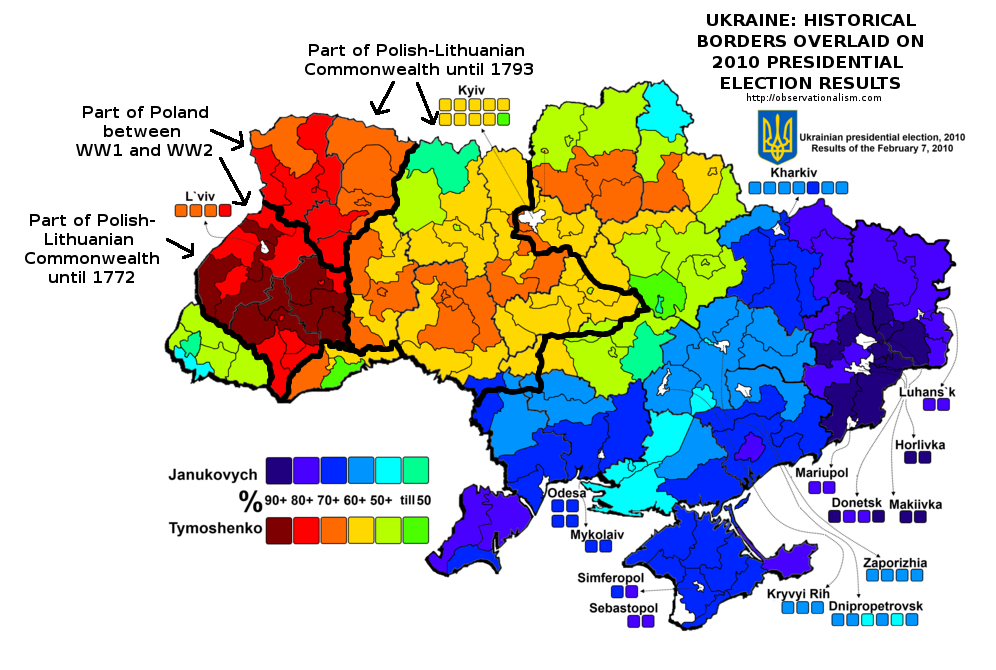
Yatsenyuk told his cabinet that, “We will fight using all methods and techniques for the resumption of peace and regaining control of Donetsk and Luhansk region.” By ‘resumption of peace,’ he meant resumption of control over Donbass. “Peace” is the term he uses to mean control. In other words: until the Yatsenyuk Government wins, there will continue to be war in Donbass, “using all methods and techniques” to achieve his (that is, America’s) victory in subduing the residents there. This subduing means exterminating some, and driving the others out; so that, in either case, they won’t become voters in future Ukrainian elections. The last time that these people voted in a Ukrainian election was 2010, when they voted 90% for Viktor Yanukovych, the man whom Obama overthrew. Without that 90% vote, Yanukovych wouldn’t have been elected. Obama consequently doesn’t want them voting in any future Ukrainian election. That’s the reason why they’re being bombed — to get rid of them.

On March 17th, Ukraine’s parliament, the Rada, voted to declare Donbass to be “temporarily occupied territory,” until the residents there are conquered. The day before that, the figurehead President of Ukraine had presented to the Rada a draft resolution proposing to solve the problem of the resistant Donbass with a resolution he published on his website on March 14th saying that the region has “special status,” and temporary self-government, but this proposal wasn’t the one the Rada passed. The President nonetheless declared that his terminology was somehow law from the moment it had been published on his website.

U.S. President Obama wants the war resumed as quickly as possible, but Angela Merkel and other European leaders have urged that it not be resumed at all. Consequently, there is a split in the Western alliance about this matter. Apparently, Prime Minister Yatsenyuk has determined that he now has enough weapons and loans to be able to resume the war very soon, until final victory.

Obama, evidently, is determined to finish the job that he started with his coup. It was bloody, but the follow-through will need to be far more so. And he has the full support of the U.S. Congress, and of the major think tanks, to continue this until victory. EU nations that don’t like it — well, Obama’s agent controlling Ukraine said famously, on 4 February 2014, “F—k the EU.”

Many European leaders don’t want to be involved in a war against Russia. However, on March 12th, Yatsenyuk said “Ukraine is in a state of war with … the Russian Federation.” That is the service he is providing to Barack Obama, and to the 98%+ of the members of the U.S. Congress who likewise want this war: Ukraine has become the proxy state for America’s war against Russia.

———-

Investigative historian Eric Zuesse is the author, most recently, of  They’re Not Even Close: The Democratic vs. Republican Economic Records, 1910-2010, and of CHRIST’S VENTRILOQUISTS: The Event that Created Christianity, and of Feudalism, Fascism, Libertarianism and Economics.


Thirty four civilians killed in just one village of Khryashevatoye in two weeks — the U.S. war against the people of Ukraine

From Fort Russ

February 15, 2015
Translated by Kristina Rus
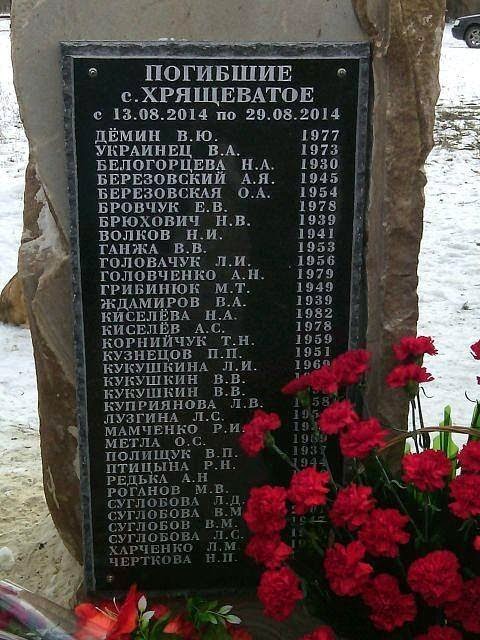
This is a memorial in the village of Khryashevatoye near Lugansk. Here are the names of 34 victims who died from August 13th to 29th, 2014. 28 of them were inhabitants of the village.
To understand the scale of the tragedy: 28 victims –  2.3% of the total population of Khryashevatoye. It’s like, for example, they killed 66 thousand people in Kiev in two weeks for nothing. Or 193 thousand in New York.
Is it clear? Is it clear, damn militarists? Is it clear, armchair warriors?
I don’t believe that on February 15, there will suddenly be peace. But I pray about it. That there will be no more deaths in this war. Not one.
Kristina Rus: 
On the list  you can see 4, 3, 2 people with the same last name, from the same family. This is just one village. And how many villages, towns and cities were in the line of fire over the last 10 months? 

“What truce? They’re still killing civilians”

Posted on Fort Russ

Published in Il Fatto Quotidiano tv
February 17, 2016
Subtitles and text translated from Italian by Tom Winter
The subtitles:
That’s the reply to the truce!
There’s never been a “truce.” They’re still killing civilians.
Have you been in the town. Well, there’s the truce for you.
[paint on wall] The Junta will not pass.
That was a school; this was a soccer field
[painted over basement: “There are people here” (Non-combatants)
“Bomb Shelter”
“This elderly man was killed by mortar fire. It was his blood you saw in the snow.”
The text:
Zorinsk, Chernukino, Pervomaisk, Stakanov. The front runs along the line of these villages a few kilometers from Lugansk, the capital of the self-proclaimed Peoples Republic. The militia, the so-called pro-russian separatists, explain that it is a zig-zag front, where the lines dovetail, so the risk of meeting Kiev troops is high. In this part of eastern Ukraine, the Minsk accords are not yet operative, and the snowstorm does not stop the fighting, either. At Zorinsk, not far from Perevalsk, one constantly hears the thunder of explosions, artillery, and multiple-launch rockets. The morning of the 16th, according to militiamen, a fragmentation shell fired from the Ukrainian lines killed an elderly man and seriously injured one other. Despite the weather, there is still a lot of blood on the snow.
Eliseo Bertolasi

Vladimir Putin’s interview with Egyptian newspaper Al-Ahram

Posted on The Kremlin, February 9, 2015

Excerpt:
In the run-up to his visit to the Arab Republic of Egypt, Vladimir Putin gave an interview to the Al-Ahram daily newspaper…

QUESTION: How would you assess the situation in Ukraine and around it? What do you think will be the most appropriate way out of the Ukrainian crisis?

VLADIMIR PUTIN: I would like to remind Egyptian readers that the Ukrainian crisis was not caused by the Russian Federation. It has emerged in response to the attempts of the USA and its western allies who considered themselves ‘winners’ of the cold war to impose their will everywhere. Promises of non-expansion of the NATO to the East (given yet to the Soviet authorities) have turned out to be hollow statements. We have seen how NATO’s infrastructure was moving closer and closer towards Russian borders and how Russian interests were being ignored.

Moreover, in the framework of the EU Eastern Partnership Program there have been attempts to tear states which had been parts of the former USSR off Russia and to prompt them to make an artificial choice “between Russia and Europe.” The Ukrainian crisis has become a high point of these negative trends. We repeatedly warned the USA and its western allies about harmful consequences of their interference in Ukrainian domestic affairs but they did not listen to our opinion.

Last February the USA and a number of EU member states supported the coup d’état in Kiev. The ultranationalists who seized the power using military force put the country on the edge of disruption and started the fratricidal war.

Unfortunately, today we can see how the ‘war party’ in Kiev actively supported from the outside continues its attempts to push the Ukrainian people over the edge of a catastrophe. The situation in Donbas has aggravated dramatically. Ukrainian security forces resumed the bombing of Donetsk, Lugansk and other residential areas in the region. They are building up their military presence there. The “new wave” of mass mobilization has been announced in the country; there are calls for “taking revenge” after summer “military failures” and for a forceful “Ukrainization of Donbas.”

Ukraine is militarizing rapidly. We can judge by the statistics: in 2014, the Ukrainian military budget increased by almost 41 percent. This year, according to preliminary data, it will more than triple and reach more than $3 billion – which is about 5 percent of the country’s GDP. And this is happening when its economy supported mostly with international, including Russian, funds is in rather deplorable situation.

We certainly feel worried. We hope that common sense will prevail. Russia strongly calls for a comprehensive and exclusively peaceful settlement of the Ukrainian crisis based on the Minsk agreements which were largely achieved owing to the initiative and efforts of the Russian side.

The most important condition for the stabilization of the situation is immediate cease-fire and ending of a so called ‘anti-terrorist’, but in fact punitive, operation in the south-east of Ukraine. Kiev’s attempts to exert economic pressure on Donbas and disrupt its daily life only aggravate the situation. This is a dead-end track, fraught with a big catastrophe.

It is evident that the crisis will continue until the Ukrainians themselves agree with each other. Until the unbridled radicalism and nationalism are finished with, and the society is consolidated around positive values and genuine interests of Ukraine. To achieve this, Kiev authorities need to listen to their people, find a common language and reach an agreement with all political forces and regions of the country. They need to elaborate such constitutional state system formula that would provide for a safe and comfortable living for all citizens with human rights being fully observed.

In the meantime, it is necessary to do one’s utmost to make all the parties to the conflict gather around the negotiating table. In this context, the Russian side stands for forging sustainable and direct contacts between Kiev and Donetsk and Lugansk, for continued work within the Contact Group. On our part, we intend to actively contribute to that process.

For the full interview with questions on many topics:

http://eng.kremlin.ru/transcripts/23575