USAF Global Strike Command Director says nuclear weapons have an important role for the world

From Sputnik News, February 19, 2015

US Air Force Global Strike Command Director Michael Fortney said that the role and utility of the US nuclear arsenal is as important in the current strategic climate as it was in previous decades.

WASHINGTON (Sputnik) — The role and utility of the US nuclear arsenal is as important in the current strategic climate as it was in previous decades, US Air Force Global Strike Command Director Michael Fortney said.

“The role of our [US] nuclear arsenal is at least as important today as it was in decades past,” Fortney stated at the annual nuclear deterrence summit in Washington, DC on Wednesday. “I believe US nuclear weapons have an important role for our country, our allies, and… a role for the world.”

Those responsible for the US nuclear weapons arsenal must “understand their role and utility”Fortney said, emphasizing their utility as a “strategic speed bump” that has so far prevented major world powers from engaging in head-to-head war.Without naming specific countries, Fortney noted increased tensions among nuclear armed states who are currently modernizing their arsenals across all legs of their nuclear triad.

Fortney raised concerns about certain nuclear states revising their military doctrines reflecting “a resurgent doctrinal utility” for their strategic nuclear forces.

The top nuclear powers on the planet, Russia and the United States, are currently engaged in extensive nuclear modernization, according to both countries’ defense agencies.

Russia announced an updated military doctrine at the end of 2014 re-emphasizing its right to use nuclear weapons in retaliation or if a conventional attack threatened the very existence of the state, according to the document. The new doctrine stopped short of including a nuclear pre-emptive strike notion.

http://sputniknews.com/us/20150219/1018456711.html

Nazi hands that rock American cradles

It is natural when people move to a foreign country to form ethnically-based groups where they can share common traditions, foods, heritage, history, and teach their children about their heritage.

However, when the “heritage” involves Stepan Bandera and other Nazi collaborators, racists, and ultra-nationalists, when their version of history writes out, re-writes, or even glorifies genocidal activities, and when the group begins funding and promoting activities as well as a political agenda in their new country as well as in their original country, that is very dangerous and cannot be ignored.

This article describes the activities of OUNb-UCCA affiliated groups in America aimed at young people.

This article does not include the influence of Nazi officials and scientists brought to America under Operation Paperclip, and the alliances and mentoring they provided (with the blessing of the United States government) within many branches of government and industry as well as in the American neighborhoods where they lived. It does not include the homegrown Nazi and neo-Nazi individuals and groups in this country, or the industrialists who support Nazism and fascism.  Those numbers dramatically increase the phenomenal level of influence and political pressure and power.

This is in addition to historic racism in America, which provides another layer of support.

— Editor

———————————————————————————

By George Eliason, February 15, 2015
Posted in Global Research

Are Ukrainian-American children brought up to be Bandera followers? If the children of all the Eastern European and Baltic emigre populations bring their children up in American this way, will it have an effect on non-emigre children in the US? With a combined population of 20 million career age emigre ultra nationalists according to their own estimates in the United States alone, you had better find out.

Was the Euromaidan which was funded heavily by the combined emigre populations about democracy? Answering this in a surprise statement at a cabinet meeting on February 10th 2015, Ukrainian President Petro Poroshenko opened up about the basis of the post-coup Ukrainian state and the ideology it is built on.

“I think to the contrary that the Galicians are the foundation of the Ukrainian state,”

This definitely throws a damper on anyone in the EU or USA calling the Euro-maidan a pro-democratic protest or revolution. The Galicians that Poroshenko is referring to formulated the ideology of Stepan Bandera that is now the foundation of post Maidan Ukraine.

According to Ukrainian-American George Masni, a former UCCA Arizona state president “The “simple nationalism” Poroshenko is talking about is love of ones nation that drives to defend it from invaders. This type of nationalism is better known as patriotism.”

If ultra-nationalist ideology wasn’t part of the Ukrainian political landscape pre-Maidan, where did it come from? Before 1991 this ideology was foreign in Ukraine except for a tiny minority in the Lviv region.

The Nazi/ nationalist ideology of Stepan Bandera made its home in the hearts of Eastern European emigres worldwide, particularly in the United States and Canada. Each succeeding generation has been taught to be more dedicated to it than their parents were. Continue reading

Ukraine denouement: From the military battlefield to the arena of international finance

From Counterpunch, February 16, 2015
By Michael Hudson

The fate of Ukraine is now shifting from the military battlefield back to the arena that counts most: that of international finance. Kiev is broke, having depleted its foreign reserves on waging war that has destroyed its industrial export and coal mining capacity in the Donbass (especially vis-à-vis Russia, which normally has bought 38 percent of Ukraine’s exports). Deeply in debt (with €3 billion falling due on December 20 to Russia), Ukraine faces insolvency if the IMF and Europe do not release new loans next month to pay for new imports as well as Russian and foreign bondholders.

Finance Minister Natalia Yaresko announced on Friday that she hopes to see the money begin to flow in by early March.[1] But Ukraine must meet conditions that seem almost impossible: It must implement an honest budget and start reforming its corrupt oligarchs (who dominate in the Rada and control the bureaucracy), implement more austerity, abolish its environmental protection, and make its industry “attractive” to foreign investors to buy Ukraine’s land, natural resources, monopolies and other assets, presumably at distress prices in view of the country’s recent devastation.

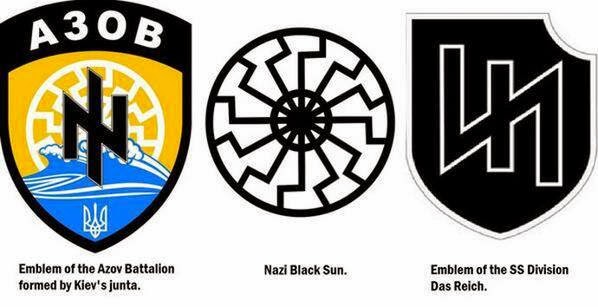
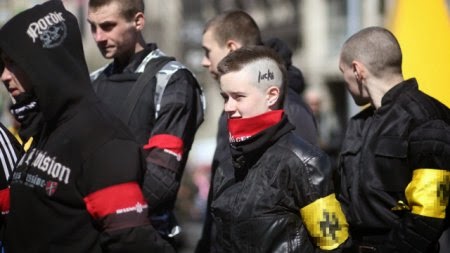
Looming over the IMF loan is the military situation. On January 28, Christine Lagarde said that the IMF would not release more money as long as Ukraine remains at war. Cessation of fighting was to begin Sunday morning. But Right Sector leader Dmytro Yarosh announced that his private army and that of the Azov Battalion will ignore the Minsk agreement and fight against Russian-speakers. He remains a major force within the Rada.

How much of Ukraine’s budget will be spent on arms? Germany and France made it clear that they oppose further U.S. military adventurism in Ukraine, and also oppose NATO membership. But will Germany follow through on its threat to impose sanctions on Kiev in order to stop a renewal of the fighting? For the United States bringing Ukraine into NATO would be the coup de grace blocking creation of a Eurasian powerhouse integrating the Russian, German and other continental European economies.

The Obama administration is upping the ante and going for broke, hoping that Europe has no alternative but to keep acquiescing. But the strategy is threatening to backfire. Instead of making Russia “lose Europe,” the United States may have overplayed its hand so badly that one can now think about the opposite prospect. The Ukraine adventure turn out to be the first step in the United States losing Europe. It may end up splitting European economic interests away from NATO, if Russia can convince the world that the epoch of armed occupation of industrial nations is a thing of the past and hence no real military threat exists – except for Europe being caught in the middle of Cold War 2.0.

For the U.S. geopolitical strategy to succeed, it would be necessary for Europe, Ukraine and Russia to act against their own potential economic self-interest. How long can they be expected to acquiesce in this sacrifice? At what point will economic interests lead to a reconsideration of old geo-military alliances and personal political loyalties?

The is becoming urgent because this is the first time that continental Europe has been faced with such war on its own borders (if we except Yugoslavia). Where is the advantage for Europe supporting one of the world’s most corrupt oligarchies north of the Equator?

America’s Ukrainian adventure by Hillary’s appointee Victoria Nuland (kept on and applauded by John Kerry), as well as by NATO, is forcing Europe to commit itself to the United States or pursue an independent line. George Soros (whose aggressive voice is emerging as the Democratic Party’s version of Sheldon Adelson) recently urged (in the newly neocon New York Review of Books) that the West give Ukraine $50 billion to re-arm, and to think of this as a down payment on military containment of Russia. The aim is old Brzezinski strategy: to foreclose Russian economic integration with Europe. The assumption is that economic alliances are at least potentially military, so that any power center raises the threat of economic and hence political independence.

The Financial Times quickly jumped on board for Soros’s $50 billion subsidy.[2] When President Obama promised that U.S. military aid would be only for “defensive arms,” Kiev clarified that it intended to defend Ukraine all the way to Siberia to create a “sanitary cordon.” Continue reading

Azov battalion thugs hijack a car of Mariupol prosecutor

From Fort Russ

February 15, 2015
Rusvesna
Translated by Kristina Rus

Militants from Azov battalion, threatening with a pistol, stole the SUV of a Mariupol prosecutor.

Prosecutor of one of the districts of Mariupol experienced unity with Ukraine on his own skin.

When he was driving on a highway in his SUV, he was cut off by a military truck with soldiers from Azov punitive battalion. Jumping out of the truck with weapons, the militants forced the Prosecutor to get out of the car and give them the keys.

Attempts by the Prosecutor to explain who he is, ended predictably. The militants put the gun to the head of the stubborn civil defender. The mercenaries “liberated” the prosecutor from his car and disappeared in it.

In the occupied Mariupol such a case is not uncommon. As local residents say, “Azov” can do anything – grab people on the streets, break into a house and take out anything they want.

The law enforcement who serve the new government, prefer not to intervene and not to investigate such cases, as a response to any criminal case can be a grenade in their window.

Military correspondent of Rusvesna (“Russian Spring”),  Steppe.

http://fortruss.blogspot.com/2015/02/azov-battalion-thugs-hijack-car-of.html

Support Venezuela — interview with John Pilger:

Posted on Information Clearing House
By John Pilger and Michael Albert
February 16, 2015 “ICH” – “ZNet” –

Albert: Why would the U.S. want Venezuela’s government overthrown?

Pilger: There are straightforward principles and dynamics at work here. Washington wants to get rid of the Venezuelan government because it is independent of US designs for the region and because Venezuela has the greatest proven oil reserves in the world and uses its oil revenue to improve the quality of ordinary lives. Venezuela remains a source of inspiration for social reform in a continent ravaged by an historically rapacious U.S. An Oxfam report once famously described the Sandinista revolution in Nicaragua as ‘the threat of a good example’. That has been true in Venezuela since Hugo Chavez won his first election. The ‘threat’ of Venezuela is greater, of course, because it is not tiny and weak; it is rich and influential and regarded as such by China. The remarkable change in fortunes for millions of people in Latin America is at the heart of U.S. hostility. The U.S. has been the undeclared enemy of social progress in Latin America for two centuries. It doesn’t matter who has been in the White House: Barack Obama or Teddy Roosevelt; the US will not tolerate countries with governments and cultures that put the needs of their own people first and refuse to promote or succumb to U.S. demands and pressures. A reformist social democracy with a capitalist base – such as Venezuela – is not excused by the rulers of the world. What is inexcusable is Venezuela’s political independence; only complete deference is acceptable. The ‘survival’ of Chavista Venezuela is a testament to the support of ordinary Venezuelans for their elected government – that was clear to me when I was last there. Venezuela’s weakness is that the political ‘opposition’ — those I would call the ‘East Caracas Mob’ – represent powerful interests who have been allowed to retain critical economic power. Only when that power is diminished will Venezuela shake off the constant menace of foreign-backed, often criminal subversion. No society should have to deal with that, year in, year out.

What methods has the U.S. already used and would you anticipate their using to unseat the Bolivarians? 

There are the usual crop of quislings and spies; they come and go with their media theatre of fake revelations, but the principal enemy is the media. You may recall the Venezuelan admiral who was one of the coup-plotters against Chavez in 2002, boasting during his brief tenure in power, ‘Our secret weapon was the media’. The Venezuelan media, especially television, were active participants in that coup, lying that supporters of the government were firing into a crowd of protestors from a bridge. False images and headlines went around the world. The New York Times joined in, welcoming the overthrow of a democratic ‘anti-American’ government; it usually does. Something similar happened in Caracas last year when vicious right-wing mobs were lauded as ‘peaceful protestors’ who were being ‘repressed’. This was undoubtedly the start of a Washington-backed ‘colour revolution’ openly backed by the likes of the National Endowment for Democracy – a user-friendly CIA clone. It was uncannily like the coup that Washington successfully staged in Ukraine last year. As in Kiev, in Venezuela the ‘peaceful protestors’ set fire to government buildings and deployed snipers and were lauded by western politicians and the western media. The strategy is almost certainly to push the Maduro government to the right and so alienate its popular base. Depicting the government as dictatorial and incompetent has long been an article of bad faith among journalists and broadcasters in Venezuela and in the US, the UK and Europe. One recent US ‘story’ was that of a ‘US scientist jailed for trying to help Venezuela build bombs’. The implication was that Venezuela was harbouring ‘nuclear terrorists’. In fact, the disgruntled nuclear physicist had no connection whatsoever with Venezuela.

All this is reminiscent of the unrelenting attacks on Chávez, each with that peculiar malice reserved for dissenters from the west’s ‘one true way’. In 2006, Britain’s Channel 4 News effectively accused the Venezuelan president of plotting to make nuclear weapons with Iran, an absurd fantasy. The Washington correspondent, Jonathan Rugman, sneered at policies to eradicate poverty and presented Chávez as a sinister buffoon, while allowing Donald Rumsfeld, a war criminal, to liken Chavez to Hitler, unchallenged. The BBC is no different. Researchers at the University of the West of England in the UK studied the BBC’s systematic bias in reporting Venezuela over a ten-year period. They looked at 304 BBC reports and found that only three of these referred to any of the positive policies of the government. For the BBC, Venezuela’s democratic initiatives, human rights legislation, food programmes, healthcare initiatives and poverty reduction programmes did not exist. Mission Robinson, the greatest literacy programme in human history, received barely a passing mention. This virulent censorship by omission complements outright fabrications such as accusations that the Venezuelan government are a bunch of drug-dealers. None of this is new; look at the way Cuba has been misrepresented – and assaulted – over the years. Reporters Without Borders has just issued its worldwide ranking of nations based on their claims to a free press. The U.S. is ranked 49th, behind Malta, Niger, Burkino Faso and El Salvador.

Why might now be a prime time, internationally, for pushing toward a coup? If the primary problem is Venezuela being an example that could spread, is the emergence of a receptive audience for that example in Europe adding to the U.S. response?

It’s important to understand that Washington is ruled by true extremists, once known inside the Beltway as ‘the crazies’. This has been true since before 9/11. A few are outright fascists. Asserting US dominance is their undisguised game and, as the events in Ukraine demonstrate, they are prepared to risk a nuclear war with Russia. These people should be the common enemy of all sane human beings. In Venezuela, they want a coup so that they can roll-back of some of the world’s most important social reforms – such as in Bolivia and Ecuador. They’ve already crushed the hopes of ordinary people in Honduras. The current conspiracy between the US and Saudi Arabia to lower the price of oil is meant to achieve something more spectacular in Venezuela, and Russia.

What do you think the best approach might be to warding off u.s. machinations, and those of domestic Venezuelan elites as well, for the Bolivarians?

The majority people of Venezuela, and their government, need to tell the world the truth about the attacks on their country. There is a stirring across the world, and many people are listening. They don’t want perpetual instability, perpetual poverty, perpetual war, perpetual rule by the few. And they identify the principal enemy; look at the international polling surveys that ask which country presents the greatest danger to humanity. The majority of people overwhelmingly point to the U.S., and to its numerous campaigns of terror and subversion.

What do you think is the immediate responsibility of leftists outside Venezuela, and particularly in the U.S.?

That begs a question: who are these ‘leftists’? Are they the millions of liberal North Americans seduced by the specious rise of Obama and silenced by his criminalising of freedom of information and dissent? Are they those who believe what they are told by the New York Times, the Washington Post, the Guardian, the BBC? It’s an important question. ‘Leftist’ has never been a more disputed and misappropriated term. My sense is that people who live on the edge and struggle against US-backed forces in Latin America understood the true meaning of the word, just as they identify a common enemy. If we share their principles, and a modicum of their courage, we should take direct action in our own countries, starting, I would suggest, with the propagandists in the media. Yes, it’s our responsibility, and it has never been more urgent.


Click for Spanish, German, Dutch, Danish, French, translation- Note- Translation may take a moment to load.

http://www.informationclearinghouse.info/article41011.htm

Huge spy program exposed: NSA has hidden software in hard drives around the world

From Business Insider, February 16, 2015
by Joseph Menn, Reuters

SAN FRANCISCO (Reuters) – The U.S. National Security Agency has figured out how to hide spying software deep within hard drives made by Western Digital, Seagate, Toshiba, and other top manufacturers, giving the agency the means to eavesdrop on the majority of the world’s computers, according to cyber researchers and former operatives.

That long-sought and closely guarded ability was part of a cluster of spying programs discovered by Kaspersky Lab, the Moscow-based security software maker that has exposed a series of Western cyberespionage operations.

Kaspersky said it found personal computers in 30 countries infected with one or more of the spying programs, with the most infections seen in Iran, followed by Russia, Pakistan, Afghanistan, China, Mali, Syria, Yemen, and Algeria. The targets included government and military institutions, telecommunication companies, banks, energy companies, nuclear researchers, media, and Islamic activists, Kaspersky said.

The firm declined to publicly name the country behind the spying campaign, but said it was closely linked to Stuxnet, the NSA-led cyberweapon that was used to attack Iran’s uranium enrichment facility. The NSA is the agency responsible for gathering electronic intelligence on behalf of the United States.

A former NSA employee told Reuters that Kaspersky’s analysis was correct, and that people still in the intelligence agency valued these spying programs as highly as Stuxnet. Another former intelligence operative confirmed that the NSA had developed the prized technique of concealing spyware in hard drives, but said he did not know which spy efforts relied on it.

NSA spokeswoman Vanee Vines declined to comment. This could be as big as the Stuxnet attack on an Iranian nuclear power plant (picture).

Kaspersky published the technical details of its research on Monday, which should help infected institutions detect the spying programs, some of which trace back as far as 2001.

The disclosure could further hurt the NSA’s surveillance abilities, already damaged by massive leaks by former contractor Edward Snowden. Snowden’s revelations have hurt the United States’ relations with some allies and slowed the sales of U.S. technology products abroad.

The exposure of these new spying tools could lead to greater backlash against Western technology, particularly in countries such as China, which is already drafting regulations that would require most bank technology suppliers to proffer copies of their software code for inspection.

Peter Swire, one of five members of U.S. President Barack Obama’s Review Group on Intelligence and Communications Technology, said the Kaspersky report showed that it is essential for the country to consider the possible impact on trade and diplomatic relations before deciding to use its knowledge of software flaws for intelligence gathering.

“There can be serious negative effects on other U.S. interests,” Swire said.

TECHNOLOGICAL BREAKTHROUGH

According to Kaspersky, the spies made a technological breakthrough by figuring out how to lodge malicious software in the obscure code called firmware that launches every time a computer is turned on.

Disk drive firmware is viewed by spies and cybersecurity experts as the second-most valuable real estate on a PC for a hacker, second only to the BIOS code invoked automatically as a computer boots up.

“The hardware will be able to infect the computer over and over,” lead Kaspersky researcher Costin Raiu said in an interview.

Though the leaders of the still-active espionage campaign could have taken control of thousands of PCs, giving them the ability to steal files or eavesdrop on anything they wanted, the spies were selective and only established full remote control over machines belonging to the most desirable foreign targets, according to Raiu. He said Kaspersky found only a few especially high-value computers with the hard-drive infections.

Kaspersky’s reconstructions of the spying programs show that they could work in disk drives sold by more than a dozen companies, comprising essentially the entire market. They include Western Digital, Seagate, Toshiba, IBM, Micron, and Samsung.

Western Digital, Seagate and Micron said they had no knowledge of these spying programs. Toshiba and Samsung declined to comment. IBM did not respond to requests for comment.

How much did companies like IBM know?

GETTING THE SOURCE CODE

Raiu said the authors of the spying programs must have had access to the proprietary source code that directs the actions of the hard drives. That code can serve as a roadmap to vulnerabilities, allowing those who study it to launch attacks much more easily.

“There is zero chance that someone could rewrite the [hard drive] operating system using public information,” Raiu said.

Concerns about access to source code flared after a series of high-profile cyberattacks on Google Inc and other U.S. companies in 2009 that were blamed on China. Investigators have said they found evidence that the hackers gained access to source code from several big U.S. tech and defense companies.

It is not clear how the NSA may have obtained the hard drives’ source code. Western Digital spokesman Steve Shattuck said the company “has not provided its source code to government agencies.” The other hard drive makers would not say if they had shared their source code with the NSA.

Seagate spokesman Clive Over said it has “secure measures to prevent tampering or reverse engineering of its firmware and other technologies.” Micron spokesman Daniel Francisco said the company took the security of its products seriously and “we are not aware of any instances of foreign code.”

According to former intelligence operatives, the NSA has multiple ways of obtaining source code from tech companies, including asking directly and posing as a software developer. If a company wants to sell products to the Pentagon or another sensitive U.S. agency, the government can request a security audit to make sure the source code is safe.

“They don’t admit it, but they do say, ‘We’re going to do an evaluation, we need the source code,'” said Vincent Liu, a partner at security consulting firm Bishop Fox and former NSA analyst. “It’s usually the NSA doing the evaluation, and it’s a pretty small leap to say they’re going to keep that source code.”

Kaspersky called the authors of the spying program “the Equation group,” named after their embrace of complex encryption formulas.

The group used a variety of means to spread other spying programs, such as by compromising jihadist websites, infecting USB sticks and CDs, and developing a self-spreading computer worm called Fanny, Kaspersky said.

Fanny was like Stuxnet in that it exploited two of the same undisclosed software flaws, known as “zero days,” which strongly suggested collaboration by the authors, Raiu said. He added that it was “quite possible” that the Equation group used Fanny to scout out targets for Stuxnet in Iran and spread the virus.

(Reporting by Joseph Menn; Editing by Tiffany Wu and Business Insider)

This article originally appeared at Reuters. Copyright 2015.

http://www.businessinsider.com/r-russian-researchers-expose-breakthrough-us-spying-program-2015-2?utm_content=bufferc0d4b&utm_medium=social&utm_source=facebook.com&utm_campaign=buffer

Used under Fair Use Rules.
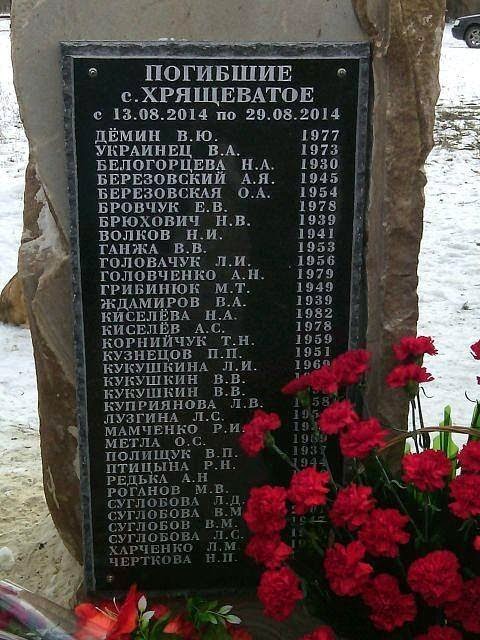
Thirty four civilians killed in just one village of Khryashevatoye in two weeks — the U.S. war against the people of Ukraine

From Fort Russ

February 15, 2015
Translated by Kristina Rus
This is a memorial in the village of Khryashevatoye near Lugansk. Here are the names of 34 victims who died from August 13th to 29th, 2014. 28 of them were inhabitants of the village.
To understand the scale of the tragedy: 28 victims –  2.3% of the total population of Khryashevatoye. It’s like, for example, they killed 66 thousand people in Kiev in two weeks for nothing. Or 193 thousand in New York.
Is it clear? Is it clear, damn militarists? Is it clear, armchair warriors?
I don’t believe that on February 15, there will suddenly be peace. But I pray about it. That there will be no more deaths in this war. Not one.
Kristina Rus: 
On the list  you can see 4, 3, 2 people with the same last name, from the same family. This is just one village. And how many villages, towns and cities were in the line of fire over the last 10 months? 

Ukrainian troops surrender by the hundreds

Posted on Fort Russ

2/17/2015
Novorossia Militia Update

Translated from Russian by J.Hawk

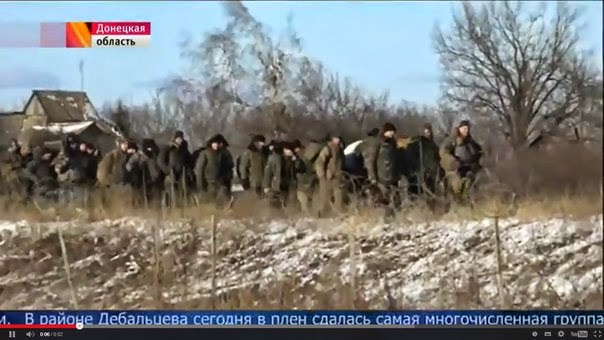
“Ukrainian punitive troops are surrendering in large numbers. Journalists have filmed the surrender of one of the punitive units in the Debaltsevo cauldron. More than 70 men laid down their arms to save their lives and surrendered to LPR People’s Militia. All punitive troops who lay down their arms and cease resistance will receive hot food and warm clothing, as well as medical aid if they are wounded. The main reward for their conscience and their refusal to continue the war is that their lives will be spared.”

Video of the surrender of the 70-strong Ukrainian unit.

https://www.youtube.com/watch?v=dTBGJaRqkU0

Ukrainian soldiers ordered to break out “on their own”

Posted on Fort Russ

2/17/2015
The Ukrainian military is attempting to break through the Debaltsevo Cauldron

Translated from Russian by J.Hawk

Fighting around Debaltsevo escalated during the second half of the day, according to DPR. “The situation has grown more complex. The level of shelling from the outside of the cauldron has increased. UAF moved against Logvinovo to break a corridor into Debaltsevo,” DPR Ministry of Defense representative Eduard Basurin announced on Tuesday.

He added that DPR forces do not respond to provocations but resist enemy offensive actions. According to Basurin, the militia had established contact with the Ukrainian military and are holding the first meeting of the Joint Control and Coordination Center.

Apart from that, the mothers of Ukrainian soldiers surrounded in Debaltsevo say that troops there received orders to abandon their defensive positions and equipment and attempt to exit the encirclement in small groups. They say command and control has been completely lost, which means the soldiers are on their own. This became known to several mothers who established telephone contact with their sons. On February 17th the relatives of the soldiers are holding a spontaneous meeting at the Ministry of Defense in Kiev.

J.Hawk’s Comment: So it’s clear that the Debaltsevo cauldron is crumbling, it’s only a question of how many Ukrainian soldiers will manage to exit it. Some no doubt will, but others will become prisoners–there are reports that some 300 junta troops surrendered in Debaltsevo alone so far. But whatever equipment they brought with them to Debaltsevo is going to fall into the hands of Novorossia’s army.

These were the best units the Ukrainian army had. Let’s not forget the “fourth wave of mobilization” had only just begun, so the forces at Debaltsevo were the remnants of the regular, pre-civil war Ukrainian military or the survivors of the campaigns of 2014. For all the problems with the most recent wave of mobilization, the Kiev junta can count on a trickle of replacements. But the heavy equipment is for all intents and purposes irreplaceable. Once these tanks, BMPs, artillery are gone, they are gone for good, and it would take a long time to bring the Ukrainian military back to the state it was in only two months ago.

http://fortruss.blogspot.com/2015/02/ukrainian-soldiers-ordered-to-break-out.html

DPR leader: Kiev betrayed 5,000 encircled in Debaltsevo

From Sputnik News, February 14, 2015

As Debaltseve is not mentioned in the Minsk agreement and that means that Kiev “simply betrayed” 5,000 Ukrainian armed forces’ soldiers.

DONETSK (Sputnik) – The forces of the Donetsk People’s Republic (DPR) willcease fire everywhere except for inner regions of the self-proclaimed republic, any attempts of Kiev soldiers to break out the encirclement at the town of Debaltseve will be stopped, theDPR head said Saturday.“We are ceasing fire everywhere but inner regions of DPR. Any attempt of [Kiev soldiers] to leave the ‘cauldron’ [Debaltseve encirclement] will be stopped. I have already given this order,” Alexander Zakharchenko told reporters.

“There is not a single word about Debaltseve in [Minsk] agreements. That means that Ukraine simply betrayed 5,000 people in the ‘cauldron’,” Zakharchenko said.

Debaltseve, one of Ukraine’s biggest railroad junctions, has become the site of intense fighting between Kiev and southeastern Ukrainian pro-independence fighters.

Earlier in the day, deputy head of the DPR forces Eduard Basurin stated that the republic was not planning to let Kiev soldiers trapped in Debaltseve leave the town until they surrender. According to Basurin, Kiev told soldiers to not surrender, as they would be taken out ofDebaltseve in rotations or usingOSCE help after February 15.Kiev denies claims that its soldiers are encircled in Debaltsevo.

During Thursday’s Minsk talks, the leaders of Kiev and the breakaway republics of Donetsk and Luhansk managed to sign a deal, stipulating a ceasefire from Saturday night, prisoner swaps, weaponry withdrawal and constitutional changes in Ukraine.

Donetsk forces announced readiness to cease fire and allow surrounded Kiev soldiers to leave the Debaltseve area “on respectful conditions.”

An earlier ceasefire agreement reached by the warring sides last September broke down, with clashes intensifying in recent weeks. Debaltseve, one of Ukraine’s biggest railroad junctions, has become the site of intense fighting. According to reports, up to 10,000 Ukrainian troops remain surrounded after attempting to recapture the contested town.


http://sputniknews.com/europe/20150214/1018270783.html#ixzz3Rj1kQLp6