A revolt that didn’t happen — Kolomoisky

From Colonel Cassad, March 25, 2015

Several theses about the consequences of Kolomoisky’s defeat.

1. The resignation of Kolomoisky from the position of the governor of the Dnepropetrovsk region implies that there will be a reconfiguration of the political and economical field of the South-Eastern Ukraine. The chief jew-banderovite will be replaced by Rezhnichenko, who is a person from Poroshenko’s deck. Previously, he was given the Zaporozhye region to be his feeding ground. Some mistakenly believed that the reason of the conflict lies in the energy assets. However, the real reason is primarily the establishment of political control over the regions of the south-east, which where Kolomoisky previously reigned unchallenged. The permission from Washington was obtained for this process, which predetermined the rapid capitulation of Kolomoisky. This whole story shows how, by a single motion from Washington, can the intra-Ukrainian political alignment change and how far a regular Ukrainian is far from determining his fate and how little power even the bloodsuckers from the junta leadership actually wield over it.

2. Some mistakenly believe that Kolomoisky has some kind of clever plan, that he’ll go now and then he’ll emerge and… and then he’ll do something.
In the reality he will do nothing, after his resignation and Korban’s resignation (he also left today), Kolomoisky lost the abilities that he obtained by integrating into the government bureaucracy. If before the governors whom he appointed in the South-East went to bow before Kolomoisky in Dnepropetrovsk, now they’ll go to bow before Poroshenko in Kiev. The appointee of the head of Poroshenko’s administration now sits in the domain of the former master of the South-East. Palitsa in Odessa rushed to remove the visiting bandits from the city even before the resignation of Kolomoisky, which of course didn’t save the city from yet another showdown. On this background, quite concrete threats directed at Kolomoisky were sounded, which were much more substantial than his weak attempts of collecting signatures for the resignation of Nalivaychenko or of threatening with a maidan. Actually, the essence of these threats is simple: Kolomoisky, having relinquished his political power, must also relinquish his repression power by releasing the punitive troops who obey him and locking them onto the centralized structures of the SBU and the MIA. The bandit nature of these units won’t change, but they must now report not to Kolomoisky but to Avakov, Nalivaychenko, and Poroshenko. Correspondingly, if this scheme will be implemented (and I believe that it will be implemented), then Kolomoisky will become just a rich and influential person, but also somebody who has no ability of opposing Poroshenko in matters of policy of force.

3. Whether Kolomoisky will be able to keep “his precious” in the state assets will depend on the terms of his capitulation. A scenario in which Kolomoisky may be allowed to keep the control over “Ukrnafta” in exchange for obedience the transfer of punitive troops to the different owners without too much hassle. However, considering the peculiarities of the Ukrainian politics, they’ll probably try to utterly fleece Kolomoisky, taking revenge for all of his previous misdeeds. Thankfully, Kolomoisky made plenty of enemies in Ukraine. The “Privat” group itself is unlikely to be dismembered, because this may trigger the collapse of the already weakened “Privat-Bank”. However, its influence will likely be maximally restricted, with the intent of turning Kolomoisky into yet another “unpretentious oligarch”. Naturally, Kolomoisky will resist where he can in order to not permit the full collapse of his empire, but these will be precisely the rearguard skirmishes, when the main battle is already lost.

4. This story will obviously strengthen Poroshenko’s power, but to a limited degree, because Avakov, Yatsenyuk, and Nalivaychenko are at this moment only situational allies of Poroshenko in his fight with Kolomoisky. Also, the emergence if these allies was secured not by the influence of Poroshenko himself, but rather by the “goodwill” of Washington, which made a clear bet on Poroshenko and which suggested to Kolomoisky that he shouldn’t cross the true owners of the Ukraine. Hence the absence of revolts, maidans, and marches on Kiev, because this would imply taking a stand directly against Washington. This would be funny, considering the fact that Kolomoisky’s assets are located in the West. Kolomoisky is certainly a thug, but he is not a moron. So it was easier to lose power than it was to lose everything. Therefore, despite all of their noisy threats against Kiev, Kolomoisky and Korban casually surrendered their power today.

5. Strengthening of the central authority in Kiev will mean that the controllability of the processes in the South-East will increase because instead of the headstrong Kolomoisky and his appointees there will be mostly obedient Gauleiters sitting there, who will implement the general line of the Kiev junta. It is also guaranteed that the portion of grey business associated with the trade through the front line will now belong to the new masters of regions (this primarily has to do with semi-legal and illegal schemes of coal trading). The punitive battalions will be forced to report to the centralized structures — either the MIA or the SBU (the “Right Sector” militants will likely remain under Nalivaychenko, naturally nobody is going to let Yarosh in the General Staff now) with a more realistic operational control by sector commands. Also it is worth expecting the decrease of pressure on the General Staff and Muzhenko, because the informational attack on them was sponsored by Kolomoisky. Besides this, after the fall of Kolomoisky the traditional outflow of his former associates to the winning camp will start. Naturally, Kolomoisky, unless he will be fully destroyed, will keep a part of his political clutter in the form of the purchased MPs in the Verkhovnaya Rada. However, this will be more of a regular lobbyist group than an instrument for the struggle for power now. For Novorossia the fall of Kolomoisky and the centralization of the command over punitive battalions will imply that it will no longer be possible to underwrite the ongoing war on the designs of Kolomoisky and “uncontrolled battalions”. “Partner Pete” is now responsible for everything. On the other side, the centralization of control in Ukraine will more likely serve the goals of internal mobilization of the junta in the face of the next stage of the war. Little has actually changed for Novorossia, just like before her future will depend on the outcome of the military standoff against the AFU.

Should we sympathize with Kolomoisky? Of course, not. Along with Turchinov and Poroshenko, Kolomoisky is one of the most bloody junta bosses, who did much for the civil war to follow its bloodiest scenario. The exasperation of the war is in many ways due to precisely the activity of Kolomoisky, which led to the Odessa Khatyn, after which all of the remaining bridges were burned. In principle, I don’t abandon the hope that sooner or later justice will reach Kolomoisky, as well as other chiefs of a coup that ended with a civil war.

Original article: http://colonelcassad.livejournal.com/2107559.html (in Russian)

http://cassad-eng.livejournal.com/151381.html

U.S. House votes 348-48 to arm Ukraine; Russia warns lethal aid will “explode the whole situation”

From Zero Hedge
By Tyler Durden
Posted on Global Research, March 26, 2015

Yesterday, in a vote that largely slid under the radar, the House of Representatives passed a resolution urging Obama to send lethal aid to Ukraine, providing offensive, not just “defensive” weapons to the Ukraine army – the same insolvent, hyperinflating Ukraine which, with a Caa3/CC credit rating, last week started preparations to issue sovereign debt with a US guarantee, in essence making it a part of the United States (something the US previously did as a favor to Egypt before the Muslim Brotherhood puppet regime was swept from power by the local army).

The resolution passed with broad bipartisan support by a count of 348 to 48.

According to DW,  the measure urges Obama to provide Ukraine with “lethal defensive weapon systems” that would better enable Ukraine to defend its territory from “the unprovoked and continuing aggression of the Russian Federation.”

“Policy like this should not be partisan,” said House Democrat Eliot Engel, the lead sponsor of the resolution. “That is why we are rising today as Democrats and Republicans, really as Americans, to say enough is enough in Ukraine.”

Engel, a New York Democrat, has decided that he knows better than Europe what is the best option for Ukraine’s people – a Europe, and especially Germany, which has repeatedly said it rejects a push to give western arms to the Ukraine army, and warned that Russia under President Vladimir Putin has become “a clear threat to half century of American commitment to an investment in a Europe that is whole, free and at peace. A Europe where borders are not changed by force.

This war has left thousands of dead, tens of thousands wounded, a million displaced, and has begun to threaten the post-Cold War stability of Europe,” Engel said.

Odd, perhaps the US state department should have thought of that in a little over a year ago when Victoria Nuland was plotting how to most effectively put her puppet government in charge of Kiev and how to overthrow the lawfully elected president in a US-sponsored coup.

Then again, one glance at the Rep. Engel’s career donors provides some explanation for his tenacity to start another armed conflict and to escalate what he himself defines as a cold war into a warm one.


So what will Obama do? As a reminder, the president has been far more eager to sit this one out, and giving Europe the upper hand when it comes to the decision if and when to escalate the proxy civil war in Ukraine.  To be sure, the vote puts even more pressure on the Obama administration, which has repeatedly said it was considering providing lethal aid to Ukraine; it just never dared to actually pull the trigger. Several months ago, the Joint Chiefs of Staff chairman General Martin Dempsey said we would “absolutely consider” providing lethal aid, sentiments that were echoed by Defense Secretary Ashton Carter, who said that he was also “inclined” in that direction.

Obama’s options may be even more limited after NATO’s top military commander General Philip Breedlove said Sunday that the West should “consider all our tools” to assist Ukraine, including sending defensive weapons to areas held by pro-Russian rebels.

For now the president is delaying because according to the State Department, the White House is waiting to see whether the second Minsk ceasefire will hold before deciding whether to deliver lethal assistance.

Ironically, the biggest stumbling block ahead of an outright overture to World War III, may be Hillary Clinton herself. The former SecState, currently embroiled in an e-mail communication scandal, was recently revealed to have been a recipient of some very generous foreign donations into the Clinton foundation: donations where Ukraine was at the very top!


Considering last week’s news of a just as dangerous cold war being waged between Obama’s right hand (wo)man, Valerie Jarrett, and the Clintons, it is perhaps just as likely that Obama, whose foreign policy team is absolutely abysmal and whose offshore “achievements” can best be described as a disaster, is not eager to get involved in Ukraine not so much to avert the cold war with Russia to turn hot, but to make Hillary’s life difficult as she launches her challenge to Obama’s favorite populist Elizabeth Warren.

Then again, when it comes to calling the foreign shots, the US president is merely a figurehead, and the real decision-maker has always been the US military-industrial complex. So while Obama may stall sending weapons, he will ultimately get a tap on the shoulder from the gentle folks shown on the table below, who will soon demand something in exchange for their millions in lobby funding.

The prepackaged spin is already ready: “sending weapons to the Kiev government would not mean involvement in a new war for America”, claimed the abovementioned Eliot Engel who sponsored the document. “The people of Ukraine are not looking for American troops,” Engel said. “They are just looking for the weapons.

Beautiful. And if weapons the Ukraine wants, the US MIC will be delighted to provide them.

So the only question is how Russia will responds to this escalation: according to RT, “Washington’s decision to supply Ukraine with ammunition and weapons would “explode the whole situation” in eastern Ukraine and Russia would be forced to respond “appropriately,” Russia’s Deputy Foreign Minister Sergey Ryabkov said at the end of February.

“It would be a major blow to the Minsk agreements and would explode the whole situation,” TASS quoted Ryabkov as saying.

In other words, bullish for stocks – just think of the central-bank monetary paradrops that World War III would unleash.

US House Votes 348-48 To Arm Ukraine, Russia Warns Lethal Aid Will “Explode The Whole Situation”

Agent Orange funding opens door to U.S. militarism and covert action In Vietnam

Posted on Global Research, March 26, 2015

Is the United States finally accepting responsibility for the devastating ongoing effects of Agent Orange in Vietnam,

Or is this funding just a way to get USAID in the door to meddle in the country’s affairs as part of Obama’s “Asian Pivot” strategy?

Originally published by MintPress News.
By Kevin Zeese and Margaret Flowers 

Martin Dempsey

U.S. Chairman of the Joint Chiefs of Staff, Gen. Martin Dempsey, right, and Vietnamese Chief of General Staff of the Army, Lt. Gen. Do Ba Ty, left, during an honor guard review before their talks in Hanoi, Vietnam. The easing of an arms embargo against Vietnam and a military agreement with the Philippines show the Obama administration wants deeper security ties with Asia. On Thursday, Oct. 2, 2014, the State Department announced it would allow sales, on a case-by-case basis, of lethal equipment to help the maritime security of Vietnam, easing a ban that has been in place since communists took power at the end of the Vietnam War in 1975. Hanoi welcomed the step, saying it would promote the U.S.-Vietnam partnership. 

The use of Agent Orange constitutes a war crime with devastating effects on the people in Vietnam not only during the war but even today. The U.S. military knew that its use of Agent Orange would be damaging, but, as an Air Force scientist wrote to Congress, “because the material was to be used on the enemy, none of us were overly concerned.”

Ecocide was committed when “the U.S. military sprayed 79 million liters of herbicides and defoliants over about one-seventh of the land area of southern Vietnam.” The 2008-2009 President’s Cancer Panel Report found that nearly five million Vietnamese were exposed to Agent Orange, resulting in “400,000 deaths and disabilities and a half million children born with birth defects.”

In this photo taken on Wednesday, Aug. 8, 2012, Le Van Tam, 14, is picked up by his father at a rehabilitation center in Danang, Vietnam. The children were born with physical and mental disabilities that the center's director says were caused by their parents' exposure to the chemical dioxin in the defoliant Agent Orange. On Thursday, the U.S. for the first time will begin cleaning up leftover dioxin that was stored at the former military base that's now part of Danang's airport.  (AP Photo/Maika Elan)

Le Van Tam, 14, is picked up by his father at a rehabilitation center in Danang, Vietnam. The children were born with physical and mental disabilities that the center’s director says were caused by their parents’ exposure to the chemical dioxin in the defoliant Agent Orange used by the U.S. military during the Vietnam war. Wednesday, Aug. 8, 2012. 

No one has been held accountable for this crime. U.S. courts have blocked lawsuits brought by the people of Vietnam, and the United States has never paid adequate war reparations to assist in caring for the victims of Agent Orange or to clean up the environment.

In recent years, however, the U.S. has begun to fund cleanup and treatment programs for Agent Orange victims. The timing of this change in policy comes as the U.S. military has been building a relationship with the Vietnamese military as part of the so-called “Asian Pivot.” Yet this relationship has been impaired by the United States’ failure to properly deal with Agent Orange.

Funding for Agent Orange damages is being used to open the door to greater U.S. military involvement and influence in the region, but it will also allow an expansion of U.S. covert operations in Vietnam that set the stage for the U.S. to install a “friendlier” government, if necessary for U.S. hegemony in the region.

This funding is coming through the U.S. Agency for International Development (USAID), which has close ties to the CIA and a long history of covert intelligence and destabilization. Vietnam is experiencing a greater U.S. military presence along with USAID and the National Endowment for Democracy, also known for fomenting regime change.

 Drawing Vietnam into US militarism

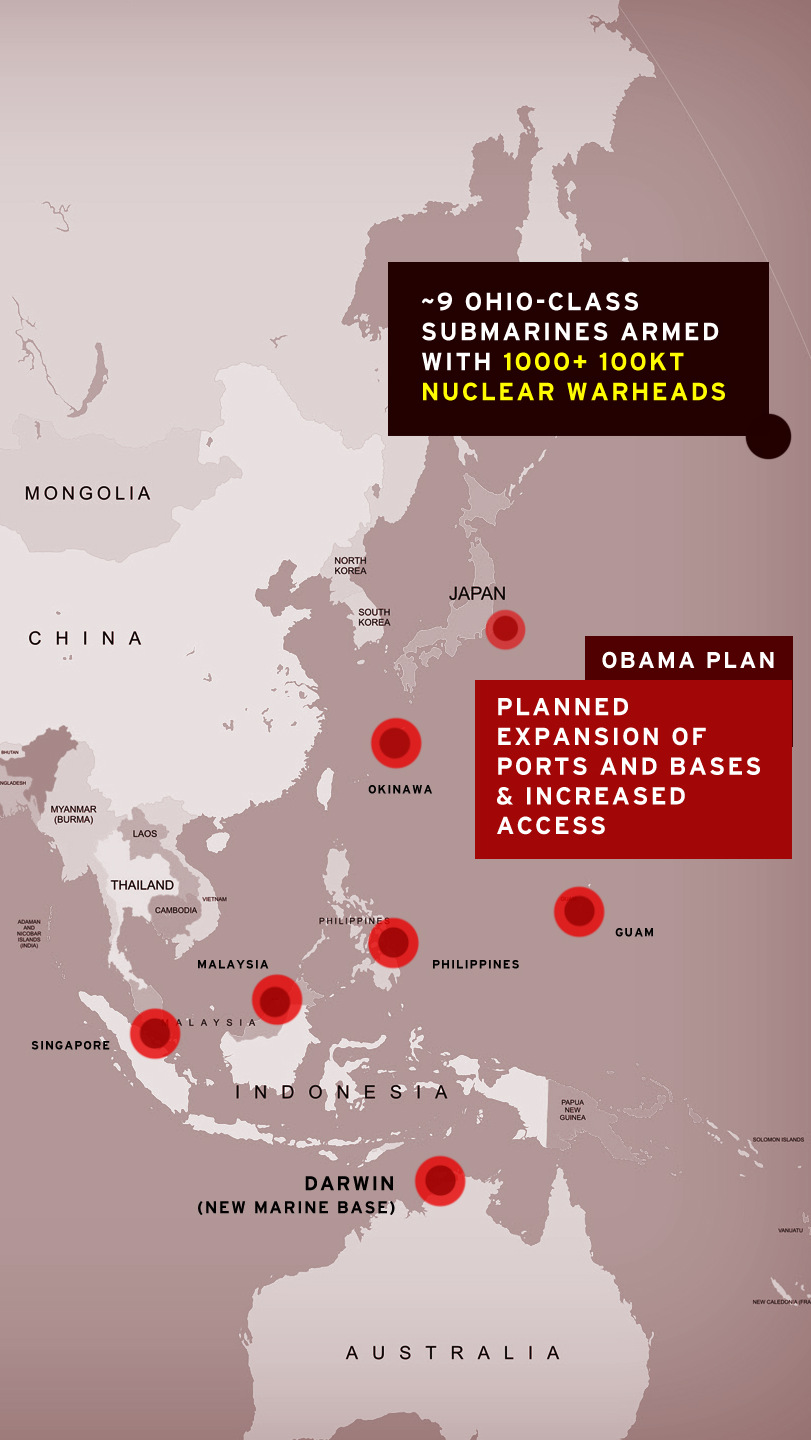
With its Asian Pivot, the U.S. intends to surround and isolate China by moving 60 percent of its Navy to the Asia-Pacific region, developing military agreements with countries there, and conducting joint military exercises with Pacific countries. The U.S. is also negotiating a massive corporate power-expanding treaty, the Trans-Pacific Partnership (TPP), which excludes China.

Map of current US military deployments in S.E. Asia.  (Courtesy of the   Copyright Schiller Institute, Inc. 2015. All Rights Reserved.)

Map of current US military deployments in S.E. Asia. (Courtesy of the Schiller Institute, Inc. 2015. All Rights Reserved.)

Vietnam has been a focal point for the U.S. military since the end of the George W. Bush administration, a prelude to the Asian Pivotthat was formally announced by President Obama. For the last five years, the U.S. and Vietnam have been involved in joint military exercises. The U.S. has also started to sell weapons to Vietnam, seeking to transition the Vietnamese from Russian weapons to American weapons. And there has been a series of high-level meetings between the two countries.

In June 2013, The Diplomat reported, “the Chairman of the U.S. Joint Chiefs of Staff hosted the first visit by the Chief of the General Staff of the Vietnam People’s Army (and Deputy Minister of National Defense), General Do Ba Ty. Ty’s delegation included the commander of Vietnam’s Air Force and the deputy commanders of the Navy and General Intelligence Department. His trip included a visit to the Joint Base Lewis-McChord in Washington state suggesting future possible joint activities.”

On July 25, 2013 Obama met with President Truong Tan Sang in Washington to form a U.S.-Vietnam Comprehensive Partnership, covering a range of concerns including war legacy and security issues. They agreed to cooperate militarily through the U.S.-Vietnam Defense Policy Dialogue and the bilateral Political, Security, and Defense dialogue to discuss future military cooperation.

That meeting was followed by two high-level meetings between the U.S. and Vietnamese militaries. On Oct. 1, 2013 they held the 6th U.S.-Vietnam Political, Security and Defense Dialogue. The U.S. delegation included representatives from the State Department, Defense Department, USAID and the U.S. Pacific Command, while the Vietnamese delegation included representatives from the foreign affairs, public security and national defense ministries. The agenda included counterterrorism, counternarcotics, human trafficking, cyber law enforcement, defense and security, disaster response, search and rescue, war legacy and cooperation in regional organizations.

On Oct. 28 to 29, 2013 a second meeting was held in Washington. The 4th U.S.-Vietnam Defense Policy Dialogue was a deputy minister-level meeting and involved officials from their respective defense ministries. The Diplomat reported that “both dialogues were held within the framework of the Memorandum of Understanding on Advancing Bilateral Defense Cooperation signed on September 19, 2011 and the U.S.-Vietnam Joint Statement of July 25, 2013.”

“What was new?” The Diplomat continued. “The two sides agreed to step up cooperation between their navies and their respective defense academies and institutions.”

Yet the Vietnamese are continuing to move slowly in building a military relationship with the U.S. Vietnam limits the U.S. Navy to one port call per year and continues to bar U.S. Navy warships from entry to Cam Ranh Bay. Further, Vietnam has yet to approve a request made by Defense Secretary Leon Panetta in June 2012 to set up an Office of Defense Cooperation in the U.S. Embassy in Hanoi.

A key factor holding back a closer military relationship is the inadequate cleanup of Agent Orange and the United States’ insufficient commitment to dealing with war legacies. After the 4th Defense Policy Dialogue, Vietnamese Deputy Defense Minister Nguyen Chi told Voice of Vietnam, “A better defense relationship should be based on the efficiency of practical cooperation, including overcoming [the] war aftermath… General speaking (sic), the U.S. has offered Vietnam active cooperation in the issue, but it is not enough as the consequences of war are terrible.”

Bloomberg reported last year on the fifth year of joint military operations, tying them to the Asian Pivot: “Two U.S. Navy ships began six days of non-combat exercises with the Vietnamese military as the U.S. seeks to bolster its presence in Asia at a time of growing tension between China and its neighbors.” Lt. Comm. Clay Doss, a Navy public affairs officer, described the evolution, saying: “The quality and depth of the exchanges is increasing each year as our navies get to know each other better.”

Chairman of the Joint Chiefs of Staff Martin Dempsey visited Vietnam in August – the first visit of a Joint Chiefs chairman since 1971. Dempsey’s trip came amid an escalation in conflicts between China and Vietnam. Among other things, he visited a U.S. military base where toxic defoliants had been stored.

In October, the U.S. eased a ban on lethal weapons sales to Vietnam. The U.S. said the arms sales would improve the maritime military capabilities of Vietnam so it could be more effective in conflicts in the Asia-Pacific region. In December 2013, Secretary of State John Kerry announced $18 million in assistance to Vietnam to provide its coast guard with five unarmed, high-speed patrol boats.

An October commentary in the People’s Daily, the flagship newspaper of China’s Communist Party, described these acts as destabilizing and “a clear extension of America’s interference with the balance of power in the region.” Maritime conflicts between Vietnam and China have been increasing as the U.S. adds military strength to Vietnam’s navy and coast guard. China maintains that disputes should be resolved through negotiations. Citing the Declaration of the Conduct of Parties in the South China Sea, the Chinese side maintains that “related countries should solve maritime disputes peacefully.”

Meanwhile, in Vietnam there are also concerns about an escalation of disputes: “Some senior Vietnam Communist Party leaders have worried over the years that moving to upgrade military-to-military ties with the US would provoke China to increase its pressure on Vietnam and its assertiveness in the South China Sea.”

In addition to challenging China, the U.S. also seeks to undermine the relationship between Vietnam and Russia. Russia, an arch rival of the U.S., has been the main weapons supplier for Vietnam since 2009. The U.S. wants to reorient Vietnam’s military away from Russia, which holds multi-billion dollar arms sales contracts with Vietnam, including the sale of submarines and fighter jets.

Sputnik, a Russian government-owned news media outlet, reported earlier this month that the U.S. “bullied” Vietnam to stop allowing Russia to use the Cam Ranh Bay naval base. The State Department says it has “urged Vietnamese officials to ensure that Russia is not able to use its access to Cam Ranh Bay to conduct activities that could raise tensions in the region.” Igor Korotchenko, director general of the Russian Center for Analysis of World Arms Trade, described the U.S. as stirring up tensions, instituting an arms race and creating regional instability.

Agent Orange funding a tool for US militarism — and what else?

A U.S. Air Force C-123 flies low along a South Vietnamese highway spraying Agent Orange on dense jungle growth beside the road to eliminate ambush sites for the Viet Cong during the Vietnam War. During the Vietnam War, Air Force C-123 planes sprayed millions of gallons of herbicides over the jungles of Southeast Asia to destroy enemy crops and tree cover.

A U.S. Air Force C-123 flies low along a South Vietnamese highway spraying Agent Orange on dense jungle growth beside the road to eliminate ambush sites for the Viet Cong during the Vietnam War. During the Vietnam War, Air Force C-123 planes sprayed millions of gallons of herbicides over the jungles of Southeast Asia to destroy enemy crops and tree cover.

The Vietnamese government told the U.S. that one thing preventing a closer relationship between the U.S. and Vietnamese militaries is the failure of the U.S. to deal with the lasting effects of Agent Orange. After 50 years of the Agent Orange crisis the U.S. is finally beginning to fund some cleanup efforts. This funding is coming from USAID, which has a sordid history of serving as a cover for U.S. militarism and the CIA in Vietnam and around the world.

In William Blum’s 2004 book “Killing Hope,” John Gilligan, director of USAID under the Carter administration, describes the depth of the CIA-USAID relationship: “At one time, many AID [USAID] field offices were infiltrated from top to bottom with CIA people. The idea was to plant operatives in every kind of activity we had overseas, government, volunteer, religious, every kind.”

Likewise, The Washington Post reported in 2010 that, “In South Vietnam, the USAID provided cover for CIA operatives so widely that the two became almost synonymous.”

During the Vietnam War, USAID operated a police training program that was tied to death squadsFormer New York Times correspondent A. J. Langguth wrote that “the two primary functions” of the USAID police training program were to allow the CIA to “plant men with local police in sensitive places around the world,” and bring to the U.S. “prime candidates for enrollment as CIA employees.”

The covert role of USAID has persisted. As The Washington Post reported in 2010, then-CIA Director Leon Panetta promised spies “new cover” for secret ops, and agencies that provide such cover include USAID and the State Department.

USAID has recently used health crises as cover for its covert operations. In 2011, Pakistan had a polio crisis, recording the highest number of polio cases in the world; it was a spiraling health catastrophe. USAID used a vaccination program organized by Save the Children, which had operated for 30 years in Pakistan, as cover to find Osama bin Laden.

The USAID-funded vaccination program used a Pakistani doctor and a local group, Lady Health Workers, to gain entrance to bin Laden’s home by going door-to-door to administer vaccinations. When vaccinations were administered to bin Laden’s children and grandchildren USAID tested the DNA of the used needles. It is likely that the doctor and two organizations were not aware they were being used by USAID. Save the Children staff members were expelled from Pakistan and the doctor was sentenced to 33 years in prison. His lawyer was murdered last week, and 74 health care workers have been killed since December 2012.

Last year, The Associated Press uncovered a USAID HIV-prevention program in Cuba used for covert operations. Beginning in October 2009, USAID, working through the Washington-based Creative Associates International, sent “Venezuelan, Costa Rican and Peruvian young people to Cuba in hopes of ginning up rebellion. The travelers worked undercover, often posing as tourists, and traveled around the island scouting for people they could turn into political activists.” They created an HIV-prevention workshop that “memos called ‘the perfect excuse’ for the program’s political goals.” Cuba uncovered the covert mission when the youth were questioned about their funding.

David Shear Nguyen Chi VinhU.S. Ambassador to Vietnam David Shear, center, and Vietnam’s Deputy Defense Minister Nguyen Chi Vinh, third left, along with delegates, attend a ceremony marking the start of a project to clean up dioxin left over from the Vietnam War, at a former U.S. military base in Danang, Vietnam Thursday Aug. 9, 2012. 

Noting that USAID has “a long history of engaging in intelligence work and meddling in the domestic politics of aid recipients,” Foreign Policy reported on another USAID program in Cuba, also exposed in 2014, where USAID covertly launched a social media platform in 2010, creating a Twitter-like service that would spark a “Cuban Spring.” The digital Bay of Pigs failed to spark a revolt, but it did expose the political leanings of 40,000 Cubans. This was reportedly not a CIA project, but a USAID project meant to undermine the Cuban government. Indeed, USAID has evolved to carry out its own meddling in the affairs of governments.

A 2006 State Department cable, released by WikiLeaks in 2013, outlined the United States’ strategy for undermining the Venezuelan government of Hugo Chávez by “Penetrating Chavez’ Political Base,” “Dividing Chavismo,” and “Isolating Chavez internationally.” The same office responsible for the digital Bay of Pigs in Cuba, USAID’s Office of Transition Initiatives, also carried out the program in Venezuela.

Bolivia expelled USAID in 2013 because it was meddling in Bolivian politics. President Evo Morales was upset that USAID money reached lowland regional governments that attempted to overthrow him in 2008. A Freedom of Information Act (FOIA) request showed that USAID provided “$10.5 million for ‘democracy-building’ awarded to Chemonics International in 2006 ‘to support improved governance in a changing political environment.’” (Democracy development is a common cover for programs to foment rebellion.)

Bolivia is one of the many countries that have recently expelled USAID over the organization’s meddling in internal politics. The Los Angeles Times reported in 2013 that “about 50 countries have adopted laws to limit foreign funding of civic groups or more strictly control their activities. About 30 other countries are considering restrictions.”

Meanwhile, U.S. covert actions in Vietnam have not ended. A blogger and lawyer who spent a year in the U.S. as a fellow the National Endowment for Democracy was arrested in December 2012 for pro-democracy activities. The National Endowment for Democracy has been providing hundreds of thousands of dollars to various Vietnamese projects related to changing the government in recent years. USAID has a major presence with 38 ongoing projects in Vietnam.

It may be that regime change activities are already beginning in Vietnam. In 2014, there were large anti-China protests and attacks on Chinese businesses in Vietnam. Some speculated that the Vietnamese government was behind the protests, but David Koh, a reporter for Singapore’s Straits Times, who works with NGOs in Vietnam, interviewed officials and businessmen in Vietnam and reported that the government was surprised by the protests.

The protests were also against economic conditions and other issues in Vietnam, and it remains unclear who planned and funded the events. Researchers in Singapore who interviewed people on the ground in Vietnam wrote:

“A large number of Vietnamese flags and T-shirts had been purchased before the demonstrations suggesting that the attacks were not spontaneous. Even maps locating Chinese and Taiwanese factories had been photocopied in large numbers. The leaders of the riots have been reported to have been using walkie-talkies to communicate with each other. The fact that the violence affected as many as 200 factories in a single day already suggests that a high level of professionalism and organization was involved. This suggests that the riots were premeditated, although unlike the earlier peaceful demonstration of the patriots, they were not announced openly. Workers were believed to receive from VND50,000 to VND300,000 VND (equivalent to US$2.3 to US$14) to follow the agitators. This begs the question: where did the money come from?”

It’s important to note that people were paid more than a day’s labor to participate.

The Singapore researchers ultimately concluded that the Vietnamese government was the big loser:

“However, for now, the notion that the riots and violence were simply the result of a wave of blind nationalism and anti-Chinese sentiments must be re-examined. The current crisis presents major challenges for not only Vietnam-China relations, regional stability and ASEAN’s unity, but most of all, for Vietnam’s political system.”

Agent Orange Trojan Horse compounds war crimes

In addition to opening up Vietnam to a deeper relationship with the U.S. military – which is dangerous enough for Vietnam, China, Russia and the broader Asia-Pacific region – what else will USAID do with its foothold in Vietnam? As USAID so routinely involves itself in the affairs of foreign governments, it would be foolish to assume that USAID does not have other plans for Vietnam.

Rather than paying war reparations, the U.S. is using Agent Orange as a Trojan Horse to further U.S. militarization in Vietnam, escalate conflict with China and break the Vietnamese relationship with Russia. It may also be laying the groundwork for regime change if Vietnam does not comply as a tool of U.S. empire.

Vietnam should continue to demand war reparations that are adequate for the problems the U.S. created and keep the U.S. military at arm’s length. Vietnam should kick out USAID and the National Endowment for Democracy, and demand that payments be made directly to Vietnam to keep U.S. meddling out of their country. Indeed, the U.S. should not be allowed to leverage the war crime of its use of Agent Orange as a tool for more U.S. militarism and intervention.

Agent Orange Funding Opens Door To US Militarism And Covert Action In Vietnam

http://www.globalresearch.ca/agent-orange-funding-opens-door-to-us-militarism-and-covert-action-in-vietnam/5438809


A veia terrorista de Barack Obama

English translation: https://freeukrainenow.org/2015/03/25/the-terrorist-vein-of-barack-obama/

Resistir.info
por José Goulão
13/Março/2015

Depois de ter herdado, de início com algum pudor e sob outras designações, a guerra contra o terrorismo inventada pelo seu antecessor, Barack Obama não se limita a igualar George W. Bush no recurso a práticas terroristas como, em alguns casos – e não apenas o do record mundial de execuções extra judiciais cometidas com drones – consegue ultrapassá-lo.

A situação mais flagrante, e que contribuiu para demonstrar como os Estados Unidos são governados por um partido único, porque em matéria de violações dos direitos humanos não há quem consiga distinguir um democrata de um republicano, é a da proliferação de ameaças, tentativas e execuções de golpes de Estado.

No reinado de Obama a série faz corar de inveja alguns dos mais empedernidos falcões que passaram pela Casa Branca: Honduras, Paraguai, Ucrânia, Macedónia, Egipto, Qatar, Síria, Líbia, Iraque, Mali, República Centro Africana e, como não podia deixar de ser, Venezuela.

O assunto venezuelano poderá ter passado quase despercebido. Foi escondido para com isso se tentar abadar o fracasso da intentona, ou então explicado ao contrário através dos mecanismos censórios doutrinários que caricaturam o papel da comunicação social.

O golpe esteve marcado para 12 de Fevereiro, tentando reeditar a tragédia chilena de 1973, mas as autoridades venezuelanas anteciparam-se e puseram a nu um contexto através do qual se prova que em Washington não se olha a princípios nem a meios para alcançar os fins pretendidos, sempre apresentados, como é de bom-tom, como a instauração da democracia onde supostamente ela não existe.

Nesse dia 12 de Fevereiro, no quadro da chamada “Operação Jericó”, um bombardeiro Tucano ENB 312, já anteriormente envolvido num atentado contra dirigentes das FARC colombianas, deveria ter bombardeado o palácio presidencial de Caracas, a Assembleia Nacional, instalações da ALBA e a televisão TeleSur para instaurar um “governo de transição” a entregar a reconhecidos fascistas como António Ledezma, significativamente conhecido como “o vampiro”, Maria Corina Machado e Leopoldo Lopez. O avião, pintado com as cores da aviação venezuelana, pertence a um bando de mercenários integrado na máfia mundial dos exércitos privados e empresas de segurança que dá pelo nome de Academi e outrora se chamou Blackwater – de que todos já ouviram falar como um dos mais activos braços terroristas na invasão do Iraque. Empresa onde pontificam um ex-patrão da NSA (Agência Nacional de Segurança) e o ex-procurador geral da Administração Bush.

A trama da intentona conduz ao quartel-general de operações em Bogotá e ao comandante da operação, Ricardo Zuñiga, assessor de Barack Obama para a América Latina e também, porque quem sai aos seus não degenera, neto do presidente do Partido Nacional das Honduras que organizou os golpes fascistas de 1963 e 1972. Acresce que Washington recorreu a outsorcing para montar a operação, atribuindo ao Canadá a gestão dos aeroportos civis a utilizar, ao Reino Unido a propaganda e ao Mossad israelita as eliminações físicas consideradas necessárias. Ledezma, o “vampiro”, viajara recentemente a Israel, onde foi recebido afectuosamente por Netanyahu, Lieberman & Cia.

Como o golpe falhou e foi desmascarado, em 9 de Março Barack Obama accionou o estatuto que lhe permite declarar a Venezuela “uma ameaça contra a segurança nacional” dos Estados Unidos, previsto para os casos em que exista “uma extraordinária e invulgar ameaça à segurança nacional e à política externa, situação que deve ser tratada como uma emergência nacional”. Isto é, Barack Obama instaurou a estratégia terrorista de golpe de Estado permanente contra a Venezuela, alegando a corrupção dos dirigentes de Caracas e a violação dos preceitos democráticos.

Ironia do destino, um dos escolhidos para o tal “governo de transição”, o supracitado “vampiro” Ledezma, em tempos autor do “Caracazo”, massacre de centenas de estudantes que protestavam contra a austeridade, é o governador da região de Caracas, eleito através dos mecanismos de um regime que ele próprio e os seus tutores não consideram democrático.

Eis como Obama em nada se distingue dos mais tenebrosos falcões que passaram pela Casa Branca. Anote-se, por ser verdade, que na Venezuela, na Ucrânia, na Macedónia e onde quer que tal lhe convenha, o presidente dos Estados Unidos não tem qualquer pudor em recorrer a dirigentes e grupos de assalto nazi-fascistas desde que seja, ele o diz, para instaurar a democracia.

[*] Jornalista.

O original encontra-se em jardimdasdelicias.blogs.sapo.pt/a-veia-terrorista-de-barack-obama-748181

Este artigo encontra-se em http://resistir.info/ .
http://www.resistir.info/venezuela/goulao_13mar15.html     

The terrorist vein of Barack Obama

Vein: a distinctive quality, style, or tendency.

synonyms: mood, frame of mind, temper, disposition, attitude, tenor, tone, key, spirit, character, fashion, feel, flavor, quality, atmosphere, humor, manner, mode, way, style

From resistir.info
By José Goulão
March 13, 2015
Rough translation of original article in Portuguese

Once you have inherited, at first with some modesty and under other names, the war against terrorism invented by his predecessor, Barack Obama is not limited to match George W. Bush in the use of practices of terrorism as in some cases – not just the world record of extrajudicial killings with drones – he can surpass it.

The most egregious situation, and contributing to demonstrate how the United States is governed by a single party, because in matters of human rights violations no one can distinguish a Democrat from a Republican, is the proliferation of threats, attempts and execution of coups d’etat.

In the reign of Obama the series makes blush with envy some of the most hardened hawks that passed in the White House: Honduras, Paraguay, Ukraine, Macedonia, Egypt, Qatar, Syria, Libya, Iraq, Mali, Central African Republic and, it could not be, Venezuela.

The subject Venezuelan may have passed almost unnoticed. It was hidden for with this if you try abadar the failure of the putsch, or explained to the contrary by the doctrinal censorial mechanisms that caricature the role of the media.

The coup was scheduled for February 12, trying to re-edit the Chilean tragedy of 1973 but the Venezuelan authorities anticipated up and laid bare a context through which it proves that Washington does not look at the beginning nor the means to achieve the purposes intended, always presented, as good manners, as the establishment of democracy which supposedly does not exist.

On this day February 12, as part of “Operation Jericho,” a Tucano ENB 312 bomber, already involved in an attack against the Colombian FARC leaders, should have bombed the presidential palace in Caracas, the National Assembly, ALBA facilities and the Telesur television to establish a “transitional government” to deliver the fascists recognized as Antonio Ledezma, significantly known as the “vampire”, Maria Corina Machado and Leopoldo Lopez. The plane, painted with the colors of the Venezuelan aviation, belongs to an integrated band of mercenaries in the world mafia of private armies and security companies by the name of Academi and once was called Blackwater – that everyone has heard one of the most active terrorist arms in the invasion of Iraq. Company where pontificate a former boss of the NSA (National Security Agency) and the former attorney general of the Bush administration.

The plot of the putsch leads to the headquarters operations in Bogota and the operation commander, Ricardo Zuñiga, an adviser to Barack Obama for Latin America and also because those who leave with their non-degenerate, president of the grandson of the Honduras National Party that organized the fascist coups of 1963 and 1972. Moreover, Washington resorted to outsourcing to mount the operation, giving Canada the management of civil airports to use, the UK advertising and the Israeli Mossad physical deletions deemed necessary. Ledezma, “vampire”, recently traveled to Israel, where he was received warmly by Netanyahu, Lieberman & Cia.

As the coup failed and was exposed, on 9 March Barack Obama triggered the statute that allows you to declare Venezuela a “threat to national security” of the United States, provided for cases where there is “an extraordinary and unusual security threat national and foreign policy, a situation that should be treated as a national emergency.” That is, Barack Obama brought the terrorist strategy of permanent coup against Venezuela, claiming the corruption of leaders of Caracas and the violation of democratic principles.

Ironically, one of the chosen for such a “transitional government”, the aforementioned “vampire” Ledezma in time author of the “Caracazo” massacre of hundreds of students protesting against austerity, is the governor of the region of Caracas, elected through the mechanisms of a system that he and his tutors do not consider democratic.   Here’s how Obama is no different of the darkest hawks passed by the White House. Record yourself, to be true, that in Venezuela, Ukraine, Macedonia and wherever such suits him, the US president has no qualms about resorting to leaders and Nazi-fascist assault groups provided that, he says, it is to introduce democracy.


Original source: jardimdasdelicias.blogs.sapo.pt/a-veia-terrorista-de-barack-obama-748181

http://www.resistir.info/venezuela/goulao_13mar15.html

War Reparations and Germany’s 1952 Debt Reduction Plan

This is in addition to the huge sums that Germany owes Greece.

Posted on Global Research
Committee for the Abolition of Third World Debt
5 March 2015
by Oscar Ugarteche

The largest debt problems in terms of GDP faced in financial history have belonged either to the United States or to European Governments. Large debt problems in developing and emerging nations have usually stemmed out of a drop in GDP size due to a fall in export earnings and a rise in interest rates. The reason is that creditors stop lending at a certain point and start restructuring existing debt which leads to debt growth but it is not really new lending. In major nations, lending goes on as the strategic reason for borrowing has normally been justified: a war. As a result, the leading debt reduction and innovative management schemes are related to these.

Contrary to the impression generated by extensive works on the Latin American and African debt, it is the under researched European and US historical debt that must be looked into in order to understand some historical solution patterns to debt problems. Current European very high debt levels (over 90% of GDP) are due partially to accumulated current account deficits of over 3% of GDP for over a decade plus the cost of bank rescues in 2009-2010 plus some countercyclical policy costs. Greece has additional debt due to major infrastructure works. It entered the Euro with a high debt level (around 100% of GDP) but the total GDP amount shrunk 33.3% from 55,318 million euros to 36,866 million euros in constant terms between 2007 and 2013 as a result of austerity policies. |1| If GDP had remained stagnant, the index would be 131% and not 174.9% and rising.

Historically the debt that arose from the Confederate States of the United States was not recognised by the US Federal Government and was subject to complicated negotiations with British private bondholders until the late 1920’s when it was finally agreed that it would not be repaid. (Corporation of Foreign Bondholders, First Annual Report of the Council, London, February, 1904 and Fifty Seventh Annual of the Council, London, 1930) What was agreed finally in the League of Nations was that State debts have always to be guaranteed by the National Governments in order for creditors to be able to collect their debts.

The debt discussion revived after WWI, as the European war was financed locally in each country and internationally by the United States from 1915 onwards. This implied two things: first, the UK borrowed from the United States and onlent to third parties; and secondly the warring countries additionally borrowed directly from the US. At the end of the war this had to be solved somehow in order for those countries to recover growth. This is dealt with in H. Fisk’s The Inter Ally Debts. An Analysis of War and Post War Public Debts. New York, Banker’s Trust, 1924. Germany was not able to float bonds in New York after the War was declared so they only borrowed in Marks and dealt with through hyperinflation that did away with most of its value in 1922-1923.

Another aspect of the German debt was the introduction of reparation payments that although just from an ethical point of view, were extremely large for the economic capacity of the country as Keynes pointed out in his Economic Consequences of the Peace. According to Professor Albrecht Ritschl |2| from the LSE Germany managed to keep afloat borrowing money from the US during the 1920’s. The two largest loans are the Dawes Plan and the Young Plan but there were other loans adding up to 840.7 million dollars in 1939. The Young Plan contained massive debt reduction. Reparations payments were never met in full in the 1920’s and were suspended in 1932. They were reinitiated in 1990 without any readjustment in value after the reunification. The last quota was paid in 2010. |3|

In October 1929, U.S. President Hoover, under pressure from US academia, announced the creation of a Hoover Year that was meant to restructure debts payments due from July 1, 1931 to June 30, 1932, into ten yearly quotas. The mechanism would be in place as long as it was needed. The object was to relieve the UK from its payments to the US and to transfer this benefit on to the other allies that in turn would transfer them to German reparations. This relief was later eschewed by Chancellor Hitler who, after winning the elections, declared a debt cease payment in June 1933.

After WWII, in May 1951 a tripartite commission was formed by the US. UK and France in order to discuss post war and pre war debts. All creditors met in London in July 1951 to see what to do with the German debts and the solution proposed by Germany and widely accepted by the US and UK was that as Germany was divided into two, the debt would have to be divided equally and only 50% of the total public debt would be negotiated. Reparations would not be restored until after reunification. The other half would be left for negotiations also after the reunification, someday.

The Tripartite Commission announced that they were prepared to make important concessions in terms of the amounts and priorities of their claims some referred to post war assistance (1945-1951), making it clear that post war debts were conditioned by satisfactory and equitable agreement on pre-war debt. The amounts owed in 1939 were: 840.7 million dollars, 51.5 million pounds and 2,775.2 million French Francs, to name the debts of the leading three creditors. In 1939 constant US dollars the equivalent would be 206 billion dollars.

This plus the debt to the other 67 countries was reduced first by 50% and then the remaining 50% was reduced by half and made payable over a 25 year period (1953 to 1979). More interestingly, when the German unification finally came about, The German Federal Government demanded that the winning countries (of WWII) do not place a debt burden on the defeated countries, I.E. on East Germany. If they had respected the 1953 London agreement it would have meant recognising the other 50% of the debt and doping something with it. Instead, Germany was given a massive debt reduction in exchange for restoring reparations payments without any adjustment in value.

The German people should be grateful and remember the massive debt reductions and the concessional terms it received in time of need and despair after World War II. No one at the time either in the US, UK nor France, to name the three largest creditors, said “the taxpayers were unwilling to bail out those people.” History serves a purpose and we should all learn from it.

Source : Alainet

Oscar Ugarteche, a Peruvian economist, is the Coordinator of the Observatorio Económico de América Latina (OBELA), IIE-UNAM, Mexico – www.obela.org. Member of the SNI/Conacyt and president of ALAI. His most recent book is Arquitectura Financiera Internacional: una Genealogía de 1850-2008, México DF., IIEC-UNAM, 2014. 392pp. The material presented here uses that source except when stated otherwise.

http://cadtm.org/The-Debt-Reduction-Germany

http://www.globalresearch.ca/war-reparations-and-germanys-1952-debt-reduction-plan/5438502

IMF: Ukraine must now steal $1.5 Billion+ from Russia to buy weapons

Originally from Deutsche Wirtschafts Nachrichten
March 24, 2015
Posted on Global Research

IMF: Ukraine will not pay back [part of] its debts to Russia

German Economic News  |  Published: 03/24/15 00:25 clock [Translation, and interspersed notes, by Eric Zuesse.]

In December, a multi-billion-dollar loan [variously stated as $3-$3.5 billion] to Ukraine comes due, which Ukraine had received from Russia. The IMF has provided a new debt plan, however, dictating that existing loans to Ukraine that have an expiration-date are to be subjected to a haircut. Thus, the resource gap of the country totaling $40 billion is to be reduced.

Since the crisis, Ukraine has received several loans from the IMF and the EU [and the U.S.]. These loans must be repaid in a few years from now. However, the financial situation of the country remains vulnerable. Over the next four years overdue loans totaling $15 billion need to be paid [they’re mostly loans from Russia]. Only three billion of them are an old loan Russia that has to be paid in December of this year. The IMF might prevent it [from being repaid in full, even though it has seniority over the new loans that are coming from the West].

The IMF has developed a program for Ukraine, under which the current financial hole is to be filled in the amount $40 billion. The due debts [the senior debt] are part of the plan, and will be restructured, according to the IMF. Exactly how it is to happen, the IMF does not explain. Experts say that the IMF believes that Russia should participate in a haircut. The Financial Times reports [“Bailout projections indicate Ukraine will not repay Russia debt” 5:21 PM, 22 March 2015] that the IMF requires that Russia’s $3.5 billion bond issue be included in the restructuring. Charles Blitzer, a former IMF employee, has informed the FT of this.

However, Blitzer is uncertain how large the haircut will be. ”It is up to the Ukrainian authorities to determine the extent and nature of the debt restructuring,” he said. [In other words: the IMF will grant Ukraine the right to determine how much of that $3-3.5B will be repaid to Russia. The Kyiv Post puts it this way: “Kyiv does not intend to fully repay a $3 billion bond owed to Russia this year according to official projections underpinning Ukraine’s new international bailout, say credit experts.”] Government sources close to the matter estimate that there will be a planned debt reduction of 50 percent. ”But creditors would rather try to agree on a term extension,” said Blitzer.

Whether all international creditors will accept a haircut, and if so, to what extent, is not yet clear. Last week, Russian Finance Minister Anton Siluanow said that Russia still expects that the $3.5B debt will be repaid this December in full. And Franklin Templeton [Funds], the largest bondholder of Ukraine, has brought in Blackstone legal help for debt negotiations.

Last week, the Ukrainian Finance Minister [the American] Natalija Jaresko told the WSJ that so far pledged loans to Ukraine [$40B] will not be enough to bring Ukraine back onto its feet. ”The package will stabilize the banking system, but it is not enough to seriously re-stimulate growth,” said Jaresko. ”I need more support.” She said that no nation currently pays more to protect the entire world from a nuclear power [Russia] than does Ukraine, and that, “if our partners, for whatever reason, are not able to assist us with defensive military means, then they should provide us more financial assistance [so that we can buy the weapons against Russia ourselves].”

This past Friday, the Ukrainian central bank had to explain why three of Ukraine’s banks were being declared insolvent. The VAB Bank, Astra Bank and the City Commerce Bank are now deprived of their licenses. At the same time, Ukraine is already planning an expansion of military resources. In sum, for the year of 2015, a total of $3.8 billion will be spent on armaments. [This by a country that cannot even pay its bondholders, when all of the new Ukrainian bonds are actually paying only for Ukraine’s war against the residents of its own former Donbass region.]

Investigative historian Eric Zuesse is the author, most recently, of  They’re Not Even Close: The Democratic vs. Republican Economic Records, 1910-2010, and of CHRIST’S VENTRILOQUISTS: The Event that Created Christianity, and of Feudalism, Fascism, Libertarianism and Economics.

http://www.globalresearch.ca/imf-ukraine-must-now-steal-1-5-billion-from-russia-to-buy-weapons/5438508

The West won’t admit: Crimeans still saying no to Ukraine

From Consortium News, March 22, 2015
By Robert Parry

A central piece of the West’s false narrative on the Ukraine crisis has been that Russian President Vladimir Putin “invaded” Crimea and then staged a “sham” referendum purporting to show 96 percent support for leaving Ukraine and rejoining Russia. More recently, Assistant Secretary of State Victoria Nuland claimed that Putin has subjected Crimea to a “reign of terror.”

Both elements have been part of the “group think” that dominates U.S. political and media circles, but this propagandistic storyline simply isn’t true, especially the part about the Crimeans being subjugated by Russia.

Consistently, over the past year, polls conducted by major Western firms have revealed that the people of Crimea by overwhelming numbers prefer being part of Russia over Ukraine, an embarrassing reality that Forbes business magazine has now acknowledged.

An article by Kenneth Rapoza, a Forbes specialist on developing markets, cited these polls as showing that the Crimeans do not want the United States and the European Union to force them back into an unhappy marriage with Ukraine. “The Crimeans are happy right where they are” with Russia, Rapoza wrote.

“One year after the annexation of the Ukrainian peninsula in the Black Sea, poll after poll shows that the locals there — be they Ukrainians, ethnic Russians or Tartars are all in agreement: life with Russia is better than life with Ukraine,” he wrote, adding that “the bulk of humanity living on the Black Sea peninsula believe the referendum to secede from Ukraine was legit.”

Rapoza noted that a June 2014 Gallup poll, which was sponsored by the U.S. government’s Broadcasting Board of Governors, found that 82.8 percent of Crimeans said the March 16 referendum on secession reflected the views of the Crimean people. In the poll, when asked if joining Russia would improve their lives, 73.9 percent said yes and only 5.5 percent said no.

A February 2015 poll by German polling firm GfK found similar results. When Crimeans were asked “do you endorse Russia’s annexation of Crimea,” 93 percent gave a positive response, with 82 percent saying, “yes, definitely.” Only 2 percent said no, with the remainder unsure or not answering.

In other words, the West’s insistence that Russia must return Crimea to Ukraine would mean violating the age-old U.S. principle of a people’s right of self-determination. It would force the largely ethnic Russian population of Crimea to submit to a Ukrainian government that many Crimeans view as illegitimate, the result of a violent U.S.-backed coup on Feb. 22, 2014, that ousted elected President Viktor Yanukovych.

The coup touched off a brutal civil war in which the right-wing regime in Kiev dispatched neo-Nazi and other extremist militias to spearhead a fierce “anti-terrorism operation” against resistance from the ethnic Russian population in the east, which – like Crimea – had supported Yanukovych. More than 6,000 Ukrainians, most of them ethnic Russians, have been killed in the fighting.

Despite this reality, the mainstream U.S. news media has misreported the crisis and distorted the facts to conform to U.S. State Department propaganda. Thus, many Americans believe the false narrative about Russian troops crushing the popular will of the Crimean people, much as the U.S. public was misled about the Iraq situation in 2002-03 by many of the same news outlets.

Or, as Forbes’ Rapoza put it: “At some point, the West will have to recognize Crimea’s right to self rule. Unless we are all to believe that the locals polled by Gallup and GfK were done so with FSB bogey men standing by with guns in their hands.” The FSB is a Russian intelligence agency.

The GfK survey also found that Crimeans considered the Ukrainian media, which has been wildly anti-Russian, unreliable. Only 1 percent said the Ukrainian media “provides entirely truthful information” and only 4 percent said it was “more often truthful than deceitful.”

So, the people at the frontline of this conflict, where Assistant Secretary Nuland, detected a “reign of terror,” say they are not only satisfied with being restored to Russia, which controlled Crimea since the 1700s, but don’t trust the distorted version of events that they see on Ukrainian TV.

Practical Reasons

Some of the reasons for the Crimean attitudes are simply pragmatic. Russian pensions were three times larger than what the Ukrainian government paid – and now the Ukrainian pensions are being slashed further in compliance with austerity demands from the International Monetary Fund.

This month, Nuland boasted about those pension cuts in praising the Kiev regime’s steps toward becoming a “free-market state.” She also hailed “reforms” that will force Ukrainians to work harder and into old age and that slashed gas subsidies which helped the poor pay their heating bills.

Last year, the New York Times and other U.S. news outlets also tossed around the word “invasion” quite promiscuously in discussing Crimea. But you may recall that you saw no images of Russian tanks crashing into the Crimean peninsula or an amphibious landing or paratroops descending from the skies. The reason was simple: Russian troops were already in Crimea.

The Russians had a lease agreement with Ukraine permitting up to 25,000 military personnel in Crimea to protect the Russian naval base at Sevastopol. About 16,000 Russian troops were on the ground when the Feb. 22, 2014 putsch occurred in Kiev – and after a crisis meeting at the Kremlin, they were dispatched to prevent the coup regime from imposing its control on Crimea’s people.

That Russian intervention set the stage for the March 16 referendum in which the voters of Crimea turned out in large numbers and voted overwhelmingly for secession from Ukraine and reintegration with Russia, a move that the Russian parliament and President Putin then approved.

Yet, as another part of its false reporting, the New York Times claimed that Putin denied that Russian troops had operated inside Crimea – when, in fact, he was quite open about it. For instance, on March 4, 2014, almost two weeks before the referendum, Putin discussed at a Moscow press conference the role of Russian troops in preventing the violence from spreading from Kiev to Crimea. Putin said:

“You should note that, thank God, not a single gunshot has been fired there. … Thus the tension in Crimea that was linked to the possibility of using our Armed Forces simply died down and there was no need to use them. The only thing we had to do, and we did it, was to enhance the defense of our military facilities because they were constantly receiving threats and we were aware of the armed nationalists moving in. We did this, it was the right thing to do and very timely.”

Two days after the referendum, which recorded the 96 percent vote in favor of seceding from Ukraine and rejoining Russia, Putin returned to the issue of Russian involvement in Crimea. In a formal speech to the Russian Federation, Putin justified Crimea’s desire to escape the grasp of the coup regime in Kiev, saying:

“Those who opposed the [Feb. 22] coup were immediately threatened with repression. Naturally, the first in line here was Crimea, the Russian-speaking Crimea. In view of this, the residents of Crimea and Sevastopol turned to Russia for help in defending their rights and lives, in preventing the events that were unfolding and are still underway in Kiev, Donetsk, Kharkov and other Ukrainian cities.

“Naturally, we could not leave this plea unheeded; we could not abandon Crimea and its residents in distress. This would have been betrayal on our part.”

But to make it appear that Putin was denying a military intervention, the Times and other U.S. news outlets truncated Putin’s statement when he said, “Russia’s Armed Forces never entered Crimea.” The Western press stopped there, ignoring what he said next: “they were there already in line with an international agreement.”

Putin’s point was that Russian troops based in Crimea took actions that diffused a possibly violent situation and gave the people of Crimea a chance to express their wishes through the ballot. But that version of events didn’t fit with the desired narrative pushed by the U.S. State Department and the New York Times. So the problem was solved by misrepresenting what Putin said.

But the larger issue now is whether the Obama administration and the European Union will insist on forcing the Crimean people – against their will – to rejoin Ukraine, a country that is rapidly sliding into the status of a failed state and a remarkably cruel one at that.

Investigative reporter Robert Parry broke many of the Iran-Contra stories for The Associated Press and Newsweek in the 1980s. You can buy his latest book, America’s Stolen Narrative, either in print here or as an e-book (from Amazon andbarnesandnoble.com). You also can order Robert Parry’s trilogy on the Bush Family and its connections to various right-wing operatives for only $34. The trilogy includes America’s Stolen Narrative. For details on this offer, click here.

Crimeans Keep Saying No to Ukraine

http://www.globalresearch.ca/crimeans-keep-saying-no-to-ukraine/5438563

NATO commander urges warfare against “the false narrative”

The false narrative — such a disruptive,  murderous force which can destroy nations.

Commander Breedlove is right: The way to attack the false narrative is to drag the false narrative into the light and expose it.

The problem is that he is peddling the false narrative, not someone else. More and more people realize this and are exposing it. Factual, accurate narratives love the light, and that’s what Breedlove wants to eliminate — the truth. So, though he uses the language of truth and of honor, what he actually proposes is something very different. He says it is necessary to wage war on this information.

It’s increasingly difficult to “sell” the US/Pentagon/NATO false narrative as true. They can do it with higher volume, by slander and libel, and by trying to eliminate any fact-based narratives.

There will be more computer and website attacks, greater pressure put on the mainstream media to keep out any contrary narrative, political pressures and laws, personal attacks, and probably physical attacks in the myriad ways which the military has at their disposal. Anyone espousing “Russia’s” position will be targeted.

The truth and everyone telling the truth have become the enemy to Commander Breedlove and his allies. What they want, they intend to get if at all possible. However, truth does shine brightly, along with the  people who share it.

It is critical now more than ever to give information to as many as we can in as many ways as we can.

Posted by Rick Rozoff

Ukrinform
March 23, 2015
Breedlove urges West to start information warfare with Russia

images

KYIV: The western countries, primarily the NATO member states, should engage in the informational confrontation with aggressive Russian propaganda.

NATO Supreme Allied Commander Europe Philip Breedlove said this in Brussels on Sunday, Ukrinform reports.

“We need as a western group of nations or as an alliance to engage in this informational warfare. The way to attack the false narrative is to drag the false narrative into the light and expose it,” Breedlove said.

https://rickrozoff.wordpress.com/2015/03/23/top-nato-commander-calls-for-information-warfare-against-Russia/

NATO ready to consider Ukraine bid for membership: Stoltenberg

From Rick Rozoff

Ukrinform
March 21, 2015
NATO ready to consider Ukraine’s bid for membership

images

KYIV: NATO is ready to consider the Ukraine’s bid for membership in the alliance, if Ukraine decides to submit it.

This has been stated by NATO Secretary General Jens Stoltenberg in Brussels at the forum organized by the German Marshall Fund.

“It is up to Ukraine decide whether to submit the bid for NATO membership or not. Ukraine should decide that. If it submits, we will consider the application in the same way as we consider the application of any other country,” Ukrainian media telegraf.com.ua quotes him.

In 2015, the units and the individual officers of the Armed Forces of Ukraine will take part in 237 events of the individual partnership program [Individual Partnership Action Program] with NATO.

https://rickrozoff.wordpress.com/2015/03/21/nato-ready-to-welcome-ukraine-as-full-member-Stoltenberg/