On the 58th Anniversary of the Iraqi Revolution. The 1958 Revolution ended four decades of British domination

It became clear that regime change could only be achieved by a military invasion.

After a protracted public relations campaign—demonizing Saddam Hussein and other Iraqi leaders, attempting to link Iraq to the Sept. 11 attack, fabricating claims that Iraq had “weapons of mass destruction,” including nuclear weapons—U.S. and British forces invaded Iraq on March 19, 2003.

How many times will Americans allow this to go on?

Global Research, July 15, 2016
Liberation 13 July 2016
iraqi-forces

This article was originally published in 2011 by Liberation School website. 

You have given Iraq the opportunity to stand on its own,” President Barack Obama told hundreds of cheering U.S. troops in Baghdad on April 7, 2009, his first visit to the country after being elected. He added that now, “Iraqis need to take responsibility for their country.

For brazen hypocrisy and condescension, these words—repeated in essence by virtually all the top civilian and military officials of the Bush and Obama administrations over the past eight years—are hard to beat.

The implication is that before the U.S. invasion and occupation in 2003, Iraq was not able to “stand on its own,” and now the Iraqi people must be prodded to “take responsibility for their country.” This theme is really no different than the racist propaganda used by the colonial powers to justify their murderous exploitation in Africa, Asia, the Americas and the Middle East over hundreds of years.

The real history of Iraq is deliberately distorted or completely ignored by the corporate media and officials here for the simple reason that it utterly demolishes this colonialist narrative.

July 14, 2016, marks the 58rd anniversary of the Iraqi Revolution. The 1958 revolution ended four decades of British domination and marked the beginning of Iraqi independence. The fall of Baghdad on April 9, 2003, reduced Iraq once more to colonial status, now under U.S. rather than British rule.

Iraq before the 1958 revolution

Iraq is one of the oldest continually inhabited centers of human civilization, long known as Mesopotamia or the “land between the [Tigris and Euphrates] rivers.” Modern Iraq came into being in the aftermath of World War I (1914-18), a war of empires vs. empires. At the end of the war, the winners took over the colonies of the losers. Britain and France took over much of the Middle East from the defeated Turkey-based Ottoman Empire, and divided it up between them.

The former Ottoman provinces of Basra, Baghdad and Mosul became the new British “mandate” of Iraq. The British were also awarded Palestine by the just-established “League of Nations.” France was given “mandates” over present-day Lebanon and Syria. All were in reality colonies. The mandate system was justified on the supposed basis that the Arab people needed the tutelage of the British and French to prepare for “self-rule.”

The Arab people did not see it that way. In 1919 and 1920, revolts swept the region, from Egypt (also under British control) to Iraq, where the heaviest fighting took place, leaving thousands dead including the British commanding general. In 1925, another uprising, centered in the predominantly Kurdish region of northern Iraq, was answered by the British dropping poison gas from planes on the population.

Because of the fierce resistance to colonial domination by Arabs and Kurds alike, Britain granted Iraq its nominal independence in 1932. But it was independence in name only. The country was ruled by a British-installed monarchy, and continued to be occupied by British military bases.

Intifadas (uprisings) against the rule of British and their Iraqi collaborators, like Nuri as-Said, continued and intensified after the end of World War II.

To fortify their domination, the British promoted the development of a class of big landowners in Iraq, who exported grain, dates and other products. The peasants, who constituted the majority of the population, were treated as serfs–bound to the land and living in utter poverty.

In the 1950s, life expectancy in Iraq was 28-30 years. Infant mortality was estimated at 300-350 per 1,000 live births. By comparison, infant mortality in England at the time was around 25 per 1,000 births.

Illiteracy was more than 80 percent for men and 90 percent for women. Diseases related to malnutrition and unsanitary water were rampant.

A statistical survey at the time showed income of less than 13 Fils—4 cents—per day for individual peasants in Diwaniya, one of the more prosperous agricultural regions.

According to a 1952 World Bank report, the average yearly income for all Iraqis was $82. For peasants it was $21. (“Revolution in Iraq,” Society of Graduates of American Universities in Iraq, 1959)

Neocolonial and landlord rule was maintained by a ruthless secret police/military regime that tortured, murdered and imprisoned countless thousands of Iraqis. Still, the resistance was strong, as evidenced by the fact that Iraq was placed under martial law 11 times between 1935 and 1954, for a total of nine years and four months.

Underlying Iraq’s extreme poverty was this simple fact: oil-rich Iraq owned none of its own oil.

The United States and Iraq

U.S. involvement in Iraq began after World War I. U.S. corporations were granted 23.75 percent of Iraq’s oil as a reward for having entered World War I on the side of the victorious British and French empires. British, French and Dutch oil companies also each received 23.75 percent shares of Iraq’s petroleum resources. The broker of the deal, an Armenian oil baron named Calouste Gulbenkian, got the remaining five percent.

In the latter stages of World War II (1939-1945), the Roosevelt and Truman administrations, dominated by big banking, oil and other corporate interests, were determined to restructure the post-war world to ensure the dominant position of the United States.

The key elements in their strategy were: 1) U.S. military superiority in nuclear and conventional weaponry; 2) U.S. domination of newly created international institutions like the United Nations, International Monetary Fund and World Bank, and establishment of the dollar as the world currency; 3) control of global resources, particularly oil.

In pursuit of the latter, the U.S. government was intent on taking control of certain strategic assets of the British Empire, the war-time alliance between the two countries notwithstanding. Among those assets was Iraq.

Continue reading →

June 22, the day Nazi Germany invaded the Soviet Union; President Putin addresses the State Duma

From Kremlin.ru

Vladimir Putin addresses the State Duma’s plenary session
April 22, 2016

The President reviewed the Duma deputies’ results and work over the last five-year parliamentary session.

President of Russia Vladimir Putin: Colleagues,

I wanted to meet with you as the parliament’s sixth convocation comes to the end of its mandate and thank you for your work over these years. I want to thank you and say a few words about the results of your work. Of course, I want to take a look forward too at the tasks the next parliament will have before it.

But first of all, let me turn to the tragic date we are marking today. Seventy-five years ago, Nazi Germany treacherously invaded the Soviet Union and the Great Patriotic War began. By this time, as we know, the Nazis has already enslaved many European countries.

The Soviet people took the brunt of the Nazis’ force, but they met the enemy with tremendous unity and resistance, and withstood the onslaught, fighting literally to the death to protect their homeland. They drove the enemy right back to its lair, inflicted a crushing defeat on the invaders and achieved the Great Victory.

Today, we bow our heads before this heroic generation. Our fathers and grandfathers gave their lives to save Russia and all of humanity from the fascist scourge. We will always remember their sacrifice and courage. We treasure the bright memory of all who gave their lives in that war, and all our veterans who are no longer with us now. I propose that we honour their memory with a minute of silence.

(Minute of silence)

It was the Nazis who unleashed this war. Their ideology of hatred, blind faith in their own exceptional nature and infallibility, and desire for world domination led to the twentieth century’s greatest tragedy.

We know the biggest lesson of that war: it could have been prevented. It could have been stopped if efforts had been made to firmly rein in the Nazis and their accomplices’ wild ambitions in time. But this did not happen. Our country, the Soviet Union, made direct proposals for joint action and collective defence, but these proposals were simply left hanging.

The leaders of a number of Western countries chose instead to pursue a policy of containing the Soviet Union and sought to keep it in a situation of international isolation. But it was Nazism that was the real and terrible global threat. Politicians underestimated its danger, overlooked the threat and did not want to admit that enlightened Europe could give birth to a criminal regime that was growing ever stronger.

The international community let its vigilance down and lacked the will and unity to prevent this war and save the lives of millions and millions of people. What other lesson do we need today to throw aside tattered old ideological differences and geopolitical games and unite our forces to fight international terrorism?

This common threat is spreading its danger before our very eyes. We must create a modern collective security system beyond blocs and with all countries on an equal footing. Russia is open to discussions on this most important issue and has repeatedly stated its readiness for dialogue.

For now though, as was the case on the eve of World War II, we see no positive response. On the contrary, NATO is stepping up its aggressive rhetoric and aggressive actions close to our borders. In this situation, we have no choice but to devote particular attention to the tasks we must address in order to increase our country’s defence capability.

I would like to thank the State Duma deputies for their deep and substantive understanding of Russia’s state interests and for knowing how to defend these interests decisively. Of course, I also want to thank you for your consolidated legislative support for the proposals on strengthening our country’s security.

Colleagues, your work and its results deserve a worthy assessment. It is particularly important that the laws you have adopted have played a big part in enabling us to fulfil our social obligations to our citizens, develop our most important economic sectors and improve our country’s political system. I want to stress this point.

You have accomplished a tremendous amount of work in all these areas. This successful work is the result of the efforts made by all parliamentary parties and their willingness to pursue a constructive dialogue with each other, with the Government, and with the other participants in the legislative initiative.

A truly historic result of this convocation’s work was the legal integration of Crimea and Sevastopol, which followed on your sincere and heartfelt moral support for the peninsula’s people on the eve of the referendum on joining the Russian Federation. You were active in supporting the view shared by the vast majority of Crimea and Sevastopol’s people, sometimes emotionally, and when needed, very professionally.

During this time, all parliamentary parties displayed a degree of unity of which your voters can be deservedly proud. In a very short period of time, you adopted more than 120 laws that smoothed the way for Crimea and Sevastopol’s entry into the Russian Federation. You helped people to get through the transition period’s difficulties, feel at home in Russia and know that their rights are reliably guaranteed and new opportunities have opened before them.

A readiness to consolidate for the sake of the tasks at hand and for Russia’s sake is this convocation’s distinguishing feature. It is very important now that the next parliamentary convocation continues these traditions, including this strict respect for the rules of parliamentary ethics. Continuity in law-making work is of tremendous importance.

This ensures the legislative base’s quality and also the authoritative reputation of the entire Russian jurisdiction. We should most definitely continue the practice of annual reports on the state of our country’s legislation. These reports are drafted by both chambers of the Federal Assembly together with the regional parliaments. This is a very useful practice, I think, very important work.

I want to stress particularly that the legislative branch is an independent branch of power and no opportunist, short term interests or desire to push some decision through as fast as possible should interfere with its work. There should be no hasty or superficial approach when examining and adopting laws. I particularly emphasise this point. The key task for the new convocation in the law-making process will be to ensure a well-planned and systemic legislative process with deep and substantive discussion of draft laws.

Colleagues, I particularly want to mention your great contribution to developing our political system. You have passed a whole swathe of laws that strengthen Russia’s democratic foundations, make the political system more transparent and effective, and set higher standards for political competition.

We now have ten times more political parties than we did five years ago. But we know very well that the political system’s quality cannot be measured by the number of parties, but by their ability to influence the decision-making process regarding the issues of greatest concern to our people.

The parliamentary parties have considerable advantages, and these opportunities are deservedly earned. But during the upcoming election campaign, you will have to pass the test once again before your voters. The executive order setting the date for the State Duma election has already been signed. The election will take place under the mixed-member system on September 18th.

Let me stress that the State Duma will soon get an influx of deputies elected in single-seat districts, and this will bolster considerably the parliament’s representative functions and ties with the regions. It is very important that your work gives our people added guarantees of their social rights. These rights should be guaranteed by laws that regulate education, healthcare, and the housing and utilities sector.

You have devoted much effort over these last years to precisely these issues, including support for motherhood and childhood. These are complicated issues of course, difficult problems, but their resolution is crucial for our country’s future. All of the different issues are important of course. Security and international affairs are important, but nothing is more important than the economy and the social sector.

We have put together an effective anti-corruption legal base over these last years, toughened requirements to all categories of civil servants, and introduced bans on opening accounts in foreign banks and possessing foreign companies’ assets.

Now we must ensure that all comply strictly with the law no matter what the office they hold. I am sure that we all share a unanimous position on this issue. I note too that the laws you have passed on strategic planning and industrial policy are extremely important, as is the law on priority development areas, for example.

The work on modernising civil law continues, including incentives for business and investment and measures to combat internet piracy. You have also passed the law on parliamentary oversight, which will most certainly raise the prestige and significance of the deputies’ work.

Improving our environmental legislation is an area of much importance today. Protecting nature and the animal and plant world and guaranteeing people’s right to a good natural environment are common tasks for all political parties. I know that during this parliament’s term you have examined draft laws on the preservation and restoration of forests and ensuring forest fire prevention. The new State Duma will have to continue this work just as actively as you have, all the more so as we have declared 2017 the Year of the Environment.

All parliamentary parties have also shown unity on foreign policy issues. I already mentioned this. Yes, there were some attempts to play up differences between parties, but no one succeeded in splitting your unity and splitting the consolidation in our society and between your voters. At the same time, your contacts with colleagues abroad have become more intensive.

Friends, many political parties have already set dates for holding their congresses to announce candidates and present their campaign programmes. Essentially, the election campaign has begun. Ahead of you is some fierce competition, debates with opponents, and a far from easy time for all who will be taking part in these elections.

I hope that you will do everything possible to ensure that this election is honest, open, and takes place in a spirit of mutual respect. It is also my hope that you will hold a battle not of mudslinging against each other, but of ideas, the implementation of which should strengthen our country and raise our people’s living standards. I appeal to you to do this.

It is very important that all political parties realise their responsibility for preserving social stability and strive not just for the best election results, but for voters’ trust in the election’s outcome. I am sure that stability and trust are key factors and foundations for our country’s successful development.

You are all experienced people and have traversed all the difficulties of election campaigns before. But let me say again nonetheless that the most important players now are not the parties and candidates, but the voters, our country’s people. They are most important. It is they who give you the powers to decide their biggest problems so as to make our country an independent and effectively functioning state in which people can live and work in comfort and safety.

I am sure that you understand well the tasks before our country today. You have already demonstrated this through your work as deputies based on the principles of patriotism and service to people. You have succeeded in developing high standards of political and parliamentary culture and applying them in practice in your everyday work. It will be useful for our country and for the voters if this constructive political style becomes the distinguishing feature of this election campaign too.

You all have much work ahead of you. No matter where you will be working in the future, I wish you professional success and satisfaction, and I want to thank you once again for the very important and responsible work you have done in the Russian parliament.

Thank you very much.

http://en.kremlin.ru/events/president/news/52198

Obama slams door in Putin’s face: by his actions says if Putin doesn’t want Russia’s retaliatory forces eliminated, he’ll need to be the one to press the nuclear button first

What Zuesse describes is a duplicitous enemy, one who masquerades with pretty words and distracting gestures as a friend, while planning your downfall.

The clock is ticking down.

From Global Research

Global Research, June 06, 2016
obama-putin

Actions speak louder than mere words, and U.S. President Barack Obama has now acted, not only spoken. His action is to refuse to discuss with Russian President Vladimir Putin, Russia’s biggest worry about recent changes in America’s nuclear strategy — particularly a stunning change that is terrifying Putin.

On Sunday June 5th, Reuters headlined “Russia Says U.S. Refuses Talks on Missile Defence System”, and reported that, “The United States has refused Russian offers to discuss Washington’s missile defence programme, Russian Deputy Defence Minister Anatoly Antonov was quoted as saying on Sunday, calling the initiative ‘very dangerous’.”

Russia’s concern is that, if the “Ballistic Missile Defense” or “Anti Ballistic Missile” system, that the United States is now just starting to install on and near Russia’s borders, works, then the United States will be able to launch a surprise nuclear attack against Russia, and this system, which has been in development for decades and is technically called the “Aegis Ashore Missile Defense System”, will annihilate the missiles that Russia launches in retaliation, which will then leave the Russian population with no retaliation at all, except for the nuclear contamination of the entire northern hemisphere, and global nuclear winter, the blowback from America’s onslaught against Russia, which blowback some strategists in the West say would be manageable probems for the U.S. and might be worth the cost of eliminating Russia.

That theory, of a winnable nuclear war (which in the U.S. seems to be replacing the prior theory, called “M.A.D.” for Mutually Assured Destruction) was first prominently put forth in 2006 in the prestigious U.S. journal Foreign Affairs, headlining “The Rise of Nuclear Primacy” and which advocated for a much bolder U.S. strategic policy against Russia, based upon what it argued was America’s technological superiority against Russia’s weaponry and a possibly limited time-window in which to take advantage of it before Russia catches up and the opportunity to do so is gone.

Paul Craig Roberts was the first reporter in the West to write in a supportive way about Russia’s concerns that Barack Obama might be a follower of that theory. One of Roberts’s early articles on this was issued on 17 June 2014 and headlined “Washington Is Beating The War Drums”, where he observed that “US war doctrine has been changed. US nuclear weapons are no longer restricted to a retaliatory force, but have been elevated to the role of preemptive nuclear attack.”

Russia’s President Vladimir Putin has tried many times to raise this issue with President Obama, the most recent such instance being via a public statement of his concern, made on May 27th. Apparently, the public statement by Antonov on June 5th is following up on that latest Putin effort, by Antonov’s announcement there that Obama now explicitly refuses to discuss Putin’s concerns about the matter.

The fact that these efforts on the part of the Russian government are via public media instead of via private conversations (such as had been the means used during the Cuban Missile Crisis in 1962, when the shoe was on the other foot and the U.S. President was concerned about the Soviet President’s installation of nuclear missiles 90 miles from the U.S. border) suggests that Mr. Obama, unlike U.S. President John Fitzgerald Kennedy in 1962, refuses to communicate with Russia, now that the U.S. is potentially in the position of the aggressor.

Russia is making its preparations, just in case it will (because of the Aegis Ashore system) need to be the first to attack. However, some knowledgeable people on the subject say that Russia will never strike first. Perhaps U.S. President Obama is proceeding on the basis of a similar assumption, and this is the reason why he is refusing to discuss the matter with his Russian counterpart. However, if Mr. Obama wishes to avoid a nuclear confrontation, then refusing even to discuss the opponent’s concerns would not be the way to go about doing that. Obama is therefore sending signals to the contrary — that he is preparing a nuclear attack against Russia — simply by his refusal to discuss the matter. In this case, his action of refusal is, itself, an answer to Putin’s question, like slamming the door in Putin’s face would be. It’s a behavioral answer, instead of a merely verbal one.

The geostrategist John Helmer discussed on May 30th the question of when the “Trigger Point” will likely be for Putin to decide whether there is no reasonable alternative but to launch — and for him then to launch — World War III.

Investigative historian Eric Zuesse is the author, most recently, of  They’re Not Even Close: The Democratic vs. Republican Economic Records, 1910-2010, and of  CHRIST’S VENTRILOQUISTS: The Event that Created Christianity.

Putin warns Romania and Poland against installing ABM missiles

From RINF

May 28, 2016

Eric Zuesse

On Friday, May 27th, Russia’s President Vladimir Putin again asserted that American President Barack Obama lies when saying that the reason America’s anti-ballistic missile (“ABM”) or Ballistic Missile Defense (“BMD”) system is being installed in Romania, and will soon be installed in Poland, is to protect Europe from Iranian missiles that don’t even exist and that Obama himself says won’t exist because of Obama’s deal with Iran. Putin is saying: I know that you are lying there, not being honest. You’re aiming to disable our retaliatory capacity here, not Iran’s. I’m not so dumb as to believe so transparent a lie as your assurances that this is about Iran, not about Russia.

Putin says that ABMs such as America is installing, disable a country’s (in this case, Russia’s) ability to retaliate against a blitz invasion — something increasingly likely from NATO now as NATO has extended right up to Russia’s very borders — and that Russia will not allow this disabling of Russia’s retaliatory forces.

He said that “NATO fend us off with vague statements that this is no threat to Russia … that the whole project began as a preventive measure against Iran’s nuclear program. Where is that program now? It doesn’t exist. … We have been saying since the early 2000s that we will have to react somehow to your moves to undermine international security. No one is listening to us.”

In other words, he is saying that the West is ignoring Russia’s words, and that therefore Russia will, if this continues, respond by eliminating the ABM sites before they become fully operational. To do otherwise than to eliminate any fully operational ABM system on or near Russia’s borders would be to leave the Russian people vulnerable to a blitz attack by NATO, and this will not be permitted.

He said: “At the moment the interceptor missiles installed have a range of 500 kilometers, soon this will go up to 1000 kilometers, and worse than that, they can be rearmed with 2400km-range offensive missiles even today, and it can be done by simply switching the software, so that even the Romanians themselves won’t know.”

In other words: Only the Americans, who have designed and control the ABM system, will be able to know if and when Russia is left totally vulnerable. Not even the Romanians will know; and Putin says, “Russia has ‘no choice’ but to target Romania” — and later Poland, if they follow through with their plans to do the same.

By implication, Putin is saying that, whereas he doesn’t need to strike Romania’s site immediately, he’ll need to do it soon enough to block the ABM system’s upgrade that will leave Russia vulnerable to attack and (because of the fully functional ABM) with no ability on Russia’s part to counter-strike.

He is saying: Remove the ABM system, or else we’ll have to do it by knocking it out ourselves.

Putin knows that according to the Article Five, “Mutual Defense,” provision of the NATO Treaty, any attack against a NATO member, such as Romania, is supposed to elicit an attack by all NATO members against the nation that is attacking. However, Putin is saying that, if NATO is going to be attacking Russia, then it will be without any fully operational ABM system, and (by implication) that Russia’s response to any such attack will be a full-scale nuclear attack against all NATO nations, and a nuclear war resulting which will destroy the planet by unleashing all the nuclear weaponry of both sides, NATO and Russia.

Putin is saying that either Romania — and subsequently Poland — will cancel and nullify their cooperation with U.S. President Obama’s ABM installation, or else there will be a surgical strike by Russia against such installation(s), even though that would likely produce a nuclear attack against Russia by NATO, and a counter-strike nuclear attack by Russia against NATO.

When Putin said “No one is listening to us” on the other side, the NATO side, Putin meant: I don’t want to have to speak by means of a surgical strike to eliminate a NATO ABM system, but that’s the way I’ll ‘speak’ if you are deaf to words and to reason and to common decency.

He will not allow the Russian people to become totally vulnerable to a nuclear attack by the United States and its military allies. He is determined that, if NATO attacks Russia, then it will be game-over for the entire world, not only for Russia.

He is saying to Obama and to all of NATO: Please hear and understand my words, and be reasonable, because the results otherwise will be far worse for everyone if you persist in continuing to ignore my words.

—————

Investigative historian Eric Zuesse is the author, most recently, of  They’re Not Even Close: The Democratic vs. Republican Economic Records, 1910-2010, and of  CHRIST’S VENTRILOQUISTS: The Event that Created Christianity.

Putin Warns Romania and Poland Against Installing ABM Missiles

Moldovans protest against joint military exercises; NATO = War and Death

From Sputnik
June 2, 2016

NATO equals war and death, Moldova, Sputnik 6-2-16

Moldovan youngsters hold anti-NATO banners during a protest in the border town of Sculeni, Moldova, Tuesday, May 3, 2016 against the May 3-20 joint US-Moldovan military exercises as less than 20 percent of Moldovans want to join the military alliance

http://sputniknews.com/politics/20160602/1040675105/leave-nato-europeans-petition.html

Information released on June NATO exercise in Kherson

From Fort Russ

Translated by Ollie Richardson for Fort Russ
31st May, 2016
 
[Disclaimer: This information has not been confirmed by NATO or related persons or bodies]
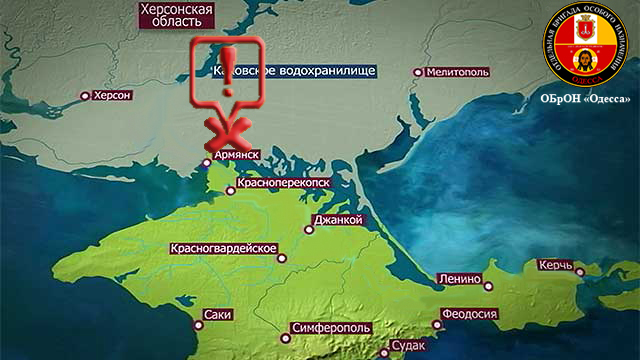
During the intelligence activities by the “Odessa” brigade it became known that military exercises under the auspices of NATO will be held on the territory of the Kherson region in the first half of June. Such countries as Ukraine, USA, Turkey, and other contingents of NATO forces will take part.
Military equipment and heavy weapons involved in the above event will arrive and be unloaded at the deep-sea ports of Odessa and Nikolaev. With the above mentioned ports, it will spill over into the territory of Kherson region, namely the venue of military maneuvers.
One of the notable nuances is that the Western-controlled media is silent about these exercises. This occurs despite the fact that previously such plans were preceded any public statements or publication in the news.
In addition, another factor is that the accumulation of troops and military equipment will be in close proximity to the state border with the Russian Federation, namely the Crimean Peninsula.
Also, attention should be paid to the fact that over the past week Israeli vessels, in very small volumes and with an urgent speed, exported concentrated vegetable oil and grain through the Nikolaev seaport. It was very similar to the desire in short notice to remove liquid assets from certain territories. At the same time, given the agility of the Israelis, all this can have an ulterior motive.
The “Odessa” brigade focused on the fact that because of a combination of the information received in light of the aggressive policy of the West, the vassal government in Kiev, and also the created and supported armed groups, it looks quite alarming. Thus, there is a definite probability of a possible aggravation of the military-political situation in the southern regions of Ukraine in the form of armed aggression against the Russian Federation, namely Crimea.

Aufruf: NATO-Gipfel in Warschau bereitet Krieg vor – Höchste Zeit, aus der NATO auszutreten!

26. Mai 2016 •

Hier unterschreiben >>

Der folgende Aufruf wird in ganz Europa zirkuliert – bitte helfen Sie mit, ihn weitmöglichst zu verbreiten!

Der bevorstehende NATO-Gipfel am 8.-9. Juli in Warschau ist allein schon eine weitere Provokation gegenüber Rußland. Mit diesem Aufruf sagen wir, die Unterzeichner, „Stopp!“ zu dieser nuklearen Eskalation, bevor Irreparables geschieht.

Wir leben in dunklen Zeiten. Eine neue Raketenkrise baut sich auf, dieses Mal als Spiegelbild der Krise, als die Sowjetunion Atomsprengköpfe auf Kuba, unmittelbar an der Türschwelle zu den Vereinigten Staaten, stationierte. Heute ist die Lage umgekehrt. Während damals die NATO gegen den Warschauer Pakt kämpfte, veranstaltet diese nun ein Gipfeltreffen genau in jener Stadt!

Wir, die Unterzeichner, stellen fest, daß die NATO eine provokative „Einkreisungspolitik“ betreibt:

  1. Die ständige Osterweiterung der NATO bis an die Grenzen Rußlands, trotz der Zusicherungen des Westens an Gorbatschow 1989, daß dies niemals geschehen werde.
  2. Die Stationierung der Aegis-Raketenabwehrsysteme in Rumänien, Polen, der Türkei und Spanien. Diese Waffen, die von MK41-Startsystemen gestartet werden, können für defensive Missionen (in der Luft, zu Land und zur See), aber auch für Offensivschläge mit Nuklearwaffen genutzt werden.
  3. Der ständige Rotationseinsatz von vier jeweils 1000 Mann starken Regimentern und die Stationierung von schwerem Kriegsgerät in den baltischen Staaten, Polen und Rumänien.
  4. Die Schaffung einer „nordischen Front“ gegen Rußland, bestehend aus den NATO-Mitgliedstaaten Dänemark, Island und Norwegen, und den Mitgliedern der „NATO-Partnerschaft für den Frieden“, Schweden und Finnland.
  5. Die Modernisierung von Atomwaffen, insbesondere die in Deutschland stationierten B61-12-Bomben und die Long Range Standoff LRSO Cruisse Missiles. Die US-Senatorin Dianne Feinstein sagte dazu: „Diese sogenannten Verbesserungen dieser Waffen scheinen… dafür konzipiert zu sein, sie einsatzfähiger zu machen, einen begrenzten Nuklearkrieg zu kämpfen und zu gewinnen…“

Um diese Bedrohung zu beenden, fordern wir:

  1. daß unsere Regierung beim kommenden NATO-Gipfel in Warschau eine Politik des „leeren Stuhls“ (Boykotts) verfolgt; und
  2. daß unsere Regierung ihre Absicht erklärt, die NATO zu verlassen, die schon längst keine Existenzberechtigung mehr hat.

Um dem gegenwärtigen Countdown zum Nuklearkrieg zu entgehen, fordern wir außerdem unsere Regierung auf, unverzüglich die Bedingungen für eine neue globale Friedens- und Sicherheitsarchitektur auf der Grundlage der von den BRICS vorgeschlagenen „Win-Win“-Kooperation zu schaffen, einer Kooperation, der sich Europa und die Vereinigten Staaten im eigenen Interesse anschließen sollten.

Die gewaltigen Anstrengungen, die im 20. Jahrhundert für Kriege gemacht wurden, müssen heute im gleichen Maß für den Frieden und die gegenseitige Entwicklung aufgewendet werden!

Hier unterschreiben >>

http://bueso.de/node/8623

Petition to get France out of NATO

From Fort Russ

Sortirdelotan.fr, May 28, 2016

Here at Fort Russ, we do not expect that signatures outside of France will be of use, but it seemed that Fort Russ readers would be interested in knowing of this project and in reading its rationale… 

Translation by Tom Winter

Headline:
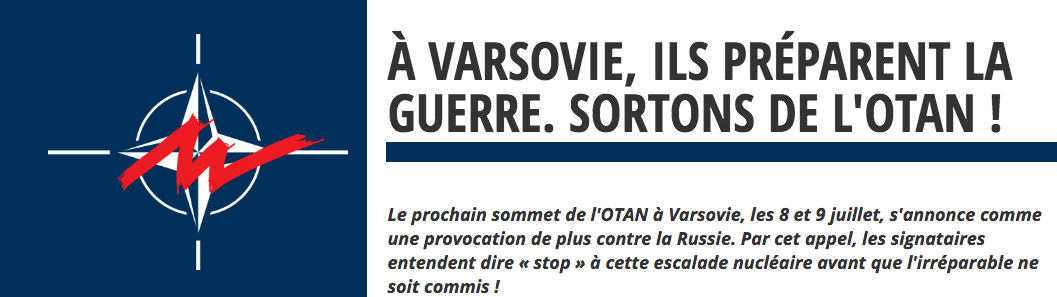
“At Warsaw they are getting set for war. Let’s get out of NATO!

“The next NATO summit in Warsaw July 8 and 9, just one more provocation against Russia. With this appeal, the signatories mean to say “STOP” to this nuclear escalation before something undoable gets done”

Text:
The hour is grave. A new missile crisis is brewing against Russia, a mirror image of the 1962 missile crisis when the Soviet Union deployed missiles in Cuba, at the very portals of the United States. The situation has gotten upside down: then NATO was struggling against the Warsaw Pact; today it meets in Warsaw!

Therefore, we the undersigned, find that we are faced with a provocative policy of encirclement:

1. continuous expansion of NATO to Russia’s borders, despite the guarantees given by the West to Gorbachev in 1989 that this would not happen;

2. deployment of the Aegis missile defense shieldin Romania, Poland, Turkey, and Spain. Featuring MK41 launch systems, these weapons can be used for defense missions (anti-aircraft, anti-submarine, anti-ship), but also for attack missions against ground targets;

3. deployment in the Baltic countries, Poland, and Romania, by rotation, of four regiments of a thousand men each with permanent military equipment;

4. constitution of a “northern” front against Russia, bringing together NATO members (Denmark, Iceland and Norway) or its Partnership for Peace (Sweden and Finland).

To end this menace we demand:
1. That the French government use the “policy of the empty chair” at the upcoming NATO summit in Warsaw;

2. that it announce its decision to leave the organization that no longer has any raison d’être. 

We call on France to create the conditions for a return to an order of peace in the world, based on “win-win” cooperation proposed by the BRICS, which Europe and the United States have an interest in joining.

Let us mobilize today all those means that we have committed in the twentieth century for war, for peace through mutual development!

http://www.fort-russ.com/2016/05/petition-to-get-france-out-of-nato.html

EgyptAir Flight MS804 – what the media won’t tell you

Global Research, May 29, 2016
21st Century Wire 27 May 2016
EgyptAir-Flight-804

New details have emerged regarding the mysterious downing of EgyptAir flight MS804.

‘TAMPERED EVIDENCE?’ – Alleged items from doomed EgyptAir flight MS804 – notice the debris appears to be without fire damage. Reports suggest workers gathering evidence didn’t follow protocol. (tribwgntv.files.wordpress.com)

According to early reports, we learned that EgyptAir’s MS804 Airbus A320 carrying 66 people, left from Paris Charles de Gaulle International Airport at 11.09pm (21.09 GMT) local time on Wednesday night bound for Cairo International Airport 01:15 GMT (03:15 Cairo time).

Around 2.45am Egypt local time (00.45 GMT) Greek air traffic controllers reported MS804, was headed southeast before making an abrupt turn to the northwest – only to vanish from radar while traveling at 37,000 feet, inside of Egyptian airspace.

With no distress call given, officials are still confounded over the direct cause of the air disaster – one week later.

Intially, Greek Defense Minister Panos Kammenos stated that MS804 abruptly ‘swerved’ at a 90 degree angle and then 360 degrees, before dramatically losing altitude  – but according to Egyptian investigators this week, this claim is questionable until the black box is located:

The head of Egypt’s National Air Navigation Services Company is challenging that account. Administrative board chairman Mohi El-Din Azmi told Egyptian state-run media Al-Ahram on Sunday that the plane did not swerve or lose altitude before it disappeared off the radar.

After the disappearance of MH370, there was an onslaught of reportage offering insight into the unprecedented hull loss of the Boeing 777.

Continue reading →

Operation “Sea Breeze”: How US Marines ‘studied’ Russian in Crimea in 2006

From Fort Russ

May 24, 2016

Blogger Mikhail Sinelnikov-Orishak (@sine-or in Live Journal)

Translated by Kristina Kharlova

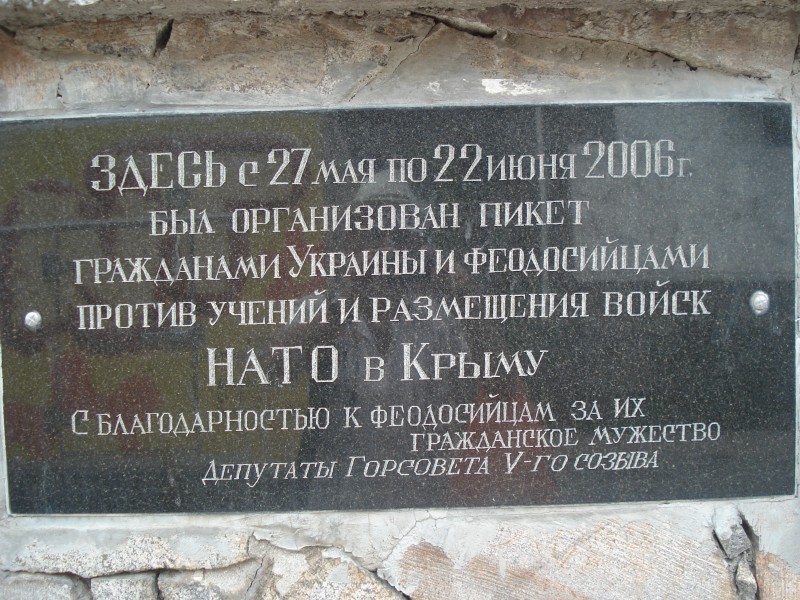
In my personal archive I found a photo from the era when Crimea was still Ukrainian:

“From May 27 to June 22 2006 here was held a protest by citizens of Ukraine and Feodosia against the exercises and deployment of NATO forces in Crimea. With gratitude to Feodosians for their civil courage from deputies of 5th City Council”

For those who didn’t know or tried to forget – I will remind: on May 27, 2006 the American ship “Advantage” came into the port of Feodosia where it unloaded several dozen containers with firearms, equipment and construction materials for military exercises “Sea Breeze-2006.”

Immediately began protests of Crimean residents against the presence of NATO troops: rallies, tent cities, peace marches. The tension has boiled to a point when more than 200 US Marines had to be hastily evacuated from the sanatorium of the Ministry of Defense of Ukraine near Alushta, where they, as it turns out, have been “studying Russian language”. At least, so said the representatives of the administration of then-President Yushchenko. In the end, the US State Department and the Pentagon have issued a joint statement on suspension of Sea Breeze-2006 due to a crisis … in the Middle East.

It should be noted that such NATO exercises were held in the Black sea 5 (!) times since 1997, and 4 of them in the territorial waters of Ukraine. Why did “Sea Breeze-2006” become a “stumbling block”?

Any military exercise initially has a script according to which further events must unfold. At the time, it went as follows:

Some “Runo peninsula”, formerly part of the country of Sapphire, with a thriving “regime”, hostile to NATO, comes under the jurisdiction of a “democratic state” of Emerald. Thus, the peninsula with all the familiar city names of Evpatoria, Sevastopol, Simferopol gains “political independence”, which Sapphire cannot accept and creates an IRM – “Independent Runo Movement”.
International community for a while ignores sabotage, murders of foreign citizens, committed by IRM. But ‘separatists’ commit a raid on a local university and take hostage a large group of students – citizens of countries-NATO members, and in Simferopol at the same time break out rallies and demonstrations demanding restoration of the previous status of the peninsula as a province of Sapphire. The government of Emerald appeals for help to the United Nations, and the UN gives NATO the permission to conduct the operation to free the hostages, for the establishment of peace and stability “in the Northern part of the Black sea”.

This legend was published in the media which finally infuriated the residents of “Runo Peninsula”. On June 24 2006 all American experts and military equipment finally left the “inhospitable” Crimea aboard a Ukrainian merchant vessel “Anatoly Kolesnichenko”.

P. S. As an expert comment from an interview with ex-NATO Secretary General Anders Fogh Rasmussen on the Ukrainian TV channel “Inter” on August 7, 2014: “What a ridiculous accusation, NATO never intended to establish military bases in Ukraine…”

http://www.fort-russ.com/2016/05/operation-sea-breeze-how-us-marines.html