The situation in Debaltsevo may overturn all Minsk agreements

Posted by Fort Russ

“There is no cauldron, Mister President!”

February 12, 2015
Translated from Russian by Kristina Rus

The situation in Debaltsevo may overturn all Minsk agreements

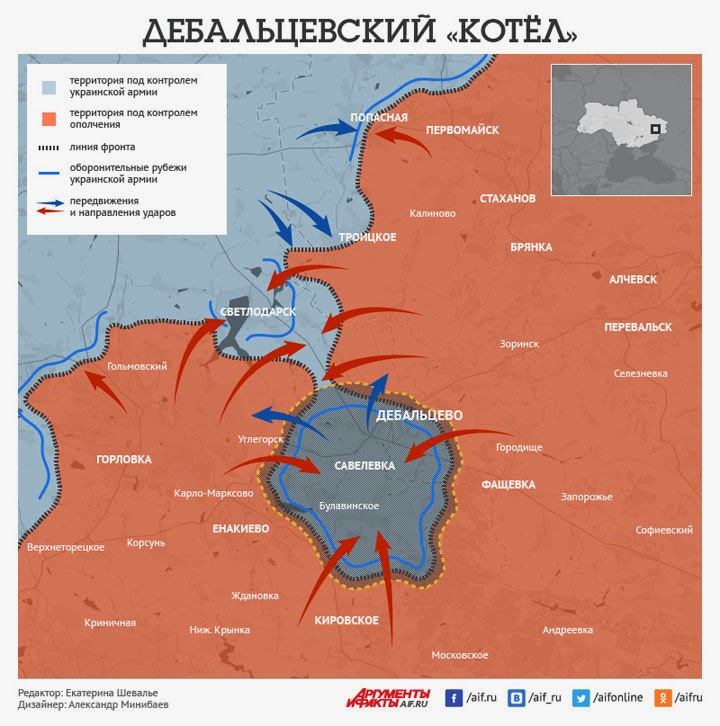
During the entire Minsk negotiations Ukrainian General staff disinformed Poroshenko about the situation in Debaltsevo, and the most important trump card in the hands of the President of Ukraine turned out to be a bluff. UAF was not able to crack open the cauldron, and it has turned into the most sticking point of negotiations, which may turn everything agreed upon in Minsk upside down.

Poroshenko’s perception of reality was ultimately shattered by his propaganda trip to Kramatorsk in the company of the chief of the General staff Muzhenko and a French philosopher-Russophobe Bernard-Henri Levy. The President of Ukraine is a man not too brave, very emotional and gullible. What was originally conceived as “pumping” of Western public opinion with all the classic moves of PR campaigns, turned into a psychological trap for himself.

The Minister of Defense and head of General staff, spurred by Turchynov, had promised the President to carry out the operation, which will deblock Debaltsevo, and at the same time “will pay back for Kramatorsk.” When Poroshenko was already flying to Minsk, he was convinced that it is enough to buy some time and the attack on Logvinovo will end in complete victory, and he will get a new starting position for negotiations. Throughout the entire night Poroshenko checked for updates from his General staff, but victory did not come. It hasn’t come by morning, and a light bulb went off: something is not right, the cauldron does exist! Although he has already for 10 hours told respected people that it did not.

One can only guess about the motives of the security block of Ukraine for disorienting and misinforming their Commander In Chief. The dominant conspiracy theory: Turchynov, actually managing the security block, thus was buying time, following the general American line. More down to earth and realistic version: it was a traditional (of all times and all peoples) aspiration of parquet generals to please and ward off accusations, glossing over reality. Considering the general panic mood, combined with an unbridled propaganda, it is much more likely than a transatlantic conspiracy about Debaltsevo cauldron. The Ukrainian command also doesn’t quite understand what is happening. There is no connection with some units for more than a week, and if there is, it boils down mainly to cries for help and heated exchanges about “who is to blame”. The chain of misinformation may well start from the very bottom, gradually accumulating “meat”. And to treat any information in a favorable light is a very common mistake of bad scouts and analysts. The past six months revealed much about the strategists of the Ukrainian General staff.

All night from Wednesday to Thursday UAF tried to exert pressure upon the entire front line. A formation of two thousand from Svetlodarsk, which was assembled by UAF for almost a week, went head on to the strongholds and minefields of NAF at Logvinovo, but the militia has also strengthened this position in recent days. NAF even managed to transfer significant reserves to Uglegorsk. As a result an attack on Logvinovo from two sides (there was also an attack from Debaltsevo, but very unconvincing) was stopped only by the morning. By this moment Poroshenko got his own localized apocalypse.

UAF also tried to attack directly from Lugansk through the infamous village of Schastye, simultaneously firing on the city from MLRS, which has not happened for six months. UAF command, as it turned out later, believed that LPR units were too busy near Debaltsevo and Bakhmut highway, that supposedly weakened defense of the direct road to Lugansk (this is, again, another demonstration of the low level of Ukrainian intelligence and strategic analysis). Battalion “Azov” again imitated the offensive on the coastal route through the neutral zone with the same results, as a few days ago. These people are generally more prone to simulate turbulent activity than to thoughtful action.

Where UAF is not capable of real activity, the pressure was carried out using MRLS and heavy weapons. For example, Peski, Opytnoye, Donetsk itself, Gorlovka, Yenakievo, Makeevka, Dokuchayevsk, and Dzerzhinsk were heavily shelled.

Vladimir Putin, appearing to the press after the talks, openly called on the Ukrainian side to allow troops in Debaltsevo to surrender, or to arrange an organized exit. Poroshenko wanted to turn the situation around Debaltsevo into his almost only trump card, and in the end it became a monstrous failure. In fact, regardless of what and in what language is written in the agreement of the contact group, Debaltsevo cauldron may turn into a huge mass grave in the next two days, because none of the demoralized generals (as Poroshenko himself) will give an order to surrender. And to organize a controlled exit of the Ukrainian troops from the encirclement in such a short time is impossible. Soldiers are not concentrated in any one place, but scattered in groups by checkpoints, many without communications, without commanders and without ammo. Even if they can scavenge some food at homesteads, no one will bring them ammo or medical supplies. In the steppes there is dirt and slush, to detour the positions of the militia on the road to Logvinovo through fields is impossible, even if there was fuel. Militia doesn’t even need to use heavy weaponry, it is enough to gradually cut off one checkpoint from the another.

After the defeat of Ukrainian attack on Logvinovo a real danger emerged to get a second cauldron in Svetlodarsk, which would trap this other “deblocking unit”, that was built up over a week. Another thing is that it is problematic to create a new operational encirclement of a large formation in two days, and any offensive action by NAF will now be associated with hysterical information uproar in Ukraine, although UAF themselves have failed at Uglegorsk, Logvinovo, and now of Svetlodarsk. Only officers and soldiers can explain to the Ukrainian public that “a cauldron – is no good”, but if they start talking, it will seem more like a riot, and in a hysterical atmosphere no one will listen.

It is interesting, that a new offensive on Logvinovo was started by UAF immediately after the announcement of the results of Minsk talks, sometime around noon. Commander Semen Semenchenko – one of the most active “Twitter warriors” – said that the Ukrainians had already taken Logvinovo and are “carrying out a sweep”. In reality, the situation remained exactly what it was, a new attack on “cauldron lid” is purely political in nature.

Thus, a small village Logvinovo on the highway Debaltsevo – Artemovsk turned for Poroshenko into a “new airport“, only now these attacks also have a purely military, practical value.

Poroshenko will be now learning about the difficult reality with apparent difficulty and reluctance. For him this reality, among other things, is dotted with various “red lines” which he can’t cross even verbally. The military situation had become a taboo, although it remains a key part of the agenda. Even the questions of the political status can be brushed off, creating “joint commissions” including representatives from DPR and LPR, but the front line requires immediate decisions. Sometimes everything depends not on big ideas and global plays, but simply on the human qualities of a particular politician or officer. But a commander in chief of the Ukrainian army, alas, got this position as a figure of compromise and was controllable from the start. He, as a person, may want to achieve something. To preserve peace in Europe, for example. But it is beyond the range of circumstances and human power.

Debaltsevo cauldron has evolved from a military operation of a local value into the main factor of political settlement. What will happen there in the next few days (or rather, what steps will Kiev take to change the situation) will determine the further balance of power. To demonstrate DPR and LPR in the face of Europeans as “wild barbarians”, and Russia as the aggressor will not work anymore. You were given options – it’s your choice.  Even Zakharchenko and Plotnitsky were brought to you for negotiations, and in the end we got a vague paper signed by Kuchma, whose position at the moment is – a retiree. “Ratified verbally” certain agreements – it’s such a fresh and new phenomenon in international diplomacy that all textbooks should be rewritten.

To seriously discuss the details of pulling the heavy artillery to some distance from the front line (lines?) is pointless. As well as to discuss clause-by-clause an agreement, from which there will not even be a memory left in a short time. Yes, the Ukrainian troops will be pulled from the actual line, but Ukraine’s control over the border with Russia can only be restored after a constitutional reform, guaranteeing new status for Donetsk and Lugansk. That is, “money – in the morning, chairs – in the evening”.

A much more important question, is how long can the state of “no peace, no war” hold. To predict it now is extremely difficult, it all depends on many factors, including purely private, invisible to the naked eye. Most of these factors are now in Kiev. What will happen to public opinion, if the losses exceed all reasonable limits? When and on what conditions will Debaltsevo surrender? How hard will the Parliament groups fight against the bills on the new status of Donbass, and how will Poroshenko cope with it? There is a myriad of these key elements. Especially that in reality there is no monitoring mechanism for the removal of heavy weapons from either side. OSCE can not monitor the ceasefire: tanks and 80 mm mortars will remain at the contact line, which do not fall under the category of “heavy artillery”, and in an urban setting – they are terrible, deadly weapons. A mine doesn’t break the asphalt, but bounces from it. Shrapnel flies in all directions parallel to the ground, and people lose their legs.

All this looks like a new calm before a big war.

http://fortruss.blogspot.com/2015/02/a-new-calm-before-big-war.html

Poroshenko surrenders Ukraine to the IMF

Posted on Fort Russ

[Original headline at source: “Poroshenko acquires a big loan for Ukraine from IMF, conditioned on consigning lands, resources and procurements of public services to US mega-corporations”]

Ukraine, Lagarde (IMF) announce: Loans to 40 billion euro in exchange for reforms (on the Greek model)
Published February 12, 2015 in ControInformazione.info
February 12, 2015
Translated from Italian by Tom Winter
If you are a puppet of the US empire and you consign your sovereignty to Washington, you get an abundance of money, financing, arms, and multinational corporations looking for business and ready to plunder the resources of your country. If instead you put yourself on a collision course with these powers, as in the case of Greece, your financial faucets get shut off, and you risk default.
This is the lesson from two parallel vignettes, that of Ukraine on one side, where a U.S. puppet government took office, via coup d’etat, and on the other, that of Greece, where, thanks to free elections, a popular government took office hostile to big banks and the EU.
In the first case, also thanks to ministers in the government with U.S. passports (See “Ukraine launches a government with foreign ministers”), and to the total subordination of the state to directives from Washington, in opposing Russia, everything gets allowed, to save the country from the economic collapse that a clique of pro-America oligarchs have brought it to.
For Ukraine, aside from the other big loans at the disposition of the IMF, there will be other financing, “multi-lateral and bi-lateral” loans for the country in the USA-EU orbit, a country whose economy will enjoy, all told, a sustaining loan of 40 billion dollars over four years. Christine Lagarde, administrator of the IMF, announced it with pride, revealing the terms of an “agreement in principle” with Kiev for a package of 17.5 billion dollars from the IMF, without guarantee, but committing the government in Kiev to “ambitious” economic reforms. (“Ambitious reforms” already actuated in other countries: cuts to health care, worker layoffs, reduced pension payouts, reduced funding for education, destruction of welfare, and the like — As in Greece.
Other financial institutions will join with the IMF, such as the Bank for Reconstruction and Development, as well as the European Central Bank itself (the one that denied any help to Greece), Lagarde reported. Bottom line is a “finance package” of 40 billion over the course of four years.
In this plan the Ukrainian government will conduct negotiations will various lenders, putting all the potential resources of the country on the table: the vast farmlands, mining, petroleum prospecting concessions to American multinationals, public services to contract, public health and hospitals to privatize, and labor reforms (of the type “Jobs Act”) to harrow the country, and so on and on.
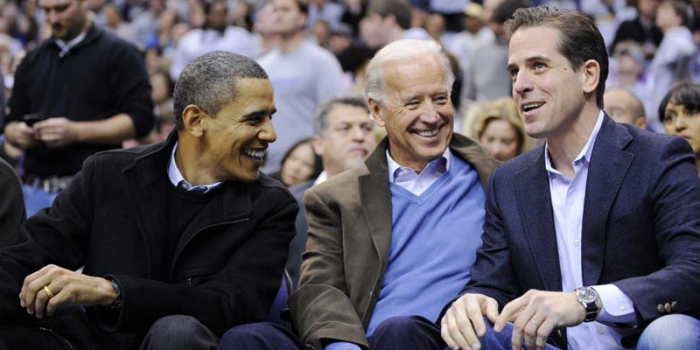
In keeping with this plan, Hunter Biden, youngest son of Joe Biden, vice-president of the United States of America, has been put on the board of directors of Ukraine’s most important gas company, Burisma Holdings. (See Biden’s son enters the country’s main gas company)
US President Obama, vice-president Biden, 
with Hunter Biden, new board member of Burisma Holdings.
This is the price paid by a country that has consigned itself “voluntarily” to the protection of the USA, subverting the preceding accords with Russia and other Eurasian counties.
This story can easily show how intimately connected political scenarios are with the financial levers that are available to the dominant powers that set the rules in this world.
Should anyone disingenuously suppose that finance and international politics are two different arenas, today you totally have to change your mind.
Original:

“The US should keep out of the Ukraine conflict”– EU Parliament President Martin Schulz in heated talk show roundtable

Participants on Günther Jauch talk show, February 8, 2015:

Martin Schulz — EU Parliament President
Gabriele Krone-Schmaltz — ARD (Ukrainian TV) Moscow correspondent
John Kornblum — former U.S. ambassador to Germany
Harald Kujat — formerly NATO/Bundeswehr General

Posted on Fort Russ
 2/11/2015

Germans are fed up with the US ‘”over-protectiveness” and are not willing to fight for Poroshenko

Translated from Russian by J.Hawk

Ukrainian special services ought to immediately put out an arrest warrant on the European Parliament deputy Martin Schulz. This “Colorado beetle” and “quilted jacket” [both are derogatory terms used to describe the Ukrainian proponents of good relations with Russia] dared, on the state ARD TV channel, to call what’s happening in Ukraine a civil war, while the current Kiev government really hates that term. You are liable to get arrested for that, like the journalist Kotsaba.

Schultz made that statement on Gunther Jauch’s talk show, which is the equivalent of Savik Schuster’s show in Ukraine.

The next show aired on February 8. The topic: “Fateful Days for Europe—Whom is Putin Listening to?” Needless to say, the topic was Ukraine.

The discussion as to whom Putin listens to included the European Parliament President Martin Schulz, the ARD Moscow correspondent Gabriele Krone-Schmaltz, the former US ambassador to Germany John Kornblum, and the former NATO [actually, Bundeswehr] general Harald Kujat.

The discussion was heated and shows that being under the “over-protectiveness” of the US Big Brother has long gotten under the Germans’ skin, and any reference to that fact caused applause among the studio audience.

It would be difficult to call Schultz a Russophile and a Ukrainophobe. Nevertheless even he could not force himself to lie in front of the cameras and call the conflict on the Donbass one between the Forces of Light against Colorado beetle terrorists.

The Donbass conflict is a civil war. It must be resolved by diplomatic means, and not through the use of the Ukrainian army. “If Minsk-1 had failed, maybe Minsk-2 will fail too, but even then we need to continue the negotiations even if it means Minsk-70,” is how Schultz sees the problem’s resolution.

One left with an impression of tension in the German-US relations. Judging by how Angela Merkel spent the entire 2014 agreeing with Obama, the anti-US sentiment in Germany had grown, to the point that Kornblum was reduced to complaining to his German audience that “these days I’m seeing a tendency to blame everything on the US.”

His statement that “it’s Russia that’s waging war”, Krone-Schmaltz met with a rather sharp reply. “I want to emphasize, I am underscoring that if Russia were included during the preparations for the association agreement with Ukraine (and this is normal diplomatic work), none of this would be happening. I also believe that if the Eastern regions of Ukraine, where there is fighting right now, were given some autonomy, none of this would be happening. One can’t judge everything by today’s events and blame Moscow as soon as something goes wrong. One needs to engage in a little self-criticism.” Judging by the studio applause, she hit the nail on the head.

“Mr. Kornblum, what do you think about what McCain said to Merkel, namely that she ‘doesn’t care that people in eastern Ukraine are being killed like cattle’? Such rhetoric in Germany, to put it mildly, is considered unfriendly,” said Jauch to Kornblum. “Well, McCain is known for his sharp tongue. There are heated discussions, people are getting hot-headed. If you knew how many times I was told that America is responsible for that war. But we are not dealing with a ‘civil war’ but with a Russian aggression,” continued Kornblum.

General Kujat could not remain indifferent to that statement. “There is no military solution. Let me clarify: the West does not have a military solution. If we do something idiotic and intervene, we will not win but lose, and there will be a huge catastrophe. The situation looks different for Russia. Russia could adopt a military solution and we need to keep that in mind. But if Russia had really wanted it, that war, that conflict in Eastern Ukraine, would have been over in 48 hours. We keep hearing from various sources that regular Russian forces are participating in the fighting. Ukraine’s president also repeated that claim. However, I have no trustworthy information that would confirm that. Even the Ukrainian GenStaff Chief recently said: we are not fighting against regular Russian forces. If there were regular Russian forces there, the conflict would be over in 48 hours. What we are hearing is propaganda.”

To Schulz’s words that “Putin obviously has influence over the separatists,” Krone-Schmaltz reacted as follows: “it would be an oversimplification that Moscow controls the separatists, and Kiev controls its forces. It’s obvious there are forces that nobody controls. Kiev likewise does not control several of its military formations. For example, there was an ceasefire agreement after the Boeing MH17 catastrophe, in order to collect the victims. And who violated that ceasefire? Not the separatists but the Ukrainian army, whoever might be representing it! It’s been like this until today. I remind you that the Right Sector still insists it has a right to carry weapons. Therefore the EU ought to exert pressure also on Kiev so that the situation does not spin out of control.”

Schulz also pointed out that there are too many Americans involved. “This conflict is occurring on the border with the EU, therefore the US ought to pull back. I think it would be best if the Europeans were to solve this problem themselves,” he said to thunderous applause. Continue reading

Ukraine may criminalize anti-war speech: 5 years in prison for “denying Russian aggression”

From RT, February 12, 2015

anti-war-protest-ukraine

 A woman from the Volyn Region of Ukraine is holding a banner saying “Mothers of Volyn against war” at an anti-conflict rally in front of the parliament in Kiev.
(RIA Novosti / Evgeny Kotenko)

A bill submitted by an MP from President Poroshenko’s party in the Ukrainian parliament seeks to criminalize public speech that reject the government’s narrative on the civil war, which it describes as a Russian military invasion.

The controversial bill amends the Ukrainian criminal code to make “public denial or justification of the Russian military aggression against Ukraine in 2014-2015” a felony.

The ‘crime’ would carry a penalty ranging from a heavy fine and up to a five-year jail term for repeat offences or convicts who held public office.

If the bill is signed into law, it would be the latest move to attack civil freedoms by Ukraine’s post-coup government defending its security policies from criticism.

Last week a Ukrainian court ordered the two-month detention of a journalist from western Ukraine who called for a boycott of the ongoing military draft. Ruslan Kotsaba stated that he would rather spend two to five years in prison for refusing to serve in the military than shoot at Ukrainians in what he described as a ‘fratricidal war’. Prosecutors charged him with high treason, a crime carrying a 15-year term in Ukraine.

READ MORE: Ukrainian reporter ‘charged with high treason’ after calls to dodge draft

The prosecution of Kotsaba was sharply criticized by Amnesty International, which labeled him a ‘prisoner of conscience’ and demanded his immediate release.

“Ruslan Kotsaba’s position may be viewed differently. But by arresting him for making his position public, the Ukrainian authorities violate the basic human right for freedom of expression, which the Ukrainians had been defending at the Maidan,” Tatyana Mazur, head of Amnesty’s Ukrainian branch, said in a statement.

In a separate incident, Anton Gerashchenko an aide to the Ukrainian interior minister threatened opponents of the military draft that any person taking part in last week’s anti-war rally in Mariupol would be detained, identified and fingerprinted.

http://rt.com/news/231555-ukraine-bill-agression-denial/

http://www.globalresearch.ca/ukraine-may-criminalize-anti-war-speech-five-years-for-denying-russian-aggression/5430929

Minsk-2 Preliminary Analysis

Posted on Fort Russ
2/12/2015

Minsk-2: Withdrawal of Forces and Autonomy for the Donbass.
By Russkiy Malchik

Translated from Russian by J.Hawk

Information is still scarce. We have seen the main principles which were clear. But it’s obvious that they spent 16 hours discussing not the basic principles but the details. It is the details that are the core of the peace plan.

Unfortunately neither Poroshenko nor other leaders signed the joint declaration, and the “Collection of Measures” were signed only by the members of the contact group, namely LPR/DPR, Kuchma in Kiev’s name, OSCE, and Zurabov. That list likewise contains 13 points with fairly general formulations, which will require further clarification. But there are also specifics that have been published and by which we can assess how the negotiations went and what kind of compromise was reached.

The first has to do with the withdrawal of heavy weapons under OSCE control. The conditions are rather odd: it specifies a distance of 50km (for cannon) or 140km (for rocket artillery), from the actual line of the front as of midnight, February 15, and for the militia from the September 19 line [the line of demarcation from Minsk-1].

This means that both sides should leave their positions, creating a huge belt (100-300km) without weapons, de facto up to the borders of the Donetsk and Lugansk regions. Which leads to the following question: who will control it? This is the key question. So far there are no clear answers. But considering that the issue of peacekeepers was frequently brought up, this is who they have in mind. It is not for nothing that the Donbass representatives said that they will accept only Russian and Belarusian peacekeepers. Kiev, on the other hand, does not want peacekeepers, but if it does agree it will want NATO troops. So there is a big question mark here.

The second interesting provision is this. In the paragraph 11 which concerns Ukraine’s constitutional reform, which is to be implemented by the end of 2015, there is a provision which includes the main provisions of the law on the “Special Status of Lugansk and Donetsk Region”, which read as follows:

–Immunity from punishment, prosecution, or discrimination for individuals which participated in the events that took place in various parts of the Donetsk and Lugansk regions (this amounts to legalizing all combatants).

–The right to language self-determination.

–The participation of local self-government in the nominating process for the office of prosecutor general and the courts in the regions (LPR and DPR de-facto control over the legal and law enforcement systems).

–The central government shall enter into agreements with the local self-government concerning economic, social, and cultural development of the regions (Kiev will enter into agreements with Donetsk and Lugansk concerning all crucial aspects of the joint economy).

–The government supports the socio-economic development of the separate regions (Kiev will partially finance the reconstruction of Lugansk and Donetsk, and guarantees the fulfillment of social obligations).

–The central government shall facilitate cross-border cooperation between the several districts of the Donetsk and Lugansk regions with regions of the Russian Federation (Kiev will not oppose the cooperation between Lugansk, Donetsk, and Russia).

–The establishment of people’s militia in accordance with local government decisions in order to maintain public order in the several regions (the militia becomes a law enforcement organization, all power institutions remain under the control of the current leadership).

–The authority of the local authorities and officials from special elections that were designated by the Verkhovna Rada in accordance with this law, cannot be invalidated before their terms run out (this guarantees the rights of the current DPR and LPR government until they are re-elected as part of the process of forming local self-government through new elections).

As a result, Donbass receives widespread autonomy within the framework of nominally unitary Ukraine. This is the compromise which satisfied Putin after the 16-hour Minsk marathon. Moreover, France and Germany guarantee the re-establishment of the Donbass banking system, and will reach an agreement with Russia concerning the rules concerning the free trade zone between EU, Russia, and Ukraine, while taking into consideration the special status of Donbass.

The third detail pertains to border control. Here the language is extremely clear. The border between Ukraine and Russia will be re-established only after Ukraine carries out constitutional reforms, which implies autonomy (self-government, people’s militia, cross-border cooperation with Russia). In other words, once Kiev gives Donbass control over its own territory, then the border shall be re-established…but will remain under militia control.

To sum up this quick analysis based on still-incomplete information one can say the following: in purely diplomatic sense, Russia scored a success, forcing Kiev and the West to accept a painful and temporary, but real compromise. It is based on freezing the military conflict and the autonomy of the Donbass while nominally preserving Ukraine’s borders. In practice we are talking about reformatting Ukraine from a unitary into a federal state, regardless of Poroshenko’s denials. If the Galicia banderites realize this, they’ll start screaming about “Poroshenko’s treason.”

Of course, the implementation of the agreement is another question. The fact that neither Poroshenko nor European leaders signed it does not make it easier. On the other hand, Hollande’s and Merkel’s wishes are more than real, so it will fall to them to compel Kiev to implement the “Collection of Measures.” The only other option is a complete defeat for Ukrainian forces. To which Putin merrily alluded when he mentioned Debaltsevo—either you come out with your hands up, or you’ll continue to get killed.

The Minsk peace plan from February 12 does not solve the problem (and it could not solve it), but creates the possibility to delay the war until the end of 2015. With one condition: that Kiev and Washington accept the federalization of Ukraine. If not, the war will come to Kiev.

J.Hawk’s Comment:  The biggest factor here is whether the Ukrainian military is up to the task of continuing the fighting. If it is, if Poroshenko believes its forces have been sufficiently restored, the fighting will resume. However, the Ukrainian military took a heavy beating in the last months’ fighting and it will find it difficult to replace the lost equipment. Mobilization is unpopular, and there is little chance that NATO will rearm Ukraine. Last but not least, there is also the IMF and its stringent conditions on government spending that come as part of its bailout packages. Yaresko had already announced that Ukraine’s budget will have to undergo significant changes in order to accommodate the IMF. It’s difficult to see what else in that budget could be cut aside from the defense spending. Hollande and Merkel are not stupid, they’ve seen enough of Poroshenko to know what he is capable of, so therefore they will most likely act through the IMF to reduce Ukraine’s ability to wage war.

So overall this is a better agreement than Minsk-1, though not as good one as might have been reached should the Ukrainian military first suffered a catastrophic defeat. The fact that Novorossia will continue to enjoy unimpeded contact with the Russian Federation is also a major plus–Minsk-1 agreement called for the border control to be returned to Ukraine. 

But in the meantime Novorossia continues to exist and to enjoy a high degree of autonomy, though it is not likely that its authority will spread all the way to the borders of the Lugansk and Donetsk regions, even though Minsk-2 does not appear to contain any language concerning demarcation lines.   The above, of course, assumes that there will be a ceasefire at midnight of February 15, and there might not be one. Minsk-2 says nothing about Debaltsevo, which means the Ukrainian side will continue its attempts to break into or out of the encirclement. If the ceasefire goes into effect as of the 15th with the Ukrainian forces still trapped in Debaltsevo, they will have no choice but to surrender their weapons and depart. Poroshenko cannot allow that to happen, so the fighting could well continue. One can always perpetrate a “false flag” attack or two as an excuse for breaking the ceasefire…


http://fortruss.blogspot.com/2015/02/minsk-2-preliminary-analysis.html

What is the Debaltsevo cauldron hiding?

From Fort Russ


February 8, 2015
Newsli.ru

What’s inside in the Debaltsevo cauldron? Why did the leaders of Europe rush to Russia?

Admittedly, when “the mousetrap” began to shut, everyone began to shout about the need… the need of what? Oh, about the need to follow the Minsk agreements..

The “Debaltsevo cauldron” was intended as a “Debaltsevo springboard” to start a victorious attack on DPR and LPR. In this regard, huge quantities of weapons, ammunition and food was brought to this area. This was confirmed by the militia after the capture of Uglegorsk. They got arsenals overflowing with weapons and warehouses with American food.

To foolishly lose such volume of weapons and “illegal American aid” for tens and hundreds of millions of dollars, and then to beg for the “ultimate weapon to defeat Putin” – this is the height of idiocy and helplessness of senior command.

Likely for this reason, to rehabilitate themselves in the eyes of sponsors, the Ukrainian offensive started today on all fronts at once, and with a simultaneous request for a truce…

It is a madhouse, and not a government and a General staff! They are so unpredictable, that honestly, it’s laughable! And yet, there are theories that in the arsenals of Debaltsevo one will find phosphorous and cluster shells and bombs, banned by international conventions, but used by the Ukrainian armed forces during the shelling of cities and towns. This could be evidence of war crimes…


http://www.fortruss.blogspot.com/2015/02/what-is-debaltsevo-cauldron-hiding.html

Does Poroshenko know the truth about Debaltsevo?

Posted on Fort Russ
 2/11/2015
Ukraine’s Minister of Defense: The Debaltsevo Pocket is “Made Up.”

Translated from Russian by J.Hawk

There is no encirclement at Debaltsevo, said Ukraine’s Defense Minister Stepan Poltorak at a briefing in Kiev on February 11.

Poltorak denied the militia claims that the “encirclement had been completed around Debaltsevo.”

“There is no encirclement. It’s made up by those who want it to exist. The units which are located at Debaltsevo and the vicinity is receiving ammunition. There is contact with them, communications, and coordination. We are working according to plan. Right now we are working on reinforcing the grouping,” said Poltorak.

The Minister also said there is no threat to Mariupol, where Ukrainian forces went on offensive on February 10. “Mariupol is in good hands, the defense is strong, and there are also appropriate reserves. The armed forces jointly with the Azov regiment took a few measures to expand the territory under our control in accordance with the Minsk Protocol,” said Poltorak.

J.Hawk’s Comment: One has to wonder whether this piffle is just for public consumption, or whether Poroshenko believes in it too. Semenchenko may well be right that the senior commanders are sending up false reports of successes to avoid making Poroshenko angry. Consequently, Poroshenko may not even know what his own army is doing right now. And how would he know, given the low quality of senior officers and officials on whom he is relying for information?

http://fortruss.blogspot.com/2015/02/does-poroshenko-know-truth-about.html


Ukraine’s new Prosecutor General continuing the pattern of nepotism

From Fort Russ

2/11/2015
“What, again”? Godfather-President Appoints Godfather theProsecutor General.
By ua_katarsis

Translated from Russian by J.Hawk

Everyone remembers how the former President Yanukovych appointed Pshonka, to whose children he was the godfather, as the Prosecutor General. The new President Poroshenko decided not to deviate from the tradition and likewise appointed someone to whose children he is the godfather.

“The Verkhovna Rada voted to appoint Viktor Shokin the new Prosecutor General of Ukraine. Shokin was supported by 318 deputies, and needed 226 to be confirmed. Prior to that the Rada had voted to dismiss Vitaliy Yarema from that post. Shokin’s candidacy was presented by Poroshenko, who said he knows Shokin for over 15 years and knows him as a professional with good reputation.”

Shokin for his part opted not to ignore the ancient Ukrainian tradition of nepotism. “The Deputy Prosecutor for the Odessa region became Tatyana Gornostayeva, the daughter of the newly appointed Prosecutor General Viktor Shokin.”

Shokin’s other relatives are likewise employed by the Prosecutor’s General office. “They include Shokin’s son-in-law and father-in-law, who likewise were appointed to senior leadership posts at that institution. The husband of Shokin’s daughter, Aleksey Gornostayev, became the Deputy Prosecutor General for the Kiev region of Odessa. The father of Aleksey Gornostayev now works as the Deputy Prosecutor General of the Dnepropetrovsk Region. Prior to that he occupied various posts, and he has headed the Prosecutor’s General office in Dnepropetrovsk.

Faces may have changed, but the methods of exploiting the people remain the same.

J.Hawk’s Comment: Aside from the sheer nepotism and the “godfather angle” of this shockin’, excuse me, Shokin appointments (which Shokin, incidentally, denies) one thing they have in common is that they pertain to cities and regions (Odessa, Dnepropetrovsk) where Kolomoysky’s influence is quite strong. Shokin is known to have put together a number of cases against Poroshenko’s rivals in earlier years, including against Kolomoysky himself. The combination of Yarosh’s new Right Sector/Volunteer Battalion HQ being located in Dnepropetrovsk, and of Poroshenko’s loyalist to Dnepropetrovsk indicates either a brewing conflict between Poroshenko and Kolomoysky (this assumes that Yarosh remains in Kolomoysky’s pay), or a conflict between Poroshenko and Yarosh over how Kolomoysky’s empire is carved up.


http://www.fortruss.blogspot.com/2015/02/all-in-family-ukraines-new-prosecutor.html