From Fort Russ
Petition to get France out of NATO
From Fort Russ
Sortirdelotan.fr, May 28, 2016
Here at Fort Russ, we do not expect that signatures outside of France will be of use, but it seemed that Fort Russ readers would be interested in knowing of this project and in reading its rationale…
Translation by Tom Winter
Headline:
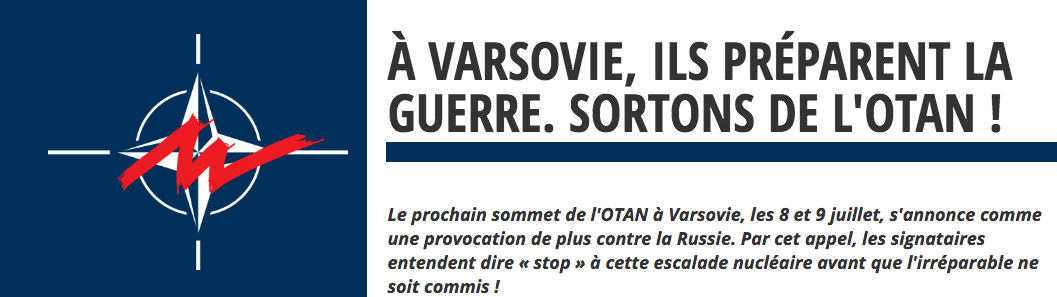
“At Warsaw they are getting set for war. Let’s get out of NATO!
“The next NATO summit in Warsaw July 8 and 9, just one more provocation against Russia. With this appeal, the signatories mean to say “STOP” to this nuclear escalation before something undoable gets done”
Text:
The hour is grave. A new missile crisis is brewing against Russia, a mirror image of the 1962 missile crisis when the Soviet Union deployed missiles in Cuba, at the very portals of the United States. The situation has gotten upside down: then NATO was struggling against the Warsaw Pact; today it meets in Warsaw!
Therefore, we the undersigned, find that we are faced with a provocative policy of encirclement:
1. continuous expansion of NATO to Russia’s borders, despite the guarantees given by the West to Gorbachev in 1989 that this would not happen;
2. deployment of the Aegis missile defense shieldin Romania, Poland, Turkey, and Spain. Featuring MK41 launch systems, these weapons can be used for defense missions (anti-aircraft, anti-submarine, anti-ship), but also for attack missions against ground targets;
3. deployment in the Baltic countries, Poland, and Romania, by rotation, of four regiments of a thousand men each with permanent military equipment;
4. constitution of a “northern” front against Russia, bringing together NATO members (Denmark, Iceland and Norway) or its Partnership for Peace (Sweden and Finland).
To end this menace we demand:
1. That the French government use the “policy of the empty chair” at the upcoming NATO summit in Warsaw;
2. that it announce its decision to leave the organization that no longer has any raison d’être.
We call on France to create the conditions for a return to an order of peace in the world, based on “win-win” cooperation proposed by the BRICS, which Europe and the United States have an interest in joining.
Let us mobilize today all those means that we have committed in the twentieth century for war, for peace through mutual development!
http://www.fort-russ.com/2016/05/petition-to-get-france-out-of-nato.html
À varsovie, ils préparent la guerre. Sortons de l’OTAN !
Le prochain sommet de l’OTAN à Varsovie, les 8 et 9 juillet, s’annonce comme une provocation de plus contre la Russie. Par cet appel, les signataires entendent dire « stop » à cette escalade nucléaire avant que l’irréparable ne soit commis !
L’heure est grave. Une nouvelle crise de missiles se prépare contre la Russie, image miroir de celle qui avait conduit en 1962 l’Union soviétique à déployer des missiles à Cuba, aux portes des Etats-Unis. La situation s’est inversée : à l’époque l’OTAN luttait contre le Pacte de Varsovie ; aujourd’hui, elle se réunit à Varsovie !
Ainsi, nous soussignés, constatons que nous sommes devant une politique d’encerclement provocatrice :
- élargissement continu de l’OTAN aux frontières de la Russie, malgré les garanties données par les Occidentaux à Gorbatchev en 1989 que ceci n’aurait pas lieu ;
- déploiement d’un bouclier de défense anti-missile Aegis en Roumanie, en Pologne, en Turquie, en Espagne. Dotées de systèmes de lancement MK41, ces armes peuvent être utilisées pour des missions de défense (anti-aérienne, anti-sous-marine, antinavire), mais aussi pour des missions d’attaque contre des objectifs terrestres ;
- déploiement dans les pays Baltes, en Pologne et en Roumanie, par rotation, de quatre régiments de mille hommes chacun et d’équipements militaires permanents ;
- constitution d’un front « nordique » contre la Russie, regroupant des membres de l’OTAN (Danemark, Islande et Norvège) ou de son Partenariat pour la paix (Suède et Finlande).
- modernisation des armes nucléaires tactiques de l’OTAN en Europe (B61), qui vise, comme l’a dit la senatrice Dianne Feinstein le 25 mars dernier, à les rendre «plus utilisables et à nous aider à combattre et à gagner une guerre nucléaire limitée»
Pour mettre fin à cette menace nous exigeons :
- que le gouvernement français joue la « politique de la chaise vide » au prochain sommet de l’OTAN à Varsovie ;
- qu’il annonce sa décision de quitter cette organisation qui n’a plus aucune raison d’être.
Nous appelons la France à créer les conditions du retour à un ordre de paixdans le monde, fondé sur la coopération « gagnant-gagnant » proposée par les BRICS, auquel l’Europe et les Etats-Unis ont tout intérêt à se joindre.
Les moyens que nous avons engagés au XXe siècle pour la guerre, mobilisons-les aujourd’hui pour la paix par le développement mutuel !
Veuillez remplir le formulaire ci-dessous pour signer l’appel.
Petitioning Parlamentari – Sindaci: Basta sanzioni alla Siria e ai Siriani
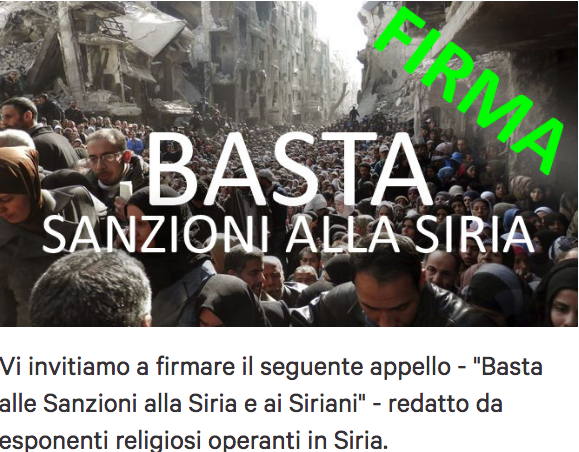
Vi invitiamo a firmare il seguente appello – “Basta alle Sanzioni alla Siria e ai Siriani” – redatto da esponenti religiosi operanti in Siria.
https://www.change.org/p/parlamentari-sindaci-basta-sanzioni-alla-siria-e-ai-siriani
Basta sanzioni alla Siria e ai siriani
Nel 2011 l’Unione Europea, varò le sanzioni contro la Siria, presentandole come “sanzioni a personaggi del regime”, che imponevano al Paese l’embargo del petrolio, il blocco di ogni transazione finanziaria e il divieto di commerciare moltissimi beni e prodotti. Una misura che dura ancora oggi, anche se, con decisione alquanto inspiegabile, nel 2012 veniva rimosso l’embargo del petrolio dalle aree controllate dall’opposizione armata e jihadista, allo scopo di fornire risorse economiche alle cosiddette “forze rivoluzionarie e dell’opposizione”.
In questi cinque anni le sanzioni alla Siria hanno contribuito a distruggere la società siriana condannandola alla fame, alle epidemie, alla miseria, favorendo l’attivismo delle milizie combattenti integraliste e terroriste che oggi colpiscono anche in Europa. E si aggiungono a una guerra, che ha già comportato 250.000 morti, sei milioni di sfollati e quattro milioni di profughi.
La situazione in Siria è disperata. Carenza di generi alimentari, disoccupazione generalizzata, impossibilità di cure mediche, razionamento di acqua potabile, di elettricità. Non solo, l’embargo rende anche impossibile per i siriani stabilitisi all’estero già prima della guerra di spedire denaro ai loro parenti o familiari rimasti in patria. Anche le organizzazioni non governative impegnate in programmi di assistenza sono impossibilitate a spedire denaro ai loro operatori in Siria. Aziende, centrali elettriche, acquedotti, reparti ospedalieri sono costretti a chiudere per l’impossibilità di procurarsi un qualche pezzo di ricambio o benzina.
Oggi i siriani vedono la possibilità di un futuro vivibile per le loro famiglie solo scappando dalla loro terra. Ma, come si vede, anche questa soluzione incontra non poche difficoltà e causa accese controversie all’interno dell’Unione europea. Né può essere la fuga l’unica soluzione che la comunità internazionale sa proporre a questa povera gente.
Così sosteniamo tutte le iniziative umanitarie e di pace che la comunità internazionale sta attuando, in particolare attraverso i difficili negoziati di Ginevra, ma in attesa e nella speranza che tali attese trovino concreta risposta, dopo tante amare delusioni, chiediamo che le sanzioni che toccano la vita quotidiana di ogni siriano siano immediatamente tolte. L’attesa della sospirata pace non può essere disgiunta da una concreta sollecitudine per quanti oggi soffrono a causa di un embargo il cui peso ricade su un intero popolo.
Non solo: la retorica sui profughi che scappano dalla guerra siriana appare ipocrita se nello stesso tempo si continua ad affamare, impedire le cure, negare l’acqua potabile, il lavoro, la sicurezza, la dignità a chi rimane in Siria.
Così ci rivolgiamo ai parlamentari e ai sindaci di ogni Paese affinché l’iniquità delle sanzioni alla Siria sia resa nota ai cittadini dell’Unione Europea (oggi assolutamente ignari) e diventi, finalmente, oggetto di un serio dibattito e di conseguenti deliberazioni.
Firmatari
Padre Georges Abou Khazen – Vicario apostolico dei Latini ad Aleppo
Padre Pierbattista Pizzaballa – Emerito Custode di Terrasanta
Padre Joseph Tobji – Arcivescovo maronita di Aleppo
Padre Boutros Marayati- Vescovo armeno di Aleppo
Suore della Congregazione di San Giuseppe dell’Apparizione dell’Ospedale “Saint Louis” di Aleppo
Comunità Monache Trappiste in Siria
Dottor Nabil Antaki – Medico, ad Aleppo, dei Fratelli Maristi
Suore della Congregazione del Perpetuo Soccorso – Centro per minori e orfani sfollati di Marmarita
Padre Firas Loufti – Francescano
Monsignor Jean-Clément Jeanbart – Arcivescovo greco-cattolico di Aleppo
Monsignor Jacques Behnan Hindo – Vescovo siro-cattolico di Hassakè-Nisibi
Padre Mtanios Haddad – Archimandrita della chiesa Cattolica-Melchita e Procuratore patriarcale
Mons. Hilarion Capucci – Arcivescovo emerito della Chiesa greco-cattolico melchita
S.B. Ignace Youssef III Younan Patriarca di Antiochia dei Siri
Mgr.Georges Masri, Procuratore presso la Santa Sede della Chiesa Sirocattolica
S.B. Gregorio III Laham – Patriarca dei Melchiti
In data 20 maggio l’appello è stato inviato a :
Alto rappresentante dell’Unione Europea per gli affari esteri e la politica di sicurezza – Federica Mogherini
Referente Consiglio dell’Unione europea – Virginie Battue
Presidente del Consiglio Matteo Renzi
Ministro degli Affari Esteri – Paolo Gentiloni
Sottosegretario di Stato Ministero degli Affari Esteri – Benedetto della Vedova
La raccolta di firme, ovviamente, procede e – qualsiasi sarà il voto del Consiglio dell’Unione Europea sulla questione – la mobilitazione contro le sanzioni alla Siria è appena cominciata.
Appello promosso in Italia dal
https://www.change.org/p/parlamentari-sindaci-basta-sanzioni-alla-siria-e-ai-siriani
Christian leaders in Syria ask your support to stop the anti-Syria sanctions
From Fort Russ
![]() |
| Green: SIGN! Text: “We invite you to sign the following appeal – “Enough with the sanctions on Syria and the Syrians” – written by religious leaders operating in Syria.” |
Petition: stop the anti-Syria sanctions
This title is the link. The part where you sign is in English.
Here is what the Italian says:
Enough with the sanctions on Syria and the Syrians! In 2011 the European Union initiated the sanctions against Syria, presenting them as “sanctions on personnel of the regime,” but which imposed an oil embargo, blocked any financial transaction, and prohibited the trade of many goods and products. This measure continues today, although with a somewhat inexplicable decision, in 2012 the oil embargo was removed from areas controlled by the armed and jihadist opposition,in order to provide economic resources to the so-called “revolutionary forces and the opposition” .
In these five years, the sanctions on Syria have helped destroy Syrian society condemning her to hunger, epidemics, poverty, and encouraging fundamentalist militia fighters and terrorist who also strike in Europe And add to that a war that has already resulted in 250,000 deaths, six million displaced and four million refugees.The situation in Syria is desperate. Food shortages, widespread unemployment, inaccessibility of medical care, rationing of drinking water, electricity. Not only that, the embargo makes it impossible for the Syrians who settled abroad before the war to send money to their relatives or family members left behind.
Non-governmental organizations engaged in assistance programs are unable to send money to their workers in Syria. Companies, power plants, aqueducts, hospital departments are forced to close because of the inability to procure spare parts or gasoline.Today the Syrians see the possibility of a better future for their families in running away from their land. But, as you see, this solution also involves many difficulties and causes intense controversy within the European Union. Exile cannot be the only solution that the international community knows how to propose to these poor people.
So we support all humanitarian initiatives and initiatives towards peace that the international community is implementing, in particular through the difficult negotiations in Geneva, but whole waiting and hoping for such expectations to find concrete answers after so many bitter disappointments, we ask that the sanctions that affect the daily life of every Syrian be immediately removed. The expectation of the longed-for peace can not be divorced from a concrete concern for those who today are suffering because of an embargo whose weight falls on an entire people.
That’s not all: rhetoric about refugees fleeing the Syrian war appears hypocritical if at the same time we continue to starve, prevent medical care, deny drinking water, work, security, and dignity to those who remain in Syria. So we turn to the parliamentarians and mayors of each country so that the iniquity of sanctions on Syria is made known to the citizens of the European Union (now totally unaware) and become, finally, the subject of a serious debate and consequent resolutions.
Signatories
Father Georges Abou Khazen – Apostolic Vicar of the Latins in Aleppo
Father Pierbattista Pizzaballa – Emeritus Custos of the Holy Land
Father Joseph Tobji – Maronite Archbishop of Aleppo
Father Boutros Marayati- Armenian Bishop of Aleppo
Sisters of the Congregation of St. Joseph of the Hospital “Saint Louis,” Aleppo
The Trappist community in Syria
Dr. Nabil Antaki – M.D. in Aleppo, the Marist Brothers
Sisters of the Congregation of Perpetual Help – Center for children and orphans displaced, Marmarita
Father Firas Loufti – Franciscan Monsignor
Jean-Clément Jeanbart – greek-Catholic Archbishop of Aleppo
Monsignor Jacques Behnan Hindo – Syrian Catholic Bishop of Hassaké-Nisibi
Father Mtanios Haddad – Archimandrite of the Melkite Catholic Church and the patriarchal Attorney
Msgr. Hilarion Capucci – Archbishop Emeritus of greek-Melkite Catholic Church
S.B. Ignace Youssef III Younan, Patriarch of Antioch of the Syrians
Mgr.Georges Masri, Procurator to the Holy See of the Syro-Catholic Church
S.B. Gregory III Laham – Patriarch of the Melkites
Translation from Italian for Fort Russ by Tom Winter
http://www.fort-russ.com/2016/05/christian-leaders-in-syria-ask-your.html
Aleppo has been under fire by terrorists for four years. “They got orders from outside…”

Aleppo is Syria’s largest city. During the conflict’s first year Aleppo was relatively calm, unlike many other Syrian cities. In July 2012 hell broke out. The story from medical doctor Tony Sayegh about life in the million-city is dramatically different from the one we usually hear. In this interview he talks about living under terror, about the sanctions and the road to peace.
Hell on earth. Hospitals bombings. Tens of thousands of refugees.
No one has been able to escape the dramatic news about Aleppo in North Western Syria. But Tony Sayegh is not satisfied with how the Western media describes the situation. The first thing he does when we reach him on the phone is to say thank you.
– I say thank you, because the Western media always reports from the other side. We who are living in the Government-controlled area of Aleppo are never allowed to express our views about what is happening. In almost four years we have lived under the fire from terrorists.
Proletären gets in contact with Tony Sayegh through the Syrian Medical Association in Aleppo. He is a surgeon and teaches at the faculty of medicine at Aleppo University.
– Many doctors have left the city. Either because they are afraid or because there are no jobs. Many hospitals and clinics have been destroyed.
Despite war and hardship Tony Sayegh has stayed and continued with his life, just like most of the city’s residents. He is anxious to give his view on the development and tell who are ones guilty of terrorism and attacks on hospitals.
– We who live here refuse to talk about the western and eastern Aleppo, as if the city would be divided into two parts. It’s not true. Most of the city is under the Syrian government’s control. A small part is in the hands of armed groups, or terrorists as we consider they are.
The words from Tony Sayegh are important. A large majority of Aleppo’s inhabitants, nearly 1.5 million people, are in the government-controlled area. In the ”opposition-controlled” and much smaller part there is about 300,000 people. Yet it is this side media constantly refer to in the reports from Aleppo.
It is also important to note that ”opposition” in this case means Jabhat al-Nusra, stamped as a terrorist group by the UN, and its allies. Because these groups are the ones who control the ”opposition area” of Aleppo.
• What do you think about the allegations that Syrian and Russian air force are bombing civilian targets in the “opposition” Aleppo? In late April, photos were spread from Al-Quds hospital where ”Aleppo’s last paediatrician”, Wassim Mohammed Maaz, was killed. Doctors Without Borders who support al-Quds condemned the attack.
– First I want to say that we in the Syrian Medical Association have not heard of him. Every doctor in Syria must register in the association to be allowed to work. Since we do not know who he is, we can not express an opinion. The same applies to other doctors who are reported dead.
– But I want to inform you that we know many doctors in terrorist-controlled areas, says Tony Sayegh. We have doctors there who work for and are paid by the Syrian government. Residents in these areas need the care as well.
As for al-Quds Tony Sayegh do not believe the media reports. Four years ago there was no such hospital in Aleppo. Whatever it was that was attacked, it was not an established, well-known health facility. Tony Sayegh believes that the images of an anonymous building with sandbags outside indicates that it was a military site.
– Doctors Without Borders is also not a clean organization, they have their financiers and receive outside support, says Tony Sayegh.
Doctors Without Borders have previously admitted that field hospitals in the Syrian opposition areas that the organization supported primarily cared for rebel fighters and not civilians. This is not mentioned in the media reports.
And it is not mentioned that the al-Qaeda group Jabhat al-Nusra in Aleppo has taken over health facilities and used them for other purposes. Already in April 2013 New York Times wrote that al-Nusra ”has set up camp in a former children’s hospital and has worked with other rebel groups to establish a Shariah Commission in the eye hospital next door to govern the city’s rebel-held neighborhoods”.
What was it like in Aleppo before the conflict? And what happened when the war came to the city? We ask Tony Sayegh.
– The people of Aleppo lived a normal life like in any city. It was a quiet town. Aleppo is Syria’s economic and industrial capital. During the first year of the Syrian crisis many people moved here from other cities, because in Aleppo it was quiet and the economical situation was good.
In July 2012 everything changed. But it was not the residents of Aleppo who rebelled against the rulers. Parts of the city were invaded by armed groups with fighters from other areas of Syria and from other countries. Tony Sayegh believes that the interests at stake of the invasion was much bigger than the control of a single city.
– The attempt to overthrow the government of Syria with weapons and riots had failed. Then they decided to focus on Aleppo, to turn against the whole Syrian economy. The armed groups took over the water utilitys and power plants to stop the supplys to the residents, and they focused on the industries. Entire factorys were taken down and driven to Turkey. They stole everything. That was when everything turned upside down and the bad days of Aleppo began.
• Who were behind the invasion and the looting of industries?
– Those who did this are terrorists no matter which name they go under. Most were not even Syrians, although there are Syrians among them. They got orders from outside. The looting of factories to Turkey took place on the orders of Mr. Erdogan, the president of Turkey.
Four years after the invasion, life remains difficult in the Government-controlled area of Aleppo. Power shortage is a major concern. Food is available for purchase, but it is expensive. Something that makes life even more tough are the economic sanctions that the US and EU have imposed on Syria.
– The sanctions do not hit the government but the people. It is us who pay the price. Luckily, Syria still has friends so we can buy medications. Although many doctors left and hospitals have been destroyed, and although we lack a lot, we still give patients a good health care, says Tony Sayegh.
For almost four years the violence has been ever present. The weeks before our conversation there were reports about massive bombardment of rockets, grenades and gas canisters against government areas. Among the places attacked, parts of the Maternity Hospital al-Dabit was destroyed and twenty people were killed.
– It’s nothing new. We get our daily dose of bombs and grenades from the terrorists. We do not know whether it is accidental or intentional, but innocent people are killed, women and children are killed. This is never reported in the West.
• In the Western world we often hear about “moderate rebels” and “opposition” fighting for democracy and getting weapons and military training from the West.
– We are still trying to understand the meaning of “moderate rebels” and “opposition”. We do not understand, we have not found them. They are terrorists who go by different names, like Jabhat al-Nusra or Daesh, and they are supported by the Gulf States, says Tony Sayegh and continues:
– Is Saudi Arabia a defender of democracy and human rights? Compare the situation of women in Syria before the conflict with the situation for women in Saudi Arabia. Their talk of democracy and human rights is a joke.
The war in Syria has been going on for more than five years. Despite the ceasefire agreement and meetings organized by the UN the killing and destruction continues. When these words are written, we hear tragic reports about the horrific terrorist bombings in the coastal cities of Jableh and Tartus with so far 148 dead.
We finish the conversation with Tony Sayegh with the question that we have asked many Syrians during the years of conflict:
• How to make peace in Syria? What should the outside the world do to help Syria and its people to get away from the hell of war?
– I’ll give you a short answer. Leave us alone, forget us.
• What do you mean?
– Well, what we need is the US, Europe, Turkey and the Gulf States to leave us alone and stop supporting terrorists. There should be a decision by the UN Security Council that other states should stay out of Syria and that all those who have supported the terrorists should be punished.
– When you have left us alone, when the borders are closed and you have forgotten about us, then I am confident that the Syrian army can bring us peace.
Patrik Paulov
Syrian analyst, Afraa Dagher, to U.S.: “Is It normal to kill kids, women? Is this normal for you?”

After a series of coordinated suicide bombings rocked the Syrian coast, killing over one hundred innocent civilians, Syrians are becoming even more frustrated with the hypocrisy of the West, not only in terms of the faux solidarity expressed when Belgium and France were attacked and the subsequent silence when it comes to Syria, but also in the constant Western whining about a “war on terror” that is made up of supporting and directing the very terror organizations it tells its own population it is trying to defeat.
Nowhere outside of its own borders does anyone truly believe that the United States represents freedom and democracy. That lie is reserved for hundreds of millions residing in the U.S., constantly plugged in to American media and the constant barrage of pro-war propaganda. It is thus highly ironic that it is the American people who are the key to stopping the American war machine from its continued march across the rest of the world before finally running out of steam and coming back home to march upon its own population.
Still, Syrians, over 6,000 miles away from the United States, besieged by five years of intense warfare, are fully aware of who has brought this destruction to their doorsteps even if Americans are still unaware that the destruction is even taking place.
In an interview with Aimee Anderson of ED TV, Afraa Dagher, a Syrian political analyst currently residing in Syria, expressed much of that frustration. After reporting the facts of the recent bombings, Dagher stated what many Syrians feel and what any informed observed can easily see for himself. She said,
There is a mastermind behind this. Such [an] attack is well-organized and is planned. . . . . It is an organized plan to destroy our infrastructure, battle stations, hospitals, electricity directorate, many of our important and sensitive sides, killing our people. So called Ahrar al-Sham announced their responsibility but the U.S. refuses to designate it or to classify it as a terrorist group in [at] the U.N. Later, the so-called ISIS declared its responsibility. As I said, [there is] no presence for those [ISIS] in our cities in the coastal line. They are just a cover. At the time, Israel[i] media was so happy to announce that this is a great attempt to kill those [who support] Assad and who support their government. Al Jazeera also reported it as ISIS. It is not ISIS. It is the “moderate rebels.” The “moderate rebels” of the West bombing Assad’s stronghold.
Afraa then moves on to address the perpetrators of the attacks – the root of the problem – the United States, NATO, the GCC, and Israel. Most notably, she addresses the West, who is always harping on about the need for “democracy” in countries other than their own. Afraa asks,
Is this your democracy, to kill who is against you and your views and who is believing what I believe, in my government, so you must kill me? Is this your democracy? I think you are slaughtering every Syrian. Every day. Aleppo, Deir al-Zour, Raqqa, Latakia, Jobleh, Tartus. And I see it also as a message to Russia. Because Russia has its airbase in Tartus. They say “We are here. We can hit any point we want.” Please watch the video about this. Is it a crime? A war crime? Or is it normal to kill kids, women, innocent people? Is this normal for you?
Unfortunately, the answer to that question is “yes.”
VIDEO on original article.
Brandon Turbeville – article archive here – is the author of seven books, Codex Alimentarius — The End of Health Freedom, 7 Real Conspiracies, Five Sense Solutions and Dispatches From a Dissident, volume 1 and volume 2, The Road to Damascus: The Anglo-American Assault on Syria, and The Difference it Makes: 36 Reasons Why Hillary Clinton Should Never Be President. Turbeville has published over 650 articles on a wide variety of subjects including health, economics, government corruption, and civil liberties. Brandon Turbeville’s radio show Truth on The Tracks can be found every Monday night 9 pm EST at UCYTV. His website is BrandonTurbeville.com He is available for radio and TV interviews. Please contact activistpost (at) gmail.com.
White House U-turns on Pakistan drone deaths. “Deaths by CIA strikes not included in the numbers” now will be
The Obama Administration has reversed its position on which countries will be included in its upcoming estimate of the civilian deaths caused by the US drone program, according to a report in yesterday’s Washington Post.
Earlier this week, a report in the Post – based on briefings from anonymous Administration officials – stated that strikes taken in Pakistan by the CIA would not be included in the numbers. However, an article in yesterday’s Post – also based on anonymous US government sources – now suggests that the White House has changed its position, and will include strikes taken in Pakistan in its tally.
The exclusion of Pakistan would have meant that as many as two-thirds of known US drone strikes – including some of the worst reported errors – would have been left out of the US tally of deaths. Strikes in Pakistan have included an attack on a funeral in June 2009 that killed as many as 50 civilians, and a strike on a meeting of tribal elders in March 2011 that killed 41. Pakistan has reportedly seen the use of some of the most controversial aspects of the US drone program, such as ‘signature strikes’, where individuals are targeted on the basis of patterns of behavior.
The absence of the Pakistan numbers would also have avoided any need to address controversial claims made in June 2011 by John Brennan, now Director of the CIA. At the time, Brennan said that no civilians had been killed during a yearlong period from 2010 to 2011. However, in August that year, he altered his position slightly, saying there was no “credible evidence” of such deaths. The Administration has never publicly disputed or corrected his statement.
Recent research by the human rights organization Reprieve – which assists the civilian victims of drone strikes – has found that the US is frequently unable to identify those killed by covert strikes in countries including Pakistan and Yemen. Reprieve has found that, in targeting 41 named individuals, US strikes killed 1,147 unknown men, women and children – often leaving the original target still alive.
Commenting, Jennifer Gibson, staff attorney at Reprieve, said:
It’s been three years since President Obama promised long-overdue transparency over the most dangerous legacy of his Presidency – a drone programme that has reportedly killed thousands in countries where the US is not at war. In that time, we have been inundated with repeated and contradictory claims about the program from ‘anonymous’ sources who cannot be held accountable for their claims.
This week, the Administration’s spin machine was once again in action, first leaking that the government’s numbers would not include Pakistan – a country that accounts for three-quarters of all strikes – and then absurdly walking back that position. Enough panicked legacy spinning – the Administration must reveal the true scale of the civilian deaths it has caused, and at the very least, offer an apology to the victims.
Notes
1. Reprieve is an international human rights organization. Reprieve’s London office can be contacted on: communications [at] reprieve.org.uk / +44 (0) 207 553 8140. Reprieve US, based in New York City, can be contacted on Katherine [dot] oshea [at] reprieve.org / +1 917 855 8064.
2. The US Government’s claim that Pakistan will be included in its tally was reported by the Washington Post, here, while the previous claims can be found in the Post’s earlier report, here.
3. The 2011 comments by John Brennan can be found here.
4. Reprieve’s recent research into deaths under the US drone program is available here.
EgyptAir Flight MS804 – what the media won’t tell you
“Advise & Assist”: US Special Forces photographed on front lines in Syria with Kurds
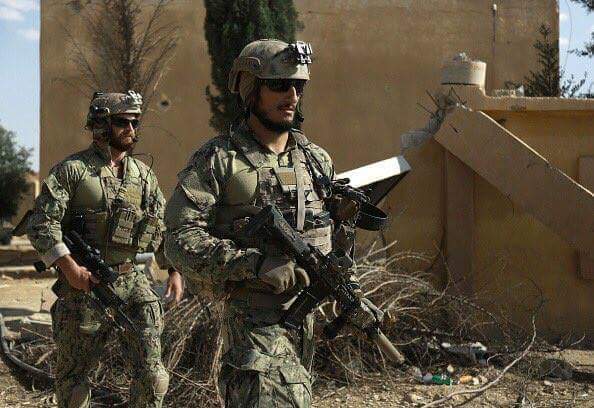
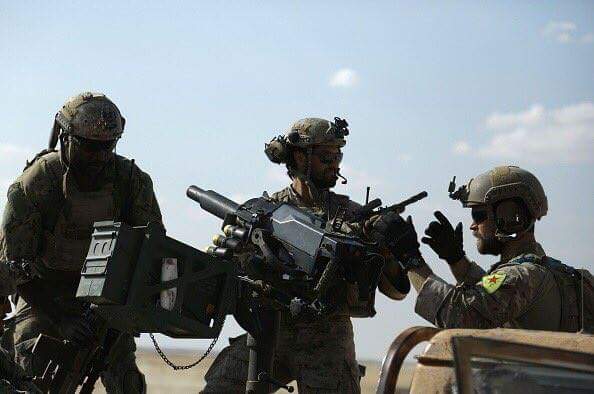
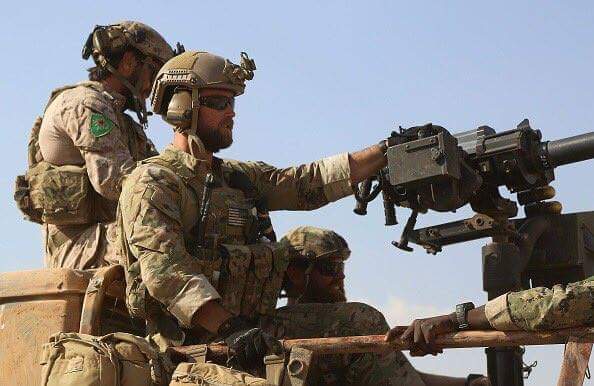
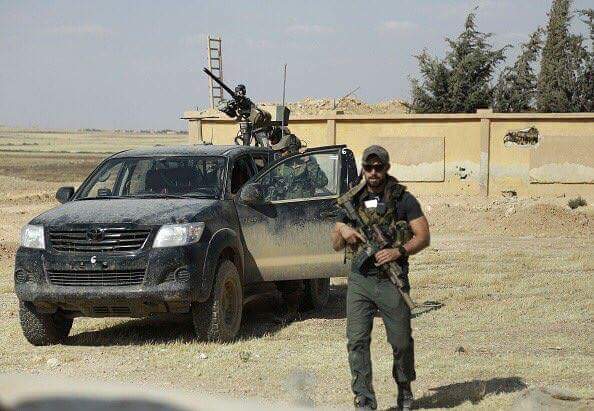
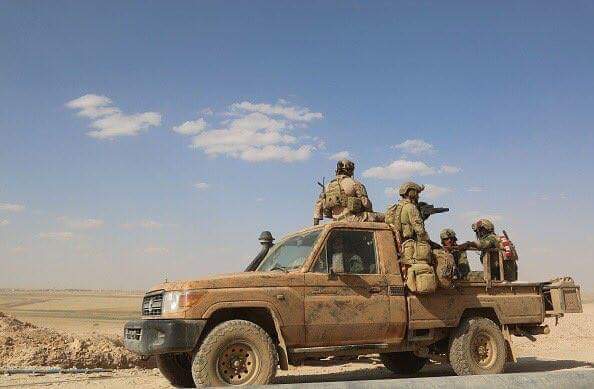
US special forces soldiers have been caught on camera fighting on the front lines with the Kurds against ISIS in Syria.
The troops were spotted by an AFP photographer, who said there are just over a dozen of them in the village of Fatisah; just 30 miles north of Raqqa.
Some of the troops are wearing plain clothes, while others are in military garb carrying the insignia of the Kurdish YPG:
This takes the mission to ‘assist’ quite far indeed.
Watch a video of this report below, or here on Youtube:


Pentagon spokesman Peter Cook admitted that:
“Our special operations forces in the past have, yes, worn insignias and other identifying marks with their partner forces,”
“They do what they can to blend in.”
However, he stressed:
“They are not on the forward line. They are providing advice and assistance, their advise-and-assist role has not changed.”
Cook couldn’t explain the difference between the forward line and the front line, saying:
“I don’t have a yardstick for you. This is a fluid situation.”
Unfortunately for the United States, there is absolutely nothing fluid about the fact that these troops are operating illegally in Syria as they do not have the explicit permission of the Syrian government to be there; unlike the Russians who did have such a mandate.
What do you think these special forces soldiers have been tasked with doing exactly?