Stratfor “forecasted” US bases on Russia’s borders, now “forecasts” Russia’s fragmentation. Who will stand for Russia?

Posted on Fort Russ

Je suis Putin

March 12, 2015

Translated by Kristina RusA man like Putin: by 2018, each region will need their own Vladimir Vladimirovich.

On February 28 Stratfor posted a very interesting document – Decade Forecast: 2015-2025.

“Stratfor” is “Strategic Forecasting Inc.”, also known as the “shadow” or “private CIA” engaged in a highly profitable business of collecting, evaluating and forecasting information. “Statfor” was founded in 1996 in Austin, Texas, by George Friedman, a former professor of political science, who is now the director of the organization. Today the audience of the company is 300 thousand paid subscribers and over two million free subscribers.

Among them – Coca-Cola, which gets advice about the stability of the situation in China on the eve of the Olympic games in Beijing; the corporation “Northrup Grumman” interested about the possibility of Japan obtaining nuclear weapons; “Intel”, asking about the presence of Hezbollah in Latin America and their likelihood to carry out terrorist acts, the owner of hotel chain “Radisson”; looking for the end date of the offensive of militant Islamist groups. Also the services of Stratfor are used by “Goldman Sachs”, “Merrill Lynch”, US marine corps and Georgetown University. Each pays 20 thousand dollars a year to get their hands on a tailored confidential information.

However, Friedman has more serious clients, namely the U.S. State Department, Pentagon, and the large global financial oligarchy standing behind them.

It is easy to figure out, connecting Stratfor’s predictions with the subsequent actions of the government and the U.S. army.

Thus, on March 27 [2014], George Friedman published an article titled “American strategy after Ukraine: from Estonia to Azerbaijan”. There, among other points, particular focus was on the military strategy of the United States against Russia after the beginning of the Ukrainian crisis. In particular, Friedman rightly argued that at this point in time, NATO is not able to wage war against the Russian Federation due to the long stretch of its Western front line and the length of communications for the supply of food, fuel and ammunition for the battle units.

The solution for this problem Friedman proposed by moving military bases directly to the Russian border at several points, as the only possible condition for full deployment of a punitive campaign against Russia, which is rapidly getting out of control of the United States.

And, by the end of the year, this process took place in reality.

So, in mid-December of last year for several days the skies were closed over Zaporozhye, Kharkov and Dnepropetrovsk, and witnesses reported that a large number of transport aircraft, the type of “Hercules” and others landed in Ukrainian airports, bringing the equipment, vehicles and troops, consisting mainly of soldiers of private military companies. The numbers mentioned were about the size of a division from 10 to 15 thousand people, mostly mercenaries from PMC “Academi” (until 2009 it was called Blackwater, owned by Eric Prince, executing orders from the Pentagon).

Previously they were already seen in Donetsk, later in Mariupol. A secret NATO base was set up in  Kharkov oblast: already much has been transported by land, the masks were off and airplanes were involved. Military experts pointed out that some of the equipment and troops was moved from a military base in Hungary near Debretsen. Previously on the territory of Ukraine trains were seen with American armored vehicles, among which were BMPs Bradley, BTRs Stryker and Hummers.

Therefore, the publications of “Stratfor” should be taken seriously.

The document before us is a geopolitical forecast for the next ten years, describing the future of all continents. I will not go into all the details – it has already been done by many analysts.

I will focus on key phrases and what I read between the lines. The article clearly articulates the strategic objective of establishing administrative control over Russia by way of its fragmentation – federalization. Here is a quote:

“To the West from Russia, Poland, Hungary and Romania will try to return the regions once lost in the battle with the Russians. They will attempt to annex Ukraine and Belarus. In the South, Russia will lose the ability to control the North Caucasus; Central Asia will begin to destabilize. In the North-West, Karelia will try to return to Finland. In the Far East the coastal regions will start to conduct an independent policy, more associated with Japan, China and the United States, than with Moscow. Other regions will not necessarily seek autonomy, but may get it against their will. Main idea: there will not be a revolt against Moscow, on the contrary, the weakening Moscow will leave a vacuum. In this vacuum the separate fragments of the former Russian Federation will exist.

[Wait, is he talking about Ukraine!? – KR]

This will lead to a major crisis in the next decade. Russia possesses a vast nuclear arsenal, scattered across the country. The decline of the Moscow power will raise the question of control over these missiles and about how to guarantee restraint from their application. This will be a huge challenge for the United States. Washington is the only power, that can solve this problem…”

[So, America throws all its might to destabilize Russia, the end result of which will be loose nukes – Bravo! – KR]

Next, “Stratfor” talks about a necessity to create a stable and economically sustainable government in the nuclear regions, in order to neutralize the missiles by non-military means.

[Only America, the policeman of the world, can be a responsible owner of nuclear weapons – KR]

In the final part of the study the private intelligence agents laid down the fundamental principle of the American doctrine in relation to Russia:

“The US has entered the Cold war early, and (at least in Europe) did not suffer any losses. This is the guiding principle of the American foreign policy, brought almost to perfection: if a hegemon emerges in Europe [I can tell they are fans of Brzezinsky – KR], the US intervenes as early as possible, as during the Cold war, building alliances and positioning troops on the main defensive positions. Now this is done in relation to Russia. <…> The Americans will try to build a system of alliances, parallel to NATO, from the Baltic States to Bulgaria, and engage as many countries as possible. They will try to lure Turkey into the union and stretch it to Azerbaijan. The troops will be send to these countries in proportion to threats.”

[Imagine if Russia tried to enter into military unions with Canada and Mexico? – KR]

The State Department is well aware that under Vladimir Putin the task of federalization is not feasible, as all rehearsals and attempts of Maidan were ineffective and did not find support in society. In addition, the effectiveness of security forces that provide physical order in the capital is undeniable.

Therefore the main task now is to implement technologies of soft power, which include attempts to undermine the economy, the formation of anti-government public opinion through mass media, organizing round tables and conferences, work at universities and nudging the authorities in the provinces to gain more independence from Moscow.

“Stratfor” writes about this: “Given the structure of the Federation, in which profits from exports go first to Moscow, and only then are redirected to local governments, the regions receive a very different amount of this profit. This will lead to the repetition of the Soviet experience in the 1980’s and the 1990’s, when Moscow has lost the ability to maintain state infrastructure. All this will cause the regions to seek solutions independently, forming formal and informal autonomous associations. Economic ties between Moscow and the periphery will weaken.”

Now let us remember that the first public statement after the accession to the post of mayor of Yekaterinburg, Yevgeny Roizman, concerned “injustice that the money goes first to Moscow and then is distributed”, and subsequently a group of people close to Roizman held protests under the slogan “Stop feeding Moscow”. Among the protesters great activity was shown by young people from a foreign agent-NGO “Golos” (“Voice”), headed by the famous “color revolution technologist” Marko Ivkovich from Serbia, who was banned from entering Russia by FSB in 2012.

The fact is, in Russia the vertical of power now ends at the post of a governor, which allows municipalities to implement policies, different from the state, to form their own budgets controlling a city, using large funds to protect their business with security forces and mass media. At the start of the reform of local self-government, which should continue the vertical of power to the cities, the described system will be broken, and the American diplomats will capitalize on the resistance of local “princelings”.

[Not always will a region flourish if it is given more authority from the center. Instead the inherent culture of corruption in Russia may flourish under such arrangement, which will please Russia’s enemies. But of course local authorities will always demand more power and more control over financial flows – KR]

A key objective of the US is to beat Vladimir Putin at 2018 election, for which the entire arsenal of available technologies will be engaged –  marches, lowering of oil prices, political killings – we may likely see, for example, the general director and owner of the anti-Russian TV channel “Dozhd” (“Rain”), Natalia Sindeeva, shot with a bullet with minted initials of Vladimir Putin. History teaches us that often after a strong ruler comes a weak one, and Americans are well aware of it!

An important role, as conceived by the US, is given to the young generation born in 2000, who will turn 18 in 2018, and who had never lived without Putin. Who will they vote for? They did not, as the author of these lines and most of their readers, witness the bloody shoot-outs and cars exploding on the streets in the 90’s, total racketeering of business, pervasive corruption, deliberate destruction of industry, agriculture, army, non-payment of salaries for several months. Today in universities they are told romantic stories about the “real freedom” of that era, although it is appropriate to call it a time of chaos and anarchy. However, in certain ways they are synonymous with the concept of freedom.

In case US looses the next election for the President of Russian Federation, a special tool is prepared: actions of disobedience will take place across the regions, and their exit from the Russian Federation will begin, writes “Stratfor”. Rostislav Ishchenko, president of the Center for System Analysis and Forecasting, in his article “It rips at the weakest spot” rightly notes: the revolutionaries in Yekaterinburg don’t even have to storm anything. The municipal authorities already are infiltrated with American collaborators, and the government of the region will not be able to immediately react – it is extremely passive and does not have the political will, and its staff consists of the officials who are keen to outlive one governor after another.

What should be our next steps?

First, we need absolute unification of the country, all the people – around the President and commander-in-chief. I am convinced, that the course taken by Vladimir Putin is completely justified. It assumes full sovereignty in all spheres of life, the priority of the interests of Russia as a determinant of state strategy, productive, mutually beneficial cooperation with countries in Latin America and Asia, uniting them around Russia as a new pole of power on Earth. This course is implemented competently, firmly and consistently, and also accurately. We must strongly support it, thwarting any attempts to split the society from the President by the liberals from the fifth column.

Secondly, the authority of the FSB, whose job is to defend the constitutional rights of citizens and territorial integrity of the state, containing anti-Russian activity, today is clearly lagging behind the demands of the time and the situation in the state, as well as the laws that ensure their authority.

I am talking about such precedents as activities of the notorious member of the Ekaterinburg City Duma and a friend of Yevgeny Roizman – Konstantin Kiselev. Professor of the Institute of Philosophy and Law of the Ural State University visited the U.S. and Kiev, lectured on “the utility of” Maidan and positively noting the “contribution” of Yarosh and Turchinov into “the building of the Ukrainian nation”, and even prepared an online conference with the leader of the “Right Sector” in Yekaterinburg.

In this situation, the power structures of Ekaterinburg looked completely toothless: formally no existing article of the criminal code of the Russian Federation applied to the activities of the “political scientist”. If Professor Kiselev called for direct appeals to overthrow the government and seize government buildings or promoted fascism – he could be subjected to the article for extremism, but smart and cautious MP never allowed himself to go that far. Each student, whom the liberal teacher pushed to the “right” frame of thinking, had to make the last step on his own and arrive at the desired conclusion. And the unauthorized contacts with foreign diplomats and agents of Western intelligence, positive coverage of color revolutions, is not a reason to start investigation under the current laws.

Numerous conductors of implementation in Russia of Western values continue their work – “RPR-Parnas”, “Progress Party”, “Civic platform”, “Yabloko”, non-profit organizations “Memorial”, “Voice”, “The Sakharov’s Center”, which this way or another are involved in the preparation of anti-government marches and destabilization of the population, undermining the image of the government, and numerous liberal media supporting them, distorting reality, causing panic. Their activities should be stopped.

If we take the example, as demanded by the liberals, from the United States of America, there after the September 11 terrorist attacks the authority of security structures was expanded. May be it’s our turn? Vladimir Putin has long been waiting for the public opinion to ripen. We already have a full “set” – preparation of color revolutions, assassinations, corruption and the coalition with Americans at local levels. Enough signals to act.

In reality, if we are to withstand the destructive forces, then at a minimum, we should not be weaker. If our special agencies will concede, we will lose in the struggle, and the CIA has historically always been stronger, almost unlimited in their scope of work and generously funded.

We need new legislative initiatives, including the introduction into the criminal code of definitions of activities of the fifth column. Together with public institutions, it is necessary to define appropriate measures of deterrence and punishment.

And the third and main conclusion, we need to start thinking about how to form a new generation of patriotic politicians at all levels of government. Already the US is trying to install their people at key positions. They need to be pushed out, but we need the human resources, and they need to be selected and educated.

To bet the political success only on Vladimir Putin, first of all, puts an enormous strain on him, and secondly, poses a security threat to him personally. We need to appoint its own Putin to each region and municipality, and then any attempts to overthrow the President will lose sense – because his course will be clearly planned and steadily continued at each level.

Our main motto should be: “Today we are all Putin”.

Ukraine : Les Etats-Unis veulent la guerre… sur le sol européen

English translation:

The US wants war — on European soil

Agora Vox, vendredi 6 mars
Boniface MUSAVULI

On ne devrait plus se bercer d’illusions sur les intentions des dirigeants américains : ils veulent la guerre. Une guerre qui doit se dérouler sur le Vieux Continent et qui doit entraîner le plus d’Européens possible dans une confrontation militaire avec la Russie. Les Ukrainiens, sauf un grand sursaut des masses populaires, devraient se résigner à voir leur pays servir durablement de champ de bataille à ce conflit des grandes puissances dont les enjeux leur échappent, depuis qu’ils ont perdu le contrôle des manifestations « Place Maïdan », un soir de février 2014.

De l’EuroMaïdan à l’escalade militaire

En tout cas, les derniers développements aux Etats-Unis ne sont guère rassurants. Un an après les manifestations de l’EuroMaïdan, odieusement dévoyées par « des atlantistes  », les États-Unis ont officialisé la décision d’envoyer en Ukraine quelques 600 parachutistes appartenant à la 173ème brigade aéroportée. L’annonce a été faite lundi dernier par le colonel Michael Foster, commandant de la brigade, et confirmée par Ben Hodges, haut commandant des forces américaines en Europe. Les premières unités combattantes de la brigade devraient se poser en Ukraine d’ici le 8 mars. Officiellement, pas pour combattre, mais pour former les troupes ukrainiennes (en débâcle dans le Donbass) au maniement des armes américaines en voie d’expédition[1].

Au sujet, justement, de l’expédition des armes américaines à Kiev, on sait qu’elle entraînerait réciproquement l’accroissement des moyens militaires des républiques autonomes de l’Est (Donetsk et Lougansk) par Moscou. Parce que, pour la Russie, il est hors de question que les forces des pays de l’OTAN se déploient jusque sur les frontières russo-ukrainiennes, et ils n’ont pas tort. Les Russes n’ont jamais digéré d’avoir été bernés par les Occidentaux en marge de la réunification allemande[2]. C’est pour essayer de contrer ce risque d’escalade militaire que la France et l’Allemagne ont décidé, début février dernier, d’entrer directement en contact avec Vladimir Poutine, sans consulter Washington. Il s’agissait de rassurer le chef du Kremlin sur le fait que Français et Allemands s’opposeront à l’envoi en Ukraine des armes américaines[3]. Le président russe s’est montré ouvert aux propositions franco-allemandes, et accepté les Accords de Minsk II[4] du 11 février 2015. Le hic avec Minsk II est qu’il y avait deux grands absents : les Britanniques et les Américains. N’étant pas liés par ces accords, ils vont continuer d’attiser le conflit.

Il faut vous entretuer pour l’Amérique

Dix jours seulement après la signature des Accords de Minsk, David Cameron annonçait l’envoi de soldats britanniques en Ukraine. Une semaine plus tard, John Sawers, l’ancien patron du MI16, (sorte de CIA britannique) affirmait que « la guerre contre la Russie ne fait que commencer »[5]. Avec l’envoi des unités de combat en Ukraine par les USA, les Britanniques sont ainsi rejoints par leurs cousins américains qui tiennent à ce que la situation continue de se dégrader et qu’elle finisse par dégénérer. Bien évidemment, les armées américaines et britanniques ne vont pas s’engager en première ligne contre l’armée russe. Ce déploiement atlantiste vise plutôt à entretenir durablement un climat de haine entre populations, un environnement de violence permanente et de désolation.

Une des stratégies utilisées par les fauteurs de troubles états-uniens contre les pays qu’ils ciblent consiste à frapper directement les populations soit par des violences aveugles, soit pas des embargos, soit pas des humiliations en mettant systématiquement ces drames collectifs sur le dos de l’« ennemi » qu’ils se sont choisi. Il ne faudrait pas s’étonner si les populations russes/russophones des pays frontaliers deviennent la cible des tueries aveugles et des famines provoquées volontairement, ce qui les amènera à demander de plus en plus l’aide de Moscou. Une aide que Poutine ne pourra pas durablement leur refuser, au risque de se mettre à dos les Russes de l’intérieur[6]. Sauf qu’en intervenant davantage en Ukraine ou, le moment venu, dans les pays baltes, le président russe deviendrait un « agresseur ». Exactement l’image que les médias occidentaux et les dirigeants d’outre-Atlantique s’emploient à lui coller à la peau. Dès lors, des forces européennes, plus ou moins officiellement, chemineraient vers les « pays agressés » par la Russie. Le début d’un engrenage meurtrier au cœur de l’Europe.

Face à ces agissements américains, on est tenté de dire : ils sont fous ces Américains ! Pas du tout. En réalité, les Etats-Unis, une puissance à bout de souffle, misent sur le conflit ukrainien pour entraîner le plus d’Européens possible dans une confrontation militaire avec la Russie[7]. Le pari est que, sauf usage d’armes stratégiques (scénario suicidaire), le sol américain devrait être préservé des ravages de cette guerre qui commence. Lorsque tout cela sera fini, Européens et Russes, quel que soit le camp qui l’aura emporté sur l’autre, seront ruinés économiquement, voire exsangues. Comme à l’issue de la Première et de la Seconde Guerre mondiale, il ne restera qu’une puissance d’ultime recours : les Etats-Unis d’Amérique.

Des milliards de dollars de contrats de reconstruction, une remise sous tutelle des nations européennes et la préservation, par l’Amérique, de son statut de « superpuissance planétaire ».


[2] Le 9 février 1990, James Baker, secrétaire d’Etat américain (de George Bush), avait assuré à Mikhaïl Gorbatchev que l’alliance occidentale n’étendrait “pas d’un pouce” son influence vers l’Est si Moscou acceptait que l’Allemagne réunifiée entre dans l’Otan. Le lendemain, 10 février, Hans-Dietrich Genscher, le ministre allemand des Affaires étrangères, refit cette promesse à Edouard Chevardnadze, son homologue russe : « l’Otan ne s’étendra pas à l’Est ». Mais depuis, la Pologne, la République Tchèque, la Hongrie, la Bulgarie, la Roumanie, la Slovaquie, la Lituanie, la Lettonie et l’Estonie ont adhéré à l’Otan. Avec les évènements de l’EuroMaïdan, l’enjeu était, entre autres, de faire également entrer l’Ukraine dans l’Otan. Cf. http://www.courrierinternational.co…

[3] C’est en tout cas ce qu’assure le journaliste italien Giulietto Chiesa : https://www.youtube.com/watch?v=1w6…

[4] Parce qu’il y a eu Minsk I, Protocole signé le 11 septembre 2014, et qui ne fut pas respecté.

[7] Provoquer un conflit brutal entre Européens et Russes permet aux Américains de se prémunir contre une éventuelle alliance stratégique entre Européens et Russes, alliance qui entraînerait de fait la fin de l’hégémonie américaine. Dans Le Grand échiquier de Zbigniew Brzezinski (1997), où il est question, entre autres, de « briser la Russie » en trois entités (une Russie européenne, une république de Sibérie et une république extrême-orientale), il est également question de cultiver la docilité des « sujets protégés » et d’empêcher les rivaux potentiels de former des alliances offensives. Un rapprochement stratégique entre la Russie et les nations européennes (sujets protégés) est ainsi un scénario que les tenants de l’hégémonie états-unienne n’admettraient en aucune manière.

http://mobile.agoravox.fr/tribune-libre/article/ukraine-les-etats-unis-veulent-la-164505

The US wants war — on European soil

Posted on Fort Russ

Analysis by Boniface Musavuli
Translated from French by Tom Winter

One should nurse no illusions about the intentions of the American leadership: they want war. A war that will take place on the old continent and that should involve as many Europeans as possible in confrontation with Russia. The Ukrainians, short of some mass uprising, must resign themselves to seeing their country serve as the long term battlefield for this conflict of the great powers, since their stakes got out of hand when they lost control of the demonstrations at Maidan Square one night in February 2014.

In any case, the latest developments in the United States are hardly reassuring. One year after the demonstrations of the Maidan, hatefully guided by the Atlanticists, the US has officially announced the decision to send 600 parachutists of the 173rd Airborne Brigade to Ukraine. The announcement was made last Monday by Colonel Michael Foster, brigade commander, and confirmed by Ben Hodges, supreme commander of US forces in Europe.

The first combat units are expected to arrive from here in Ukraine March 8. Officially, not for combat, but to train Ukrainian troops, fresh from their debacle in the Donbass, in the use of the American weaponry now being shipped.[1] As far as that goes, shipping American arms to Kiev, one realizes that it will encompass a reciprocal enlargement of military materiel for the autonomous republics of the east, (Donetsk and Lugansk) by Moscow, because, for Russia, it is out of the question for NATO troops to be deployed on the russo-ukrainian borders, and rightly so.

The Russians have never digested getting misled by the West on the sidelines of German reunification.[2] It was to sideline the risk of military escalation that France and Germany decided, beginning of February, to get into direct contact with Vladimir Putin without consulting Washington. It was a matter of reassuring the chief of the Kremlin that France and Germany will oppose the shipping of American weapons to Ukraine.[3] The Russian president showed himself to be open to the Franco-german proposals, and accepted the accords of Minsk II.[4]

The main glitch with Minsk II is the pair of absentees: the Brits and the Americans. Not being bound by the accords, they are going to keep on fueling the conflict.

You must kill each other for America

Just 10 days after the Minsk II accords were signed, David Cameron announced the deployment of British soldiers to Ukraine. One week later, John Sawers, former boss of MI16 (British CIA) confirmed “The war against Russia is only beginning.”[5]

With the deployment of combat units to Ukraine by the US, the Brits are joined by their American cousins who maintain that the situation continues to worsen and degenerate. Obviously, the American and British forces are not going to engage in frontline combat against the Russian Army. Rather this Atlanticist deployment has in view establishing a climate of hatred between populations, a permanent environment of desolation and violence.

One of the strategies used by US incendiarists against the countries they target consists in directly striking the populations, whether by random violence, whether by embargo, or humiliations in systematically putting collective tragedies on the back of “the enemy” that they have chosen. It should surprise no one if the Russian or Russophone population of border countries become the target of indiscriminate killings, deliberately caused famines, that will lead them to demand help from Moscow all the more, help that Putin will not for long be able to refuse them at the risk of turning his back on his own Russians.[6] Except that in assisting further in Ukraine, or if it comes to that, in the Baltics, the Russian President would become an “aggressor”— exactly the image the western media and the leaders from across the Atlantic are trying to pin on him. So some European forces, more or less officially, would lead down the road to “countries threatened’’ by Russia — the beginning of a murderous grind at the heart of Europe.

Faced with these American activities, one is tempted to exclaim “These Americans are insane!” Not at all. In reality, the US, a power running out of breath, counts on the Ukrainian conflict to engage as many Europeans as possible in a military confrontation with Russia. [7] The betting is that (apart from the use of strategic weapons, a scenario of suicide) the American soil will be spared the ravages of the resultant war. When all is said and done, Europeans and Russians, no matter which camp prevails, will be economically drained and ruined. Just like the outcome of the First and Second World War, there will abide only one power of last resort, the United States of America.

Several billions of dollars in contracts for reconstruction, the remission of European states into a protectorate, and the preservation, by America, of her status as the planetary superpower.

Boniface Musavuli

[1] http://www.politis.fr/Escalade-les-…

[2] February 9, 1990, James Baker, George Bush’s Secretary of State, assured Mikhail Gorbachev that the western alliance would not extend its influence one inch eastwards is Moscow would accept the entrance of a reunified Germany into NATO. The very net day, February 10, Hans-Dietrich Genscher, German foreign affaires minister, made the same promise to Edward Chevardnadze his Russian counterpart: NATO will not expand to the East. But since, Poland,the Çech Republic, Hungary, Bulgaria, Rumania, Slovakia, Lithuania, Latvia and Estonia have joined NATO. With the outcomes of the Euro-Maidan, the object was, among others, to get Ukraine into NATO Cf. http://www.courrierinternational.co…
[3] This is, at any rate, what the Italian journalist Giulietto Chiesa assures us: https://www.youtube.com/watch?v=1w6…
[4] Because there was Minsk I, a protocol signed September 11, which was not respected.
[7] Provoking a brutal conflict between Europe and Russia permits the Americans to put off an eventual alliance between the Europeans and the Russians, an alliance that would end the American hegemony. In The Grand Chessboard, Zbigniew Brzezinski (1997), it is the question of “breaking Russia” into three units (European Russia, a Republic of Siberia, and Republic of the Far East), it is also a question of cultivating the docility of the protected subjects, and preventing potential rivals from forming offensive alliances. A strategic rapprochement between Russia and the European nations, (protected subjects) is thus a scenario that the US holders of hegemony would never allow.


http://www.fortruss.blogspot.com/2015/03/the-us-wants-war-on-european-soil.html

Report: War crimes of the armed forces and security forces of Ukraine: torture of the Donbass region residents (English) — PDF

Posted on Fort Russ

Please post and distribute.

March 13, 2015
Published November 24, 2014

This report was written by a non-state organization ‘The Foundation for the Study of Democracy’ (headed by M. Grigoriev) and the Russian Public Council for International Cooperation and Public Diplomacy (presided by S. Ordzhonikidze) with the assistance of V. Dzhabarov, S. Mamedov, I. Morozov, S. Markov and other members of the Committee for Public Support of the Residents of South-Eastern Ukraine. For the purposes of investigating specific cases of torture, inhuman or degrading treatment, experts of the Foundation interviewed the ex-prisoners released by the Ukrainian side, in some cases five or ten minutes after the exchange. The report written by the Foundation includes the results of interviews with over 100 prisoners released by the Ukrainian side. Experts of the Foundation conducted the interviews in the period from 25 August to 4 November 2014. It should also be noted that, according to those interviewed, the Ukrainian side releases only those prisoners who are in relatively satisfactory physical condition. Thus, one may conclude that the situation in Ukraine regarding torture is more serious than the one described in this report.

1 The majority of the interviewees are still afraid of possible punitive and unlawful measures by the Ukrainian side against their families, most of their names in this report have been changed. However, as part of legal procedures, a video of each interview has been recorded and personal data – first and second names, age, and place of residence – collected. 

 As the European Court of Human Rights opined, the Convention on Human Rights prohibits in absolute terms torture, irrespective of other circumstances. Moreover, it is assumed in the law of the European Union that ‘the State is responsible for the actions of all of its agencies, such as the police, security forces, other law enforcement officials, and any other State bodies who hold the individual under their control, whether they act under orders, or on their own accord.’ Unlike other clauses of the Convention related to rights, Article 3 makes no provision for derogation (reservations) in the event of a war or other emergency threatening national security. Article 15 paragraph 2 explicitly states that there can be no derogation from Article 3 within the Convention. The information collected by the Foundation for Democracy Studies gives grounds to believe that the Ukrainian armed forces, the National Guard and other military units of the Ministry of the Interior of Ukraine, as well as the Security Service of Ukraine (SBU) systematically and on purpose violate Article 3 of the European Convention on Human Rights that reads, ‘No one shall be subjected to torture or to inhuman or degrading treatment or punishment.’ The extent to which torture is being used and the fact that this is done systematically prove that torture is an intentional strategy of the said institutions, authorized by their leadership. Commenting on their practice of committing torture, Liliya Rodionova, deputy head of the Committee for Refugees and Prisoners of War (Donetsk), who is personally engaged in the exchange of prisoners, says the following about the prisoners that the Ukrainian side releases:

“Almost everyone released comes back with their ribs and legs broken and teeth ripped out. There is not a single person with no marks of beating. Treatment does not begin until right before the exchange. There is a guy with eight gunshot wounds. Even at the hospital, he was beaten. They stuck fingers in his wounds. They use pliers to rip out teeth and beat right in the wounds. Many come back with fractured skulls. One of the torture tools is an awl that they use for stabbing prisoners. Lately, they have been seizing ordinary people, not members of the self-defence forces. They use gunpowder and electroshock to torture people, they brand them. Some were thrown into a pit with dead bodies, crushed with a shovel bucket, had a smouldering iron stuck in their mouth. People were kept in iron containers with no source of oxygen. The torture techniques are sophisticated and brutal, they leave the victims maimed. Those in need of medical treatment, even with diabetes, receive no medical assistance. Prisoners from our side can be told by the color of their skin. It is greyish. Each time an exchange is to take place, we draw up a list of acute patients, but the other side won’t release them.”

Simon Verdian, a volunteer helping the Committee, who was himself released in September 2014, says, ‘I know of cases when prisoners had gunpowder spread over their genitals, were branded with hot iron, executed by shooting in front of other prisoners, sent to a mine field, crashed with shovel buckets into the ground and left in a pit of dead bodies for the whole night. Most of their meals consist of bread and water.’

1 «Prohibition of Torture, Inhuman or Degrading Treatment or Punishment under the European Convention on Human Rights (Article  3)», Council of Europe, Interights, 2008.


Please read and share the full 49 page PDF report (in English) here:

Part I.Methods and circumstances of torture committed by the Ukrainian armed forces and security forces


http://www.fortruss.blogspot.com/2015/03/pdf-report-war-crimes-of-armed-forces.html

Nemtsov’s killer was hired by the commander of Dzhokhar Dudaev Battalion in Ukraine, Adam Osmaev

Posted on Fort Russ

Adam Osmaev

March 12, 2015
Anna Veligzhanina for Komsomolskaya Pravda
Translated by Kristina Rus

FSB source to “Komsomolskaya Pravda”: “the customer of Nemtsov’s murder was preparing an assassination of Vladimir Putin”

The main suspect in the organization of the high-profile crime – is a commander of the Ukrainian battalion in the name of Dzhokhar Dudayev, Adam Osmayev.

The correspondent of “Komsomolskaya Pravda” met with the FSB agent, who is part of the team investigating the murder of Boris Nemtsov. In an exclusive interview he spoke about the new details of the crime and named the most likely customer of the murder.

The pistol was found

Today the investigators have irrefutable proof that all persons detained on suspicion of murder of the politician are the perpetrators, – said our source in the FSB. First of all, billing (data about calls and movements of the subscriber. – Ed.) from their mobile phones showed that they conducted surveillance of Nemtsov before the murder, following him closely. The suspects were tracked with their phones at the location where Nemtsov was present with his phone. During the murder all the detainees “were in the area”: some under the bridge, some in a car, some nearby.

Zaur Dadaev pulled the trigger. He first made a confession, and then, on the advice of his lawyers, took it back. But it changes nothing, the investigation has already collected compelling evidence of his guilt. I will not give details of how this was done. The pistol was thrown into the river after the crime, it was later recovered by divers. That Zaur Dadaev immediately said to the TV cameras: “I love prophet Muhammad” – is just a cover. There was no religious motive for the killings. They cynically carried out an order. They are far from devout Muslims. In fact, just real gangsters.

And the most important thing. The executor of the murder was in close contact with Adam Osmaev, who recently became the commander of the Ukrainian battalion in the name of Dzhokhar Dudayev. They met, talked a lot on the phone. Zaur Dadaev and his cronies worked with Osmaev on Ukrainian affairs. And also with Chechens, who fought on the territory of Ukraine for the new regime. Zaur Dadaev was listed in the battalion “North” (“Sever”) of the Chechen Interior Ministry, but while serving in it, in fact, was engaged in activities against Russia. He was associated with Osmaev by a certain relationship and mutual obligations.

Непосредственно нажал на курок Заур Дадаев, который сначала дал признательные показания, а потом, по совету адвокатов, отказался от них
Zaur Dadaev

When the journalists from the Russian TV channel “Life News” were recovered from Ukraine, Zaur Dadaev was involved in this operation. Held direct communication with Osmaev. I don’t have the right to disclose the details. The evidence is still being gathered. But I can say that today the main suspected customer of Nemtsov’s murder is Adam Osmayev.

“The main purpose of the crime is to show Russia in a bad light”

– The perpetrators were told to execute the order in the place where it was committed, – continues our source. – Another words not just to kill him in the alley, but do it in the heart of Moscow across from the Kremlin – deliberately to cause outrage around the world. Before the crime they received the advance payment, it was agreed that the remainder of the money for the “job” will be transferred to their bank account.

– Why did they have to kill Nemtsov, who spoke out against Putin’s policies? It turns out, they had killed their ideological ally!

– [Ultra-] Nationalists and criminals will not stop at anything. To kill their ally for them is not a question of morality. Nemtsov became a bargaining chip. The goal was – to slander Russia, to show it in a bad light, to prevent peace in Donbass (especially after talks with Merkel and Hollande). To show the President of Russia in the eyes of the world community as the “ultimate evil” – to show: look, how he strangled the opposition. The world just began to warm up to Putin’s politics, which he is following in relation to Ukraine. And this cynical murder of Nemtsov has caused a wave of discontent, fueled by the world media. The American and European press immediately began to show this murder in their own light, placing the responsibility on the President of Russia.

Националисты и бандиты не брезгуют ничем. Убить своего союзника для них - не вопрос морали. Немцов стал разменной монетой

Preparing to blow up the President’s motorcade

Adam Osmayev was previously suspected in the attempt to organize the 2012 assassination of Vladimir Putin, at that time a Prime Minister and presidential candidate. Osmayev  planned to blow up Putin’s motorcade, which was confirmed by a video, found in his laptop, of Prime Minister’s motorcade travelling through Moscow. Then Osmaev cooperated with the investigation – admitted he came to Odessa from the United Arab Emirates with instructions from field commander Doku Umarov. But in court Osmayev refused to testify, claiming he gave his testimony after a beating. His lawyers wrote a complaint to the Prosecutor’s office and the European Court of Human Rights.

– Osmaev failed to get to Putin himself, but it seems that he did not calm down, – says our source in the FSB. – And later the most accessible target to attack the President was selected – Boris Nemtsov. Nemtsov lately was not seen as an active member of the opposition, was no competition to Putin, but his name was known. The choice of a sacrificial lamb was quite successful. The gangsters do not stop at anything. And gangsters involved in politics is a devilish blend.

Адам Осмаев ранее подозревался в попытке организации в 2012 году покушения на Владимира Путина
Adam Osmaev

– Will Osmaev be charged?

– Now everything is in the stage of investigation and evidence collection. Some of the evidence we already gathered, but I don’t want to tell everything in order not to hinder the investigation.

“KP” Files

What was Adam Osmayev “famous” for…

In 2007 in Moscow on the eve of Victory Day a terrorist attack was averted – explosives were found in a parked car. A native of Grozny, Adam Osmayev, a suspect in the case, was arrested in absentia by the Lefortovsky district court of Moscow and declared for international search. The investigation found that Osmayev with a group of Chechens and Ingush was also preparing an assassination on May 9 of the head of Chechnya, Ramzan Kadyrov.

According to the press, after that Osmayev was hiding in the UK, where he was contacted by associates of Doku Umarov and was offered to organize a new terrorist attack. Adam agreed and went to Ukraine with a fake passport. In 2012, he was arrested after an explosion in a rented apartment – the terrorist was preparing homemade bombs. Osman and his “right hand”, a Kazakh citizen, Ilya Pyanzin, admitted: they were preparing an assassination of the head of the government of Russian Federation, Vladimir Putin. The suspects also reported that they recruited fighters for future terrorist attacks in Russia. But later they took back their testimony.

Russia demanded to extradite Adam Osmayev, however, the European Court of Human Rights had blocked it, declaring: “In Russia the detainee may be subjected to torture”. Pyanzin eventually was extradited to Russia, and in September 2013 he was sentenced to ten years in a colony with a strict regime.

On November 18, 2014, the court of Odessa declared a sentence for Osmaev: 2 years and 9 months imprisonment. He was released in the courtroom “for lack of evidence of preparation of assassination” – he was credited the time he already spent in jail. The court room reacted to the sentence of Osmaev with applause, and he, in turn, encouraged them to “protect Ukraine”.

In February of this year Osmayev headed the Ukrainian battalion  in the name of Dzhokhar Dudayev, succeeding the general, deceased under Debaltsevo, Isa Munaev.

OFFICIAL COMMENT

Dmitry Peskov: In the coming days, the prosecutors will announce the motives for the murder

“We hope that in the coming days all legal formalities will be completed and prosecutors will announce their versions of the murder, will name those who are behind this,” said the President’s press secretary Dmitry Peskov to the journalists of “AP”, answering the question about the prospects of completing the investigation of the murder of Boris Nemtsov.

Readers Comments:

– You can’t make up a better plan to frame Kadyrov through Osmaev (Kadyrov’s worst enemy) and Dadaev  (a traitor), and most importantly to smear Russia

– This looks like the truth. The volunteer battalion is likely curated by the SBU. And SBU is a branch of American special agencies. Classic sacrificial lamb. Technologies of color revolutions are very cynical. The fifth column doesn’t realize that it is just disposable material for the puppet-masters.

– What a present to Kadyrov and Putin – Nemtsov’s murder! How could Kadyrov be so fooled!

– If you continue down the trail, it might lead to the UK or Americans

Kristina Rus: 

Another important point to make, is that although in Russia Nemtsov was virtually forgotten, except to the old-timers and his direct followers (he complained that he has not been on Russian TV in 8 years), Nemtsov was quite popular in Ukraine, and was frequently invited on Ukrainian TV as a Putin’s critic and a supporter of the current regime, creating a perception that he was a major opposition player in Russia. Although it is true that Nemtsov was in charge of organizing the anti-Putin rallies in Russia, he himself admitted in personal conversations in his wire taps that he had no future chances in politics, because of his disastrous track record in the 1990’s, when he was a Deputy Prime Minister at the time of the economic collapse in 1998. It is possible that to Ukrainian and foreign observers Nemtsov’s importance looked more exaggerated then it was in reality, making him a likely candidate for a sacrificial lamb.

No matter how little attention was paid to Nemtsov by the Russian media, there is no one that the Western mainstream media can not make a celebrity overnight (even after their death) – and it was achieved.

The investigation, of course, learned about the connection to Ukraine much earlier. We can wonder if Putin tried to withhold these revelations until two weeks after the murder and after the Western media had a chance to pour all the dirt that they had on Putin and Russia, ending with the European Parliament resolution to demand independent investigation. 

Now Putin can get his popcorn and watch the West change their tune after the trail lead to Ukraine. Perhaps they will try to quickly forget about it and ignore it, just like the Boeing. 


http://fortruss.blogspot.com/2015/03/nemtsovs-killer-was-hired-by-commander.html

The Powell memo and the U.S. Chamber of Commerce

This memo, written in 1971 by Lewis Powell, an influential member of the corporate legal community, called on the U.S. Chamber of Commerce to take a more active and aggressive role in the country in promoting their voice. In it, he detailed the many avenues of influence the Chamber  could take in asserting their influence.

It is a key element to understanding the uniform voice coming from mainstream media, universities, public agencies, government officials — local, state, and federal — and the many “public-private” partnerships.

Lewis Powell became Associate Justice on the Supreme Court the following year, serving on the Supreme Court from 1972 – 1987.

This memo was cited in the Robert Parry article “The Victory of ‘Perception Management'”.

Background information:

From Wikipedia:

Powell was a partner for over a quarter of a century at Hunton, Williams, Gay, Powell and Gibson, a large Virginia law firm, with its primary office in Richmond (now known as Hunton & Williams LLP). Powell practiced primarily in the areas of corporate law (especially in the field of mergers and acquisitions) and in railway litigation law. He had been a board member of Philip Morris from 1964 until his court appointment in 1971 and had acted as a contact point for the tobacco industry with the Virginia Commonwealth University. Through his law firm, Powell represented the Tobacco Institute and various tobacco companies in numerous law cases…

On August 23, 1971, prior to accepting President Nixon’s request to become an Associate Justice of the Supreme Court, Powell sent the “Confidential Memorandum” titled “Attack on the American Free Enterprise System.” He argued, “The most disquieting voices joining the chorus of criticism came from perfectly respectable elements of society: from the college campus, the pulpit, the media, the intellectual and literary journals, the arts and sciences, and from politicians.” In the memorandum, Powell advocated “constant surveillance” of textbook and television content, as well as a purge of left-wing elements. He named consumer advocate Ralph Nader as the chief antagonist of American business.[19]

This memo foreshadowed a number of Powell’s court opinions, especially First National Bank of Boston v. Bellotti, which shifted the direction of First Amendment law by declaring that corporate financial influence of elections through independent expenditures should be protected with the same vigor as individual political speech. Much of the future Court opinion in Citizens United v. Federal Election Commission relied on the same arguments raised in Bellotti.

https://en.wikipedia.org/wiki/Lewis_F._Powell,_Jr.

Continue reading →

Robert Parry: The victory of ‘perception management’

An exceptional and critically important article.

From Consortium News, December 28, 2014
By Robert Parry

Special Report: In the 1980s, the Reagan administration pioneered “perception management” to get the American people to “kick the Vietnam Syndrome” and accept more U.S. interventionism, but that propaganda structure continues to this day getting the public to buy into endless war, writes Robert Parry.

To understand how the American people find themselves trapped in today’s Orwellian dystopia of endless warfare against an ever-shifting collection of “evil” enemies, you have to think back to the Vietnam War and the shock to the ruling elite caused by an unprecedented popular uprising against that war.

While on the surface Official Washington pretended that the mass protests didn’t change policy, a panicky reality existed behind the scenes, a recognition that a major investment in domestic propaganda would be needed to ensure that future imperial adventures would have the public’s eager support or at least its confused acquiescence.
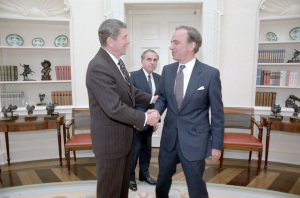
President Ronald Reagan meeting with media magnate Rupert Murdoch in the Oval Office on Jan. 18, 1983, with Charles Wick, director of the U.S. Information Agency, the the background. (Credit: Reagan presidential library)

President Ronald Reagan meeting with media magnate Rupert Murdoch in the Oval Office on Jan. 18, 1983, with Charles Wick, director of the U.S. Information Agency, in the background. (Photo credit: Reagan presidential library)

This commitment to what the insiders called “perception management” began in earnest with the Reagan administration in the 1980s but it would come to be the accepted practice of all subsequent administrations, including the present one of President Barack Obama.

In that sense, propaganda in pursuit of foreign policy goals would trump the democratic ideal of an informed electorate. The point would be not to honestly inform the American people about events around the world but to manage their perceptions by ramping up fear in some cases and defusing outrage in others – depending on the U.S. government’s needs.

Thus, you have the current hysteria over Russia’s supposed “aggression” in Ukraine when the crisis was actually provoked by the West, including by U.S. neocons who helped create today’s humanitarian crisis in eastern Ukraine that they now cynically blame on Russian President Vladimir Putin.

Yet, many of these same U.S. foreign policy operatives – outraged over Russia’s limited intervention to protect ethnic Russians in eastern Ukraine – are demanding that President Obama launch an air war against the Syrian military as a “humanitarian” intervention there.

In other words, if the Russians act to shield ethnic Russians on their border who are being bombarded by a coup regime in Kiev that was installed with U.S. support, the Russians are the villains blamed for the thousands of civilian deaths, even though the vast majority of the casualties have been inflicted by the Kiev regime from indiscriminate bombing and from dispatching neo-Nazi militias to do the street fighting.

In Ukraine, the exigent circumstances don’t matter, including the violent overthrow of the constitutionally elected president last February. It’s all about white hats for the current Kiev regime and black hats for the ethnic Russians and especially for Putin.

But an entirely different set of standards has applied to Syria where a U.S.-backed rebellion, which included violent Sunni jihadists from the start, wore the white hats and the relatively secular Syrian government, which has responded with excessive violence of its own, wears the black hats. But a problem to that neat dichotomy arose when one of the major Sunni rebel forces, the Islamic State, started seizing Iraqi territory and beheading Westerners.

Faced with those grisly scenes, President Obama authorized bombing the Islamic State forces in both Iraq and Syria, but neocons and other U.S. hardliners have been hectoring Obama to go after their preferred target, Syria’s President Bashar al-Assad, despite the risk that destroying the Syrian military could open the gates of Damascus to the Islamic State or al-Qaeda’s Nusra Front.

Lost on the Dark Side

You might think that the American public would begin to rebel against these messy entangling alliances with the 1984-like demonizing of one new “enemy” after another. Not only have these endless wars drained trillions of dollars from the U.S. taxpayers, they have led to the deaths of thousands of U.S. troops and to the tarnishing of America’s image from the attendant evils of war, including a lengthy detour into the “dark side” of torture, assassinations and “collateral” killings of children and other innocents.

But that is where the history of “perception management” comes in, the need to keep the American people compliant and confused. In the 1980s, the Reagan administration was determined to “kick the Vietnam Syndrome,” the revulsion that many Americans felt for warfare after all those years in the blood-soaked jungles of Vietnam and all the lies that clumsily justified the war.

So, the challenge for the U.S. government became: how to present the actions of “enemies” always in the darkest light while bathing the behavior of the U.S. “side” in a rosy glow. You also had to stage this propaganda theater in an ostensibly “free country” with a supposedly “independent press.”

From documents declassified or leaked over the past several decades, including an unpublished draft chapter of the congressional Iran-Contra investigation, we now know a great deal about how this remarkable project was undertaken and who the key players were.

Perhaps not surprisingly much of the initiative came from the Central Intelligence Agency, which housed the expertise for manipulating target populations through propaganda and disinformation. The only difference this time would be that the American people would be the target population.

For this project, Ronald Reagan’s CIA Director William J. Casey sent his top propaganda specialist Walter Raymond Jr. to the National Security Council staff to manage the inter-agency task forces that would brainstorm and coordinate this “public diplomacy” strategy.

Many of the old intelligence operatives, including Casey and Raymond, are now dead, but other influential Washington figures who were deeply involved by these strategies remain, such as neocon stalwart Robert Kagan, whose first major job in Washington was as chief of Reagan’s State Department Office of Public Diplomacy for Latin America.

Now a fellow at the Brookings Institution and a columnist at the Washington Post, Kagan remains an expert in presenting foreign policy initiatives within the “good guy/bad guy” frames that he learned in the 1980s. He is also the husband of Assistant Secretary of State for European Affairs Victoria Nuland, who oversaw the overthrow of Ukraine’s elected President Viktor Yanukovych last February amid a very effective U.S. propaganda strategy.

During the Reagan years, Kagan worked closely on propaganda schemes with Elliott Abrams, then the Assistant Secretary of State for Latin America. After getting convicted and then pardoned in the Iran-Contra scandal, Abrams reemerged on President George W. Bush’s National Security Council handling Middle East issues, including the Iraq War, and later “global democracy strategy.” Abrams is now a senior fellow at the Council on Foreign Relations.

These and other neocons were among the most diligent students learning the art of “perception management” from the likes of Raymond and Casey, but those propaganda skills have spread much more widely as “public diplomacy” and “information warfare” have now become an integral part of every U.S. foreign policy initiative.

A Propaganda Bureaucracy

Declassified documents now reveal how extensive Reagan’s propaganda project became with inter-agency task forces assigned to develop “themes” that would push American “hot buttons.” Scores of documents came out during the Iran-Contra scandal in 1987 and hundreds more are now available at the Reagan presidential library in Simi Valley, California.

What the documents reveal is that at the start of the Reagan administration, CIA Director Casey faced a daunting challenge in trying to rally public opinion behind aggressive U.S. interventions, especially in Central America. Bitter memories of the Vietnam War were still fresh and many Americans were horrified at the brutality of right-wing regimes in Guatemala and El Salvador, where Salvadoran soldiers raped and murdered four American churchwomen in December 1980.

The new leftist Sandinista government in Nicaragua also was not viewed with much alarm. After all, Nicaragua was an impoverished country of only about three million people who had just cast off the brutal dictatorship of Anastasio Somoza.

So, Reagan’s initial strategy of bolstering the Salvadoran and Guatemalan armies required defusing the negative publicity about them and somehow rallying the American people into supporting a covert CIA intervention inside Nicaragua via a counterrevolutionary force known as the Contras led by Somoza’s ex-National Guard officers.

Reagan’s task was made tougher by the fact that the Cold War’s anti-communist arguments had so recently been discredited in Vietnam. As deputy assistant secretary to the Air Force, J. Michael Kelly, put it, “the most critical special operations mission we have … is to persuade the American people that the communists are out to get us.”

At the same time, the White House worked to weed out American reporters who uncovered facts that undercut the desired public images. As part of that effort, the administration attacked New York Times correspondent Raymond Bonner for disclosing the Salvadoran regime’s massacre of about 800 men, women and children in the village of El Mozote in northeast El Salvador in December 1981. Accuracy in Media and conservative news organizations, such as The Wall Street Journal’s editorial page, joined in pummeling Bonner, who was soon ousted from his job.

But these were largely ad hoc efforts. A more comprehensive “public diplomacy” operation took shape beginning in 1982 when Raymond, a 30-year veteran of CIA clandestine services, was transferred to the NSC.

A slight, soft-spoken New Yorker who reminded some of a character from a John le Carré spy novel, Raymond was an intelligence officer who “easily fades into the woodwork,” according to one acquaintance. But Raymond would become the sparkplug for this high-powered propaganda network, according to a draft chapter of the Iran-Contra report.

Though the draft chapter didn’t use Raymond’s name in its opening pages, apparently because some of the information came from classified depositions, Raymond’s name was used later in the chapter and the earlier citations matched Raymond’s known role. According to the draft report, the CIA officer who was recruited for the NSC job had served as Director of the Covert Action Staff at the CIA from 1978 to 1982 and was a “specialist in propaganda and disinformation.”

“The CIA official [Raymond] discussed the transfer with [CIA Director] Casey and NSC Advisor William Clark that he be assigned to the NSC as [Donald] Gregg’s successor [as coordinator of intelligence operations in June 1982] and received approval for his involvement in setting up the public diplomacy program along with his intelligence responsibilities,” the chapter said.

“In the early part of 1983, documents obtained by the Select [Iran-Contra] Committees indicate that the Director of the Intelligence Staff of the NSC [Raymond] successfully recommended the establishment of an inter-governmental network to promote and manage a public diplomacy plan designed to create support for Reagan Administration policies at home and abroad.”

During his Iran-Contra deposition, Raymond explained the need for this propaganda structure, saying: “We were not configured effectively to deal with the war of ideas.”

One reason for this shortcoming was that federal law forbade taxpayers’ money from being spent on domestic propaganda or grassroots lobbying to pressure congressional representatives. Of course, every president and his team had vast resources to make their case in public, but by tradition and law, they were restricted to speeches, testimony and one-on-one persuasion of lawmakers.

But things were about to change. In a Jan. 13, 1983, memo, NSC Advisor Clark foresaw the need for non-governmental money to advance this cause. “We will develop a scenario for obtaining private funding,” Clark wrote. (Just five days later, President Reagan personally welcomed media magnate Rupert Murdoch into the Oval Office for a private meeting, according to records on file at the Reagan library.)

As administration officials reached out to wealthy supporters, lines against domestic propaganda soon were crossed as the operation took aim not only at foreign audiences but at U.S. public opinion, the press and congressional Democrats who opposed funding the Nicaraguan Contras.

At the time, the Contras were earning a gruesome reputation as human rights violators and terrorists. To change this negative perception of the Contras as well as of the U.S.-backed regimes in El Salvador and Guatemala, the Reagan administration created a full-blown, clandestine propaganda network.

In January 1983, President Reagan took the first formal step to create this unprecedented peacetime propaganda bureaucracy by signing National Security Decision Directive 77, entitled “Management of Public Diplomacy Relative to National Security.” Reagan deemed it “necessary to strengthen the organization, planning and coordination of the various aspects of public diplomacy of the United States Government.”

Reagan ordered the creation of a special planning group within the National Security Council to direct these “public diplomacy” campaigns. The planning group would be headed by the CIA’s Walter Raymond Jr. and one of its principal arms would be a new Office of Public Diplomacy for Latin America, housed at the State Department but under the control of the NSC.

CIA Taint

Worried about the legal prohibition barring the CIA from engaging in domestic propaganda, Raymond formally resigned from the CIA in April 1983, so, he said, “there would be no question whatsoever of any contamination of this.” But Raymond continued to act toward the U.S. public much like a CIA officer would in directing a propaganda operation in a hostile foreign country.

Raymond fretted, too, about the legality of Casey’s ongoing involvement. Raymond confided in one memo that it was important “to get [Casey] out of the loop,” but Casey never backed off and Raymond continued to send progress reports to his old boss well into 1986. It was “the kind of thing which [Casey] had a broad catholic interest in,” Raymond shrugged during his Iran-Contra deposition. He then offered the excuse that Casey undertook this apparently illegal interference in domestic politics “not so much in his CIA hat, but in his adviser to the president hat.”

As a result of Reagan’s decision directive, “an elaborate system of inter-agency committees was eventually formed and charged with the task of working closely with private groups and individuals involved in fundraising, lobbying campaigns and propagandistic activities aimed at influencing public opinion and governmental action,” the draft Iran-Contra chapter said. “This effort resulted in the creation of the Office of Public Diplomacy for Latin America and the Caribbean in the Department of State (S/LPD), headed by Otto Reich,” a right-wing Cuban exile from Miami.

Though Secretary of State George Shultz wanted the office under his control, President Reagan insisted that Reich “report directly to the NSC,” where Raymond oversaw the operations as a special assistant to the President and the NSC’s director of international communications, the chapter said.

“Reich relied heavily on Raymond to secure personnel transfers from other government agencies to beef up the limited resources made available to S/LPD by the Department of State,” the chapter said. “Personnel made available to the new office included intelligence specialists from the U.S. Air Force and the U.S. Army. On one occasion, five intelligence experts from the Army’s 4th Psychological Operations Group at Fort Bragg, North Carolina, were assigned to work with Reich’s fast-growing operation.”

A “public diplomacy strategy paper,” dated May 5, 1983, summed up the administration’s problem. “As far as our Central American policy is concerned, the press perceives that: the USG [U.S. government] is placing too much emphasis on a military solution, as well as being allied with inept, right-wing governments and groups. …The focus on Nicaragua [is] on the alleged U.S.-backed ‘covert’ war against the Sandinistas. Moreover, the opposition … is widely perceived as being led by former Somozistas.”

The administration’s difficulty with most of these press perceptions was that they were correct. But the strategy paper recommended ways to influence various groups of Americans to “correct” the impressions anyway, removing what another planning document called “perceptional obstacles.”

“Themes will obviously have to be tailored to the target audience,” the strategy paper said.

Casey’s Hand

As the Reagan administration struggled to manage public perceptions, CIA Director Casey kept his personal hand in the effort. On one muggy day in August 1983, Casey convened a meeting of Reagan administration officials and five leading ad executives at the Old Executive Office Building next to the White House to come up with ideas for selling Reagan’s Central American policies to the American people.

Earlier that day, a national security aide had warmed the P.R. men to their task with dire predictions that leftist governments would send waves of refugees into the United States and cynically flood America with drugs. The P.R. executives jotted down some thoughts over lunch and then pitched their ideas to the CIA director in the afternoon as he sat hunched behind a desk taking notes.

“Casey was kind of spearheading a recommendation” for better public relations for Reagan’s Central America policies, recalled William I. Greener Jr., one of the ad men. Two top proposals arising from the meeting were for a high-powered communications operation inside the White House and private money for an outreach program to build support for U.S. intervention.

The results from the discussions were summed up in an Aug. 9, 1983, memo written by Raymond who described Casey’s participation in the meeting to brainstorm how “to sell a ‘new product’ – Central America – by generating interest across-the-spectrum.”

In the memo to then-U.S. Information Agency director Charles Wick, Raymond also noted that “via Murdock [sic] may be able to draw down added funds” to support pro-Reagan initiatives. Raymond’s reference to Rupert Murdoch possibly drawing down “added funds” suggests that the right-wing media mogul had been recruited to be part of the covert propaganda operation. During this period, Wick arranged at least two face-to-face meetings between Murdoch and Reagan.

In line with the clandestine nature of the operation, Raymond also suggested routing the “funding via Freedom House or some other structure that has credibility in the political center.” (Freedom House would later emerge as a principal beneficiary of funding from the National Endowment for Democracy, which was also created under the umbrella of Raymond’s operation.)

As the Reagan administration pushed the envelope on domestic propaganda, Raymond continued to worry about Casey’s involvement. In an Aug. 29, 1983, memo, Raymond recounted a call from Casey pushing his P.R. ideas. Alarmed at a CIA director participating so brazenly in domestic propaganda, Raymond wrote that “I philosophized a bit with Bill Casey (in an effort to get him out of the loop)” but with little success.

Meanwhile, Reich’s Office of Public Diplomacy for Latin America (S/LPD) proved extremely effective in selecting “hot buttons” that would anger Americans about the Sandinistas. He also browbeat news correspondents who produced stories that conflicted with the administration’s “themes.” Reich’s basic M.O. was to dispatch his propaganda teams to lobby news executives to remove or punish out-of-step reporters – with a disturbing degree of success. Reich once bragged that his office “did not give the critics of the policy any quarter in the debate.”

Another part of the office’s job was to plant “white propaganda” in the news media through op-eds secretly financed by the government. In one memo, Jonathan Miller, a senior public diplomacy official, informed White House aide Patrick Buchanan about success placing an anti-Sandinista piece in The Wall Street Journal’s friendly pages. “Officially, this office had no role in its preparation,” Miller wrote.

Other times, the administration put out “black propaganda,” outright falsehoods. In 1983, one such theme was designed to anger American Jews by portraying the Sandinistas as anti-Semitic because much of Nicaragua’s small Jewish community fled after the revolution in 1979.

However, the U.S. embassy in Managua investigated the charges and “found no verifiable ground on which to accuse the GRN [the Sandinista government] of anti-Semitism,” according to a July 28, 1983, cable. But the administration kept the cable secret and pushed the “hot button” anyway.

Black Hats/White Hats

Repeatedly, Raymond lectured his subordinates on the chief goal of the operation: “in the specific case of Nica[ragua], concentrate on gluing black hats on the Sandinistas and white hats on UNO [the Contras’ United Nicaraguan Opposition].” So Reagan’s speechwriters dutifully penned descriptions of Sandinista-ruled Nicaragua as a “totalitarian dungeon” and the Contras as the “moral equivalent of the Founding Fathers.”

As one NSC official told me, the campaign was modeled after CIA covert operations abroad where a political goal is more important than the truth. “They were trying to manipulate [U.S.] public opinion … using the tools of Walt Raymond’s trade craft which he learned from his career in the CIA covert operation shop,” the official admitted.

Another administration official gave a similar description to The Miami Herald’s Alfonso Chardy. “If you look at it as a whole, the Office of Public Diplomacy was carrying out a huge psychological operation, the kind the military conduct to influence the population in denied or enemy territory,” that official explained. [For more details, see Parry’s Lost History.]

Another important figure in the pro-Contra propaganda was NSC staffer Oliver North, who spent a great deal of his time on the Nicaraguan public diplomacy operation even though he is better known for arranging secret arms shipments to the Contras and to Iran’s radical Islamic government, leading to the Iran-Contra scandal.

The draft Iran-Contra chapter depicted a Byzantine network of contract and private operatives who handled details of the domestic propaganda while concealing the hand of the White House and the CIA. “Richard R. Miller, former head of public affairs at AID, and Francis D. Gomez, former public affairs specialist at the State Department and USIA, were hired by S/LPD through sole-source, no-bid contracts to carry out a variety of activities on behalf of the Reagan administration policies in Central America,” the chapter said.

“Supported by the State Department and White House, Miller and Gomez became the outside managers of [North operative] Spitz Channel’s fundraising and lobbying activities. They also served as the managers of Central American political figures, defectors, Nicaraguan opposition leaders and Sandinista atrocity victims who were made available to the press, the Congress and private groups, to tell the story of the Contra cause.”

Miller and Gomez facilitated transfers of money to Swiss and offshore banks at North’s direction, as they “became the key link between the State Department and the Reagan White House with the private groups and individuals engaged in a myriad of endeavors aimed at influencing the Congress, the media and public opinion,” the chapter said.

The Iran-Contra draft chapter also cited a March 10, 1985, memo from North describing his assistance to CIA Director Casey in timing disclosures of pro-Contra news “aimed at securing Congressional approval for renewed support to the Nicaraguan Resistance Forces.”

The chapter added: “Casey’s involvement in the public diplomacy effort apparently continued throughout the period under investigation by the Committees,” including a 1985 role in pressuring Congress to renew Contra aid and a 1986 hand in further shielding the Office of Public Diplomacy for Latin America from the oversight of Secretary Shultz.

A Raymond-authored memo to Casey in August 1986 described the shift of the S/LPD office – where Robert Kagan had replaced Reich – to the control of the Bureau of Inter-American Affairs, which was headed by Assistant Secretary of State Elliott Abrams, who had tapped Kagan for the public diplomacy job.

Even after the Iran-Contra scandal unraveled in 1986-87 and Casey died of brain cancer on May 6, 1987, the Republicans fought to keep secret the remarkable story of the public diplomacy apparatus. As part of a deal to get three moderate Republican senators to join Democrats in signing the Iran-Contra majority report, Democratic leaders agreed to drop the draft chapter detailing the CIA’s domestic propaganda role (although a few references were included in the executive summary). But other Republicans, including Rep. Dick Cheney, still issued a minority report defending broad presidential powers in foreign affairs.

Thus, the American people were spared the chapter’s troubling conclusion: that a secret propaganda apparatus had existed, run by “one of the CIA’s most senior specialists, sent to the NSC by Bill Casey, to create and coordinate an inter-agency public-diplomacy mechanism [which] did what a covert CIA operation in a foreign country might do. [It] attempted to manipulate the media, the Congress and public opinion to support the Reagan administration’s policies.”

Kicking the Vietnam Syndrome

The ultimate success of Reagan’s propaganda strategy was affirmed during the tenure of his successor, George H.W. Bush, when Bush ordered a 100-hour ground war on Feb. 23, 1991, to oust Iraqi troops from Kuwait, which had been invaded the previous August.

Though Iraqi dictator Saddam Hussein had long been signaling a readiness to withdraw – and Soviet President Mikhail Gorbachev had negotiated a withdrawal arrangement that even had the blessings of top U.S. commanders in the field – President Bush insisted on pressing ahead with the ground attack.

Bush’s chief reason was that he – and his Defense Secretary Dick Cheney – saw the assault against Iraq’s already decimated forces as an easy victory, one that would demonstrate America’s new military capacity for high-tech warfare and would cap the process begun a decade earlier to erase the Vietnam Syndrome from the minds of average Americans.

Those strategic aspects of Bush’s grand plan for a “new world order” began to emerge after the U.S.-led coalition started pummeling Iraq with air strikes in mid-January 1991. The bombings inflicted severe damage on Iraq’s military and civilian infrastructure and slaughtered a large number of non-combatants, including the incineration of some 400 women and children in a Baghdad bomb shelter on Feb. 13. [For details, see Consortiumnews.com’s “Recalling the Slaughter of Innocents.”]

The air war’s damage was so severe that some world leaders looked for a way to end the carnage and arrange Iraq’s departure from Kuwait. Even senior U.S. military field commanders, such as Gen. Norman Schwarzkopf, looked favorably on proposals for sparing lives.

But Bush was fixated on a ground war. Though secret from the American people at that time, Bush had long determined that a peaceful Iraqi withdrawal from Kuwait would not be allowed. Indeed, Bush was privately fearful that the Iraqis might capitulate before the United States could attack.

At the time, conservative columnists Rowland Evans and Robert Novak were among the few outsiders who described Bush’s obsession with exorcising the Vietnam Syndrome. On Feb. 25, 1991, they wrote that the Gorbachev initiative brokering Iraq’s surrender of Kuwait “stirred fears” among Bush’s advisers that the Vietnam Syndrome might survive the Gulf War.

“There was considerable relief, therefore, when the President … made clear he was having nothing to do with the deal that would enable Saddam Hussein to bring his troops out of Kuwait with flags flying,” Evans and Novak wrote. “Fear of a peace deal at the Bush White House had less to do with oil, Israel or Iraqi expansionism than with the bitter legacy of a lost war. ‘This is the chance to get rid of the Vietnam Syndrome,’ one senior aide told us.”

In the 1999 book, Shadow, author Bob Woodward confirmed that Bush was adamant about fighting a war, even as the White House pretended it would be satisfied with an unconditional Iraqi withdrawal. “We have to have a war,” Bush told his inner circle of Secretary of State James Baker, national security adviser Brent Scowcroft and Gen. Colin Powell, according to Woodward.

“Scowcroft was aware that this understanding could never be stated publicly or be permitted to leak out. An American president who declared the necessity of war would probably be thrown out of office. Americans were peacemakers, not warmongers,” Woodward wrote.

The Ground War

However, the “fear of a peace deal” resurfaced in the wake of the U.S.-led bombing campaign. Soviet diplomats met with Iraqi leaders who let it be known that they were prepared to withdraw their troops from Kuwait unconditionally.

Learning of Gorbachev’s proposed settlement, Schwarzkopf also saw little reason for U.S. soldiers to die if the Iraqis were prepared to withdraw and leave their heavy weapons behind. There was also the prospect of chemical warfare that the Iraqis might use against advancing American troops. Schwarzkopf saw the possibility of heavy U.S. casualties.

But Gorbachev’s plan was running into trouble with President Bush and his political subordinates who wanted a ground war to crown the U.S. victory. Schwarzkopf reached out to Gen. [Colin] Powell, chairman of the Joint Chiefs of Staff, to make the case for peace with the President.

On Feb. 21, 1991, the two generals hammered out a cease-fire proposal for presentation to the NSC. The peace deal would give Iraqi forces one week to march out of Kuwait while leaving their armor and heavy equipment behind. Schwarzkopf thought he had Powell’s commitment to pitch the plan at the White House.

But Powell found himself caught in the middle. He wanted to please Bush while still representing the concerns of the field commanders. When Powell arrived at the White House late on the evening of Feb. 21, he found Bush angry about the Soviet peace initiative. Still, according to Woodward’s Shadow, Powell reiterated that he and Schwarzkopf “would rather see the Iraqis walk out than be driven out.”

In My American Journey, Powell expressed sympathy for Bush’s predicament. “The President’s problem was how to say no to Gorbachev without appearing to throw away a chance for peace,” Powell wrote. “I could hear the President’s growing distress in his voice. ‘I don’t want to take this deal,’ he said. ‘But I don’t want to stiff Gorbachev, not after he’s come this far with us. We’ve got to find a way out’.”

Powell sought Bush’s attention. “I raised a finger,” Powell wrote. “The President turned to me. ‘Got something, Colin?’,” Bush asked. But Powell did not outline Schwarzkopf’s one-week cease-fire plan. Instead, Powell offered a different idea intended to make the ground offensive inevitable.

“We don’t stiff Gorbachev,” Powell explained. “Let’s put a deadline on Gorby’s proposal. We say, great idea, as long as they’re completely on their way out by, say, noon Saturday,” Feb. 23, less than two days away.

Powell understood that the two-day deadline would not give the Iraqis enough time to act, especially with their command-and-control systems severely damaged by the air war. The plan was a public-relations strategy to guarantee that the White House got its ground war. “If, as I suspect, they don’t move, then the flogging begins,” Powell told a gratified president.

The next day, at 10:30 a.m., a Friday, Bush announced his ultimatum. There would be a Saturday noon deadline for the Iraqi withdrawal, as Powell had recommended. Schwarzkopf and his field commanders in Saudi Arabia watched Bush on television and immediately grasped its meaning.

“We all knew by then which it would be,” Schwarzkopf wrote. “We were marching toward a Sunday morning attack.”

When the Iraqis predictably missed the deadline, American and allied forces launched the ground offensive at 0400 on Feb. 24, Persian Gulf time.

Though Iraqi forces were soon in full retreat, the allies pursued and slaughtered tens of thousands of Iraqi soldiers in the 100-hour war. U.S. casualties were light, 147 killed in combat and another 236 killed in accidents or from other causes. “Small losses as military statistics go,” wrote Powell, “but a tragedy for each family.”

[Editor: This was only the beginning of casualties as Gulf War Illness surfaced. Destroying the lives of veterans, their family members, and non-Iraq soldiers, this ground war ended up being very costly for American soldiers, affecting even those who had never left the States, but unpacked  contaminated gear shipped home from Iraq. The Veterans Administration and the military establishment have denied their crippling and often fatal illnesses. A bioweapon organism, mycoplasma fermentans incognitus, with a United States patent, was discovered in many of these ill veterans. It is contageous.

 A simple treatment with the antibiotic doxycycline over a series of months often can eradicate the organism. However, if not eradicated, it can cause organ failure and death. Though the VA discovered the presence of this organism in a high percentage of ill veterans it tested, it has buried the information and refused to treat veterans and their families. It has often prescribed psychiatric drugs instead.

The excellent HBO film “Thanks of a Grateful Nation” covers some of this story.

Veterans have had no information, no diagnostic help, and no relief except from independent sources. Drs. Garth and Nancy Nicholson have been lead researchers and advocates for veterans and members of the public who have contracted this very serious disease — http://www.immed.org/index.htm. They have saved many people’s lives.]

On Feb. 28, the day the war ended, Bush celebrated the victory. “By God, we’ve kicked the Vietnam Syndrome once and for all,” the President exulted, speaking to a group at the White House. [For more details, see Robert Parry’s Secrecy & Privilege.]

So as not to put a damper on the post-war happy feelings, the U.S. news media decided not to show many of the grisliest photos, such as charred Iraqi soldiers ghoulishly still seated in their burned-out trucks where they had been incinerated while trying to flee. By that point, U.S. journalists knew it wasn’t smart for their careers to present a reality that didn’t make the war look good.

Enduring Legacy

Though Reagan’s creation of a domestic propaganda bureaucracy began more than three decades ago – and Bush’s vanquishing of the Vietnam Syndrome was more than two decades ago – the legacy of those actions continue to reverberate today in how the perceptions of the American people are now routinely managed. That was true during last decade’s Iraq War and this decade’s conflicts in Libya, Syria and Ukraine as well as the economic sanctions against Iran and Russia.

Indeed, while the older generation that pioneered these domestic propaganda techniques has passed from the scene, many of their protégés are still around along with some of the same organizations. The National Endowment for Democracy, which was formed in 1983 at the urging of CIA Director Casey and under the supervision of Walter Raymond’s NSC operation, is still run by the same neocon, Carl Gershman, and has an even bigger budget, now exceeding $100 million a year.

Gershman and his NED played important behind-the-scenes roles in instigating the Ukraine crisis by financing activists, journalists and other operatives who supported the coup against elected President Yanukovych. The NED-backed Freedom House also beat the propaganda drums. [See Consortiumnews.com’s “A Shadow Foreign Policy.”]

Two other Reagan-era veterans, Elliott Abrams and Robert Kagan, have both provided important intellectual support for continuing U.S. interventionism around the world. Earlier this year, Kagan’s article for The New Republic, entitled “Superpowers Don’t Get to Retire,” touched such a raw nerve with President Obama that he hosted Kagan at a White House lunch and crafted the presidential commencement speech at West Point to deflect some of Kagan’s criticism of Obama’s hesitancy to use military force.

A New York Times article about Kagan’s influence over Obama reported that Kagan’s wife, Assistant Secretary of State Victoria Nuland, apparently had a hand in crafting the attack on her ostensible boss, President Obama.

According to the Times article, the husband-and-wife team share both a common world view and professional ambitions, Nuland editing Kagan’s articles and Kagan “not permitted to use any official information he overhears or picks up around the house” – a suggestion that Kagan’s thinking at least may be informed by foreign policy secrets passed on by his wife.

Though Nuland wouldn’t comment specifically on Kagan’s attack on President Obama, she indicated that she holds similar views. “But suffice to say,” Nuland said, “that nothing goes out of the house that I don’t think is worthy of his talents. Let’s put it that way.”

Misguided Media

In the three decades since Reagan’s propaganda machine was launched, the American press corps also has fallen more and more into line with an aggressive U.S. government’s foreign policy strategies. Those of us in the mainstream media who resisted the propaganda pressures mostly saw our careers suffer while those who played along moved steadily up the ranks into positions of more money and more status.

Even after the Iraq War debacle when nearly the entire mainstream media went with the pro-invasion flow, there was almost no accountability for that historic journalistic failure. Indeed, the neocon influence at major newspapers, such as the Washington Post and the New York Times, only has solidified since.

Today’s coverage of the Syrian civil war or the Ukraine crisis is so firmly in line with the State Department’s propaganda “themes” that it would put smiles on the faces of William Casey and Walter Raymond if they were around today to see how seamlessly the “perception management” now works. There’s no need any more to send out “public diplomacy” teams to bully editors and news executives. Everyone is already onboard.

Rupert Murdoch’s media empire is bigger than ever, but his neocon messaging barely stands out as distinctive, given how the neocons also have gained control of the editorial and foreign-reporting sections of the Washington Post, the New York Times and virtually every other major news outlet. For instance, the demonizing of Russian President Putin is now so total that no honest person could look at those articles and see anything approaching objective or evenhanded journalism. Yet, no one loses a job over this lack of professionalism.

The Reagan administration’s dreams of harnessing private foundations and non-governmental organizations have also come true. The Orwellian circle has been completed with many American “anti-war” groups advocating for “humanitarian” wars in Syria and other countries targeted by U.S. propaganda. [See Consortiumnews.com’s “Selling ‘Peace Groups’ on US-Led Wars.”]

Much as Reagan’s “public diplomacy” apparatus once sent around “defectors” to lambaste Nicaragua’s Sandinistas by citing hyped-up human rights violations now the work is done by NGOs with barely perceptible threads back to the U.S. government. Just as Freedom House had “credibility” in the 1980s because of its earlier reputation as a human rights group, now other groups carrying the “human rights” tag, such as Human Rights Watch, are in the forefront of urging U.S. military interventions based on murky or propagandistic claims. [See Consortiumnews.com’s “The Collapsing Syria-Sarin Case.”]

At this advanced stage of America’s quiet surrender to “perception management,” it is even hard to envision how one could retrace the many steps that would lead back to the concept of a democratic Republic based on an informed electorate. Many on the American Right remain entranced by the old propaganda theme about the “liberal media” and still embrace Reagan as their beloved icon. Meanwhile, many liberals can’t break away from their own wistful trust in the New York Times and their empty hope that the media really is “liberal.”

To confront the hard truth is not easy. Indeed, in this case, it can cause despair because there are so few voices to trust and they are easily drowned out by floods of disinformation that can come from any angle – right, left or center. Yet, for the American democratic Republic to reset its goal toward an informed electorate, there is no option other than to build institutions that are determinedly committed to the truth.

Investigative reporter Robert Parry broke many of the Iran-Contra stories for The Associated Press and Newsweek in the 1980s. You can buy his latest book, America’s Stolen Narrative, either in print here or as an e-book (from Amazon and barnesandnoble.com). You also can order Robert Parry’s trilogy on the Bush Family and its connections to various right-wing operatives for only $34. The trilogy includes America’s Stolen Narrative. For details on this offer, click here.

A few of the informative comments under the original article:

MarkinPNW

This “Perception Management” is nothing knew. The argument has been made persuasively that the attack on Pearl Harbor actually resulted from a deliberate and successful campaign by FDR to change or “manage” the mass opinions or “Perceptions” of the US electorate from strongly pro-peace and anti-war (what could be called a “Great War syndrome” from the stupid and useless devastation of WW1) to all out pro-war for US involvement in WW2, by provoking the Japanese and refusing all peace negotiations with the Japanese who desperately were trying to avoid war.

In reference to “Orwellian Dystopia”, Orwell’s novels “Animal Farm” and “1984” were based in large part on Orwell’s experience in the Spanish Civil War and WW2, respectively.

hp

The ripened fruit of the pervert Freud’s pervert nephew Edward Bernays.

Jacob

“In the 1980s, the Reagan administration pioneered ‘perception management’ to get the American people to ‘kick the Vietnam Syndrome’ and accept more U.S. interventionism, . . .” 

The management of public perception within the U.S. regarding its imperialistic/colonial ambitions goes back much further than the 1980s. The Committee on Public Information, also known as “the Creel Commission,” was the likely model Reagan wanted to imitate. The purpose of the CPI was to convince the American public, which was mostly anti-war, to support America’s entry into the European war, also known as WWI. The CPI was in official operation from 1917 to 1919 during the Woodrow Wilson administration. But the paradigm for the use of mass propaganda to alter public perceptions is the Congregatio de propaganda fide (The Office for the Propagation of the Faith), a 1622 Vatican invention to undermine the spread of Protestantism by managing public perceptions on religious and spiritual matters.


The Victory of ‘Perception Management’


Breedlove’s bellicosity: Berlin alarmed by aggressive NATO stance on Ukraine — Spiegel

Spiegel, March 8, 2015
By Matthias Gebauer, Christiane Hoffmann, Marc Hujer, Gordon Repinski, Matthias Schepp, Christoph Schult, Holger Stark and Klaus Wiegrefe

—————————————————————-

Top NATO commander General Philip Breedlove has raised hackles in Germany with his public statements about the Ukraine crisis.

US President Obama supports Chancellor Merkel’s efforts at finding a diplomatic solution to the Ukraine crisis. But hawks in Washington seem determined to torpedo Berlin’s approach. And NATO’s top commander in Europe hasn’t been helping either.

It was quiet in eastern Ukraine last Wednesday. Indeed, it was another quiet day in an extended stretch of relative calm. The battles between the Ukrainian army and the pro-Russian separatists had largely stopped and heavy weaponry was being withdrawn. The Minsk cease-fire wasn’t holding perfectly, but it was holding.

On that same day, General Philip Breedlove, the top NATO commander in Europe, stepped before the press in Washington. Putin, the 59-year-old said, had once again “upped the ante” in eastern Ukraine — with “well over a thousand combat vehicles, Russian combat forces, some of their most sophisticated air defense, battalions of artillery” having been sent to the Donbass. “What is clear,” Breedlove said, “is that right now, it is not getting better. It is getting worse every day.”

German leaders in Berlin were stunned. They didn’t understand what Breedlove was talking about. And it wasn’t the first time. Once again, the German government, supported by intelligence gathered by the Bundesnachrichtendienst (BND), Germany’s foreign intelligence agency, did not share the view of NATO’s Supreme Allied Commander Europe (SACEUR).

The pattern has become a familiar one. For months, Breedlove has been commenting on Russian activities in eastern Ukraine, speaking of troop advances on the border, the amassing of munitions and alleged columns of Russian tanks. Over and over again, Breedlove’s numbers have been significantly higher than those in the possession of America’s NATO allies in Europe. As such, he is playing directly into the hands of the hardliners in the US Congress and in NATO.

The German government is alarmed. Are the Americans trying to thwart European efforts at mediation led by Chancellor Angela Merkel? Sources in the Chancellery have referred to Breedlove’s comments as “dangerous propaganda.” Foreign Minister Frank-Walter Steinmeier even found it necessary recently to bring up Breedlove’s comments with NATO General Secretary Jens Stoltenberg.

The ‘Super Hawk’

But Breedlove hasn’t been the only source of friction. Europeans have also begun to see others as hindrances in their search for a diplomatic solution to the Ukraine conflict. First and foremost among them is Victoria Nuland, head of European affairs at the US State Department. She and others would like to see Washington deliver arms to Ukraine and are supported by Congressional Republicans as well as many powerful Democrats.

Indeed, US President Barack Obama seems almost isolated. He has thrown his support behind Merkel’s diplomatic efforts for the time being, but he has also done little to quiet those who would seek to increase tensions with Russia and deliver weapons to Ukraine. Sources in Washington say that Breedlove’s bellicose comments are first cleared with the White House and the Pentagon. The general, they say, has the role of the “super hawk,” whose role is that of increasing the pressure on America’s more reserved trans-Atlantic partners.

German Chancellor Angela Merkel and US President Barack Obama after a Feb. 9 meeting in Washington: Increasing pressure on America’s more reserved trans-Atlantic partners.

A mixture of political argumentation and military propaganda is necessary. But for months now, many in the Chancellery simply shake their heads each time NATO, under Breedlove’s leadership, goes public with striking announcements about Russian troop or tank movements. To be sure, neither Berlin’s Russia experts nor BND intelligence analysts doubt that Moscow is supporting the pro-Russian separatists. The BND even has proof of such support.

But it is the tone of Breedlove’s announcements that makes Berlin uneasy. False claims and exaggerated accounts, warned a top German official during a recent meeting on Ukraine, have put NATO — and by extension, the entire West — in danger of losing its credibility.

There are plenty of examples. Just over three weeks ago, during the cease-fire talks in Minsk, the Ukrainian military warned that the Russians — even as the diplomatic marathon was ongoing — had moved 50 tanks and dozens of rockets across the border into Luhansk. Just one day earlier, US Lieutenant General Ben Hodges had announced “direct Russian military intervention.”

Senior officials in Berlin immediately asked the BND for an assessment, but the intelligence agency’s satellite images showed just a few armored vehicles. Even those American intelligence officials who supply the BND with daily situation reports were much more reserved about the incident than Hodges was in his public statements. One intelligence agent says it “remains a riddle until today” how the general reached his conclusions.

Much More Cautious

“The German intelligence services generally appraise the threat level much more cautiously than the Americans do,” an international military expert in Kiev confirmed.

At the beginning of the crisis, General Breedlove announced that the Russians had assembled 40,000 troops on the Ukrainian border and warned that an invasion could take place at any moment. The situation, he said, was “incredibly concerning.” But intelligence officials from NATO member states had already excluded the possibility of a Russian invasion. They believed that neither the composition nor the equipment of the troops was consistent with an imminent invasion.

The experts contradicted Breedlove’s view in almost every respect. There weren’t 40,000 soldiers on the border, they believed, rather there were much less than 30,000 and perhaps even fewer than 20,000. Furthermore, most of the military equipment had not been brought to the border for a possible invasion, but had already been there prior to the beginning of the conflict. Furthermore, there was no evidence of logistical preparation for an invasion, such as a field headquarters.

Breedlove, though, repeatedly made inexact, contradictory or even flat-out inaccurate statements. On Nov. 18, 2014, he told the German newspaper Frankfurter Allgemeine Zeitung that there were “regular Russian army units in eastern Ukraine.” One day later, he told the website of the German newsmagazine Stern that they weren’t fighting units, but “mostly trainers and advisors.”

He initially said there were “between 250 and 300” of them, and then “between 300 and 500.” For a time, NATO was even saying there were 1,000 of them.

The fact that NATO has no intelligence agency of its own plays into Breedlove’s hands. The alliance relies on intelligence gathered by agents from the US, Britain, Germany and other member states. As such, SACEUR has a wide range of information to choose from.

Influencing Breedlove

On Nov. 12, during a visit to Sofia, Bulgaria, Breedlove reported that “we have seen columns of Russian equipment — primarily Russian tanks, Russian artillery, Russian air defense systems and Russian combat troops — entering into Ukraine.” It was, he noted, “the same thing that OSCE is reporting.” But the OSCE had only observed military convoys within eastern Ukraine. OSCE observers had said nothing about troops marching in from Russia.

Breedlove sees no reason to revise his approach. “I stand by all the public statements I have made during the Ukraine crisis,” he wrote to SPIEGEL in response to a request for a statement accompanied by a list of his controversial claims. He wrote that it was to be expected that assessments of NATO’s intelligence center, which receives information from all 33 alliance members in addition to partner states, doesn’t always match assessments made by individual nations. “It is normal that not everyone agrees with the assessments that I provide,” he wrote.

He says that NATO’s strategy is to “release clear, accurate and timely information regarding ongoing events.” He also wrote that: “As an alliance based on the fundamental values of freedom and democracy, our response to propaganda cannot be more propaganda. It can only be the truth.” (Read Breedlove’s full statement here.)

The German government, meanwhile, is doing what it can to influence Breedlove. Sources in Berlin say that conversations to this end have taken place in recent weeks. But there are many at NATO headquarters in Brussels who are likewise concerned about Breedlove’s statements. On Tuesday of last week, Breedlove’s public appearances were an official item on the agenda of the North Atlantic Council’s weekly lunch meeting. Several ambassadors present criticized Breedlove and expressed their incredulity at some of the commander’s statements.

The government in Berlin is concerned that Breedlove’s statements could harm the West’s credibility. The West can’t counter Russian propaganda with its own propaganda, “rather it must use arguments that are worthy of a constitutional state.” Berlin sources also say that it has become conspicuous that Breedlove’s controversial statements are often made just as a step forward has been made in the difficult negotiations aimed at a political resolution. Berlin sources say that Germany should be able to depend on its allies to support its efforts at peace.

Pressure on Obama

German foreign policy experts are united in their view of Breedlove as a hawk. “I would prefer that Breedlove’s comments on political questions be intelligent and reserved,” says Social Democrat parliamentarian Niels Annen, for example. “Instead, NATO in the past has always announced a new Russian offensive just as, from our point of view, the time had come for cautious optimism.” Annen, who has long specialized in foreign policy, has also been frequently dissatisfied with the information provided by NATO headquarters. “We parliamentarians were often confused by information regarding alleged troop movements that were inconsistent with the information we had,” he says.

The pressure on Obama from the Republicans, but also from his own political camp, is intense. Should the ceasefire in eastern Ukraine not hold, it will likely be difficult to continue refusing Kiev’s requests for shipments of so-called “defensive weapons.” And that would represent a dramatic escalation of the crisis. Moscow has already begun issuing threats in anticipation of such deliveries. “Any weapons deliveries to Kiev will escalate the tensions and would unhinge European security,” Nikolai Patrushev, secretary of Russia’s national security council, told the Russian newspaper Komsomolskaya Pravda on Wednesday.

Although President Obama has decided for the time being to give European diplomacy a chance, hawks like Breedlove or Victoria Nuland are doing what they can to pave the way for weapons deliveries. “We can fight against the Europeans, fight against them rhetorically,” Nuland said during a private meeting of American officials on the sidelines of the Munich Security Conference at the beginning of February.

In reporting on the meeting later, the German tabloid Bild reported that Nuland referred to the chancellor’s early February trip to Moscow for talks with Putin as “Merkel’s Moscow stuff.” No wonder, then, that people in Berlin have the impression that important power brokers in Washington are working against the Europeans. Berlin officials have noticed that, following the visit of American politicians or military leaders in Kiev, Ukrainian officials are much more bellicose and optimistic about the Ukrainian military’s ability to win the conflict on the battlefield. “We then have to laboriously bring the Ukrainians back onto the course of negotiations,” said one Berlin official.

Nuland Diplomacy

Nuland, who is seen as a possible secretary of state should the Republicans win back the White House in next year’s presidential election, is an important voice in US policy concerning Ukraine and Russia. She has never sought to hide her emotional bond to Russia, even saying “I love Russia.” Her grandparents immigrated to the US from Bessarabia, which belonged to the Russian empire at the time. Nuland speaks Russian fluently.

She is also very direct. She can be very keen and entertaining, but has been known to take on an undiplomatic tone — and has not always been wrong to do so. Mykola Asarov, who was prime minister under toppled Ukrainian President Viktor Yanukovych, recalls that Nuland basically blackmailed Yanukovych in order to prevent greater bloodshed in Kiev during the Maidan protests. “No violence against the protesters or you’ll fall,” Nuland told him according to Asarov. She also, he said, threatened tough economic and political sanctions against both Ukraine and the country’s leaders. According to Asarov, Nuland said that, were violence used against the protesters on Maidan Square, information about the money he and his cronies had taken out of the country would be made public.

Nuland has also been open — at least internally — about her contempt for European weakness and is famous for having said “Fuck the EU” during the initial days of the Ukraine crisis in February of 2014. Her husband, the neo-conservative Robert Kagan, is, after all, the originator of the idea that Americans are from Mars and Europeans, unwilling as they are to realize that true security depends on military power, are from Venus.

When it comes to the goal of delivering weapons to Ukraine, Nuland and Breedlove work hand-in-hand. On the first day of the Munich Security Conference, the two gathered the US delegation behind closed doors to discuss their strategy for breaking Europe’s resistance to arming Ukraine.

On the seventh floor of the Bayerischer Hof hotel in the heart of Munich, it was Nuland who began coaching. “While talking to the Europeans this weekend, you need to make the case that Russia is putting in more and more offensive stuff while we want to help the Ukrainians defend against these systems,” Nuland said. “It is defensive in nature although some of it has lethality.”

Training Troops?

Breedlove complemented that with the military details, saying that moderate weapons aid was inevitable — otherwise neither sanctions nor diplomatic pressure would have any effect. “If we can increase the cost for Russia on the battlefield, the other tools will become more effective,” he said. “That’s what we should do here.”

In Berlin, top politicians have always considered a common position vis-a-vis Russia as a necessary prerequisite for success in peace efforts. For the time being, that common front is still holding, but the dispute is a fundamental one — and hinges on the question of whether diplomacy can be successful without the threat of military action. Additionally, the trans-Atlantic partners also have differing goals. Whereas the aim of the Franco-German initiative is to stabilize the situation in Ukraine, it is Russia that concerns hawks within the US administration. They want to drive back Moscow’s influence in the region and destabilize Putin’s power. For them, the dream outcome would be regime change in Moscow.

A massive troop training range is located in Yavoriv in western Ukraine near the Polish border. During Soviet times, it served as the westernmost military district in the Soviet Union. Since 1998, though, it has been used for joint exercises by Ukrainian forces together with the United States and NATO. Yavoriv is also the site where US soldiers want to train members of the Ukrainian National Guard for their future battle against the separatists. According to the Pentagon’s plans, American officers would train the Ukrainians on how to use American artillery-locating radar devices. At least that’s what US Army in Europe commander Lt. Gen. Hodges announced in January.

The training was actually supposed to start at the beginning of March. Before it began, however, President Obama temporarily put it on hold in order to give the ceasefire agreement reached in Minsk a chance. Still, the hawks remain confident that they will soon come a step closer to their goal. On Tuesday, Hodges said during an appearance in Berlin that he expects the training will still begin at some point this month.


http://www.spiegel.de/international/world/germany-concerned-about-aggressive-nato-stance-on-ukraine-a-1022193.html

http://www.strategic-culture.org/news/2015/03/08/breedloves-bellicosity-berlin-alarmed-aggressive-nato-stance-ukraine.html


Posted under Fair Use Rules.